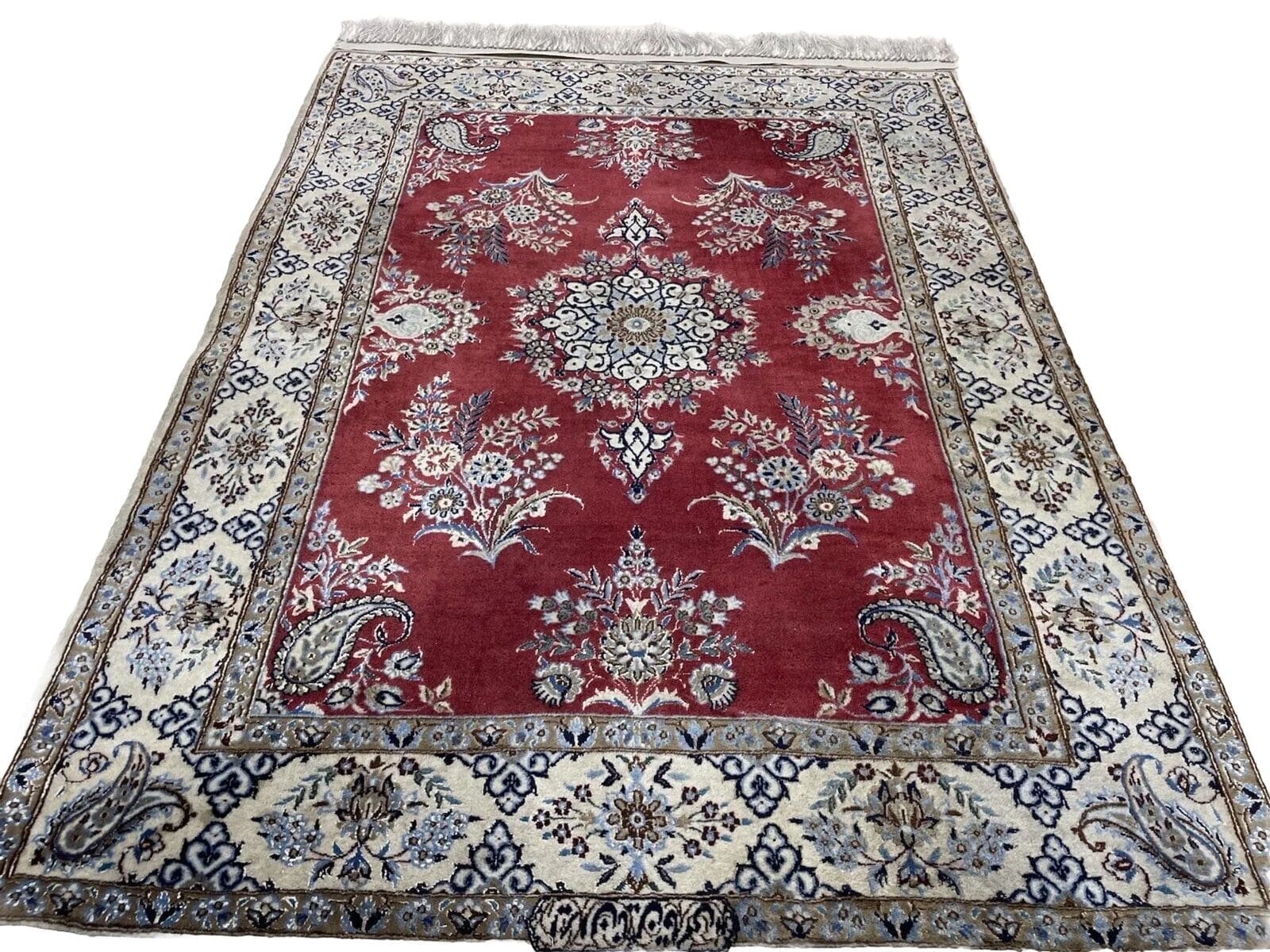
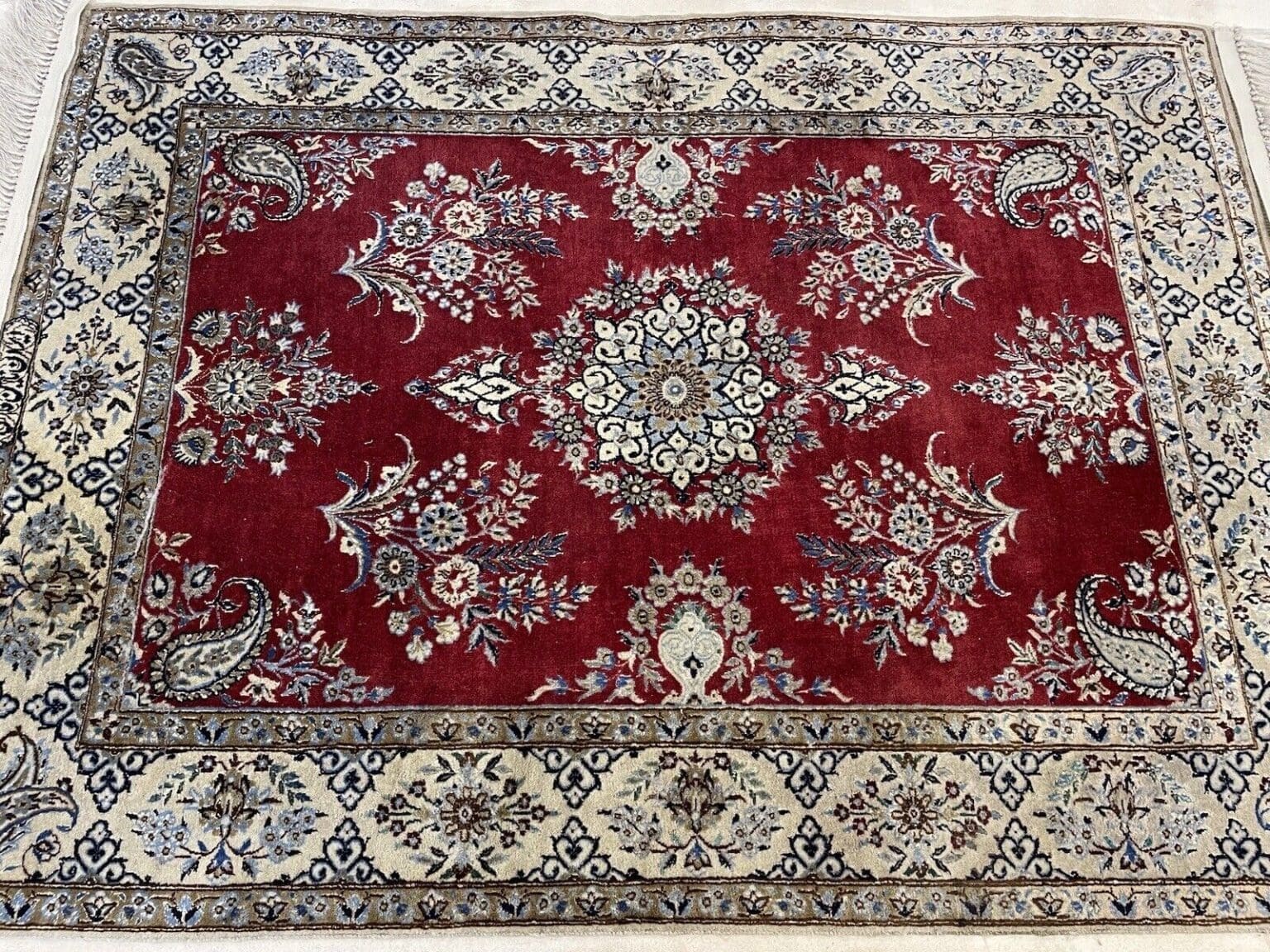
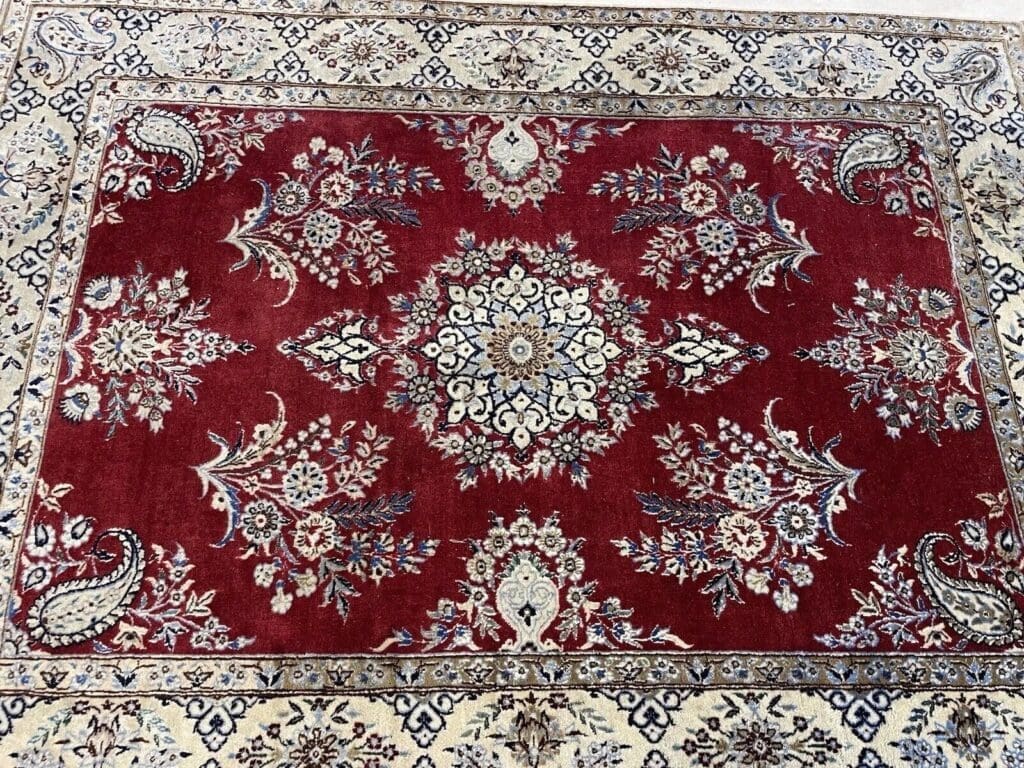
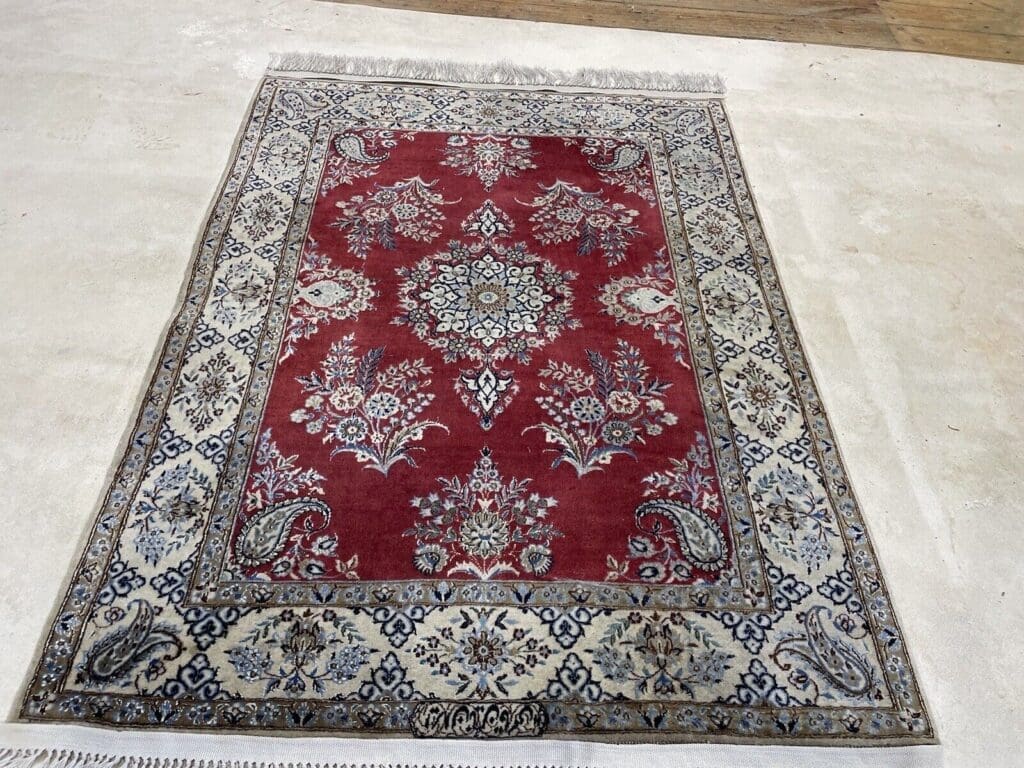
Hand-knotted Nain Persian Rug | Material: Wool and silk pile | Size: 130 x 96 cm | Pattern: Floral design with medallion and decorated corners | Condition: New with tag
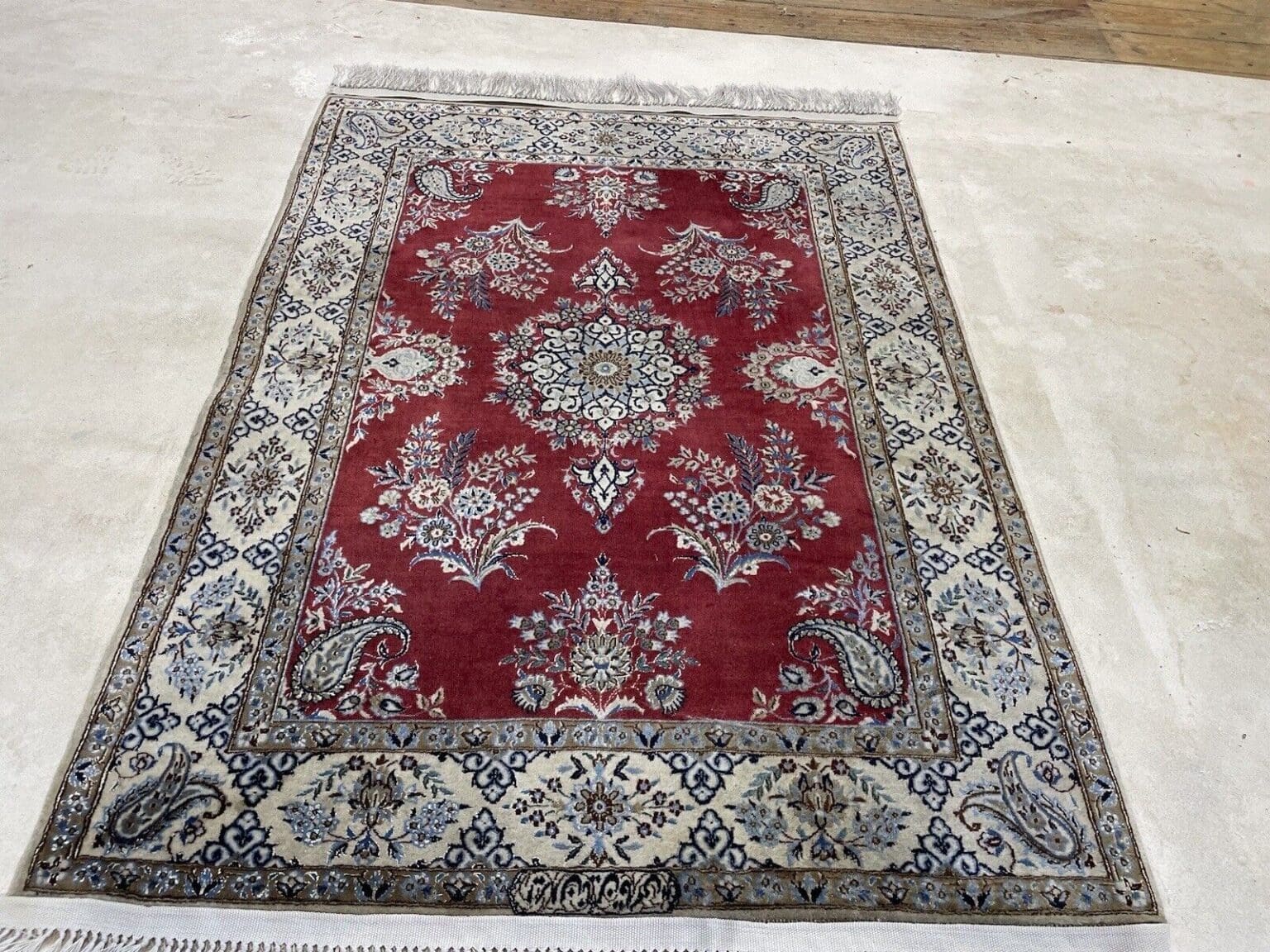
This Nain Persian rug is hand-knotted and has a pile made from wool and silk. In hand-knotting, each knot is placed individually into the prepared foundation. The knotter follows a pattern plan and builds the design row by row. The floral forms, central medallion, and decorated corners are therefore formed as knotted elements of the rug rather than printed or mechanically applied surfaces.
Wool and silk contribute different textile qualities to the pile. Wool provides body, texture, and a tactile surface. Silk can be used to define fine lines and small ornamental transitions, while also responding differently to light. In a Nain rug, this combination supports the precise rendering of delicate floral details. The pile can consequently be experienced both as a textured material and as the surface on which the pattern is drawn.
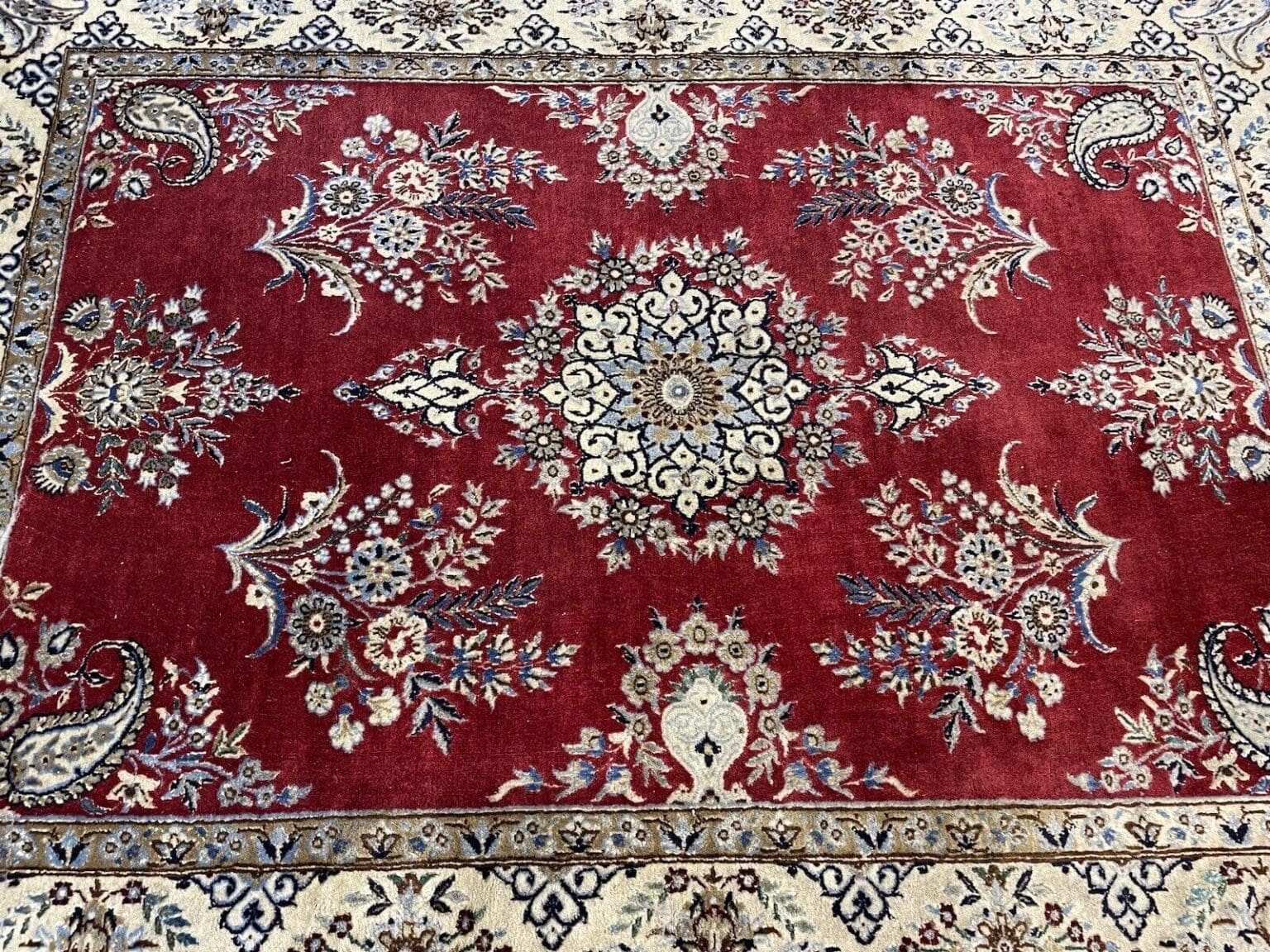
The knotting of this rug is described as high density. Dense knotting allows leaves, flowers, curving stems, and border ornaments to be drawn in small, closely controlled elements. Nain rugs are often made with more than 400,000 knots per square metre; this general feature of Nain production explains why this tradition is associated with fine contours and detailed ornament. The exact knot count of this individual rug is not specified.
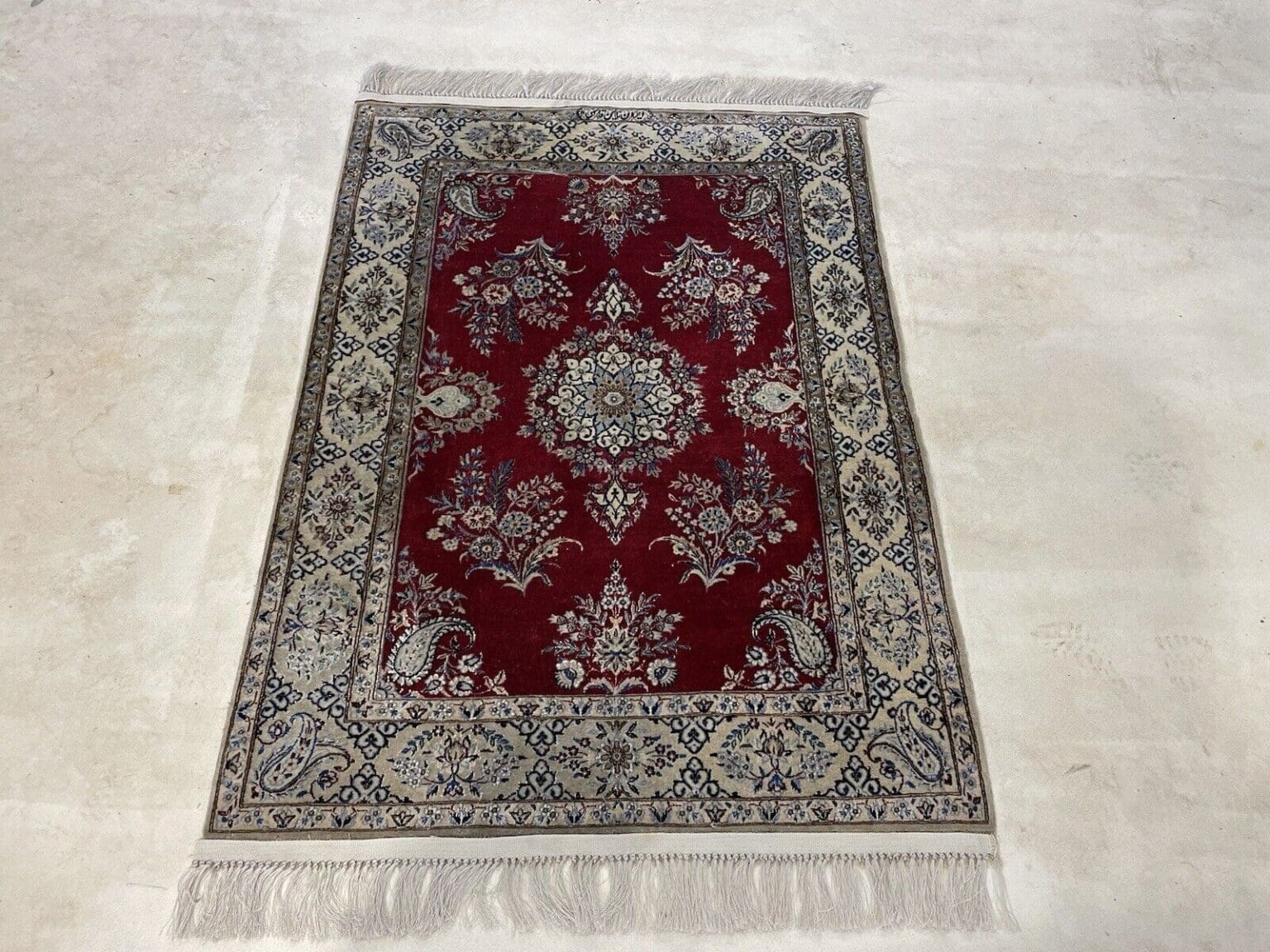
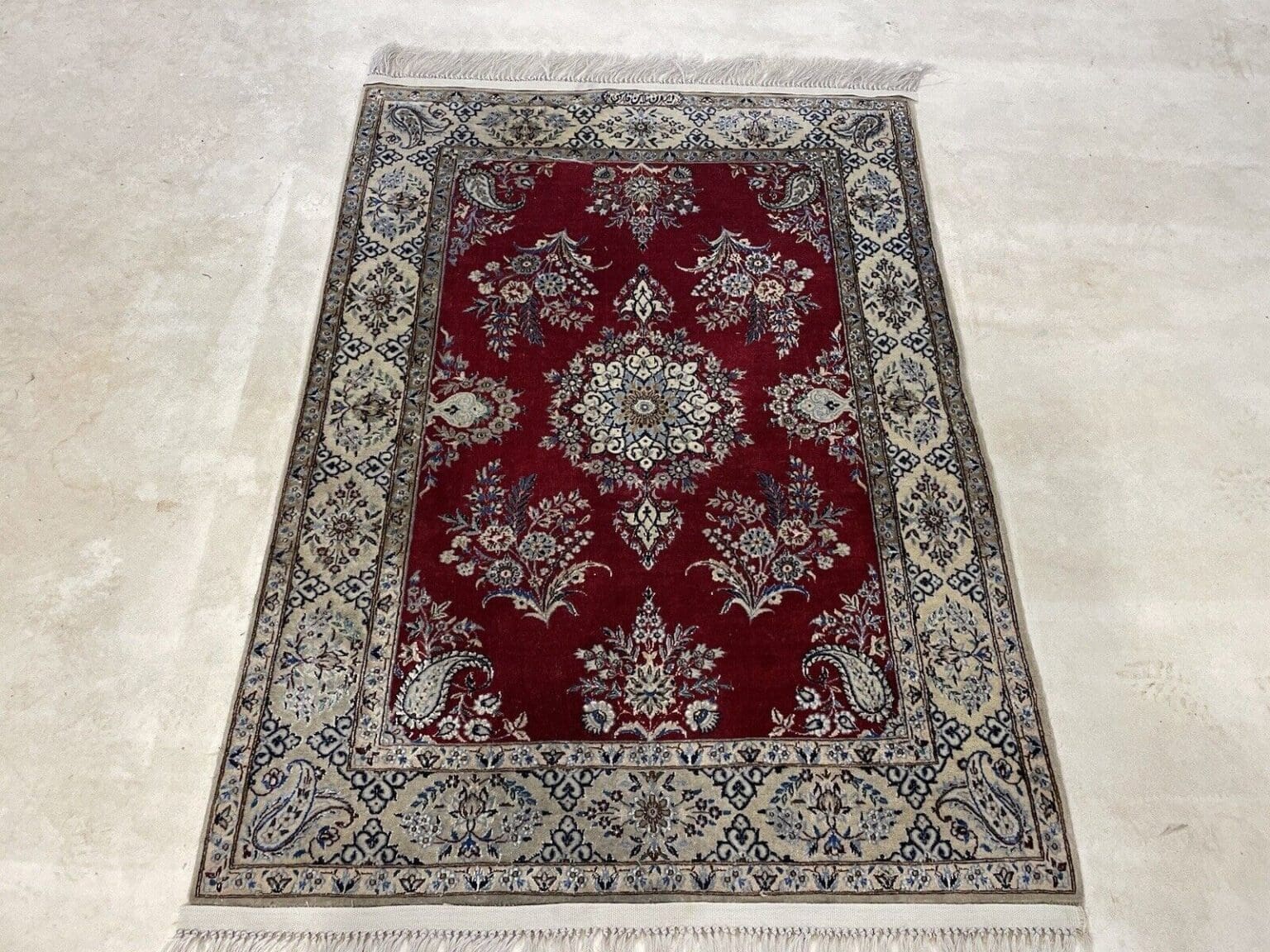
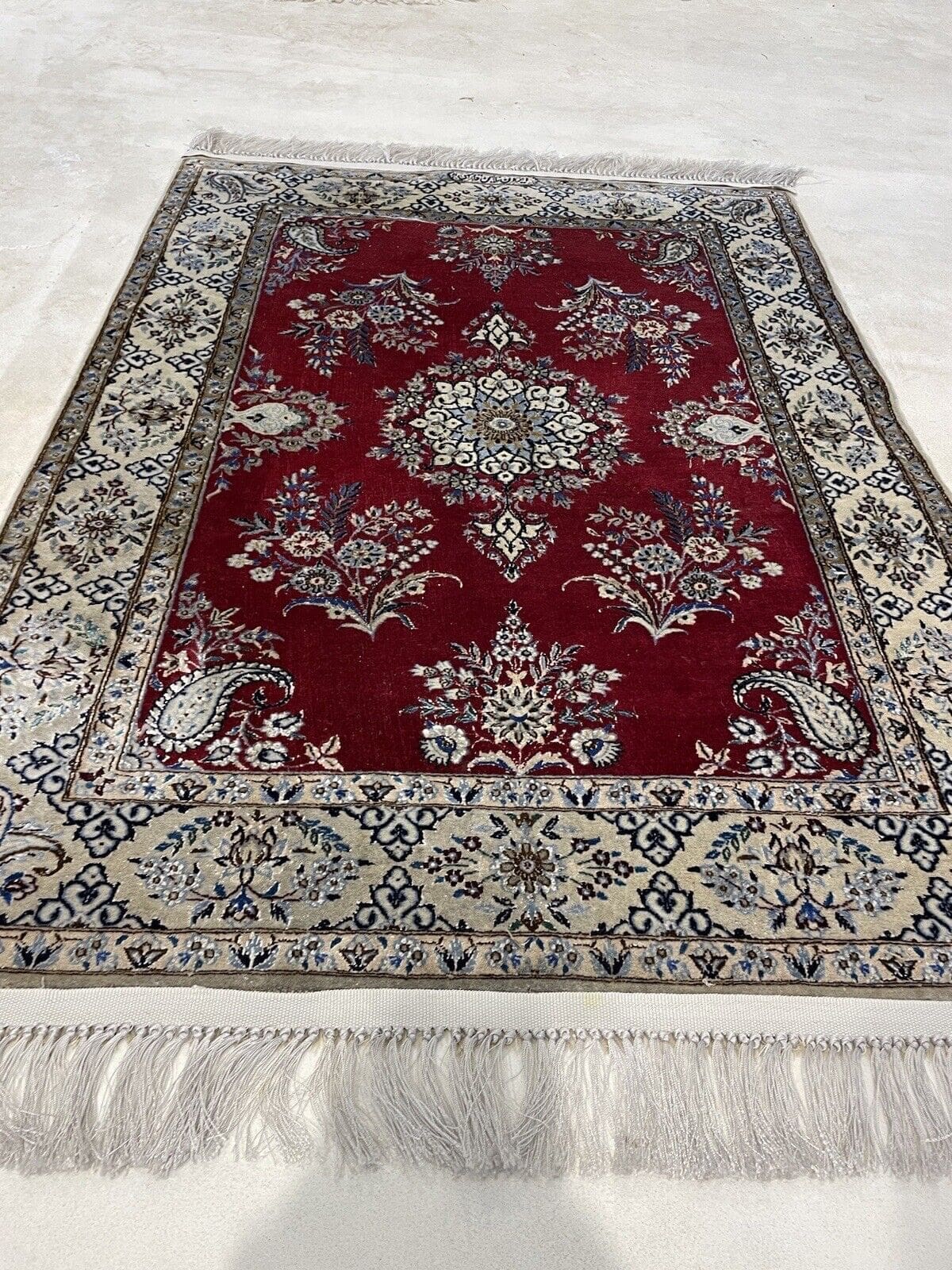
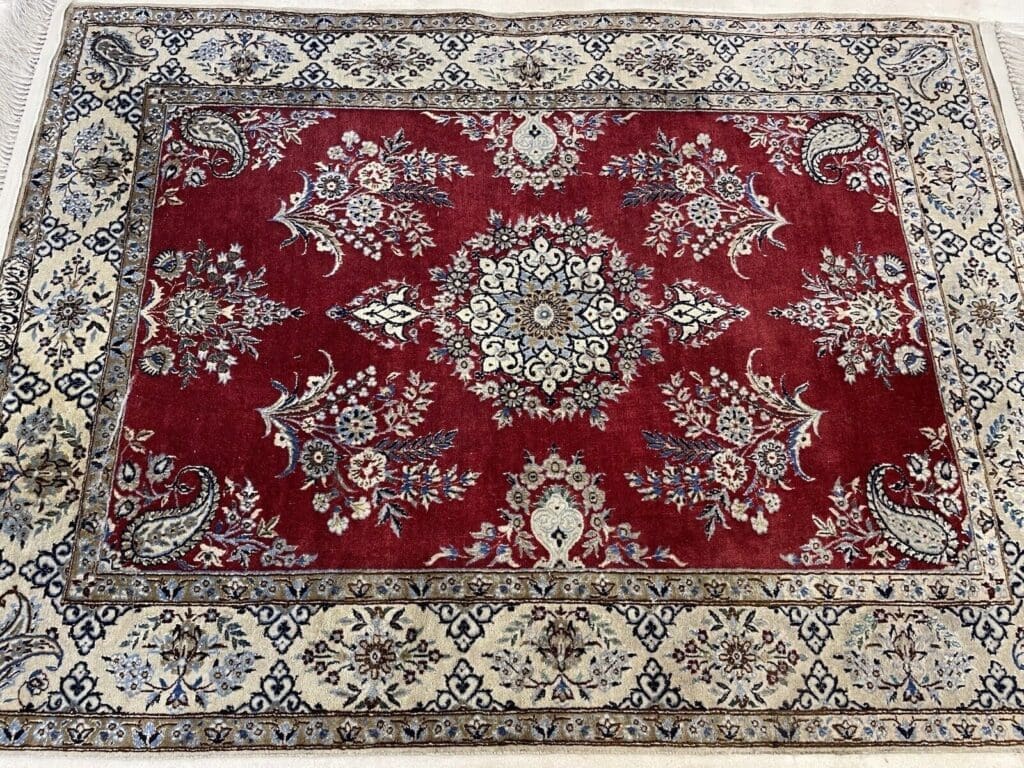
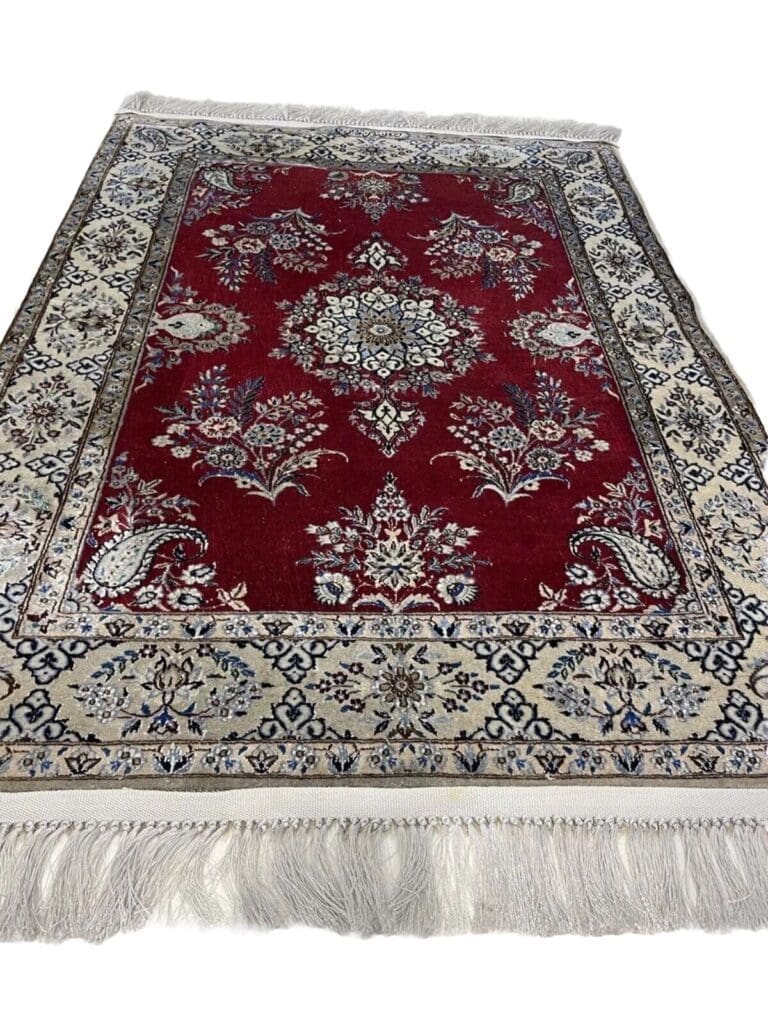
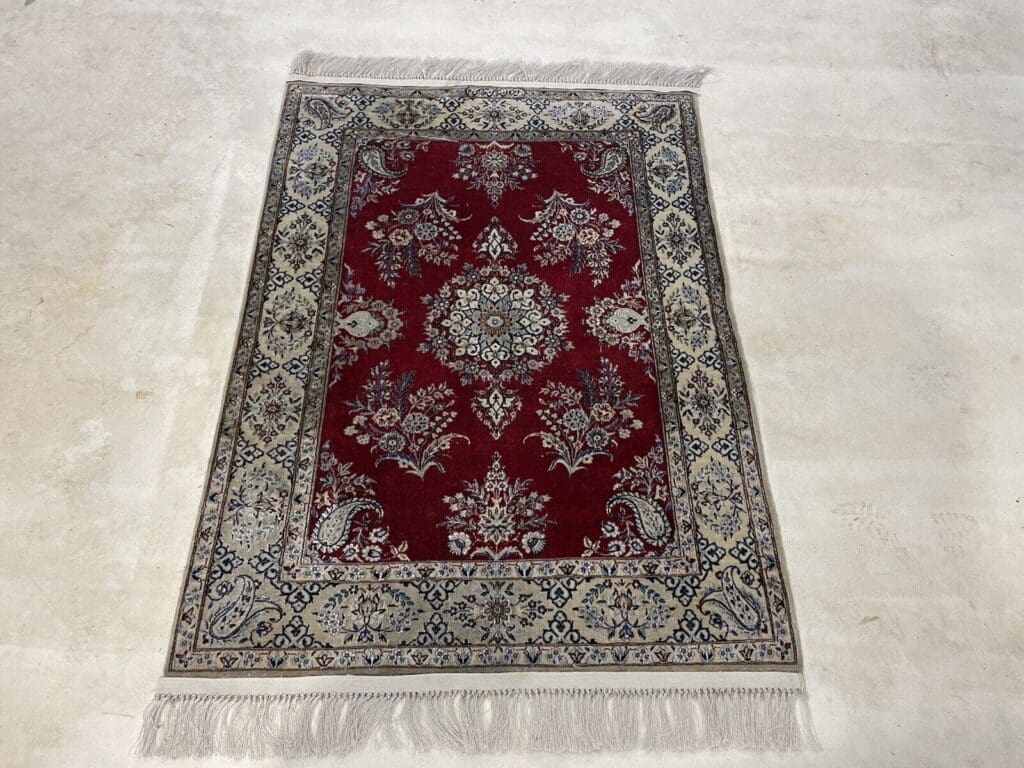
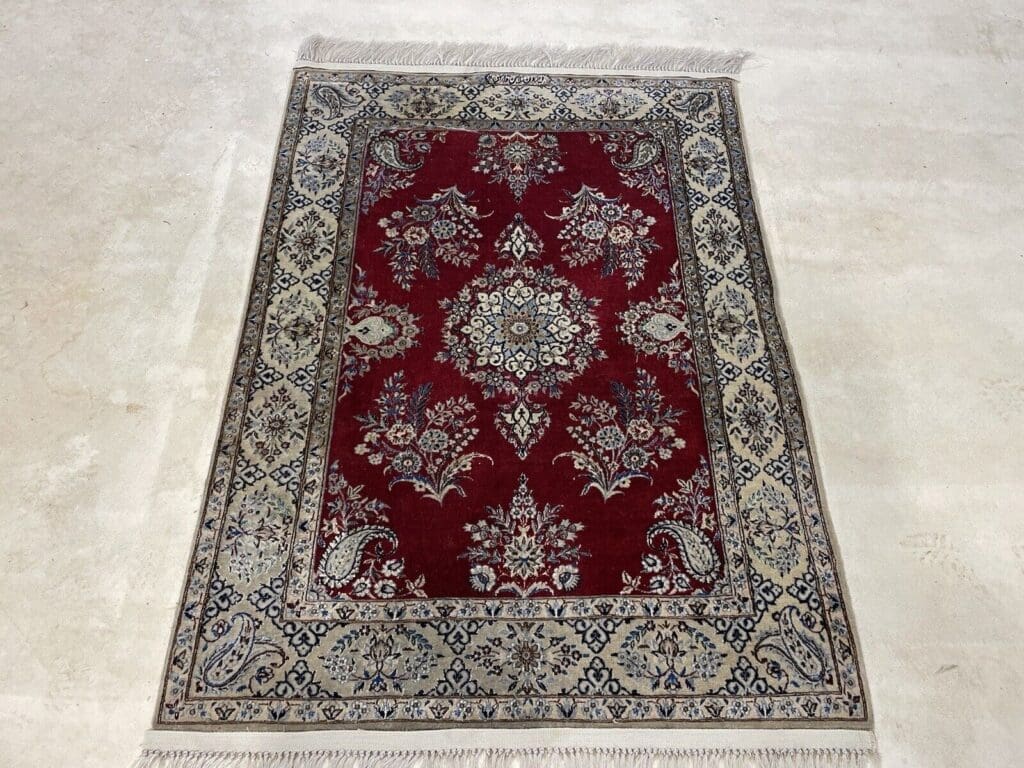
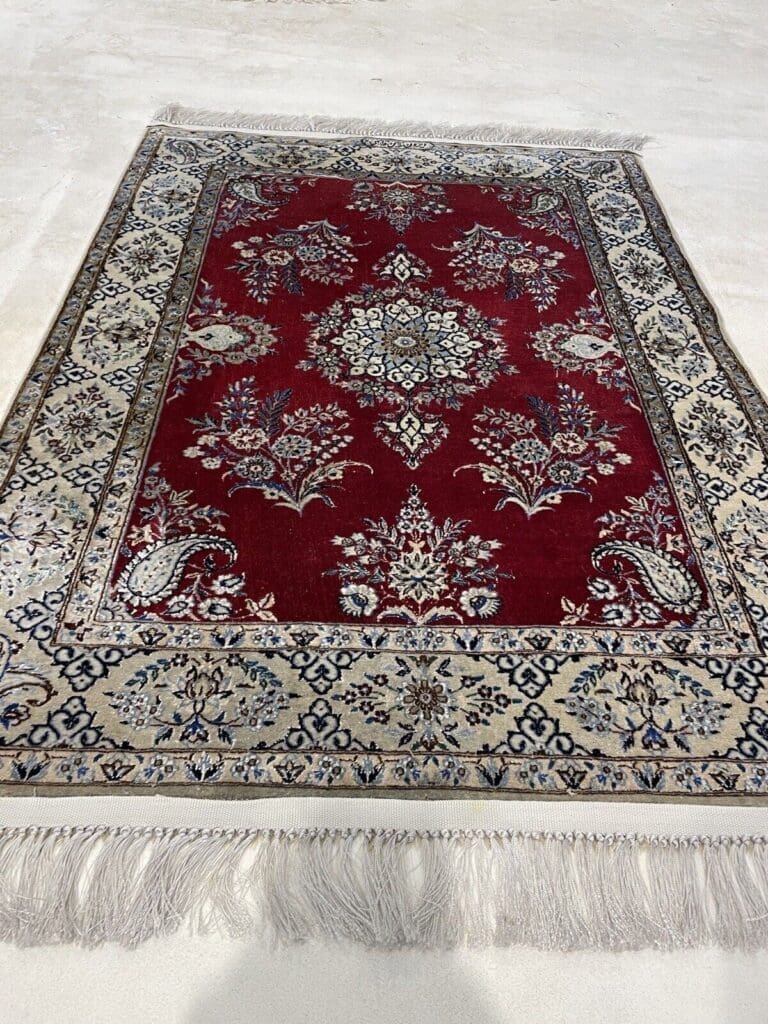
The colour treatment is described in connection with natural colouring and traditional dyes. This rug has a light red field and a beige border. Its hand-knotted construction, wool-and-silk pile, and dense knotting form the stated basis of its material and technical character. The rug is offered as new with a tag.
Origin and Tradition
Nain is a city in Iran and has given its name to an important Persian rug tradition. Nain rugs are associated with fine hand-knotted work, dense construction, and the use of refined materials. Their designs are not created merely as broad blocks of colour. Many closely placed knots are used to control the outlines of leaves, flowers, scrolling branches, and other ornaments.
The Nain tradition belongs to a Persian craft culture in which construction and design are closely connected. A rug begins with a foundation of warp threads. Weft threads and pile are then worked into that foundation. During knotting, the design is built continuously according to the pattern plan. After each row, the structure is compacted and aligned. The surface is then finished so that the drawing remains legible and the pile presents an even appearance. This process requires experience with thread tension, materials, colour changes, and the sequence of the pattern.
Nain rugs are known for coordinated colour palettes and carefully ordered ornament. This piece follows that tradition through a light red field, a beige border, and a central medallion arrangement. The origin information in the product description identifies Persian design, while the product name identifies the rug as a Nain Persian rug. Nain here refers to the named Iranian rug tradition, not simply to an unspecified decorative style.
Persian rug making has been transmitted across generations. Knowledge of preparing the foundation, placing knots, changing colours, and reading a design plan forms part of the craft. Material selection is also part of the design process. Wool gives the pile structure and substance, while silk can be used for fine accents and more delicate lines. The combination of these fibres is part of the technical and visual vocabulary associated with Nain rugs.
The medallion is a familiar organising principle in Persian rug design. It establishes a focus in the centre of the field and gives the surrounding ornaments a clear relationship to that centre. Floral branches and blossoms may be arranged around it in balanced or mirrored formations. Decorated corners complete the composition at the edges of the field. This creates a connection between the centre, the side areas, and the border while allowing the individual motifs to remain visible.
Design and Pattern
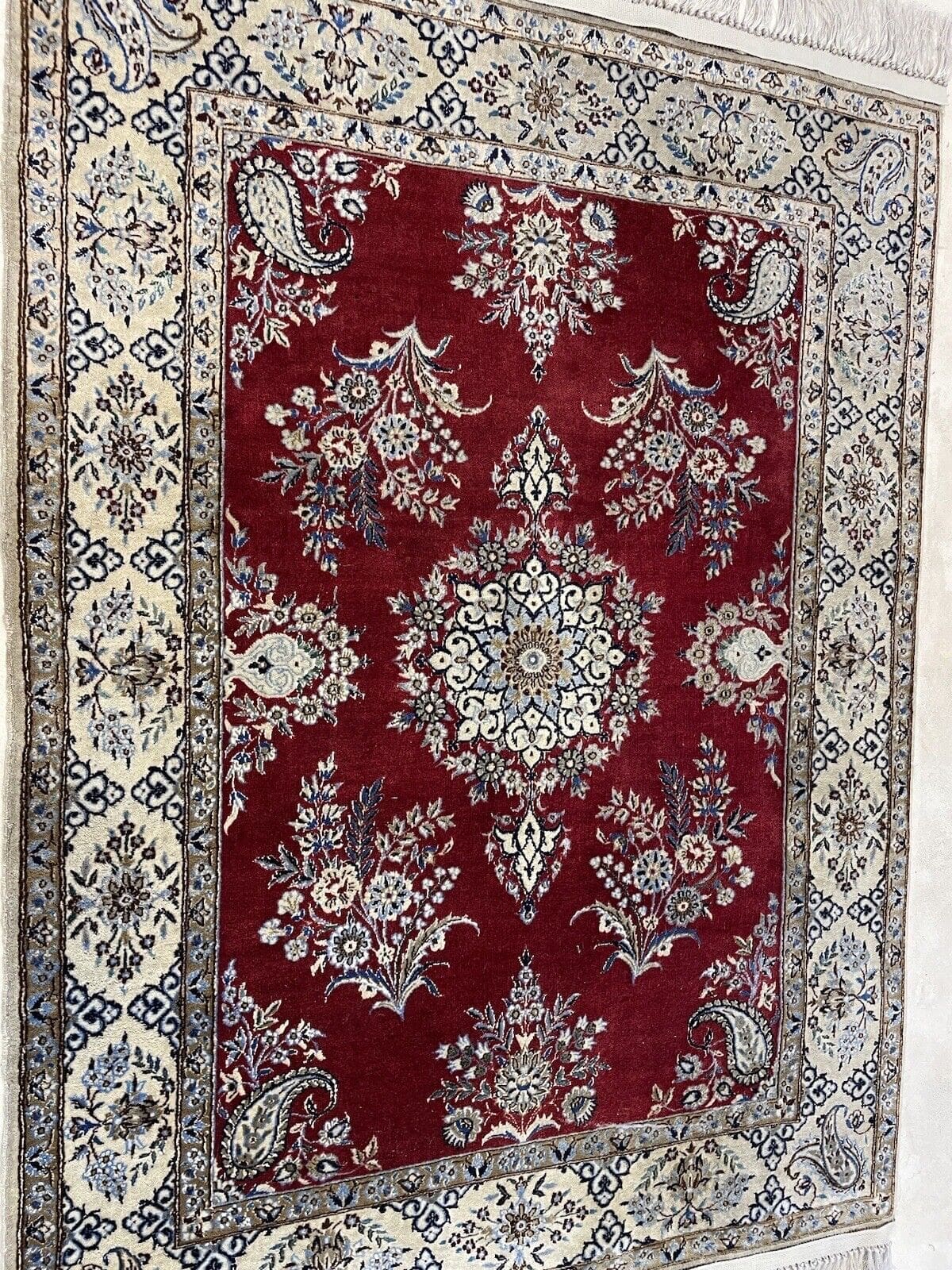
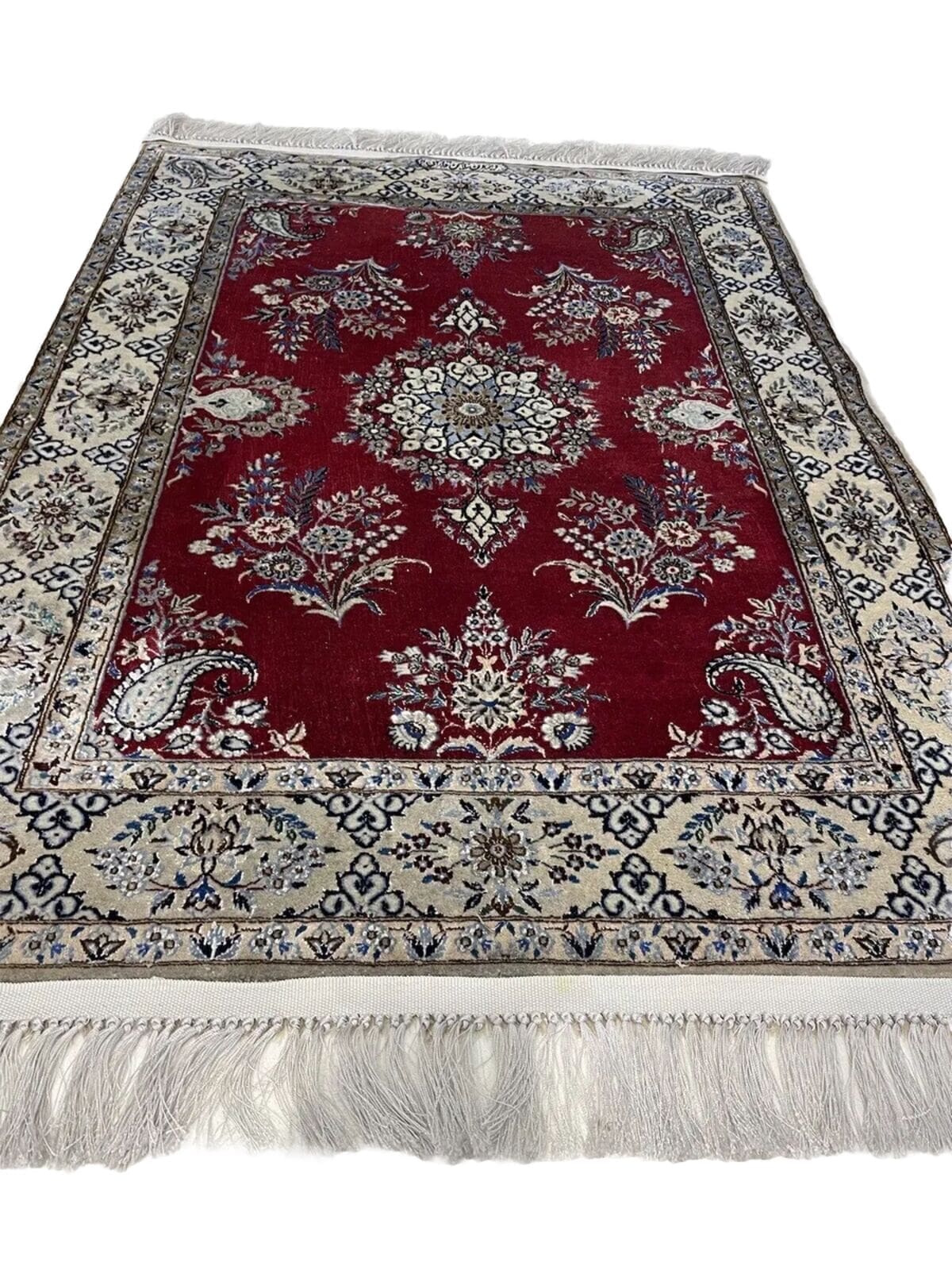
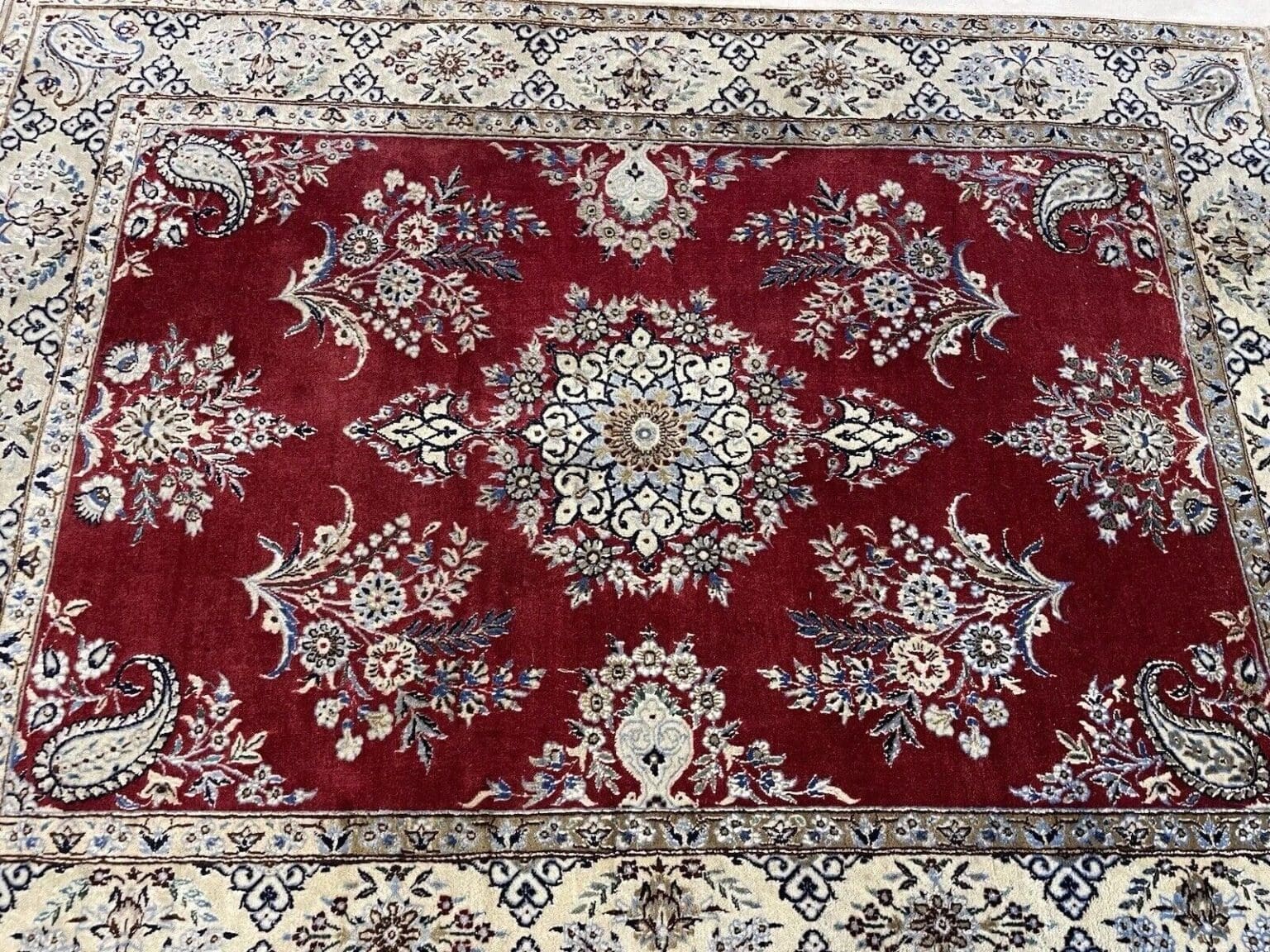
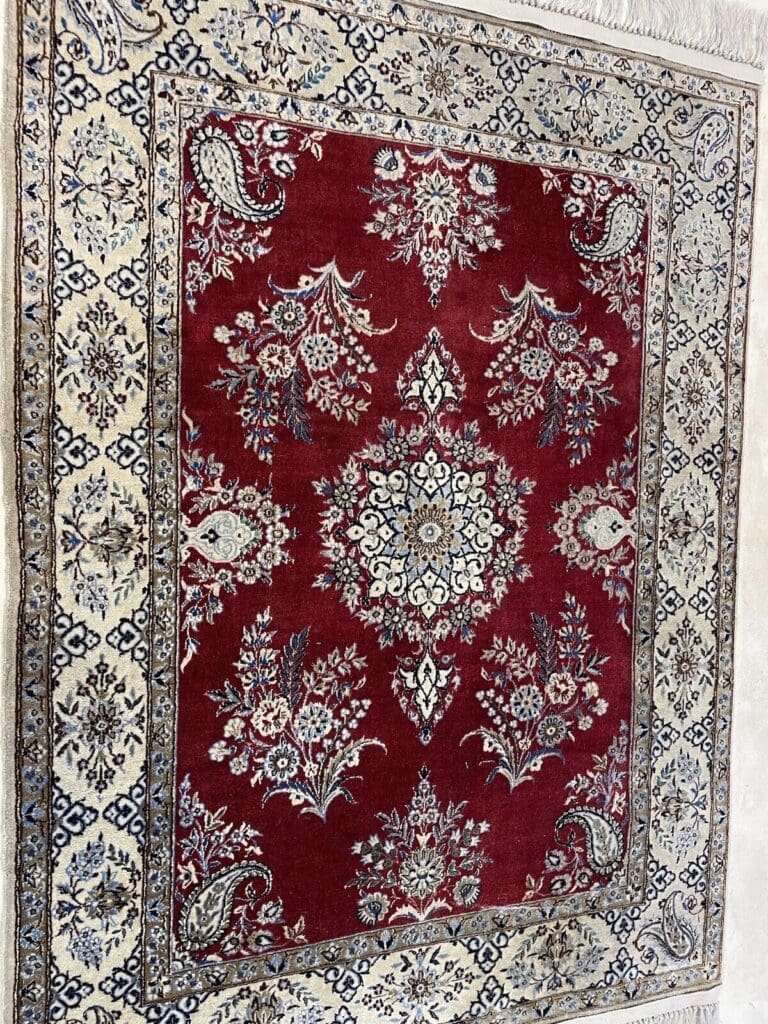
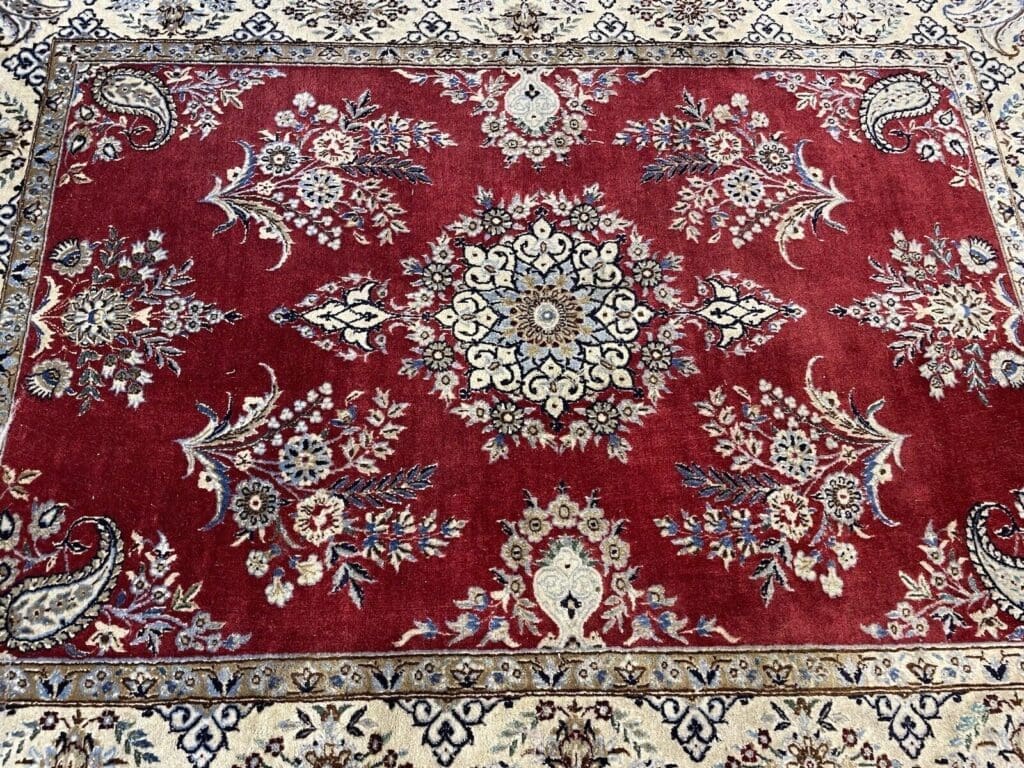
The design of this rug is floral and organised around a central medallion. Floral motifs surround the medallion, and decorated corners extend the inner composition toward the edges. The field is light red. A beige border frames the field and separates the more vivid interior from its surroundings. The resulting arrangement can be read in clear zones: centre, surrounding ornament, corner elements, and outer frame.
Floral patterns are recurring forms in Persian rug art. They draw on leaves, blossoms, vines, and stylised plant elements. They are not necessarily botanical illustrations. Instead, natural forms are transferred into an ornamental language, repeated rhythmically, and adapted to the available surface. Curves, counter-curves, and balanced repetitions help the design remain coherent across the field.
The medallion creates a visual centre for the composition. From it, the surrounding branches and blossoms can be read as a connected arrangement. The decorated corners continue the same ornamental vocabulary toward the sides. Corner elements may be closely or loosely related to a central medallion in Persian designs; in this case they are specifically identified as part of the pattern. Their role is to shape the transition between the field and the border.
The beige border has both a decorative and an organising function. It frames the light red field and places a calmer colour beside the more active interior drawing. Borders in Persian rug design are often formed from repeated vines, flowers, or structured bands. For this rug, the border is described by its beige colour; no additional information about individual border motifs is provided. The defined separation between frame and field is the stated feature.
The colour effect comes from the relationship between light red, beige, and the floral drawing. Wool and silk may respond differently to light: wool tends to read as a soft, structured surface, while silk can create finer highlights. This difference can support the visibility of small ornamental details without changing the pattern itself. The design is identified as traditionally Persian and combines the formal order of a medallion with the more flowing line of floral motifs.
A floral medallion design can be used in a range of interiors because it combines a clear centre with a framed edge. Here, the light red ground establishes the overall colour impression, while the beige border creates a transition to the surrounding room. The pattern is described as traditional Persian and Oriental. The product information does not assign individual symbolic meanings to the specific ornaments; it identifies their floral character, the medallion, and the decorated corners.
Special Features
The stated features of this one-off rug include hand-knotting, a wool-and-silk pile, dense knotting, and a colour scheme of light red with a beige border. The rug is described as new with a tag. It is also suitable for underfloor heating. This statement concerns its intended use in rooms with that type of heating.
The Nain Persian rug can be used in a living area or bedroom. An elegant hallway is also listed as a possible setting. Its floral design with medallion and decorated corners forms a complete composition across the surface. The care guidance in the description includes regular vacuuming, avoiding direct sunlight, and treating stains immediately with water and a mild cleaning product. Professional rug cleaning is recommended for deeper dirt.
The designation as a one-off follows from the hand-knotted method: the knots are placed by hand in an individual sequence rather than being produced as a printed or industrially applied design. Each hand-knotted example therefore represents its own execution of material, pattern, and colour distribution. For this rug, the listed characteristics are the Nain designation, floral medallion pattern, decorated corners, beige border, wool-and-silk pile, and new condition with tag.
FAQ
How should I care for this Nain Persian rug?
Regular vacuuming helps remove loose dust and dirt from the pile. Direct sunlight should be avoided. If a liquid or another stain reaches the rug, the affected area should be treated immediately with water and a mild cleaning product. Professional rug cleaning is recommended for deeper or more extensive soiling. Any cleaning method should take the wool-and-silk pile into account and be carried out gently. Harsh products or unsuitable treatment can affect the pile and the appearance of the colours.
Why choose a hand-knotted rug?
With a hand-knotted rug, every knot is placed individually. This allows the design to be drawn in detail and makes the finished piece a one-off. Dense knotting can define fine floral lines, the medallion, and the decorated corners with clarity. Hand-knotted rugs are also associated with durability and detailed workmanship. In this Nain Persian rug, wool and silk are combined in the pile, supporting both the structured surface and the finer areas of the pattern.
Where can this Nain Persian rug be used?
The rug is suitable for several living areas. The description names the living room, bedroom, and an elegant hallway. Its floral design with a central medallion can function as a coherent floor composition, while the beige border gives the piece a defined finish. The rug is also suitable for underfloor heating. The best placement depends on the existing furnishings and on the desired effect of the light red field. The stated range of use includes living and sleeping areas as well as a hallway.
To provide the best experiences, we use technologies like cookies to store and/or access device information. Consenting to these technologies will allow us to process data such as browsing behavior or unique IDs on this site. Not consenting or withdrawing consent, may adversely affect certain features and functions.
Functional Always active
The technical storage or access is strictly necessary for the legitimate purpose of enabling the use of a specific service explicitly requested by the subscriber or user, or for the sole purpose of carrying out the transmission of a communication over an electronic communications network.
Preferences
The technical storage or access is necessary for the legitimate purpose of storing preferences that are not requested by the subscriber or user.
Statistics
The technical storage or access that is used exclusively for statistical purposes.The technical storage or access that is used exclusively for anonymous statistical purposes. Without a subpoena, voluntary compliance on the part of your Internet Service Provider, or additional records from a third party, information stored or retrieved for this purpose alone cannot usually be used to identify you.
Marketing
The technical storage or access is required to create user profiles to send advertising, or to track the user on a website or across several websites for similar marketing purposes.
 SECURE PAYMENT
 SHIPPING PARTNERS


