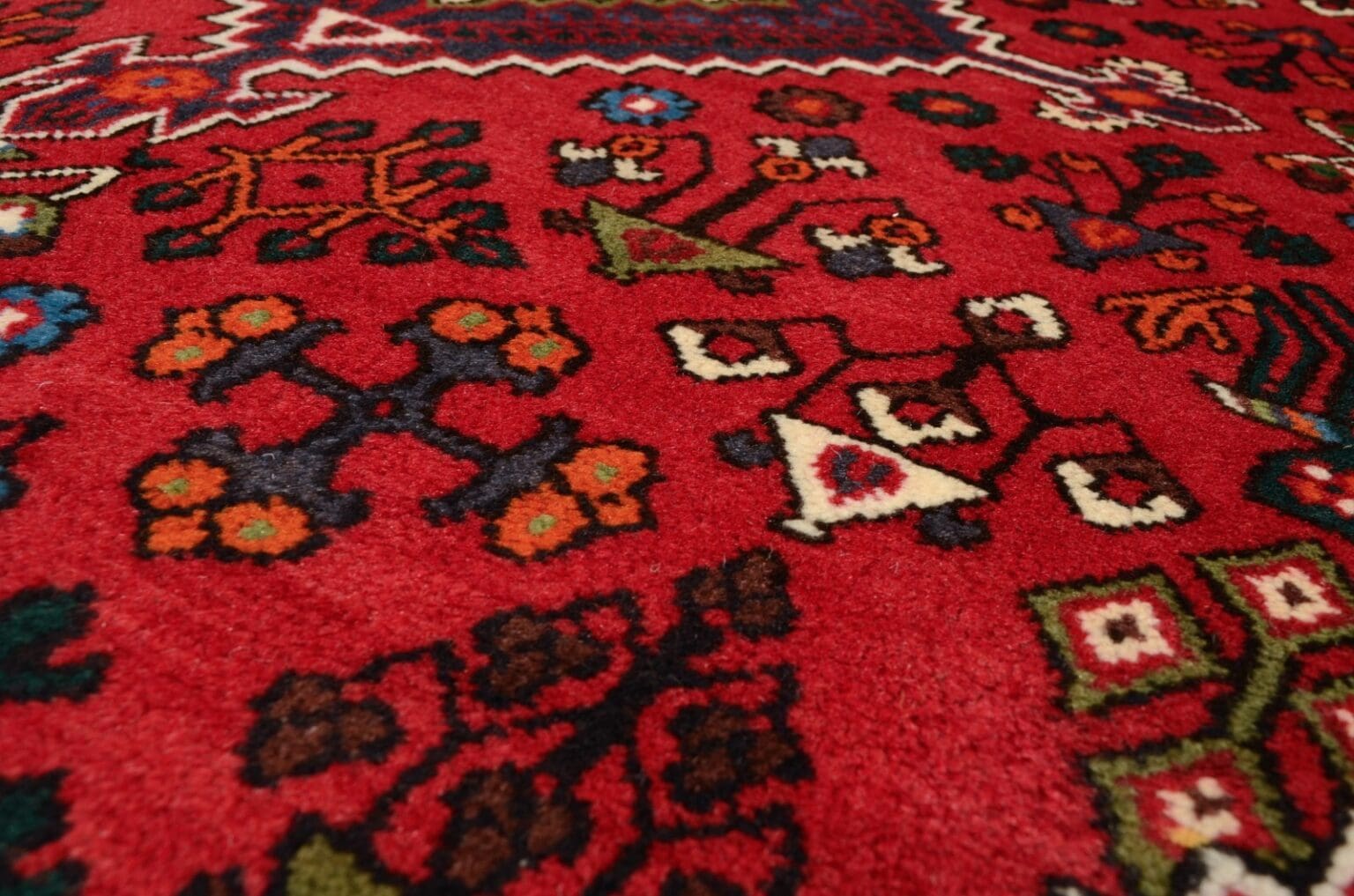
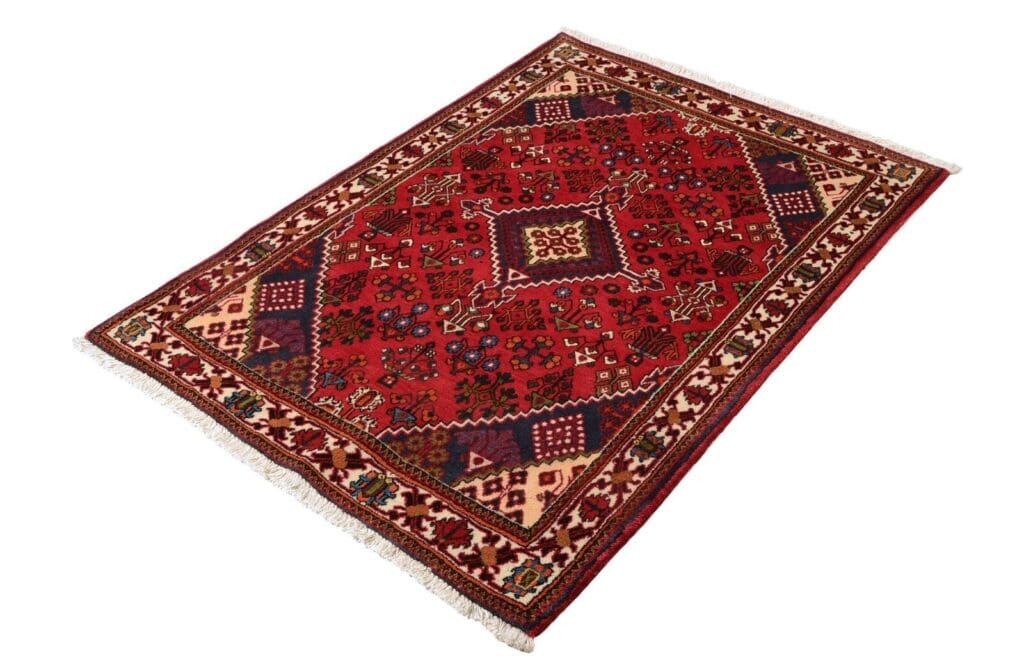
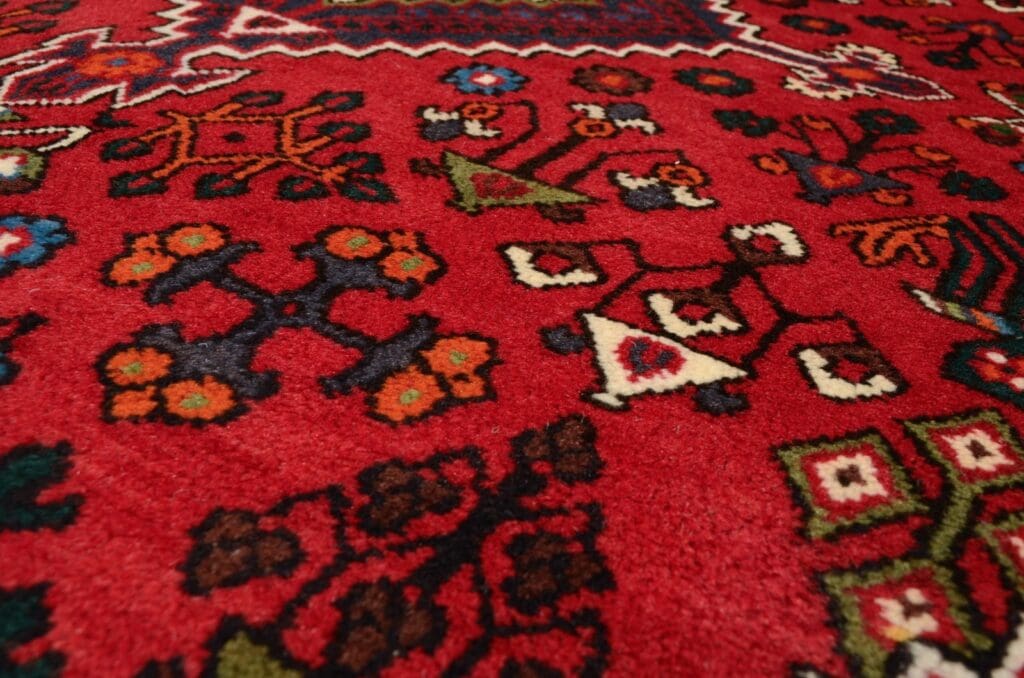
The Meymey Persian rug is hand-knotted and has a pile made entirely from new wool. New wool is a traditional natural fibre in oriental rug making. It combines a resilient, slightly textured surface with a comfortable softness underfoot. The structure of wool has long made it suitable for textile floor coverings, where a tactile pile and a durable material are both relevant to everyday use.
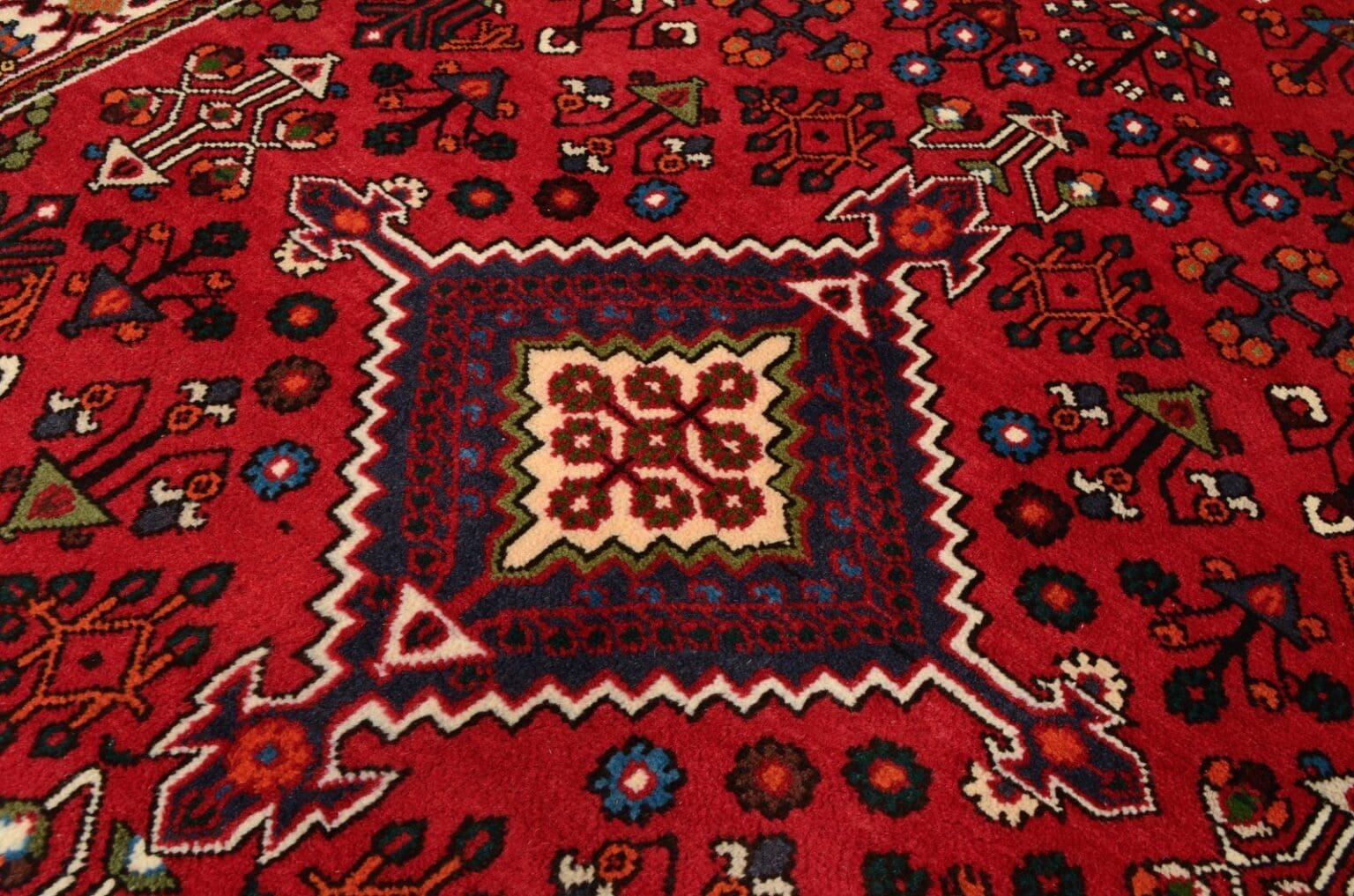
In hand-knotting, each knot is inserted individually into the prepared foundation. Rows are then compacted and the pile is trimmed to create an even surface. This method allows small motifs and defined outlines to be worked into the design. The product description gives a knot density of 250,000 knots per square metre. Knot density records the number of knots placed in the rug and is therefore related to the level of pattern definition rather than being a colour or style designation.
Hand production differs from machine manufacture because the person knotting the rug directly shapes each part of the textile. Minor variations within a hand-made design are part of that process. The new-wool pile gives the rug a warm textile character. Its thickness is described as approximately 8 mm, while its weight is approximately 5 kg.
The rug is described as perfect and unused. It is also suitable for use over underfloor heating. When placing a rug over a heated floor, professional installation, adequate air circulation and the instructions supplied for the heating system and rug should be observed. These practical measures apply even when the rug is expressly suitable for this type of floor.
Origin and Tradition
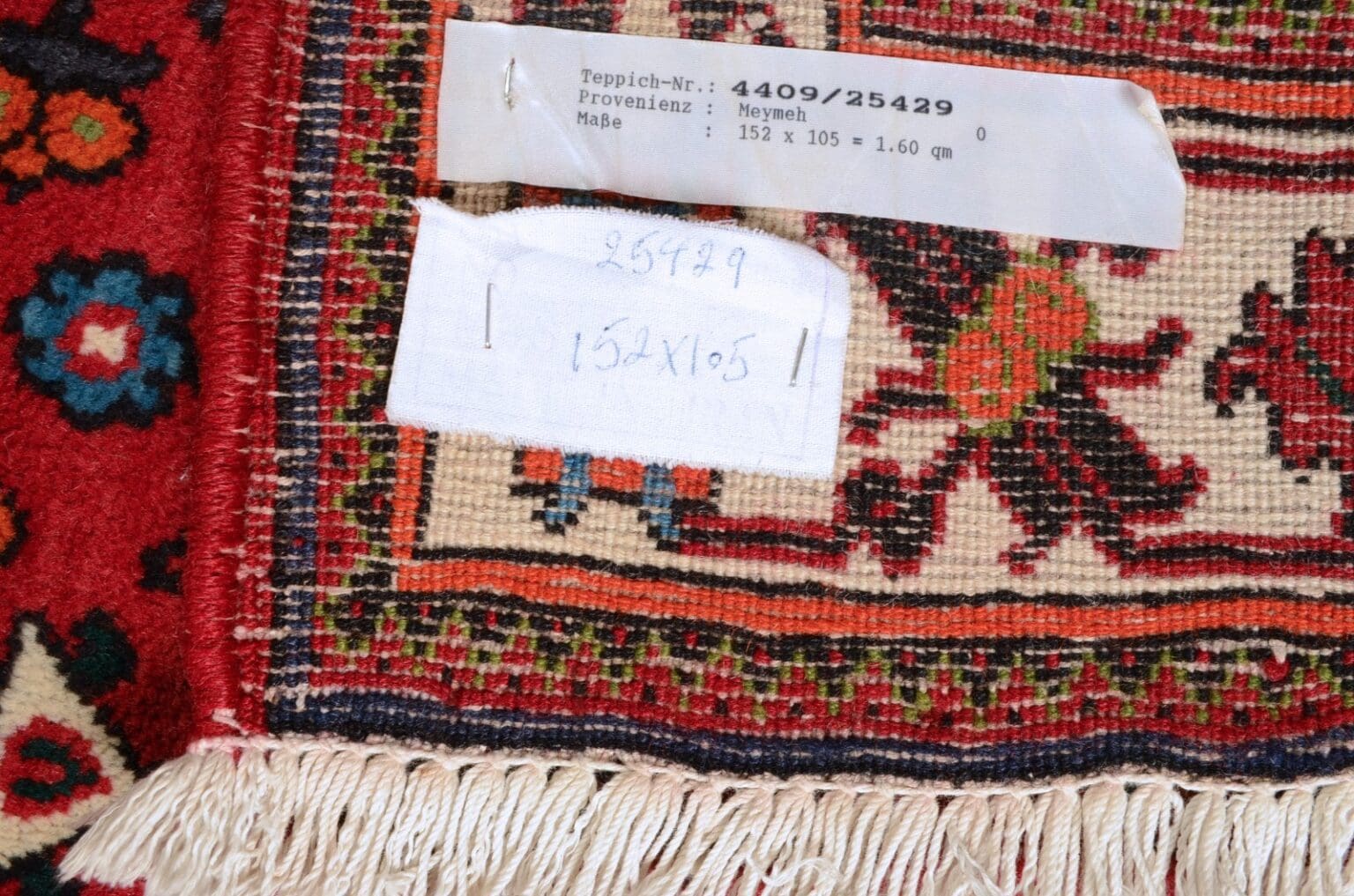
The Meymey is identified as a Persian rug from Persia, or Iran. Iran has a centuries-old rug-making tradition, also described in the source as reaching back thousands of years. Within this tradition, rugs are both useful textiles and works of handcraft in which regional design, practical knowledge and inherited ornament come together. The name Meymey refers to the local origin stated in the product information.
Iranian rug culture includes many local centres and a wide range of ways to organise a design. Construction, pattern layout and the visual balance of a rug may vary from one area to another. Hand-knotted rugs share the relationship between the prepared warp, the inserted weft and individually placed pile knots. Repeated compacting and trimming create a surface on which geometric fields and other ornaments can be arranged with clarity.
The description names Meymey as a region where rug making has an important place in the cultural identity of the local community. In this setting, inherited ideas about composition and ornament are translated into manual work. Passing knowledge from one generation to the next is a central feature of Persian knotting. It includes more than tying knots: it also involves reading a design, dividing the field into sections and coordinating the relationship between the different parts of the pattern.
Persian rugs have traditionally been made by hand. As a result, they are not completely standardised products of industrial series production. The structure of a hand-knotted rug preserves evidence of the working method, while the technique permits detailed arrangements of medallions, borders and repeated forms. Such devices have been developed over long periods within Persian rug culture and appear in locally varied versions.
The stated Iranian origin places this rug within the Persian rug tradition. That origin should be distinguished from a mere description of style: a geometric design can be made in more than one country, whereas the term Persian rug here refers to the named Iranian origin. Meymey therefore represents the local attribution given in the source, not simply a decorative label applied to a pattern.
Design and Pattern
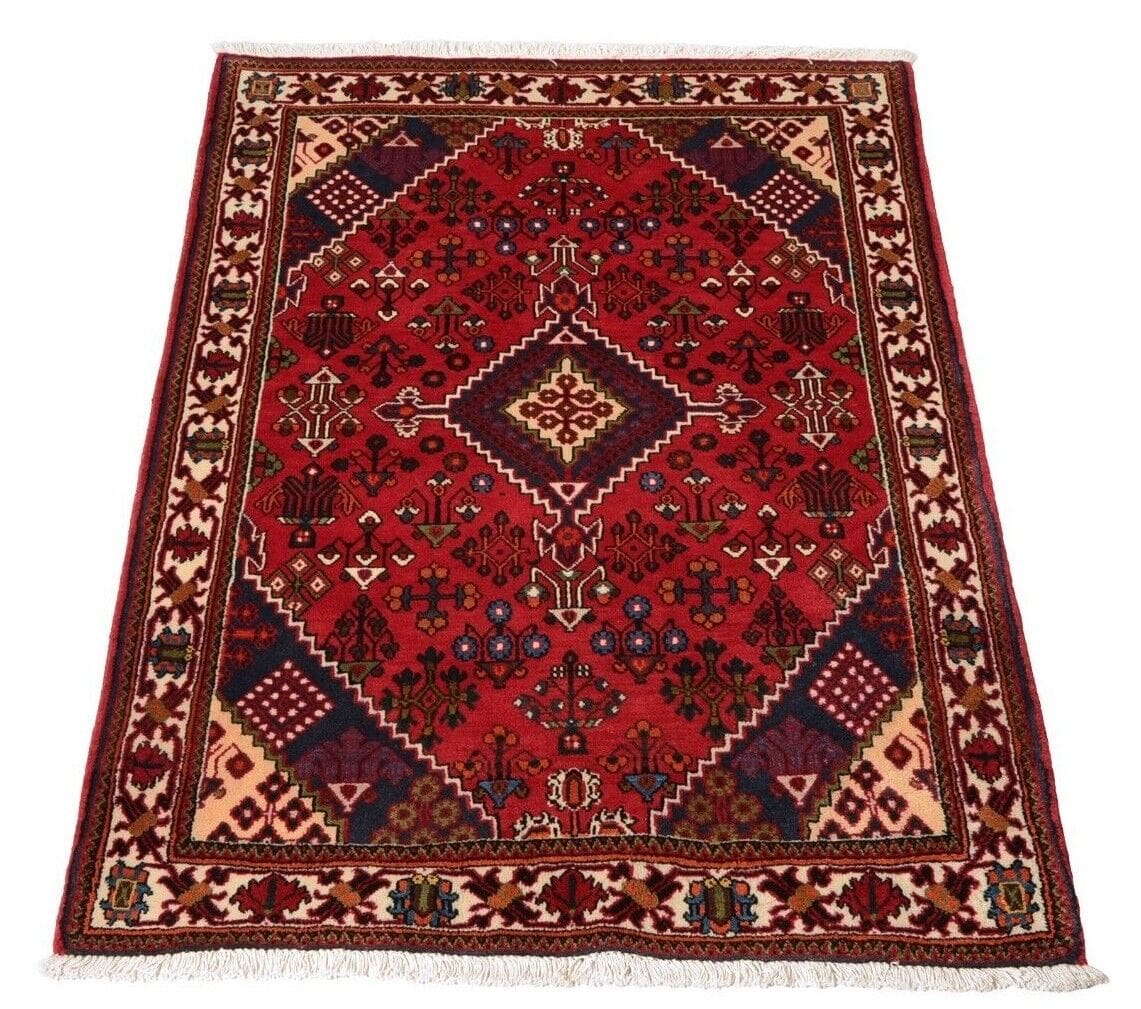
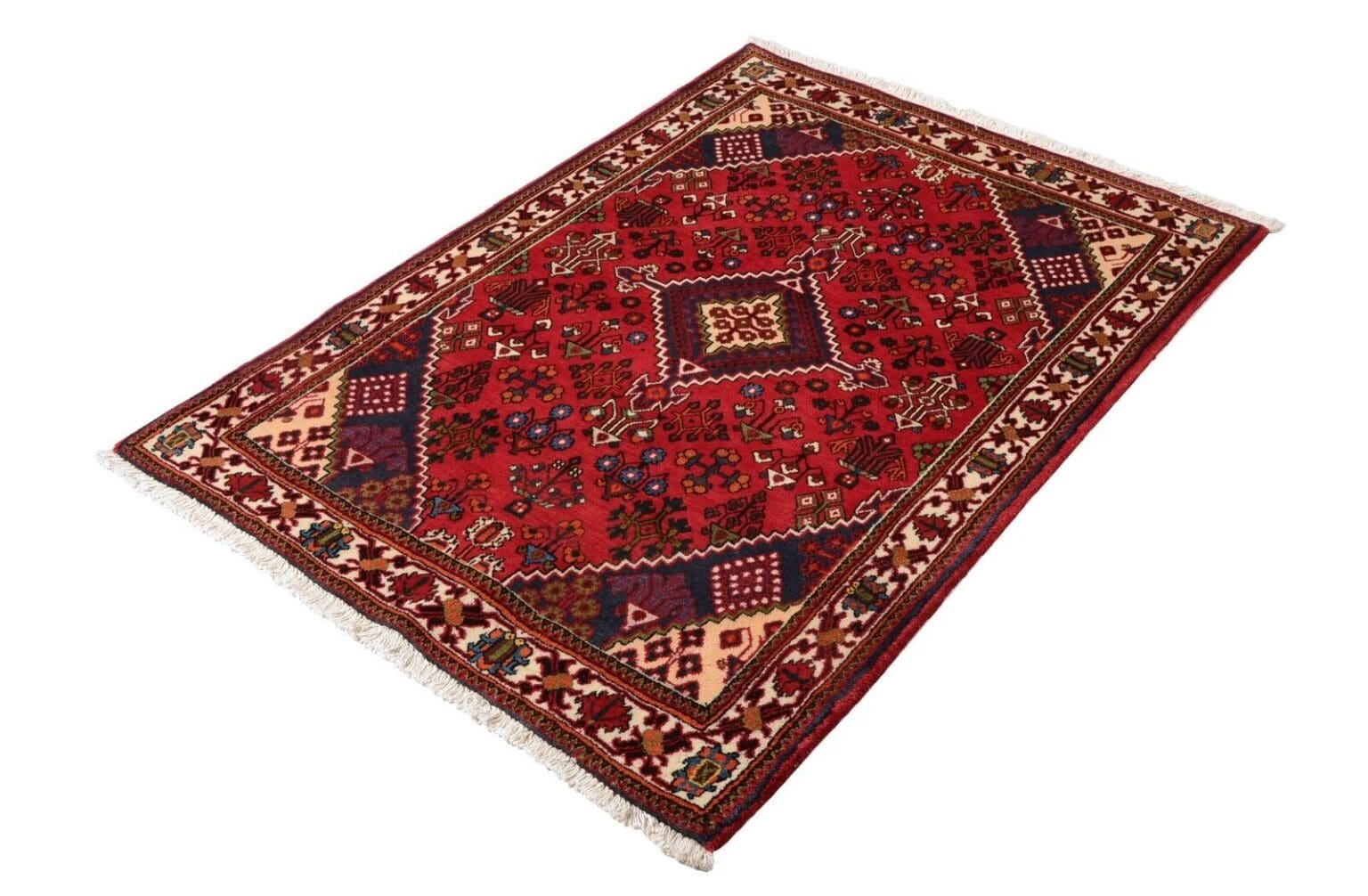
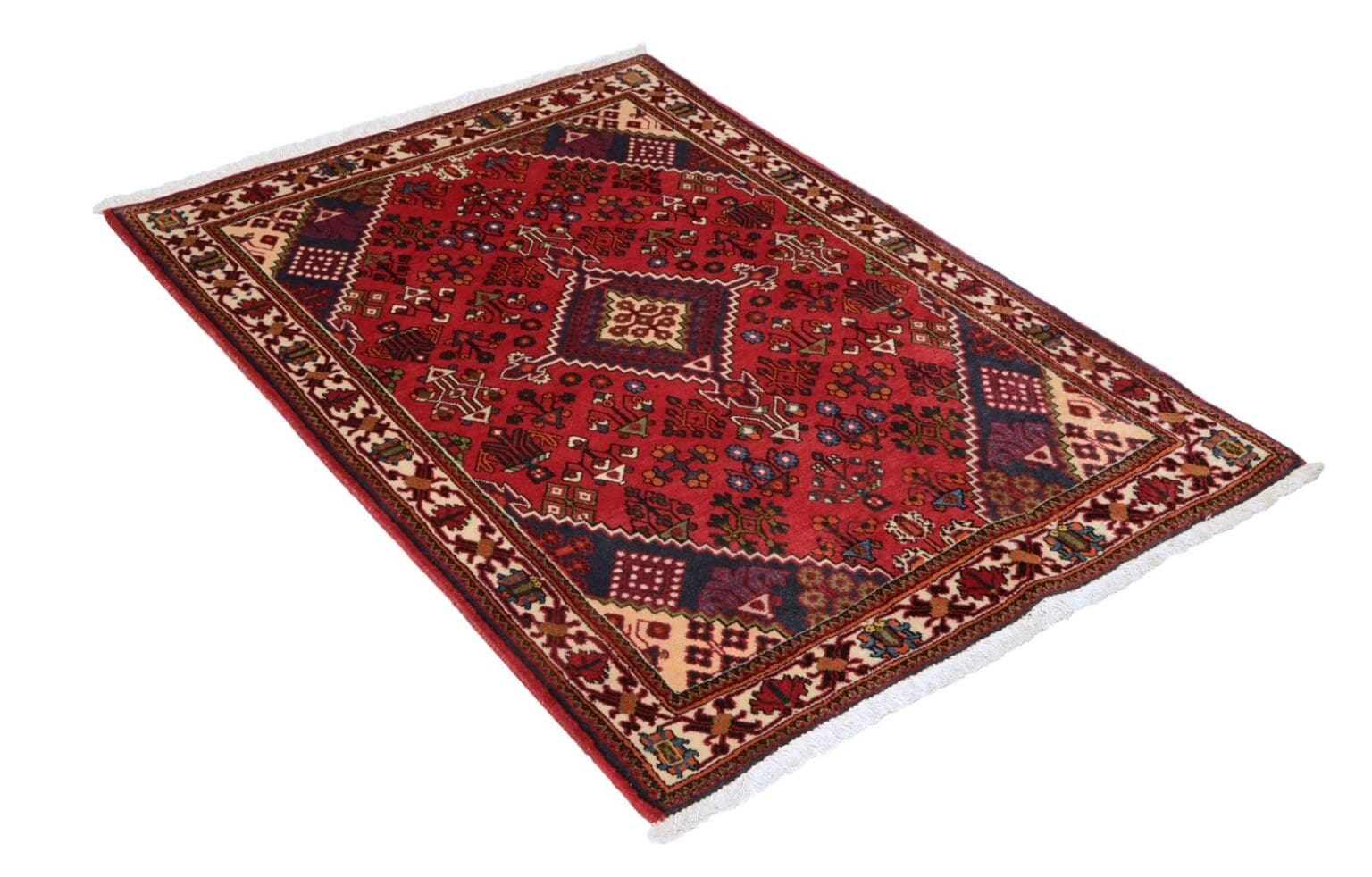
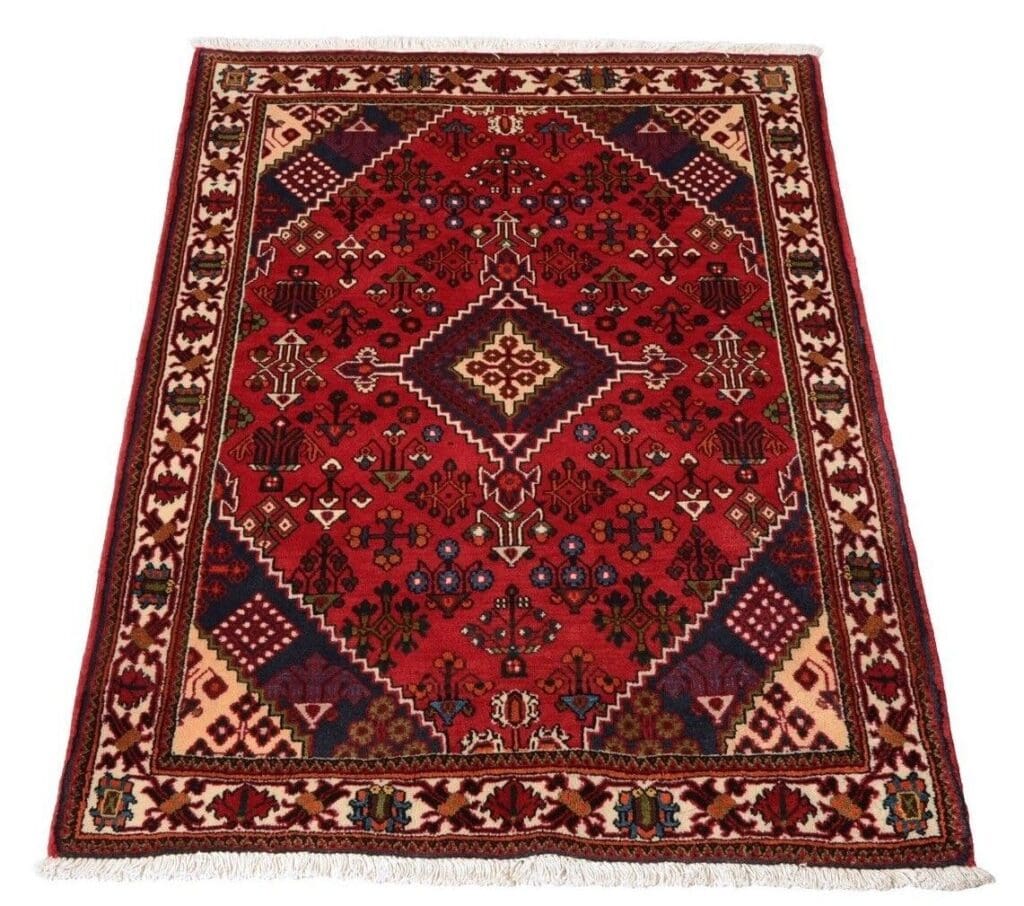
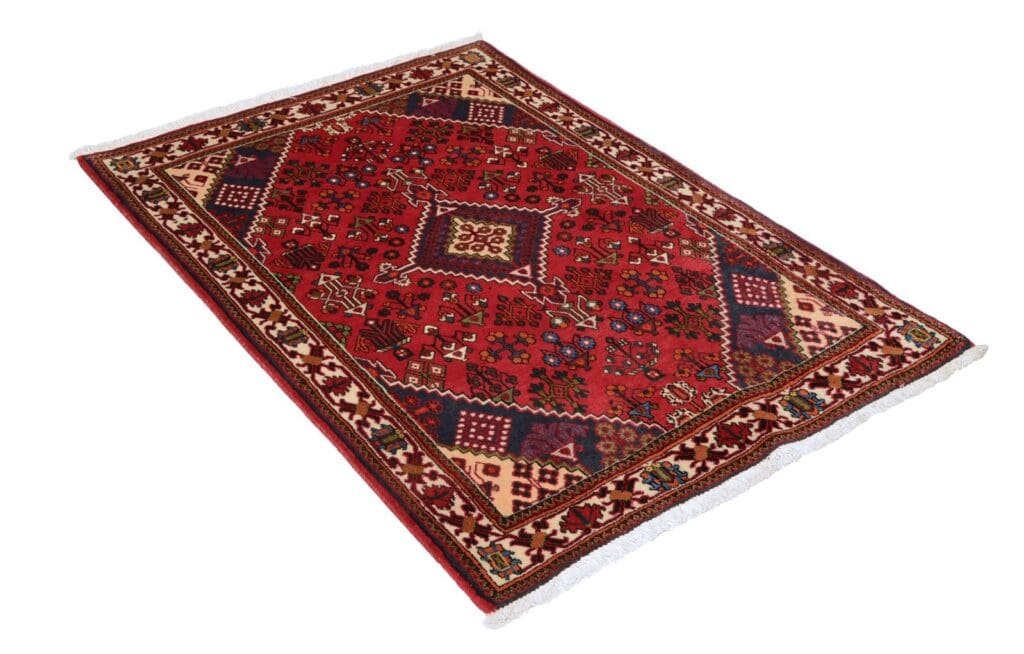
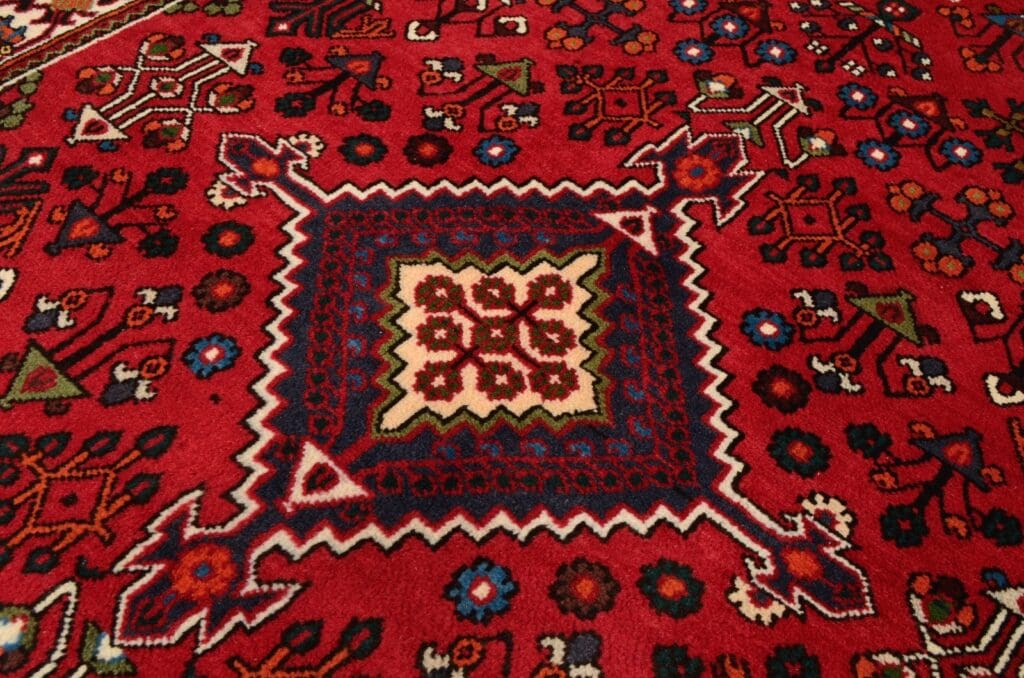
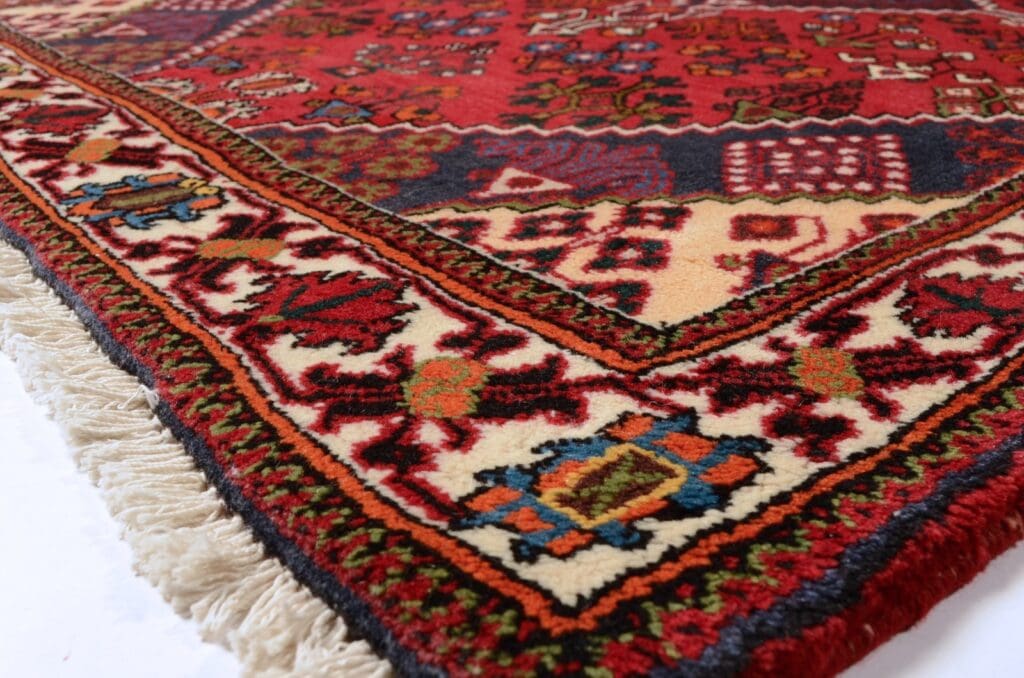
The rug has a geometric design with a medallion. A medallion is a central ornament that forms the focal point of a composition. It may be surrounded by additional fields, lines or repeated motifs. In a geometric design, the visual structure is created through axes, defined contours, repetition and the relationship between the central form and the surrounding areas.
The style is described as traditionally oriental and Persian. Traditional Persian designs often depend on a carefully ordered division of the surface. A central motif can be related to a border and supporting elements while retaining a clear overall balance. Geometric forms make the composition legible and distinguish one pattern zone from the next.
Geometric and floral language are not necessarily opposites in Persian ornament. Even where a rug is classified as geometric, lines, leaves or simplified blossoms may be interpreted through an orderly, angular vocabulary. The inherited pattern world includes both strictly repeated elements and motifs that are varied within a defined framework. The character of the design depends on how these forms are connected and distributed across the field.
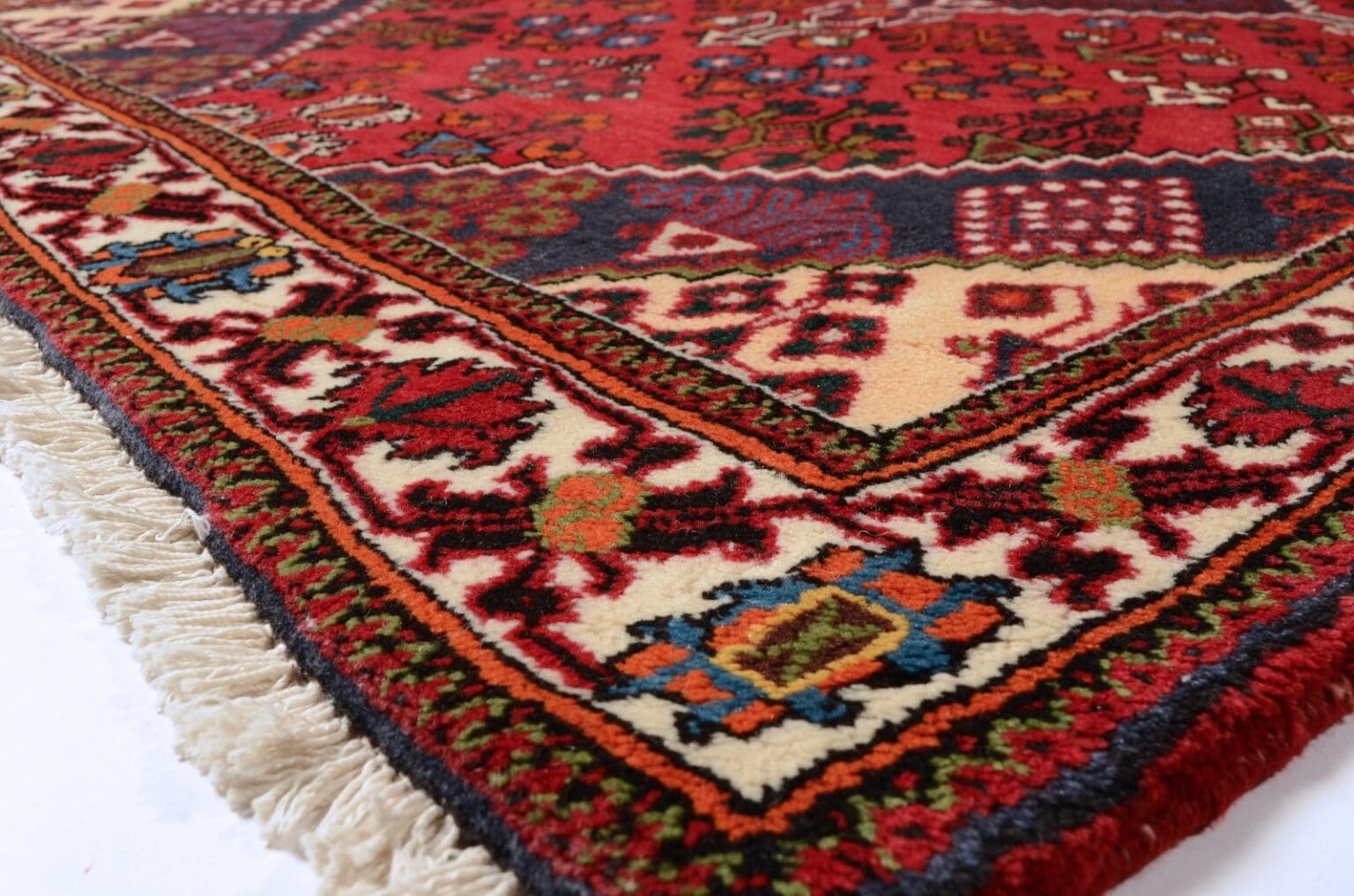
The medallion directs attention towards the centre and establishes a visual point of reference. The surrounding areas support that centre and carry the arrangement towards the edges. Borders are not merely decorative. They frame the inner field, create a transition to the outer finish and help make the proportions of the whole rug readable.
The colour description combines lively and restrained effects, joining earthy tones with stronger accents. Earth colours can provide a quiet foundation for a traditional design, while selected accents can clarify the medallion and geometric lines. The final impression depends on the interaction of the individual colours, the available light and the surrounding furnishings. The rug is consequently described as suitable for both elegant and modern interiors.
Its pattern draws on classical Persian design without being reduced to one floral motif. The visible order comes from the combination of a central medallion, geometric forms and a traditional division of the field. This keeps the composition clear while retaining the layered character associated with hand-knotted oriental rugs.
Special Features
The rug is described as a one-off. In a hand-knotted piece, the knots are not produced through an identical industrial repetition. No second rug can therefore have exactly the same execution. This uniqueness results from the manual process and from the individual combination of material, pattern and knotting work.
The explicitly stated features include its perfect, unused condition, suitability for underfloor heating, a pile of 100 percent new wool and a traditional geometric design with a medallion. Its hand-knotted construction joins the textile surface to a method in which each section is made by hand. This allows the rug to function as an independent furnishing element in different living areas.
Its classification as a Persian rug from Meymey connects the individual piece with Iranian rug tradition. The pattern can be used in a classic interior as well as alongside contemporary furnishings. Its appearance will also be influenced by placement, lighting and the materials around it.
FAQ
How should I clean the Meymey Persian rug?
For routine care, use a vacuum cleaner without a brush attachment. This removes loose dirt while avoiding unnecessary mechanical stress on the wool pile. If something is spilled, treat the area immediately with a clean, damp cloth. Do not rub aggressively, as this can work the stain further into the fibres and roughen the surface. For a more thorough cleaning, consult a professional rug-cleaning specialist. The cleaning method can then be matched to the new-wool pile, the hand-knotted construction and the type of soiling.
Can I use the rug in a living room or bedroom?
Yes. The Meymey is described as suitable for both the living room and the bedroom. Its hand-knotted construction, new-wool pile and traditional medallion design make it appropriate for either setting. In a living room, it can define the seating area or mark out a clearly arranged section of the floor. In a bedroom, it can be placed beside the bed or used within another open area. The rug is also suitable for underfloor heating. Follow the heating system’s technical instructions and ensure that the rug lies safely and evenly.
How do I choose the right place for the rug?
The right position depends on the room layout and the furniture already present. A frequently used area that is not subject to unusually heavy wear is a sensible choice. This keeps the textile surface integrated into everyday life without exposing it to avoidable strain. The central medallion can be placed where the rug remains visible rather than being hidden beneath furniture. Good lighting helps show the colours and geometric structure. Also consider furniture edges, door clearances, walking routes and the possibility of laying the rug flat and securely.
To provide the best experiences, we use technologies like cookies to store and/or access device information. Consenting to these technologies will allow us to process data such as browsing behavior or unique IDs on this site. Not consenting or withdrawing consent, may adversely affect certain features and functions.
Functional Always active
The technical storage or access is strictly necessary for the legitimate purpose of enabling the use of a specific service explicitly requested by the subscriber or user, or for the sole purpose of carrying out the transmission of a communication over an electronic communications network.
Preferences
The technical storage or access is necessary for the legitimate purpose of storing preferences that are not requested by the subscriber or user.
Statistics
The technical storage or access that is used exclusively for statistical purposes.The technical storage or access that is used exclusively for anonymous statistical purposes. Without a subpoena, voluntary compliance on the part of your Internet Service Provider, or additional records from a third party, information stored or retrieved for this purpose alone cannot usually be used to identify you.
Marketing
The technical storage or access is required to create user profiles to send advertising, or to track the user on a website or across several websites for similar marketing purposes.
 SECURE PAYMENT
 SHIPPING PARTNERS


