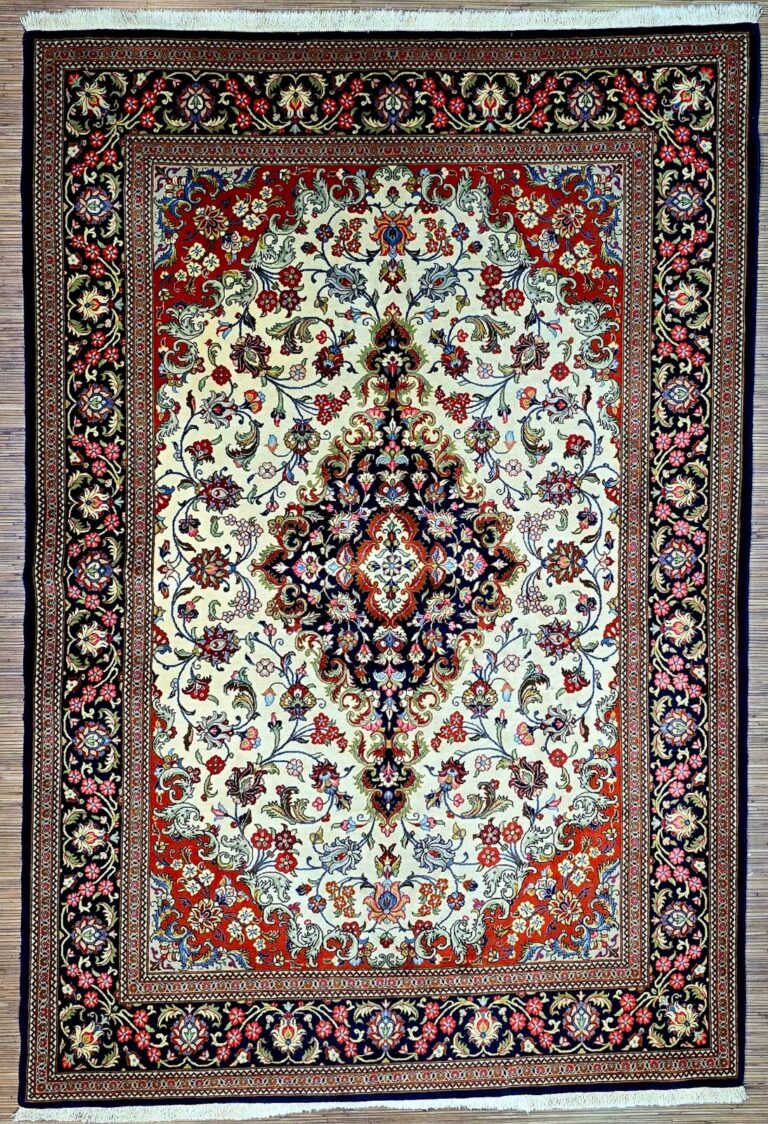
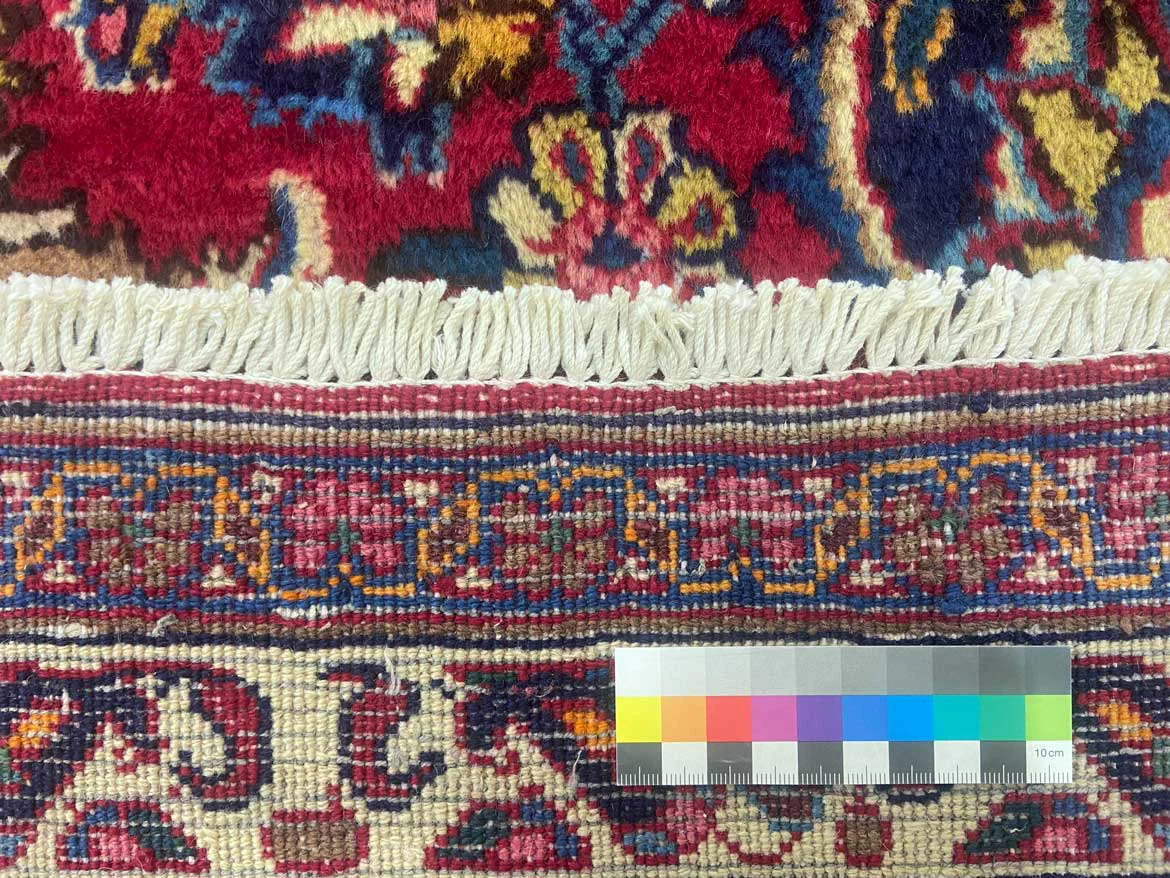
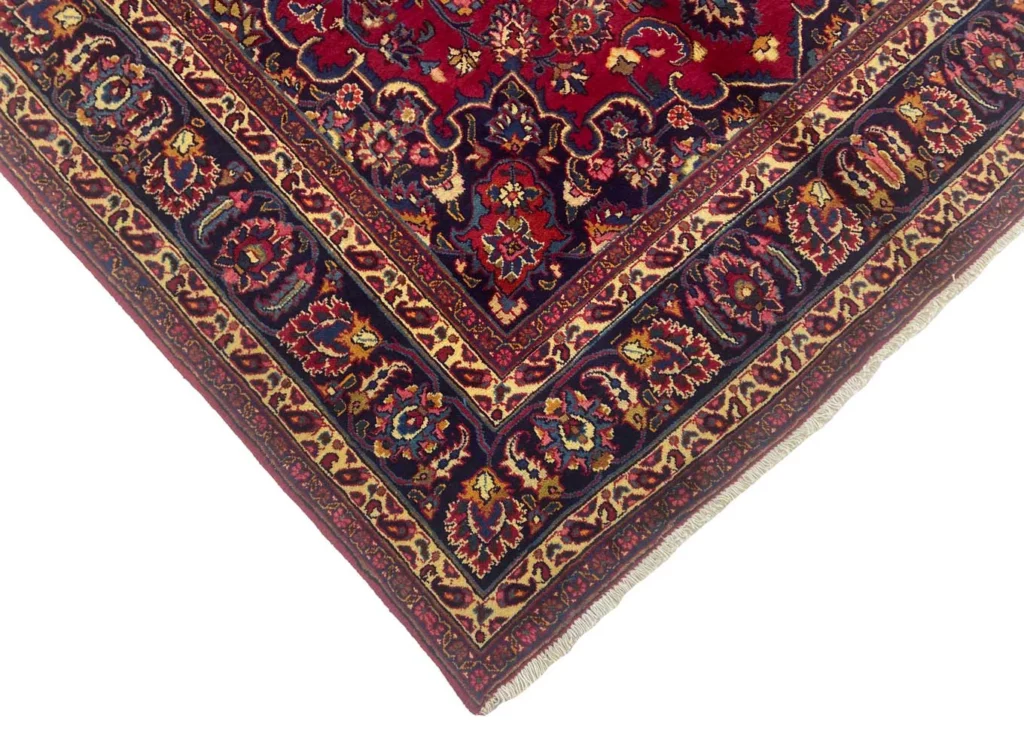
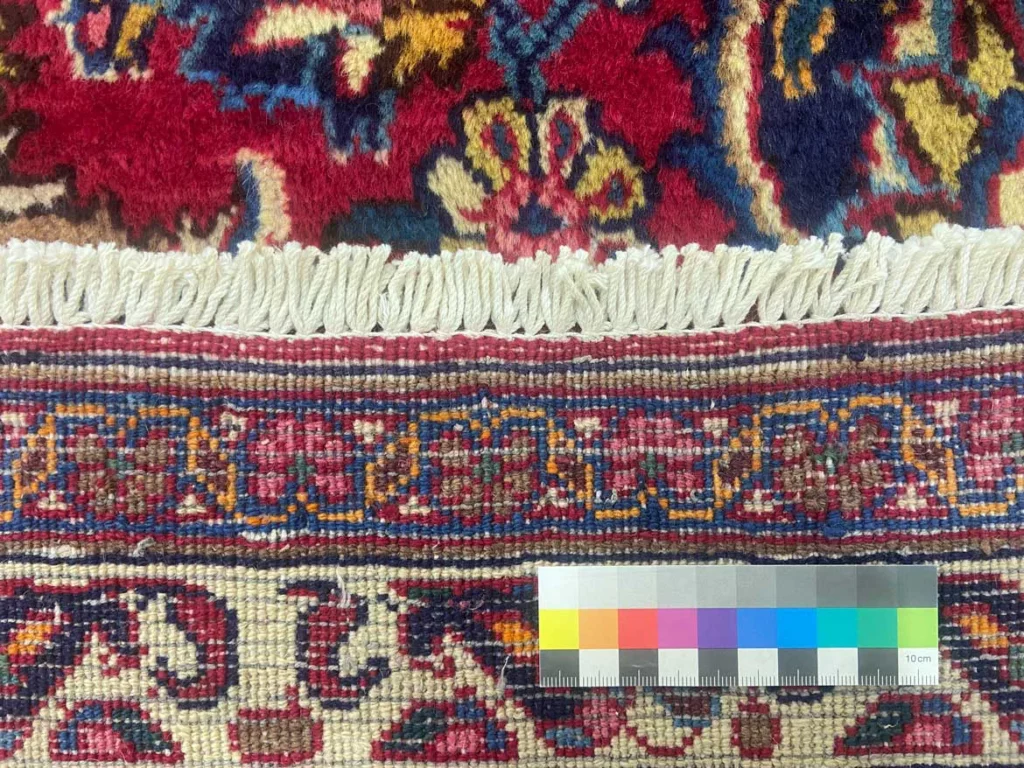
This Mashhad Persian rug is hand-knotted and has a pile made of high-quality wool. Hand knotting is central to the traditional production of Mashhad rugs. Each knot is worked into the foundation individually, so the textile surface develops through a sequence of deliberate manual steps. The listed knot density ranges from 180,000 to 250,000 knots per square metre. In this rug, that density supports the differentiated rendering of the floral forms and the classic medallion.
Wool is a longstanding material in hand-knotted Oriental rugs. It can be worked effectively during knotting and takes colour evenly. It also gives the pile a firm, tactile textile character. In a hand-knotted rug, the material and the method are closely related: the pile is not applied as a printed or industrial surface, but built up knot by knot. This creates the characteristic structure associated with hand craftsmanship.
The stated material for this piece is high-quality wool. Its manufacture is hand-knotted, and its condition is described as very well preserved. These are the relevant material and production details for the rug. Other materials are not assigned to this particular piece because its pile is specified as high-quality wool.
Care for a hand-knotted wool rug should take its construction into account. Regular gentle vacuuming removes loose dust from the pile. Spills and marks should be addressed promptly with a soft, slightly damp cloth, without vigorous rubbing. A professional rug cleaner is appropriate when deeper soiling needs to be removed. This approach helps protect both the wool surface and the hand-worked structure.
The knotting process also explains why a woven design can contain clearly defined contours and carefully separated colour areas. The weaver builds the drawing through the arrangement of individual knots and the interaction of pile, foundation and weft. The result is a textile object whose pattern is inseparable from its construction. The wool pile, hand-knotting and listed knot density therefore belong together when describing this Mashhad rug.
Origin and Tradition
Mashhad is a city in eastern Iran and gives its name to this type of Persian rug. Mashhad Persian rugs belong to the Iranian tradition of hand-knotted carpet making. The city and its surrounding area have long been associated with workshops producing rugs with carefully organised compositions and detailed ornament. The name Mashhad thus refers both to a place of origin and to a recognisable regional direction within Persian carpet art.
Persian rug making is based on practical knowledge passed through generations. Preparing the foundation, selecting and dyeing yarn, reading a design and placing knots in a regular sequence all form part of the craft. A pattern is not simply printed onto a finished surface. It grows from the work of the weaver, section by section, as the central field, surrounding ornaments and borders take shape. The process requires concentration because the design is translated into the textile through many individual decisions.
Mashhad rugs are commonly associated with balanced floral compositions and a central medallion. A design may be calm and spacious or richly articulated, depending on the density and scale of its flowers, leaves and scrolling forms. The combination of a central structure with floral ornament is an important part of the broader Mashhad tradition. It places this regional style within Persian carpet culture while still allowing individual rugs to differ in colour, detail and arrangement.
Colour is an important part of that tradition. Red is frequently used in Mashhad compositions and may be set against blue, purple and other related tones. This rug is described with red, blue and purple. Colours help distinguish the centre, field and surrounding ornament, while also giving the design its visual balance. Their function is therefore both decorative and structural. The exact distribution of the three named colours is not specified for this individual rug.
The classification Persian rug is appropriate here because this piece is described as originating in Iran. That is different from an Oriental rug made in another country, even when similar motifs are used. Within Iranian carpet making, Mashhad exists alongside other recognised centres. Tabriz, Nain and Isfahan are also associated with carefully worked designs and established craft traditions. They are separate place names, however, and related motifs do not change this rug’s Mashhad origin.
Technical skill is part of the regional tradition as well. The weaver follows a design while creating the surface through the repeated insertion of knots. Knot density affects the amount of detail that can be represented and the character of the finished drawing. For this rug, a density of 180,000 to 250,000 knots per square metre is listed. More broadly, this reflects a production method in which precision and patience are essential, rather than a surface decoration added after weaving.
Persian rugs have traditionally served both practical and representational roles. Their compositions can define a central area, relate furniture to the surrounding architecture or introduce a structured ornamental field into a room. A Mashhad rug with a floral design and medallion can be understood within that long tradition of using textiles to organise space. This background describes the rug type; the exact colours and pattern remain the characteristics of this one piece.
The history of the regional craft is therefore visible in the relationship between place, technique and ornament. Mashhad identifies the Iranian production tradition, hand knotting identifies the making process, and the medallion with floral design identifies the chosen visual language. Together these elements provide a clear description without assigning the rug to another Persian centre or adding an unsupported provenance.
Design and Pattern
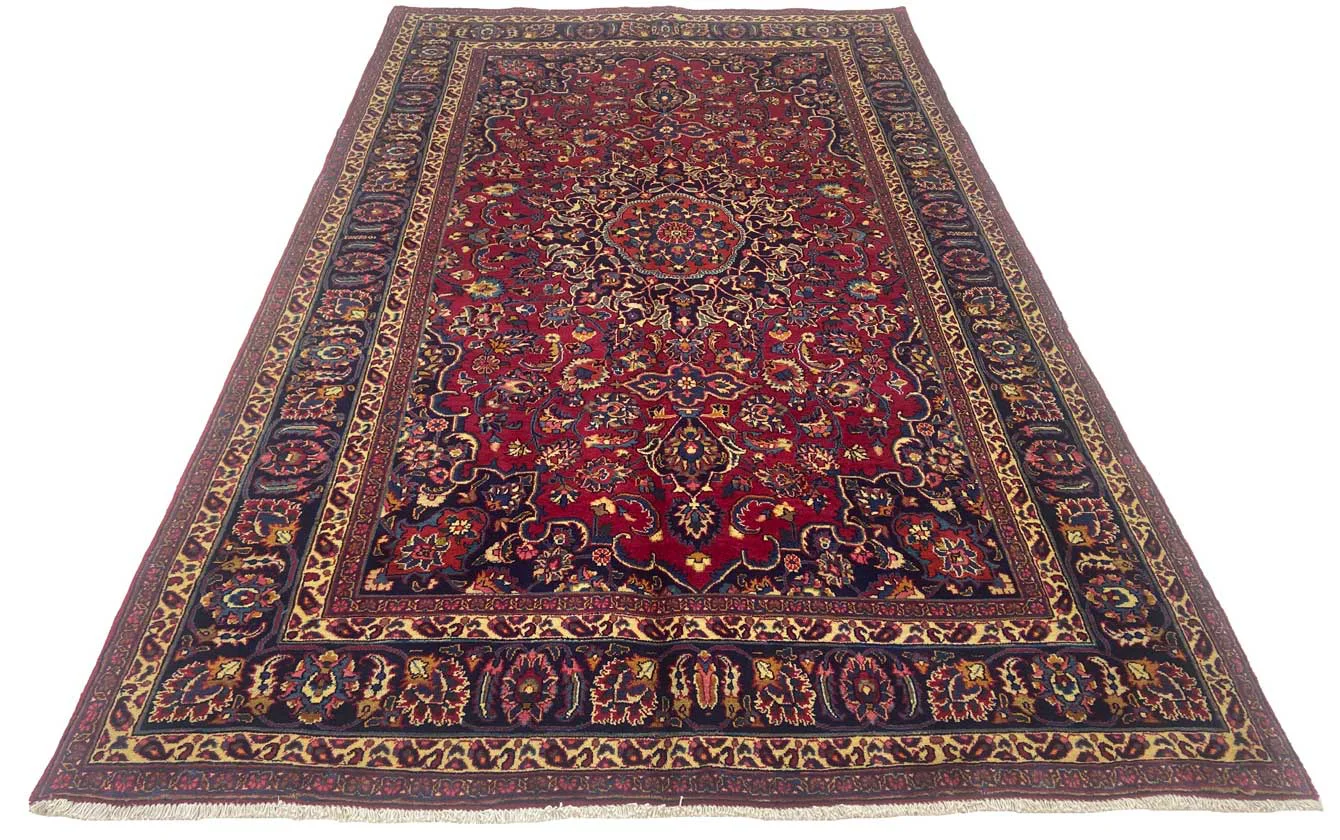
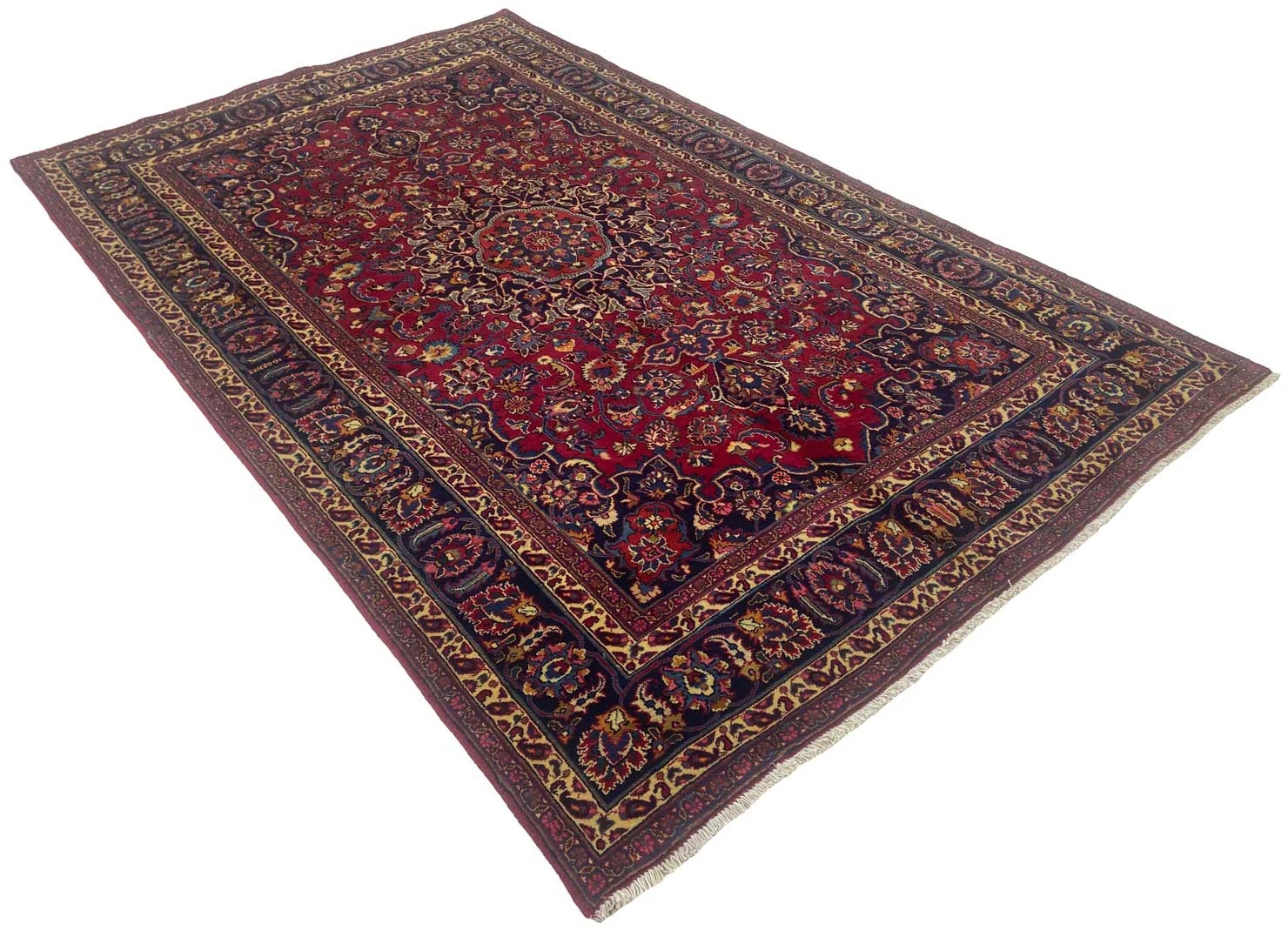
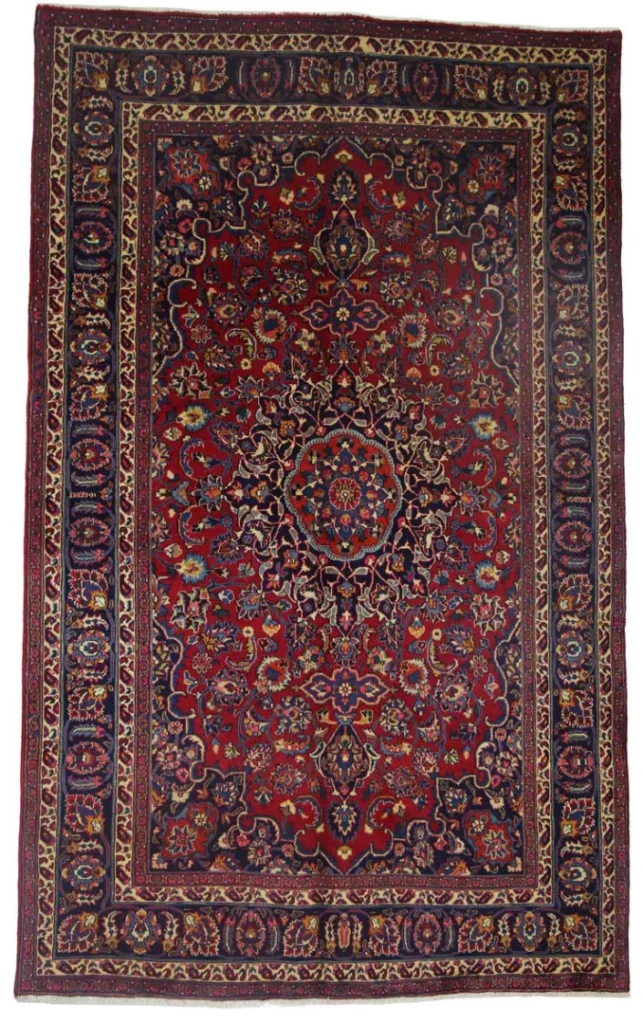
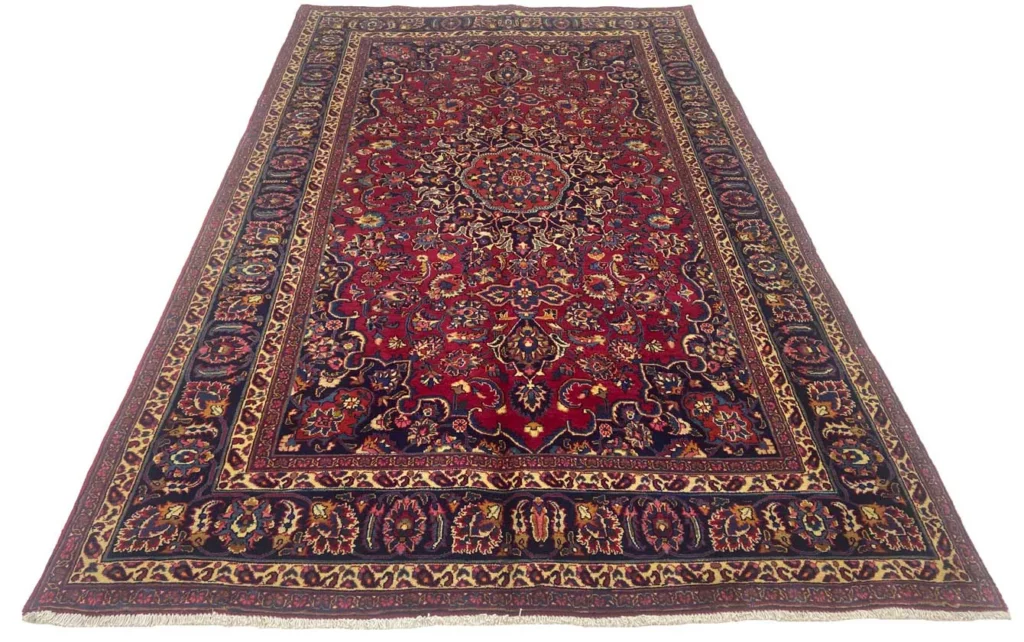
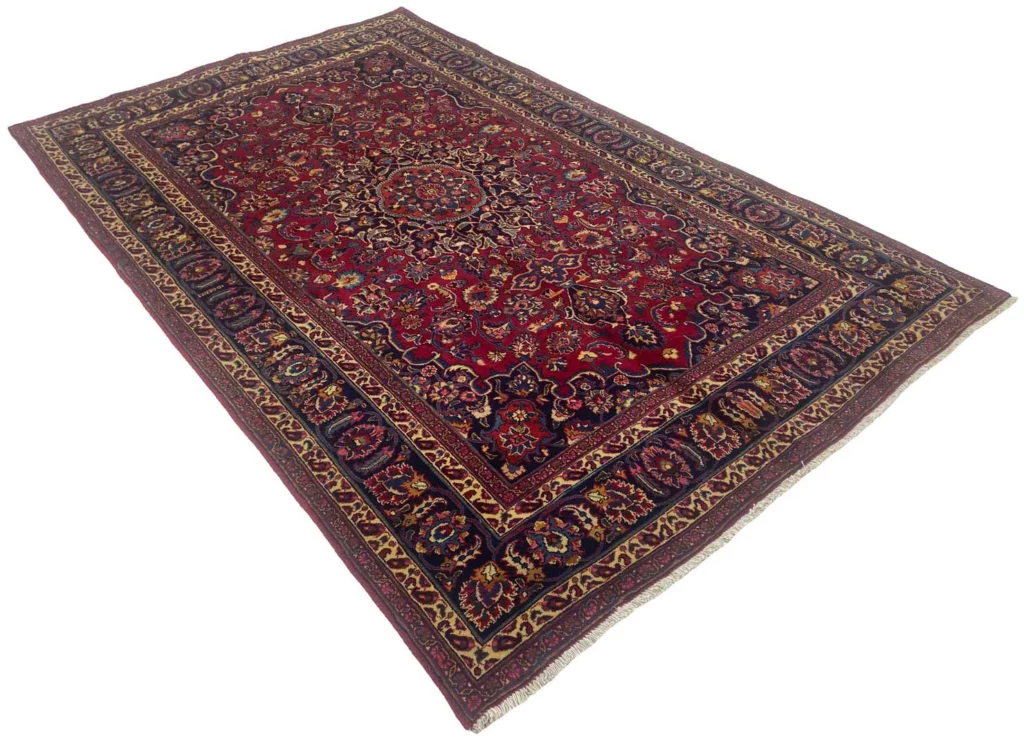
This rug has a floral design with a classic medallion. A medallion is a central ornamental form that gives the composition a visual focus. From that centre, the surrounding field can be arranged in a balanced relationship of flowers, leaves and scrolling details. Floral motifs provide the connecting language around the central element, turning separate shapes into a coherent pattern. The colours listed for this rug are red, blue and purple.
Floral ornament is one of the established vocabularies of Persian carpet design. Flowers, leaves and vines may be represented in a naturalistic way or translated into more stylised forms. In a knotted rug, every such shape has to be rendered through individual colour-bearing knots. Curves become stepped lines, shaded areas become sequences of related tones, and small flowers depend on the precision of the drawing. The visible pattern is therefore directly linked to the weaving technique.
The classic medallion organises the centre of the field. Medallions in Persian rugs can take many forms, including rounded, oval, polygonal or layered outlines. The particular outline of the medallion in this piece is not described in more detail, so no narrower classification is assigned. In general, the central device prevents the field from appearing as an unstructured collection of ornaments. It establishes an axis and gives the surrounding floral forms a relationship to the middle.
Red, blue and purple create the stated palette of this rug. Red can function as a strong ground or accent colour in Persian compositions, while blue often introduces contrast and helps separate ornamental passages. Purple adds a different tonal presence between warm and cool areas. The description identifies these colours but does not specify which one forms the ground or how they are distributed. The reliable design statement is therefore the combination of the three named colours.
In a floral medallion design, the balance between centre and surrounding field is especially important. Repeated leaves, blossoms and scrolling lines can echo the main shape and lead the eye outward. Variations in scale prevent every ornament from competing equally with the medallion. These are general principles of Persian pattern design, not additional claims about unrecorded details of this particular rug. They explain how a central motif and floral decoration can work together as a unified composition.
The listed knot density provides the technical basis for detailed pattern work, although density alone does not define the design. The final appearance also depends on the drawing, the colour choices, the wool and the skill of the knotter. In this piece, high-quality wool, hand knotting, a floral pattern and a classic medallion are specifically joined in the description. The resulting design belongs to the Mashhad tradition without needing to be labelled as a Nain, Tabriz or Isfahan rug.
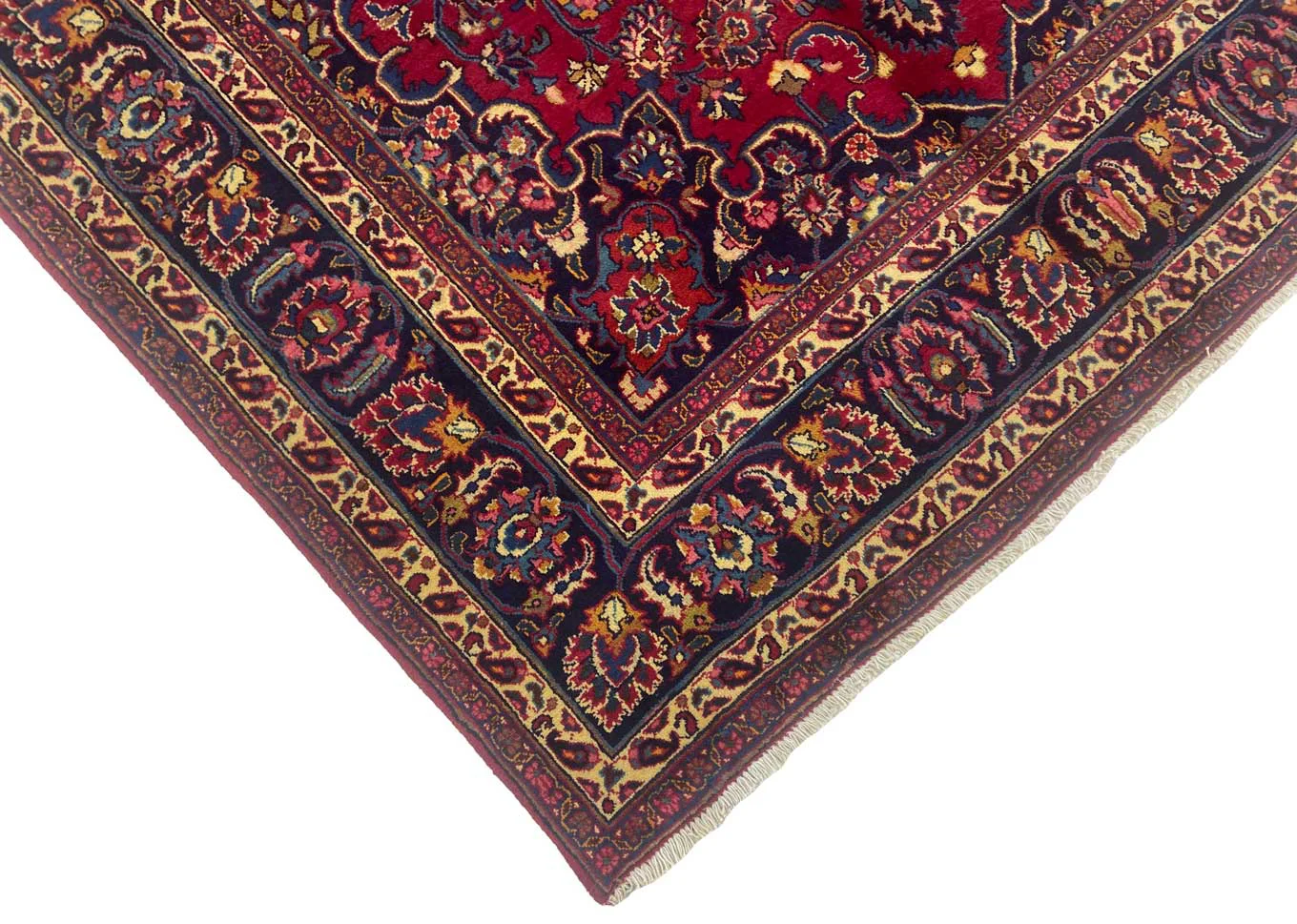
Many Persian rugs use borders to frame the central field and create a transition toward the outer edge. Floral border arrangements, narrow lines and contrasting bands are all familiar possibilities. The borders of this rug are not described specifically, so no particular border sequence is claimed here. What is established is the floral design with a classic medallion and the red, blue and purple colour combination.
Pattern language also helps distinguish regional traditions from one another. Similar flowers or medallions may appear across Iran, but their proportions, drawing conventions and colour relationships can vary from one centre to another. Mashhad compositions are commonly read through their ordered floral ornament and central focus. This rug is identified within that Mashhad context, while the individual arrangement remains unique to the one hand-knotted piece.
Special Features
The defining features of this one-off rug are its Mashhad origin, Persian classification, hand-knotted construction and high-quality wool pile. Its design combines floral ornament with a classic medallion, and the named colours are red, blue and purple. The listed density of 180,000 to 250,000 knots per square metre indicates a finely worked hand-knotted structure.
The rug is described as very well preserved. This condition statement belongs to the individual piece and complements the information about its material, technique and design. Each characteristic has a different meaning: Mashhad identifies the Iranian origin, wool identifies the pile material, hand knotting identifies the production method, and the medallion identifies the central design idea.
Its classification as a Persian rug follows from the Iranian origin given for Mashhad. It is therefore not merely an Oriental rug with a Persian-looking pattern; it is described as a Mashhad Persian rug. Other Iranian centres may share floral or medallion motifs, but related ornament does not replace the stated place of origin.
The high knot density, wool pile and carefully structured floral composition provide a clear view of the relationship between craft and design. The condition adds another specific attribute to this rug. Together, these details make it possible to describe the piece precisely while leaving out information that has not been supplied.
FAQ
How should I clean my Mashhad Persian rug?
Vacuum the rug regularly and gently to remove loose dirt from the wool pile. If a mark or spill occurs, treat it promptly by blotting with a soft, damp cloth rather than rubbing forcefully. Deeper soiling should be handled by a professional rug-cleaning service. The cleaning method should be suitable for a hand-knotted wool rug and should protect the pile as well as the underlying construction.
Where do the materials for a Mashhad Persian rug come from?
High-quality wool is specified as the pile material for this rug. Mashhad rugs are traditionally made in the region associated with Mashhad in eastern Iran. In the wider production of this rug type, fine wool and sometimes silk are used. For this individual piece, however, the stated material is high-quality wool. Wool is valued in hand-knotted rugs for its durability and its firm, tactile surface.
What determines the value of a Mashhad Persian rug?
The value of a Mashhad Persian rug is influenced by several factors, including knot density, design, materials and the quality of the craftsmanship. A higher knot density can support finer detail, while an individual composition and carefully executed ornament also affect the assessment. For this rug, the relevant features include the high-quality wool pile, hand-knotted construction, floral design, classic medallion, red, blue and purple colours, and very well-preserved condition. These attributes describe the character of this one-off piece.
To provide the best experiences, we use technologies like cookies to store and/or access device information. Consenting to these technologies will allow us to process data such as browsing behavior or unique IDs on this site. Not consenting or withdrawing consent, may adversely affect certain features and functions.
Functional Always active
The technical storage or access is strictly necessary for the legitimate purpose of enabling the use of a specific service explicitly requested by the subscriber or user, or for the sole purpose of carrying out the transmission of a communication over an electronic communications network.
Preferences
The technical storage or access is necessary for the legitimate purpose of storing preferences that are not requested by the subscriber or user.
Statistics
The technical storage or access that is used exclusively for statistical purposes.The technical storage or access that is used exclusively for anonymous statistical purposes. Without a subpoena, voluntary compliance on the part of your Internet Service Provider, or additional records from a third party, information stored or retrieved for this purpose alone cannot usually be used to identify you.
Marketing
The technical storage or access is required to create user profiles to send advertising, or to track the user on a website or across several websites for similar marketing purposes.

 SECURE PAYMENT
 SHIPPING PARTNERS