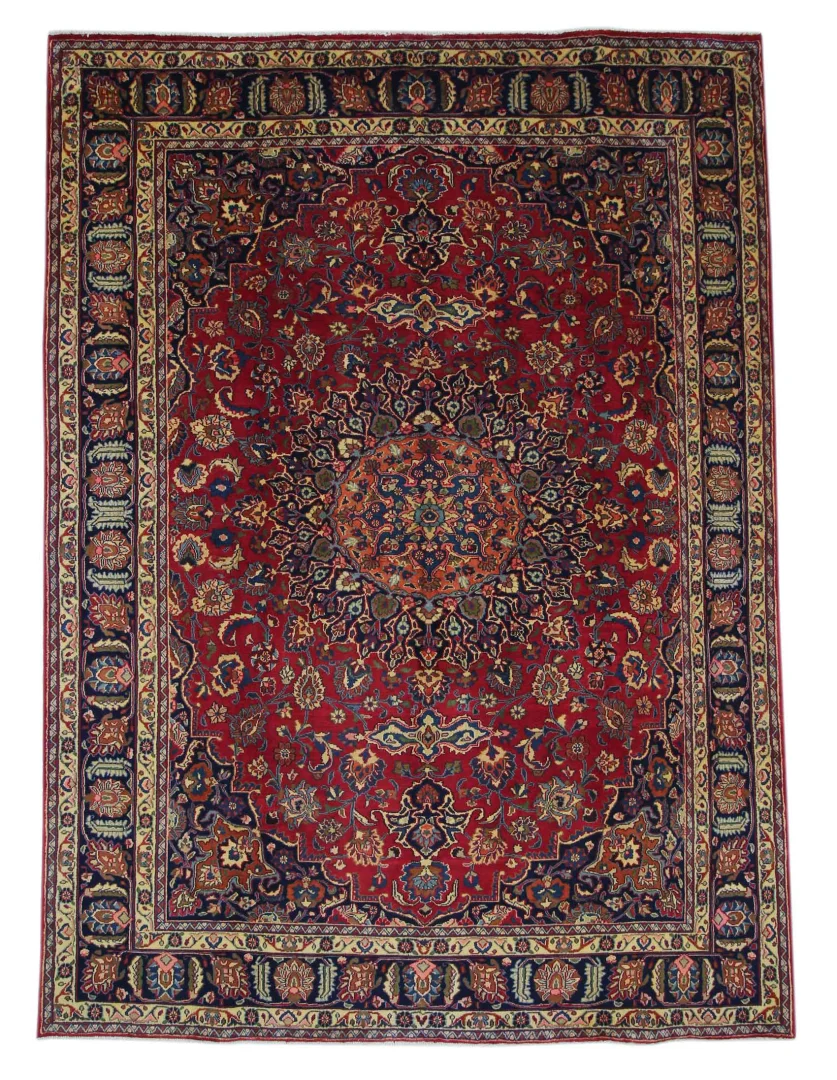
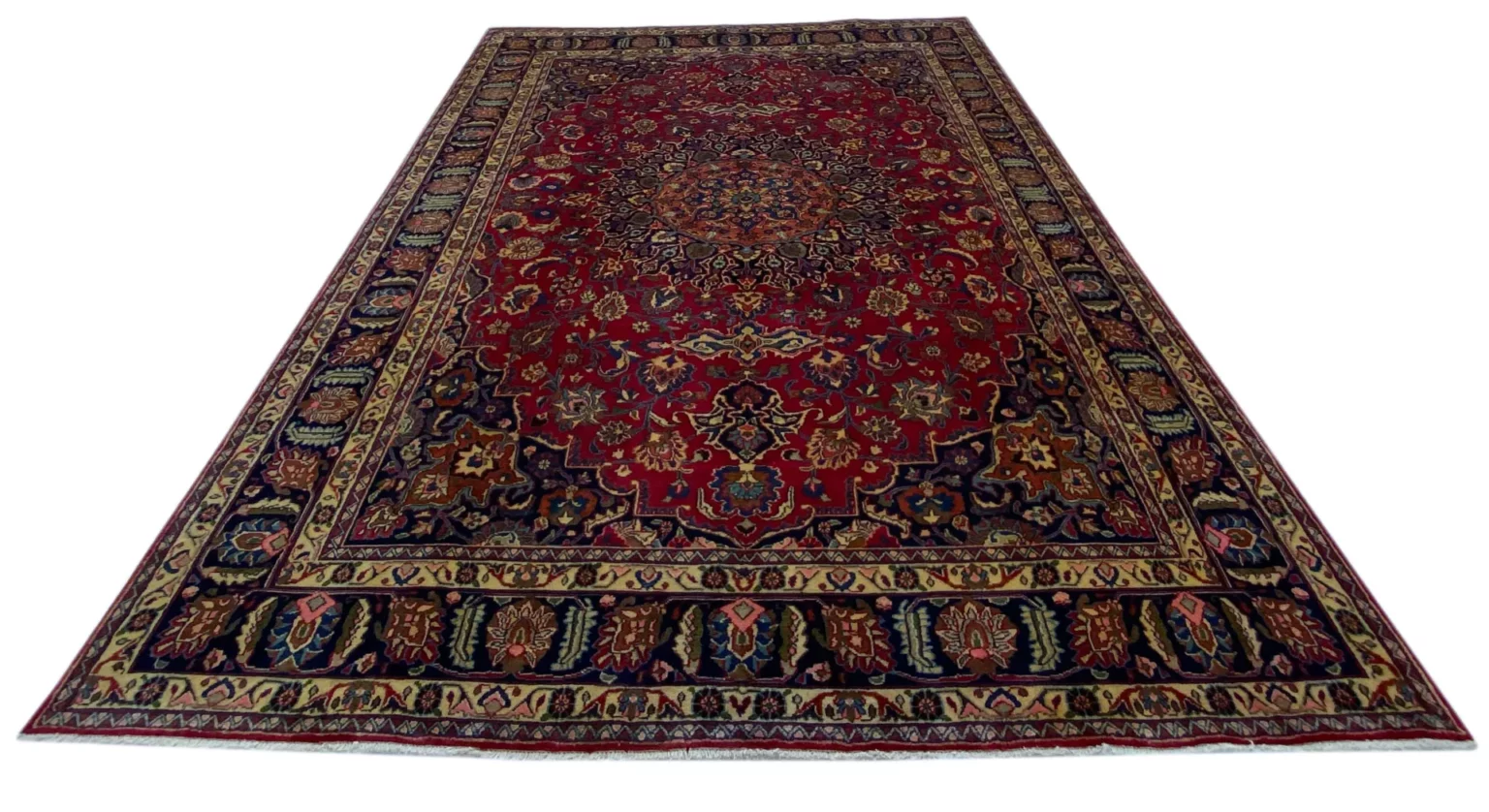
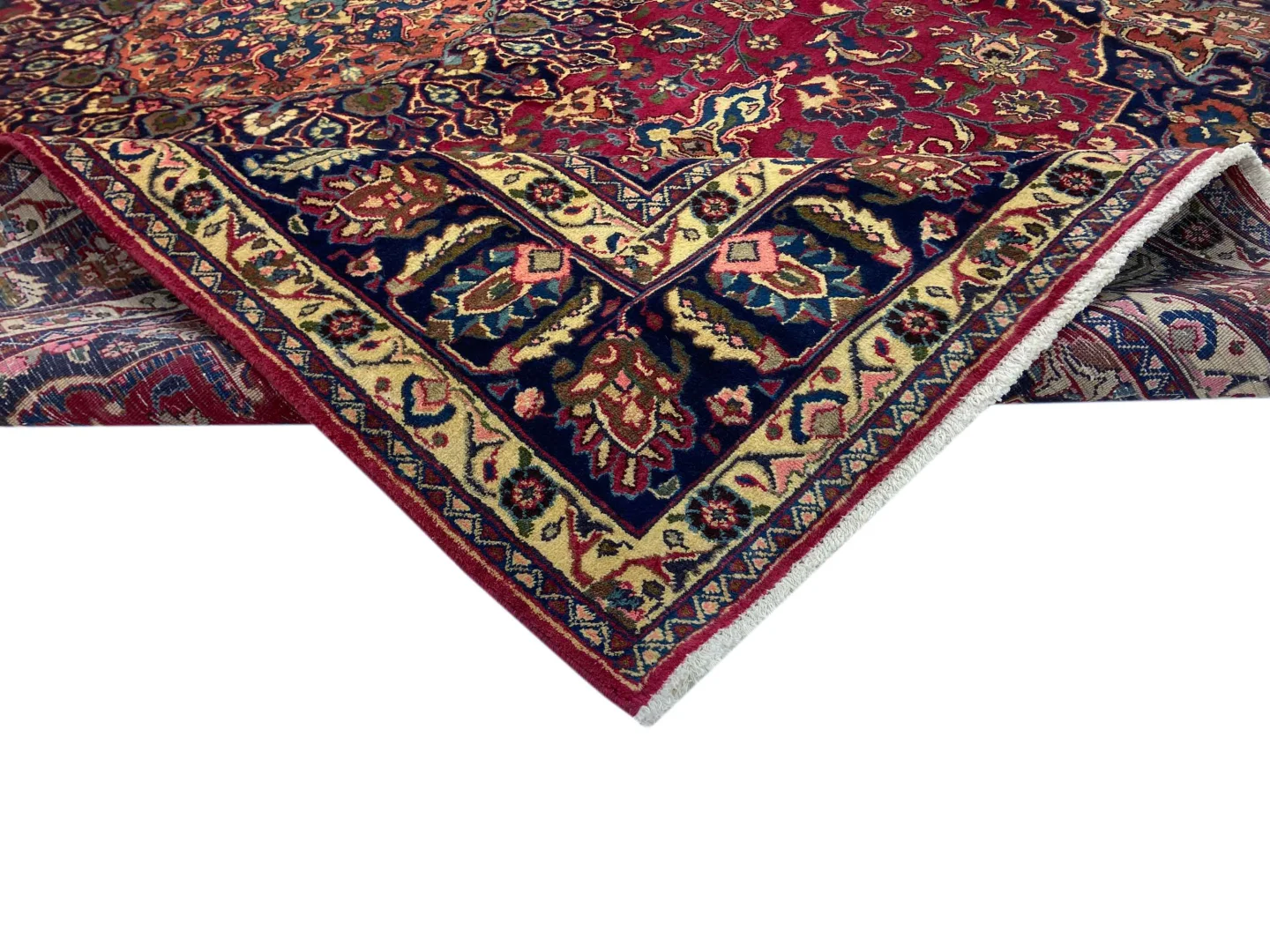
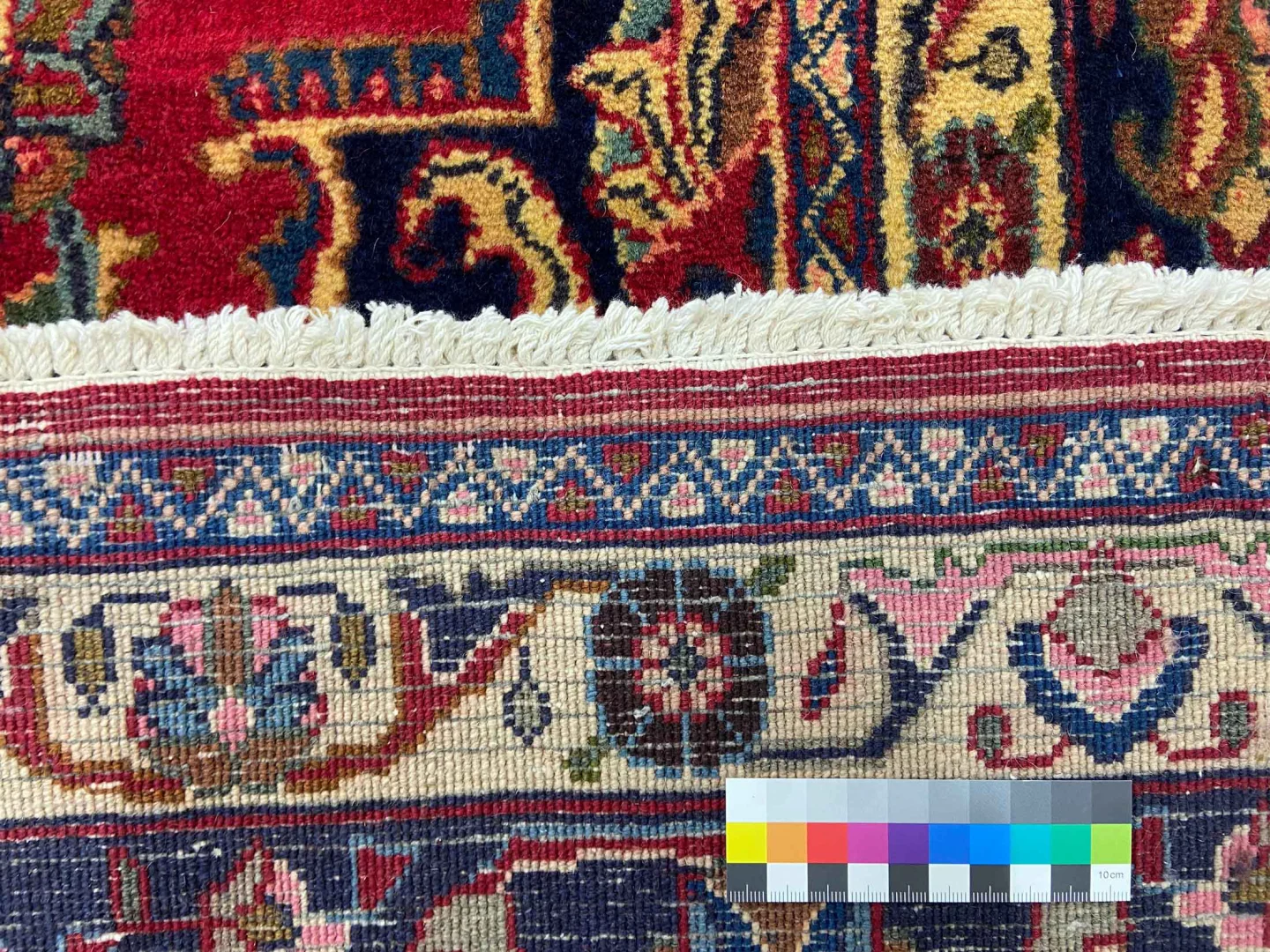
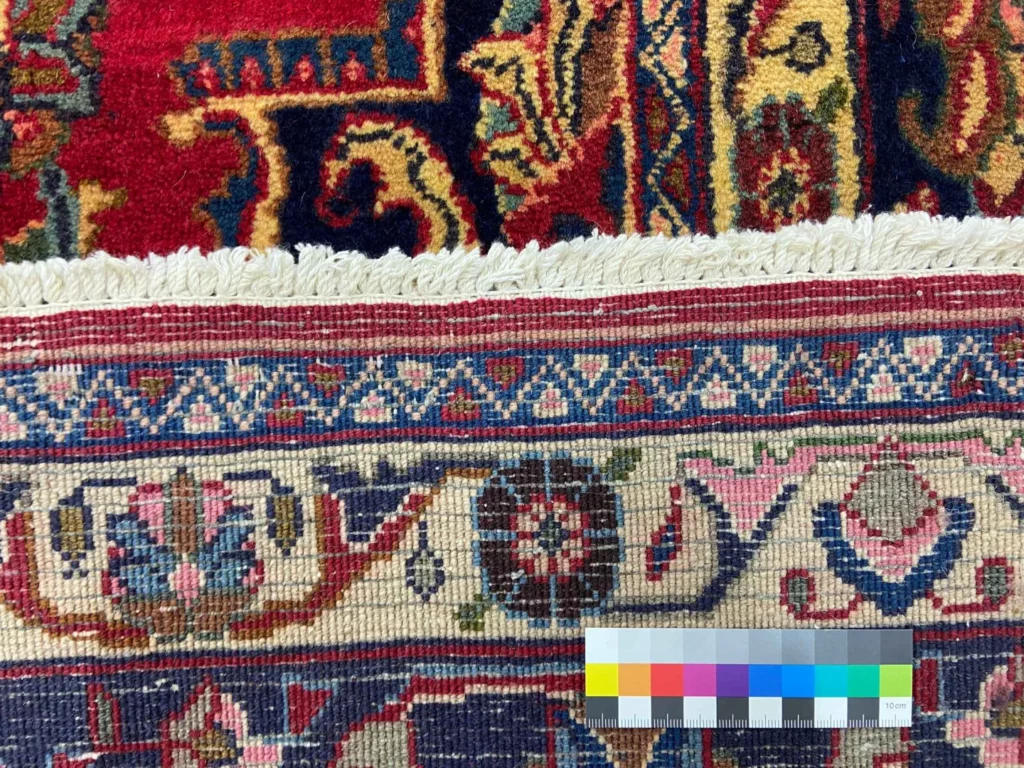
This Maschhad Persian rug is hand-knotted and has a pile made of high-quality wool. Hand-knotting is one of the established methods of Persian rug production. Instead of printing a design or reproducing it mechanically, the maker builds the pattern knot by knot within the prepared structure. This process requires concentration, experience, and a consistent working rhythm so that the contours, the central medallion, and the floral details remain clearly defined.
The product specification gives a knot density of 180,000 to 250,000 knots per square metre. Such density allows a differentiated rendering of outlines and smaller ornaments. In hand-knotted rugs, knot density is traditionally considered one indication of the degree of detail that can be achieved, since closer knotting permits more finely graded transitions. It does not define the character of a rug by itself: the quality of the drawing, the skill of the weavers, and the coordination of the colours are equally relevant to the finished textile.
Wool is a traditional material in Persian rug making. It is used for its natural handle and its suitability for a durable pile. Depending on quality and construction, Maschhad rugs can be made with different material combinations; this particular rug is described as having high-quality wool pile. The material is therefore presented together with the hand-knotted construction and the traditional design, rather than as a separate decorative feature.
The rug is in very good condition. This condition statement applies to the individual piece and complements the information about its hand-knotted construction, wool pile, and floral pattern. It does not establish a particular year of manufacture and does not provide a separate claim about restoration.
Origin and Tradition
Maschhad is situated in eastern Iran and is the most important carpet-making centre in the Khorasan region. The city is also a major historical and cultural centre. Its position connected different commercial and cultural routes, allowing influences from several parts of Persia to meet in local weaving traditions. Maschhad rugs therefore belong to a regional craft tradition that combines established Persian ornament with a distinctive approach to colour and composition.
Rug production in Maschhad developed through workshops as well as domestic weaving. Skilled makers work from inherited designs that are passed between generations while also being adapted to changing preferences. The composition is generally planned as a carefully ordered design before it is woven into the rug. During knotting, the structure is built progressively, one knot at a time. Once the knotting is complete, the edges are secured, the pile is finished, and the surface is checked as part of the customary making process.
The Maschhad tradition is closely connected with Persian rug culture, although rugs from the region are not all identical. Different qualities, formats, and designs exist within the same area. Common features may include a clearly organised field, a strong central composition, and a rich palette. Red, blue, and purple are colours frequently associated with Maschhad rugs and often serve as defining tones. Their effect comes from the relationship between the ground, the borders, and the individual ornaments.
Persian rugs are named not only for their patterns but also for their places of production. Maschhad is therefore an origin designation referring to the city and its regional knotting tradition, not merely a name for a decorative motif. Other Persian centres have their own recognised tendencies: Tabriz is associated with detailed drawing, Nain with light and finely structured compositions, and Kashan with complex patterns and vivid colours. Isfahan is known for artistic designs and a strong workshop tradition.
These distinctions demonstrate the variety found within Persian rug making. Maschhad represents a tradition in which floral forms, central medallions, and assertive colours have an important role. Regional origin explains the framework in which a rug was made, but it does not replace an examination of the individual piece. Every hand-knotted rug brings together an inherited design language and the specific decisions made by the workshop and its makers.
Design and Pattern
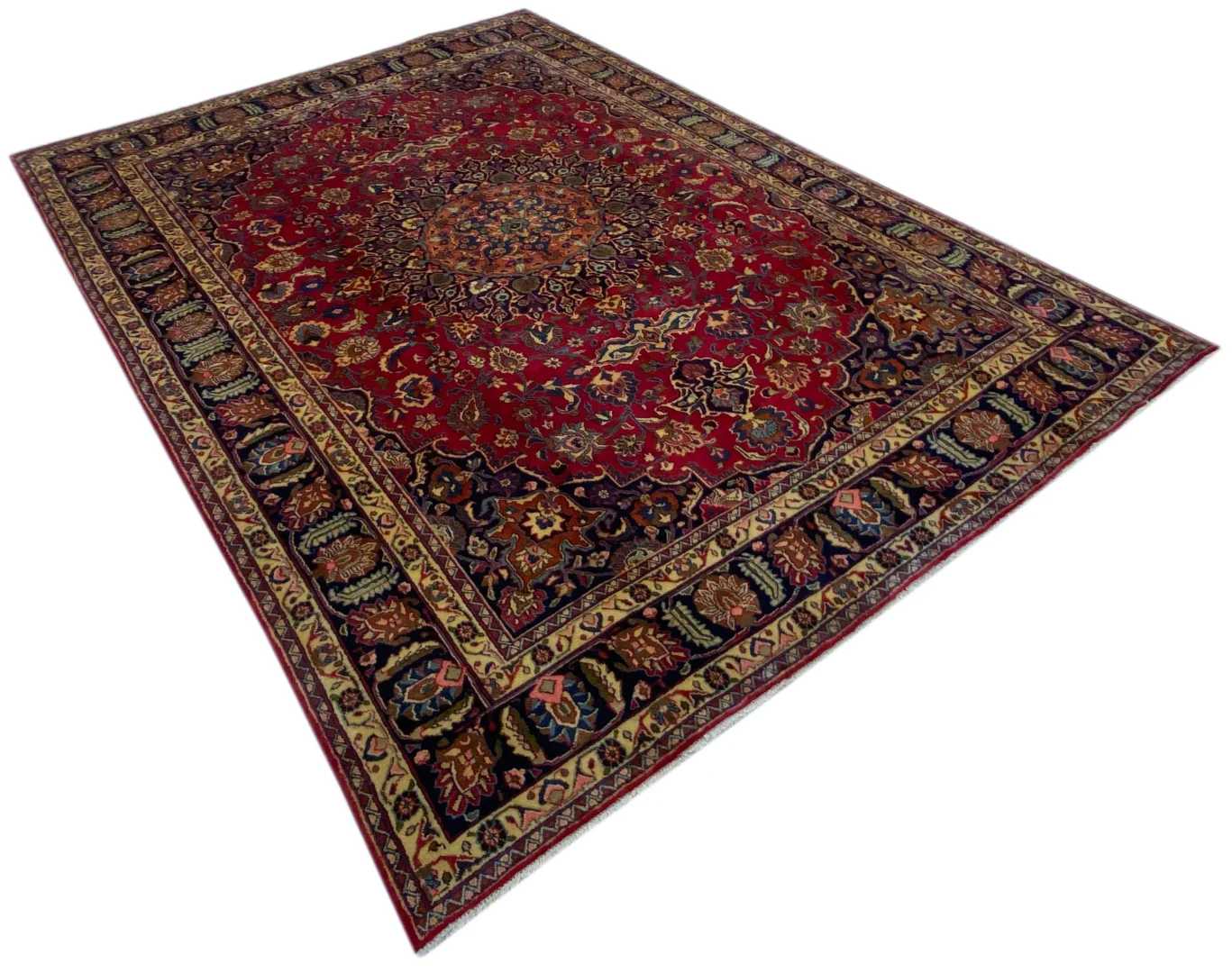
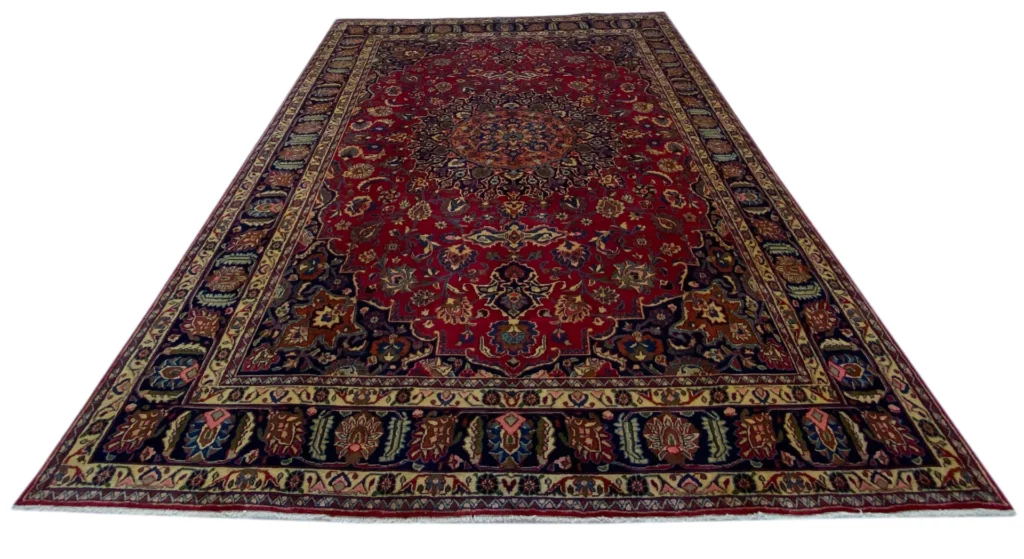
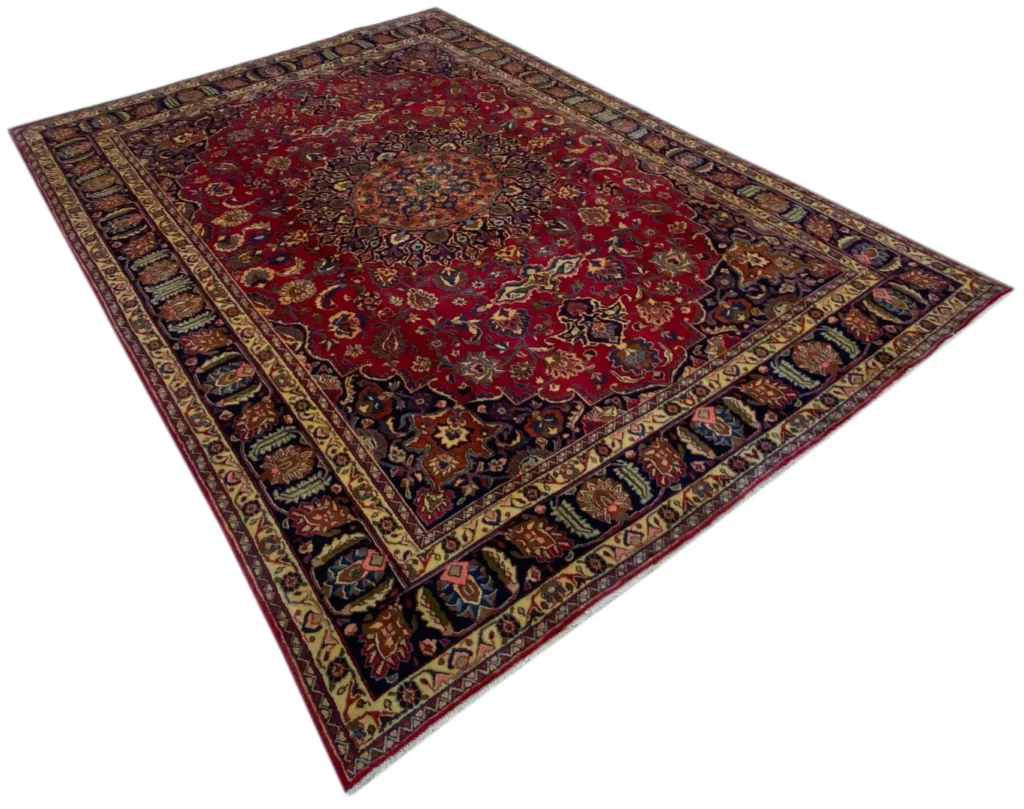
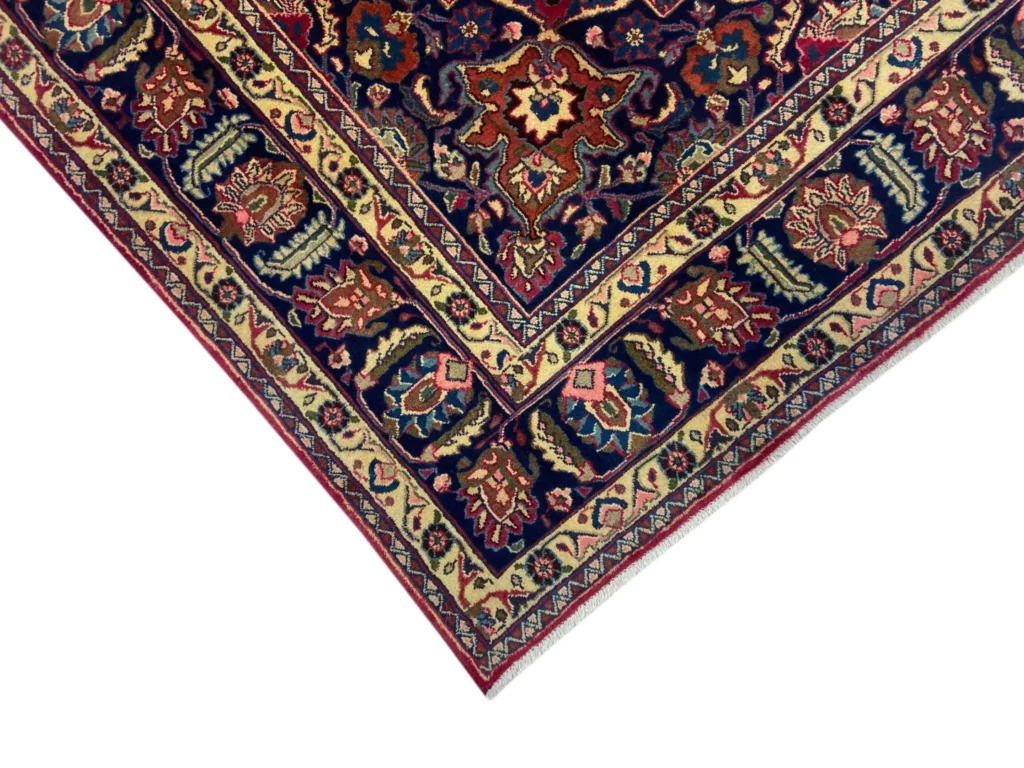
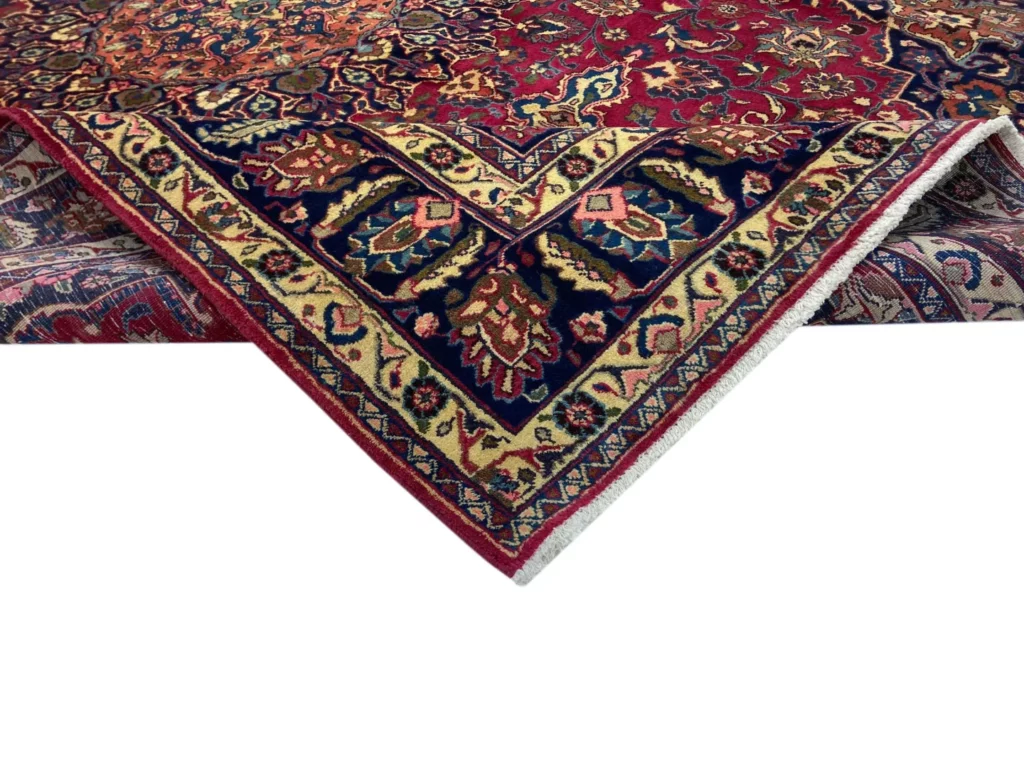
The pattern of this rug is described as a floral design with a classic medallion. The composition is therefore organised around a clearly emphasised ornamental centre, with floral elements arranged around it. The medallion acts as the visual anchor of the design, establishing a relationship between the middle, the surrounding field, and the borders. Flowers, leaves, and scrolling forms guide the eye across the surface and connect the separate parts of the composition.
Floral Persian rug patterns commonly use stylised botanical forms. Leaves, blossoms, vines, and rosettes are not necessarily copied from nature; they are translated into a regular ornamental vocabulary. Repetition, reflection, and measured spacing create rhythm across the field. In a medallion design, the floral motifs are generally related to the central form and to the areas on either side of it. This gives the rug visual continuity even when the pattern contains many individual details.
The palette associated with Maschhad rugs ranges from strong reds and blues to violet and purple. Such colours can give the field depth and help separate the outlines of the ornaments. A darker ground can make lighter blossoms and vines more visible, while a lighter field can give the pattern a quieter appearance. For this rug, the documented design characteristics are its floral treatment and classic medallion. No additional claim is made here about a specific ground colour or a particular border arrangement.
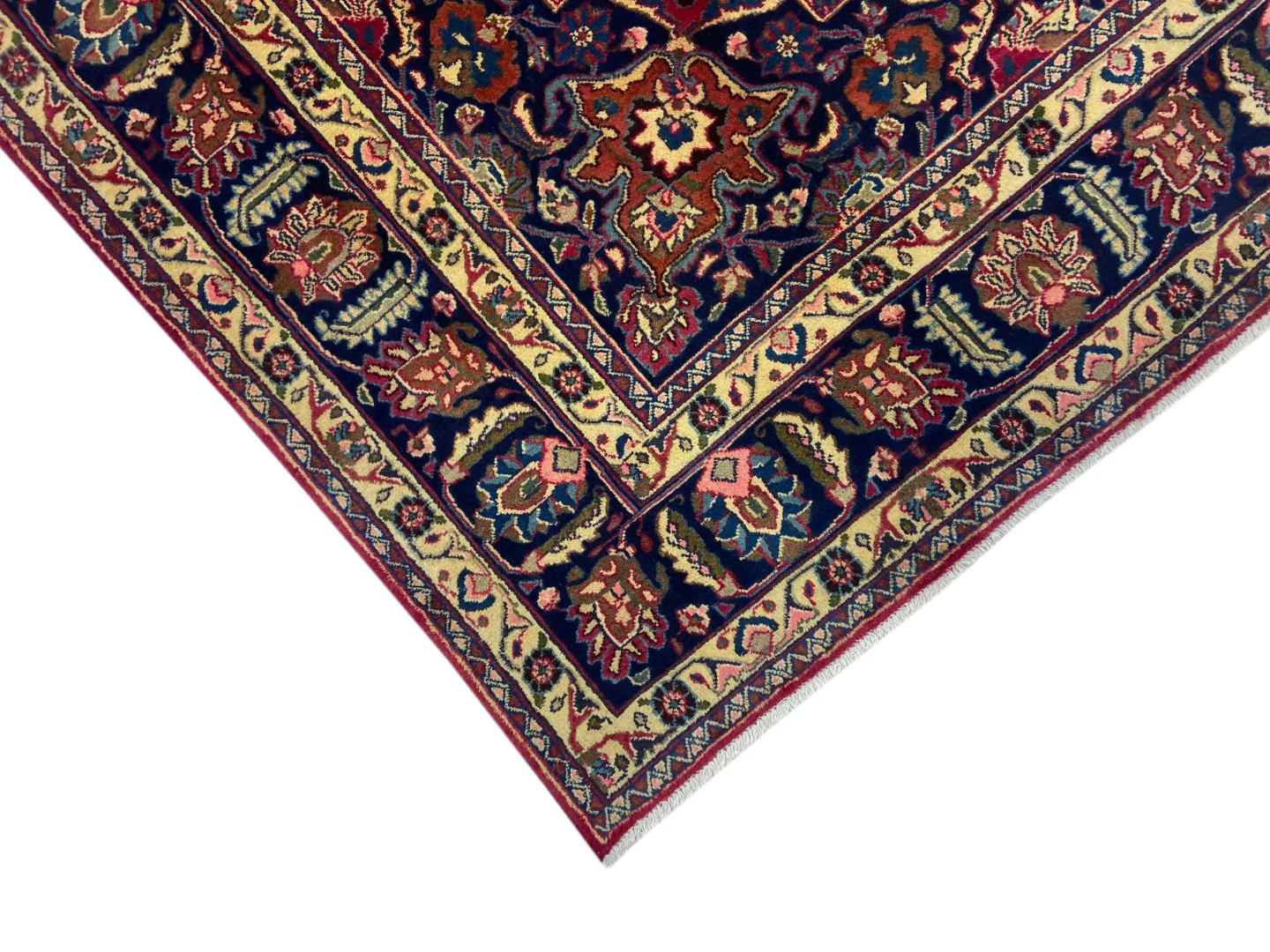
In Persian rug composition, the border provides an important ordering device. It frames the central field and marks the transition between the principal design and the outer edge. Traditional designs may use a main border together with narrower secondary borders, each carrying its own ornamental rhythm. Together they keep the pattern visually contained. When viewing a floral medallion rug, the relationship between the centre, the field, and the framing elements is therefore as important as any single flower or vine.
A classic medallion does not turn a rug into a copy of another place of origin. Tabriz, Nain, and Kashan rugs can also employ central compositions or floral ornament, but their regional drawing traditions are distinct. In this piece, the stated Maschhad origin, floral pattern, and classic medallion form a coherent Persian design. The hand-knotted construction also means that the arrangement of knots and the development of the lines are part of the textile’s visible character.
Special Features
The specific features of this rug are its Persian origin, hand-knotted construction, high-quality wool pile, stated knot density of 180,000 to 250,000 knots per square metre, and very good condition. Its pattern is a floral design with a classic medallion. These details describe the offered one-off piece and bring together its technical, material, and visual properties.
The combination of a central composition and floral ornament is firmly established in Persian rug tradition. At the same time, every hand-knotted rug remains an individual textile because manual work creates particular variations in knot placement, colour distribution, and line quality. Regular, gentle vacuuming is suitable for routine care. Spills should be dealt with promptly using a damp cloth, while professional cleaning is recommended to protect the pile and colours.
FAQ
How should I care for my Maschhad Persian rug?
Regular, careful vacuuming helps remove loose dust and dirt from the wool pile. The surface should not be subjected to unnecessary force. Fresh spills are best blotted promptly with a damp cloth rather than rubbed or worked deeper into the pile. Professional rug cleaning is recommended for a thorough treatment. Appropriate cleaning helps preserve the structure of a hand-knotted rug and supports the continued appearance of its colours. Strong household detergents and intensive do-it-yourself wet cleaning should be avoided when the material and dyes cannot be assessed with certainty.
Where do Maschhad Persian rugs come from?
Maschhad Persian rugs come from the city of Maschhad in eastern Iran. Maschhad is an important centre of regional rug making and belongs to the historic cultural landscape of Khorasan. The local tradition is associated with hand-knotted rugs using classical Persian compositions, floral ornament, and a rich colour palette. The name Maschhad therefore identifies a regional origin and is not simply a label for a pattern. This particular piece is described as a Persian rug from Persia with a floral design and a classic medallion.
What makes a Maschhad Persian rug distinctive?
A Maschhad Persian rug is defined by the combination of regional origin, hand-knotted workmanship, high-quality wool, and established Persian ornament. This piece also has a floral design and a central classic medallion. Its knot density of 180,000 to 250,000 knots per square metre supports a detailed rendering of the pattern. Because every knot is placed by hand, each rug results from a particular sequence of practical and artistic decisions. A hand-knotted rug is consequently an individual textile that presents the Maschhad tradition in its own specific execution.
To provide the best experiences, we use technologies like cookies to store and/or access device information. Consenting to these technologies will allow us to process data such as browsing behavior or unique IDs on this site. Not consenting or withdrawing consent, may adversely affect certain features and functions.
Functional Always active
The technical storage or access is strictly necessary for the legitimate purpose of enabling the use of a specific service explicitly requested by the subscriber or user, or for the sole purpose of carrying out the transmission of a communication over an electronic communications network.
Preferences
The technical storage or access is necessary for the legitimate purpose of storing preferences that are not requested by the subscriber or user.
Statistics
The technical storage or access that is used exclusively for statistical purposes.The technical storage or access that is used exclusively for anonymous statistical purposes. Without a subpoena, voluntary compliance on the part of your Internet Service Provider, or additional records from a third party, information stored or retrieved for this purpose alone cannot usually be used to identify you.
Marketing
The technical storage or access is required to create user profiles to send advertising, or to track the user on a website or across several websites for similar marketing purposes.

 SECURE PAYMENT
 SHIPPING PARTNERS


