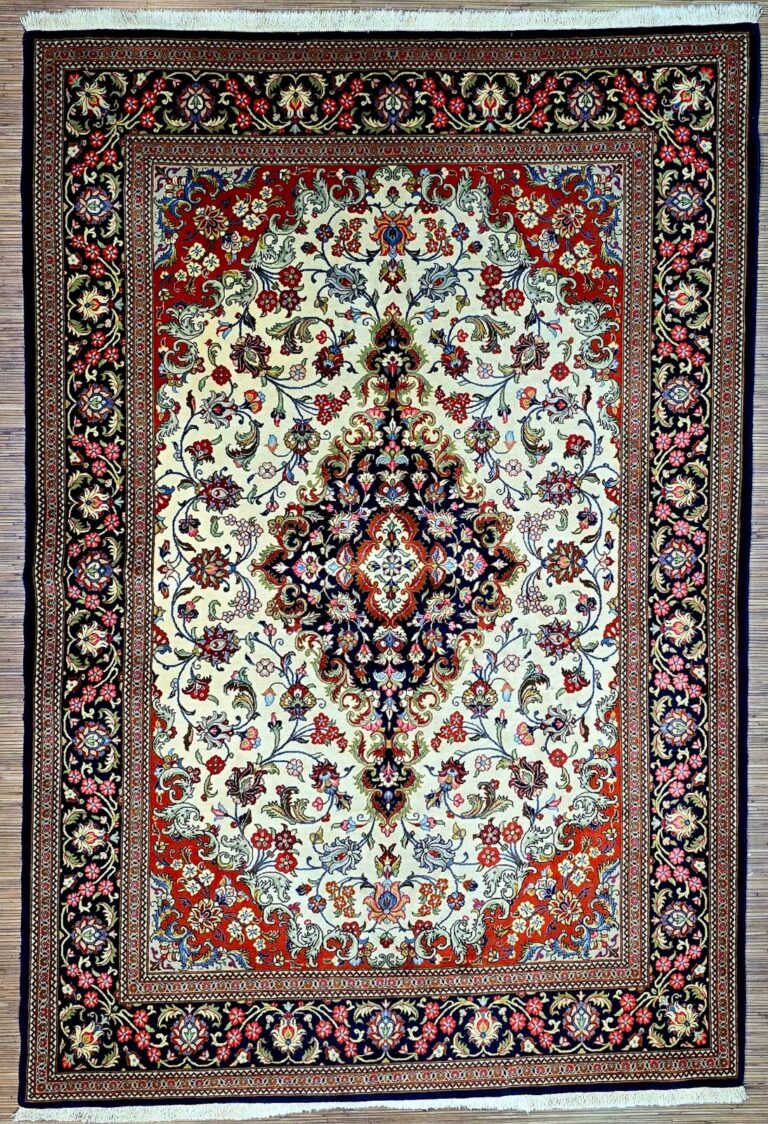
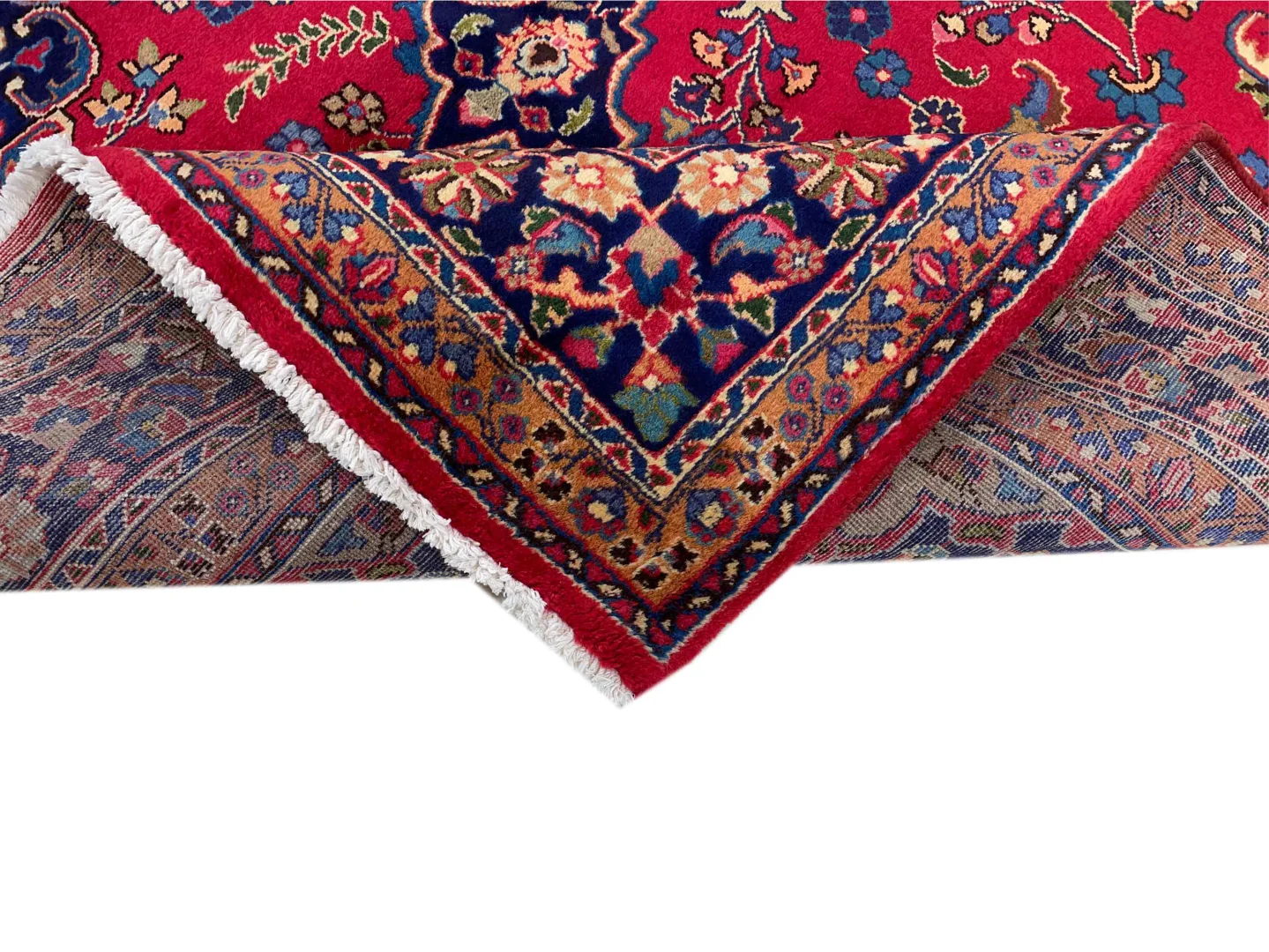
This Maschhad Persian rug is hand-knotted and made from high-quality wool. Hand knotting is a defining feature of Persian rug production: each knot is inserted individually into the prepared foundation. The resulting textile structure brings the pile, pattern and underlying construction together in one piece. Unlike a mechanically produced floor covering, a hand-knotted rug is formed through a sequence of individual working steps and is therefore a one-off object rather than a repeatedly identical series product.
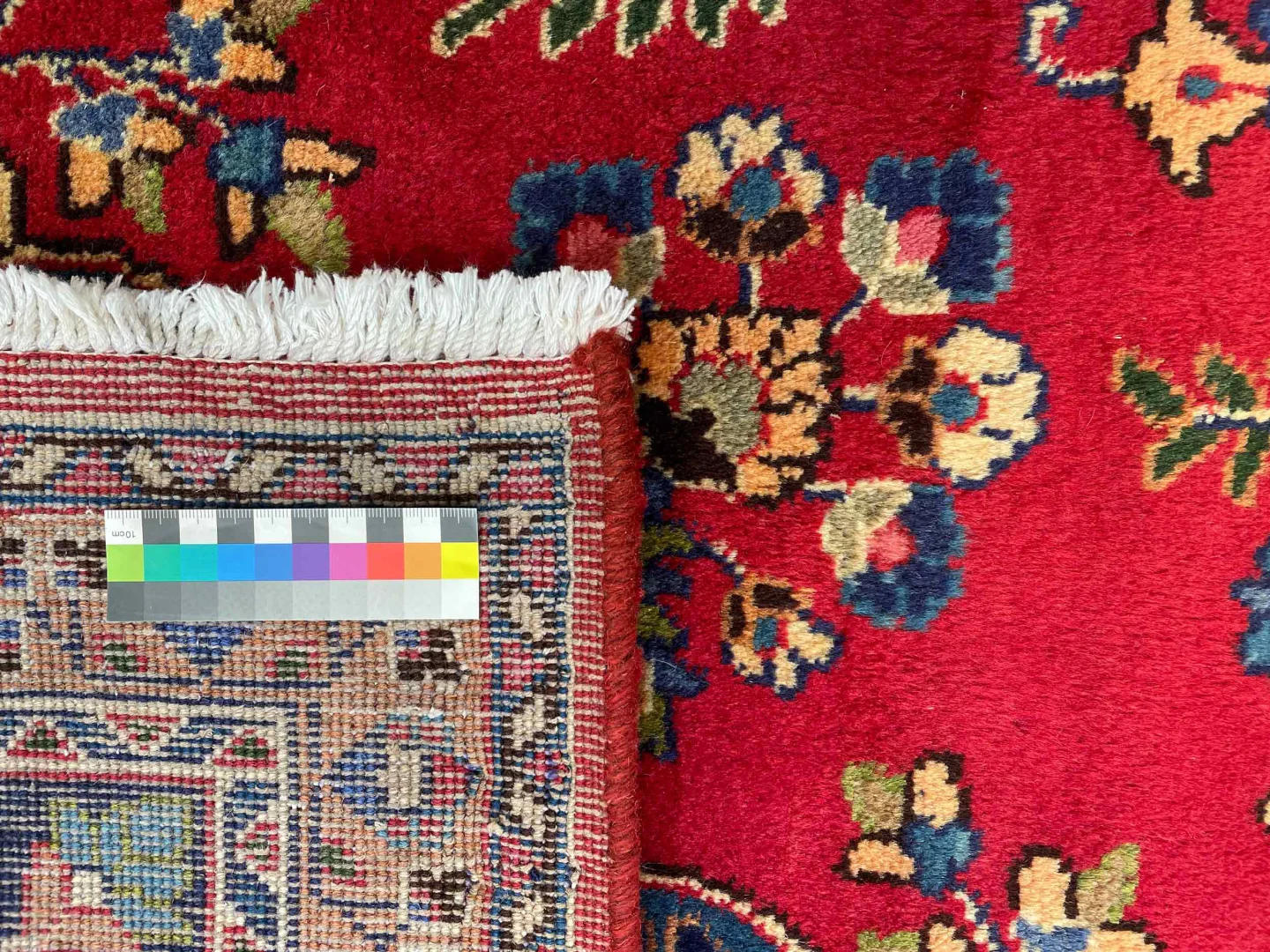
The stated knot density is 180.000 to 250.000 knots per square metre. Such density provides a suitable basis for clear contours, fine transitions and detailed ornament. In a floral composition, it supports the depiction of blossoms, leaves and the lines surrounding a central medallion. Wool forms the pile of this rug. In Persian weaving it is traditionally valued for its resilient character, practical strength and pleasant textile handle.
Wool accepts dyes well and can therefore support a nuanced visual effect. In a hand-knotted rug, the way the pile is worked also influences the feel of the surface and the legibility of the design. This piece combines high-quality wool with hand-knotted construction and a high knot density. No warp material is specified for this rug, so the material description is limited to the wool pile.
Origin and Tradition
This rug comes from Persia and belongs to the Maschhad tradition. Maschhad is situated in eastern Iran and is regarded as one of the important centres of Persian rug production. The city is also a historic and cultural centre of the wider Khorasan region. Its weaving tradition is associated with careful handwork, spacious floral arrangements and a developed approach to colour and composition.
Persian rugs are shaped by regional traditions. Differences can be seen in the choice of ornaments, the organisation of the field and the treatment of the borders. Maschhad designs are often associated with compositions in which a medallion provides the central structure. Around this focal form, floral sprays, leaves and scrolling vines may fill the field. The result is an ordered design in which the individual botanical motifs remain clearly articulated.
Maschhad’s position in eastern Iran encouraged contact between different parts of the Persian cultural world. Weavers, workshops and traders carried forms and techniques across regional boundaries. Motifs were passed on, adapted and combined with local preferences over time. The name Maschhad therefore refers not only to a city but also to an established weaving tradition with recognisable habits of composition and ornament.
A central part of Persian rug making is the translation of a drawn design into a field of individual knots. The weaver works row by row, building the image from coloured knots. Once the knots have been inserted, the pile is worked so that the drawing becomes visible. This requires concentration and consistency throughout the process. A dense construction allows delicate lines and small design elements to be represented, while wool gives the pile its substance and tactile character.
Maschhad rugs occupy an important place within Persian domestic culture as patterned textile furnishings. They are produced in many formats, from narrow runners to larger rugs intended for spacious interiors. The present piece belongs to this broad tradition through its rectangular format and classical layout. Related pattern languages can also be found in rugs from Isfahan, Tabriz and Kashan, although each of those weaving centres developed its own preferences and visual vocabulary.
Design and Pattern
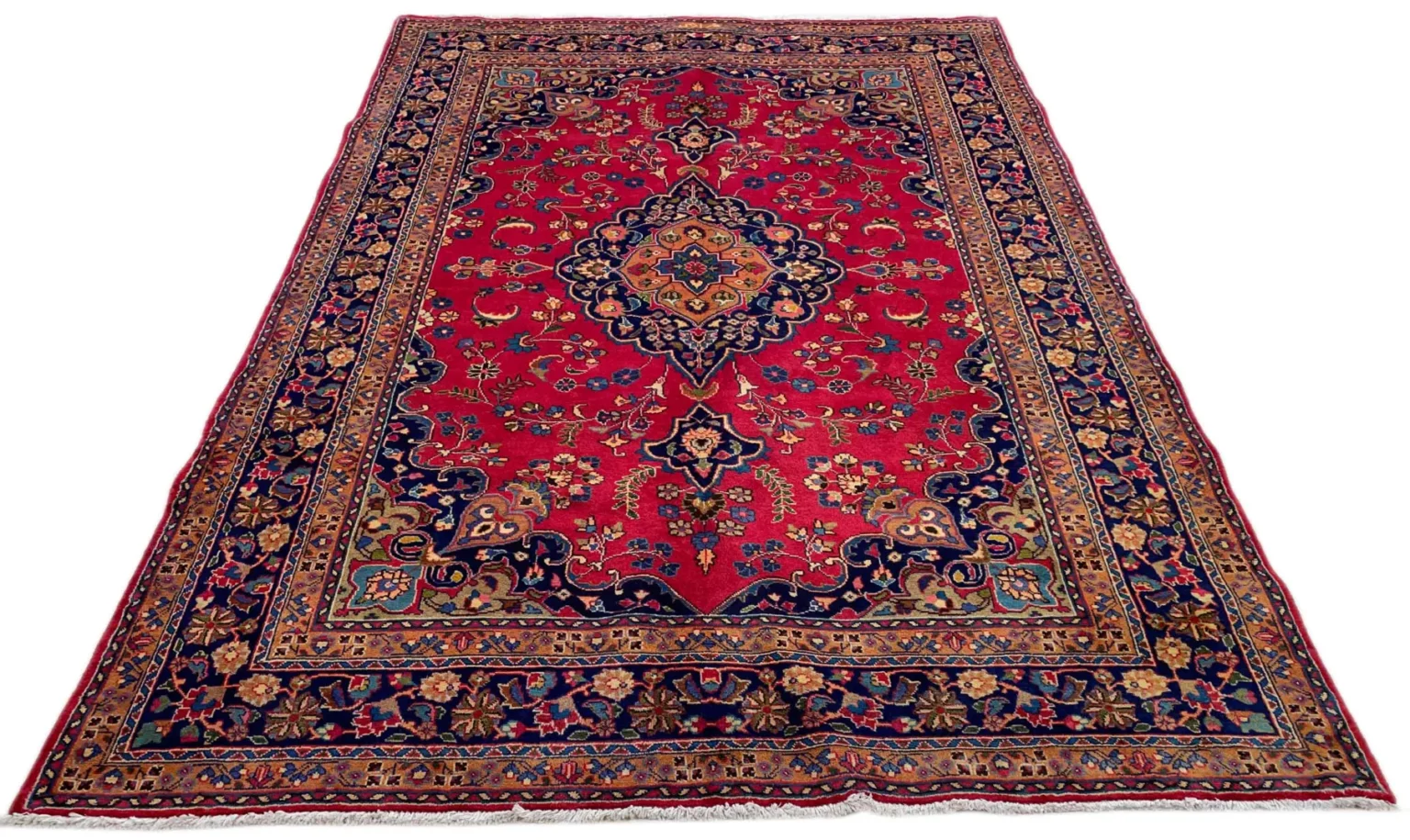
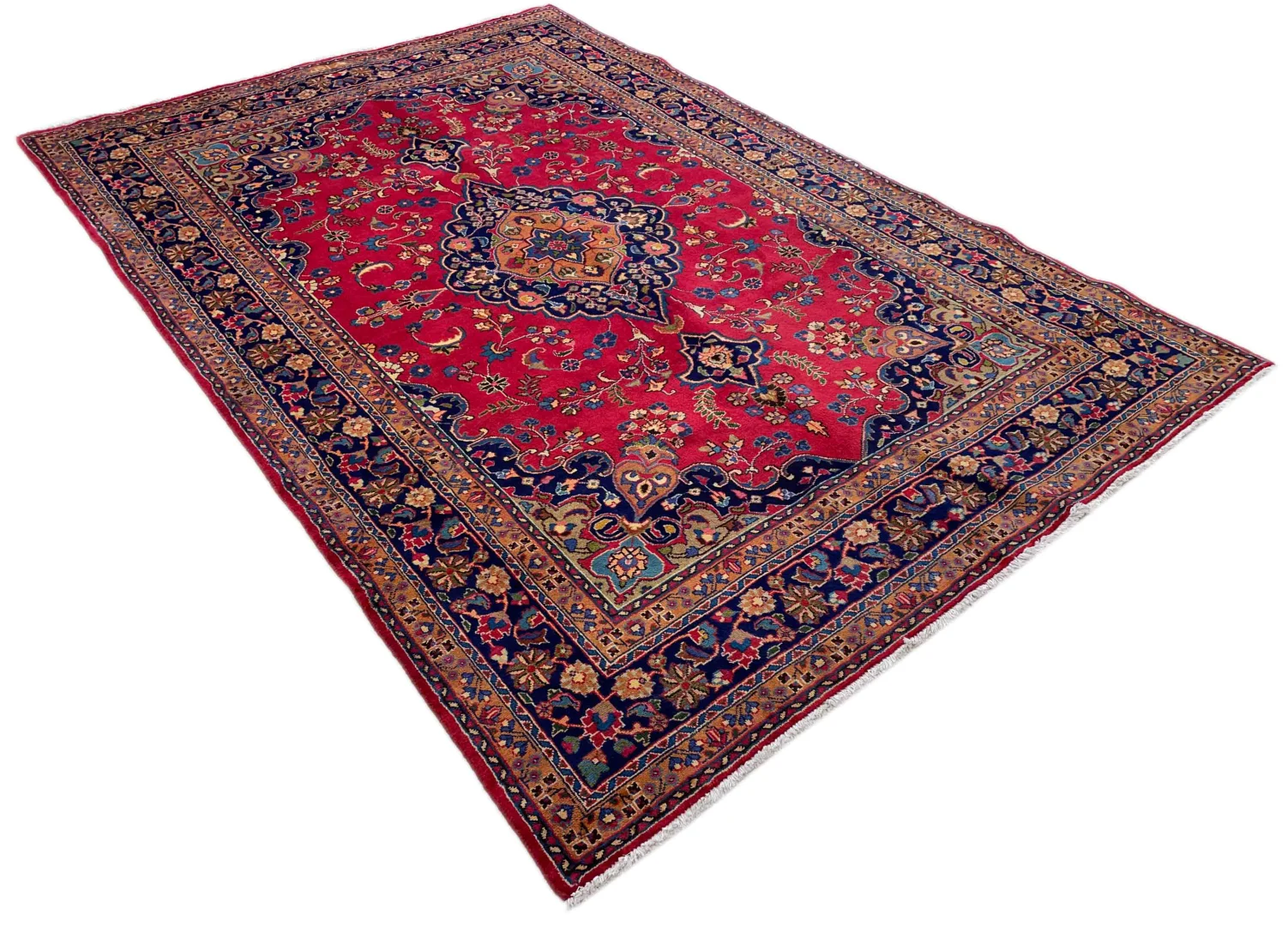
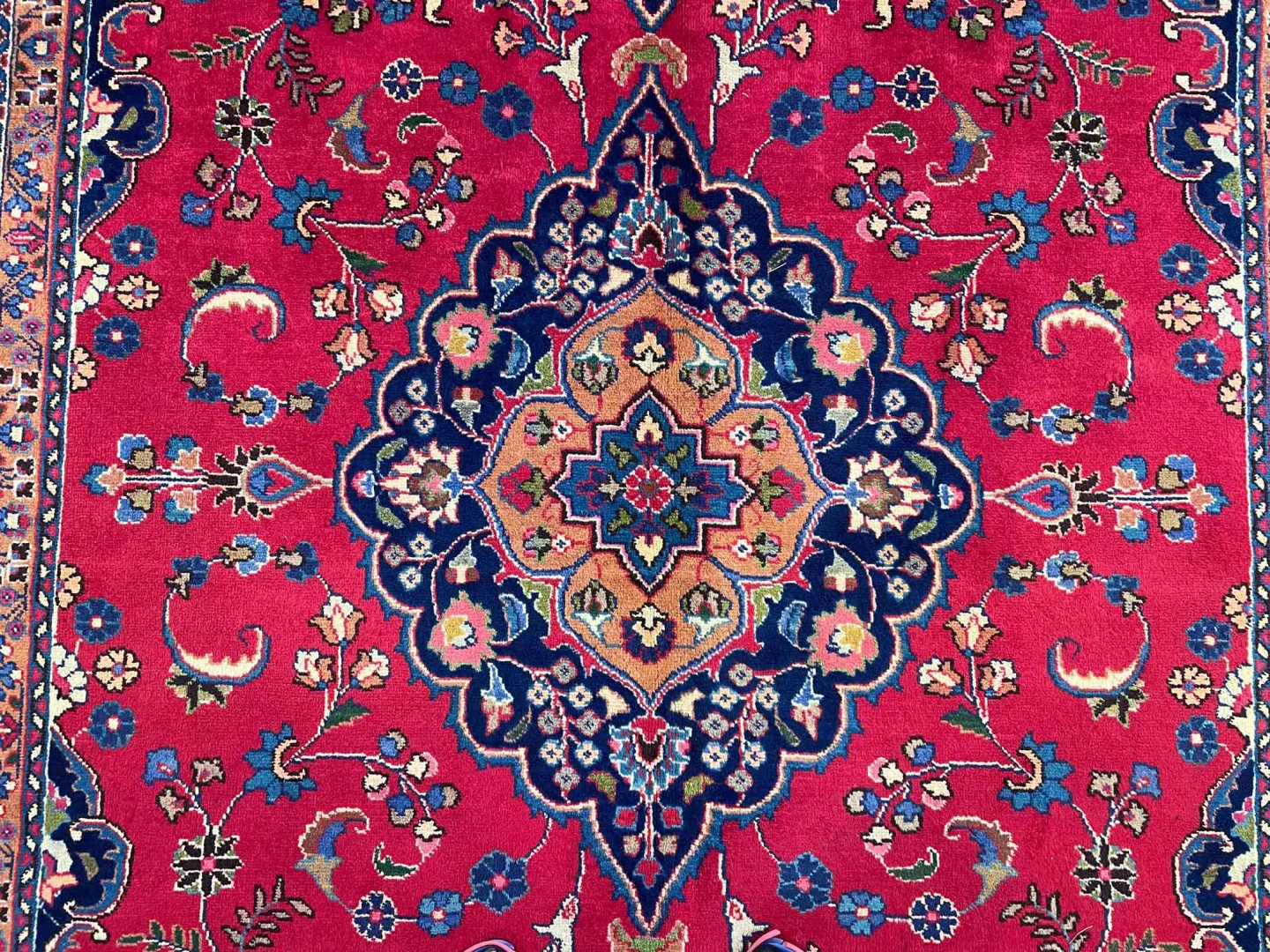
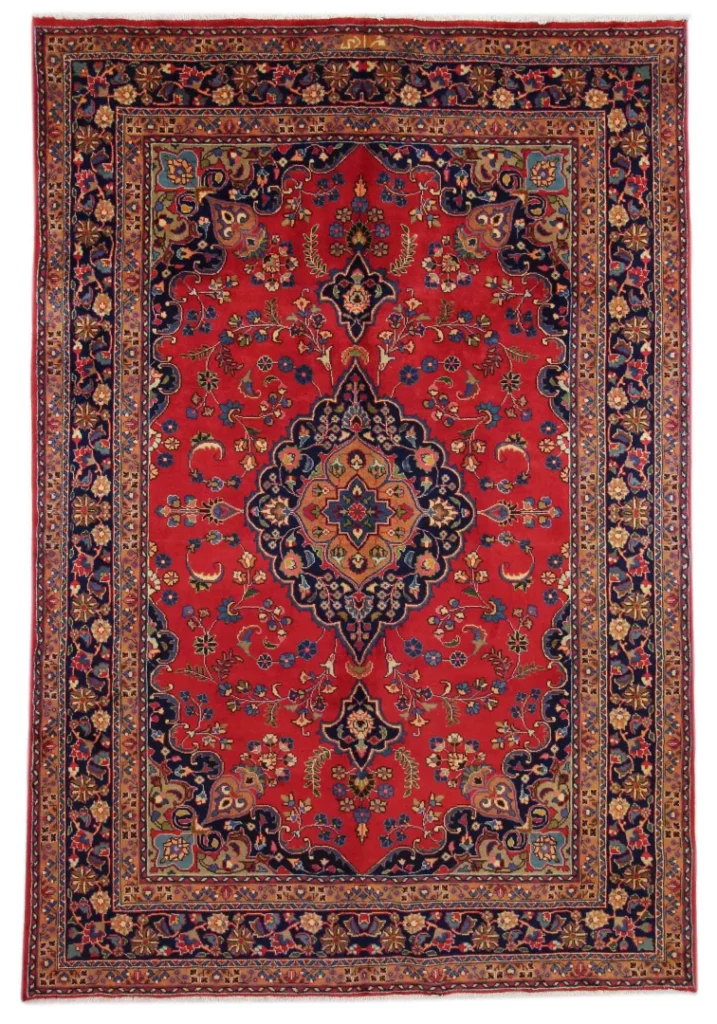
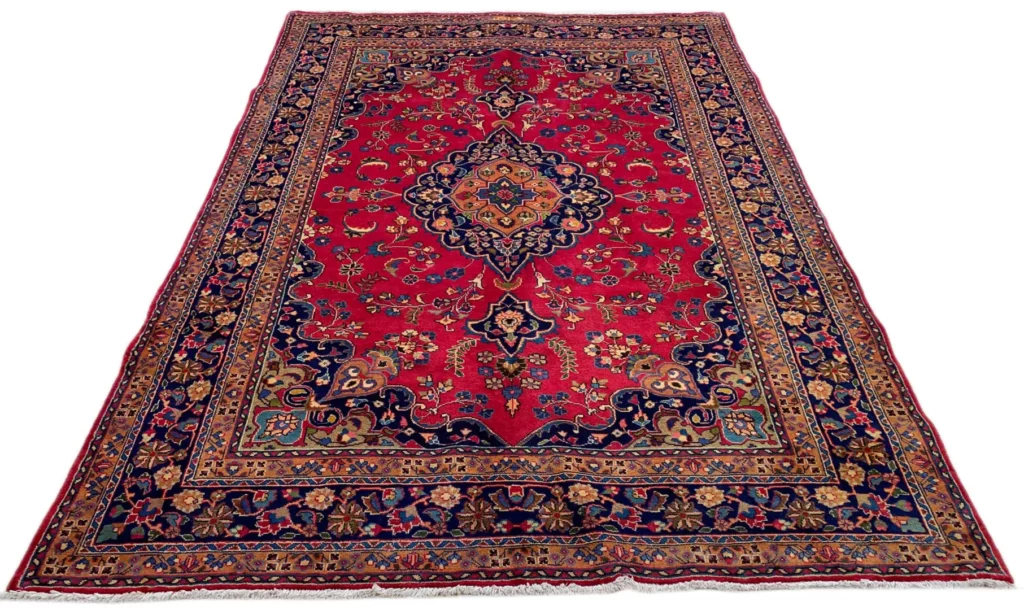
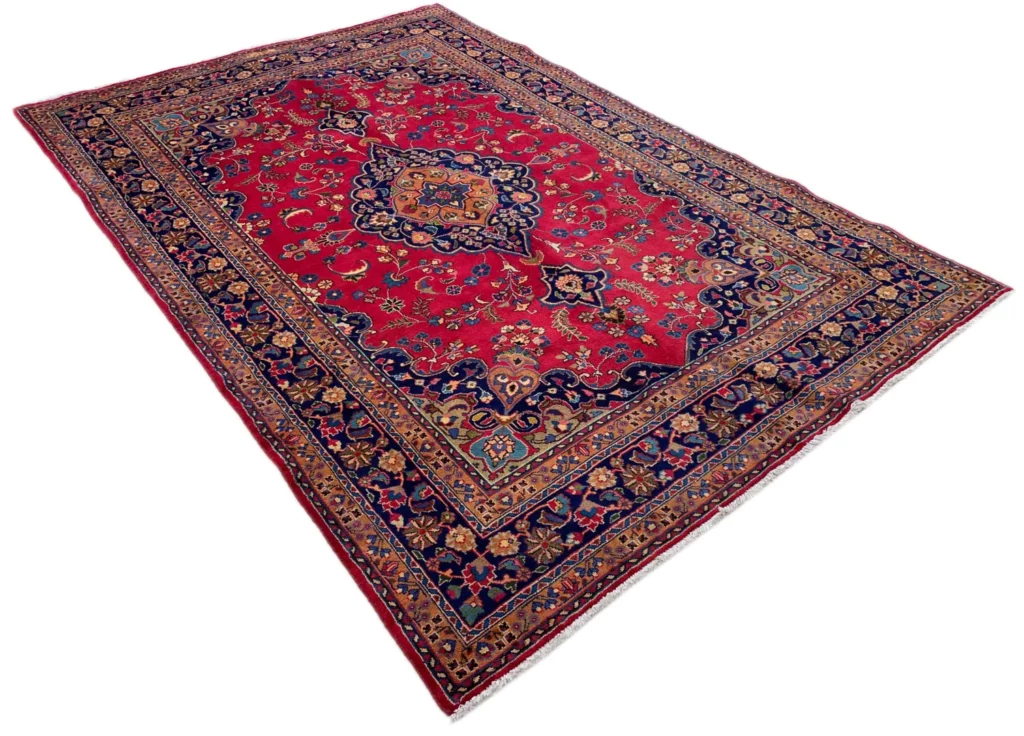
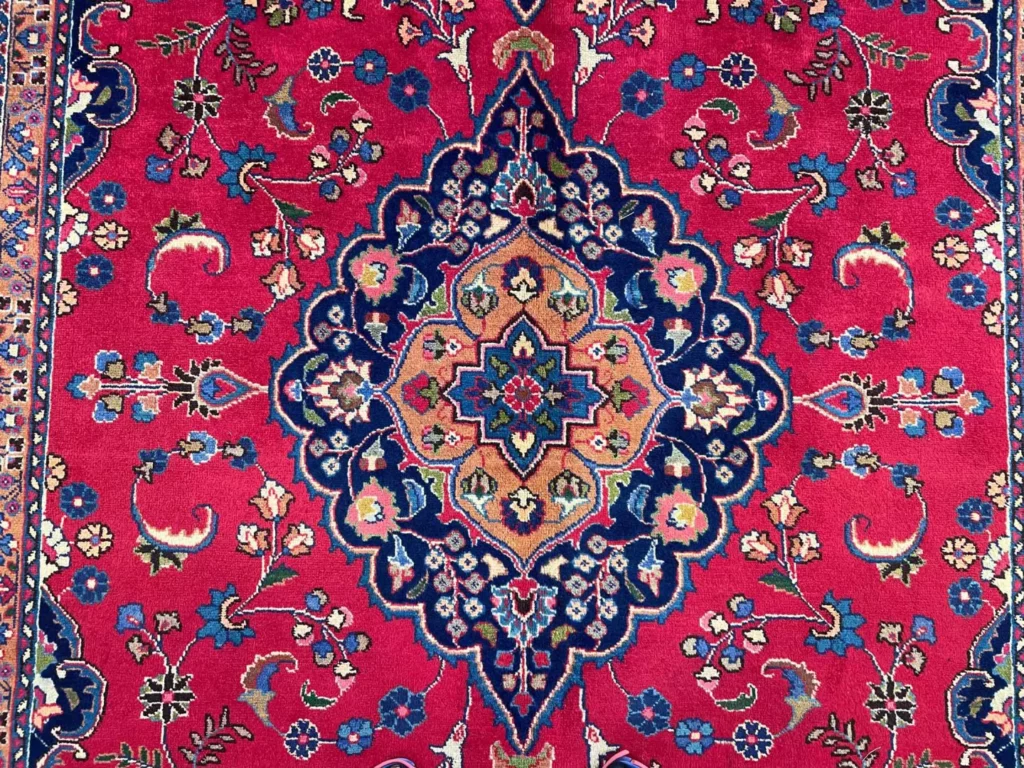
This rug has a floral design with a classic medallion. The medallion forms the centre of the composition and gives the field a clear visual order. Floral elements extend around it, leading the eye from the centre into the surrounding areas. The result is a relationship between a defined central form and repeated botanical ornament.
Floral Persian designs commonly draw on blossoms, leaves and curling vines. These motifs are not necessarily literal botanical illustrations; they are transformed into a decorative system of signs and rhythms. Lines are stylised, flowers are arranged in balanced or repeating formations, and vines connect separate elements across the field. This creates continuity within the pattern while allowing the central medallion to remain recognisable as the main organising feature.
A classic medallion may be circular, oval, polygonal or composed of several linked forms. Its treatment changes according to region, workshop and design tradition. In Maschhad compositions, the central element is often accompanied by floral fillers and flowing scrollwork. Borders perform an additional structural role by enclosing the field and creating a transition between the main design and the outer edge.
The traditional colour language of Maschhad rugs is often associated with deep red as a dominant ground or field colour. Blue, purple and other coordinated shades may be used alongside it. This regional tendency helps explain the warm and balanced character frequently found in Maschhad designs. It describes the general vocabulary of the type and is not an additional colour specification for this individual rug. The pattern details recorded for this piece are its floral design and classic medallion.
Isfahan rugs, by comparison, are known for intricate compositions and the use of silk, while Tabriz is often associated with large medallions and geometrically organised designs. Kashan has also produced many richly floral pattern traditions. Such comparisons show how similar ornamental ideas can develop different structures in different Persian centres. The Maschhad classification remains the relevant origin and style designation here; a shared motif does not change the rug’s stated provenance.
Special Features
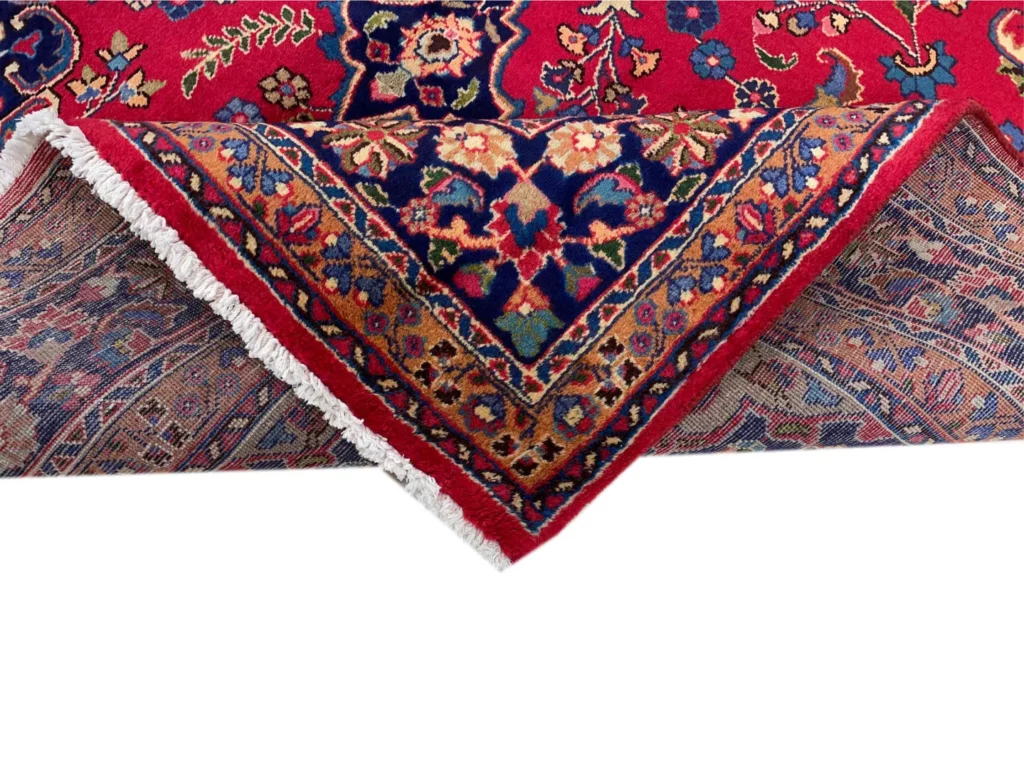
This rug is in very good condition. It combines hand-knotted construction, high-quality wool, a high knot density and a floral composition centred on a classic medallion. These are the specific features recorded for this individual piece. The arrangement gives the medallion a clear role in the design, while the floral elements organise the surrounding field.
Care for a hand-knotted wool rug should be gentle. Regular cleaning can be carried out with a vacuum cleaner without a brush attachment. This removes loose dirt while avoiding unnecessary mechanical stress on the pile. If a spill or mark occurs, it should be addressed promptly by carefully dabbing with a damp cloth. Vigorous rubbing can affect both the fibres and the appearance of the colours.
For heavier soiling, professional rug cleaning is advisable. A specialist process can take the hand-knotted construction, wool pile and colours into account. This allows the surface to be cleaned thoroughly without placing needless strain on the structure. The very good condition is a statement about this particular rug. It is a condition description of the offered piece, not a general claim about every Maschhad rug.
FAQ
How should I care for my Maschhad Persian rug?
Vacuum the rug regularly with a vacuum cleaner that has no brush attachment. If a stain appears, act promptly and gently dab the area with a damp cloth. Avoid vigorous rubbing, since it can put unnecessary pressure on the pile and affect the colours. For a more thorough treatment, professional rug cleaning is recommended, particularly when the cleaner is familiar with hand-knotted wool rugs.
How can I recognise an authentic Maschhad Persian rug?
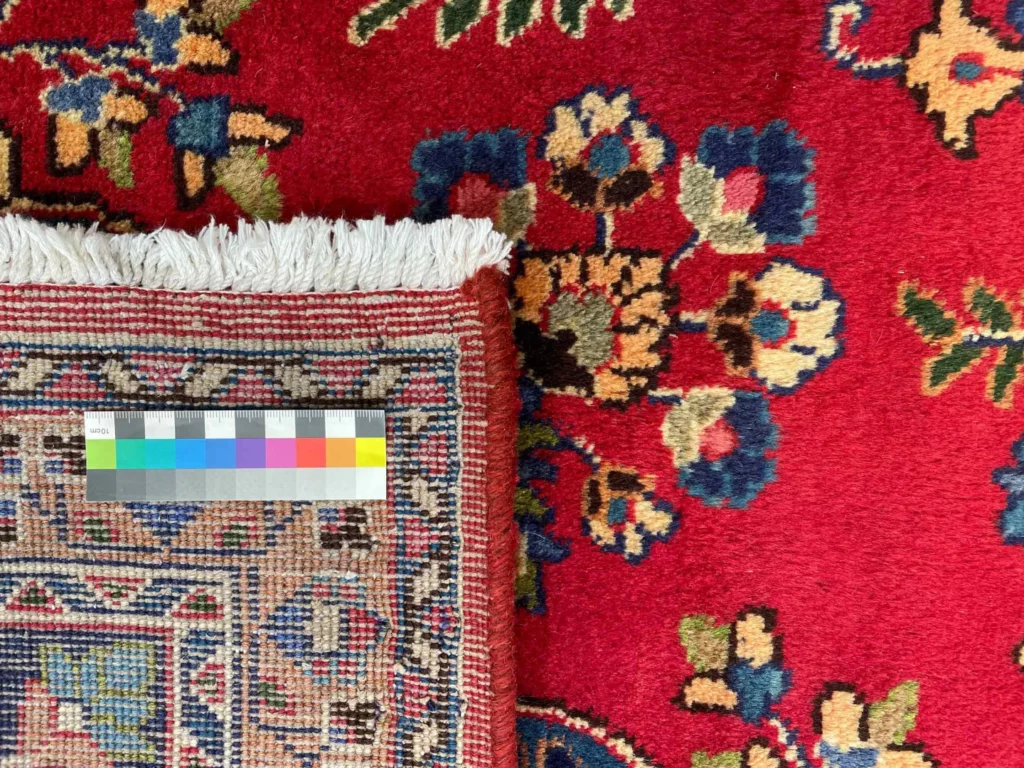
An authentic Maschhad Persian rug is hand-knotted and has a high knot density. The fineness and clarity of the pattern can also provide an indication. The back should show an even, clearly recognisable knot structure. High-quality materials are another characteristic to consider. An authenticity certificate may offer further guidance, although the individual rug is best assessed by a qualified specialist.
What sizes are available for Maschhad Persian rugs?
Maschhad Persian rugs are made in a broad range of formats. The selection includes small runners as well as larger rugs for spacious rooms. The appropriate format depends on the room and the intended placement. The piece offered here has the format stated in the listing; in general, Maschhad rugs can range from narrow elongated designs to generously proportioned rectangular room rugs.
To provide the best experiences, we use technologies like cookies to store and/or access device information. Consenting to these technologies will allow us to process data such as browsing behavior or unique IDs on this site. Not consenting or withdrawing consent, may adversely affect certain features and functions.
Functional Always active
The technical storage or access is strictly necessary for the legitimate purpose of enabling the use of a specific service explicitly requested by the subscriber or user, or for the sole purpose of carrying out the transmission of a communication over an electronic communications network.
Preferences
The technical storage or access is necessary for the legitimate purpose of storing preferences that are not requested by the subscriber or user.
Statistics
The technical storage or access that is used exclusively for statistical purposes.The technical storage or access that is used exclusively for anonymous statistical purposes. Without a subpoena, voluntary compliance on the part of your Internet Service Provider, or additional records from a third party, information stored or retrieved for this purpose alone cannot usually be used to identify you.
Marketing
The technical storage or access is required to create user profiles to send advertising, or to track the user on a website or across several websites for similar marketing purposes.

 SECURE PAYMENT
 SHIPPING PARTNERS