Maschhad rugs are associated with careful hand-knotting and a finely worked surface. The source describes Maschhad carpets as being made from wool and silk, materials that combine a soft feel with durability. Wool is traditionally valued in pile construction because it has resilience and can support a clear, stable pattern. Silk is known for its smooth handle and its ability to reflect light, bringing subtle variation to a woven surface. The use of these materials belongs to the established material tradition of Maschhad carpets; the individual pile composition of this rug is not specified separately.
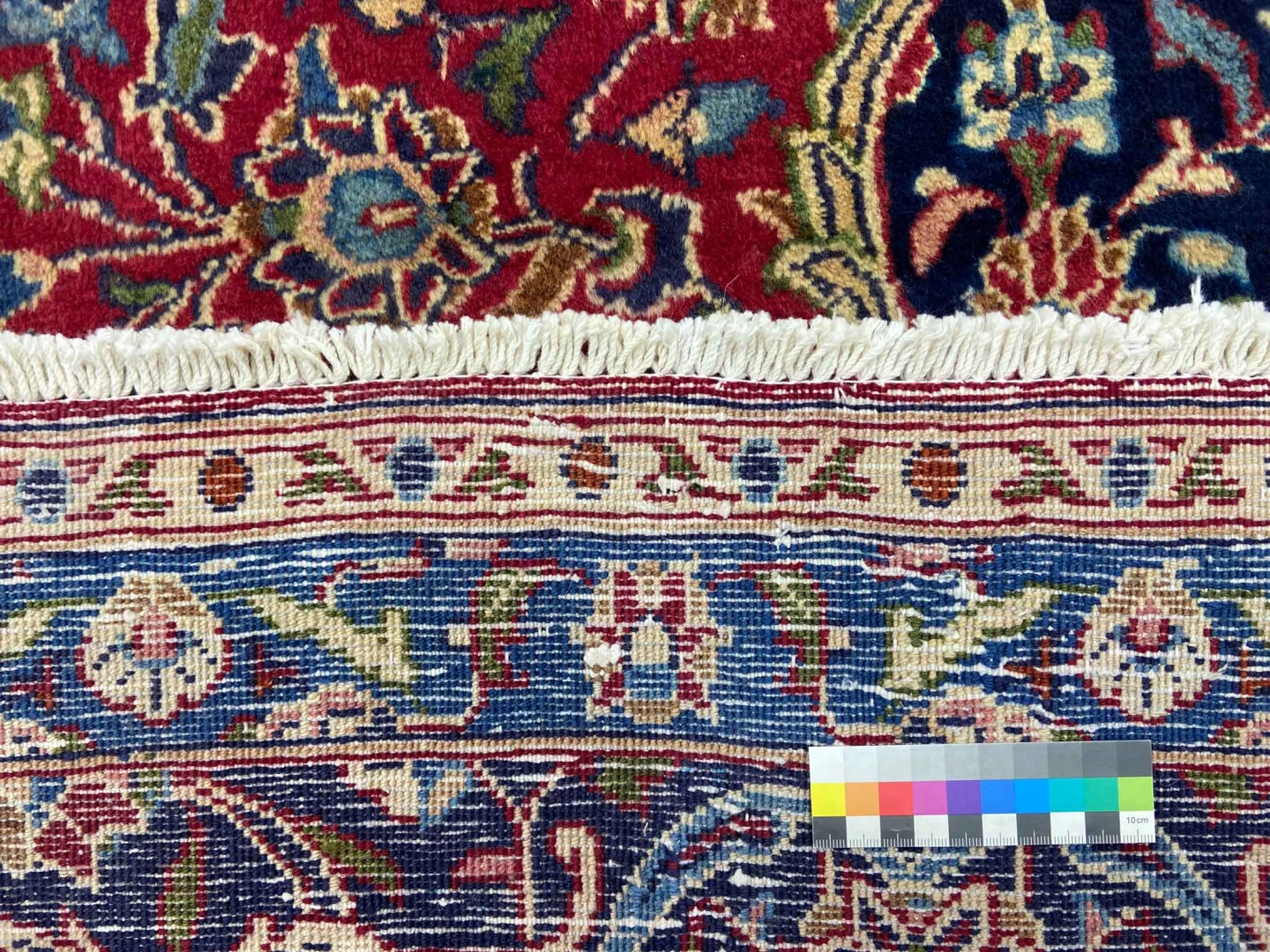
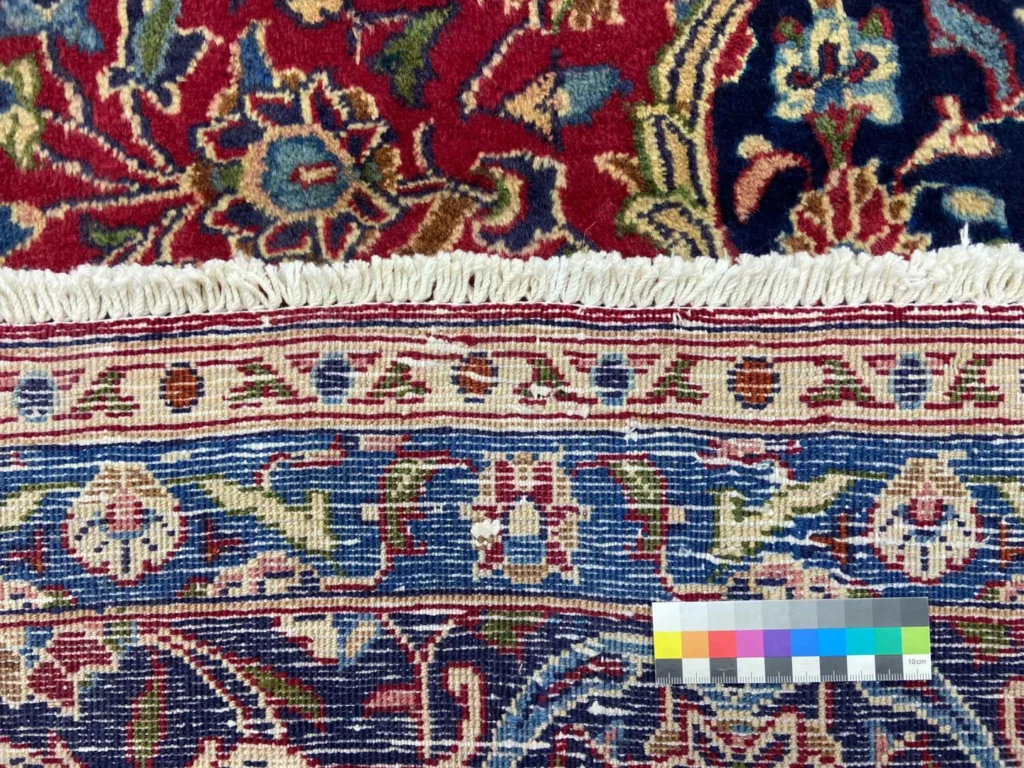
The source places the usual knot density of Maschhad carpets between 180,000 and 250,000 knots per square metre. In carpet construction, a higher knot count permits the weaver to render small details, curved outlines and transitions between colours with greater precision. It also contributes to a closely structured textile. Hand-knotting is a process in which individual knots are tied around the warp and secured through successive rows of weaving. The pile is then trimmed and the surface is finished so that the pattern can be read clearly.
Natural dyes are also described as part of the Maschhad tradition. Such dyes are valued for producing lively colour and for developing character over time. The source identifies wool, silk, hand-knotting and natural dyes as features of Maschhad carpet production, while it does not provide a separate technical inventory for this one piece.
Origin and Tradition
Maschhad is a city in Iran and gives its name to a recognised Persian carpet tradition. It is one of the important cities of the country and is known for its craft heritage. The city has long been connected with the production of carpets whose designs combine ordered composition with detailed floral drawing. A Maschhad carpet therefore belongs to the broader Iranian history of textile craftsmanship, in which practical floor coverings also developed into carefully designed works of woven art.
Iranian carpet making has a long history. Knowledge of selecting fibres, preparing yarn, tying knots, arranging colour and completing the woven surface has traditionally been passed from one generation to the next. The source connects Maschhad knotting with this extended Iranian tradition and associates the technique with close detail and a high level of knot density. These qualities do not result from a single operation: they depend on the relationship between the drawing, the prepared materials, the tension of the warp and the consistent placement of thousands of knots.
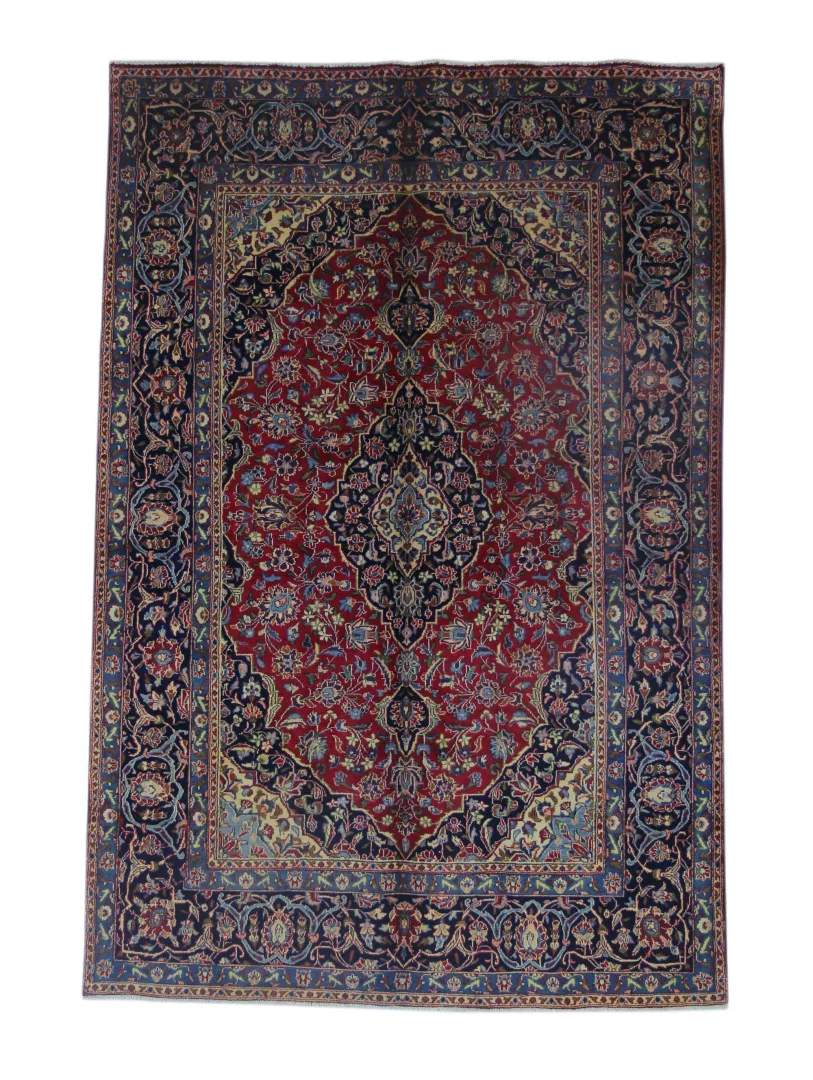
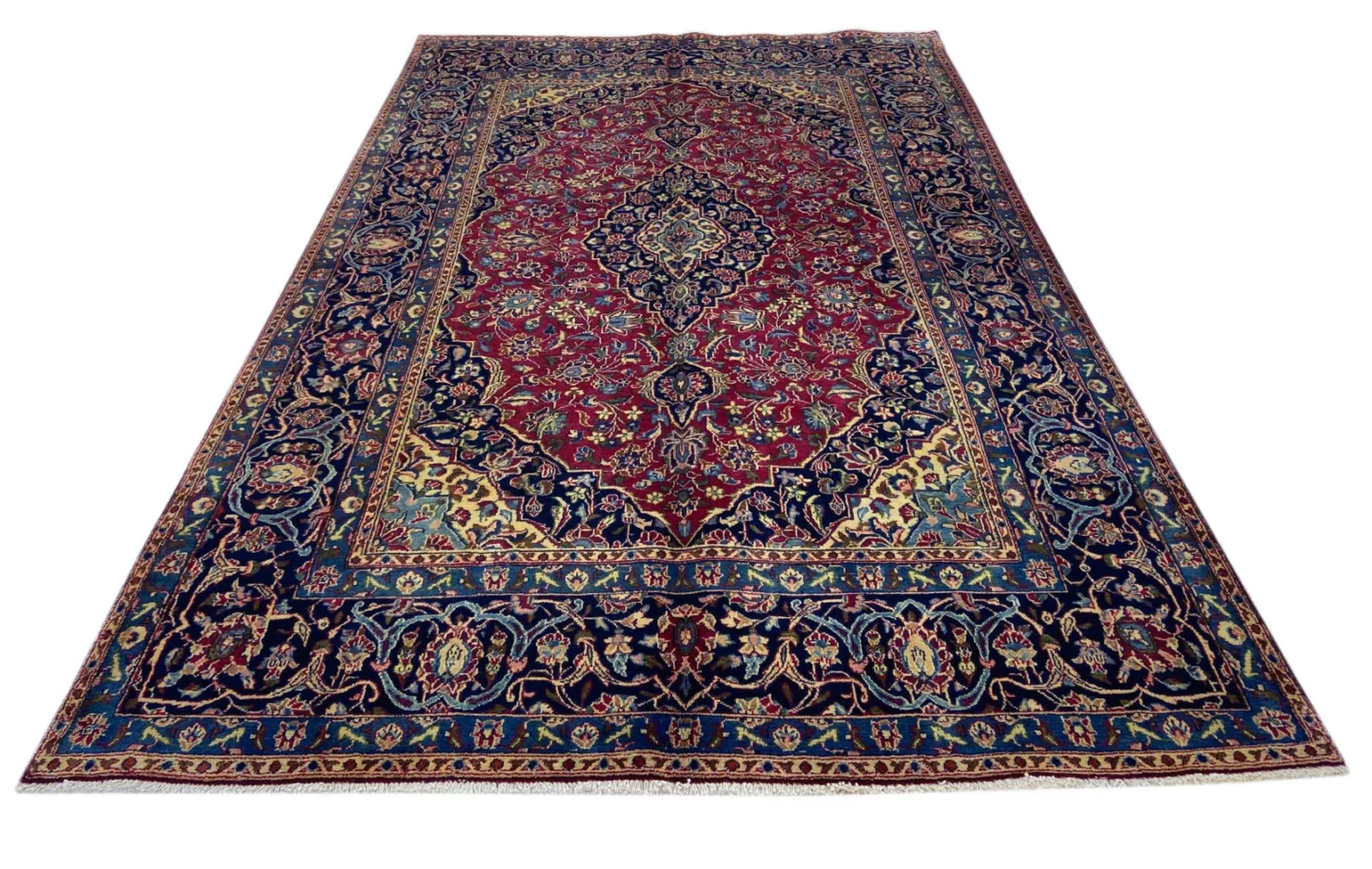
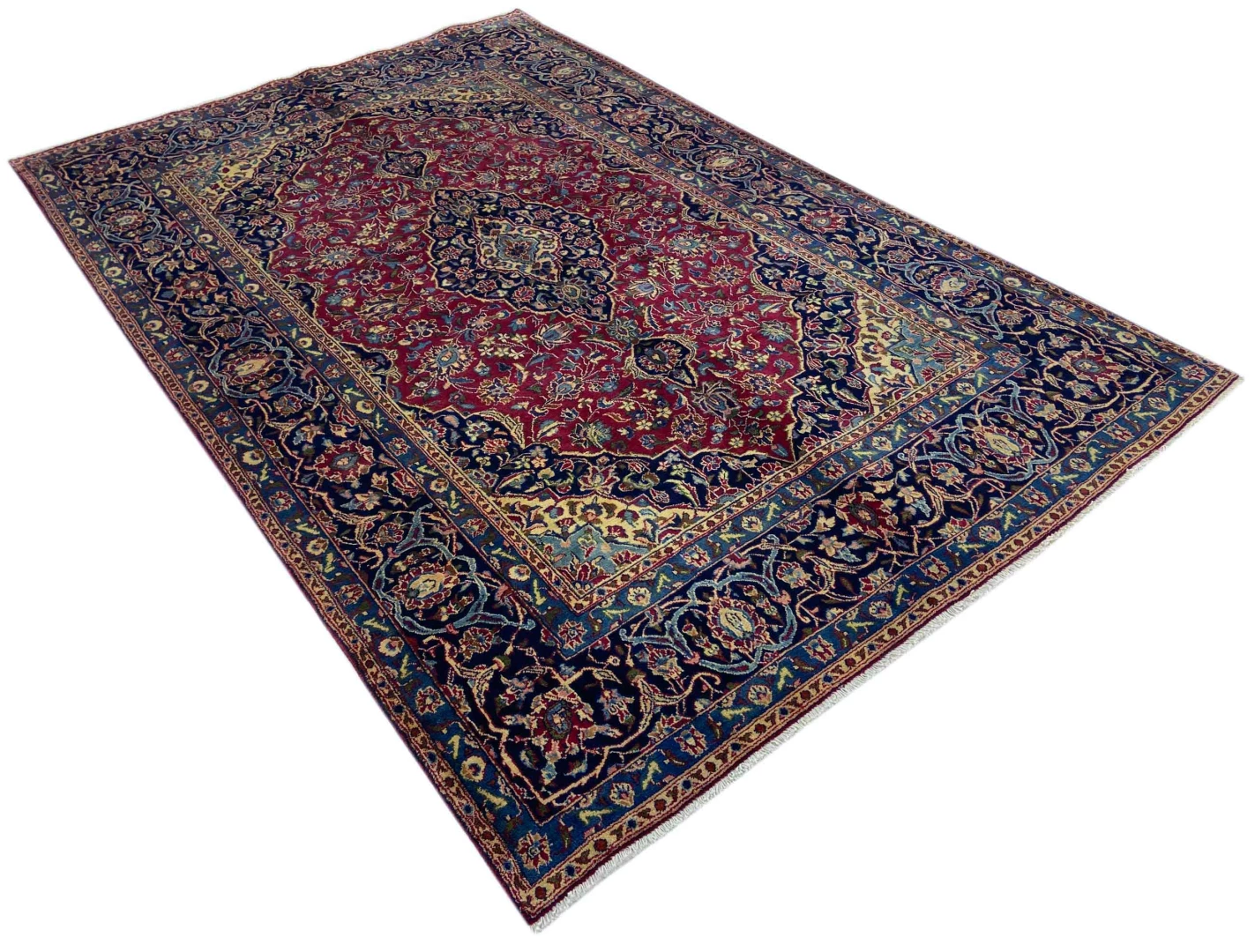
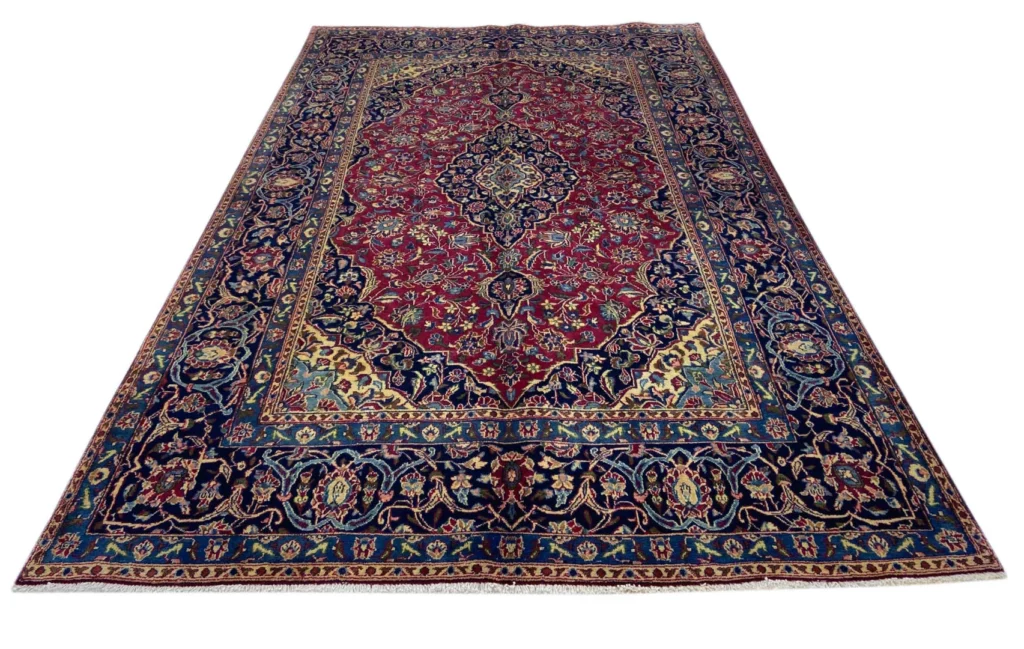
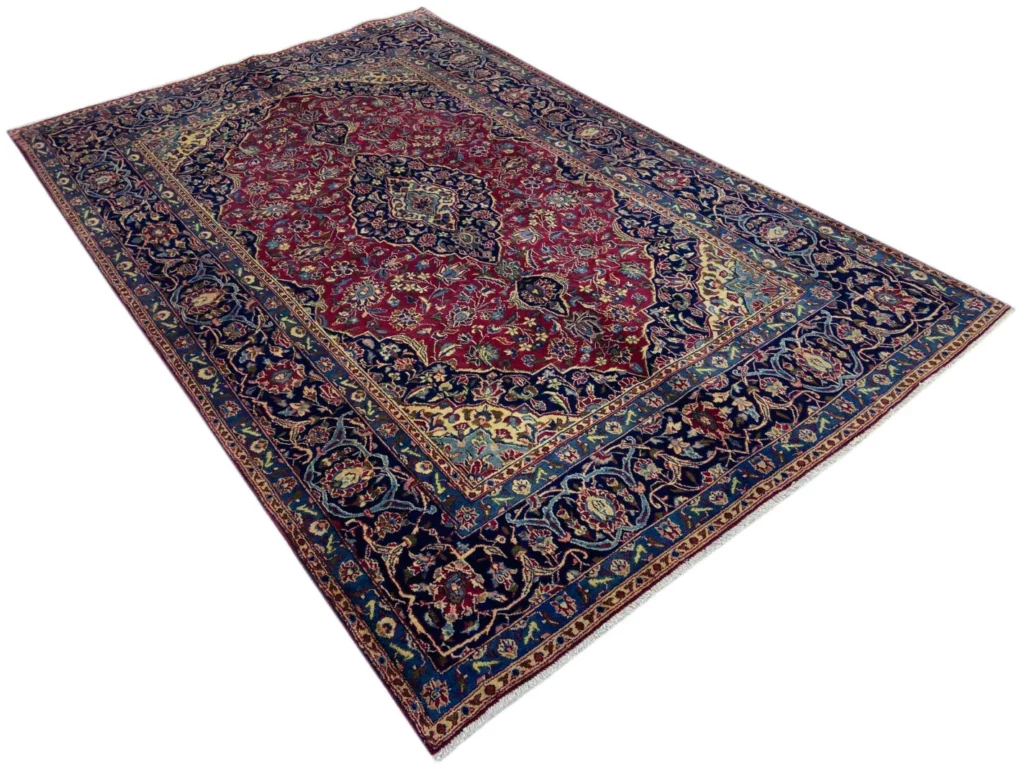
Maschhad carpets are often recognised through a palette in which strong reds play an important role, accompanied by blue and lilac nuances. Colour relationships can vary from one design to another, but the tradition is known for using these tones to create a balanced overall impression. The source also describes floral compositions and classical medallions as recurring elements. A central medallion can organise the field around a clear focal point, while surrounding flowers and vines provide continuity across the remaining surface.
The Persian carpet traditions of Isfahan and Tabriz are related but not identical. Isfahan carpets are associated with complex, symmetrical designs and high-quality materials. Tabriz carpets are often linked with distinctive geometric patterns and vivid colours. Nain and Kashan are also named among Iranian carpet traditions known for refined workmanship and the use of quality materials. These regional names describe different centres and design languages, while Maschhad remains the origin associated with this carpet tradition.
The history of Iranian carpets has made them known among collectors and carpet enthusiasts internationally. Their significance lies in the combination of manual skill, inherited methods and a planned visual language. Each hand-knotted carpet is formed through a sequence of individual decisions, even when it follows a familiar regional design. This connection between local tradition and individual execution is central to the place of Maschhad carpets within Persian weaving.
Design and Pattern
The pattern named in the source is floral. Floral carpet designs are built from flowers, leaves, stems and scrolling branches, arranged so that the field appears connected rather than fragmented. In Persian weaving, these elements may be repeated, mirrored or placed around a central structure. Their function is both decorative and organisational: small botanical forms can fill open areas, while larger blossoms and branching lines guide the eye through the composition.
Classical medallions are another pattern element associated with Maschhad carpets. A medallion is a defined central form that gives the design a visual centre. It may be surrounded by additional floral details, corner elements or a border system. The source states that classical medallions are often found at the centre of Maschhad carpets, but it does not give a separate description of the exact arrangement on this rug. The confirmed pattern description for this piece is floral.
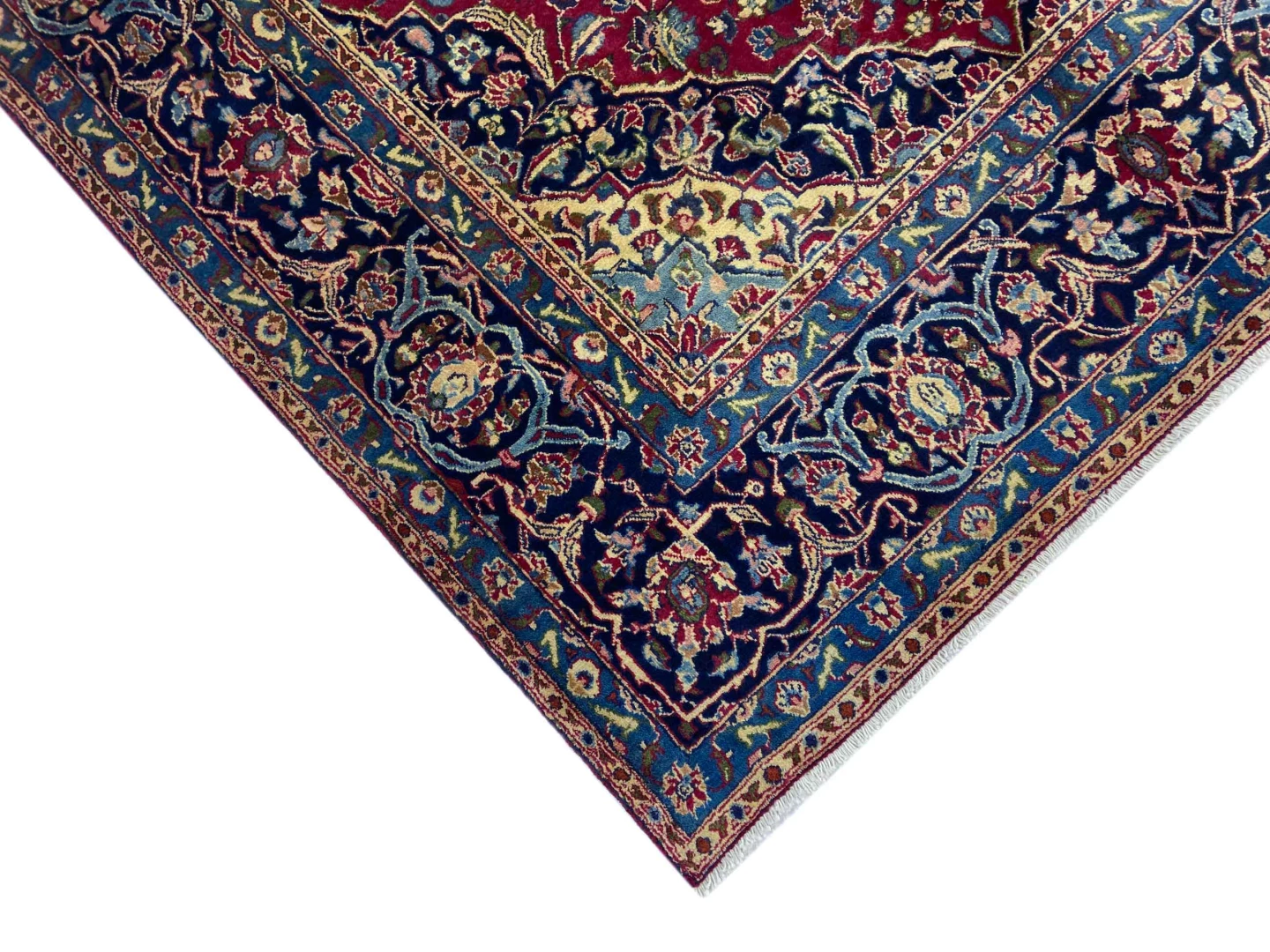
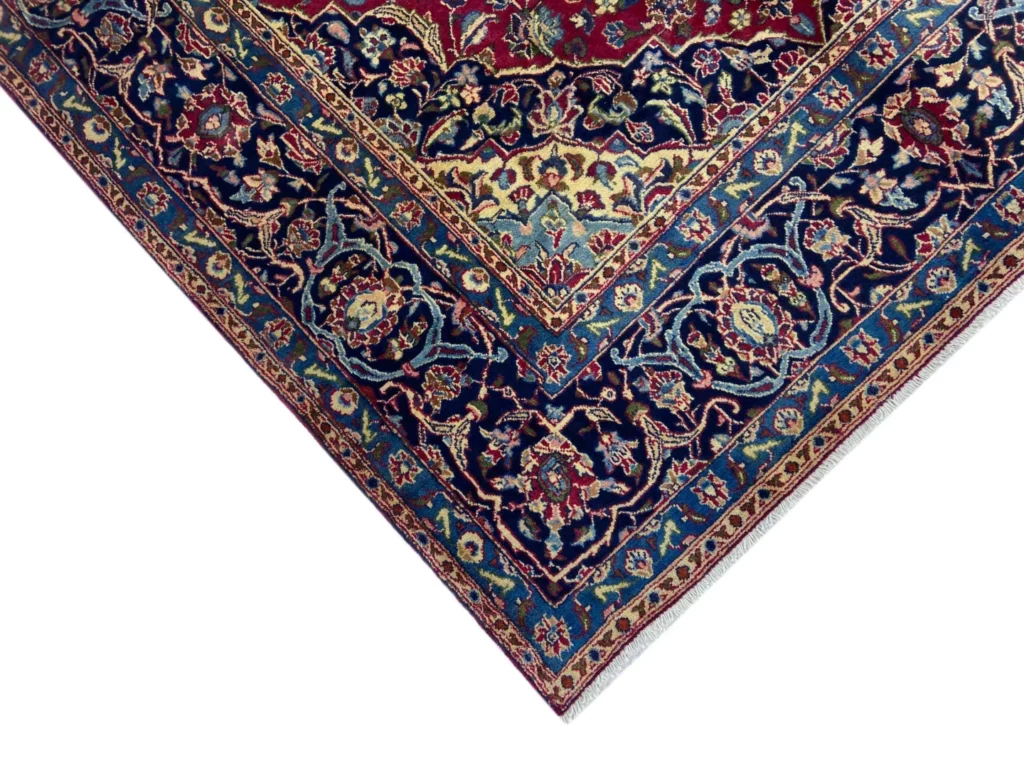
The colour tradition described for Maschhad includes powerful reds together with blue and lilac nuances. Red can provide a strong ground or accent, while blue introduces contrast and lilac adds a cooler transition between related tones. When colours are combined through small knots, the viewer sees both individual shades and the blended effect created by their proximity. Natural dyes are valued in this context because they can produce lively colours and develop a changing textile character over time.
Floral Persian designs are not simply illustrations of individual plants. They are part of a visual vocabulary developed for woven surfaces, where rhythm, balance and repetition are important. A flower may be stylised so that it remains legible within a small area, and a vine may be extended to connect separate motifs. Symmetry is common in many classical compositions, although the source does not specify the degree of symmetry in this particular rug. The broader Maschhad tradition uses floral patterning and medallion-based organisation to create a coherent field.
Borders play an important role in many Persian carpet designs by framing the central field and separating it from the outer edge. Repeated motifs in a border can echo the flowers or colours of the interior, creating a transition between the main composition and its surroundings. The exact border design of this rug is not stated. It is therefore the floral character, together with the Maschhad design tradition described in the source, that defines the confirmed pattern information here.
Comparisons with Isfahan and Tabriz show how regional pattern languages can differ within Iran. Isfahan is associated with complex symmetrical compositions, while Tabriz is often connected with geometric forms and vivid colour use. Nain and Kashan represent further Iranian traditions with their own approaches to refinement and material selection. These comparisons provide context for Maschhad without changing the origin or pattern designation of this rug.
Special Features
The source identifies this rug as hand-knotted and describes its pattern as floral. These are the specific construction and design details provided for the piece. Maschhad carpets are also associated with wool and silk, natural dyes, floral compositions and classical medallions, but the source does not separately confirm every one of these characteristics for this individual rug.
For care, regular vacuuming is recommended to help maintain the surface. Direct sunlight should be avoided, since prolonged exposure can affect textile colours. If a stain occurs, it should be treated promptly with a damp cloth. Aggressive cleaning products should not be used. More intensive cleaning should be handled with appropriate care for hand-knotted textiles.
FAQ
How should a Maschhad Persian rug be cared for?
Regular vacuuming helps remove everyday dust from the surface. The rug should be protected from direct sunlight, which can influence the appearance of colours over time. Stains should be addressed immediately with a damp cloth rather than left to penetrate the pile. Aggressive cleaning agents should be avoided because they may affect fibres or dyes. Careful, prompt treatment is the basic method given for preserving the appearance and serviceability of a Maschhad Persian rug.
Where does the knotting technique of Maschhad rugs come from?
The knotting technique belongs to the long tradition of Iranian carpet making. It is described as knowledge passed from one generation to the next. This continuity includes the preparation of materials, the tying of individual knots and the controlled arrangement of rows that form the pattern. The technique is associated with the high knot density and detailed designs found in Maschhad carpets. It is therefore part of a broader Persian craft history rather than an isolated modern method.
Are Maschhad Persian rugs suitable for underfloor heating?
Maschhad Persian rugs are described as suitable for underfloor heating because of their quality materials and open structure. They can contribute to a comfortable floor surface while allowing warmth to pass through. The source presents this suitability as a general characteristic of Maschhad carpets. For any installation, the heating system should be operated in accordance with its own specifications, while the rug should continue to receive the careful maintenance recommended for hand-knotted textiles.
To provide the best experiences, we use technologies like cookies to store and/or access device information. Consenting to these technologies will allow us to process data such as browsing behavior or unique IDs on this site. Not consenting or withdrawing consent, may adversely affect certain features and functions.
Functional Always active
The technical storage or access is strictly necessary for the legitimate purpose of enabling the use of a specific service explicitly requested by the subscriber or user, or for the sole purpose of carrying out the transmission of a communication over an electronic communications network.
Preferences
The technical storage or access is necessary for the legitimate purpose of storing preferences that are not requested by the subscriber or user.
Statistics
The technical storage or access that is used exclusively for statistical purposes.The technical storage or access that is used exclusively for anonymous statistical purposes. Without a subpoena, voluntary compliance on the part of your Internet Service Provider, or additional records from a third party, information stored or retrieved for this purpose alone cannot usually be used to identify you.
Marketing
The technical storage or access is required to create user profiles to send advertising, or to track the user on a website or across several websites for similar marketing purposes.

 SECURE PAYMENT
 SHIPPING PARTNERS


