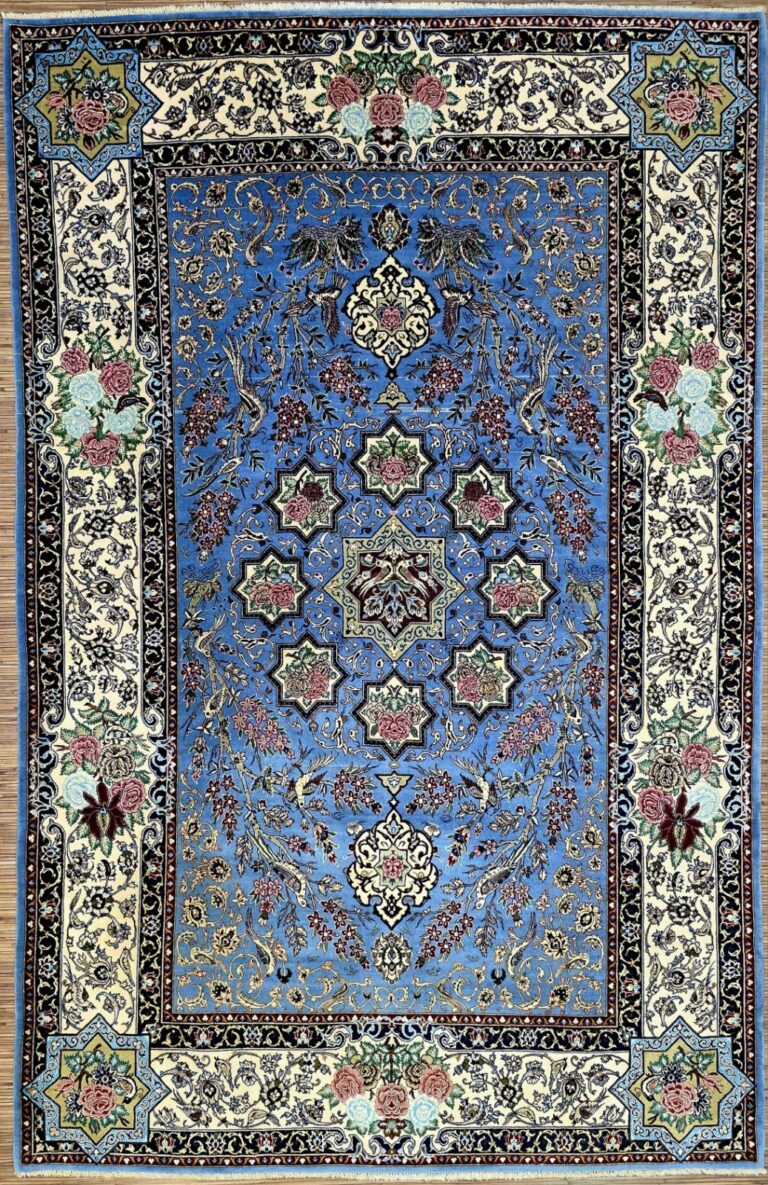
This Keshan Persian rug is hand-knotted. Its pile is made from high-quality sheep wool, while cotton is specified for the textile foundation. The combination of wool and cotton belongs to the established material vocabulary of Persian rugs. Sheep wool is used for its pleasant handle and resilience. Cotton provides a firm foundation and helps the knotted structure retain its shape.
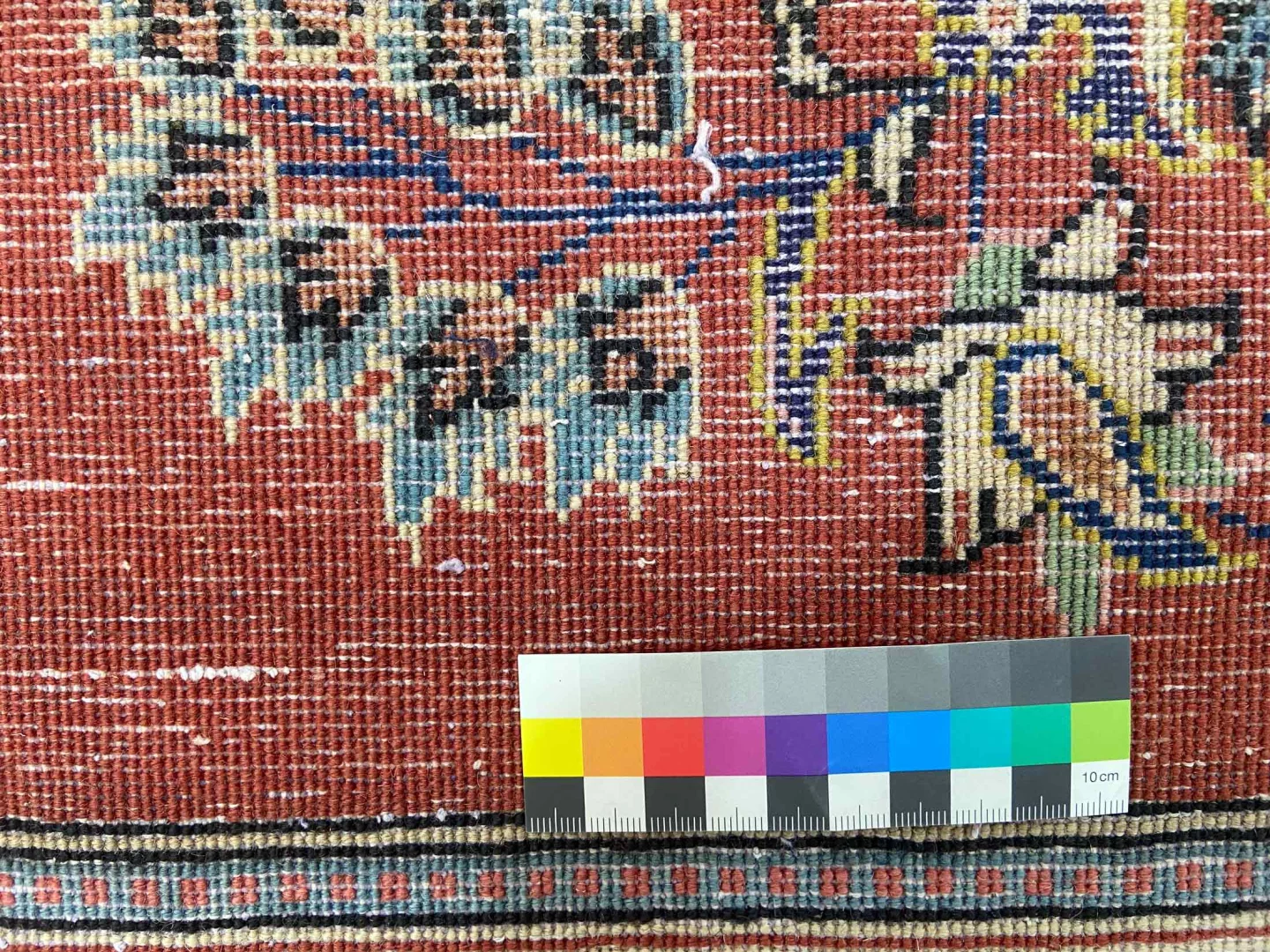
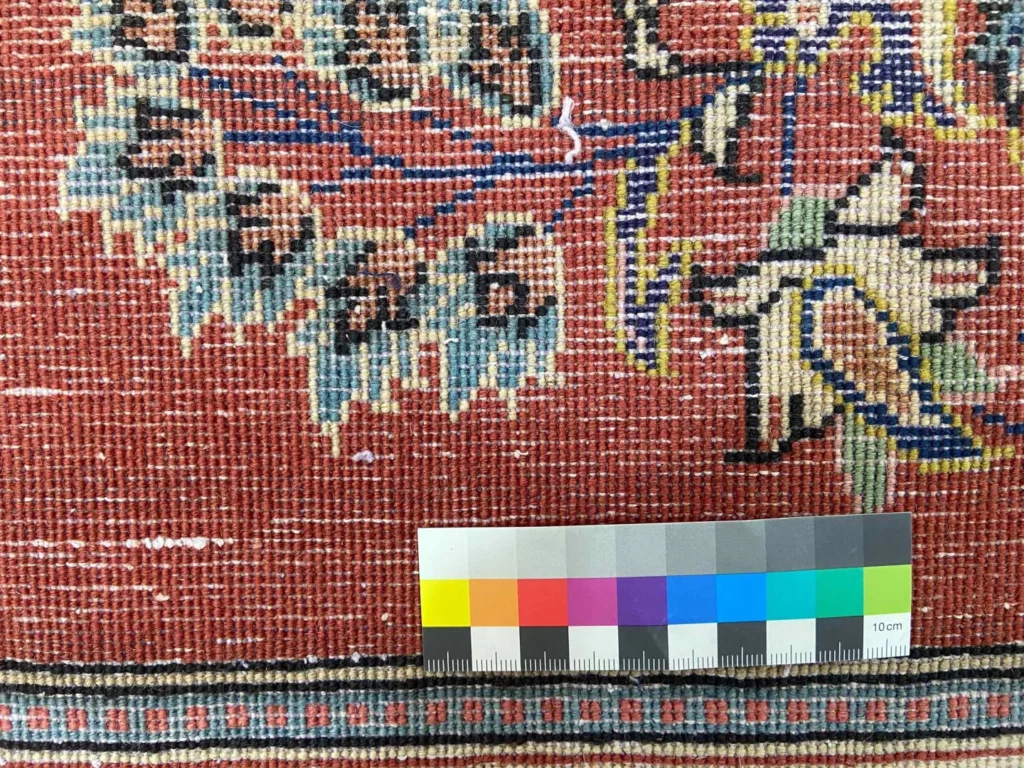
The knot density of this rug is 150,000 to 300,000 knots per square metre. This figure describes the number of individual knots within a defined area and represents a comparatively compact construction for a Keshan rug. The pile is short. As a result, the drawing remains easy to read and the surface retains a restrained, practical height.
Hand-knotting creates each part of the rug through a sequence of individual operations. Knots are inserted row by row into the foundation and secured with weft threads. The design therefore develops gradually from the construction itself. The stated sheep wool, cotton and dense knotting combine in a conventional Persian rug technique.
Origin and Tradition
Keshan rugs belong to the Persian rug tradition and are associated with the city of Keshan in Iran. Keshan is located in a region where the making of hand-knotted rugs has been maintained over a long period. The name therefore refers not merely to a decorative appearance, but to an established craft tradition. Persian rugs are produced through many manual stages, bringing together experience, knowledge of pattern layouts and careful work at the loom.
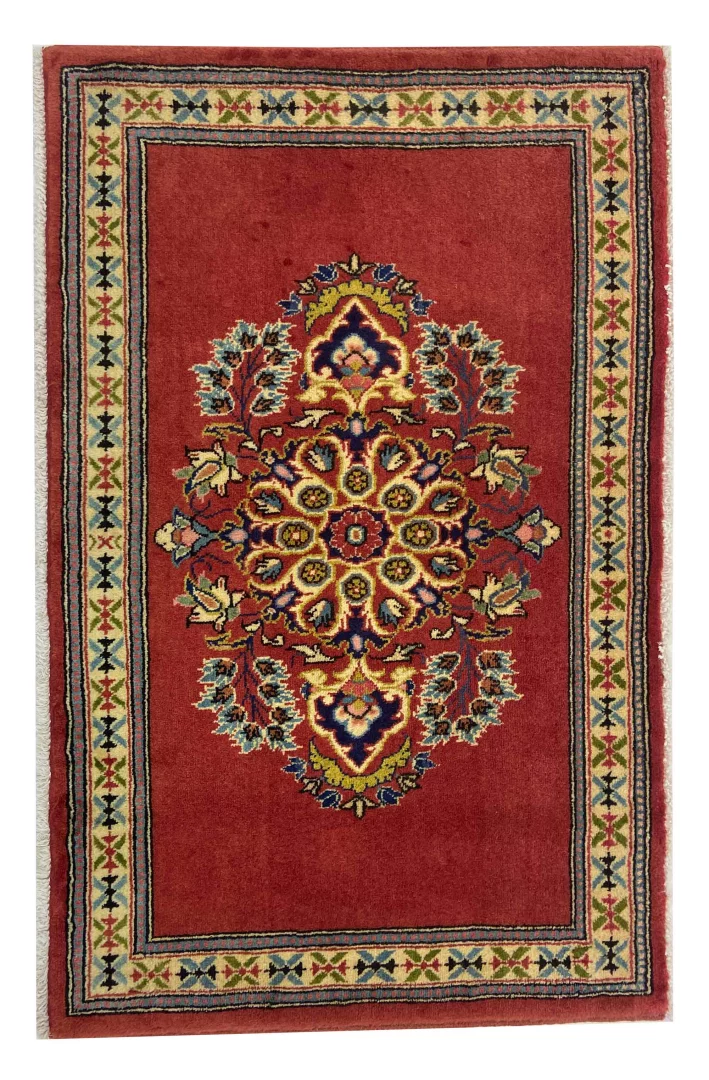
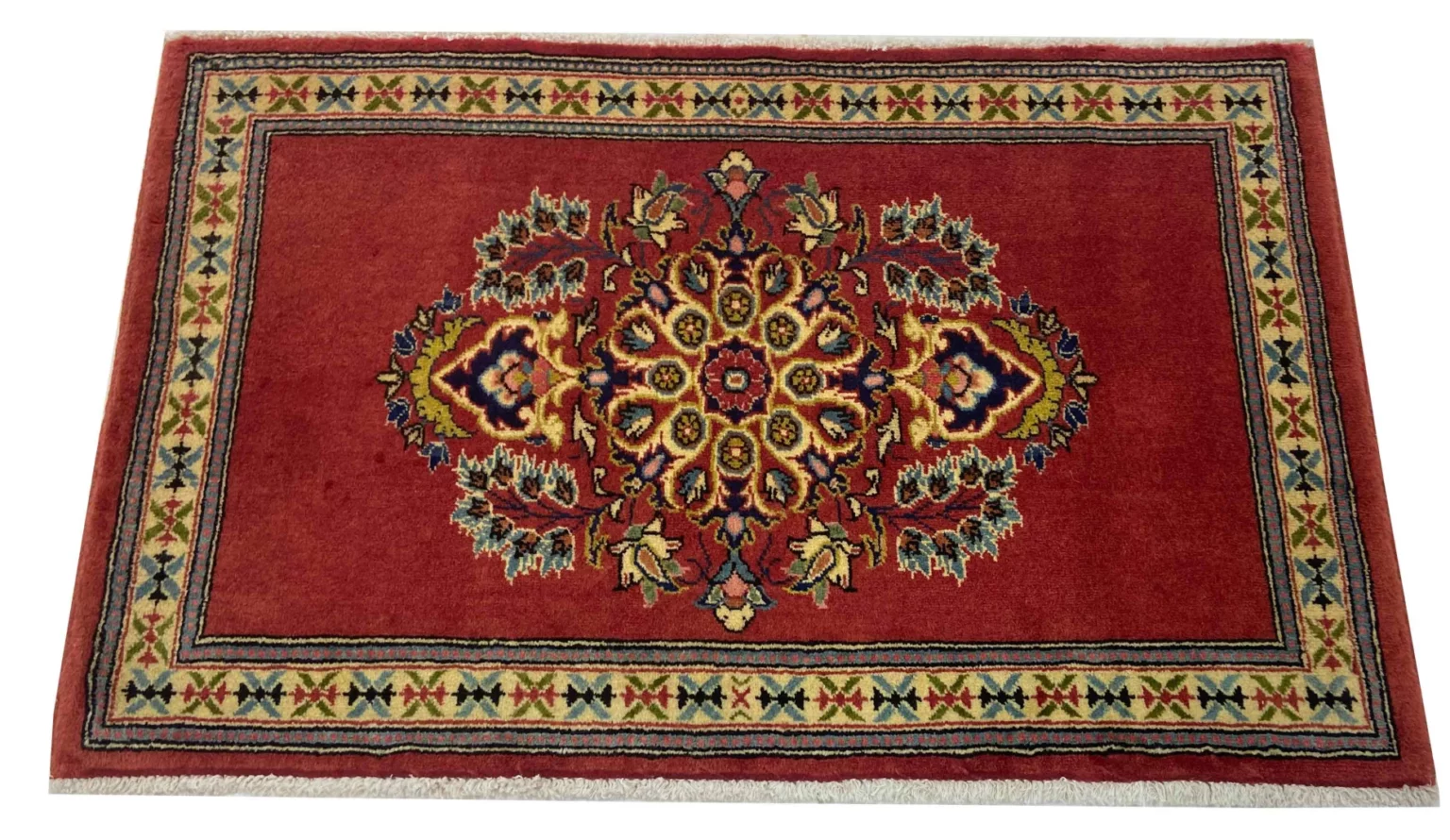
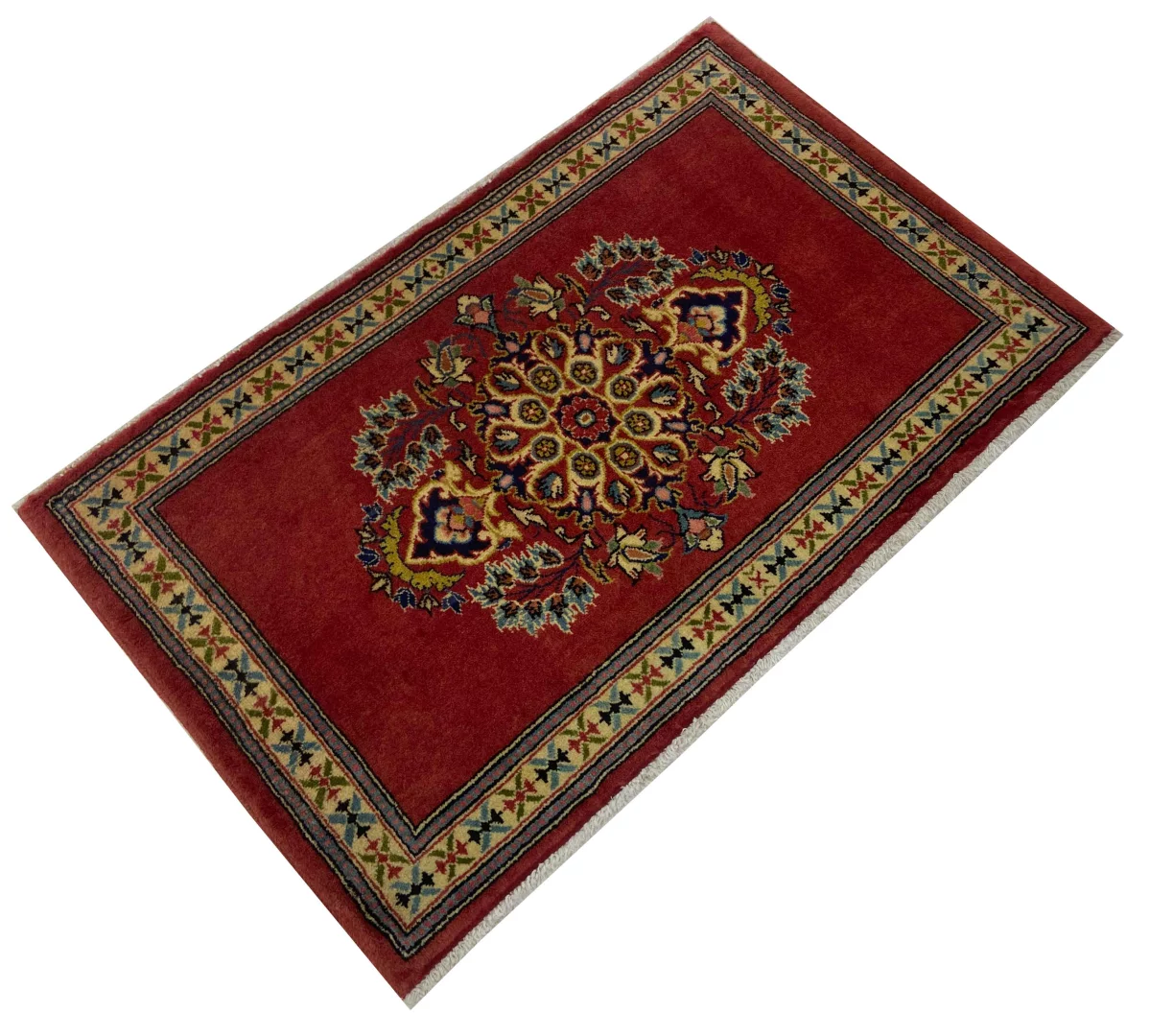
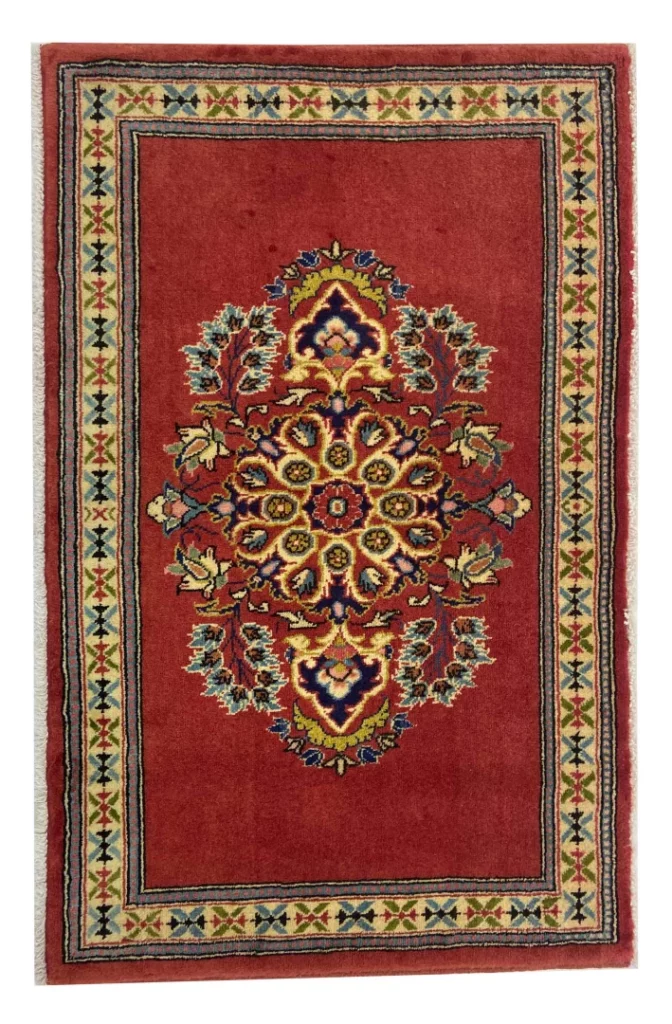
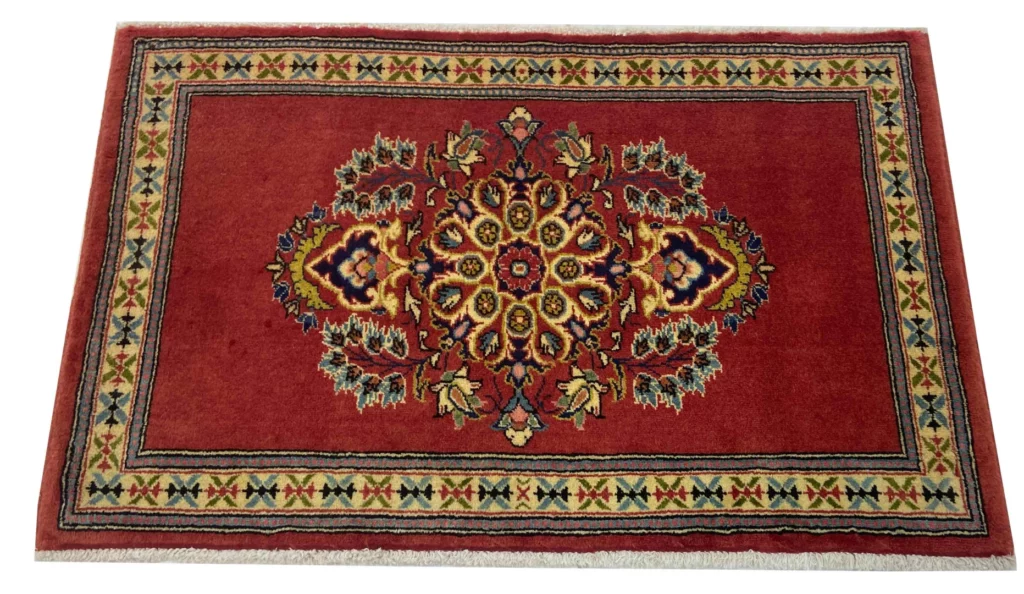
The Keshan tradition is known for compositions that are ordered and finely worked. Designs are often arranged in clearly defined fields. A central medallion, scrolling floral forms and a surrounding border may combine to create a unified composition. Not every Keshan follows the same arrangement, yet symmetry, rhythm and small-scale ornament are recurring features associated with this origin.
In Persian weaving, designs are often passed on through drawings and inherited pattern templates. Weavers translate these templates into coloured knots placed within the foundation. Each individual knot forms part of a larger grid from which flowers, leaves, vines and geometric outlines emerge. A high knot density allows such transitions and small forms to be drawn with greater differentiation. It is therefore not only a technical specification, but also connected with the design tradition.
Keshan occupies a place among several important Persian weaving centres. Isfahan is known for fine silk qualities, Heriz for a more robust structure, and Tabriz for complex patterns and colours. Kashan and Nain are also recognised centres of Persian rug production. Each region developed its own emphasis, while all remain linked by the broader history of the hand-knotted Persian rug.
Making a hand-knotted rug requires patience and confident control of repeated forms. Rows, outlines and borders must remain coordinated throughout the work. Traditional Keshan designs consequently often appear balanced and coherent. Their order does not come from industrial repetition, but from continuing manual work at the loom. Keshan origin thus denotes a cultural and technical context within Persia.
Design and Pattern
Keshan rugs are typically characterised by floral and geometric patterns. Floral motifs may include stylised flowers, leaves and scrolling vines. Geometric elements give these softer forms a firm structure. Together they create the characteristic exchange between small details and an easily understood overall composition.
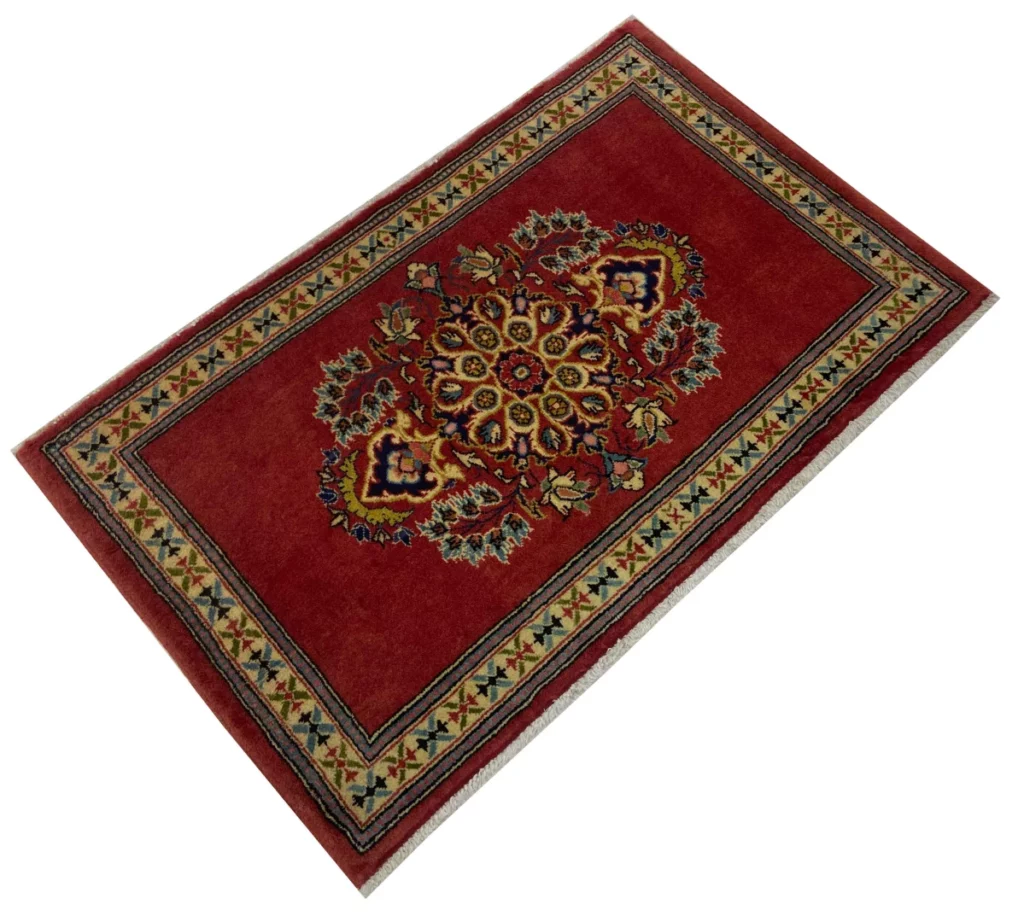
A Persian pattern is usually read in several layers. The main field carries a central ornament or a repeated arrangement, while a border frames the composition. Secondary borders can organise the transition between the inner field and the outer edge. This division allows the eye to experience numerous individual motifs as one connected design. Symmetry and regular repetition are important principles in Keshan layouts.
Colour ranges frequently associated with the Keshan tradition include deep red, blue and yellow. These colours can be combined in differing shades to give contrast to floral and geometric forms. Colour areas and lines do more than provide decoration. They separate pattern zones, emphasise contours and support the rhythm of the overall drawing. This colour tradition helps explain why Keshan rugs are often both lively and formally ordered.
Many Persian ornaments are connected with the history and culture of their region of origin. Floral imagery in rugs is not normally a literal depiction of nature, but is transformed into a textile vocabulary. Flowers are simplified, vines are given rhythm and geometric forms are interwoven. The pattern remains legible even when repeated extensively. Its appearance results from the interaction of a template, manual work and the particular structure of knotting.
Dense knotting supports the precise rendering of small motifs. Individual knots can form short lines, closed contours and subtly divided areas. A short pile keeps the surface comparatively clear and helps prevent the drawing from being obscured by a tall pile. These technical qualities generally explain the combination of detail and formal order found in finely knotted Keshan rugs.
The design of a Keshan rug is also intended to distribute its motifs in a balanced way. Open areas, scrolling forms and borders relate to one another so that no ornament stands entirely apart from the rest of the composition. The resulting visual language accommodates both floral movement and geometric clarity. Keshan patterns can therefore be used in historically informed as well as timeless interiors without losing their connection to Persian tradition.
Special Features
The specific features of this rug are its hand-knotted construction, a pile of high-quality sheep wool, cotton in the foundation, a short pile and a knot density of 150,000 to 300,000 knots per square metre. The rug is very well preserved. These points describe its construction and recorded condition without adding characteristics that are not stated.
Its handmade construction and dense knotting mean that the pattern results from many individual working steps. Regular vacuuming is recommended for everyday care. Fresh marks should be treated immediately with a damp cloth and mild cleaning detergent. Professional cleaning is recommended to help preserve the colours and structure of the rug. Keshan Persian rugs can be used in living rooms, bedrooms, offices and entrance areas.
FAQ
How can I recognise an authentic Keshan Persian rug?
Useful points of reference include hand-knotting, the materials and the knot density. A Keshan is traditionally hand-knotted, and high-quality sheep wool and cotton belong to the material combination described here. The floral and geometric patterns associated with Keshan can also assist with classification. Knot density provides further technical information about the construction. For a reliable assessment, these features should be considered together rather than relying on one ornament or one colour alone.
How should I care for my Keshan Persian rug?
The rug should be vacuumed regularly and gently so that dust does not remain in the short pile. Fresh stains can be treated with a damp cloth and a mild cleaning detergent. The affected area should be handled carefully and should not be unnecessarily saturated. Professional cleaning is recommended for more thorough care. It helps preserve the colours, the wool surface and the structure created by hand-knotting.
Which rooms are suitable for a Keshan Persian rug?
A Keshan Persian rug can be used in a range of living and working spaces. Suitable areas include living rooms, bedrooms, offices and entrance halls. Its floral and geometric patterns work with refined, timeless interiors. The rug can therefore be placed in a private room as well as in a representative work setting. It should be used in a way that allows regular care and protects the hand-knotted rug from unnecessary soiling.
To provide the best experiences, we use technologies like cookies to store and/or access device information. Consenting to these technologies will allow us to process data such as browsing behavior or unique IDs on this site. Not consenting or withdrawing consent, may adversely affect certain features and functions.
Functional Always active
The technical storage or access is strictly necessary for the legitimate purpose of enabling the use of a specific service explicitly requested by the subscriber or user, or for the sole purpose of carrying out the transmission of a communication over an electronic communications network.
Preferences
The technical storage or access is necessary for the legitimate purpose of storing preferences that are not requested by the subscriber or user.
Statistics
The technical storage or access that is used exclusively for statistical purposes.The technical storage or access that is used exclusively for anonymous statistical purposes. Without a subpoena, voluntary compliance on the part of your Internet Service Provider, or additional records from a third party, information stored or retrieved for this purpose alone cannot usually be used to identify you.
Marketing
The technical storage or access is required to create user profiles to send advertising, or to track the user on a website or across several websites for similar marketing purposes.
 SECURE PAYMENT
 SHIPPING PARTNERS