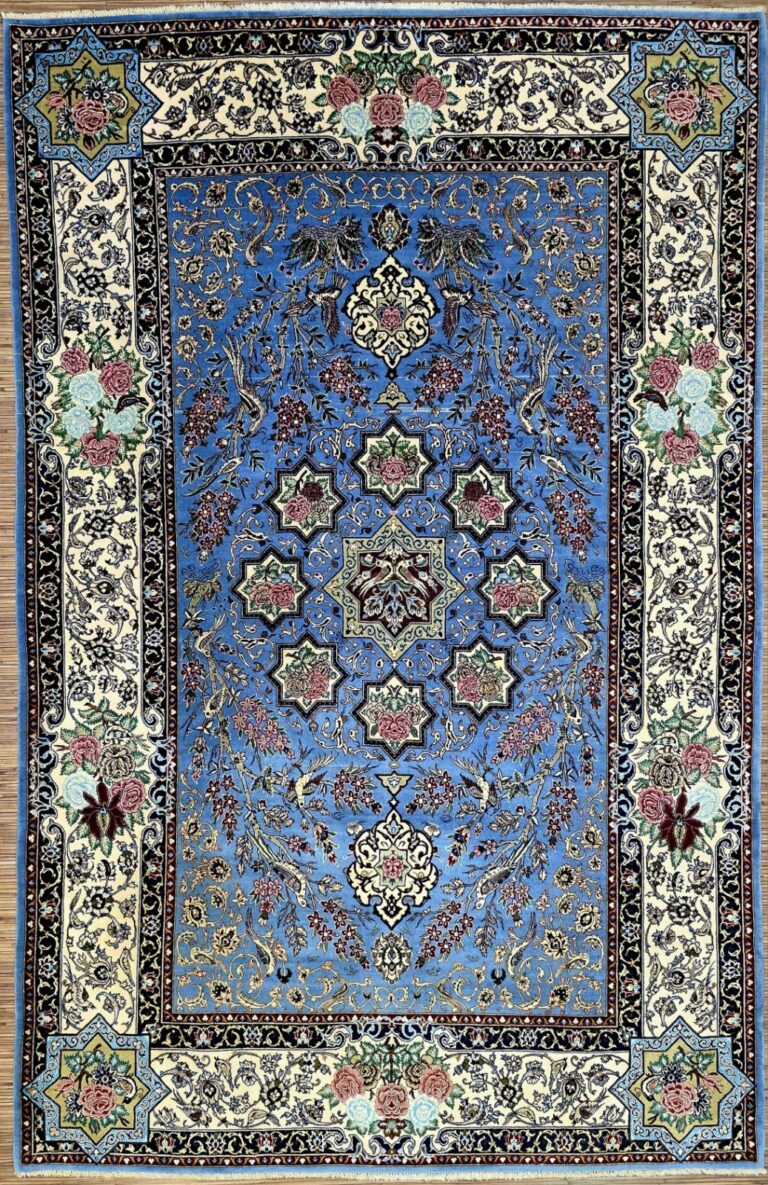
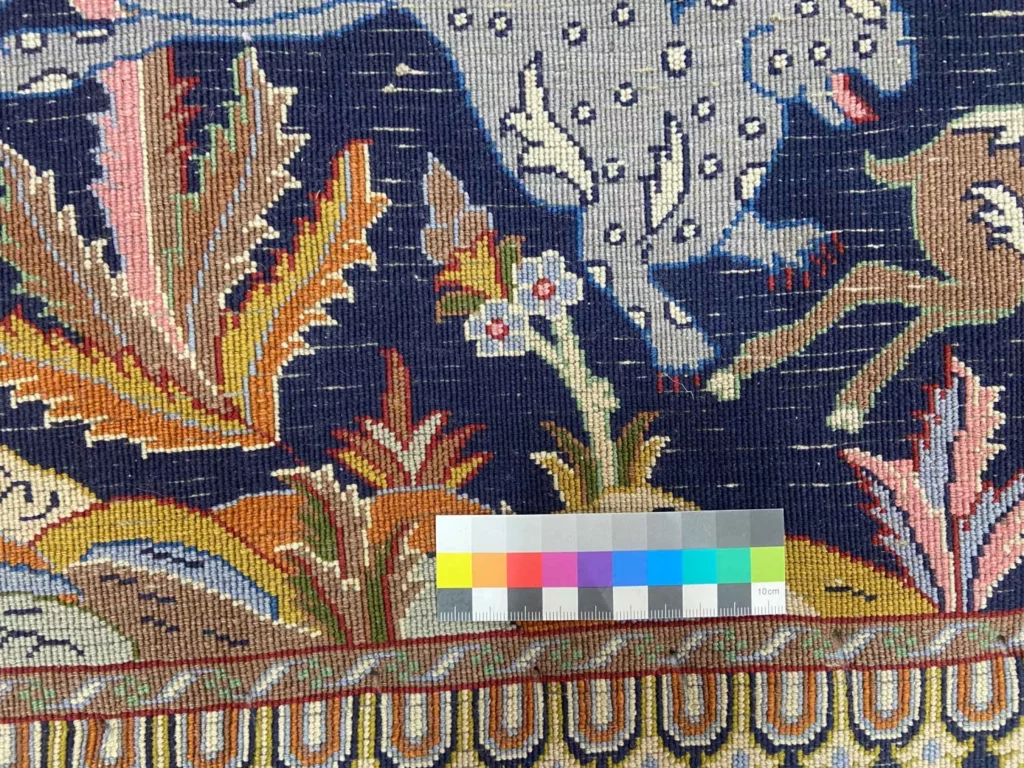
This Keshan Persian rug is hand-knotted. Its pile is made of high-quality sheep wool, while cotton is specified for the warp. The combination of a wool pile and a cotton foundation is characteristic of the material structure associated with classic Keshan rugs. It brings together a resilient woven base with a naturally woollen surface.
The rug has a short pile. This keeps the surface relatively compact and allows the design to remain clearly visible. Sheep wool is used in Keshan rug making for its durable and robust qualities. Cotton provides a firm basis for the knotting process. Because the rug is made by hand, its structure is formed knot by knot rather than through industrial machine production.
The stated knot density is between 150.000 and 300.000 knots per square metre. Within the Keshan tradition, this density supports carefully worked outlines and a differentiated rendering of floral and geometric elements. Dense construction is also associated with the description of Keshan rugs as hard-wearing and easy to maintain. This particular example is in very good condition.
Origin and Tradition
The Keshan Persian rug comes from Keshan in Iran. Keshan is one of the recognised Iranian centres of carpet weaving and has a long-established craft tradition. Its production combines practical knowledge with a developed approach to ornament. Understanding how to prepare the foundation, select and use the materials, and translate a design into knots was passed down through generations of weavers in the region.
Iranian carpets are closely connected with the history of the Persian Empire. Within that cultural setting, different regions developed their own approaches to structure, colour and ornament. Keshan occupies a distinct place in this history. Rugs from the area are associated with balanced compositions and finely worked detail. The name Keshan therefore refers not merely to a decorative style, but to an Iranian place of origin and the weaving tradition that developed there.
Carpet making also became an important economic activity in Keshan. Trade routes connected with the Silk Road helped Keshan rugs gain recognition beyond their immediate region. This commerce contributed to the economic prosperity of the area and spread the reputation of its weaving. The history of Keshan rugs is thus linked both to the skill of their makers and to the wider trading history of Iranian cities.
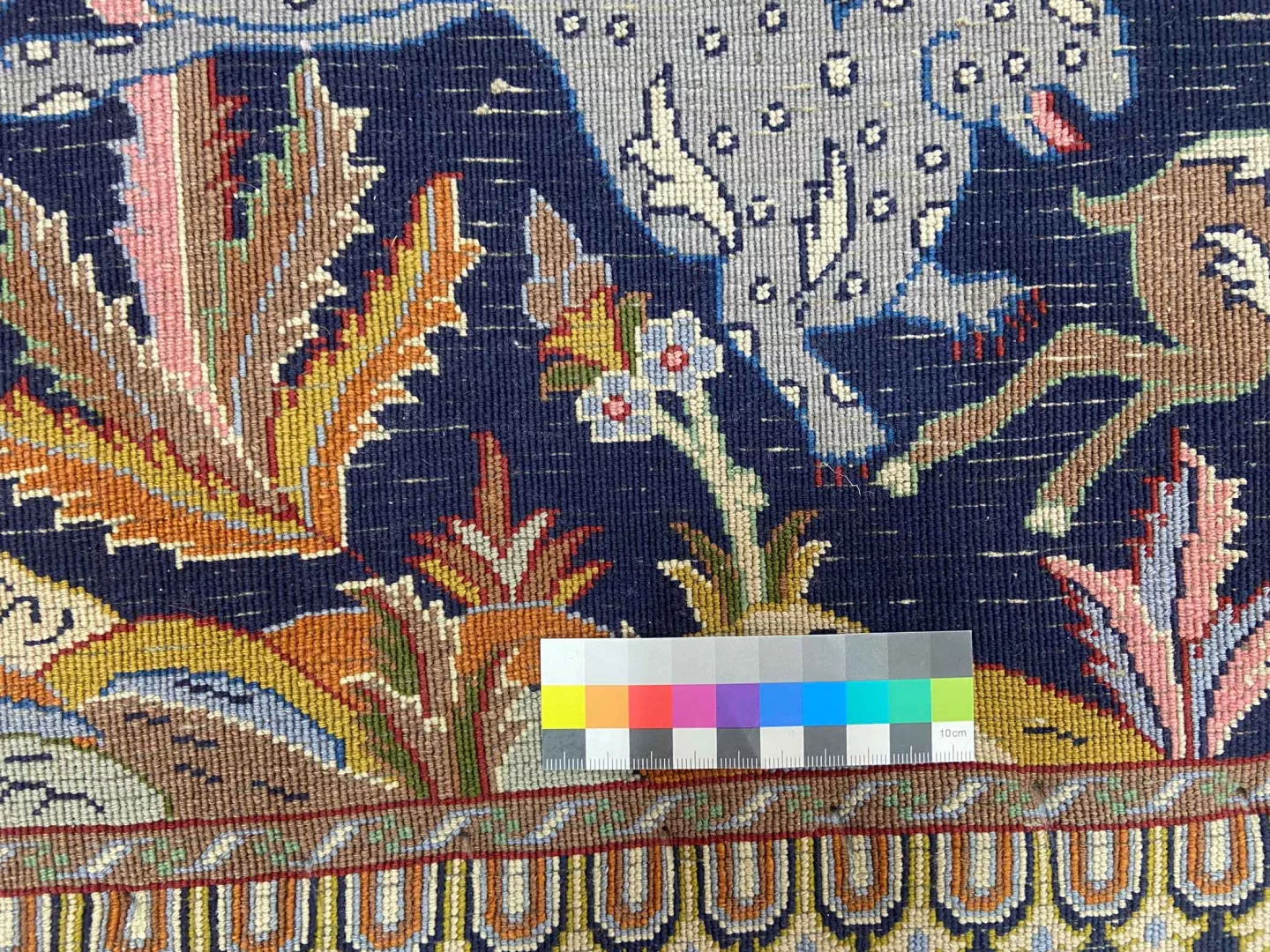
In traditional production, the rug begins with a warp and is built up by hand. Individual knots create the pile and are inserted row after row into the textile foundation. The surface is then worked so that the outlines can be read and the short pile forms an even appearance. The knot density associated with Keshan allows intricate designs to be rendered with considerable definition while preserving the visible character of hand craftsmanship.
Keshan rugs are often associated with classical Iranian interiors and formal rooms, but their tradition is not limited to one period of furnishing. Their regional identity, hand-knotted construction and established ornament give them a defined place within Persian carpet culture. Other Iranian weaving traditions include Isfahan, Tabriz, Nain and Kashan. Each region has its own emphasis, while hand knotting and the use of carefully selected materials provide points of connection across Iranian carpet making.
Design and Pattern
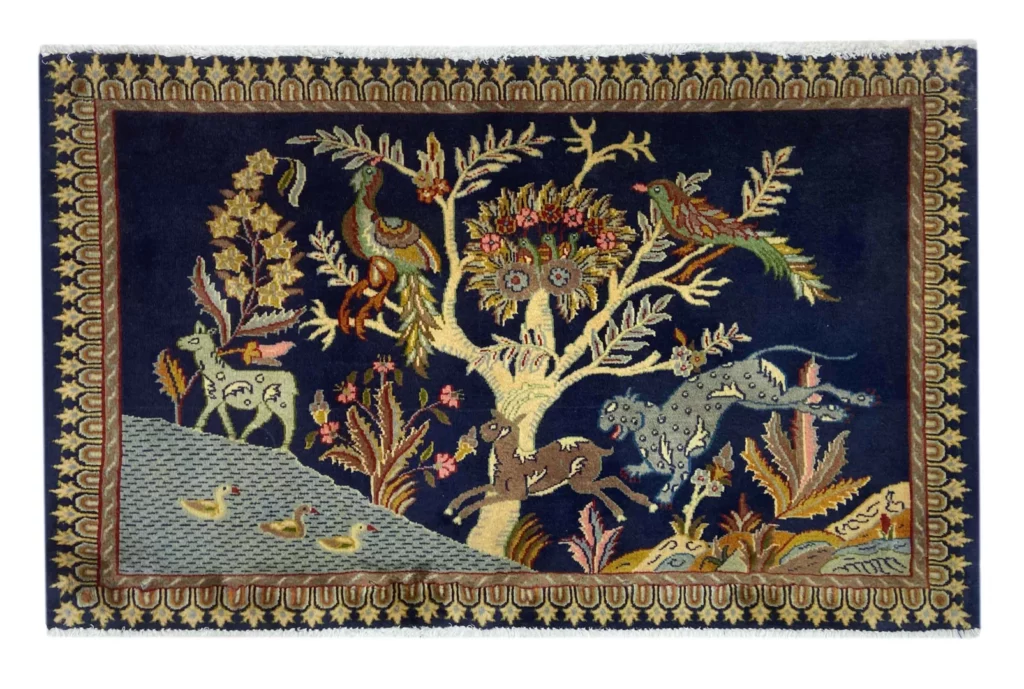
Keshan carpets are known for a varied vocabulary of motifs. Floral designs are found alongside complex geometric forms. Flowers, scrolling vegetation and other plant-based elements can be arranged within a carefully ordered composition. Geometric details provide structure through lines, repeated shapes and clear divisions of space. The interaction between these two design languages is part of the classical character associated with many Keshan rugs.
Floral ornament is generally organised rather than randomly scattered. Individual motifs are placed within a connected decorative system that guides the eye across the surface. Geometric elements can establish transitions, frame areas of the design and create a measured rhythm within a detailed composition. The exact balance of motifs belongs to the individual design of each rug; the broader floral and geometric vocabulary is part of the Keshan tradition.
The clarity of a Keshan design is closely related to its knotting technique. A higher knot density makes it possible to draw finer contours and reproduce smaller ornaments with greater differentiation. In a hand-knotted rug, each element is transferred gradually into the structure by the weaver. The result is a textile interpretation of the design rather than a mechanically repeated surface. A short pile can further support the legibility of the drawing.
Keshan designs are traditionally associated with a balanced and classical visual language. Floral and geometric ornament can work in traditionally furnished settings as well as alongside more restrained contemporary interiors. This does not mean that every Keshan rug has the same composition or the same sequence of motifs. Instead, the regional tradition provides a framework within which individual rugs can be designed and knotted with their own arrangement of detail.
Iranian carpet culture includes several other important regional traditions. Isfahan rugs are associated with artistic motifs and lively colour, while Tabriz rugs are often recognised for detailed drawing. Nain and Kashan likewise represent hand-knotted carpets with varied designs and high-quality materials. These comparisons place Keshan within the wider history of Persian carpet making without treating the different origins as interchangeable.
Special Features
The features specified for this rug are its hand-knotted construction, short pile, high-quality sheep wool and cotton, and very good condition. Its knot density falls between 150.000 and 300.000 knots per square metre. Together, these details describe the material basis and craftsmanship of the piece. Its origin in Keshan, Iran, places it within the Persian rug tradition.
Regular vacuuming is recommended for the care of a Keshan Persian rug. Occasional beating can also help keep the surface clean. If the rug has heavy soiling, professional carpet cleaning should be used. Specialist cleaning helps preserve the colours and structure and can extend the useful life of the rug. Care should be appropriate to the textile character of a hand-knotted wool rug.
The combination of a short pile, a sheep-wool surface and a cotton warp gives the material description a clear structure. At the same time, each hand-knotted rug remains an individual textile because its appearance is shaped by the work of the weaver. The very good condition is an additional feature expressly associated with this Keshan rug.
FAQ
How can the quality of a Keshan Persian rug be assessed?
Knot density, the materials used and the precision of the pattern are important points of reference. This rug has a knot density between 150.000 and 300.000 knots per square metre. Its pile is made of high-quality sheep wool and its warp is cotton. The accuracy with which floral and geometric motifs are rendered also helps show the level of hand craftsmanship in a Keshan rug.
How should a Keshan Persian rug be cared for?
Regular vacuuming provides the basic routine for keeping the rug clean. It may also be beaten occasionally. For heavy dirt, professional cleaning is recommended. This helps maintain the colours and structure of the hand-knotted rug. Since this Keshan has a short pile, cleaning should still be carried out carefully and in a way suited to its wool surface.
Where does the Keshan Persian rug come from?
The Keshan Persian rug comes from Keshan in Iran. The region is known for its long tradition of carpet weaving and for the use of high-quality materials. Trade routes connected with the Silk Road helped its rugs become widely known. Keshan therefore identifies both an Iranian place of origin and a distinct tradition of hand-knotted Persian carpets.
To provide the best experiences, we use technologies like cookies to store and/or access device information. Consenting to these technologies will allow us to process data such as browsing behavior or unique IDs on this site. Not consenting or withdrawing consent, may adversely affect certain features and functions.
Functional Always active
The technical storage or access is strictly necessary for the legitimate purpose of enabling the use of a specific service explicitly requested by the subscriber or user, or for the sole purpose of carrying out the transmission of a communication over an electronic communications network.
Preferences
The technical storage or access is necessary for the legitimate purpose of storing preferences that are not requested by the subscriber or user.
Statistics
The technical storage or access that is used exclusively for statistical purposes.The technical storage or access that is used exclusively for anonymous statistical purposes. Without a subpoena, voluntary compliance on the part of your Internet Service Provider, or additional records from a third party, information stored or retrieved for this purpose alone cannot usually be used to identify you.
Marketing
The technical storage or access is required to create user profiles to send advertising, or to track the user on a website or across several websites for similar marketing purposes.
 SECURE PAYMENT
 SHIPPING PARTNERS