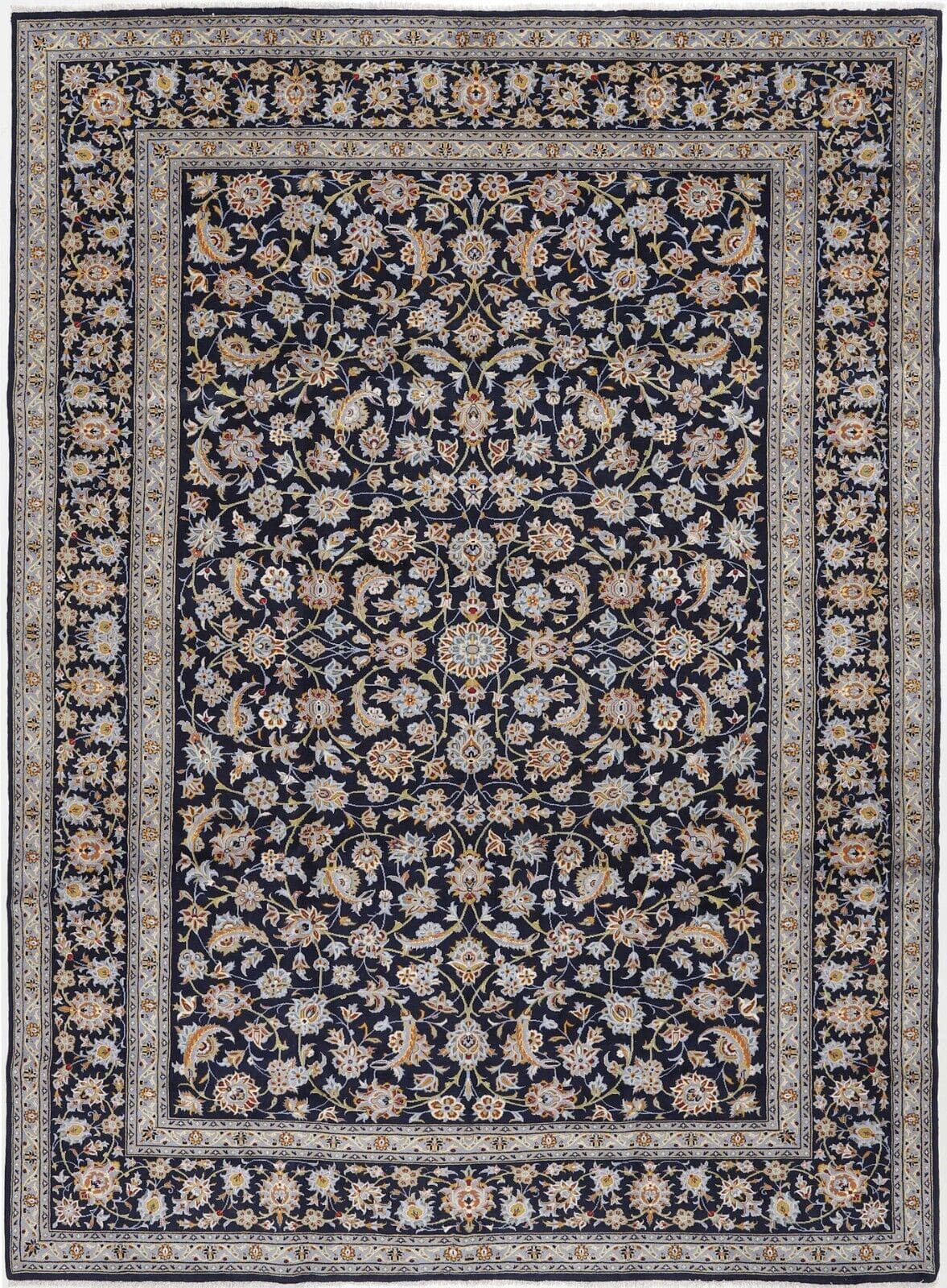
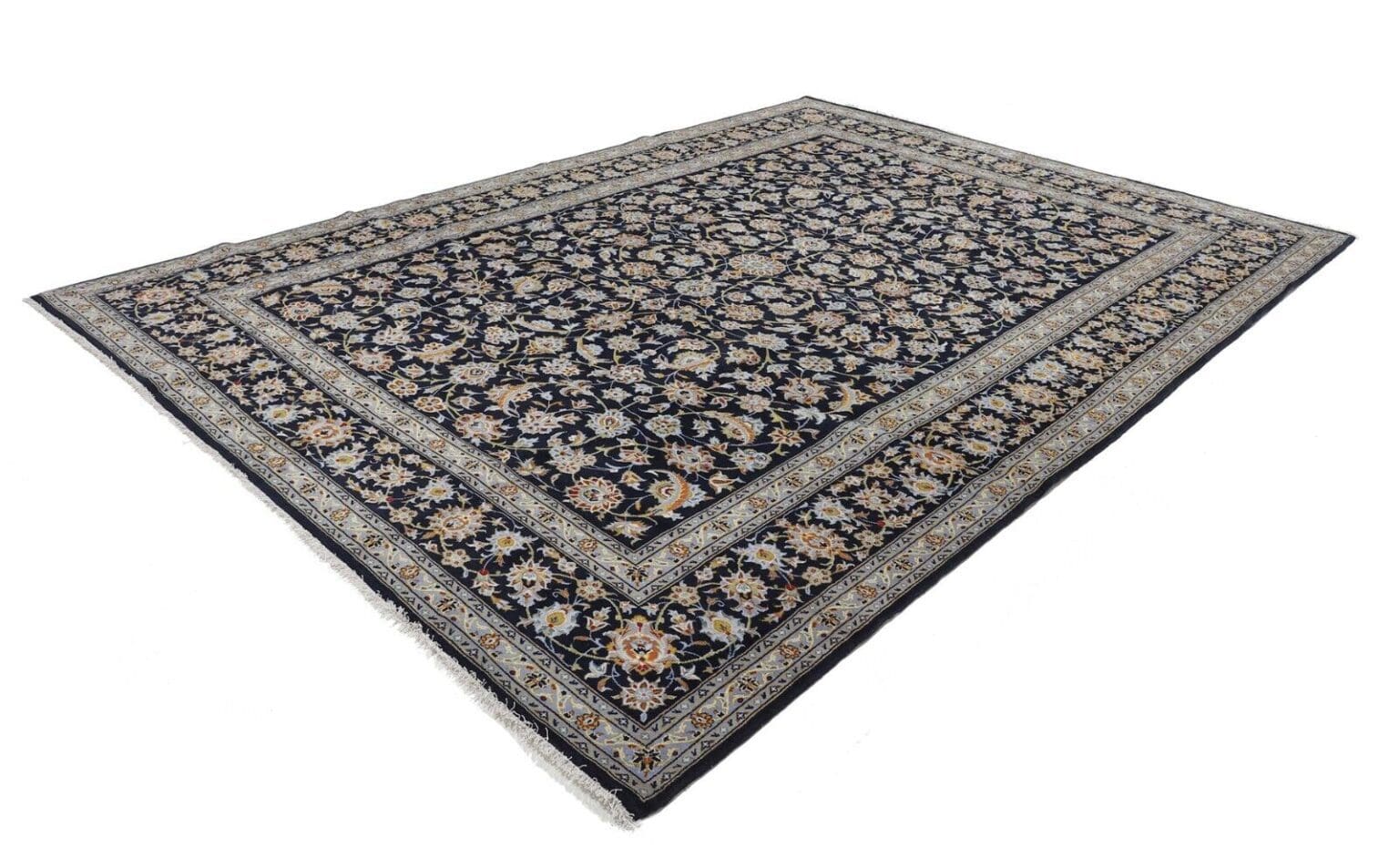
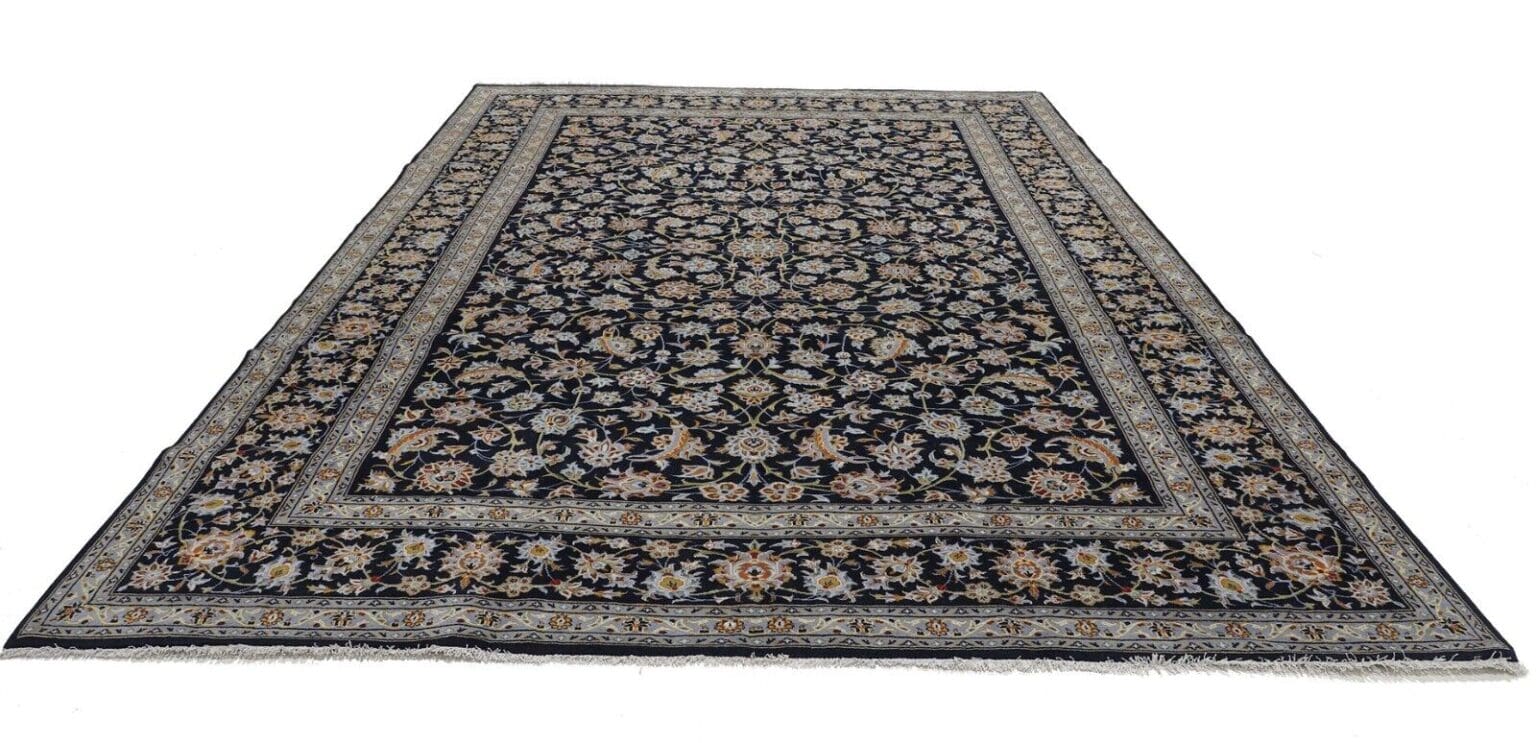
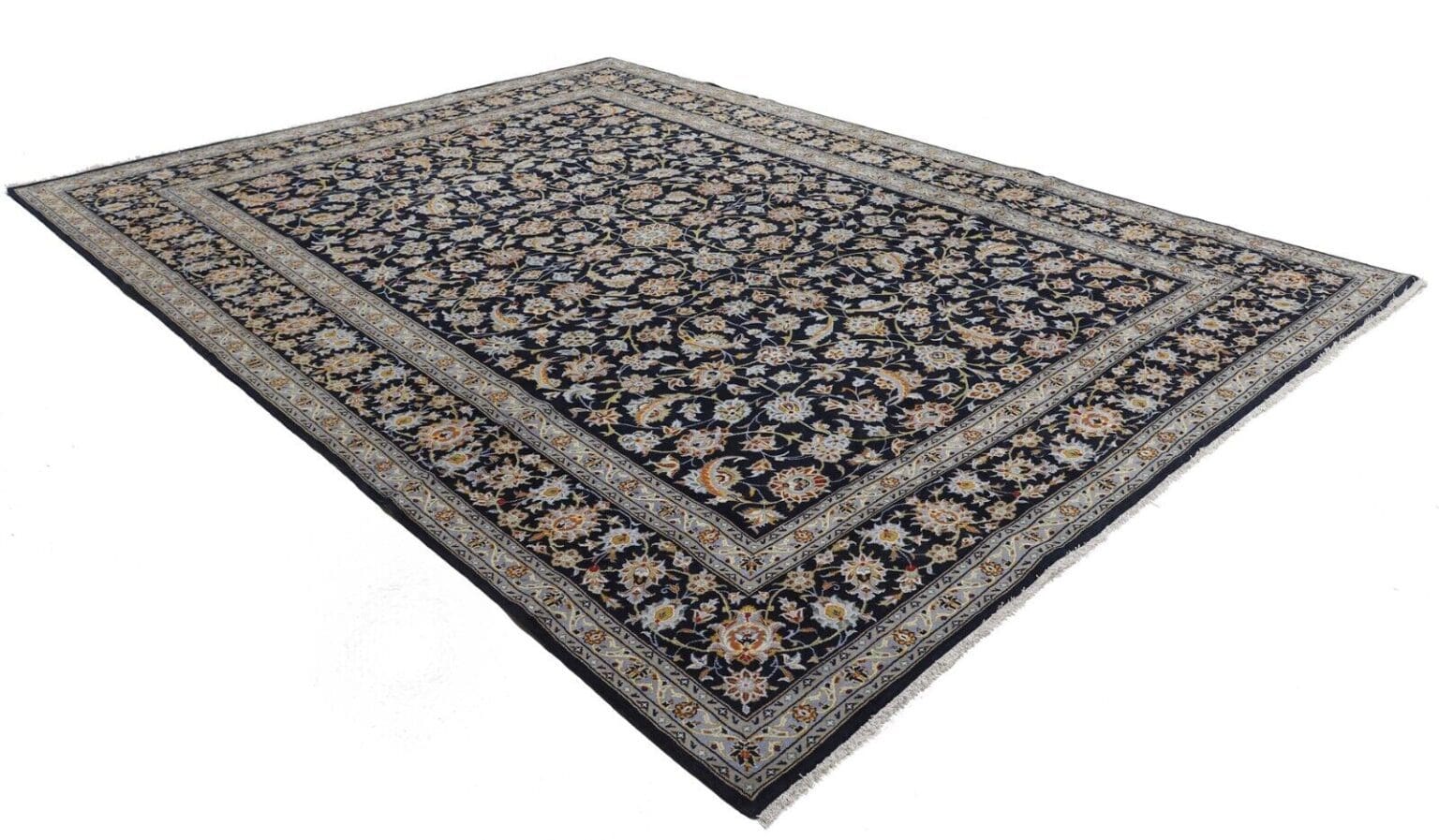
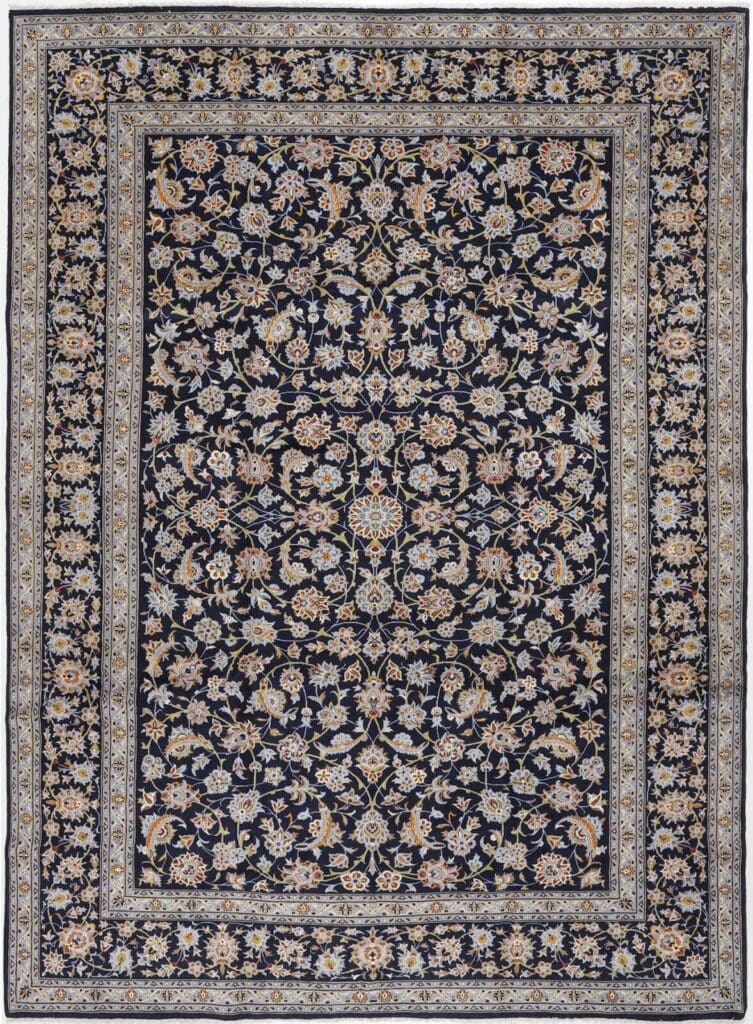
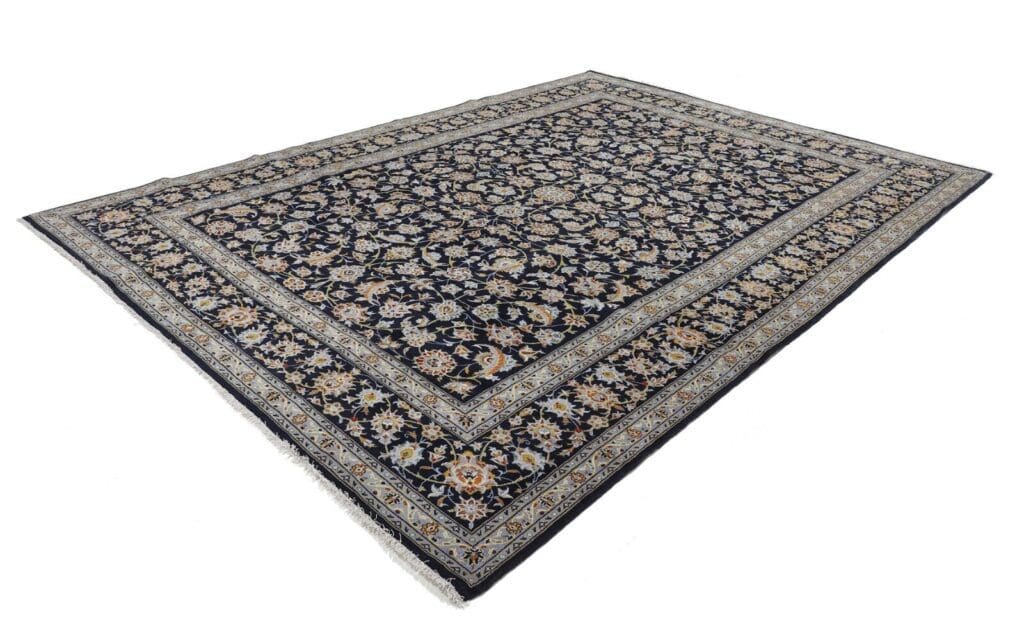
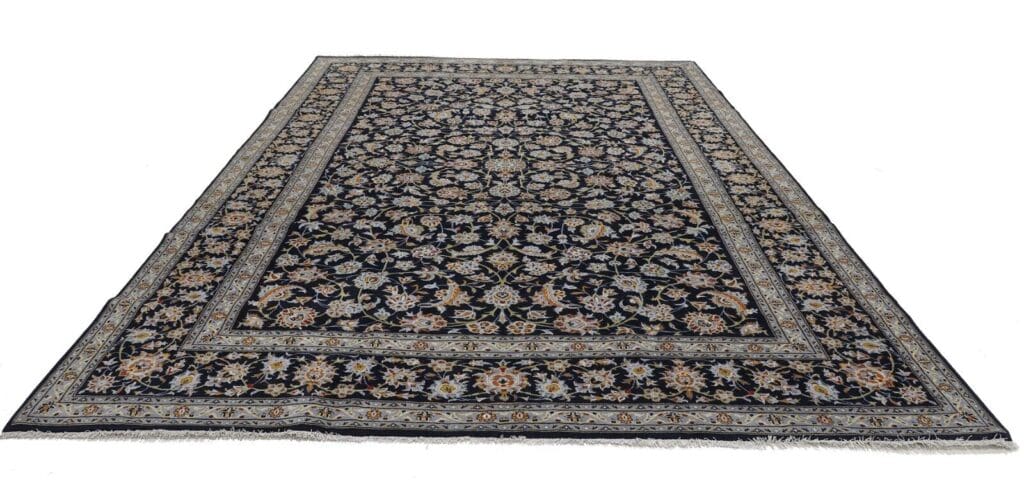
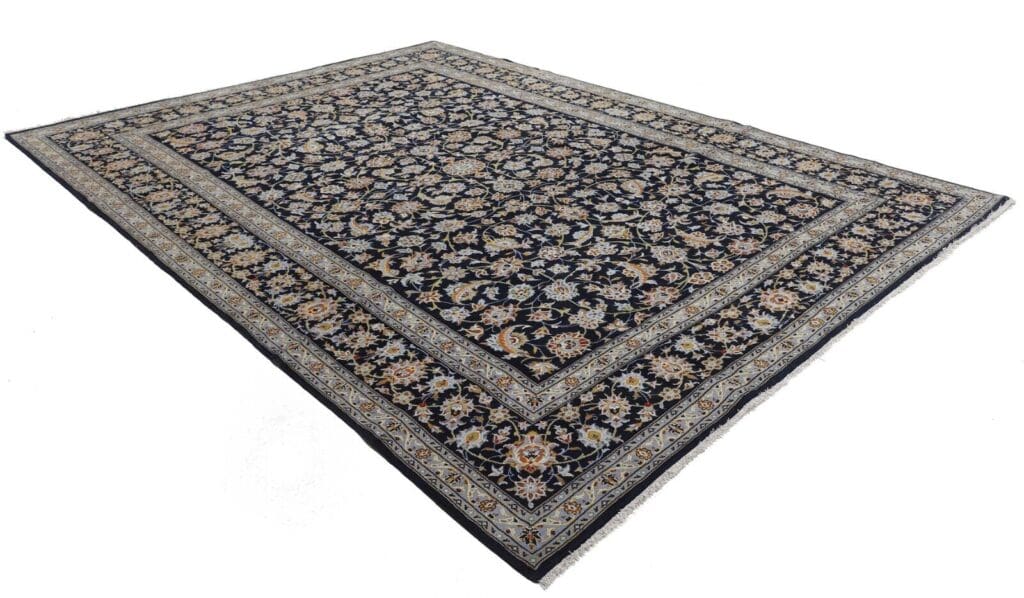
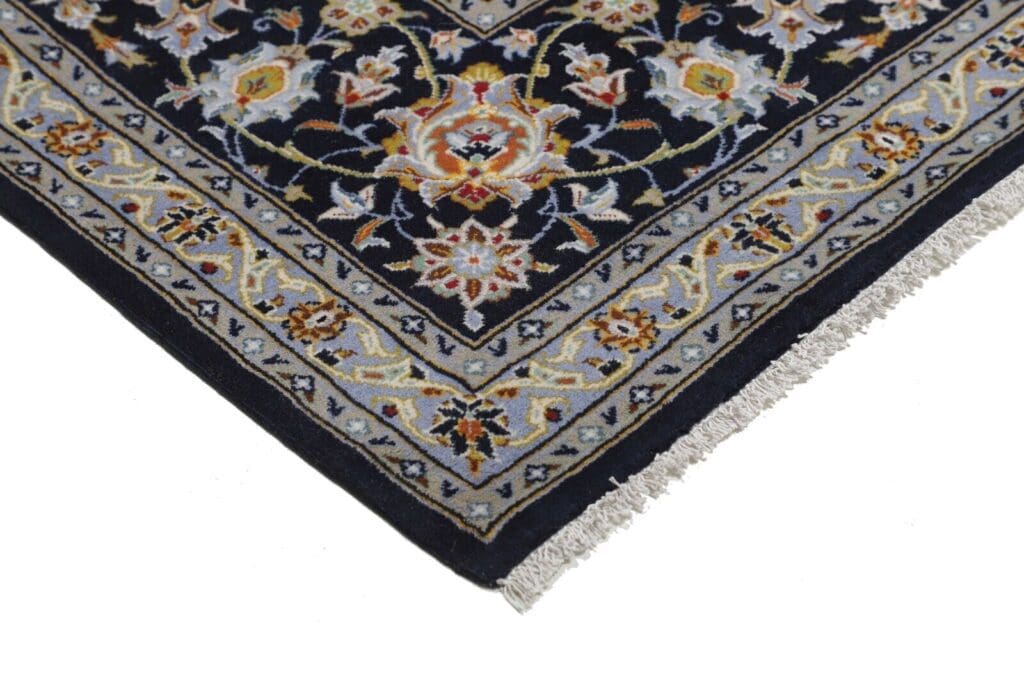
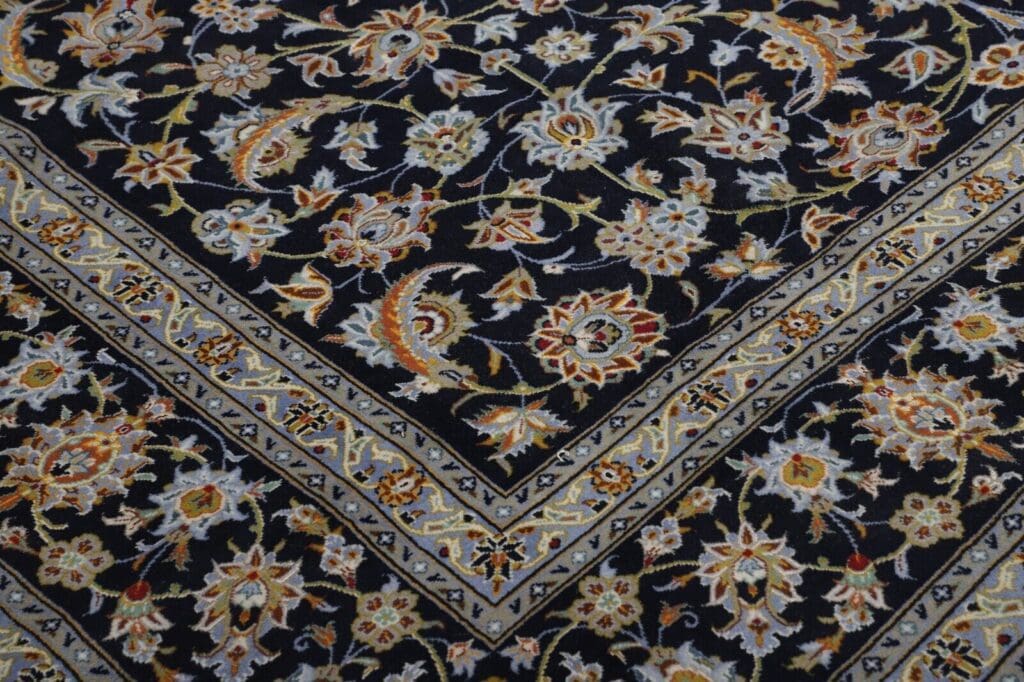
Hand-knotted Keshan Persian Rug | Knot density: High-quality hand-knotting | Material: Wool, cotton, silk | Size: 385 x 280 cm | Pattern: Oriental with floral motifs | Condition: Like new
This Persian rug is hand-knotted and comes from Iran. The listed materials are 100% wool, 100% cotton and 100% silk. The material information names all three fibres without assigning them specifically to the pile or the warp. Wool has long been used in hand-knotted rugs for its resilient, tactile surface and its ability to take colour evenly. Cotton is commonly valued in rug making for its firm and stable yarn structure. Silk is traditionally used for its smooth fibre and restrained sheen.
Hand-knotting means that individual knots are inserted by hand into a prepared foundation. The rug is built row by row, so the making of the textile and the development of the design remain closely connected. Its knot density is described as “high-quality hand-knotting”. This wording identifies the craft technique but does not provide a numerical knot count. As the work progresses, the pile is formed, trimmed and finished so that the pattern can be read across the woven surface.
The combination of wool, cotton and silk brings together different textile qualities. Wool traditionally provides a durable and pleasantly firm surface. Cotton is appreciated in oriental rug construction for its stable structure, while silk can support fine details and subtle changes in the way light is reflected. All three materials are listed here with a 100% designation. That information does not establish which fibre belongs to which part of the rug, so no further pile or warp allocation is made.
The hand-knotted technique distinguishes this rug from a machine-made floor covering. Each knot is placed individually, making the process manual and time-consuming. Traditional oriental rug production follows a sequence in which a design is transferred to the foundation, knots are inserted, the pile is worked evenly and the textile is prepared for use. These general stages explain the significance of hand-knotting without adding unrecorded details about this particular piece.
The rug is described as like new. It is also identified as easy to care for and environmentally friendly. It is suitable for use over underfloor heating. These are stated characteristics of the offered rug and complement the information about its hand-knotted construction.
Origin and Tradition
Keshan is a recognised rug-producing region in Iran. The city lies in central Iran and has a long association with the production of Persian rugs. Its regional tradition brings together urban design, controlled drawing and a strong interest in floral ornament. Keshan is often associated with rugs whose compositions include an organised field, a structured border and carefully drawn flowers and vines. The name identifies a regional and cultural context rather than one single pattern, since workshops in the area have produced many different designs and executions.
Persian rug making has a long history in Iran. Rugs were woven and knotted for everyday interiors as well as for representative settings. Over time, individual cities and regions developed particular approaches to drawing, colour and construction. Keshan became associated with an urban tradition in which floral arrangements and balanced compositions play an important role. Workshops worked from inherited designs but also adapted them to the intended setting, the available materials and the skill of the makers.
In an urban Persian rug workshop, the process generally begins with a design that establishes the field, border and secondary borders. That design is then transferred to the knotting process. Planning allows flowers, leaves, vines and framing elements to remain related across the surface. Keshan rug making therefore represents a connection between drawn order and manual production. Every knot contributes to a larger composition, while the hands of the makers give the finished textile its physical character.
Iran contains several rug regions with distinct traditions. Isfahan is associated with finely organised and often highly ornamented designs, Tabriz with differentiated drawing and a broad stylistic range, Kerman with floral compositions, and Shiraz with more locally rooted patterns. These places are not interchangeable. A rug identified as Keshan belongs to its own regional context. The origin Iran describes the wider cultural setting in which these varied Persian rug traditions developed.
Knowledge in the rug-making tradition is transmitted through examples, drawings and practical experience. Makers learn not only how to tie knots and handle fibres, but also how to organise a pattern, select colours and finish a border. Tradition does not mean that every rug looks the same. It provides a framework of inherited techniques and forms within which individual pieces are produced. This Keshan belongs to that Iranian hand-knotting tradition and is classified as a Persian rug from Iran.
Persian rugs are now collected and used in many parts of the world. Their regional names remain relevant because they point to the history of their design and making. A Keshan combines Iranian origin with an urban rug culture in which the design and the craft process are closely coordinated. The name can therefore be understood factually: it identifies a regional tradition without making a claim about a particular historical workshop or the age of this rug.
Design and Pattern
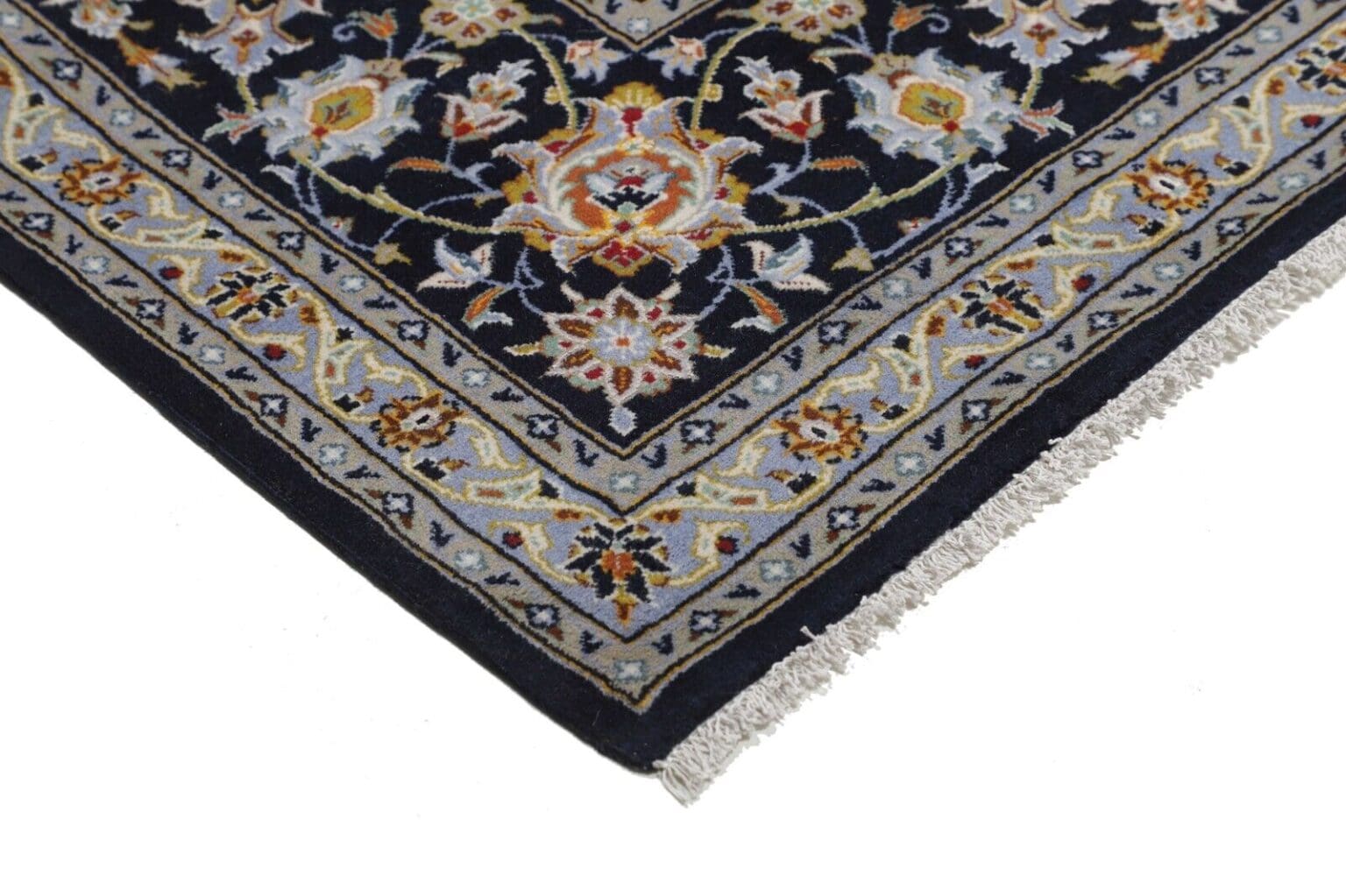
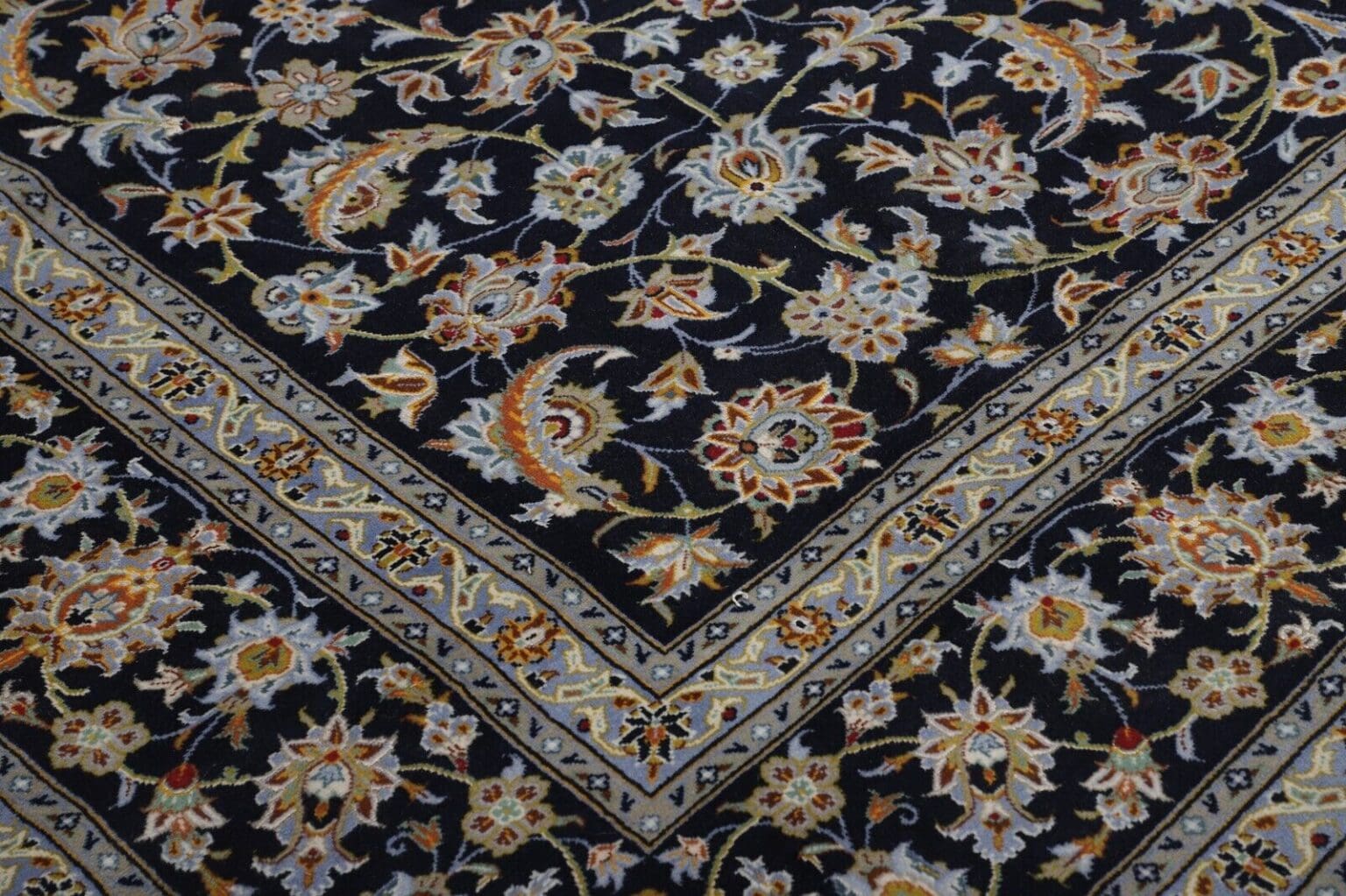
The pattern of this rug is described as oriental with floral motifs. Floral ornament is one of the major design languages found in Persian rugs. Flowers, leaves and vines may fill a central field, move along a border or appear in repeating groups. Such motifs are arranged within a considered relationship between field, frame and repetition. The floral design combines decorative forms with a clear textile order rather than treating the surface as an unstructured collection of images.
Persian pattern traditions include several broad compositional approaches. A medallion may occupy the centre of a field and be supported by motifs on either side. An all-over design repeats forms across the complete surface. Another approach uses a continuous vine to connect flowers and leaves. The description “oriental with floral motifs” establishes the floral and oriental character of this rug, but it does not specify a particular medallion, all-over or other layout.
Flowers in a rug design are usually stylised rather than botanical copies. A knotted flower is developed from lines, shapes and areas of colour. Repetition, mirroring and changes in scale create rhythm across the field. Small leaves can occupy the spaces between larger ornaments, while more prominent flowers can direct attention to particular parts of the composition. Borders complete the design and establish a visual boundary between the rug and its surroundings.
The Keshan design tradition is rooted in urban pattern planning. Drawings are prepared so that they remain legible on a knot grid. Fine details require careful execution, while larger shapes can be recognised from farther away. Wool, cotton and silk may create different surface effects within a textile, although the visible result also depends on the actual colour arrangement, pile and lighting. For this rug, the recorded pattern is oriental with floral motifs.
Floral Persian patterns may carry cultural associations, but they do not have one compulsory interpretation. Flowers can suggest growth, order or the idea of a cultivated garden. In rug art, such ideas are translated into ornamental structures. The important feature is the relationship between repetition and balance. The pattern is not merely applied decoration; it also organises the textile surface and makes the work of hand-knotting visible.
Working within a traditional pattern language still allows individual variation. Two rugs from the same region may differ in their flowers, borders or colour relationships. Designs are adapted, developed and influenced by the people who produce them. Regional classification therefore describes a shared visual and technical language rather than an identical template. In this piece, the Iranian origin, the Keshan designation and the oriental floral pattern are presented as connected but distinct facts.
Special Features
The specifically listed features are the hand-knotted construction, the materials wool, cotton and silk, and the like-new condition. The rug is described as easy to care for and environmentally friendly, and it is suitable for use over underfloor heating. These characteristics make it relevant for interiors that require a traditionally made floor covering together with practical everyday properties.
Like-new describes the recorded condition of the rug. It should not be confused with a historical age statement: no age or year of manufacture is provided. There is also no signature recorded. The description therefore remains focused on the stated origin, technique, materials, pattern and use-related properties.
Suitability for underfloor heating is a specific use characteristic of this rug. When it is installed, heat should be distributed evenly and the instructions for the heating system and floor covering should be followed. Easy care describes the intended everyday handling; it does not replace appropriate cleaning. The term environmentally friendly is included as a stated product characteristic and is not expanded with claims about certificates or special manufacturing processes.
FAQ
What makes a Persian rug distinctive?
A Persian rug brings together hand craftsmanship, regional tradition and a distinct pattern vocabulary. In this Keshan, the Iranian origin, hand-knotting and an oriental floral design appear together. Wool, cotton and silk are listed as its materials. Individual knots are inserted by hand into the foundation, using a traditional textile process rather than industrial machine production. Floral ornament is a recognised design approach in Persian rugs and may include flowers, leaves, vines and borders. The name Keshan points to an Iranian rug tradition, while allowing for the fact that rugs from the region can differ in their detailed designs.
How should I care for my Persian rug?
The rug is described as easy to care for. Regular, careful vacuuming can remove dust and loose everyday dirt. Cleaning should be suited to wool, cotton and silk. If more substantial cleaning is needed, professional rug cleaning is appropriate because the textile construction and the fibres can then be taken into account. Strong direct sunlight should be avoided so that the colours remain as even as possible. Since the rug is suitable for underfloor heating, it can be used on a suitably equipped floor; the instructions of the heating system should still be observed.
Where can I buy an authentic Persian rug?
Authentic Persian rugs are offered by specialist rug dealers, selected online shops and auction houses. When buying, the origin, technique, materials, pattern and condition should be described clearly. For this piece, Keshan and Iran are given as origin information, together with hand-knotting, wool, cotton and silk, and a like-new condition. A careful description helps distinguish a regional name from a pattern name. Specialist dealers can provide further information about construction and care when necessary. Details such as age, signature or a numerical knot count should only be included when they are explicitly documented.
To provide the best experiences, we use technologies like cookies to store and/or access device information. Consenting to these technologies will allow us to process data such as browsing behavior or unique IDs on this site. Not consenting or withdrawing consent, may adversely affect certain features and functions.
Functional Always active
The technical storage or access is strictly necessary for the legitimate purpose of enabling the use of a specific service explicitly requested by the subscriber or user, or for the sole purpose of carrying out the transmission of a communication over an electronic communications network.
Preferences
The technical storage or access is necessary for the legitimate purpose of storing preferences that are not requested by the subscriber or user.
Statistics
The technical storage or access that is used exclusively for statistical purposes.The technical storage or access that is used exclusively for anonymous statistical purposes. Without a subpoena, voluntary compliance on the part of your Internet Service Provider, or additional records from a third party, information stored or retrieved for this purpose alone cannot usually be used to identify you.
Marketing
The technical storage or access is required to create user profiles to send advertising, or to track the user on a website or across several websites for similar marketing purposes.
 SECURE PAYMENT
 SHIPPING PARTNERS


