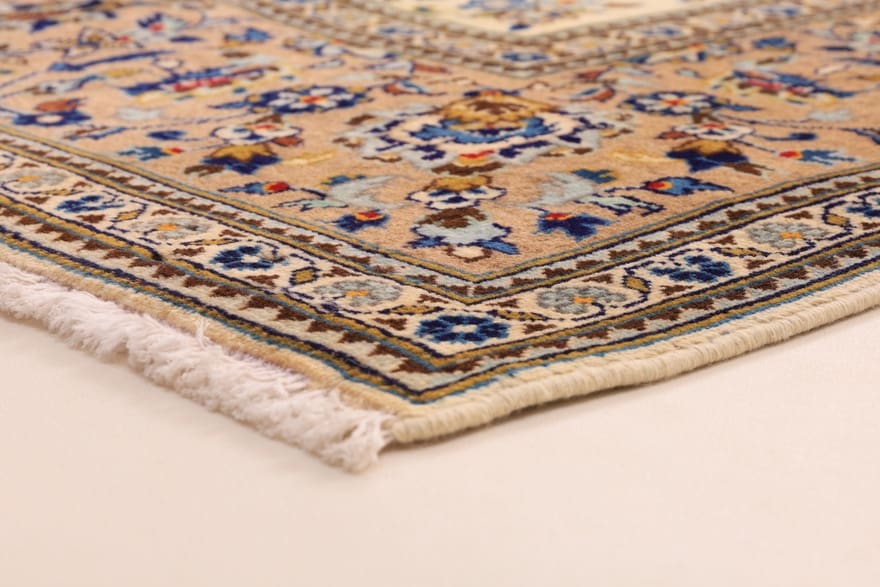
This Keshan Persian rug is hand-knotted and made from high-quality wool. Wool gives the pile a soft, comfortable surface while also providing the resilience associated with traditional rug making. It is a long-established material in Persian weaving. Wool is well suited to taking colour, offers a pleasant handle and can support a durable textile surface for regular use.
Hand-knotting means that each knot is placed by hand as the rug is built on the loom. The process gives the finished piece a clearly handmade character and allows the design to be developed gradually across the field. The stated knot density is between 200,000 and 250,000 knots per square metre. This dense construction supports the precise rendering of the floral motifs and contributes to the compact appearance of the pile.
Unlike machine production, hand-knotting combines the work of the knotter with continuous visual control of the emerging pattern. Rows are built progressively, with attention paid to the alignment of lines, the balance of colours and the definition of individual ornaments. A floral design benefits from this process because curved stems, leaves, petals and smaller decorative details can be arranged with care.
Wool combines comfort with practical use. Its surface feels agreeable underfoot, while the fibre is suitable for the regular demands associated with a household rug. The dense knotting helps the pattern retain its clarity and gives the pile a closely worked structure. Each hand-knotted rug also reflects the particular execution of the people who made it, so the craft remains visible in the way the motifs and surface come together.
The material and construction therefore serve both the visual and functional sides of the piece. The wool provides the tactile foundation, and the knotting creates the textile body in which the pattern is expressed. The result is a rug made according to a traditional Persian technique, with the central floral composition carried through a carefully worked pile.
Origin and Tradition
Keshan, also written Kashan, is a city in Iran’s Kerman province and is known for its carpet tradition. Rugs associated with Keshan are recognised for fine knotting and detailed designs, often combining floral and geometric elements. The name therefore refers not only to a place but also to a characteristic Persian design vocabulary in which technical control and ornament are closely connected.
Iranian rug weaving developed through many regional centres, each with preferences for colour, border structure, field arrangement and ornament. Keshan belongs to the Persian tradition of organised compositions and carefully rendered decoration. Floral forms may be placed around a central feature, while borders establish a visual frame. The overall approach balances richness of detail with a readable structure.
Traditional production begins with the planning of the rug’s layout. The weaver considers the field, the central design and the surrounding borders before transferring the drawing into rows of knots and colour. As the work progresses, the alignment of the contours is checked and the relationship between the separate motifs is maintained. This requires knowledge of the knotting method, the behaviour of wool and the order in which the pattern is built.
Keshan carpet making is associated with a high level of detail. Fine knots allow floral and geometric drawings to be articulated rather than reduced to broad, simple shapes. Petals, leaves, rosettes and curling branches can be given individual definition, while repeated motifs can be kept in proportion to the central design. This relationship between precision and composition is an important part of the tradition.
Persian rugs have long been used in domestic interiors as practical floor coverings and as objects of decorative value. In Iranian households, Keshan rugs have commonly been used in traditional rooms and living areas. Their place in the home reflects the dual role of the rug: it serves a practical purpose while also expressing regional craftsmanship, cultural design and the care invested in manual production.
The Persian weaving tradition also carries knowledge from one generation to the next. Skills include preparing and handling the wool, maintaining an even working tension, following a drawn or remembered design and correcting the visual balance of the emerging field. A finished rug is consequently the result of repeated manual decisions rather than a single industrial process. The established vocabulary of Keshan provides a framework, while the individual making gives the piece its own textile appearance.
This rug is described as originating in Iran beziehungsweise Persia and is offered as a Keshan Persian rug. Its classification should be understood in connection with that stated Iranian origin. The Keshan designation also places the design within a recognised regional tradition of floral ornament, detailed workmanship and classical composition. It does not suggest that every Keshan rug follows one identical pattern; the tradition includes variation in the treatment of the field, medallion and borders.
The continuing relevance of Keshan lies in the way traditional forms remain usable in contemporary homes. A Persian rug can preserve a regional visual language while serving as a functional textile. Hand-knotting keeps the connection to the craft process evident, and the floral design links the piece to a wider history of Persian decorative art.
Design and Pattern
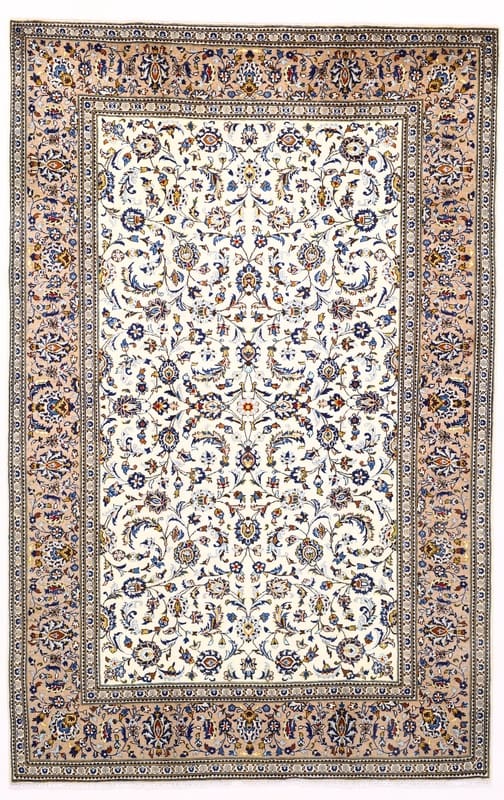
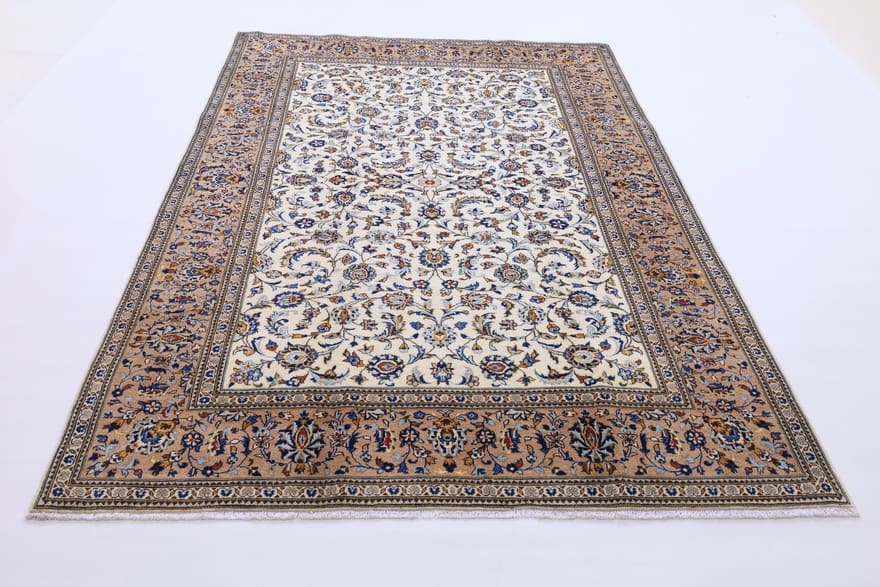
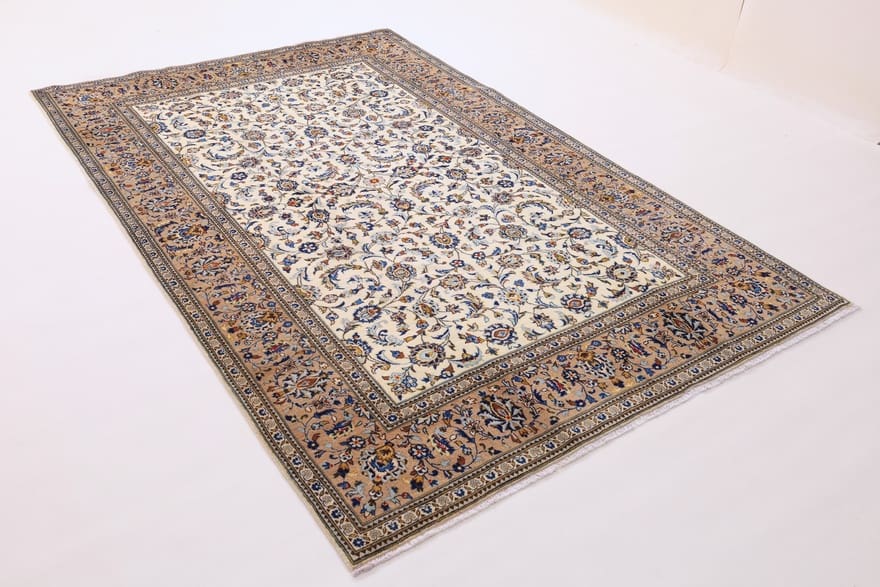
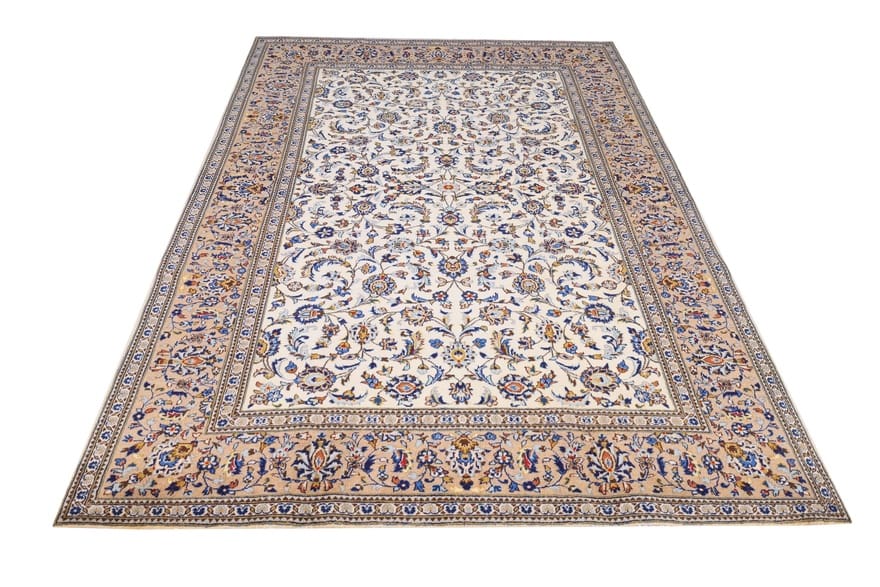
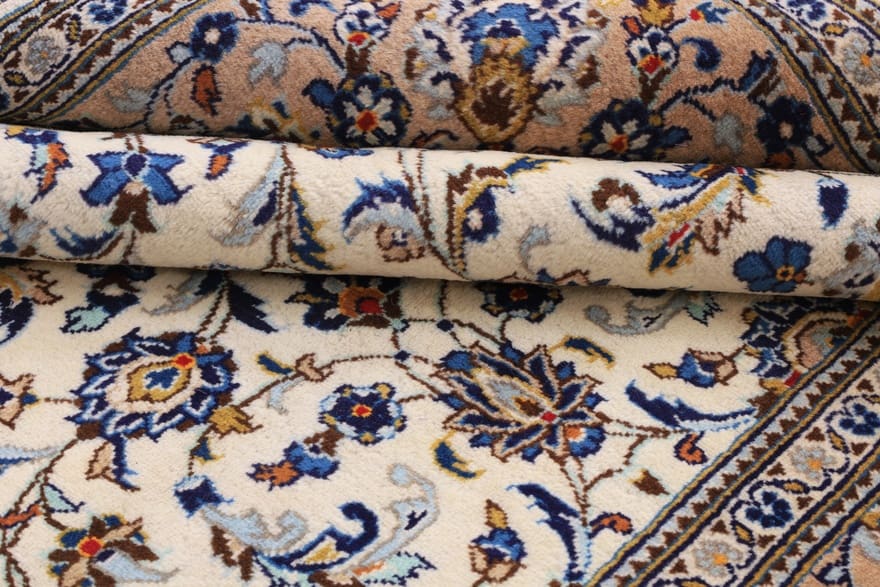
The design of this rug centres on a medallion with floral motifs. A central medallion establishes a strong focal point within the field and gives the composition a clear visual order. Around that centre, floral elements provide movement and decoration through stylised flowers, leaves and plant forms. Together, these features create the classical floral pattern stated for the rug.
Floral ornament is one of the defining languages of Persian carpet design. The motifs are generally not intended as literal botanical illustrations. Instead, natural forms are adapted into balanced shapes that can be repeated, mirrored or connected by stems and scrolling branches. This stylisation allows the pattern to suggest nature while remaining suited to the geometry of a woven or knotted surface.
The medallion gives the eye a point of orientation, while the surrounding motifs connect the centre with the rest of the field. In a classical composition, decorative elements usually relate to one another through repetition, symmetry or directional movement. Leaves may frame flowers, branches may guide the eye outward and smaller ornaments may fill spaces between larger forms. The arrangement creates coherence without removing the visibility of individual details.
The phrase classical floral pattern describes a traditional decorative direction rather than a modern abstract treatment. It can sit alongside furnishings with historical references, where the ornament reinforces an established interior language. It can also be used with simpler contemporary furniture, where the rug introduces a Persian textile accent. The design remains recognisably traditional while being adaptable to different room settings.
Within Persian culture, floral motifs are often associated with ideas such as growth, love and completeness. These associations form part of the broader cultural background of the ornament. In the rug itself, their primary role is visual: flowers, foliage and related forms organise the field around the medallion. Their symbolic history adds context, while the actual appearance depends on the specific arrangement and execution of the hand-knotted design.
The detailed pattern is closely connected with the rug’s construction. A dense knotting makes it possible to define outlines and distinguish between adjacent floral shapes. It supports the transition from one colour area to another and helps preserve the relationship between small ornaments and the larger medallion. Technical precision is therefore part of the design, not separate from it: the pattern becomes legible through the way the knots are placed.
Persian floral designs appear across carpets, decorative arts and architecture. In rugs, these forms are translated into a surface that can be viewed from above and used in a room. Borders may act as a frame, while the field carries the principal narrative of the ornament. The Keshan tradition places emphasis on an ordered, detailed composition, and this rug’s central medallion and floral motifs belong to that broader design context.
The description characterises the colours as restrained and the details as fine. This gives the composition a measured visual presence while allowing the floral decoration to remain visible. The rug can therefore function as a decorative element without relying on an overly forceful pattern. Its classical structure, central focus and botanical ornament keep the design connected to Persian tradition.
Special Features
A defining feature of this Keshan rug is the combination of hand-knotting, high-quality wool and a classical floral design. The craftsmanship is expressed through the care visible in the individual knots and in the execution of the central medallion. The rug is described as modern, with a stated age category of 0-20 years. It is therefore a relatively recent piece within the continuing Persian rug tradition.
The rug is described as suitable for heavily used areas and as easy to clean and maintain. Regular vacuuming can remove dust and everyday dirt. Stains should be gently blotted with a damp cloth. Harsh cleaning products and direct sunlight should be avoided in order to help preserve the colours. These care notes relate to the stated wool material and the practical use described for the rug.
Its classical design is described as suitable for both modern and traditional interiors. Suggested settings include living rooms, dining areas and hallways. The rug is also described as suitable for rooms with underfloor heating because of its wool and dense knotting. The temperature should not be set too high, so that the rug is not damaged. These features combine decorative use with the practical applications stated for this individual piece.
FAQ
How should I care for the Keshan Persian rug?
Regular vacuuming helps remove dust and dirt from the surface. If a stain occurs, gently blot it with a damp cloth rather than rubbing it aggressively. Harsh cleaning products should be avoided. Direct sunlight should also be limited to help maintain the colours. For more extensive cleaning, a careful treatment suitable for wool rugs is advisable.
Where can I use the Keshan rug?
The rug is described as suitable for living rooms, dining areas and hallways. Its classical floral pattern can complement both traditional and modern interiors. The central medallion provides a defined decorative focus, while the floral motifs add a Persian textile character to the room without changing the basic function of the rug as a floor covering.
Is the rug suitable for underfloor heating?
Yes. The rug is described as suitable for rooms with underfloor heating because it is made of wool and has a dense knotting technique. The temperature should not be set too high in order to avoid damaging the rug. A moderate setting supports careful use of the wool pile and the hand-knotted structure.
To provide the best experiences, we use technologies like cookies to store and/or access device information. Consenting to these technologies will allow us to process data such as browsing behavior or unique IDs on this site. Not consenting or withdrawing consent, may adversely affect certain features and functions.
Functional Always active
The technical storage or access is strictly necessary for the legitimate purpose of enabling the use of a specific service explicitly requested by the subscriber or user, or for the sole purpose of carrying out the transmission of a communication over an electronic communications network.
Preferences
The technical storage or access is necessary for the legitimate purpose of storing preferences that are not requested by the subscriber or user.
Statistics
The technical storage or access that is used exclusively for statistical purposes.The technical storage or access that is used exclusively for anonymous statistical purposes. Without a subpoena, voluntary compliance on the part of your Internet Service Provider, or additional records from a third party, information stored or retrieved for this purpose alone cannot usually be used to identify you.
Marketing
The technical storage or access is required to create user profiles to send advertising, or to track the user on a website or across several websites for similar marketing purposes.
 SECURE PAYMENT
 SHIPPING PARTNERS


