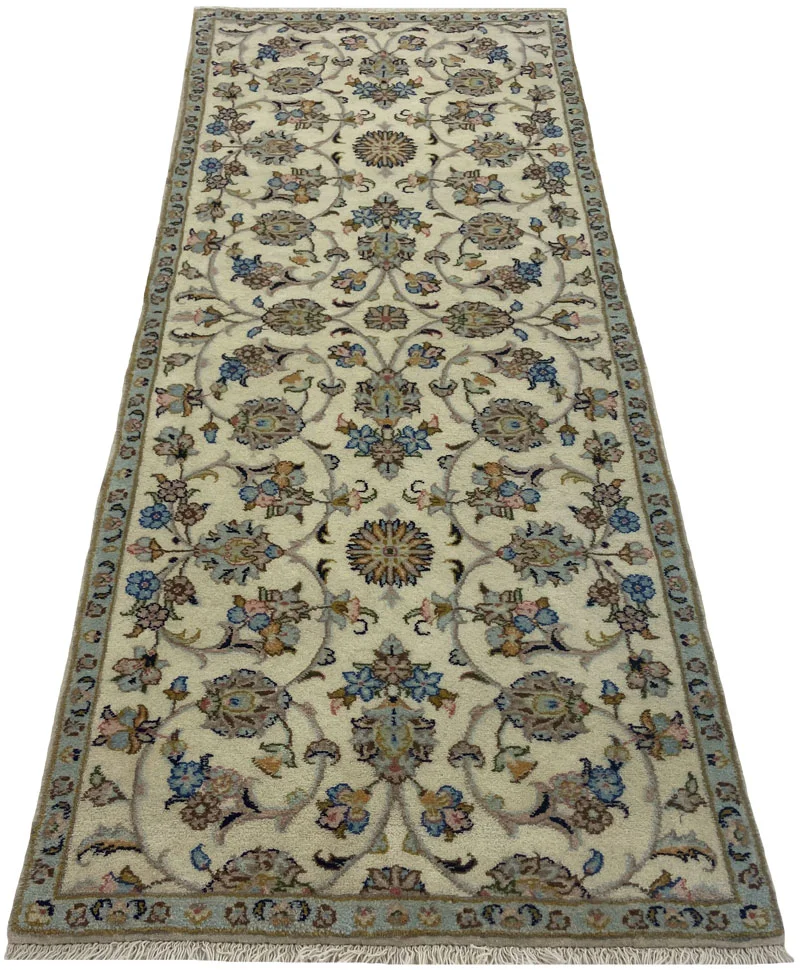
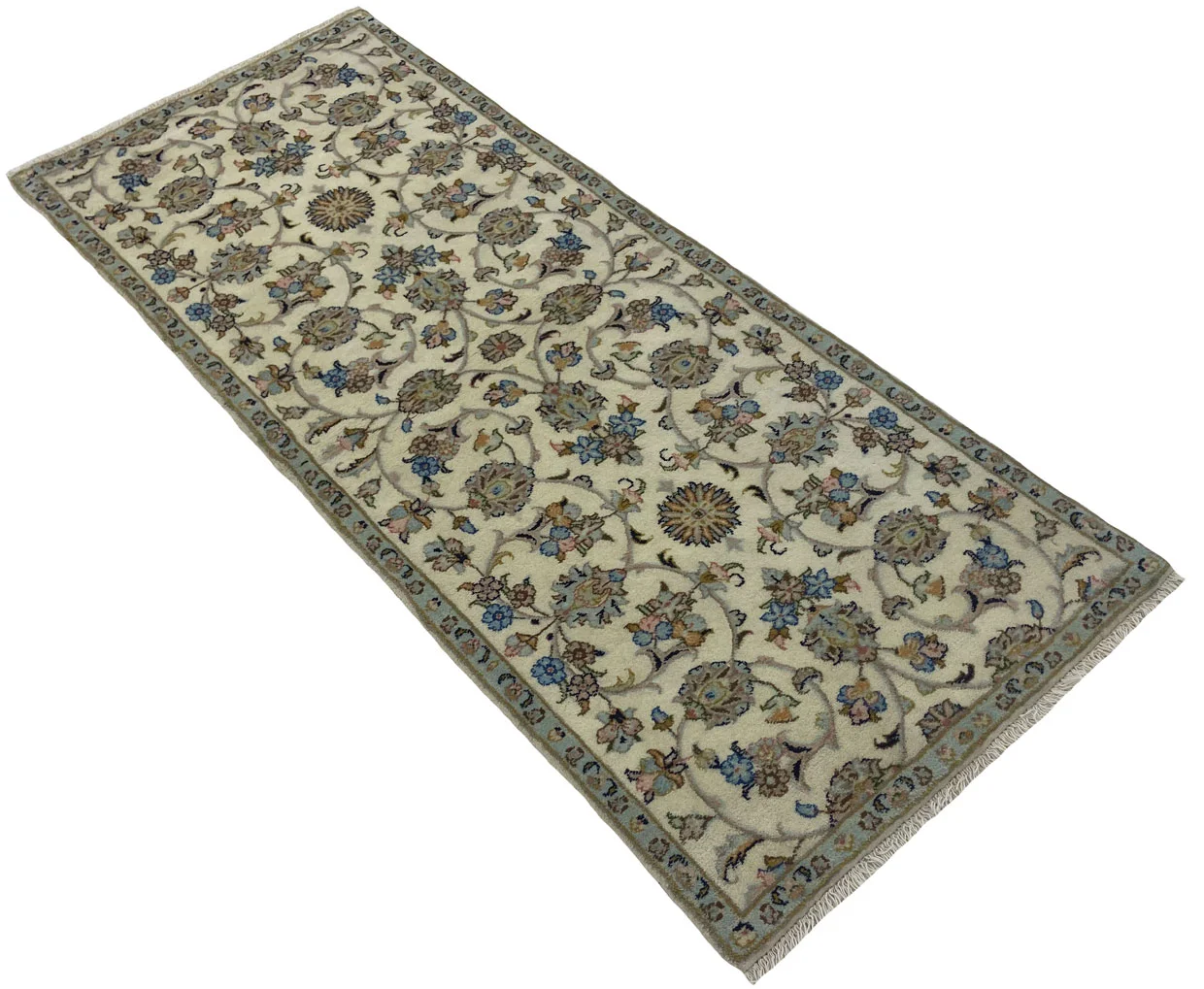
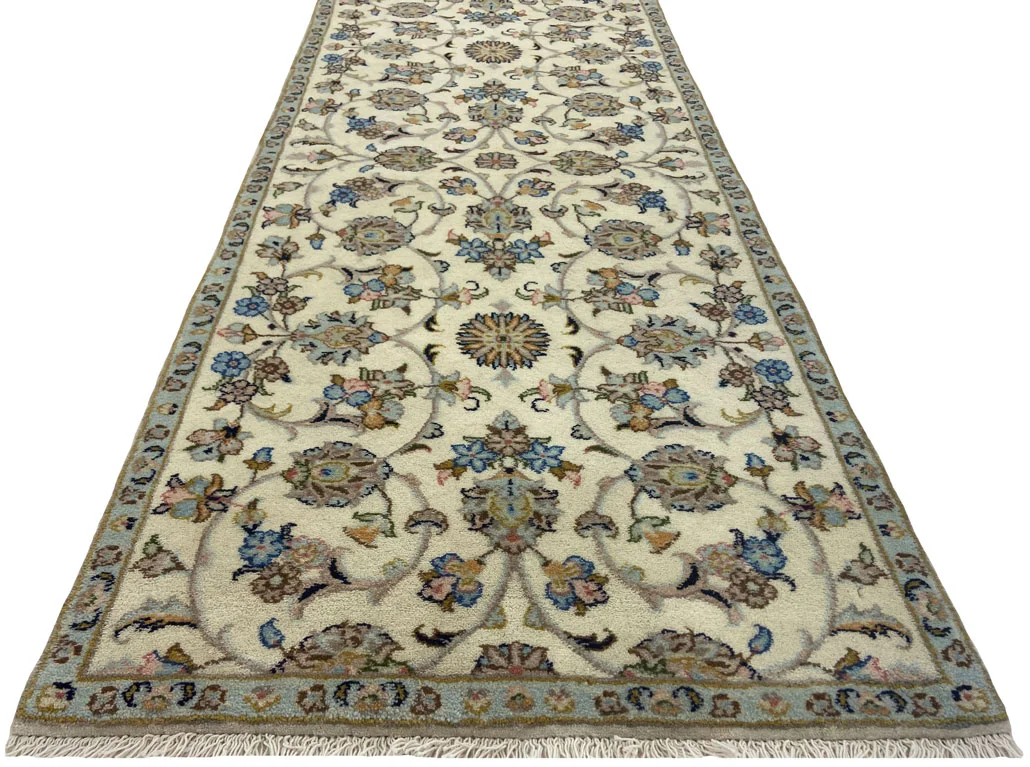
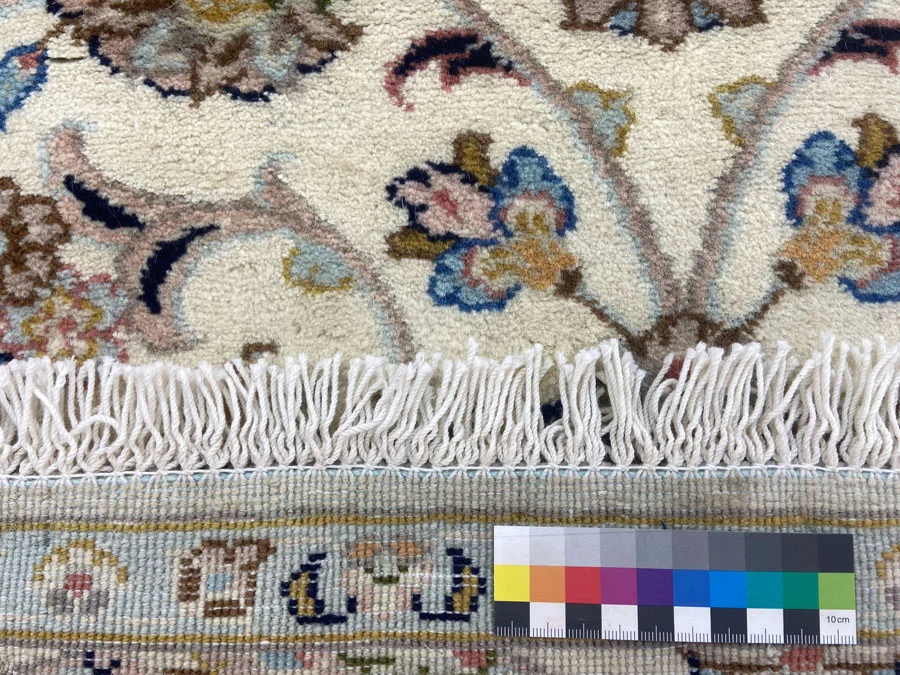
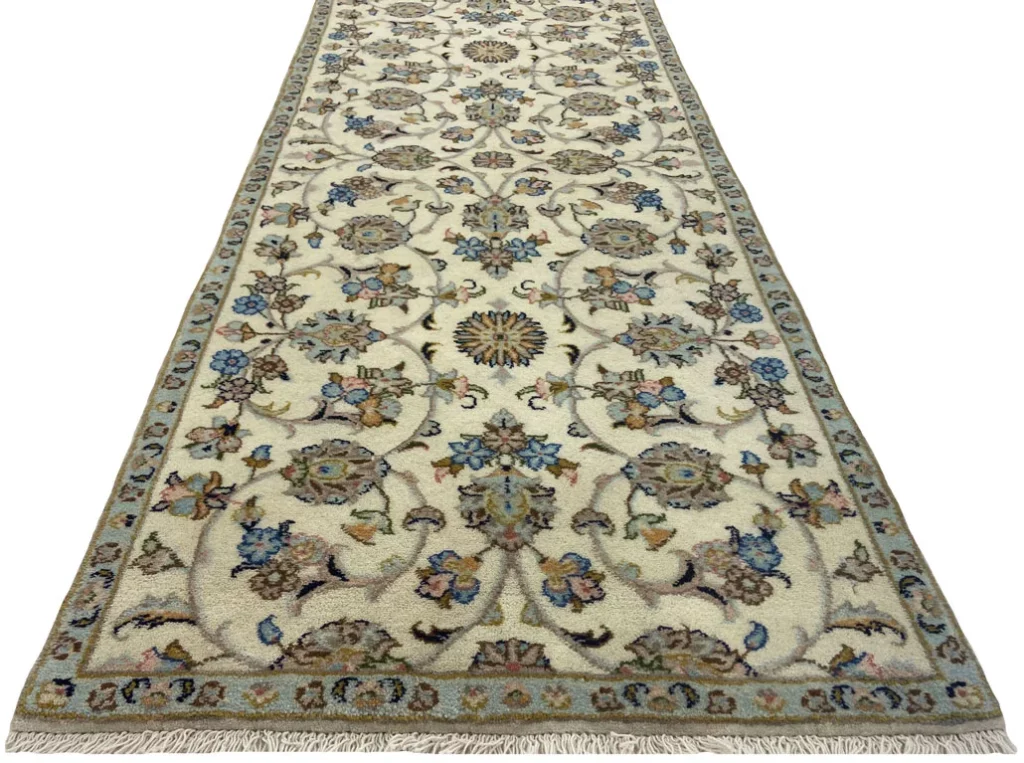
This Keshan Persian rug comes from Iran and is hand-knotted. The pile is made of high-quality sheep wool, while cotton is used for the warp. This combines a woollen surface with a firm textile foundation. The source describes the rug as hard-wearing and as being of excellent quality. These characteristics relate to the interaction of material, construction and hand craftsmanship.
In hand knotting, the pile is built knot by knot around a stretched warp. Knots are placed in rows and secured with weft threads. The surface is therefore created during the making process rather than printed or applied afterwards. Preparing the warp, maintaining an even sequence of rows and carrying the design through the work all require careful craft. Hand knotting is one of the established techniques of Persian rug production.
Sheep wool has been used for rugs for centuries because it can be made into a resilient pile. Its fibre structure accepts colour and can form a compact surface when properly worked. Cotton is often used for the warp in traditional rugs because it provides a consistent and stable base. For this rug, the source explicitly names both materials: high-quality sheep wool for the pile and cotton for the warp.
The stated knot density is between 150,000 and 300,000 knots per square metre. In general, a high knot density permits finer rendering of lines, small ornaments and transitions within a design. It also indicates the labour involved in producing the knotted surface. When a hand-knotted rug is assessed, the quality of the wool, the strength of the warp and the care of the execution are considered alongside density. This rug is described as hard-wearing and of excellent quality.
Hand-knotted rugs differ from machine-made floor coverings through their gradual construction. Each row is made separately, and the design has to be followed as the work progresses. Technical structure and visual design are therefore directly connected. The cotton warp supports the pile, while the sheep wool forms the visible and tactile surface. This relationship explains why material and knotting method are central to Persian rug craftsmanship.
Origin and Tradition
Keshan, also written as Kashan, lies in central Iran and is recognised as a historic centre of Persian rug making. The city stands within a cultural landscape shaped by the settlements and routes of the Iranian plateau. These routes allowed goods, colours, textile fibres and craft knowledge to move between regions. Over time, Keshan developed an important tradition of textile production and hand-knotted rugs.
The Keshan rug tradition belongs to the long history of Persian craftsmanship. Knowledge of spinning wool, dyeing yarn, preparing the warp and executing designs was handed down through generations. A rug is made through a sequence of connected operations rather than one isolated action. The warp is first arranged on the loom. Knots are then tied, weft threads are inserted and the rows are compacted. The finished textile emerges through the continued coordination of these stages.
The Silk Road played a role in Keshan’s economic and cultural development. Its position within an extensive trading network encouraged the exchange of silk, spices and other goods, as well as ideas about colour, ornament and textile technique. Keshan gained prosperity and international recognition through this exchange. Rugs from the region became important trade goods whose value was associated with materials, labour and the precision of their drawn designs.
Persian rugs represent many regional workshop traditions rather than one uniform style. Different places developed their own approaches to composition, ornament, colour and technical execution. Keshan is associated with carefully drawn and detailed patterns. Isfahan is known for artistic designs and fine knotting. Tabriz is associated with a broad range of colours and detailed pattern work. Nain and Kashan are also valued for quality and craftsmanship. These names identify different centres within the wider heritage of Iranian rugs.
Traditional workshops rely on practical knowledge distributed across several tasks. Preparing the warp, selecting and dyeing wool, reading a design and tying the knots each require experience. The pattern is not simply placed on a completed surface. It is constructed from individual knots as the rug is made. Planning and technical discipline are therefore inseparable from the visual result. Hand knotting preserves a method that has been refined within Persian textile culture over a long period.
The use of wool and cotton also belongs to this established tradition. The pile provides a usable surface capable of holding colour, while the warp gives the structure support. The quality of a rug does not depend on one feature alone. Material, knotting, tension, drawing and finishing work together. Keshan rugs are particularly associated with the combination of careful design and accomplished handwork.
Persian rug making has served different interiors and purposes throughout its history. Workshops produced small rugs, runners and larger pieces for living areas. Despite this variety, the essential principle of hand knotting remained the same. A runner can carry the same regional design language as a larger rug, while its elongated format changes how the composition is experienced. The shape does not alter the underlying craft tradition.
Design and Pattern
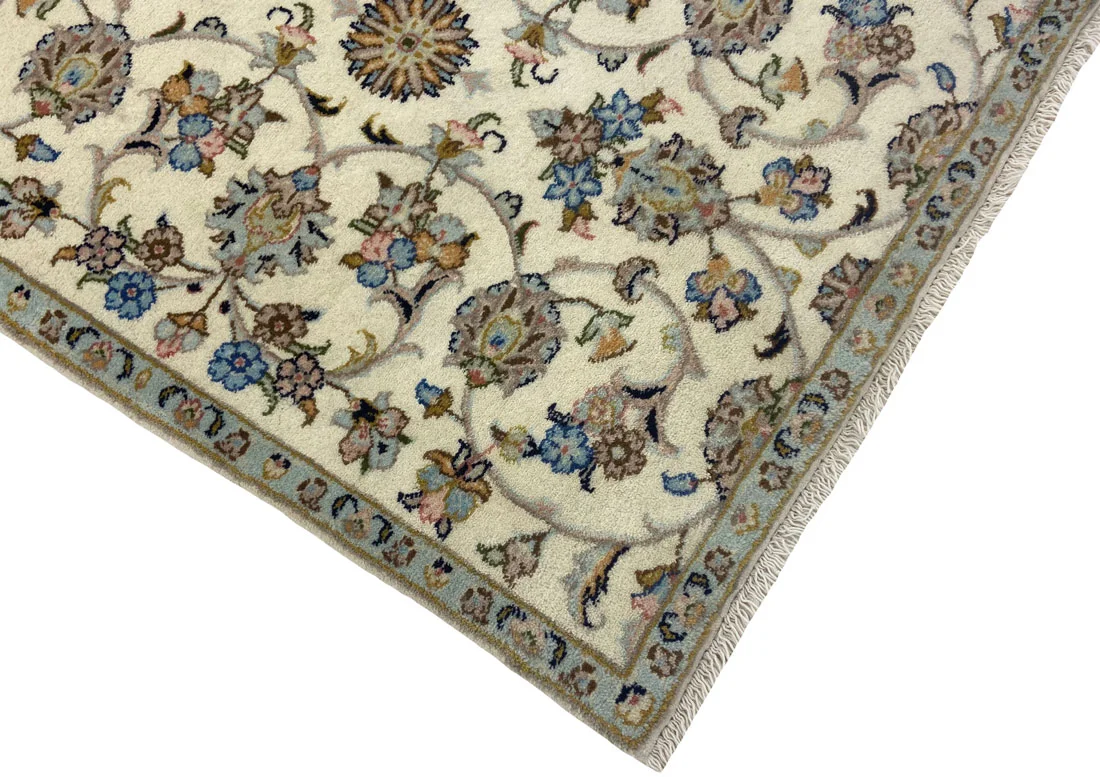
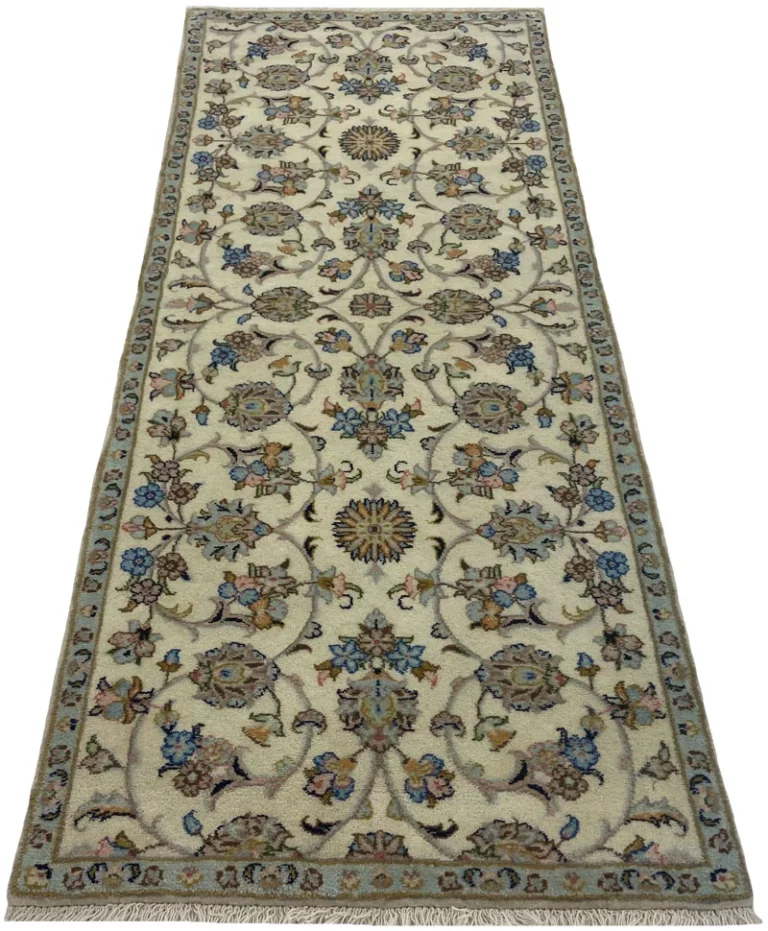
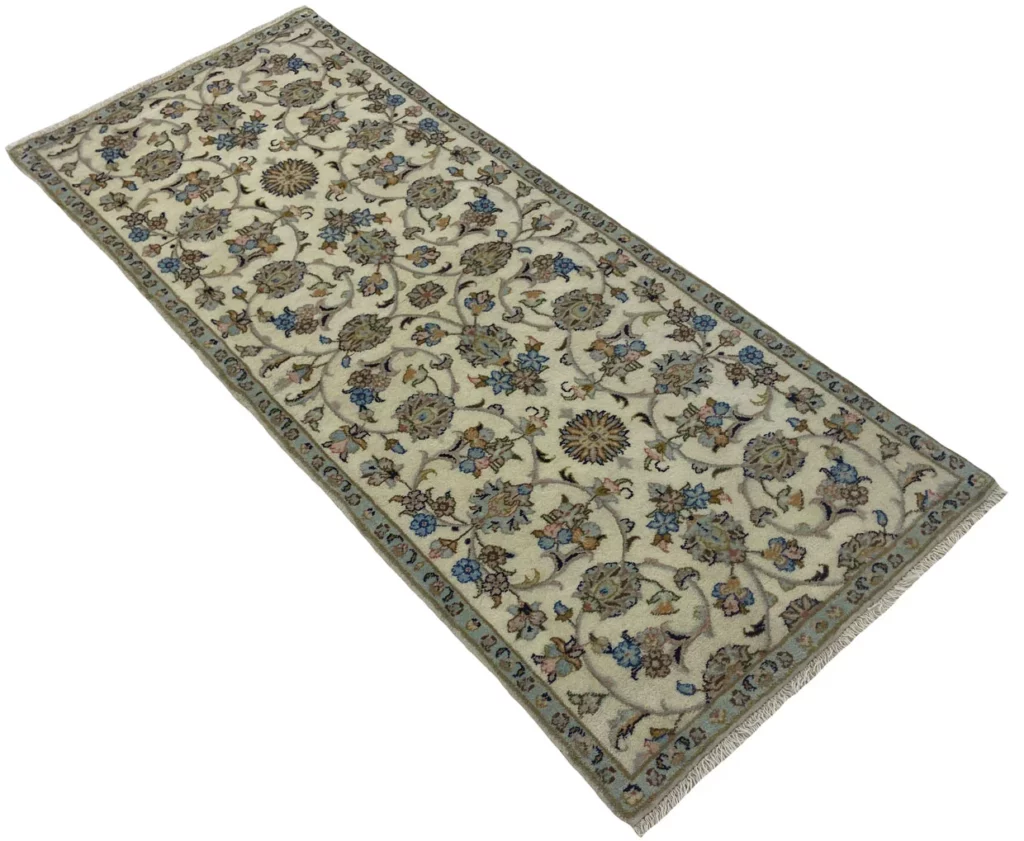
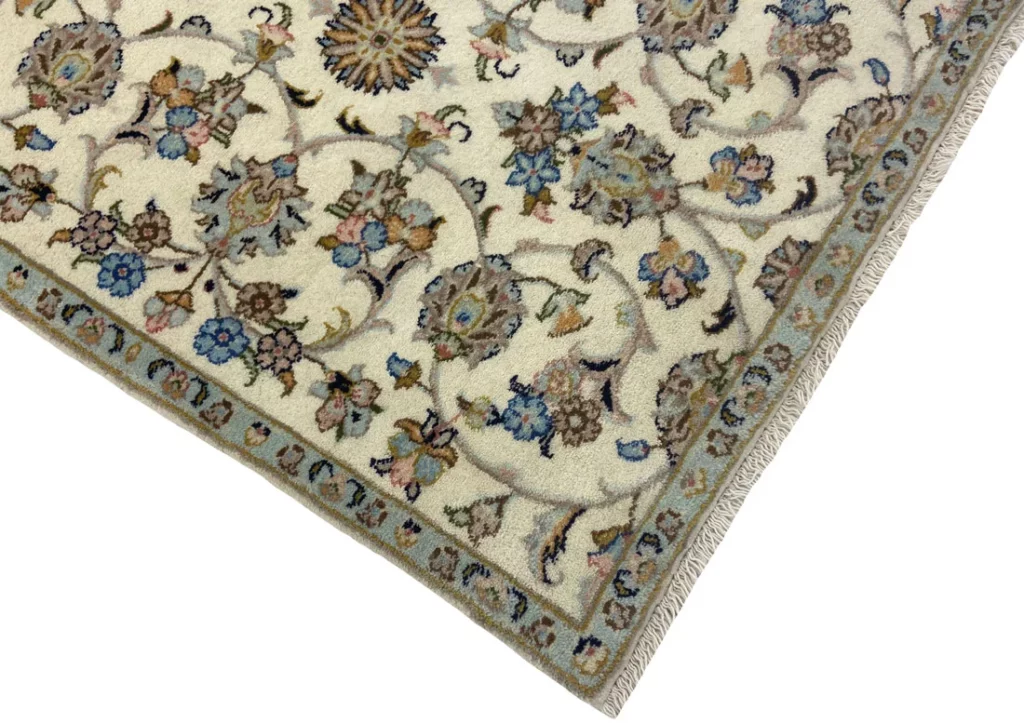
Keshan rugs are known for refined and detailed designs. Their traditional compositions may combine floral and geometric elements. Floral forms can include scrolling branches, leaves and blossoms, bringing curved movement to the field. Geometric forms introduce repetition, axes and a clearly ordered structure. Used together, these two visual languages can create a design that is both ornamental and organised.
Persian rug designs are often arranged within an overall framework. A central field may be organised around a principal ornament or a repeated drawing. A border encloses the outer edge and gives the composition a visual conclusion. Secondary borders can mediate between the central field and the outside. These terms explain the traditional vocabulary of rug design; they do not add an unreported detail to every part of this particular rug. The established point here is the Keshan connection with detailed floral and geometric pattern work.
The colour range associated with Keshan rugs extends from deep red and blue to soft beige tones. Colours may be balanced in different proportions and accompanied by additional shades. In Persian rug making, colour does more than fill separate areas. It distinguishes foreground from background, strengthens outlines and makes recurring ornaments easier to read. In a hand-knotted rug, colour transitions are produced through the arrangement of differently coloured knots. Colour selection and distribution therefore affect the clarity of the design.
Detailed drawing requires careful execution. The knotter must follow the position of individual forms row by row. Small changes in placement can alter the line of a leaf, branch or geometric element. The high knot density specified for this rug is one of the technical conditions under which fine designs can be represented. It does not, however, permit a specific motif that has not been stated to be assigned to the rug.
Floral patterns bring movement across a surface. Scrolling branches can guide the eye through a field, blossoms can provide accents and leaves can reinforce the rhythm of a line. Geometric patterns organise areas through repetition and symmetry. Many Persian designs combine both principles. A geometrically ordered border may frame a floral field, or a floral ornament may be placed within a clear axis. This interaction is an important part of the regional design tradition.
The appearance of a pattern is also related to the pile and the density of the surface. A short, dense pile can keep contours distinct and may make everyday care easier. During handwork, knots must be placed so that the drawing remains coherent across the rows. Material and design are therefore not separate layers: the sheep wool carries the colour and forms the surface, the cotton warp supports the construction and the knotting process translates the drawing into the rug.
Keshan patterns belong to a broader Persian visual vocabulary. Isfahan, Tabriz, Nain and Kashan each have their own traditions, even though floral, geometric and colour ideas may overlap. The regional name Keshan consequently refers to a particular origin and workshop culture, not to an arbitrary ornament. The combination of detailed drawing, coordinated colour and handwork explains the continuing place of this rug type in Iranian textile history.
Special Features
The features stated for this rug are its Iranian origin, hand-knotted construction, high-quality sheep wool pile and cotton warp. The listing also gives a knot density of 150,000 to 300,000 knots per square metre, describes the rug as hard-wearing and classifies it as being of excellent quality. These details concern its materials, technique and technical density. No date of manufacture or additional provenance is supplied.
The combination of wool and cotton brings together a traditional pile fibre and a stable warp material. The name Keshan places the rug within the Iranian Persian rug tradition. As a runner, its elongated format is generally suitable for narrower areas such as hallways and passageways. The best placement depends on the floor, amount of use and furnishings. Regular vacuuming and professional rug cleaning when necessary are recommended for care.
FAQ
What makes a Keshan Persian rug distinctive?
Its distinctive character comes from its Iranian origin, hand-knotted construction, high-quality sheep wool and cotton warp. The specified knot density supports detailed execution, for which Keshan rugs are known. Floral and geometric elements belong to the traditional design language of this rug type. This offering is also described as hard-wearing and as being of excellent quality.
How should I care for my Keshan Persian rug?
Vacuum the rug regularly and carefully to remove dust and loose dirt. Cleaning should take the hand-knotted construction, wool pile and cotton warp into account. If stains occur or more extensive treatment is required, professional rug cleaning is advisable. A specialist can choose a process suited to the fibres and construction. Appropriate, gentle treatment helps preserve the surface and the appearance of the design.
Which rooms are suitable for a Keshan Persian rug?
A Keshan Persian rug can be used in a living room, bedroom or hallway. Its runner format is generally suited to narrower areas and passageways. The traditional design language, with floral and geometric elements, can work with different interior styles. Before placing it, consider the floor surface, traffic route and care conditions so that the hand-knotted rug lies securely and receives suitable treatment.
To provide the best experiences, we use technologies like cookies to store and/or access device information. Consenting to these technologies will allow us to process data such as browsing behavior or unique IDs on this site. Not consenting or withdrawing consent, may adversely affect certain features and functions.
Functional Always active
The technical storage or access is strictly necessary for the legitimate purpose of enabling the use of a specific service explicitly requested by the subscriber or user, or for the sole purpose of carrying out the transmission of a communication over an electronic communications network.
Preferences
The technical storage or access is necessary for the legitimate purpose of storing preferences that are not requested by the subscriber or user.
Statistics
The technical storage or access that is used exclusively for statistical purposes.The technical storage or access that is used exclusively for anonymous statistical purposes. Without a subpoena, voluntary compliance on the part of your Internet Service Provider, or additional records from a third party, information stored or retrieved for this purpose alone cannot usually be used to identify you.
Marketing
The technical storage or access is required to create user profiles to send advertising, or to track the user on a website or across several websites for similar marketing purposes.

 SECURE PAYMENT
 SHIPPING PARTNERS


