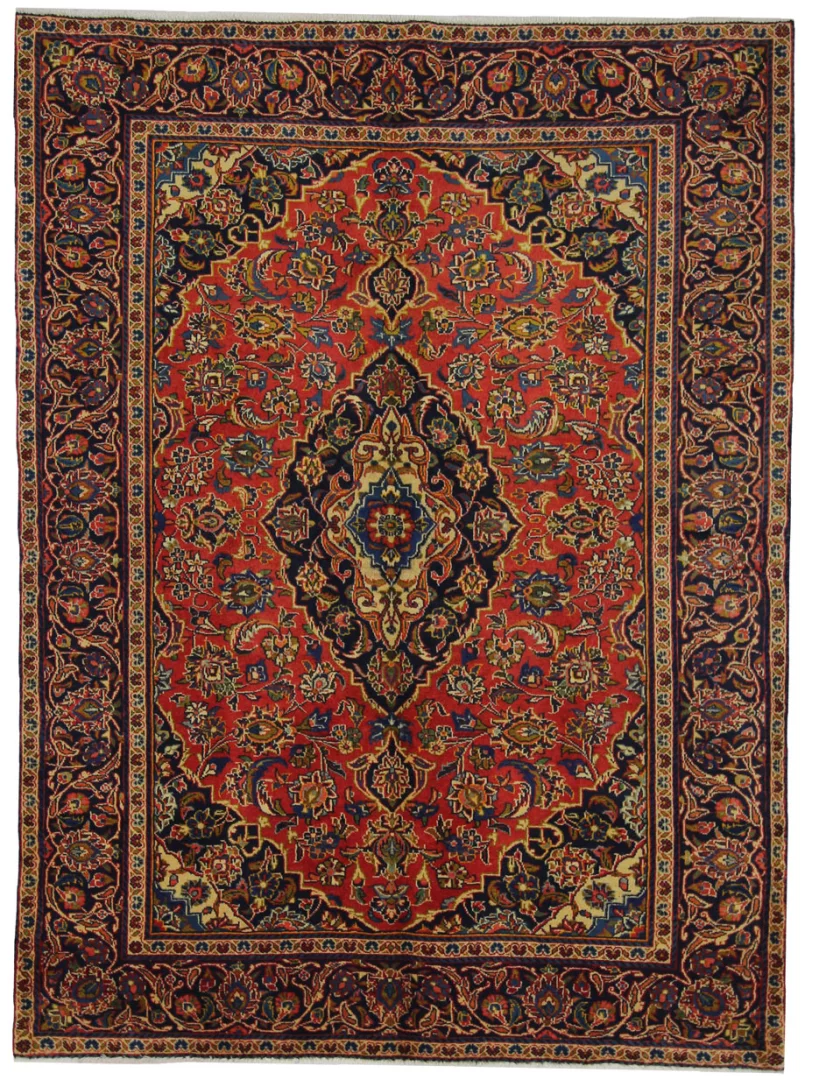
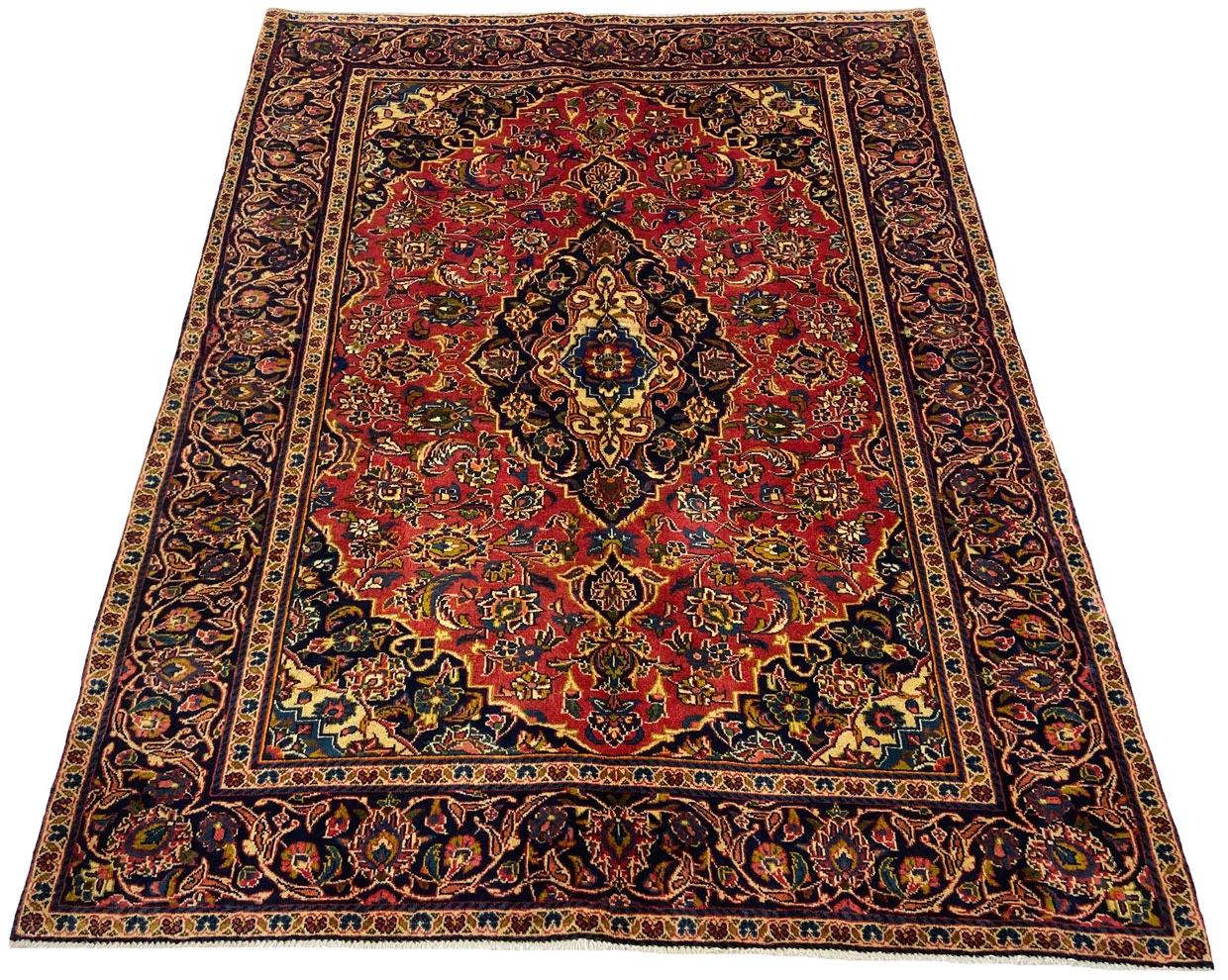
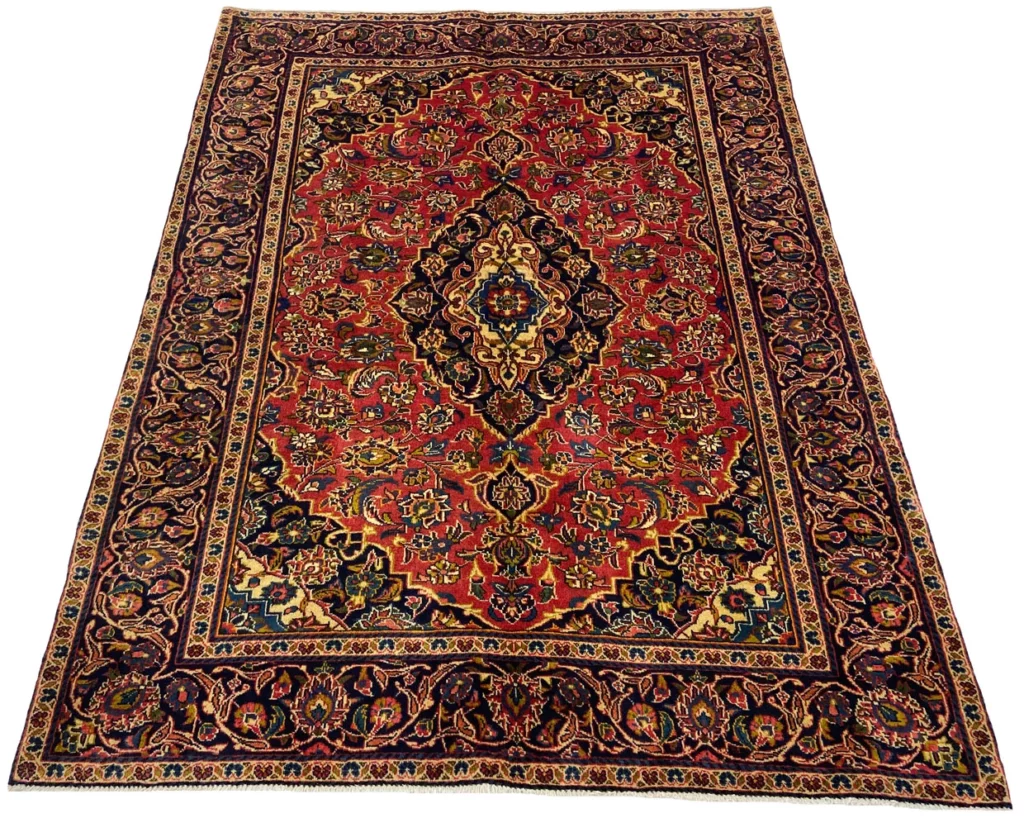
Hand-knotted Keshan Persian rug | Knot density: 150,000 – 300,000 knots/m² | Material: high-quality sheep wool pile, cotton warp and weft | Size: 187 x 140 cm | Pattern: floral and ornamental patterns in harmonious colours | Condition: Very good
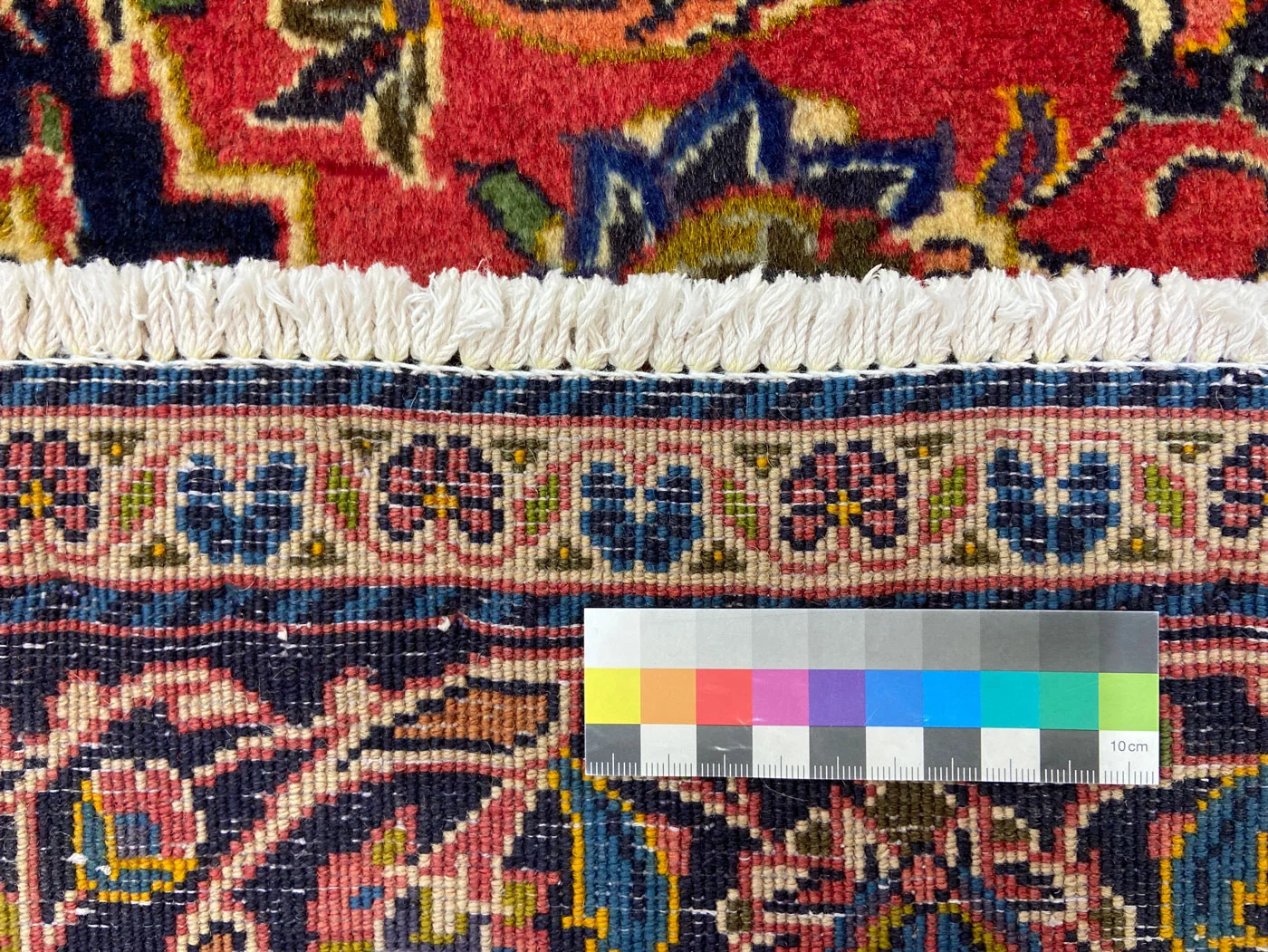
This Keshan Persian rug is hand-knotted with a pile of high-quality sheep wool. Cotton is specified for both the warp and the weft. The visible surface is therefore formed by wool, while the cotton belongs to the textile foundation that supports the rows of knots. This combination is associated with the established construction of Keshan rugs and brings together a woollen pile with a firm woven base.
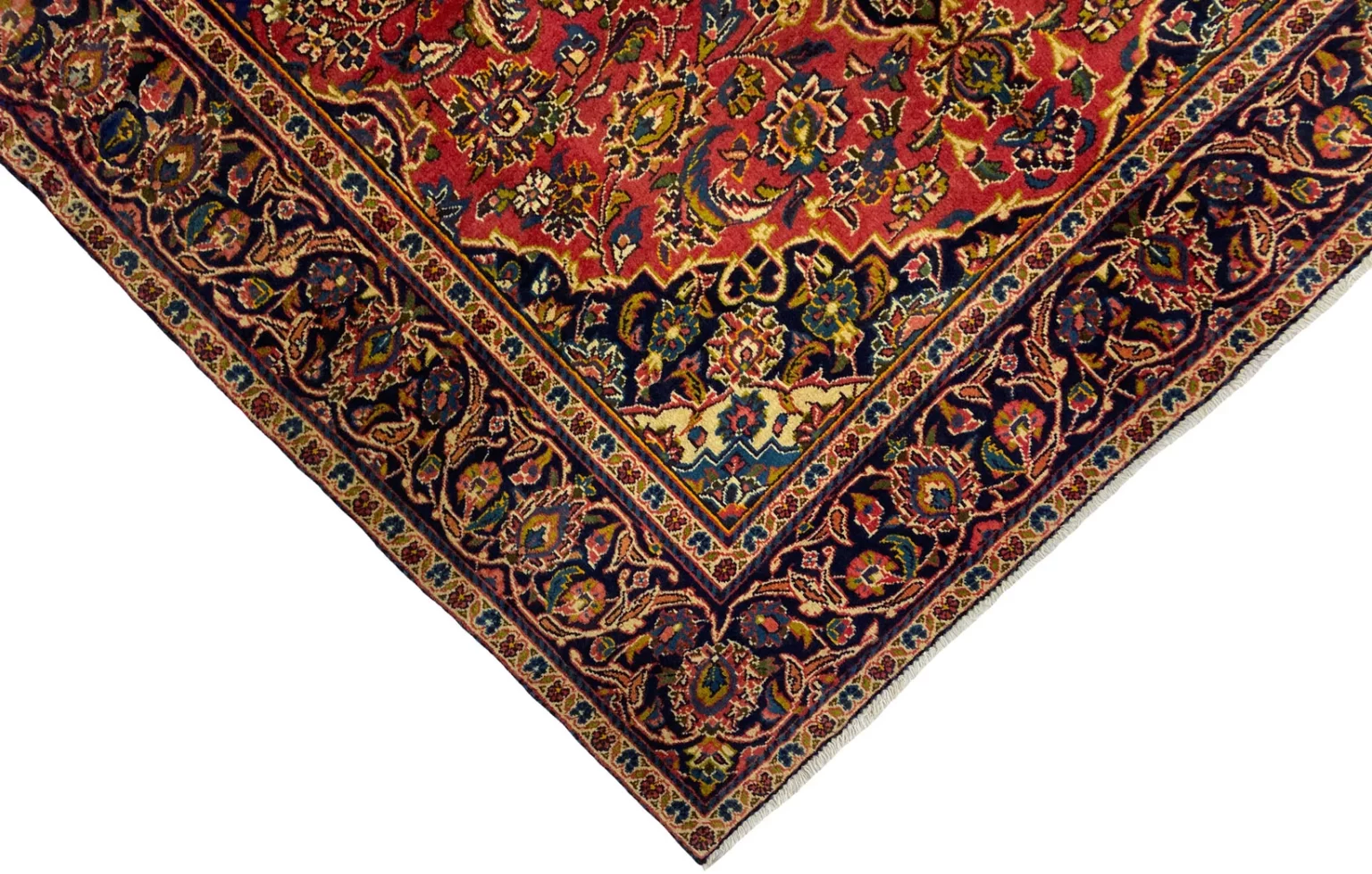
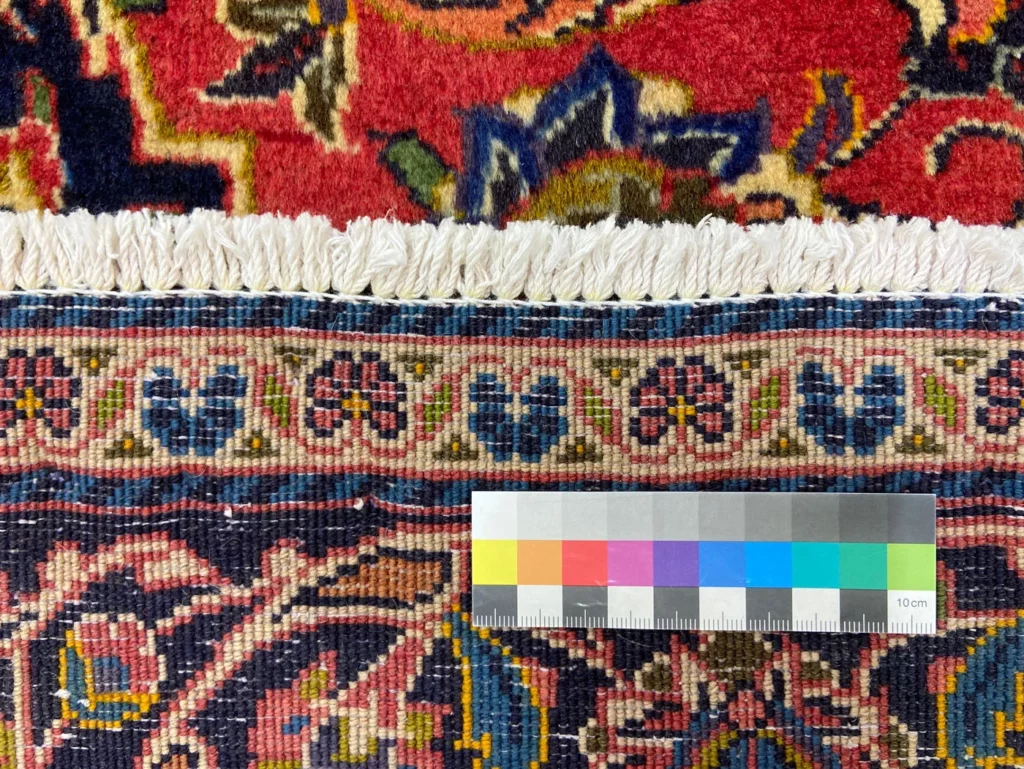
The knot density is 150,000 to 300,000 knots per square metre. In hand-knotting, individual knots are tied into the prepared warp and secured by successive weft passages. The rug is built gradually at the loom rather than produced as one industrial surface. Once the knotting is complete, the pile is trimmed and finished so that the drawing can be read across the surface. Keshan rugs are traditionally associated with a short pile, and the description also identifies high-quality wool and durability among their characteristic qualities.
Wool is used in oriental rug making because its fibres are suitable for a resilient pile and a closely worked surface. Cotton can be tensioned in an orderly way as warp and weft, creating a stable framework for the knotted rows. The hand-knotted method makes the structure distinct: the surface is made from many separate knots rather than from a printed design or a mechanically inserted pattern. The stated knot density and the named materials are consequently important parts of the rug’s construction.
Origin and Tradition
Keshan rugs originate in Keshan, Iran. The city belongs to a region with a long tradition of rug weaving and is known for historical knotting methods and skilled workmanship. Keshan is one of the Persian weaving centres whose products have been shaped over generations by established approaches to structure, drawing and ornament. The name Keshan therefore identifies not only a place, but also a developed textile tradition.
In a Persian rug workshop, production proceeds through a sequence of coordinated tasks. Warp threads establish the lengthwise framework, weft passages secure the rows, and the pile is built knot by knot. The weaver follows a planned design while maintaining the intended order of the field, borders and smaller ornaments. The time required depends on the density and complexity of the design. Craftsmanship is not limited to the number of knots; it also includes keeping the rows controlled, the outlines precise and the relationship between ground and motifs consistent.
The Keshan tradition forms part of the wider history of Iranian carpet making. Keshan rugs are counted among the recognised hand-knotted Persian rugs produced for domestic use and for broader trade. Their tradition joins the practical purpose of a floor covering with an intentionally organised ornamental surface. Workshops and manufacturers in the region have become known for producing rugs influenced by both traditional and more contemporary ideas. Even where the drawing changes, handwork remains an important reference point in the making of Keshan rugs.
Other important rug traditions are also associated with the wider Persian weaving world. Isfahan rugs are known for complex designs and lively colours. Tabriz rugs are often described through large medallions and geometric patterns. These comparisons show that Iranian weaving centres developed distinct visual priorities while sharing fundamentals such as careful knotting, the use of wool and the importance of a clearly structured design. They do not alter the origin of this rug, which is Keshan in Iran.
The long history of Persian rugs explains why a place name can carry both geographic and craft-related meaning. Designs may be passed between generations, adapted in workshops and adjusted for changing interiors while retaining recognisable regional principles. Keshan remains associated with floral and ornamental compositions and with a balanced treatment of colour. Its Iranian origin and its classification as a Persian rug are consequently central to its cultural and technical context.
Design and Pattern
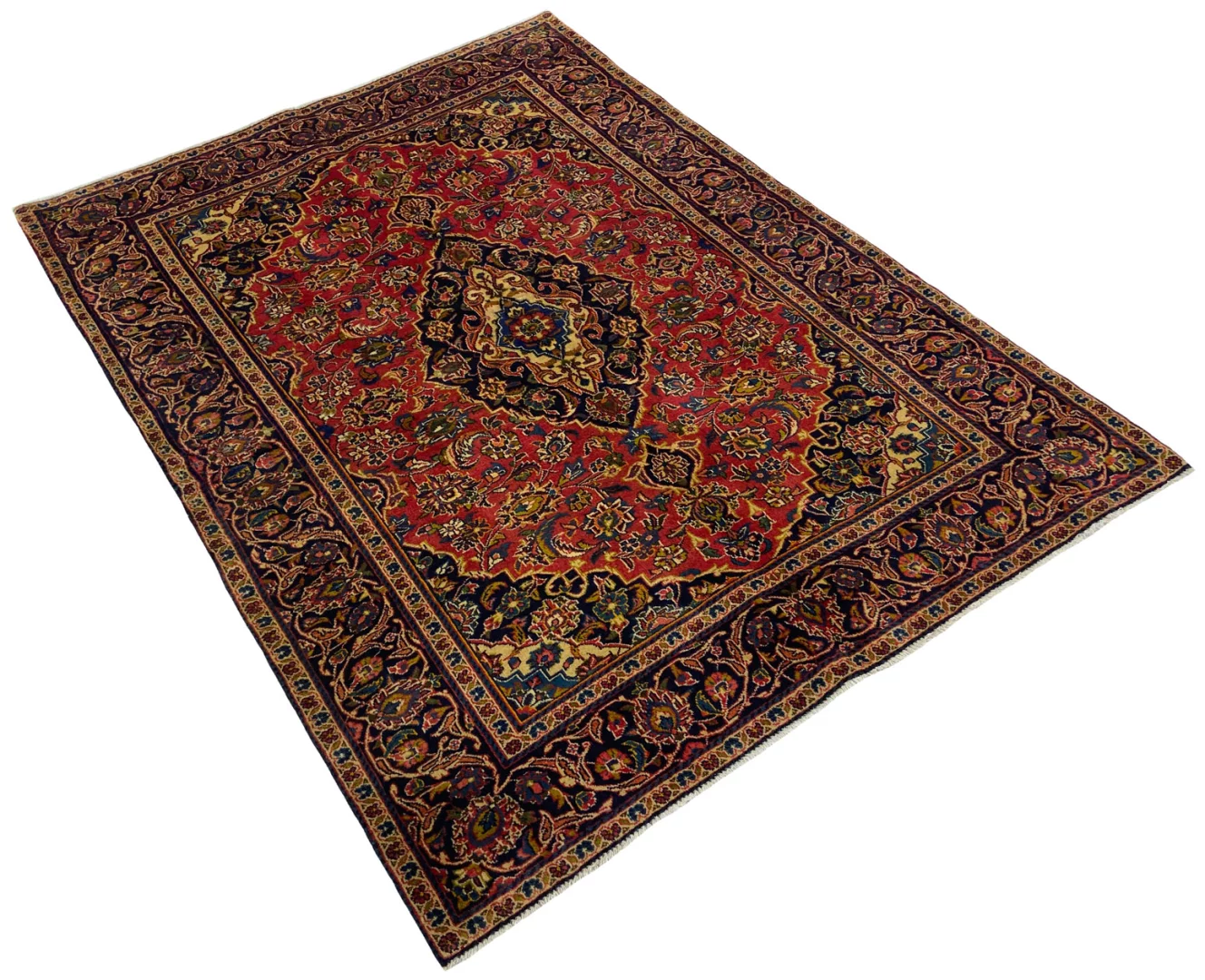
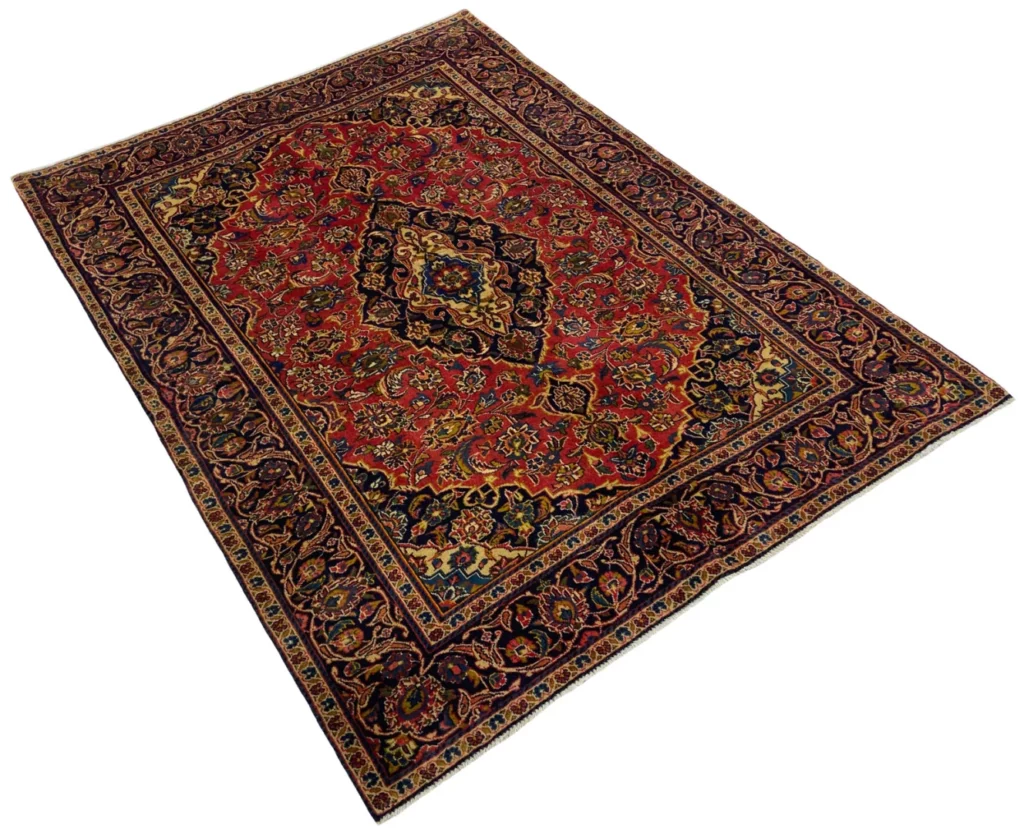
The pattern language described for this rug is floral and ornamental. Such designs divide the surface into connected areas and combine larger forms with finer details. Leaves, flowers and stylised vines can be arranged as a repeated all-over composition or around a central organisation. The description of this Keshan identifies floral and ornamental patterns in harmonious colours, but it does not specify individual motifs or a particular central layout. Those details should therefore be read from the rug itself rather than added as an assumption.
Keshan designs generally depend on clear drawing and controlled line work. Contours separate one ornament from another, while smaller fillers enliven the spaces between larger forms. A design may use a central medallion, an organised field of plant motifs or another traditional arrangement; the presence of a specific variant is a property of each individual rug. In the broader Keshan tradition, the purpose of the drawing is to maintain a readable overall order even when the ornament is finely worked.
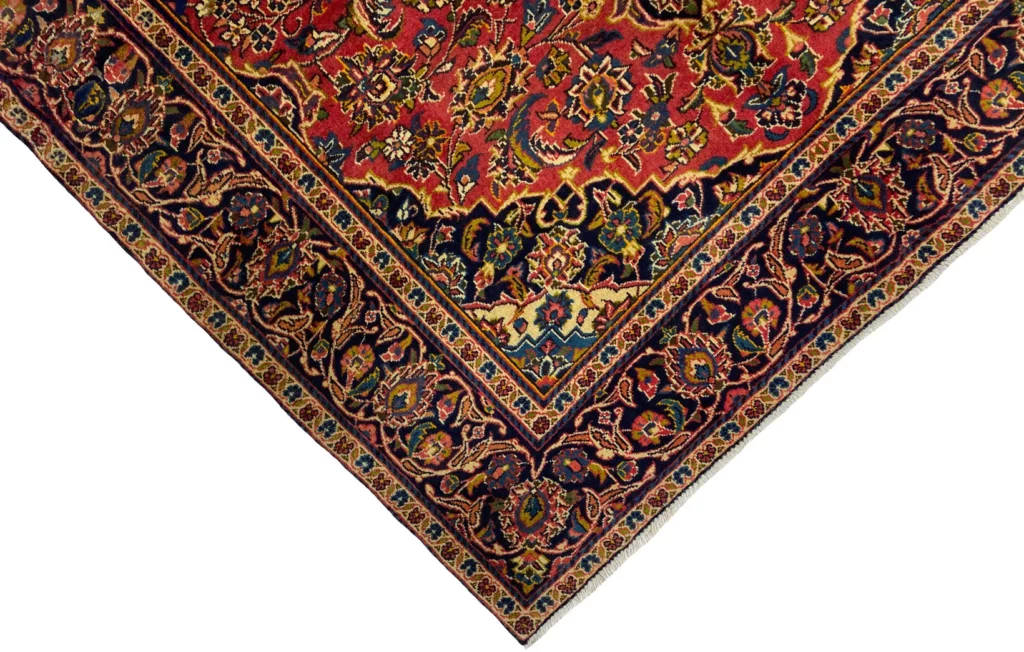
Harmonious colours do not indicate one fixed palette. They describe the way colours work together within the composition. Contrasts can distinguish the ground, border, flowers, leaves and outlines, while related shades can connect neighbouring forms. Persian rug designs traditionally use colour to keep the main drawing legible from a distance and to reveal additional detail at close range. For this rug, the stated colour character is harmonious, alongside the floral and ornamental pattern structure.
A Persian rug composition often consists of a field enclosed by one or more borders. The field carries the principal design, while the surrounding bands frame it and create a transition towards the outer edge. Borders may contain repeated floral elements, scrolling forms, geometric units or other ordered ornaments, depending on the design. When viewing a Keshan rug, the relation between field, border and contour is therefore as important as any single flower or leaf. This organisation is one reason a woven surface can be read as a complete composition rather than as a collection of isolated marks.
The comparison with other Iranian traditions illustrates the variety of Persian design. Isfahan is frequently associated with complex patterns and vivid colours, while Tabriz is often linked to large medallions and geometric ornament. These are regional points of comparison, not alternative origins for this rug. This piece is a Keshan Persian rug from Iran, described through floral and ornamental forms and a harmonious colour arrangement.
Special Features
The rug is in very good condition. The described construction also includes a short pile, durability, resistance to creasing and relatively easy cleaning. These properties are presented together with the high-quality sheep wool pile, the cotton warp and weft and the stated high knot density. Its practical character is therefore connected to the named materials and to the hand-knotted construction rather than to an unsupported claim about a different origin or technique.
Keshan rugs are traditionally made in a range of sizes and can be used in different areas of a home. Their floral and ornamental designs can be placed alongside both classical and modern interiors. For routine care, regular vacuuming is recommended, with occasional professional cleaning to help preserve the colours and structure. Cleaning should be carried out gently and with consideration for the wool pile, cotton foundation and hand-knotted construction.
FAQ
What distinguishes a Keshan Persian rug?
A Keshan Persian rug combines Iranian origin, hand-knotting and a design based on floral and ornamental forms. This example has a high-quality sheep wool pile and cotton in the warp and weft. Its stated density of 150,000 to 300,000 knots per square metre is another defining specification. Within the Keshan tradition, the surface is carefully organised and the colours are arranged in a harmonious way. The short pile and described durability add practical qualities to its craft-based character.
How should a Keshan Persian rug be cared for?
Regular vacuuming is recommended for everyday care. The wool pile should be treated gently so that the surface and its structure are not placed under unnecessary strain. Occasional professional cleaning is also advised, particularly when a deeper treatment is needed. This helps maintain the colours and structure of the hand-knotted rug. Strong or rough cleaning methods should be avoided; any more thorough treatment should take account of the wool pile, the cotton foundation and the construction made by hand.
Where does a Keshan Persian rug come from?
A Keshan Persian rug comes from Keshan in Iran. The city and its surrounding region are known for a long history of rug weaving and for established knotting traditions. Keshan rugs therefore belong to the Iranian, or Persian, carpet tradition. Their designation refers to the origin in Keshan and to the craft tradition that developed there. Other Iranian centres, including Isfahan and Tabriz, have their own design histories, but they are not the place of origin named for this rug.
To provide the best experiences, we use technologies like cookies to store and/or access device information. Consenting to these technologies will allow us to process data such as browsing behavior or unique IDs on this site. Not consenting or withdrawing consent, may adversely affect certain features and functions.
Functional Always active
The technical storage or access is strictly necessary for the legitimate purpose of enabling the use of a specific service explicitly requested by the subscriber or user, or for the sole purpose of carrying out the transmission of a communication over an electronic communications network.
Preferences
The technical storage or access is necessary for the legitimate purpose of storing preferences that are not requested by the subscriber or user.
Statistics
The technical storage or access that is used exclusively for statistical purposes.The technical storage or access that is used exclusively for anonymous statistical purposes. Without a subpoena, voluntary compliance on the part of your Internet Service Provider, or additional records from a third party, information stored or retrieved for this purpose alone cannot usually be used to identify you.
Marketing
The technical storage or access is required to create user profiles to send advertising, or to track the user on a website or across several websites for similar marketing purposes.
 SECURE PAYMENT
 SHIPPING PARTNERS


