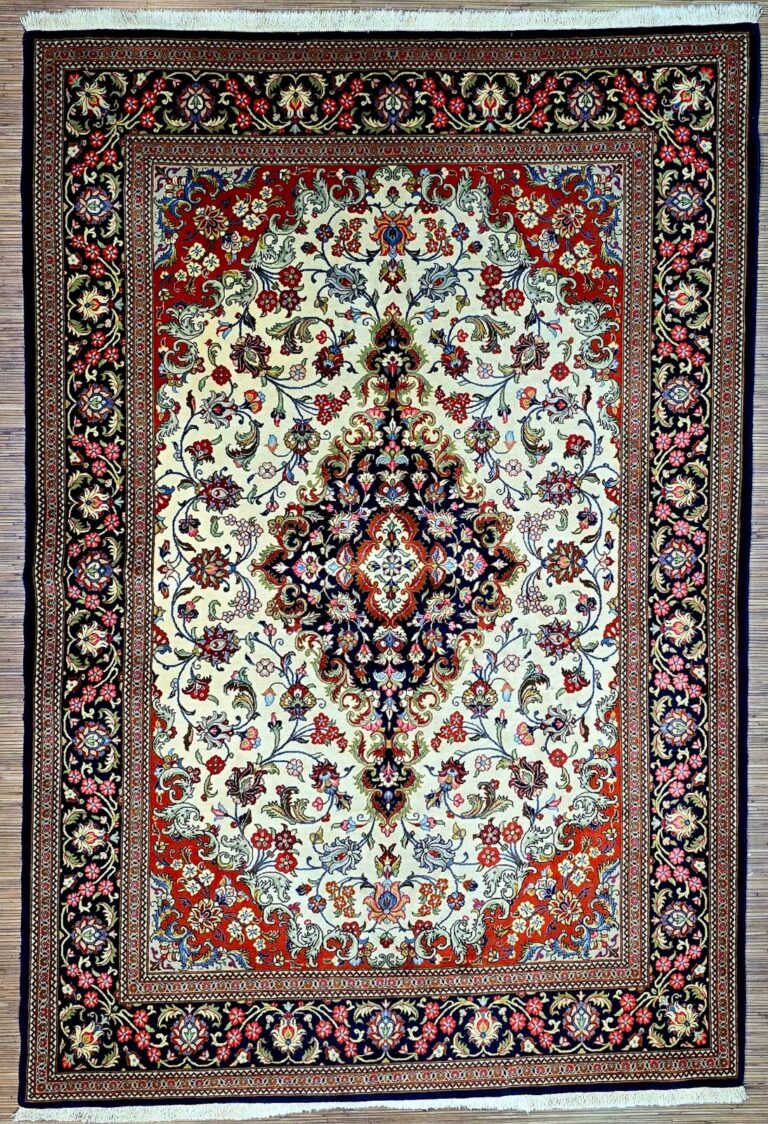
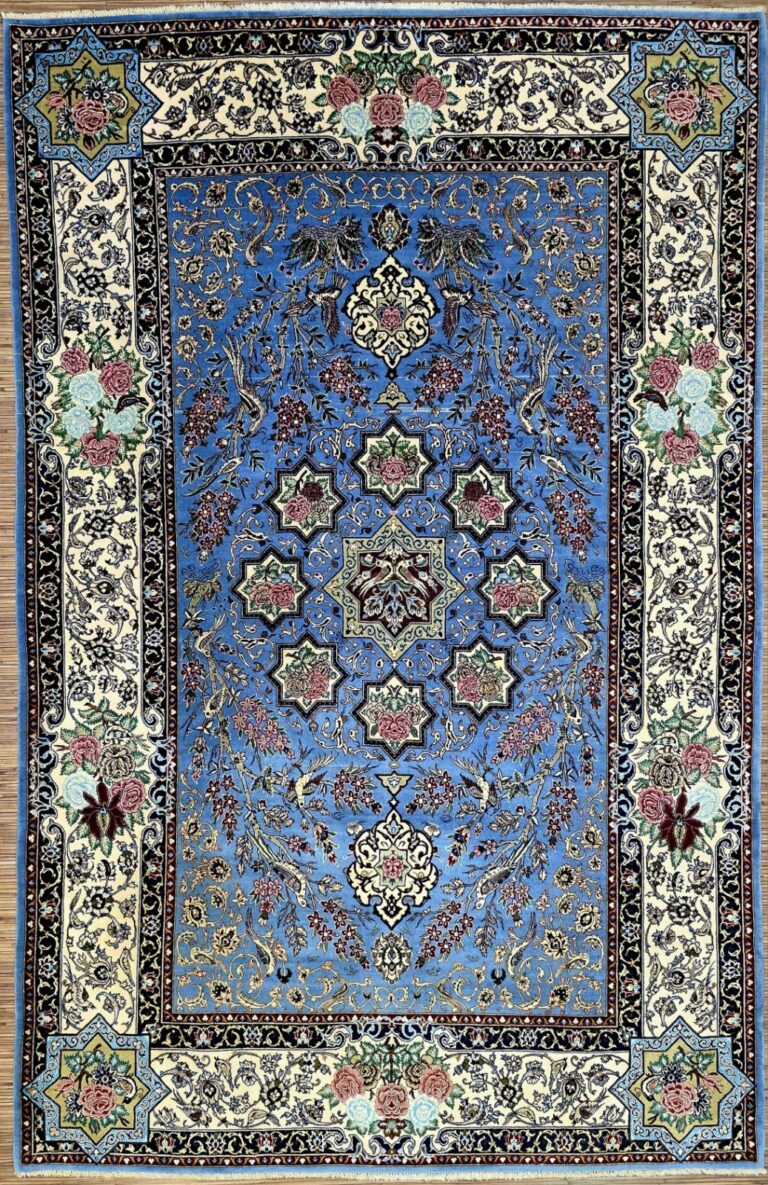
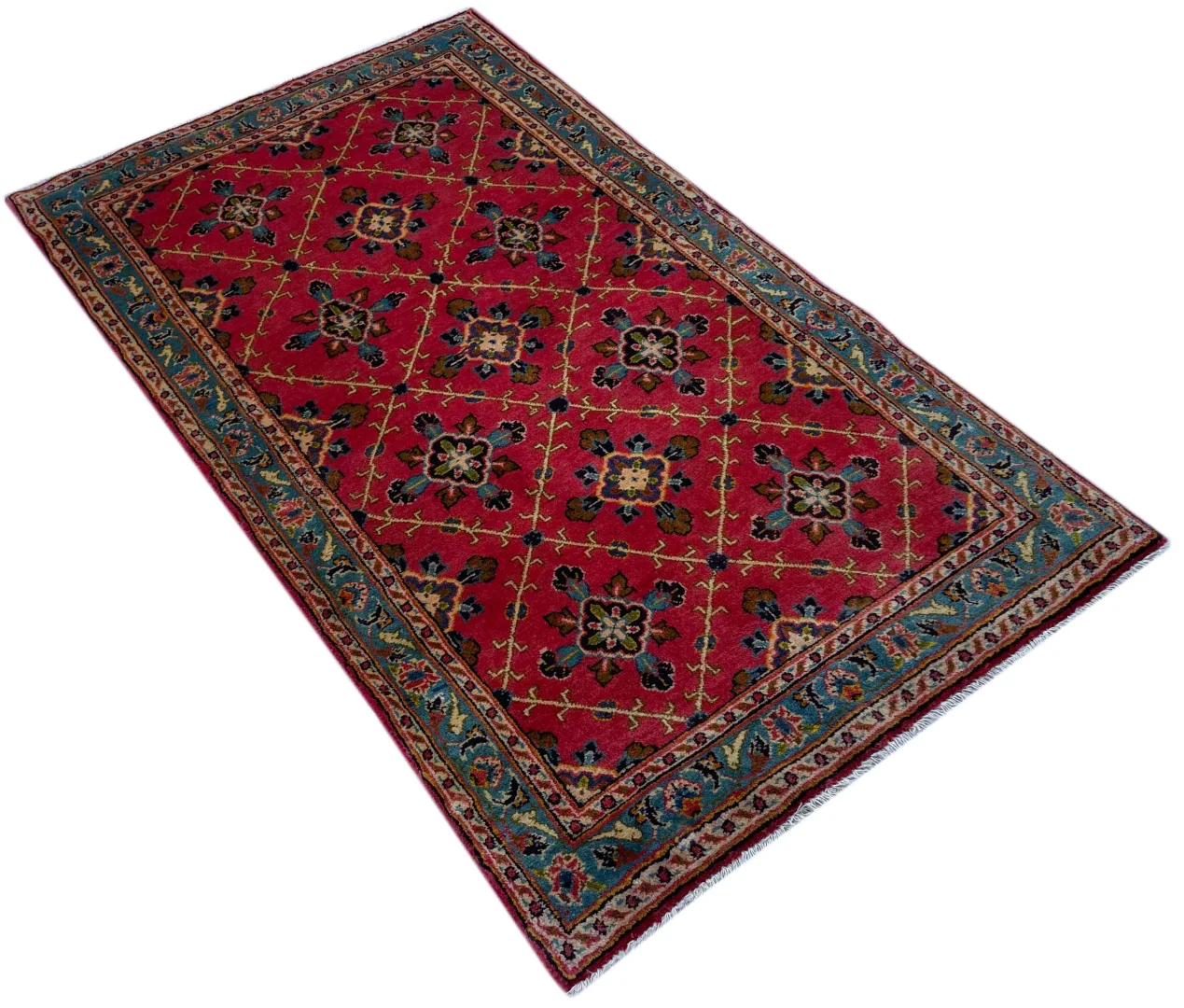
This Keshan Persian rug is hand-knotted, with a pile made from high-quality sheep wool. Cotton is used for the warp and weft. The combination of a wool pile with a cotton foundation belongs to established Persian rug-making practice. It gives the surface a distinct wool texture while providing a firm textile base. Wool from regional sheep flocks has traditionally been used in Persian weaving because it offers a resilient fibre for the visible pile and can carry detailed colour and pattern work.
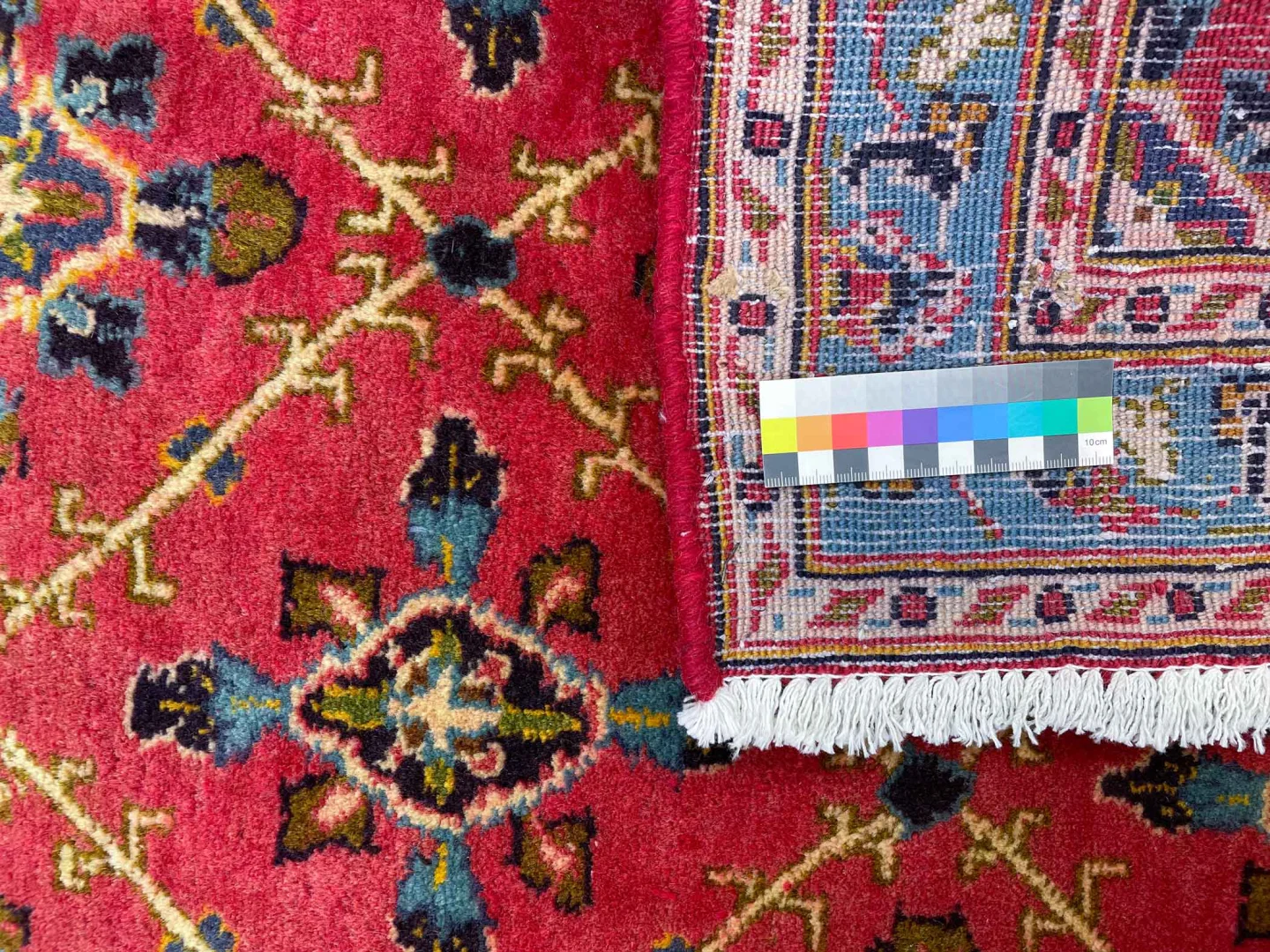
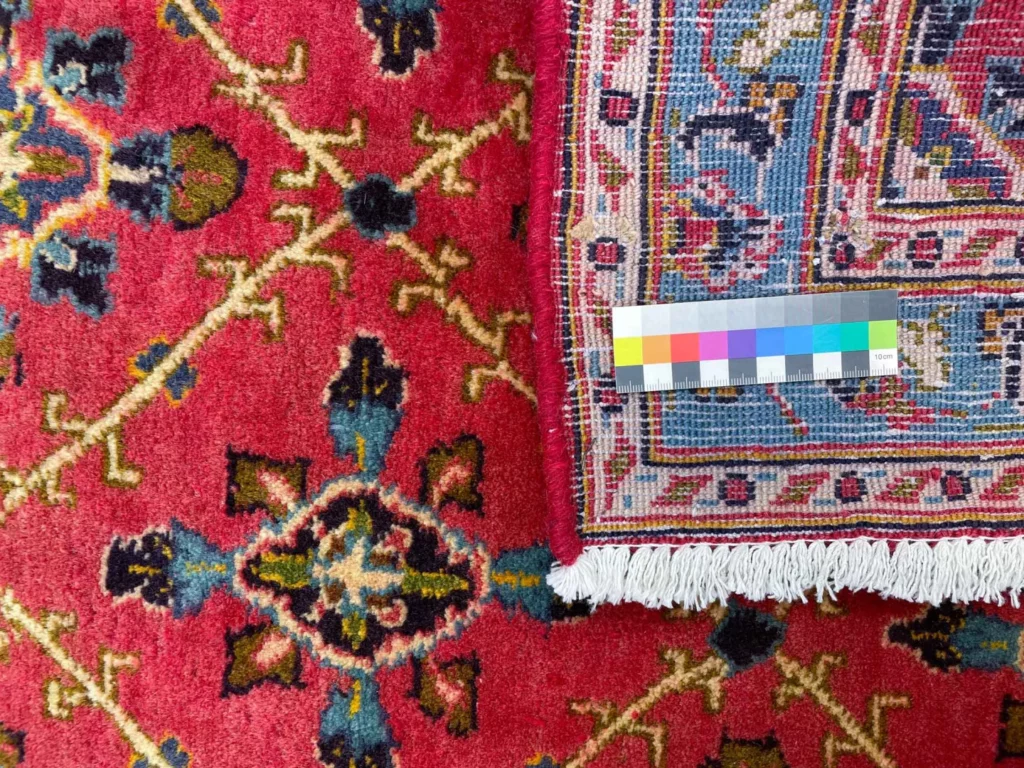
The pile of this rug is short. A short pile is generally easier to vacuum than a deep pile because dust and loose particles do not settle as far below the surface. It also keeps the drawing of the design clearly visible. Dense knotting is an important feature of the Keshan tradition. This rug has a stated knot density of 150,000 to 300,000 knots per square metre. The many individual knots allow fine variations in line and ornament while contributing to a stable rug surface.
Hand-knotting is a method in which every knot is tied individually around the prepared warp threads. The weaver works row by row, using the weft to secure and consolidate the structure. Once the knotting is complete, the pile is trimmed and the surface is finished. The resulting pattern is therefore built from a large number of separate knots rather than printed or mechanically applied. Cotton in the foundation supports the structure and flexibility, while sheep wool forms the tactile and visible pile.
The condition of this one-off rug is very good. The care of a hand-knotted wool rug depends on regular, gentle treatment. Vacuuming removes ordinary dust and dirt. Spilled substances should be blotted promptly with a damp cloth rather than rubbed aggressively. A professional cleaning every few years can complement routine care and is appropriate when the rug needs a deeper treatment.
Origin and Tradition
Keshan, also written as Kashan, is a historic rug centre in Iran. Keshan Persian rugs are associated with a distinct Persian tradition of weaving and knotting that developed over a long period. The city stood in a region where trade, skilled craft and textile design were closely connected. Rugs from Keshan became known beyond their immediate surroundings for carefully worked compositions and a high level of workmanship.
The history of the Keshan tradition reaches back to the era of the Persian Empire. Through trade routes also associated in historical accounts with the Silk Road, Persian rugs travelled to distant markets. Merchants and collectors valued them both as useful household textiles and as examples of woven art. A Keshan rug therefore represents a practical craft as well as a cultural tradition in which material, colour and ornament are planned together.
Persian rugs are traditionally produced on a vertical loom or a comparable knotting frame. The warp provides the underlying structure. Pile yarn is tied into it row by row, while weft threads secure the rows and bring the foundation together. The pile is then clipped and finished so that the design can be read across the surface. Finer knotting permits a greater number of small changes in colour, contour and ornament. The dense knotting specified for this rug belongs to a tradition in which accurate drawing is central to the finished textile.
Keshan is often connected with floral and geometric compositions. These designs are based on inherited arrangements, borders and systems of proportion rather than on random decoration. Floral scrolls, blossoms and leaves can be balanced with geometric lines and framed fields. A composition may direct the eye from a central area to surrounding details and then towards the border. This organisation gives many Keshan designs their recognisable sense of order.
Other well-known Iranian rug traditions include Isfahan, Tabriz and Nain. Each region has its own history, preferred drawing and local variations. Isfahan is often associated with carefully organised floral layouts, Tabriz with a broad range of designs and finely articulated borders, and Nain with lighter colour effects and precise ornament. These names refer to separate regional traditions. The rug described here is a Keshan Persian rug and is not reclassified by comparison with those other centres.
Design and Pattern
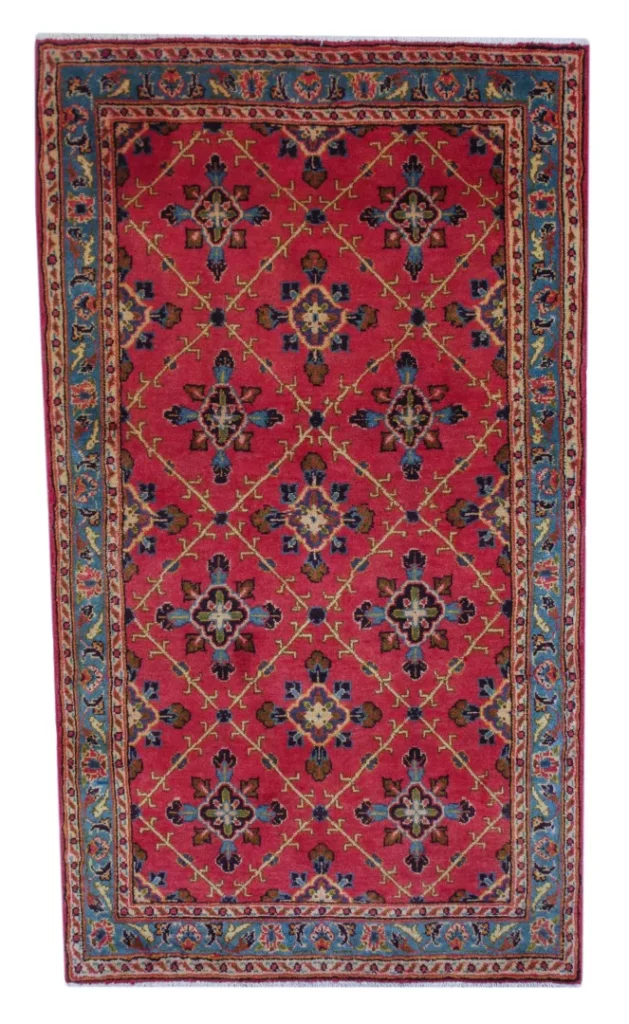
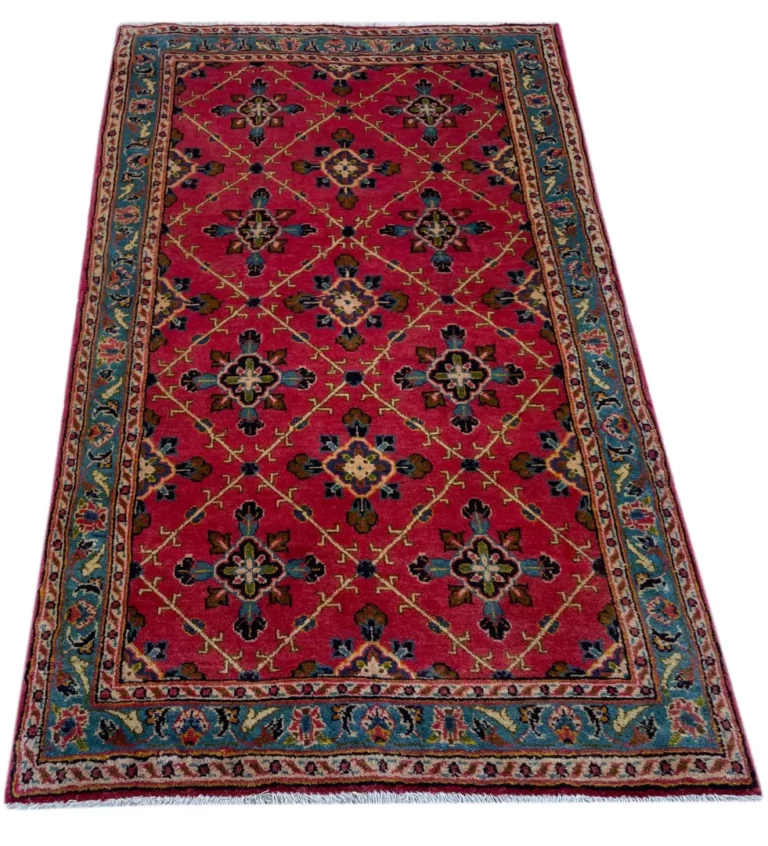
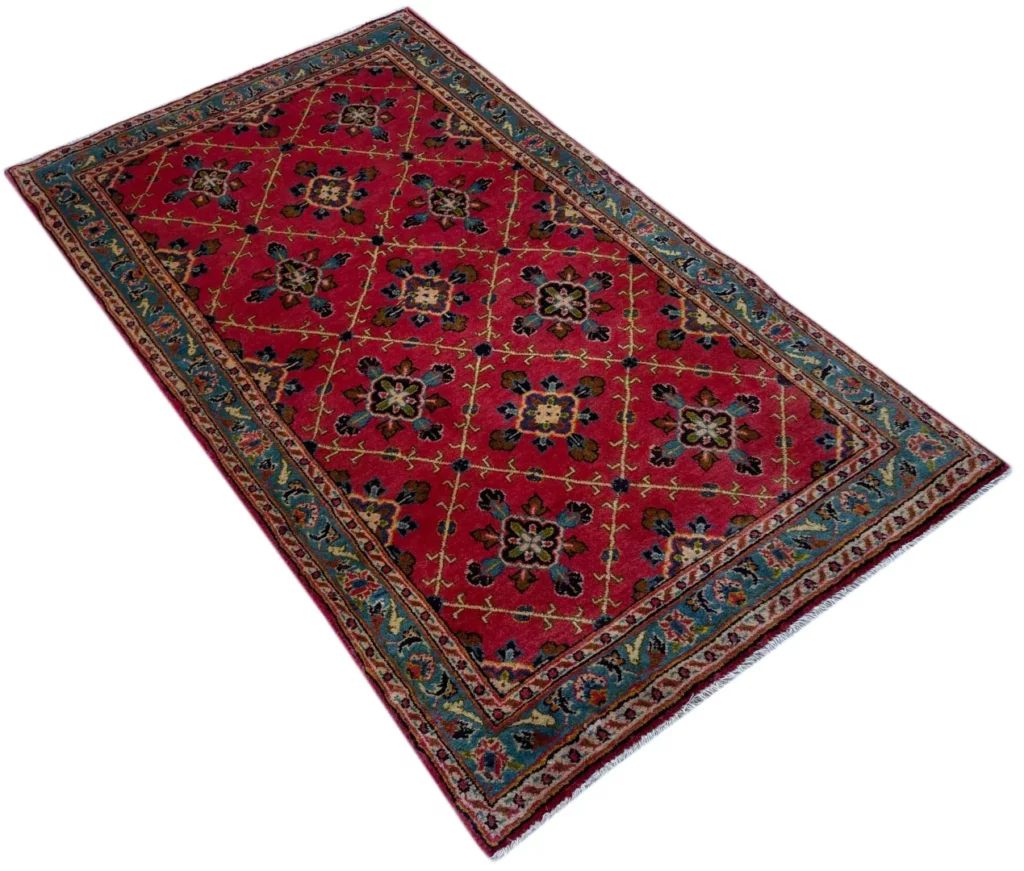
The pattern of this rug is described as classic and elegant. In the wider Keshan design tradition, floral and geometric forms are frequently combined. Flowers, leaves and curling vines provide organic movement, while geometric lines and framed shapes give the composition structure. The two visual languages can appear together, with neither one having to dominate the entire design.
Keshan designs often use a clearly organised field. A central area may be enclosed by one or more borders, with the border carrying the rhythm of the drawing along the sides. Within the field, repeated plant forms, symmetrical scrolls or geometrically framed motifs can be arranged around an underlying balance. Repetition is important because it connects individual details and keeps the pattern legible as a whole.
Red, blue and cream are among the colours most commonly associated with the traditional Keshan palette. They can be combined to create contrast while maintaining visual harmony. Red may occupy broader areas or serve as an accent, blue may define outlines and floral details, and cream may open the composition with lighter passages. The role of each colour depends on the particular arrangement. The source description identifies these colours as frequent in Keshan rugs, while the rug itself is characterised here by its classic and elegant design.
A high knot density is useful when a design contains fine lines, small blossoms or detailed geometric boundaries. Each contour must be built from individual knots, so a dense structure allows gradual changes in shape and colour. The short pile keeps the surface relatively close and makes the woven drawing easy to read. These technical features support the clarity expected of a traditionally detailed Keshan pattern.
A classic Keshan design can work in a traditional interior as well as alongside more modern furnishings. Historic floral motifs and framed borders convey the established character of Persian rug design, while geometric order and balanced colour can sit comfortably with simpler furniture. The description of this rug as classic and elegant does not restrict it to one room or one furnishing period. Keshan rugs are made for a range of uses, and their patterned structure allows the textile to function as both a floor covering and a visible decorative element.
Special Features
This rug combines an Iranian Keshan tradition with hand-knotting and a pile of sheep wool. Cotton warp and weft form the foundation. Its stated knot density of 150,000 to 300,000 knots per square metre indicates a densely worked surface on which floral and geometric details can be rendered with care.
The condition is very good. The short pile supports practical maintenance, while the traditional combination of wool and cotton provides a durable and flexible construction. As a one-off piece, the rug has its own fixed format and can be selected for a particular area where its classic pattern remains visible. Keshan Persian rugs are made in many formats, from smaller runners to larger living-room rugs.
Routine care consists of regular vacuuming and prompt attention to spills. A damp cloth can be used to blot a fresh mark, while vigorous rubbing should be avoided. Professional cleaning at intervals of several years may supplement ordinary maintenance. These recommendations apply to the general care of hand-knotted wool rugs and help preserve the pile and the clarity of the design over time.
FAQ
How should I care for my Keshan Persian rug?
Vacuum the rug regularly to remove dust and everyday dirt before particles can remain in the pile. The treatment should be gentle and suitable for a hand-knotted wool rug. If something is spilled, blot it immediately with a damp cloth instead of rubbing the area firmly. Strong rubbing can put unnecessary stress on the fibres and affect the surface. A professional cleaning every few years can provide a deeper treatment when needed. The short pile makes routine care more straightforward, but it does not remove the need for appropriate cleaning when a mark or heavier soiling is present.
How can I tell whether my Keshan Persian rug is genuine?
An authentic Keshan Persian rug is hand-knotted and has a carefully executed, relatively dense knot structure. The materials can also provide useful indications: high-quality wool is traditionally used in the pile and cotton in the foundation. A proper examination should consider the back of the rug, the regularity of the knotting, the quality of the fibres and the way the pattern has been formed. Certificates or written assessments from recognised rug experts can help confirm authenticity. No single feature is sufficient on its own; origin, technique, material and design should be considered together.
What sizes are available for Keshan Persian rugs?
Keshan Persian rugs are produced in a broad range of formats. The tradition includes smaller runners and compact rugs as well as larger rugs intended for living rooms. This variety makes it possible to choose a rug according to the available floor area, the intended use and the arrangement of furniture. This one-off rug has its own fixed format and can be placed where its classic pattern can be seen clearly. The variety of Keshan sizes does not mean that every design is made in every format; each individually knotted piece has its own proportions and arrangement.
To provide the best experiences, we use technologies like cookies to store and/or access device information. Consenting to these technologies will allow us to process data such as browsing behavior or unique IDs on this site. Not consenting or withdrawing consent, may adversely affect certain features and functions.
Functional Always active
The technical storage or access is strictly necessary for the legitimate purpose of enabling the use of a specific service explicitly requested by the subscriber or user, or for the sole purpose of carrying out the transmission of a communication over an electronic communications network.
Preferences
The technical storage or access is necessary for the legitimate purpose of storing preferences that are not requested by the subscriber or user.
Statistics
The technical storage or access that is used exclusively for statistical purposes.The technical storage or access that is used exclusively for anonymous statistical purposes. Without a subpoena, voluntary compliance on the part of your Internet Service Provider, or additional records from a third party, information stored or retrieved for this purpose alone cannot usually be used to identify you.
Marketing
The technical storage or access is required to create user profiles to send advertising, or to track the user on a website or across several websites for similar marketing purposes.
 SECURE PAYMENT
 SHIPPING PARTNERS