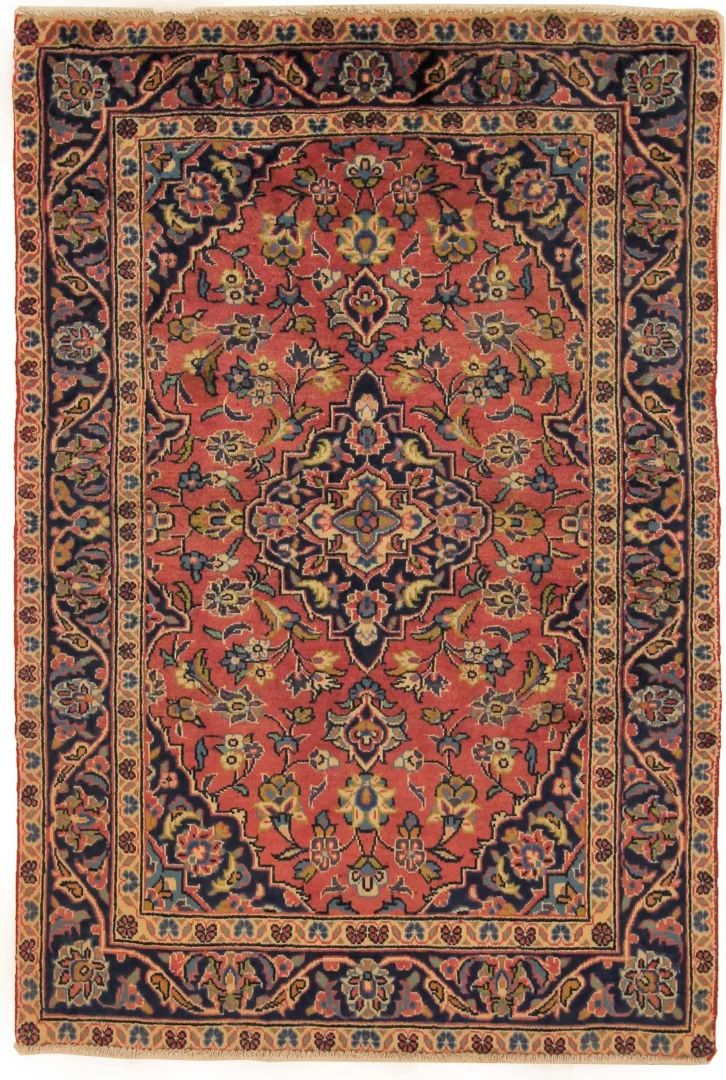
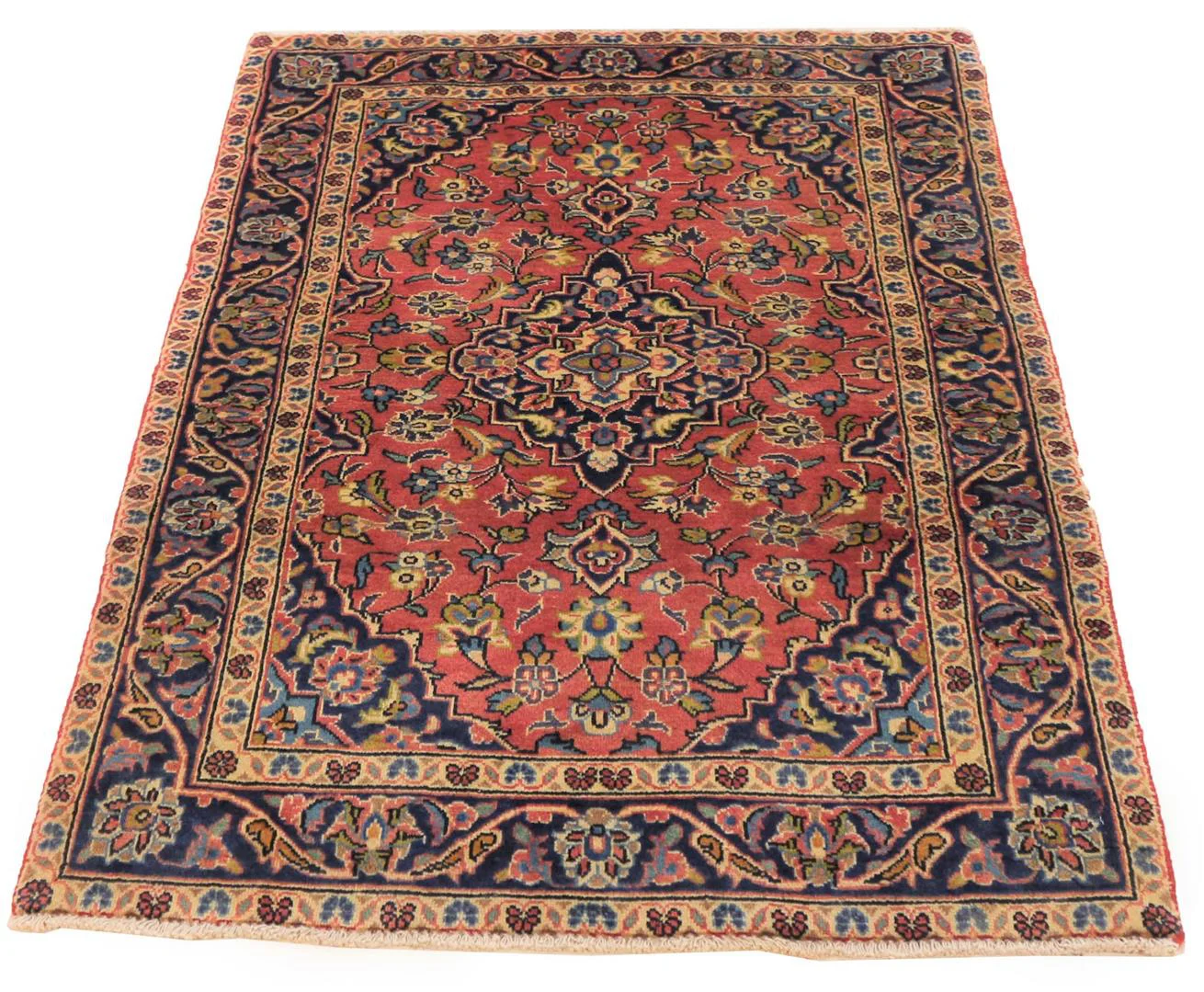
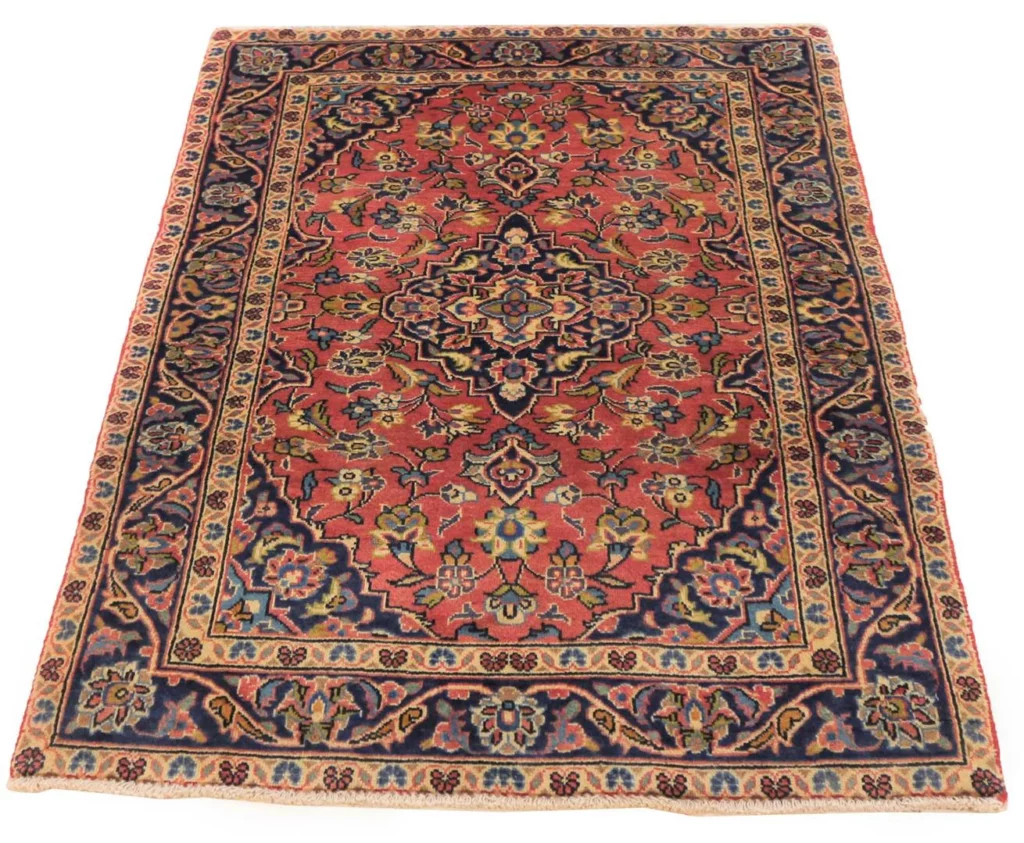
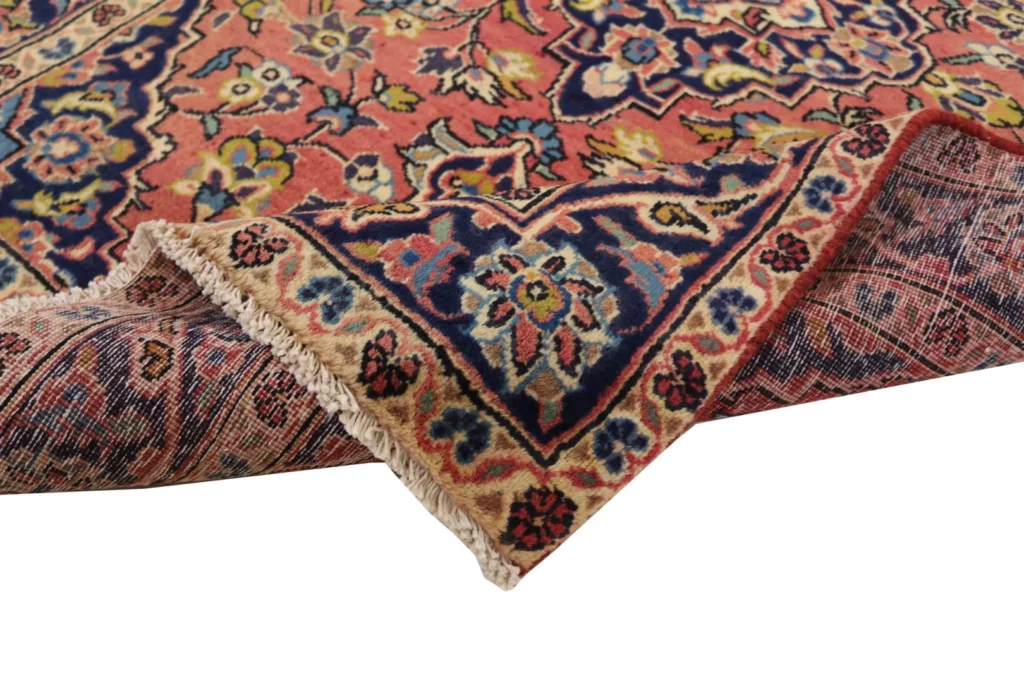
Hand-knotted Keshan Persian rug from Iran | Knot density: 100.000 – 300.000 knots/m² | Material: pile high-quality sheep wool, warp and weft cotton | Size: 136 x 93 cm | Pattern: medallion design in red, blue and beige | Condition: Very well preserved
This Keshan Persian rug is hand-knotted with a pile made from high-quality sheep wool. Wool gives the surface a pleasant tactile quality while also providing a durable fibre for a hard-wearing pile. Sheep wool has been used in Oriental rugs for centuries because it can be worked into a dense surface and retains a resilient character when carefully prepared and knotted. The pile of this rug is intended for regular use while remaining comfortable underfoot.
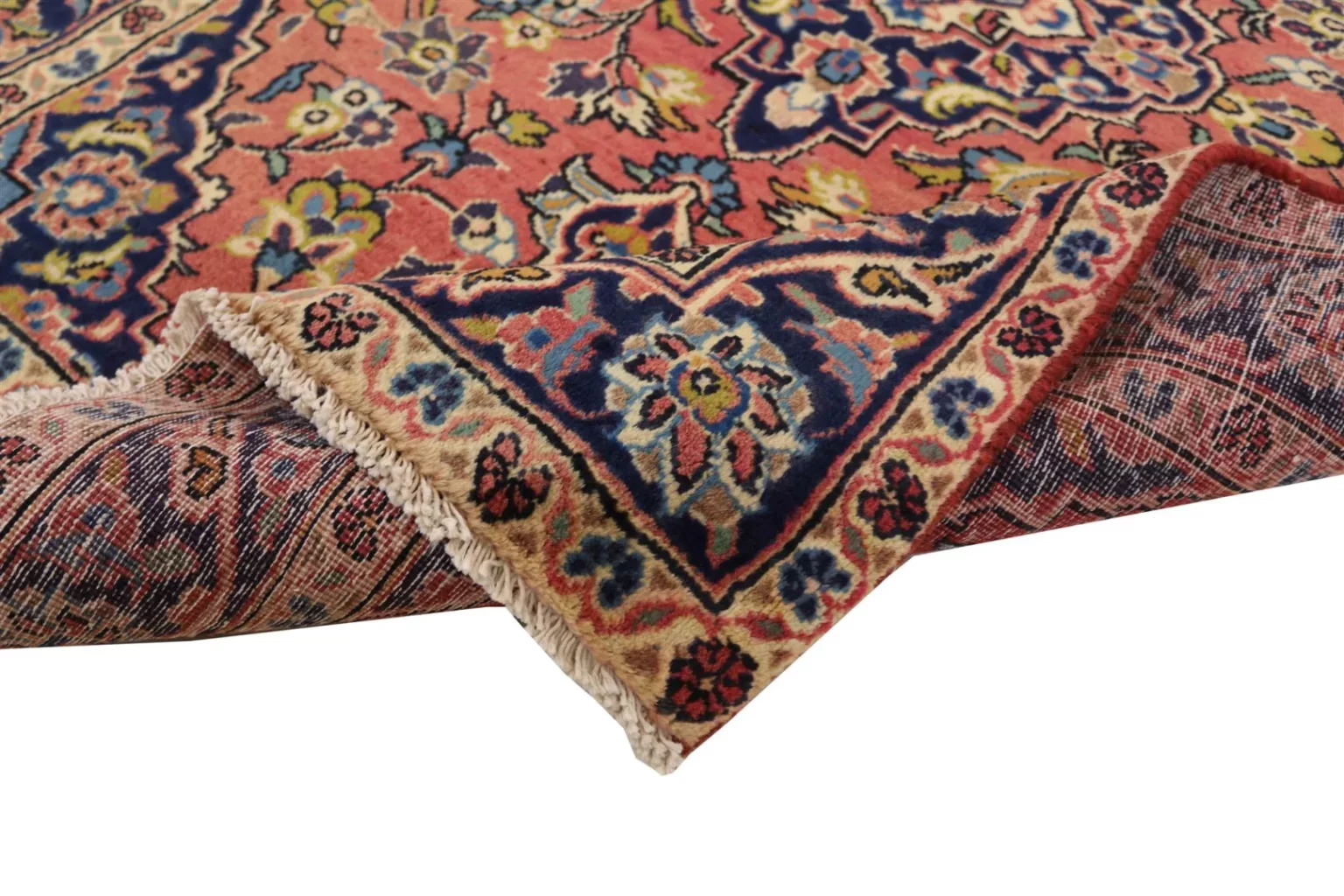
The warp and weft are made from cotton. This firm foundation supports the shape of the knotted structure and contributes to the durability of the rug as a whole. In hand-knotting, each knot is placed individually into the foundation. The rows are then compacted and the pile is finished evenly. This process creates a textile construction in which the wool pile and the cotton foundation are closely integrated.
The knot density is 100.000 – 300.000 knots per square metre. Dense knotting is one of the characteristics associated with Keshan rugs, giving the surface a compact appearance and supporting its hard-wearing construction. The combination of sheep wool and cotton brings together a resilient pile and a stable foundation. This rug is very well preserved.
Origin and Tradition
The rug comes from Keshan in Iran. Keshan is known for carpets, textiles and ceramics and has an important place in Iranian craft culture. The city belongs to a region where methods of design, dyeing and textile production developed over a long period. Keshan rugs therefore represent a distinct weaving tradition that combines careful workmanship with clearly structured compositions.
The history of Keshan rugs is connected with the trading routes along the historic Silk Road. Textiles and other goods travelled through these routes from Iran to many different regions. Carpet commerce brought prosperity to the city and helped establish Keshan as an important centre of carpet weaving. The reputation of its rugs rests on both their workmanship and their recognisable approach to composition.
Traditional Keshan production involves several coordinated stages. The foundation is prepared before the design is knotted with care. Weavers follow an established arrangement of motifs, control the distribution of colour and execute the outlines precisely. Once the knotting is complete, the pile and edges are finished so that the design remains legible and the surface has an even textile character. Handwork makes each individual rug a one-off piece.
The Keshan tradition includes both strictly classical compositions and varied interpretations. A central arrangement is common, often accompanied by a border and additional ornamental zones. There are also all-over Keshan designs in which the pattern extends across the entire field. These approaches share an ordered treatment of ornament and a balance between decorative design and practical use.
Many Keshan rugs are now more than a century old and are valued by collectors. This general appreciation reflects the continuing importance of Keshan weaving, but it is not an age statement about this individual rug. Other Iranian weaving centres are also connected with this wider tradition. Nain is known for fine designs and light colours, while Isfahan often presents elaborate floral designs and complex motifs. Tabriz and Kashan likewise offer their own traditional carpet forms.
Design and Pattern
This rug has a medallion design. A central medallion forms the visual focus and organises the surrounding ornaments around a clearly defined centre. This is one of the classic compositional formats found in Iranian rugs. It establishes a hierarchy between the centre, the surrounding field and the outer borders without dividing the surface into unrelated separate images.
The colour palette consists of red, blue and beige. In traditional rug designs, red can serve as a strong ground or accent colour and gives the pattern a distinct presence. Blue introduces a cooler contrast and can separate central motifs from bordering ornaments. Beige creates lighter passages and helps the drawing remain readable. Together, these colours form a classic Iranian colour arrangement.
In a medallion rug, the relationship between the centre, the field and the border is as important as the central motif itself. The border gathers the composition and gives the eye an outer limit. The transitions between pattern zones are created through colour placement and the repetition of smaller ornaments. As a result, the design can be read as a unified surface rather than as a collection of disconnected details.
Keshan designs may include stylised flowers, vines, leaves and other ornamental forms. These elements are not rendered as literal naturalistic images; they are transformed into a regular textile language. Lines, repetition and symmetrical relationships help the pattern appear ordered. The hand-knotted execution gives the outlines a distinct textile quality, since small variations may arise naturally from manual work.
Alongside centrally arranged rugs, the Keshan tradition also includes all-over patterns. In those designs, the ornamental theme is distributed across the entire field, whereas the medallion format gives greater emphasis to the centre. Recognising these two basic formats helps explain the variety of Keshan designs. This rug belongs to the medallion group and has the focused central arrangement associated with that format.
The combination of red, blue and beige gives the design a traditional character while keeping the composition clear and adaptable. Keshan rugs are consequently used in a variety of interior settings. Their patterns can function as an organised textile element in living rooms, dining rooms or offices. This general versatility does not alter the specific features of this rug: it has a medallion design, the stated colour palette and a sheep-wool pile.
Special Features
The notable features of this Keshan Persian rug include its dense hand-knotting, high-quality sheep-wool pile and cotton foundation. Its knot density of 100.000 – 300.000 knots per square metre supports a compact textile structure. The rug is very well preserved and combines a traditional medallion composition with red, blue and beige colouring.
Hand craftsmanship makes the rug a unique piece. Every knot is placed by hand, and the arrangement of the colours results from the interaction of the design, the materials and the weaving process. The finished rug is therefore not the same as an industrially identical series product. Its origin in Keshan, Iran, also places it within a recognised Iranian carpet tradition.
Regular vacuuming is recommended for maintenance. Professional cleaning can be used when necessary. Direct sunlight should be avoided to help prevent the colours from fading. These care measures support the preservation of Keshan rugs and help maintain both the surface and the visual effect of the pattern.
FAQ
What makes a Keshan Persian rug distinctive?
A Keshan Persian rug combines dense hand-knotting with high-quality sheep wool and a cotton foundation. Its carefully organised design is also characteristic, and may include a central medallion and classical colour combinations. This piece has a medallion design in red, blue and beige. Its knot density is 100.000 – 300.000 knots per square metre, and it is very well preserved. It therefore brings together a hand-crafted construction, an origin in Keshan, Iran, and a clearly defined ornamental composition.
How should I care for my Keshan Persian rug?
The rug should be vacuumed regularly to remove dust and loose particles from the pile. If deeper cleaning is required, professional cleaning is appropriate because the material and hand-knotted construction can then be treated properly. Direct sunlight should be avoided so that the colours do not fade. Gentle, regular care supports the durability of the sheep-wool pile and helps preserve the red, blue and beige pattern. Cleaning products or methods should not be applied to the surface without first checking their suitability.
Which rooms suit a Keshan Persian rug?
Keshan Persian rugs work well in living rooms, dining rooms and offices. In these settings, the rug can create a clearly structured textile area, while the medallion and traditional colour palette provide a decorative focal point. The resilient sheep wool and dense knotting also make this type of rug suitable for areas that are used regularly. Placement should take account of a dry environment and protection from direct sunlight. This allows practical use and preservation of the colours to be considered together.
To provide the best experiences, we use technologies like cookies to store and/or access device information. Consenting to these technologies will allow us to process data such as browsing behavior or unique IDs on this site. Not consenting or withdrawing consent, may adversely affect certain features and functions.
Functional Always active
The technical storage or access is strictly necessary for the legitimate purpose of enabling the use of a specific service explicitly requested by the subscriber or user, or for the sole purpose of carrying out the transmission of a communication over an electronic communications network.
Preferences
The technical storage or access is necessary for the legitimate purpose of storing preferences that are not requested by the subscriber or user.
Statistics
The technical storage or access that is used exclusively for statistical purposes.The technical storage or access that is used exclusively for anonymous statistical purposes. Without a subpoena, voluntary compliance on the part of your Internet Service Provider, or additional records from a third party, information stored or retrieved for this purpose alone cannot usually be used to identify you.
Marketing
The technical storage or access is required to create user profiles to send advertising, or to track the user on a website or across several websites for similar marketing purposes.
 SECURE PAYMENT
 SHIPPING PARTNERS


