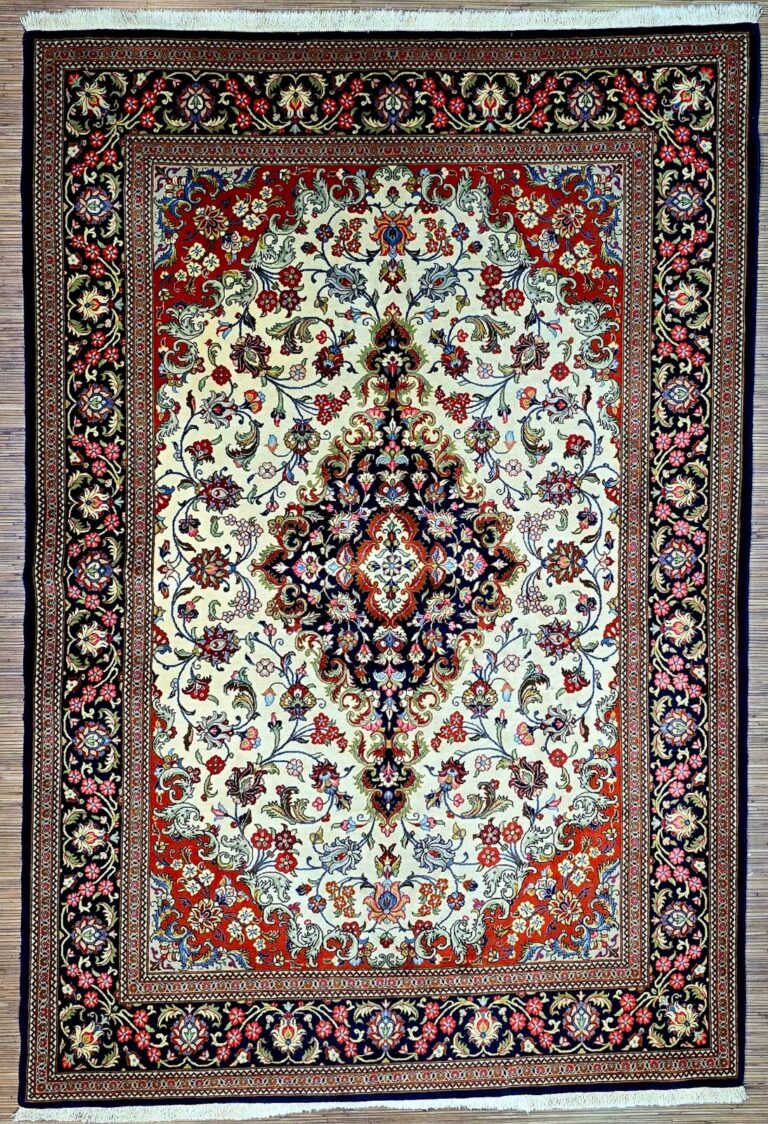
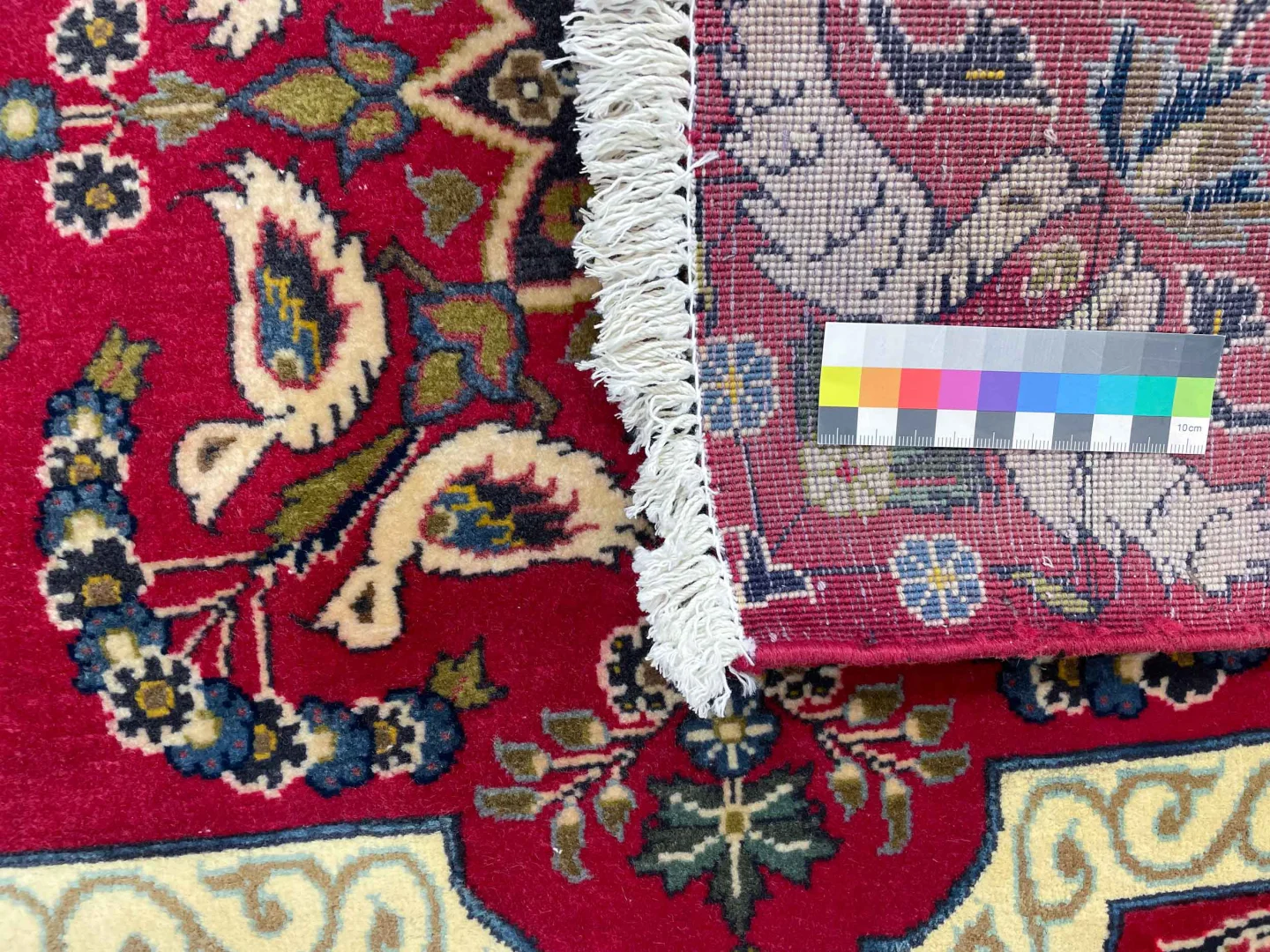
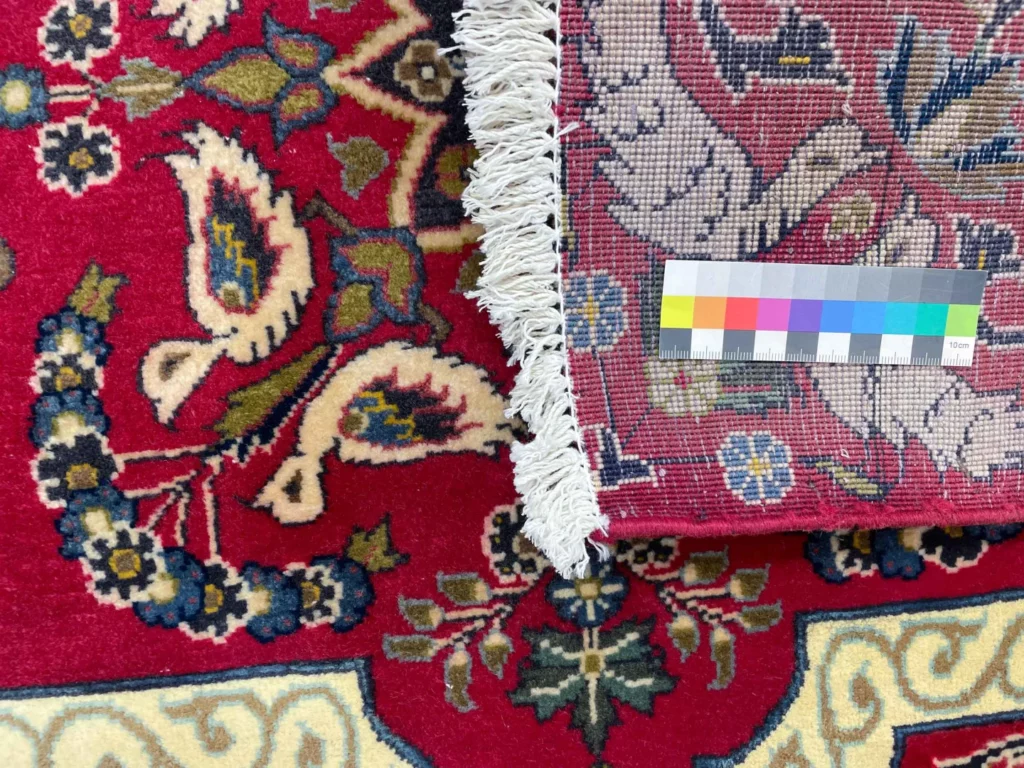
This Keshan Persian rug is hand-knotted. Its pile is made from fine sheep wool, while the warp and weft are generally made from durable cotton. The combination of a wool pile with a cotton foundation is part of the established Keshan weaving tradition. It gives the rug a defined textile structure and provides the ground in which the individual knots are secured.
Sheep wool is used for the pile because it is well suited to hand-knotted rugs. A wool surface accepts colour clearly and contributes to the attractive sheen associated with Keshan rugs. Cotton in the warp and weft forms the supporting structure beneath the pile. During hand-knotting, one row is built after another, and the pattern takes shape through the placement of the individual knots.
The knot density of this rug is given as 150.000 to 300.000 knots per square metre. Dense knotting allows fine lines, small floral details and geometric forms to be rendered with greater definition. It is also an important part of the traditional Keshan method. Knot density describes the number of knots within an area; it does not indicate the weight or thickness of the material.
Hand production makes every Keshan rug an individual piece. The tradition uses recurring design principles, but the knots are not produced through an industrial process that creates identical surfaces. Here, the sheep-wool pile, cotton foundation and dense hand-knotting define the construction. The condition of this rug is described as excellent.
Origin and Tradition
The rug comes from Persia, now Iran. The name Keshan refers to the city of Keshan and to the weaving tradition associated with it. Keshan has long been connected with the production of fine textiles. Its rug-making tradition combines the practical function of a floor covering with a carefully organised decorative language.
Keshan was once an important stop on the Silk Road. Trade routes carried goods, fibres, dyes, design ideas and technical knowledge between distant regions. The exchange of textiles and rugs helped the city gain recognition beyond its immediate surroundings. This history explains why Keshan functions both as a place of origin and as the name of a distinct Persian rug tradition.
Weaving in Keshan is rooted in knowledge passed from one generation to the next. Skills relating to materials, colour, knotting and pattern construction form part of that continuity. A rug is therefore more than a useful household object within this tradition. It also records the cultural identity of its region and the artistic abilities of the people who made it.
Keshan rugs are commonly associated with a wool pile and a cotton construction. This choice of materials developed from the requirements of hand-knotting and from local textile practice. Dense knotting makes it possible to work out ornaments precisely, while also allowing broad fields and flowing lines to be arranged within the same composition. The result is the characteristic relationship between technical precision and decorative order.
Keshan occupies an important place among Persian weaving centres. Rugs from Isfahan are also known for elaborate designs and fine materials, but they are often associated with complex geometric compositions. Tabriz rugs are recognised for quality materials and a wide variety of patterns. These comparisons show how Persian rugs share a broad craft heritage while retaining the individual visual identity of their regional traditions.
The name Keshan therefore indicates more than a location. It refers to a combination of hand-knotting, a wool pile, a cotton foundation, dense construction and classical ornament. Trade, regional culture and the continued teaching of specialist skills all contributed to the development of this tradition. The rug described here belongs to that Persian Keshan heritage.
Design and Pattern
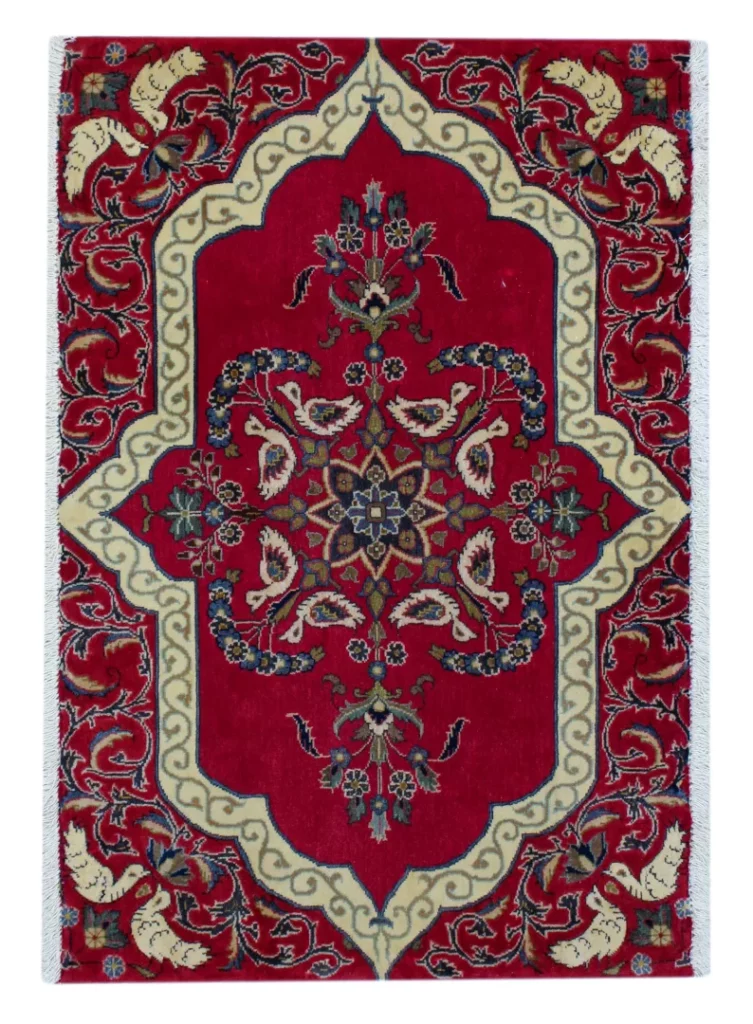
Keshan rugs are known for lively colours and detailed designs. Floral motifs and geometric forms are part of their traditional vocabulary. Flowers, leaves and tendrils may be arranged into a coordinated ornament, while geometric lines give the composition structure. Organic and clearly ordered elements can therefore appear together within one design language.
Floral patterning is one of the recurring features of the Keshan tradition. Individual motifs may stand on their own, or they may continue across a larger field. Tendrils connect blossoms and establish a visual rhythm. Geometry is present not only in straight lines, but also in symmetry, repeated shapes and the way the complete design is divided into related areas.
The high knot density supports precise pattern drawing. A close arrangement of knots can reproduce small ornaments, narrow outlines and carefully graded transitions. In a hand-knotted Keshan rug, the design is built from many separate acts of placement. Each row contributes to the contour of a leaf, the edge of a field or the repetition of a decorative element.
The Keshan colour tradition is described as lively. Colour helps distinguish the ground, borders and ornaments, rather than serving decoration alone. A floral detail can be brought forward through contrast, while related tones can bind a larger area together. Geometric forms become easier to read when the relationships between their colours are clearly organised.
In Persian rug design, the border is an important part of the overall architecture. It frames the central field and creates a transition between the principal composition and the outer finish. In Keshan designs, a border may repeat floral elements and extend the vocabulary of the central field. Geometric boundaries can provide the pattern with definition and visual direction.
Comparison with Isfahan and Tabriz is useful because these centres have their own established pattern traditions, but it does not change this rug’s Keshan origin. Isfahan is often linked with intricate geometric designs, while Keshan is frequently associated with floral motifs. Tabriz is known for a broad range of patterns and materials. Keshan remains identifiable through the relationship between floral detail and ordered form.
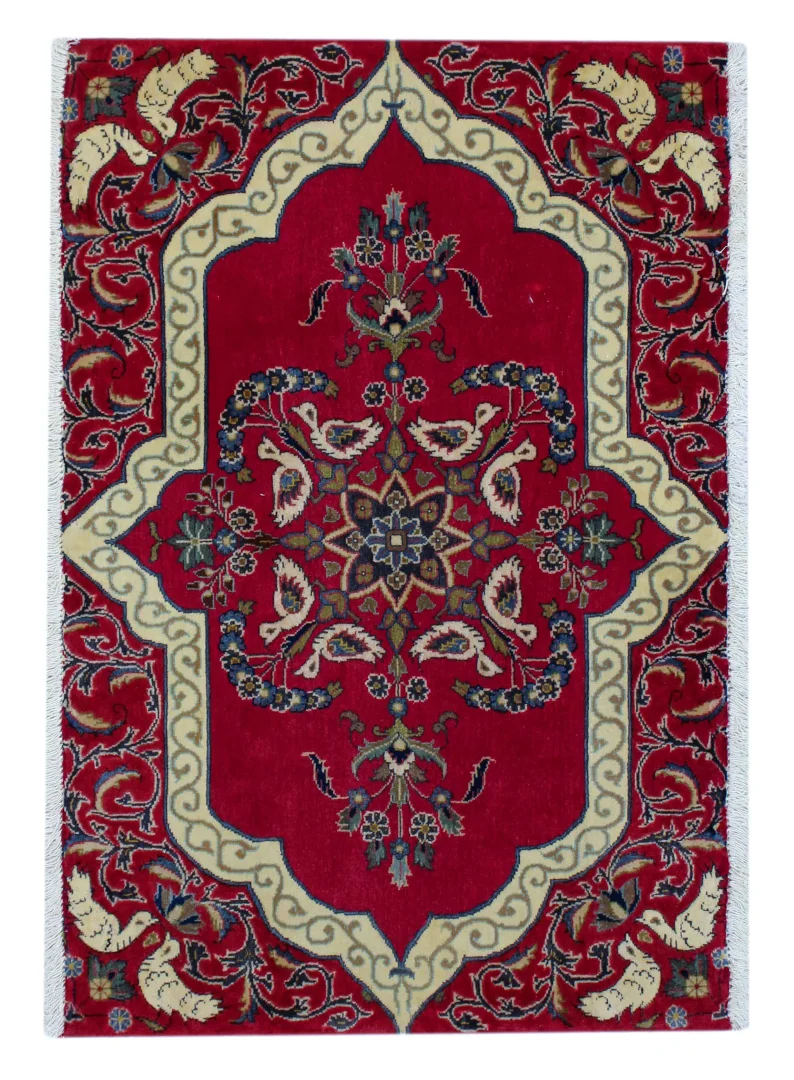
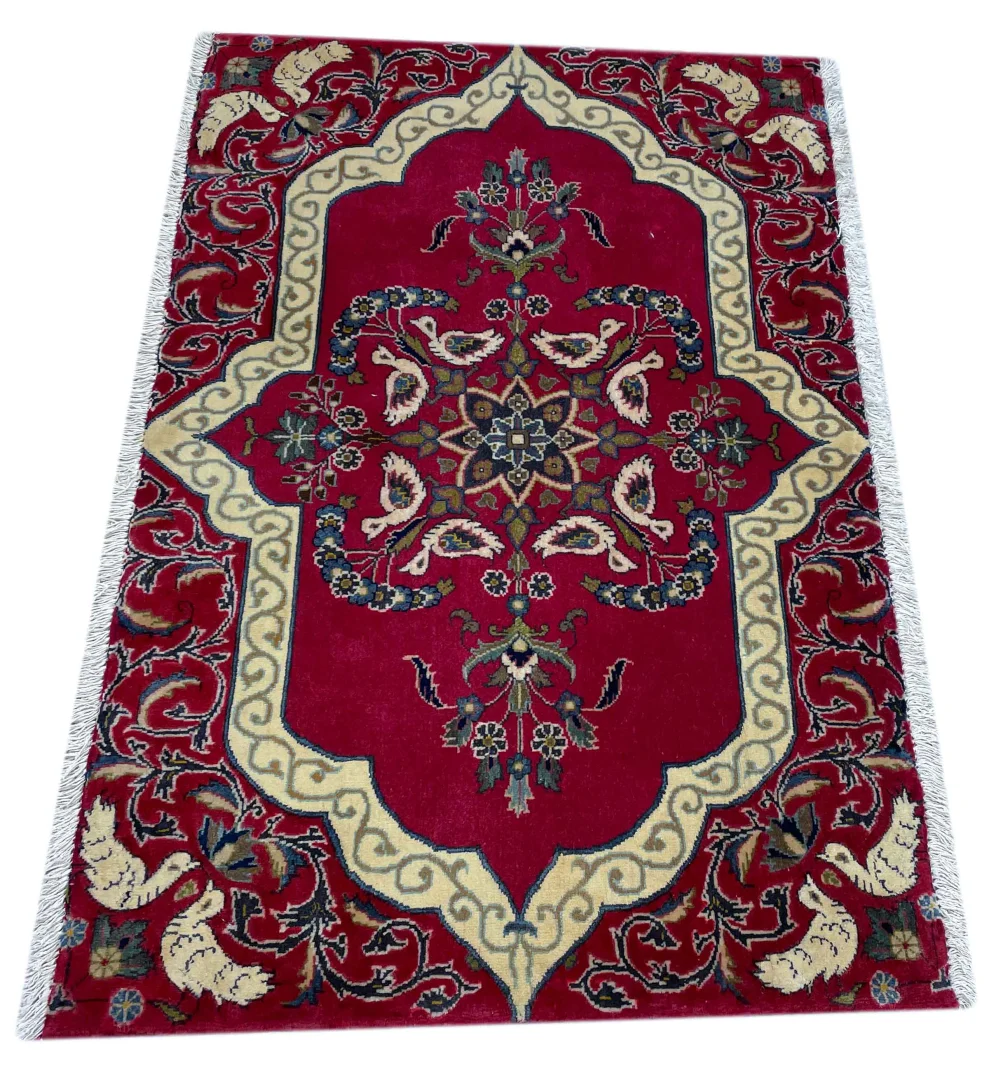
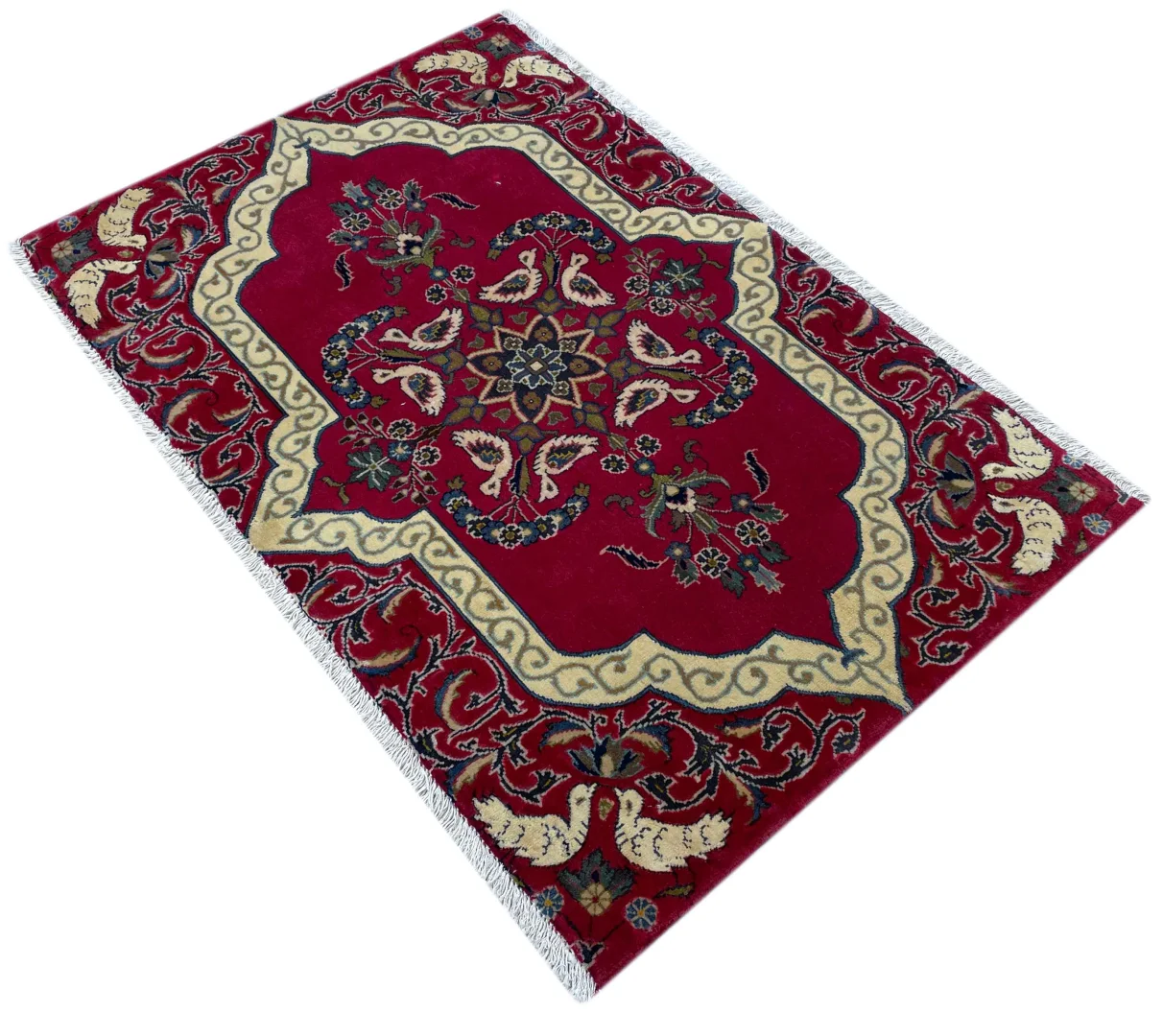
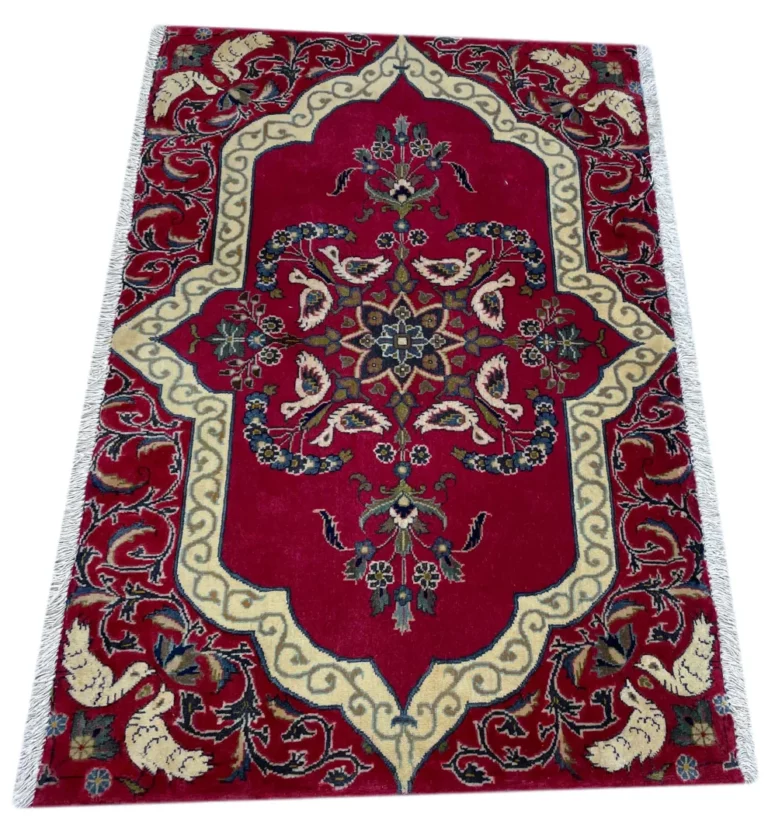
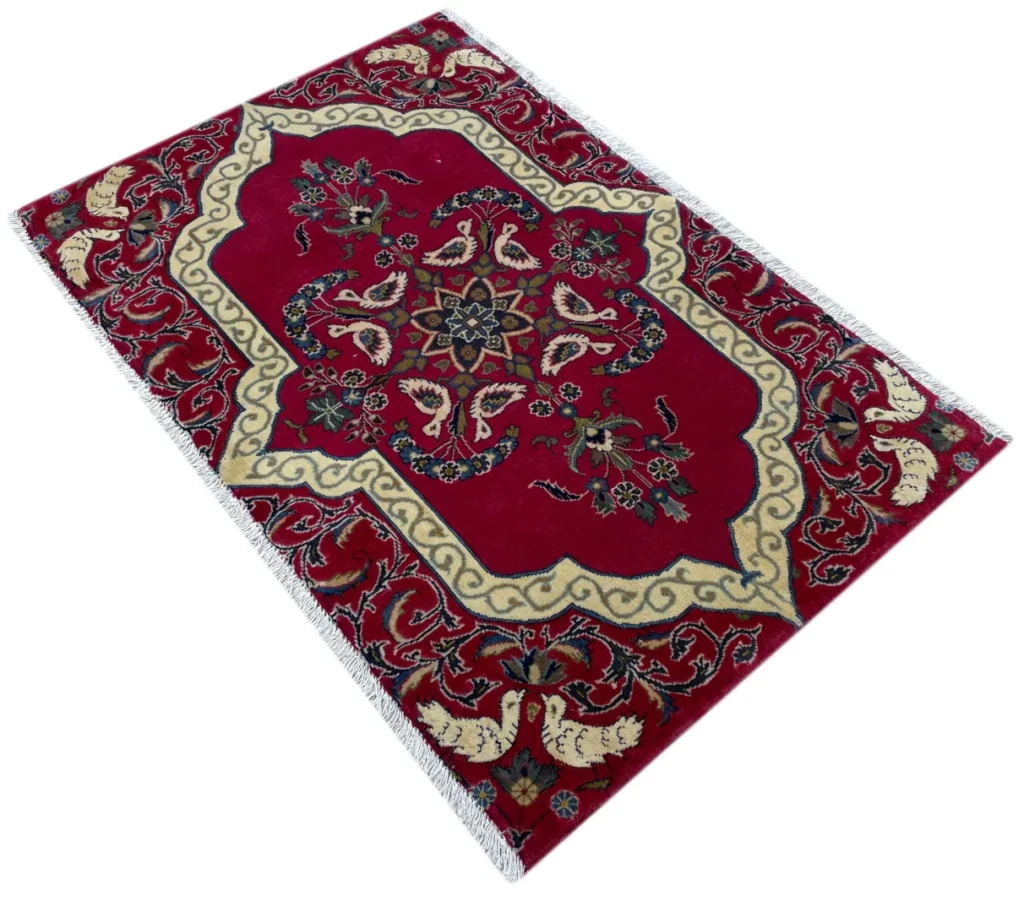
The pattern of this rug is described as a combination of floral motifs and geometric forms. It therefore belongs to the design tradition of Keshan. Its appearance is created not by one isolated ornament, but by the interaction of lines, fields, motifs and colour relationships. Hand-knotting turns that composition into a durable textile surface.
Special Features
A defining feature of this rug is its high knot density of 150.000 to 300.000 knots per square metre. Dense knotting is associated with Keshan rugs and supports the execution of detailed patterns. It is also connected with the durability attributed to this construction.
Other stated characteristics are the fine sheep-wool pile, cotton in the warp and weft, and the hand-knotted technique. The condition of this one-off rug is excellent. Keshan rugs are also connected with a long tradition of use; many examples are more than 100 years old and may increase in value over time. That general statement does not establish the age of this particular rug.
FAQ
How should I care for my Keshan Persian rug?
Regular cleaning is recommended, and the rug should be protected from direct sunlight. Professional cleaning every few years is also advisable. These measures help protect the wool pile and its colours. Because this is a hand-knotted rug, cleaning should take account of its materials and construction so that the pile, warp and weft are not placed under unnecessary strain.
What makes a Keshan rug distinctive?
Its identity rests on high knot density, the use of quality sheep wool and traditional hand production. The detailed designs associated with Keshan, including floral motifs and geometric forms, are another important element. The techniques are passed down through generations. A Keshan rug thus combines material quality, close knotting and a clearly recognisable regional pattern tradition.
Are Keshan rugs a good investment?
Keshan rugs are considered desirable because of their quality and durability. Continued demand can also support their value over time. Particularly well-maintained examples may increase in value. For an individual rug, its actual characteristics, condition, construction and origin are decisive. Many Keshan rugs are more than 100 years old; this does not mean that every individual piece has that age.
To provide the best experiences, we use technologies like cookies to store and/or access device information. Consenting to these technologies will allow us to process data such as browsing behavior or unique IDs on this site. Not consenting or withdrawing consent, may adversely affect certain features and functions.
Functional Always active
The technical storage or access is strictly necessary for the legitimate purpose of enabling the use of a specific service explicitly requested by the subscriber or user, or for the sole purpose of carrying out the transmission of a communication over an electronic communications network.
Preferences
The technical storage or access is necessary for the legitimate purpose of storing preferences that are not requested by the subscriber or user.
Statistics
The technical storage or access that is used exclusively for statistical purposes.The technical storage or access that is used exclusively for anonymous statistical purposes. Without a subpoena, voluntary compliance on the part of your Internet Service Provider, or additional records from a third party, information stored or retrieved for this purpose alone cannot usually be used to identify you.
Marketing
The technical storage or access is required to create user profiles to send advertising, or to track the user on a website or across several websites for similar marketing purposes.
 SECURE PAYMENT
 SHIPPING PARTNERS