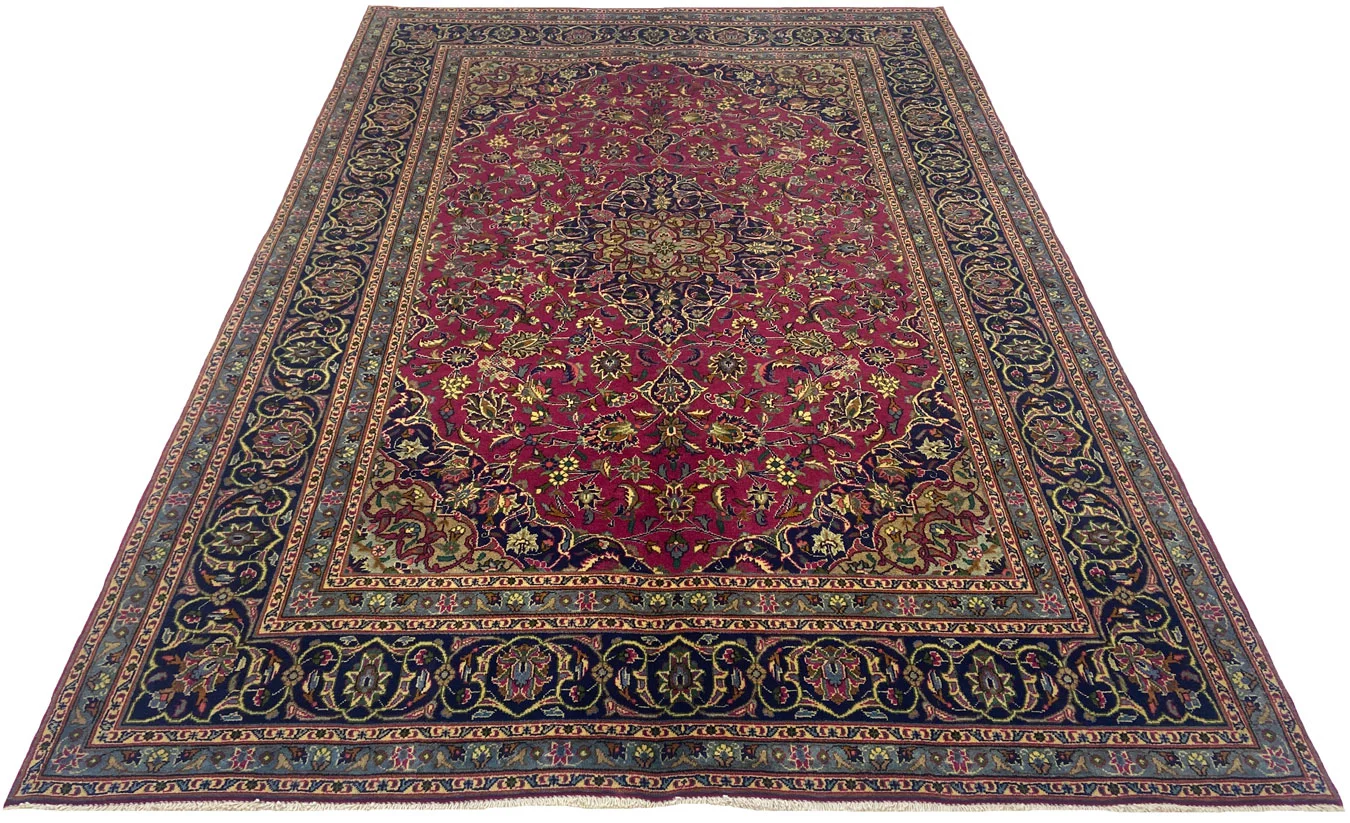
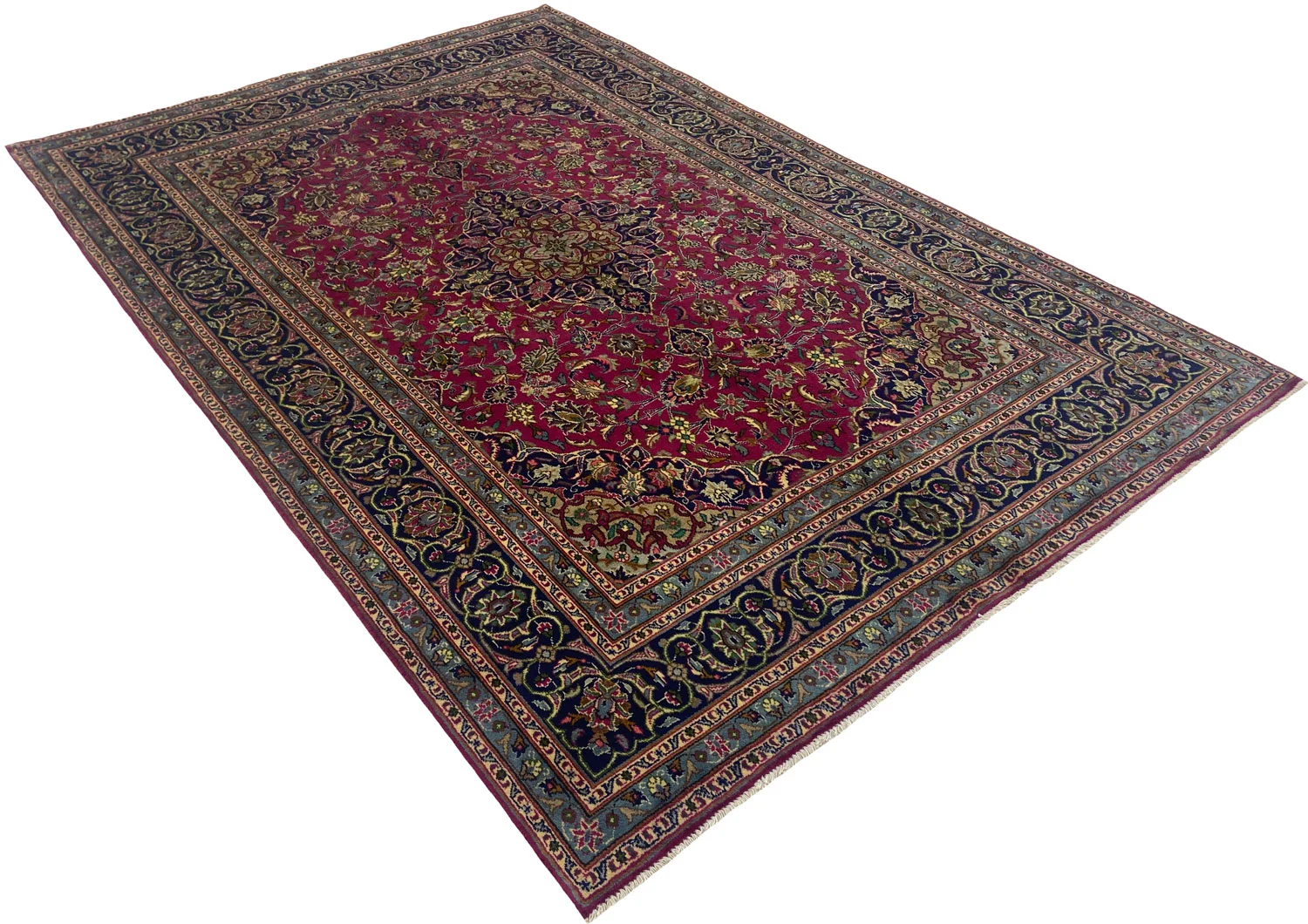
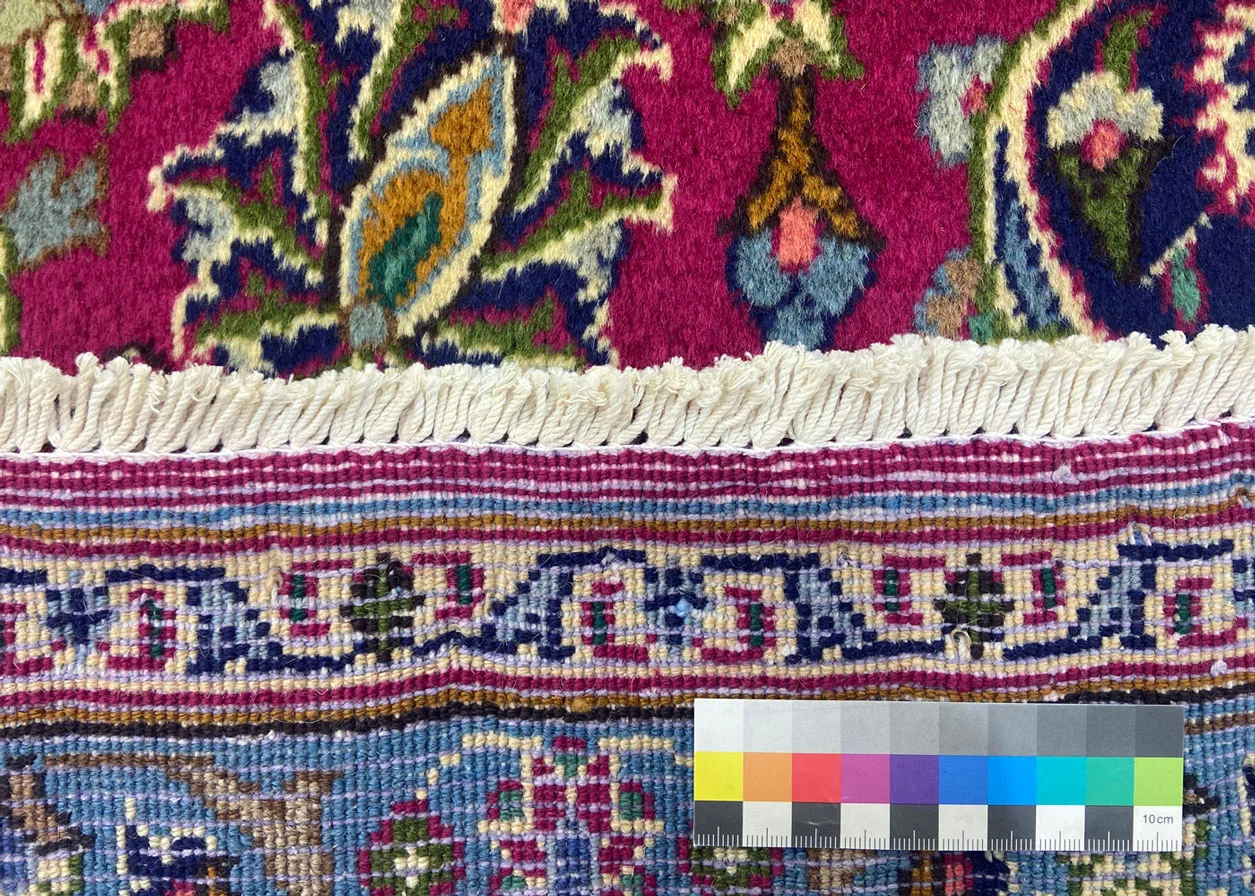
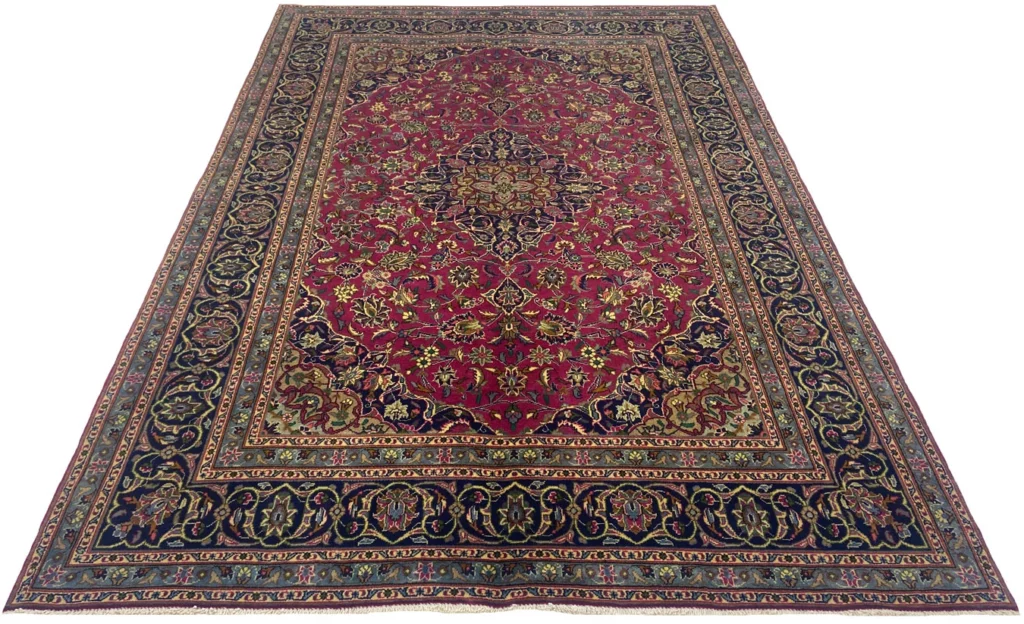
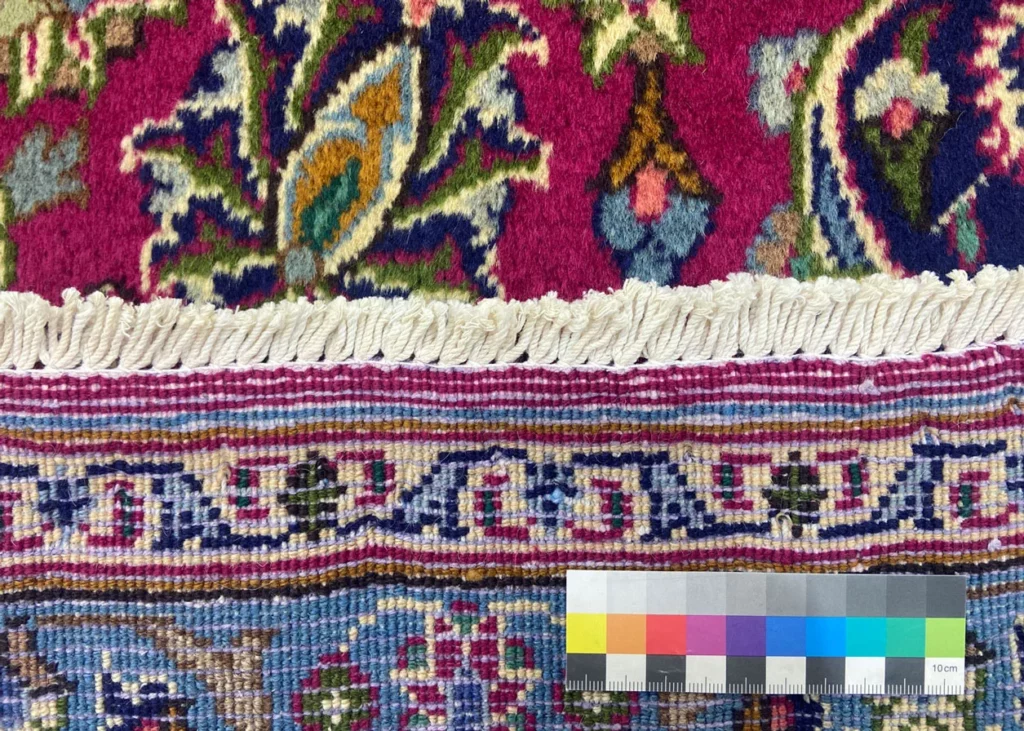
This Kashmar Persian rug is hand-knotted and has a soft pile. Its construction is described as high quality and hard-wearing, with a knot density of 200,000 to 300,000 knots per square metre. Hand-knotting creates a textile in which individual knots are placed by hand and secured within the structure of the rug. The work requires a steady rhythm, careful handling of the design and close attention to the relationship between the pile and the underlying foundation.
The soft pile gives the surface a distinct tactile character while allowing the pattern to be read across the field. In a hand-knotted rug, the pile is built row by row, so the visible drawing depends on both the arrangement of the knots and the controlled use of colour. A higher knot density generally allows weavers to render smaller changes in line and detail with greater definition. Here, the stated density forms part of the rug’s description together with its hard-wearing character.
Kashmar weaving is associated with detailed compositions and a disciplined approach to drawing. The finished surface is not produced by printing or by applying a design after manufacture. Instead, the pattern is formed during the knotting process. This makes the craft dependent on the weaver’s ability to follow a design while maintaining an even surface and a coherent relationship between borders, field and ornament.
Origin and Tradition
Kashmar is a city and weaving centre in northeastern Iran. It lies in the wider cultural landscape of Persian carpet production, where carpet making has developed through local workshops, inherited drawing traditions and the continued use of established decorative forms. Kashmar rugs are known for elaborate designs and for compositions that combine a clearly organised structure with a wealth of ornament.
The region is situated south of Mashhad and belongs to the historic setting of northeastern Persia. This geographical context is important because Persian carpet traditions are not uniform across the country. Each weaving area developed its own preferences in layout, colour, scale and subject matter. Kashmar is associated with designs that can include large central arrangements, floral surroundings and pictorial references to objects from Persian decorative culture.
Persian carpet weaving brings together practical knowledge and visual tradition. A workshop must understand how a design will translate from a drawn plan into rows of knots, how colours will relate across the surface and how the border will frame the central composition. The result is a form of textile art in which ornament is integrated into the structure of the rug rather than treated as a separate layer.
Kashmar carpets are often discussed alongside other important Persian weaving traditions. Kerman is recognised for floral patterns and lively colour combinations. Nain is associated with fine, clear designs and light colour ranges, while Isfahan is known for artistic medallions and carefully detailed compositions. These are distinct regional traditions, not alternative names for this rug. Their comparison helps place Kashmar within the broader history of Persian carpet design while preserving the specific Kashmar identity of this piece.
The continuing importance of Kashmar lies in the way regional patterns remain connected to the skills of the workshop. Traditional forms can be repeated, adapted and arranged in different compositions without losing their connection to Persian visual culture. A Kashmar rug therefore reflects both a local design vocabulary and the wider history of hand-knotted carpets in Iran.
Design and Pattern
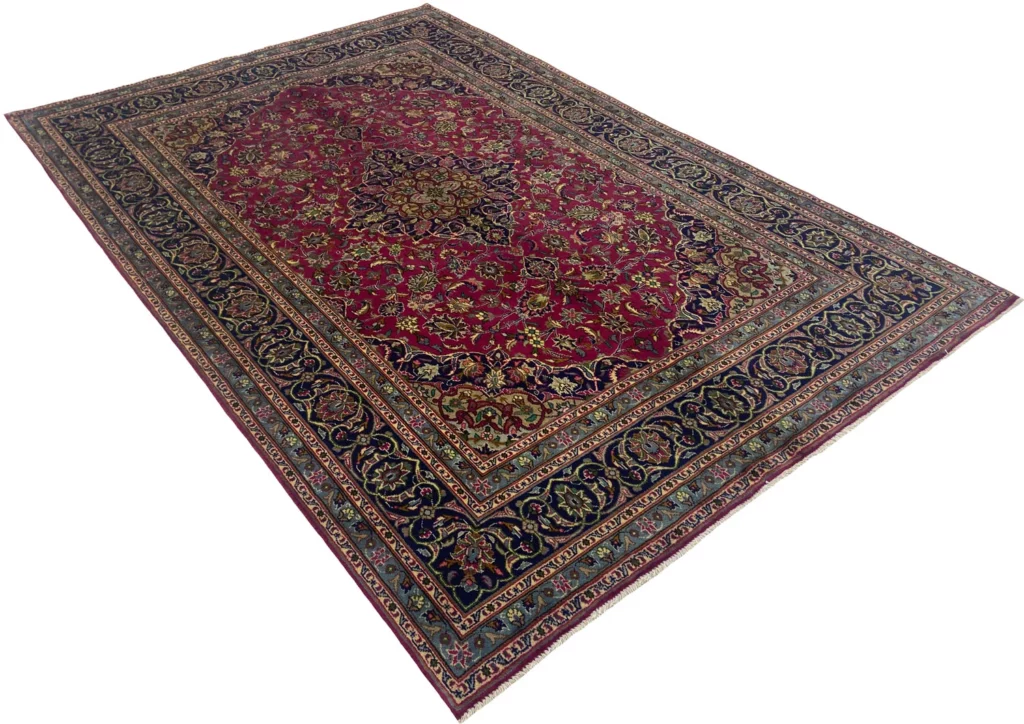
The pattern of this rug is identified as Zirkhaki. A defining feature of the Zirkhaki design is the depiction of antique objects, including vases and bowls. These objects give the composition a pictorial quality and connect the surface decoration with the long Persian tradition of representing vessels, garden imagery and ornamental forms in textiles and other works of art.
Zirkhaki compositions are decorative without depending only on a single type of arrangement. A rug may be organised with or without a central medallion, while stylised floral motifs can surround the main elements. This combination creates a visual relationship between object forms and plant ornament. The flowers act as framing and linking devices, filling spaces, directing the eye and giving the composition a sense of continuity.
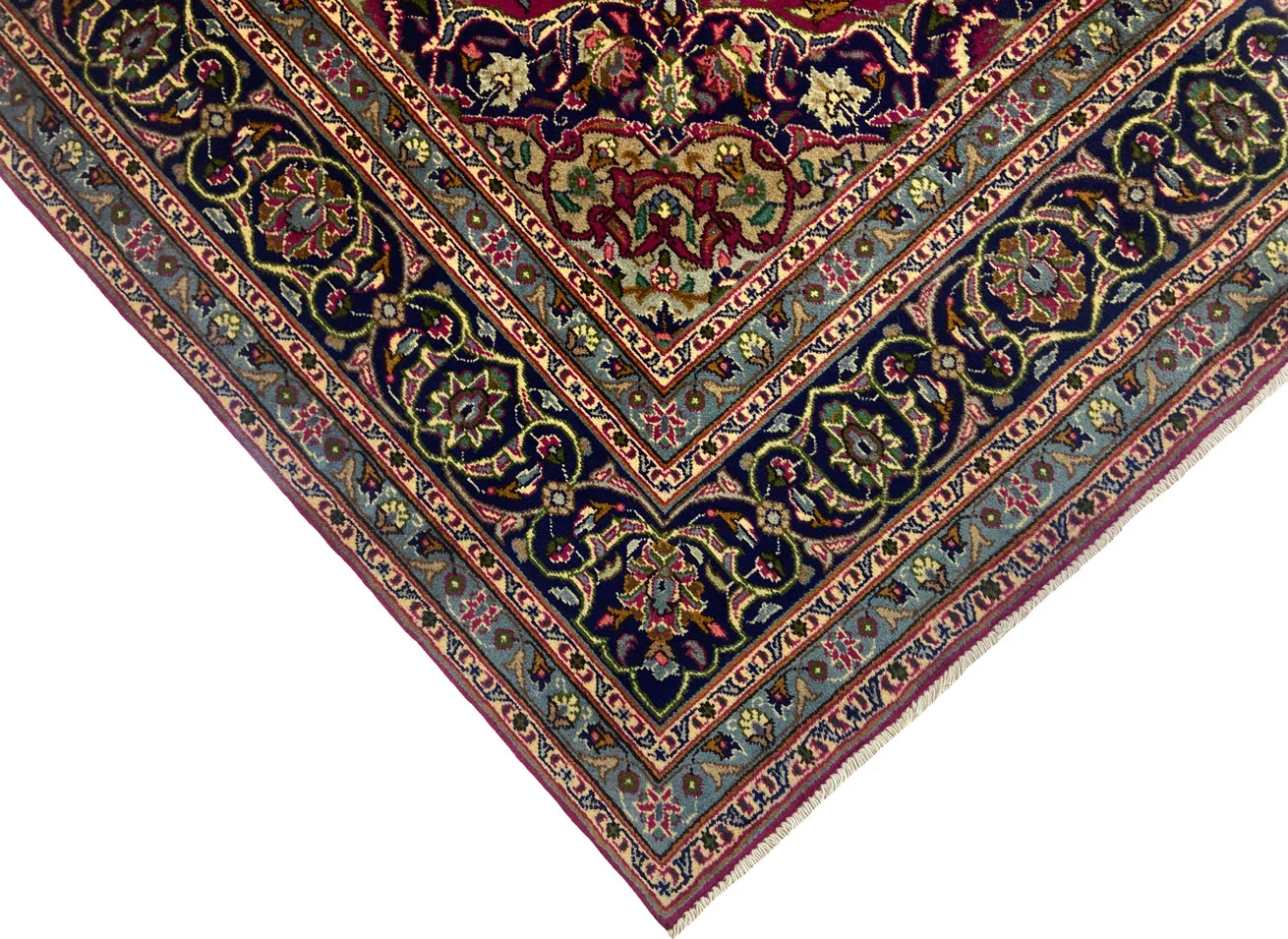
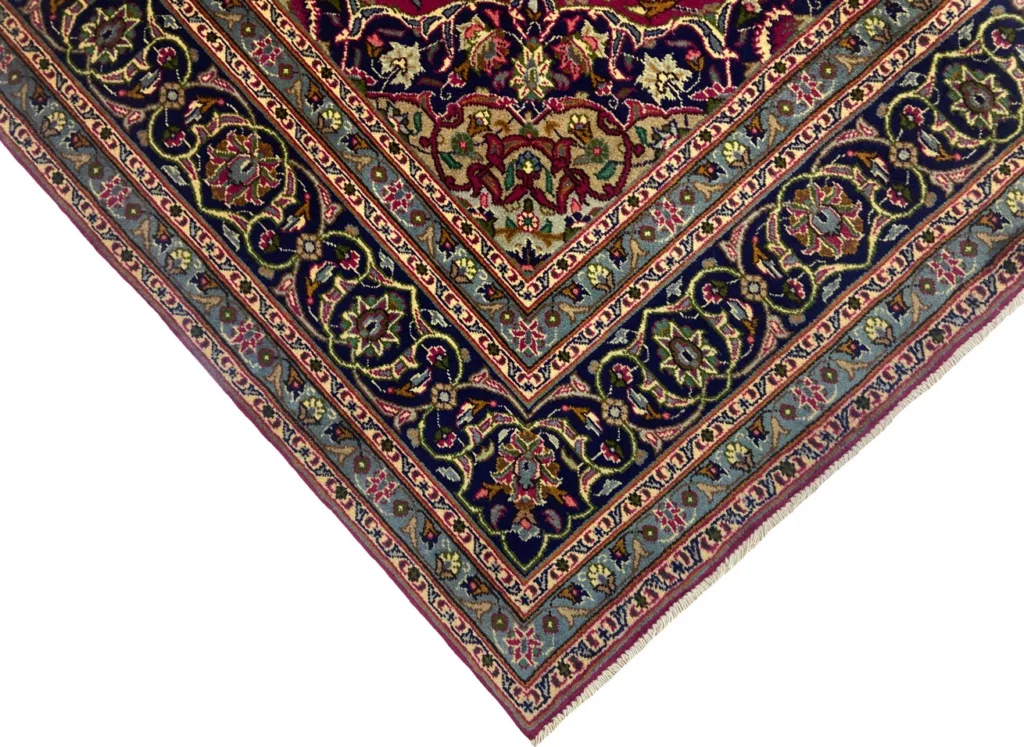
The colour description associated with Kashmar and this design includes lively, harmonious combinations. Warm reds, soft blues and earthy tones are commonly used to establish contrast while keeping the overall palette connected. Red can provide depth and visual warmth, blue can introduce quieter areas and earthy shades can relate the individual motifs to the ground of the composition. The purpose of such a palette is not merely to add variety, but to maintain balance between the different parts of the design.
Antique vessels such as vases and bowls have a long place in Persian decorative language. They may suggest abundance, cultivation and the ordered beauty of a garden, although the exact interpretation depends on the surrounding motifs and the arrangement chosen by the designer. In a carpet, the forms are translated into woven outlines and colour areas, so their identity is conveyed through a stylised rather than naturalistic treatment.
Floral ornament is another important part of the Kashmar design vocabulary. Stylised flowers can be repeated at different scales, placed around a medallion or distributed across the field. Their repetition helps create rhythm, while small variations keep the surface from appearing mechanically uniform. The border then provides a visual boundary, separating the central field from the surrounding space and completing the composition.
The design can be read from close range through its individual objects and flowers, or from farther away through the balance of colour and structure. This two-level reading is characteristic of detailed hand-knotted carpets: the larger arrangement establishes the overall impression, while the smaller motifs reward closer inspection. In this Kashmar rug, the Zirkhaki designation identifies the central decorative language without changing its Persian origin.
Special Features
The defining features of this rug are its Kashmar origin, hand-knotted construction, soft pile, Zirkhaki pattern and described knot density of 200,000 to 300,000 knots per square metre. The source also describes it as high quality and hard-wearing. These details bring together regional identity, technical construction and a pattern based on antique objects and floral surroundings.
Kashmar rugs are suitable for different types of interior setting because their compositions can combine formal structure with varied ornament. The Zirkhaki pattern provides both pictorial detail and a clearly organised decorative surface. It can therefore be considered in a living room, bedroom or entrance area, as well as alongside modern, classical or traditional furnishings. This is a general characteristic of the design tradition and does not alter the rug’s specific Kashmar provenance.
Care supports the continued appearance of a hand-knotted rug. Regular vacuuming removes loose dust, while a fresh stain should be blotted promptly with a damp cloth rather than rubbed aggressively into the pile. Professional cleaning every few years can help maintain the surface and keep the colours clear. Any cleaning method should take account of the rug’s construction and should be carried out with suitable care.
FAQ
How should I care for a Kashmar Persian rug?
Vacuum the rug regularly to remove dust from the pile. If a spill occurs, blot the affected area promptly with a damp cloth instead of rubbing it, since vigorous rubbing can work moisture or dirt deeper into the surface. Professional cleaning every few years is recommended to help preserve the clarity of the colours and the condition of the soft pile. Cleaning should be performed carefully and with methods suitable for a hand-knotted Persian rug.
Where does a Kashmar Persian rug come from?
A Kashmar Persian rug comes from Kashmar, a city in northeastern Iran. Kashmar is known for a long tradition of carpet weaving and for detailed compositions that belong to the Persian carpet tradition. The region is situated south of Mashhad. Kashmar designs can include floral ornament, medallion-based arrangements and pictorial references such as vases and bowls. This rug is identified specifically as Kashmar and should not be confused with Kerman, Nain or Isfahan rugs, which represent separate Persian weaving traditions.
What sizes are available for Kashmar rugs?
Kashmar rugs are made in a range of sizes, from smaller runners to larger room rugs. This variety allows the tradition to be used in different areas of a home, including living rooms, bedrooms and entrance spaces. The available format affects how a design is arranged and how much space is given to the field, border and decorative motifs. The individual Kashmar rug described here has its own specified size, while the broader Kashmar tradition includes many different formats.
To provide the best experiences, we use technologies like cookies to store and/or access device information. Consenting to these technologies will allow us to process data such as browsing behavior or unique IDs on this site. Not consenting or withdrawing consent, may adversely affect certain features and functions.
Functional Always active
The technical storage or access is strictly necessary for the legitimate purpose of enabling the use of a specific service explicitly requested by the subscriber or user, or for the sole purpose of carrying out the transmission of a communication over an electronic communications network.
Preferences
The technical storage or access is necessary for the legitimate purpose of storing preferences that are not requested by the subscriber or user.
Statistics
The technical storage or access that is used exclusively for statistical purposes.The technical storage or access that is used exclusively for anonymous statistical purposes. Without a subpoena, voluntary compliance on the part of your Internet Service Provider, or additional records from a third party, information stored or retrieved for this purpose alone cannot usually be used to identify you.
Marketing
The technical storage or access is required to create user profiles to send advertising, or to track the user on a website or across several websites for similar marketing purposes.

 SECURE PAYMENT
 SHIPPING PARTNERS


