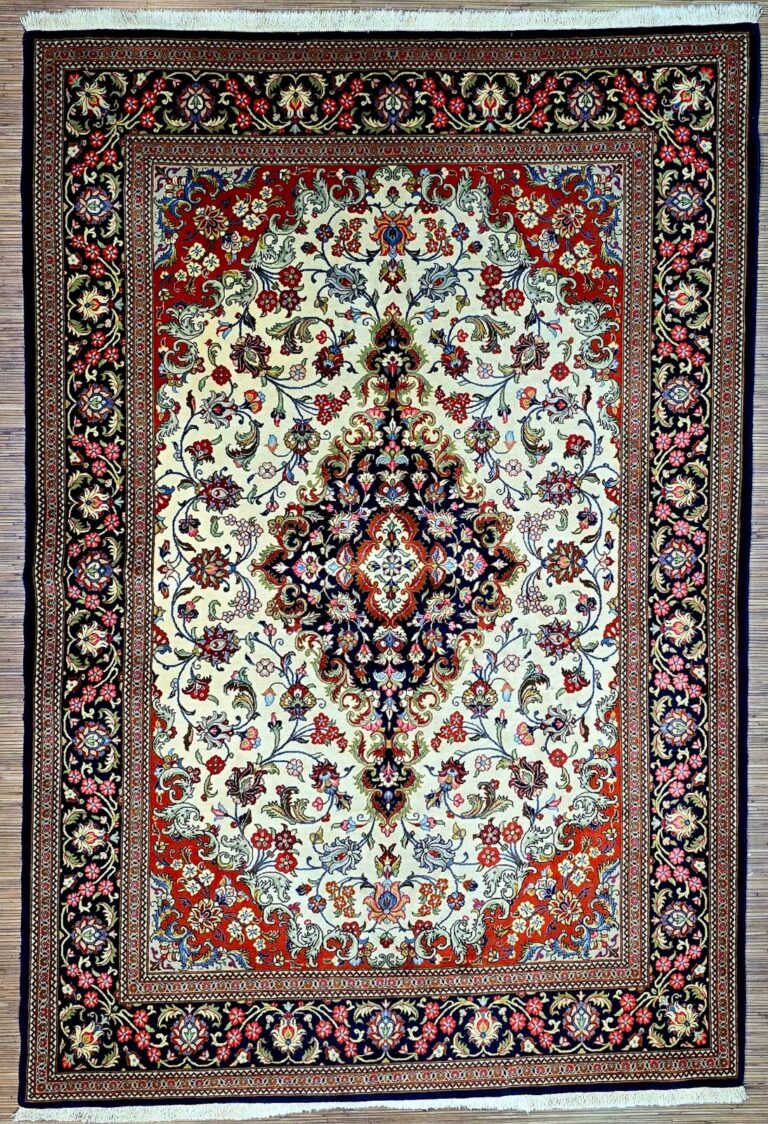
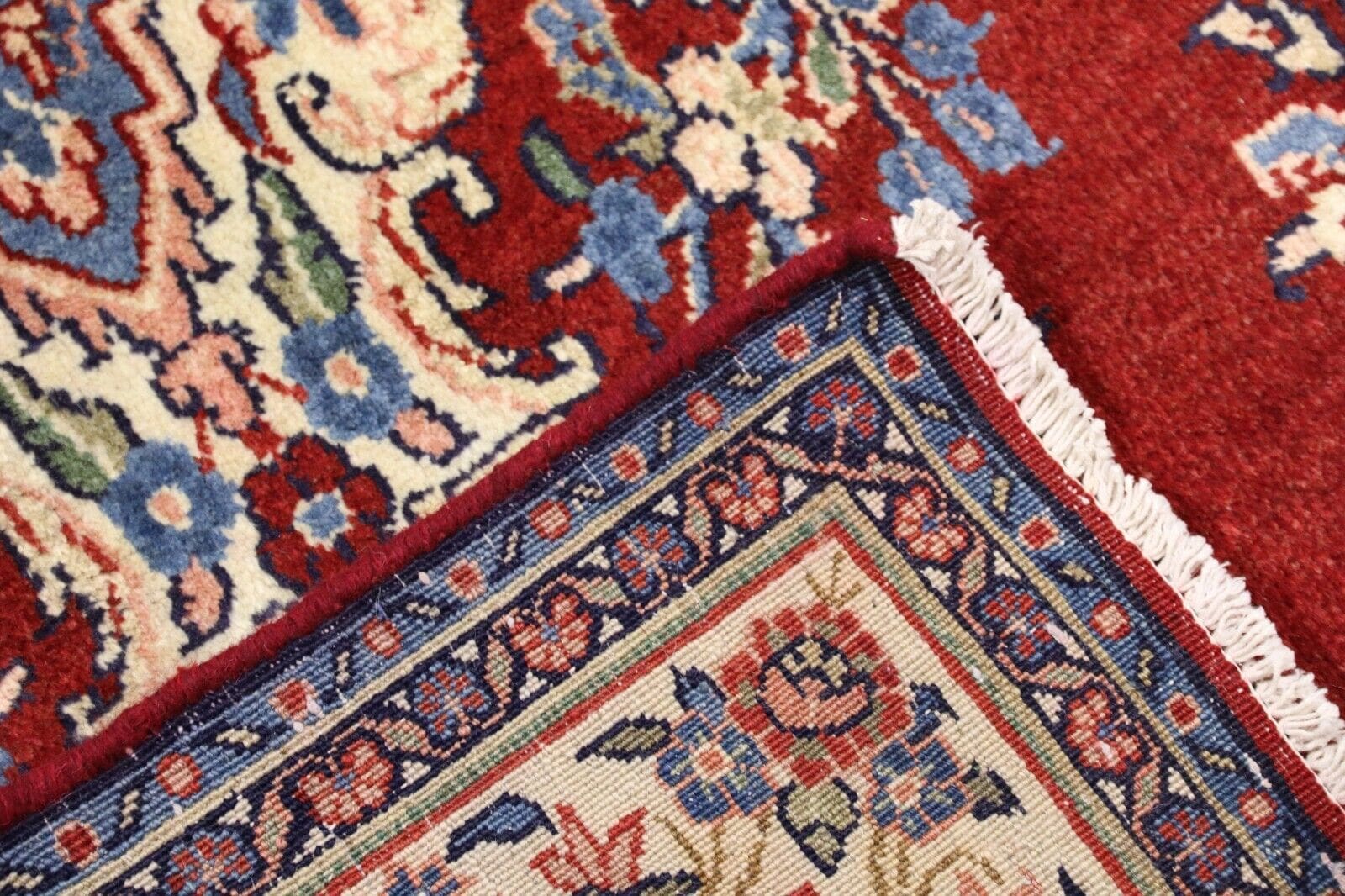
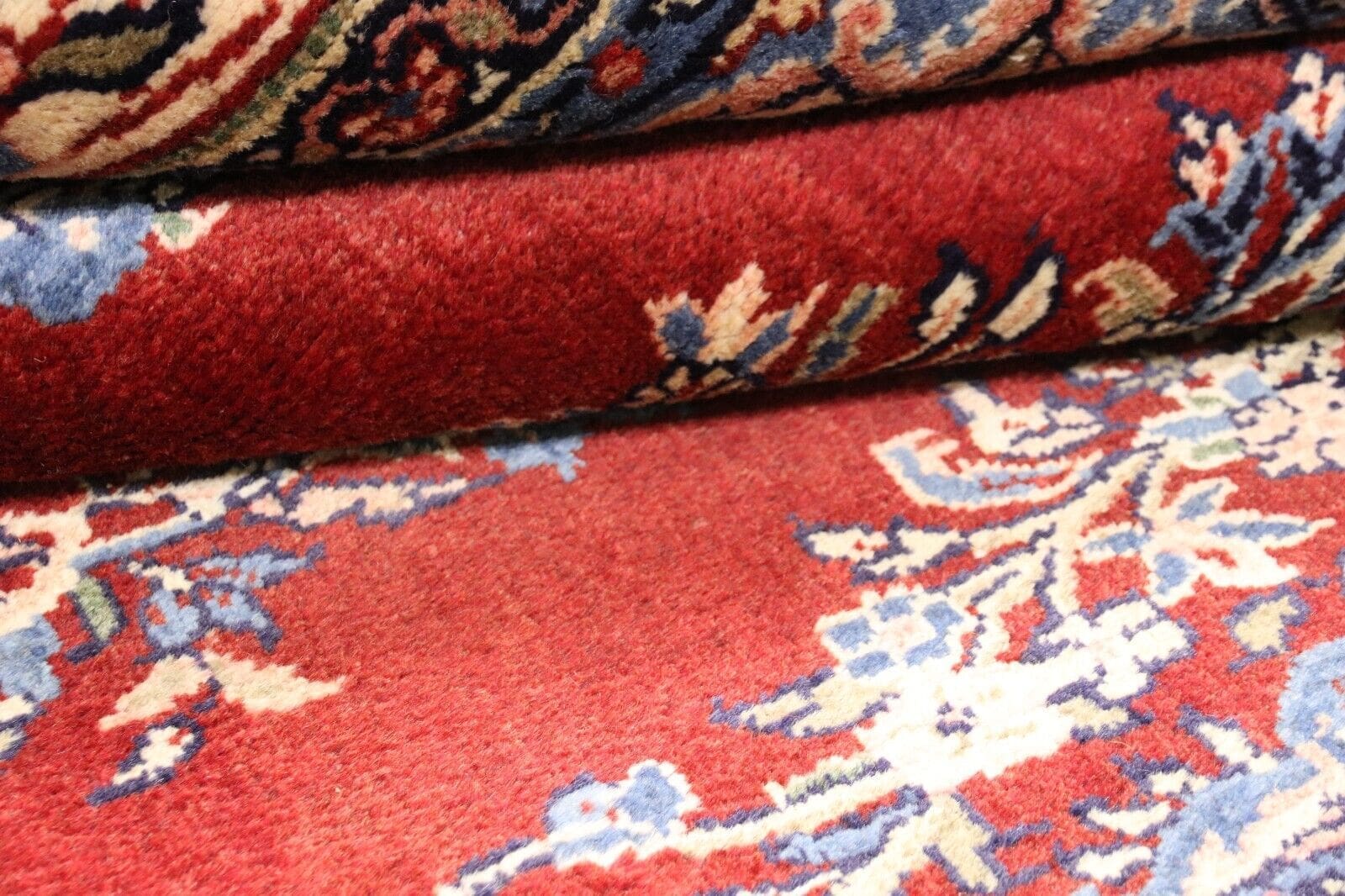
This Hamadan Persian rug is hand-knotted from 100% virgin wool. Its warp is made from 100% cotton, providing a stable foundation for the wool pile. The combination of a wool pile and cotton warp is a traditional construction in which the foundation supports the rows of knots and gives the finished textile its structure.
The rug has a knot density of approximately 200,000 knots per square metre. Hand-knotting means that the knots are placed by hand rather than formed by an industrial machine. The work requires concentration, practiced handling of the yarn and a consistent tension across the foundation. The visible pattern develops gradually as the knots and coloured areas are built up row by row.
Virgin wool is used for the pile. Wool is a traditional rug fibre because it is resilient, flexible and pleasant underfoot. Its natural structure allows the pile to recover from regular use, while the cotton warp gives the rug a firm base. The source describes the material as durable and robust as well as soft and comfortable.
The rug is described as new and in perfect condition. It is a unique, one-off piece. Its hand-knotted construction, wool pile, cotton warp and stated knot density are the defining technical characteristics of this individual rug.
Origin and Tradition
Hamadan is a major carpet-producing area in western Iran. The name Hamadan is used for a broad weaving region as well as for the city that serves as an important centre of trade. Numerous villages and local weaving communities have contributed to the area’s carpet tradition, which is why Hamadan rugs can show considerable variation in drawing, colour and scale.
Persian carpet weaving developed through a combination of rural household production, urban workshops and long-established trading routes. In Hamadan and its surrounding region, weaving traditions were transmitted through families and local communities. Designs were adapted to available materials, local taste and the requirements of the household or market for which a rug was made. This regional diversity is an important part of the identity of Hamadan carpets.
Hamadan weaving is associated with practical, clearly legible compositions. Geometric structures, repeated motifs and floral elements are common features of the wider regional vocabulary. Depending on the place of weaving, a rug may have a strongly ordered central field, an all-over arrangement or a more open design. Borders help frame the field and create a visual boundary, while smaller ornaments provide rhythm within the composition.
Traditional Persian rugs are made from designs that carry both decorative and cultural meaning. Motifs may be repeated from one generation to the next, while individual weavers interpret them through their own drawing and colour choices. The result is not a mechanically identical surface but a woven composition shaped by manual work. This relationship between inherited design language and individual execution is central to the tradition of Persian carpets.
Hamadan carpets belong to the broader family of Iranian weaving traditions alongside such recognised regional groups as Bakhtiari, Kerman and Tabriz. These names refer to distinct centres or traditions, not to the origin of this rug. Bakhtiari carpets are associated with lively colours and floral designs, Kerman carpets with detailed drawing and fine wool, and Tabriz carpets with established urban workshop traditions. Nain and Kashan are also known for their refined workmanship and varied classical and modern designs.
The regional carpet culture of Iran includes both village weaving and workshop production. Village rugs often preserve direct, strongly outlined motifs, while urban workshops may work with more formally planned compositions. These categories overlap, and a Hamadan rug should be understood through its own design and construction rather than through a single fixed template. The enduring tradition lies in the use of hand skills, durable fibres and a visual language passed through generations.
Design and Pattern
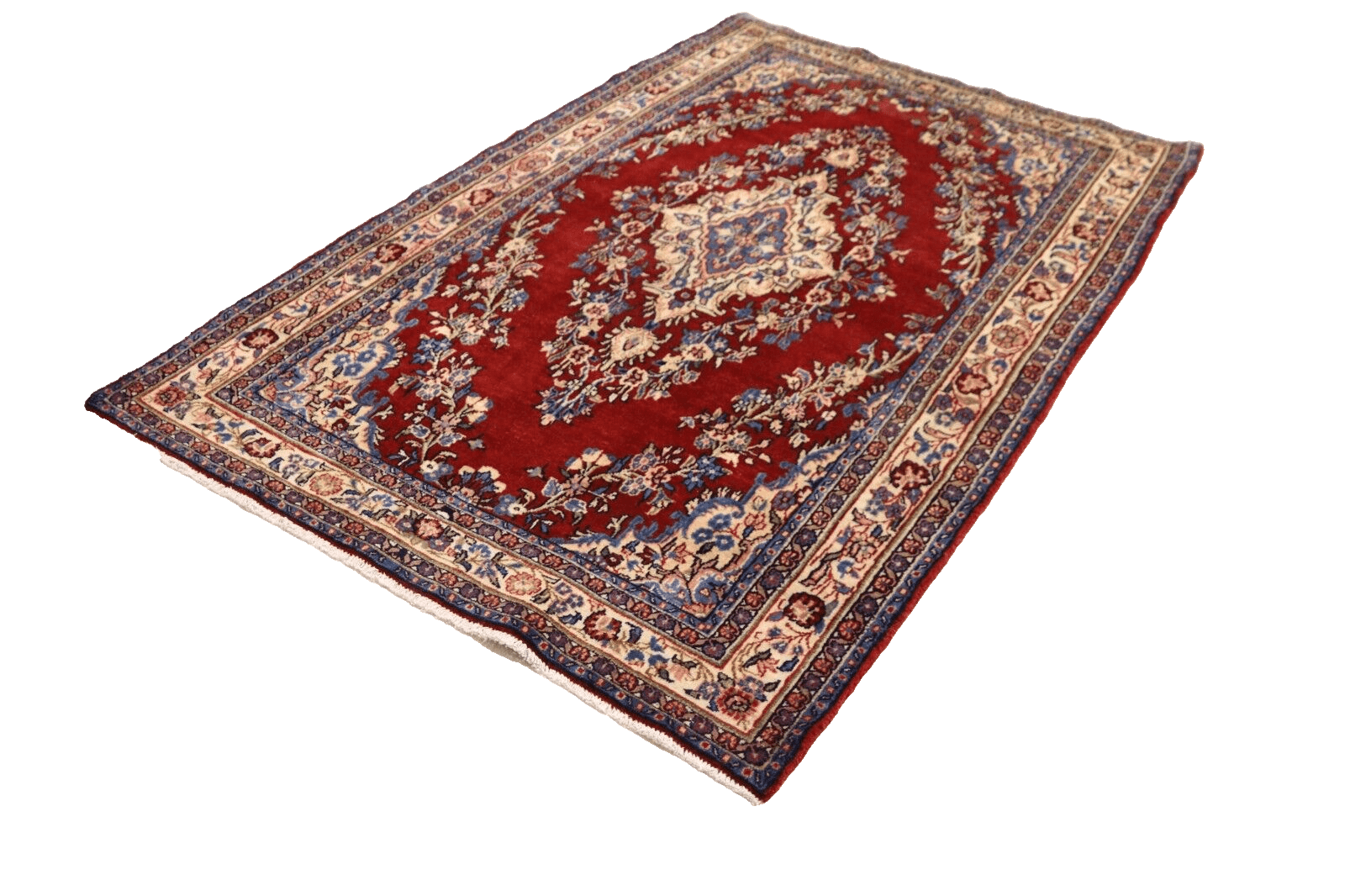
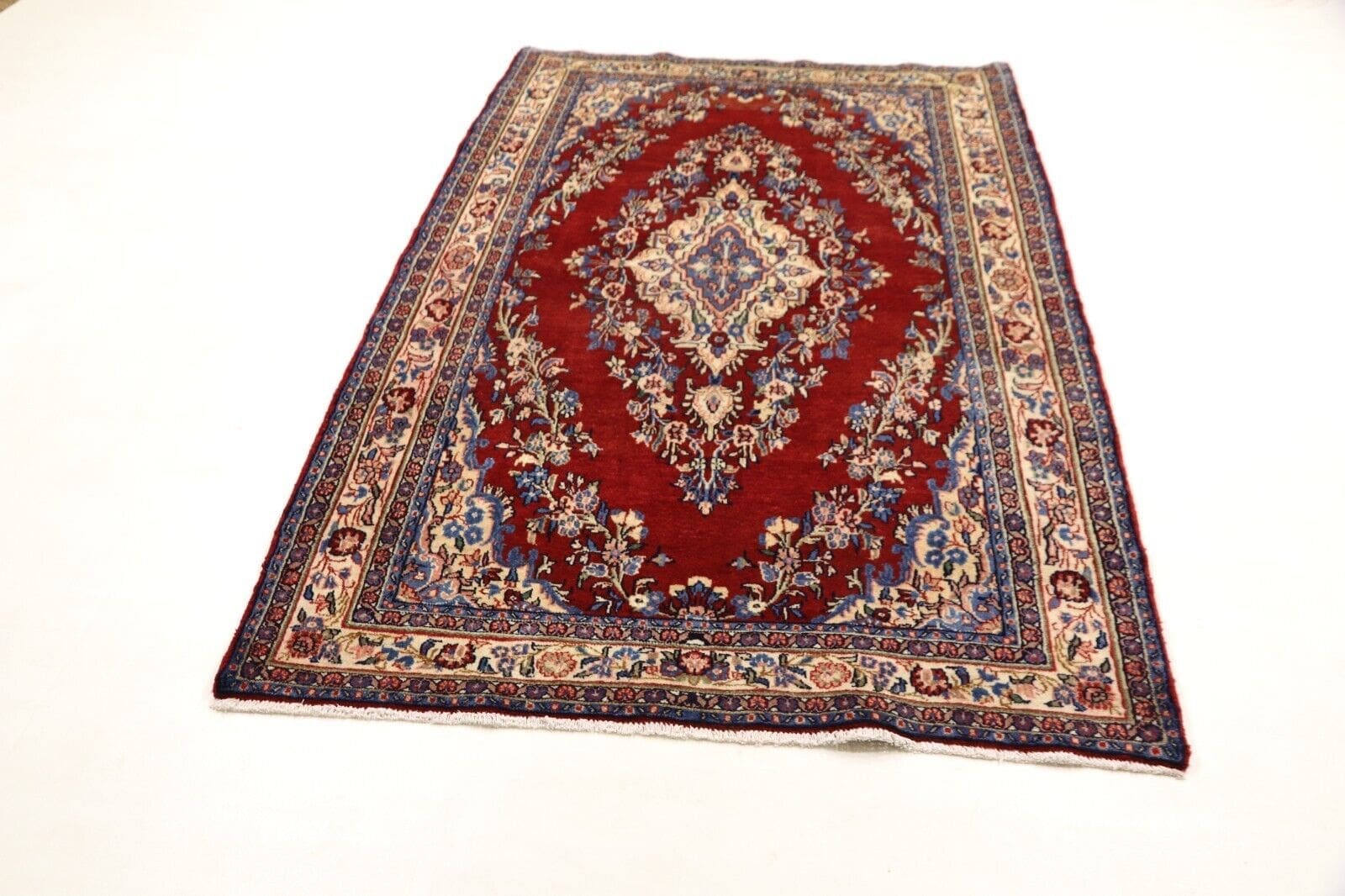
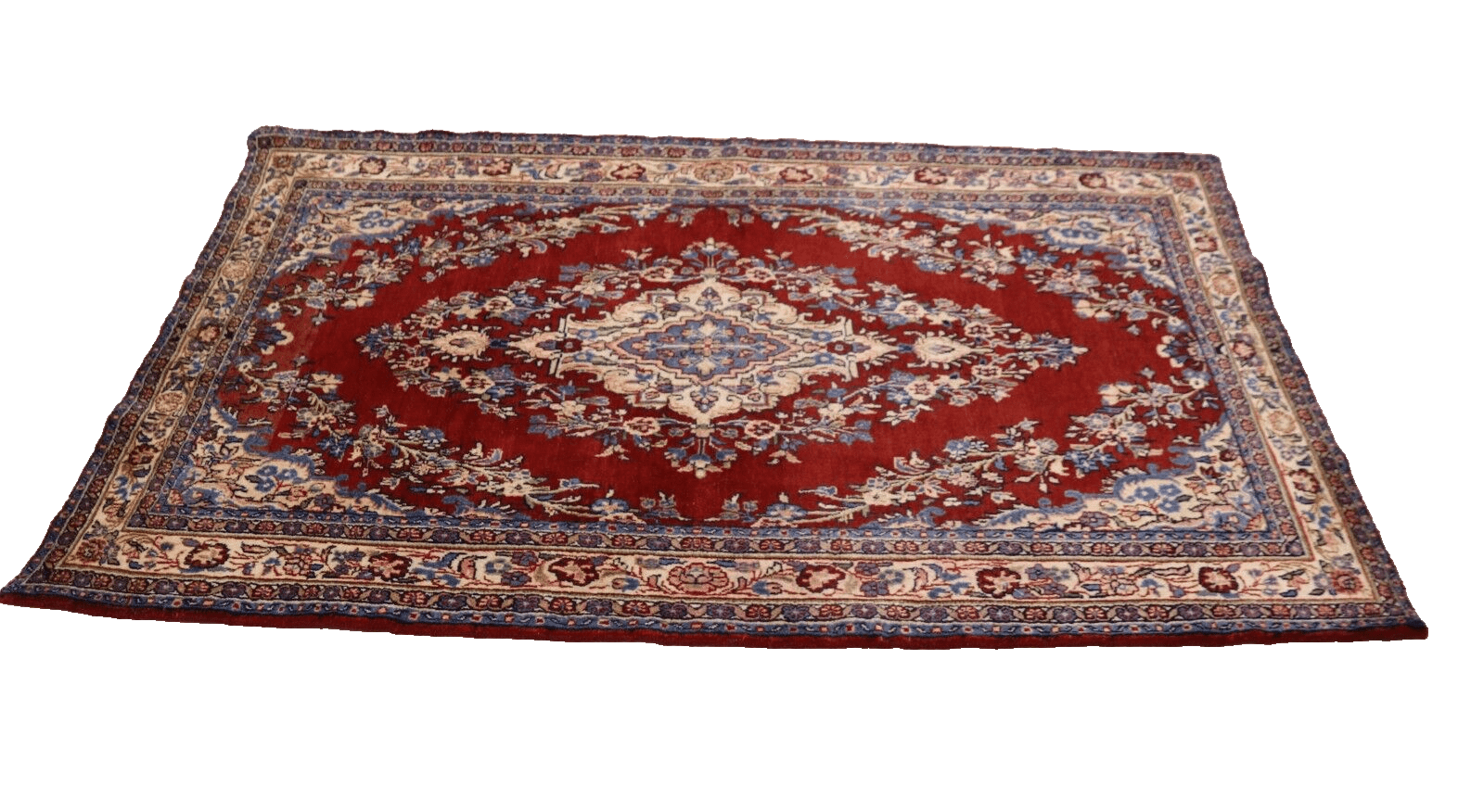
This rug is described as having geometric forms and floral designs combined in a harmonious composition. Geometry gives the pattern order and structure. Lines, angular shapes and repeated elements can establish a clear rhythm across the field, while floral motifs introduce curved contours and a more organic counterpoint. Their combination is characteristic of the way Persian carpet design balances regularity with variation.
Geometric motifs in Persian weaving may be simple or highly articulated. They can define a central arrangement, organise smaller compartments or appear as repeated ornaments. Angular drawing is especially suited to hand-knotting because the design is constructed gradually through rows of coloured knots. Small changes in outline or spacing are part of the character of a manually executed pattern rather than a sign of machine production.
Floral motifs bring references to leaves, blossoms, stems and stylised garden forms. In a carpet, such motifs are not necessarily naturalistic representations. They are often reduced to recognisable signs that can be repeated, mirrored or arranged around a central structure. Their purpose is both decorative and compositional: they connect separate areas of the field and soften the movement of geometric forms.
Persian carpet patterns are traditionally supported by a relationship between field and border. The field carries the main narrative of the design, while the border frames it and regulates the transition to the outer edge. Secondary borders may separate the main border from the field. Even when the exact arrangement varies, this layered structure helps the eye read the rug as a complete textile rather than as an isolated collection of motifs.
Colour is an important part of regional carpet design. The source describes the patterns and colours of Hamadan carpets as characteristic of the region and states that natural dyes are used. Natural dyeing is a longstanding practice in Persian weaving. Colourants derived from plants, insects and minerals are prepared through soaking, boiling or other forms of extraction, then applied to wool. The resulting shades can vary according to the source material, water, preparation and dye bath.
Traditional dyes are valued not because every rug has identical colour, but because they create a nuanced range of tones. The same dye family may produce different results depending on the wool and the conditions of preparation. In a woven design, these colour relationships help distinguish the field from the border and make repeated motifs readable. The pattern therefore depends on both drawing and the careful organisation of colour.
The design language of Hamadan is connected to the wider Persian tradition but is not limited to one motif. Regional examples may include medallions, repeated floral arrangements, angular vines or compact ornamental fields. The present rug is specifically described through its combination of geometric and floral designs; further individual motifs are not assigned to it. This distinction preserves the identity of the one-off piece without adding an unsupported pattern name.
Because the rug is hand-knotted, its design is produced through a physical process rather than printed onto a finished surface. The pattern is built into the textile as the pile is formed. This gives the design a material presence: colour, line and texture are joined in the same construction. The visual effect depends on the interaction of the wool pile, the knotting and the arrangement of the motifs.
Special Features
This rug is a one-off hand-knotted piece from Hamadan. It is made from 100% virgin wool with a 100% cotton warp and has an approximate knot density of 200,000 knots per square metre. The source describes it as new and in perfect condition. These details distinguish the individual rug from general examples of Hamadan production.
The rug is also described as soft, comfortable, durable and robust. Regular care helps preserve its appearance. Recommended care consists of vacuuming regularly without a brush attachment and occasionally beating the rug outdoors. For stains, a specialised carpet cleaner should be used, first tested on an inconspicuous area. Professional advice is appropriate when a stain is difficult or when the fibre requires careful treatment.
Its pattern combines geometric forms with floral designs, and the source identifies natural dyes as part of the characteristic colour tradition of Hamadan carpets. The rug is intended for use in living rooms, bedrooms or offices. It is a Persian rug from Iran, not a machine-made floor covering, and its individual construction means that it is not reproduced as an identical series.
FAQ
How should I care for this Hamadan Persian rug?
Vacuum the rug regularly without using a brush attachment, since a rotating or aggressive brush can place unnecessary strain on the pile. Occasional beating outdoors is also recommended as part of routine care. If a stain appears, use a specialised carpet cleaner and test it first on a concealed area. This test helps confirm that the product is suitable before it is applied to a visible section. Persistent or difficult stains should be handled with appropriate professional care rather than treated aggressively at home.
Where does the wool in this Persian rug come from?
The virgin wool comes from the highland regions of Iran, where sheep graze under suitable conditions. The source connects these conditions with the quality of the fibre and with the natural colour tones used in carpet making. Wool has long been used in Persian rugs because it offers a resilient pile with a soft, comfortable feel. In this rug, the wool forms the pile, while the cotton warp supplies the supporting foundation for the hand-knotted construction.
Why do hand-knotted rugs cost more than machine-made rugs?
A hand-knotted rug requires time and skill because every knot is placed by hand. The design is therefore constructed gradually within the textile rather than applied by an automated production process. Hand-knotting can support a substantial knot density and contributes to a durable construction when the materials and workmanship are sound. These requirements explain why hand-knotted rugs are valued differently from machine-made products and why they are regarded as long-term furnishings for the home.
To provide the best experiences, we use technologies like cookies to store and/or access device information. Consenting to these technologies will allow us to process data such as browsing behavior or unique IDs on this site. Not consenting or withdrawing consent, may adversely affect certain features and functions.
Functional Always active
The technical storage or access is strictly necessary for the legitimate purpose of enabling the use of a specific service explicitly requested by the subscriber or user, or for the sole purpose of carrying out the transmission of a communication over an electronic communications network.
Preferences
The technical storage or access is necessary for the legitimate purpose of storing preferences that are not requested by the subscriber or user.
Statistics
The technical storage or access that is used exclusively for statistical purposes.The technical storage or access that is used exclusively for anonymous statistical purposes. Without a subpoena, voluntary compliance on the part of your Internet Service Provider, or additional records from a third party, information stored or retrieved for this purpose alone cannot usually be used to identify you.
Marketing
The technical storage or access is required to create user profiles to send advertising, or to track the user on a website or across several websites for similar marketing purposes.

 SECURE PAYMENT
 SHIPPING PARTNERS