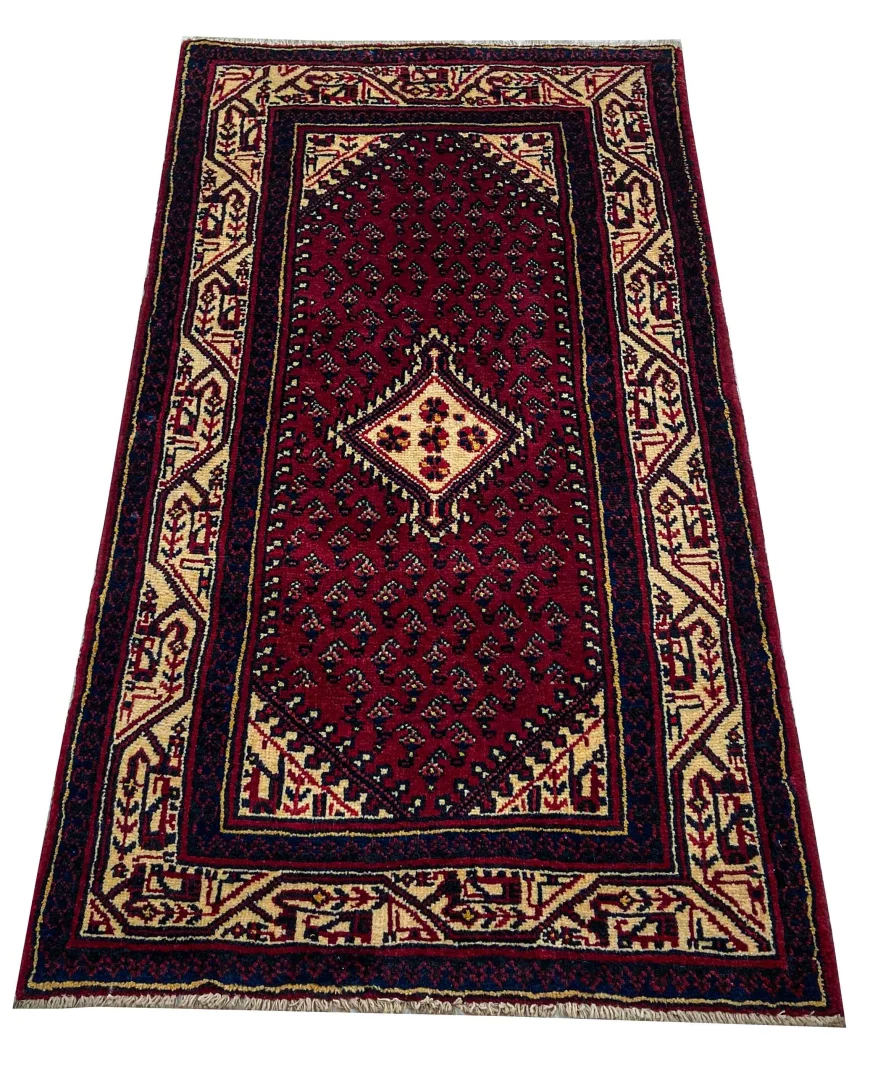
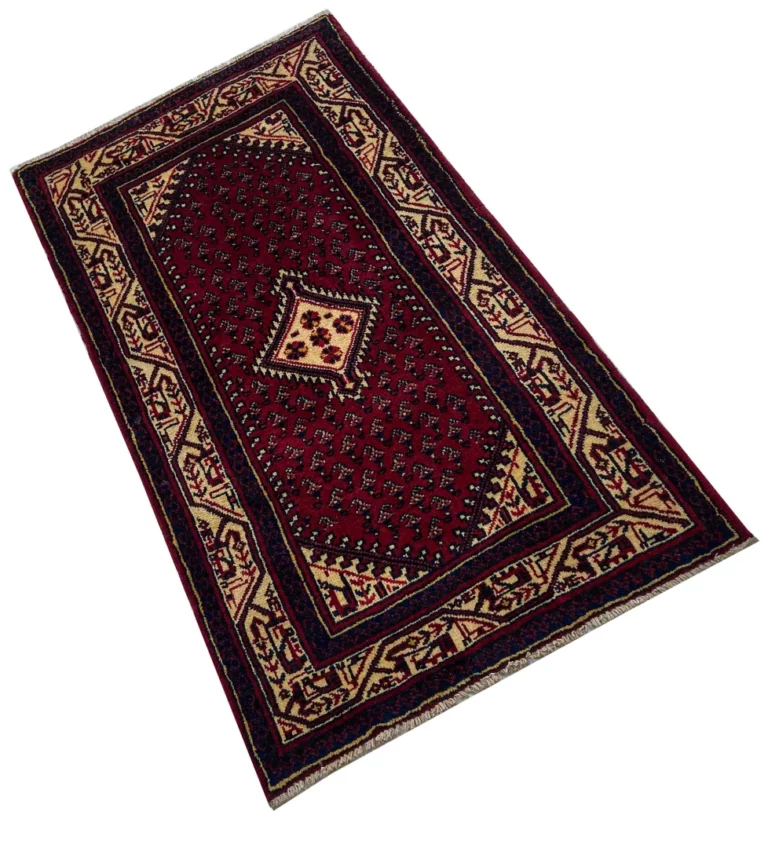
This Hamadan Persian rug is hand-knotted and has a pile made from resilient wool. Wool is one of the traditional materials used in Iranian rug making. It is valued for its durability and its pleasant handle. In a hand-knotted rug, the design is built knot by knot on a prepared foundation. Each individual piece therefore develops through a manual process rather than being produced as an identical machine-made series.
The listed knot density ranges from 100,000 to 350,000 knots per square metre. Such density supports the execution of varied designs and is consistent with the sturdy construction associated with Hamadan rugs. The technical work and the decoration are closely connected: knots, material and colour areas are brought together progressively as the weaver follows the intended composition.
Wool has long played an important role in oriental rugs because, when properly worked, it is durable and versatile. In Hamadan weaving it is traditionally used for clearly defined drawings as well as for changing colour effects. The material information for this rug identifies a wool pile; no further material is specified.
Origin and Tradition
Hamadan lies in north-western Iran and is recognised as one of the established centres of Persian rug production. The city and its surrounding area have developed a long weaving tradition in which practical knowledge has been passed from one generation to the next. Rugs from the region are associated with sound construction and a broad range of designs. The name Hamadan can refer both to work from the city and to rugs made in its wider regional environment.
Places such as Assadabad, Khamseh, Maslaghan and Nahawand are also connected with individual rug traditions. In the trade, their products are often grouped under the broader Hamadan designation. Shared regional characteristics do not mean that every rug follows one fixed pattern. Drawing, colour, proportions and technical execution can differ from one locality to another. This variety is part of the region’s identity and explains why Hamadan rugs form a diverse group rather than a single uniform style.
Weaving in north-western Iran combines regional materials with inherited methods of handwork. A hand-knotted rug is not made in the same manner as an industrial floor covering. The weaver places individual knots along the planned design and develops the surface step by step. The finished textile therefore brings together pattern, colour distribution and construction in a process that is closely tied to the skills of the maker.
Hamadan is considered one of Iran’s productive rug-making regions. Its tradition has produced many designs that can preserve established regional forms while also incorporating more contemporary influences. The name consequently identifies a place and a weaving culture rather than one rigid visual formula. A Hamadan rug reflects both the history of a regional craft and the particular interpretation found in the individual piece.
The wider Iranian rug tradition includes many centres with distinct reputations. Tabriz is associated with detailed designs and high knot densities, Isfahan with finer drawing and more luxurious materials, and Kerman with vivid colours and elegant compositions. Sarough and Bijar likewise represent their own regional traditions. These comparisons show the breadth of Iranian weaving without changing the origin of this rug, which is Hamadan.
Design and Pattern
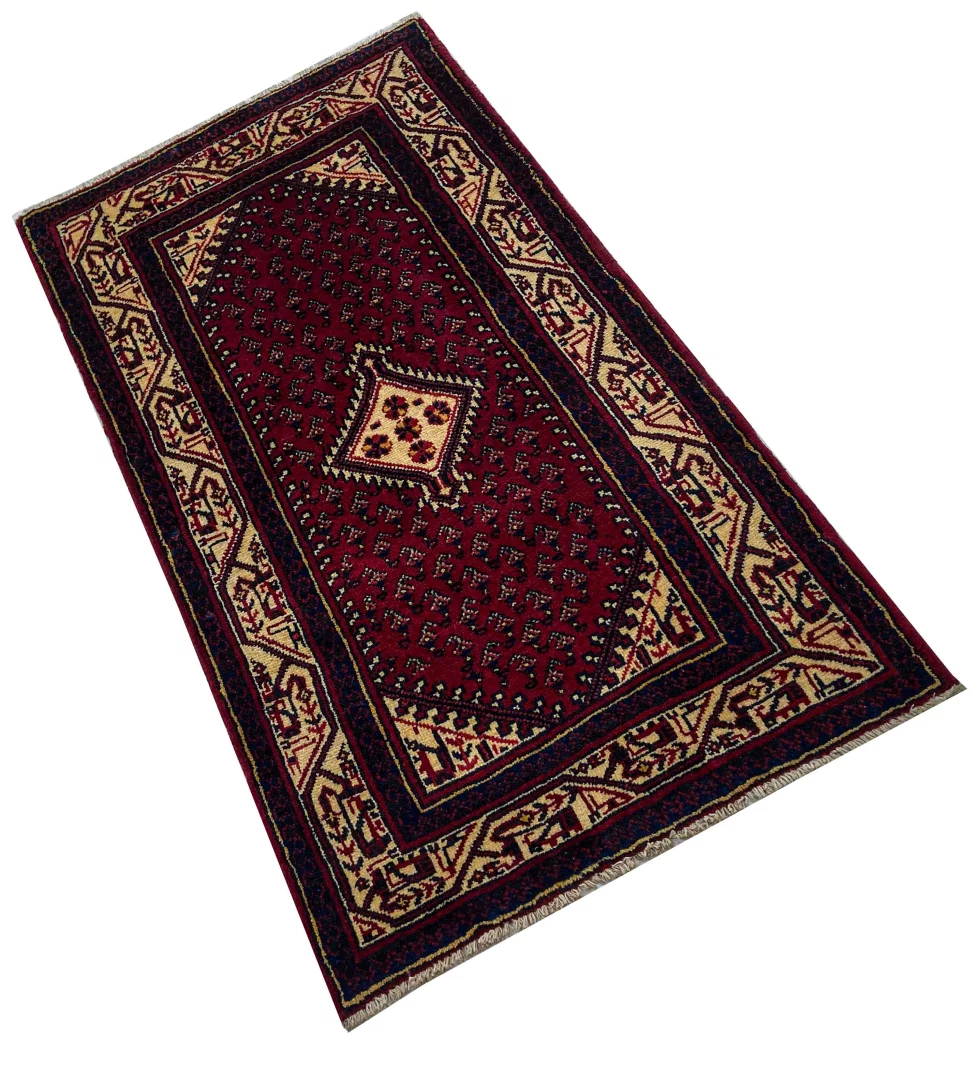
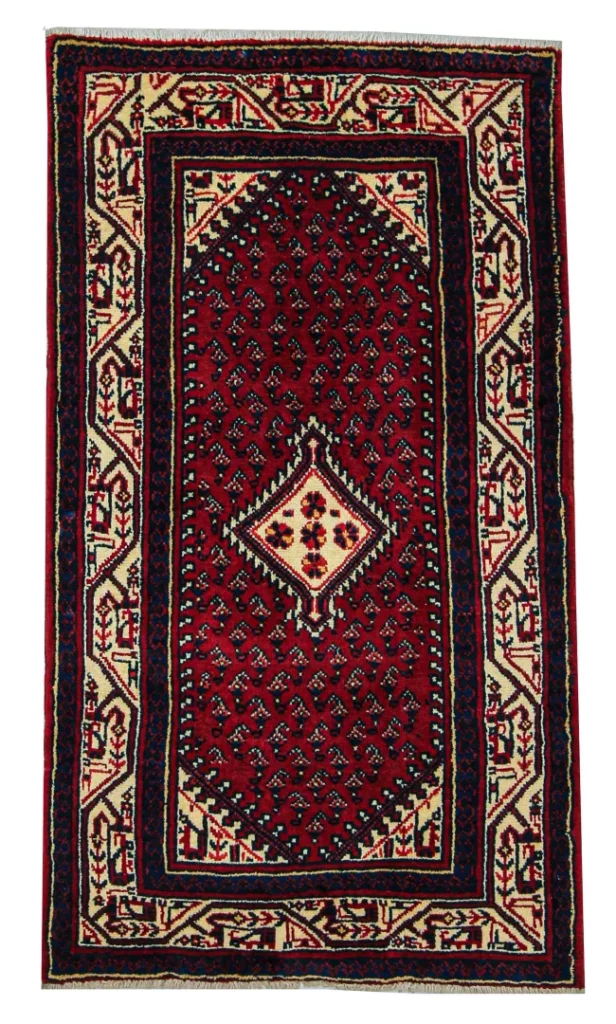
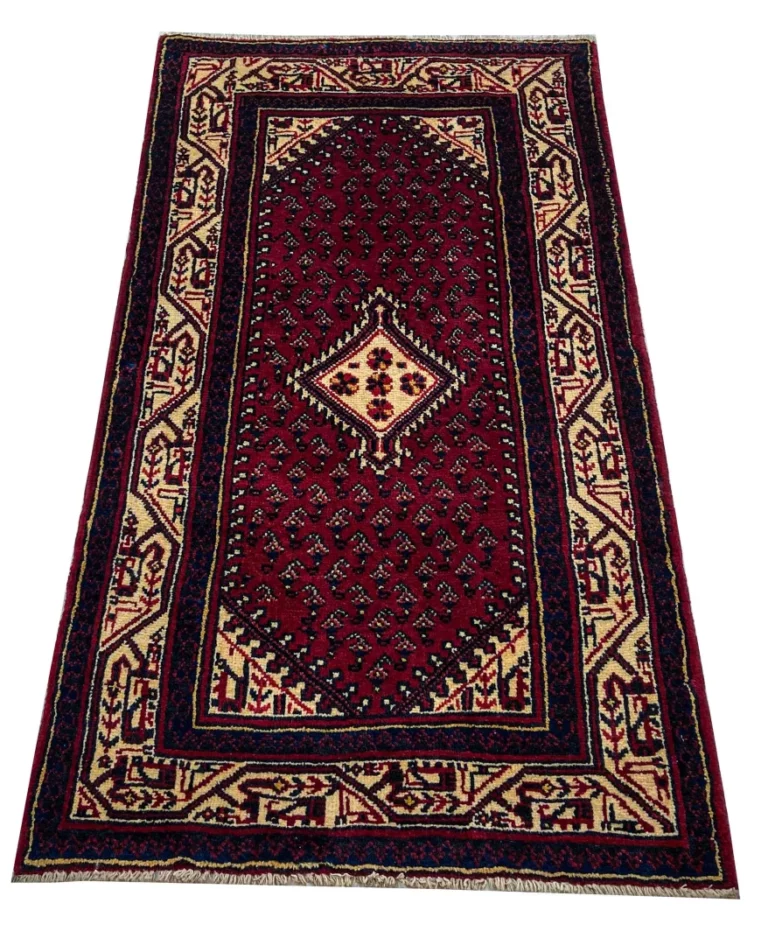
This rug is described as having varied designs. In Hamadan weaving, the traditional range includes both floral and geometric compositions. Floral drawings may contain blossoms, leaf scrolls and other stylised botanical elements. Geometric designs instead rely on ordered lines, repeated shapes, diamonds, medallions or structured fields. These two approaches belong to the broad visual vocabulary of the region.
The patterns of a Hamadan rug are more than surface decoration. They are connected with the culture and inherited visual language of north-western Iranian weaving. Repeated motifs help preserve design ideas across generations, while small variations arising from manual work give an individual rug its own character. A familiar regional form can therefore appear in a distinct interpretation rather than as a mechanically repeated image.
Hamadan designs are often associated with warm reds, blues and earthy shades. These colours may be used in different ways within floral or geometric compositions: as a ground, as an outline or as an accent inside an ornament. The effect depends on the relationship between drawing and colour distribution. A pattern is defined not only by one motif, but also by the balance between the central field, the border and the areas that connect them.
Many Persian rugs use a border to frame the inner field. Depending on the design, it may contain repeated ornaments, stylised plant forms or geometric details. The inner field can be organised around a central arrangement or covered by a continuously repeated pattern. The specific description of this rug does not identify one particular medallion, boteh or named layout. It does establish a varied design vocabulary and a clear connection with Hamadan.
The detailed work made possible by dense knotting supports the rendering of lines and ornaments with differentiation. At the same time, a hand-knotted surface is not mechanically identical from one area to the next. Manual construction joins the inherited pattern world with the character of the individual rug. Floral and geometric elements may appear separately or be combined within one overall composition.
The broad design language allows Hamadan rugs to relate to both traditional and more contemporary interiors, without assigning a specific room or use to this individual piece. Their patterns can be read in a classically furnished setting as well as alongside a more restrained interior. The decisive qualities remain the particular arrangement of colour and pattern in each rug.
Special Features
The recorded characteristics of this rug are its Hamadan origin in north-western Iran, hand-knotted construction, wool pile, a knot density of 100,000 to 350,000 knots per square metre and varied designs. Its condition is described as well preserved. These statements describe the piece directly and do not add an unstated signature, age or provenance.
Regular vacuuming is recommended for the care of a Hamadan rug. If more extensive cleaning is needed, professional cleaning can be used. Direct sunlight should be avoided because it may cause the colours to fade. These care instructions complement the information about the wool pile and hand-knotted construction and support a careful approach to the textile surface.
The combination of regional origin, traditional handwork, resilient wool and an adaptable range of patterns defines the character associated with Hamadan rugs. For this one-off piece, the well-preserved condition is an additional explicitly stated feature.
FAQ
What distinguishes this Hamadan Persian rug?
Its defining features are its connection with the Hamadan weaving region in north-western Iran, its hand-knotted construction and its pile of resilient wool. The listed knot density ranges from 100,000 to 350,000 knots per square metre. The rug is also described as having varied designs, while its condition is recorded as well preserved. Together, these details describe its origin, workmanship, material and visual character.
How should a Hamadan rug be cared for?
A Hamadan rug should be vacuumed regularly to remove loose dirt. When more thorough treatment is required, professional cleaning is recommended. Direct sunlight should be avoided, as prolonged exposure can contribute to fading. Careful handling helps protect the wool pile and the hand-knotted surface over time.
Which designs are found in Hamadan rugs?
Hamadan rugs are known for a wide variety of designs. Their traditional range includes floral and geometric patterns. Floral compositions may use stylised blossoms and scrolling leaves, while geometric drawings use clear lines and repeated forms. Warm reds, blues and earthy shades are often associated with the region. The precise arrangement varies according to local tradition and the individual hand-knotted rug.
To provide the best experiences, we use technologies like cookies to store and/or access device information. Consenting to these technologies will allow us to process data such as browsing behavior or unique IDs on this site. Not consenting or withdrawing consent, may adversely affect certain features and functions.
Functional Always active
The technical storage or access is strictly necessary for the legitimate purpose of enabling the use of a specific service explicitly requested by the subscriber or user, or for the sole purpose of carrying out the transmission of a communication over an electronic communications network.
Preferences
The technical storage or access is necessary for the legitimate purpose of storing preferences that are not requested by the subscriber or user.
Statistics
The technical storage or access that is used exclusively for statistical purposes.The technical storage or access that is used exclusively for anonymous statistical purposes. Without a subpoena, voluntary compliance on the part of your Internet Service Provider, or additional records from a third party, information stored or retrieved for this purpose alone cannot usually be used to identify you.
Marketing
The technical storage or access is required to create user profiles to send advertising, or to track the user on a website or across several websites for similar marketing purposes.

 SECURE PAYMENT
 SHIPPING PARTNERS


