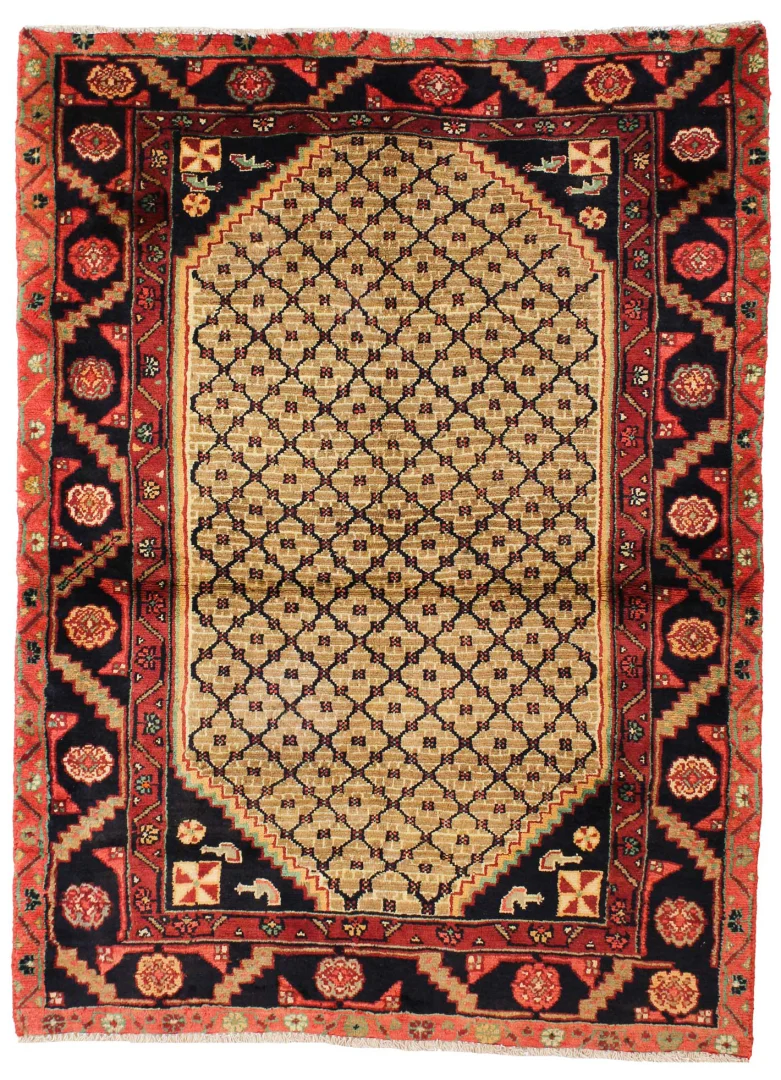
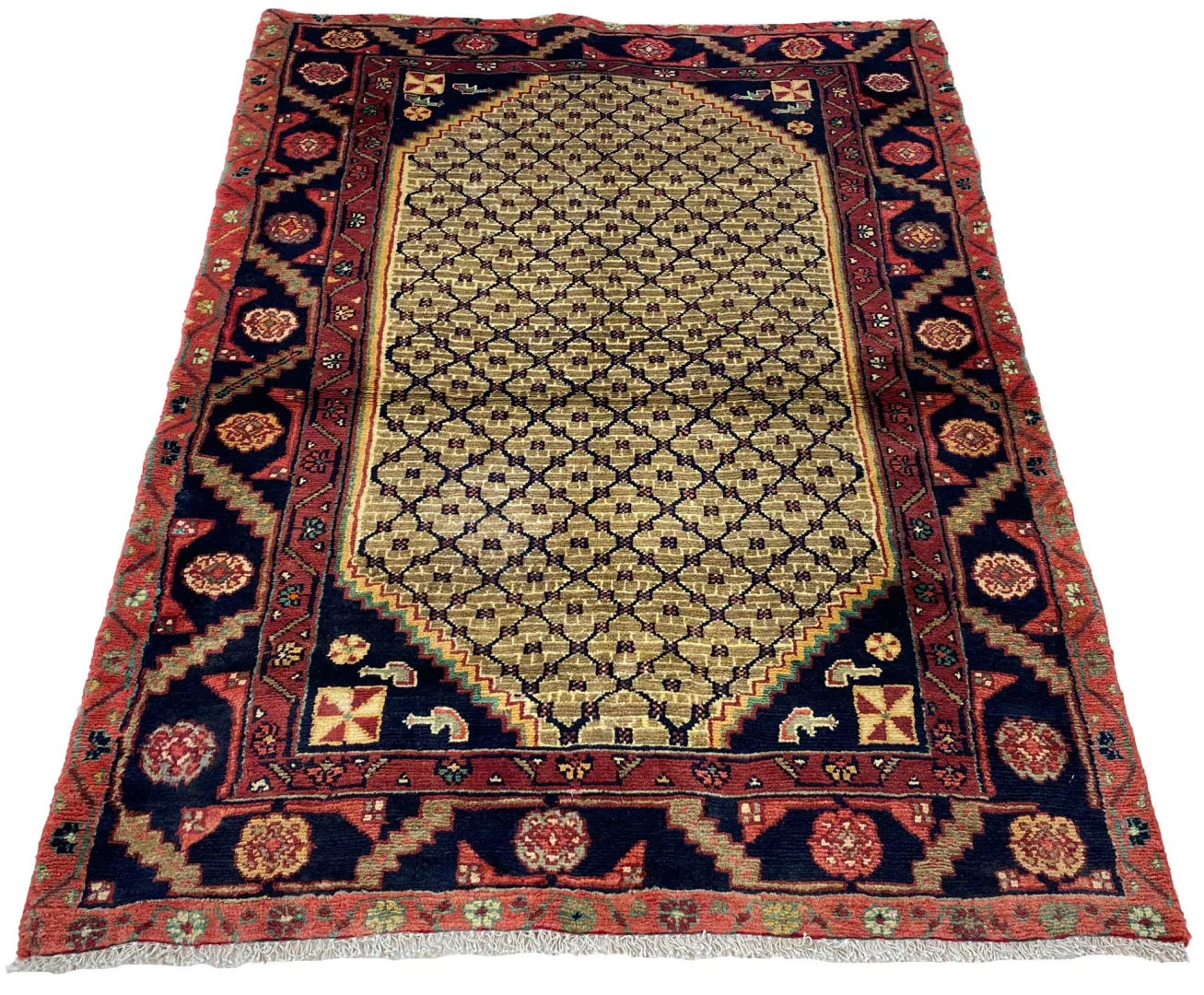
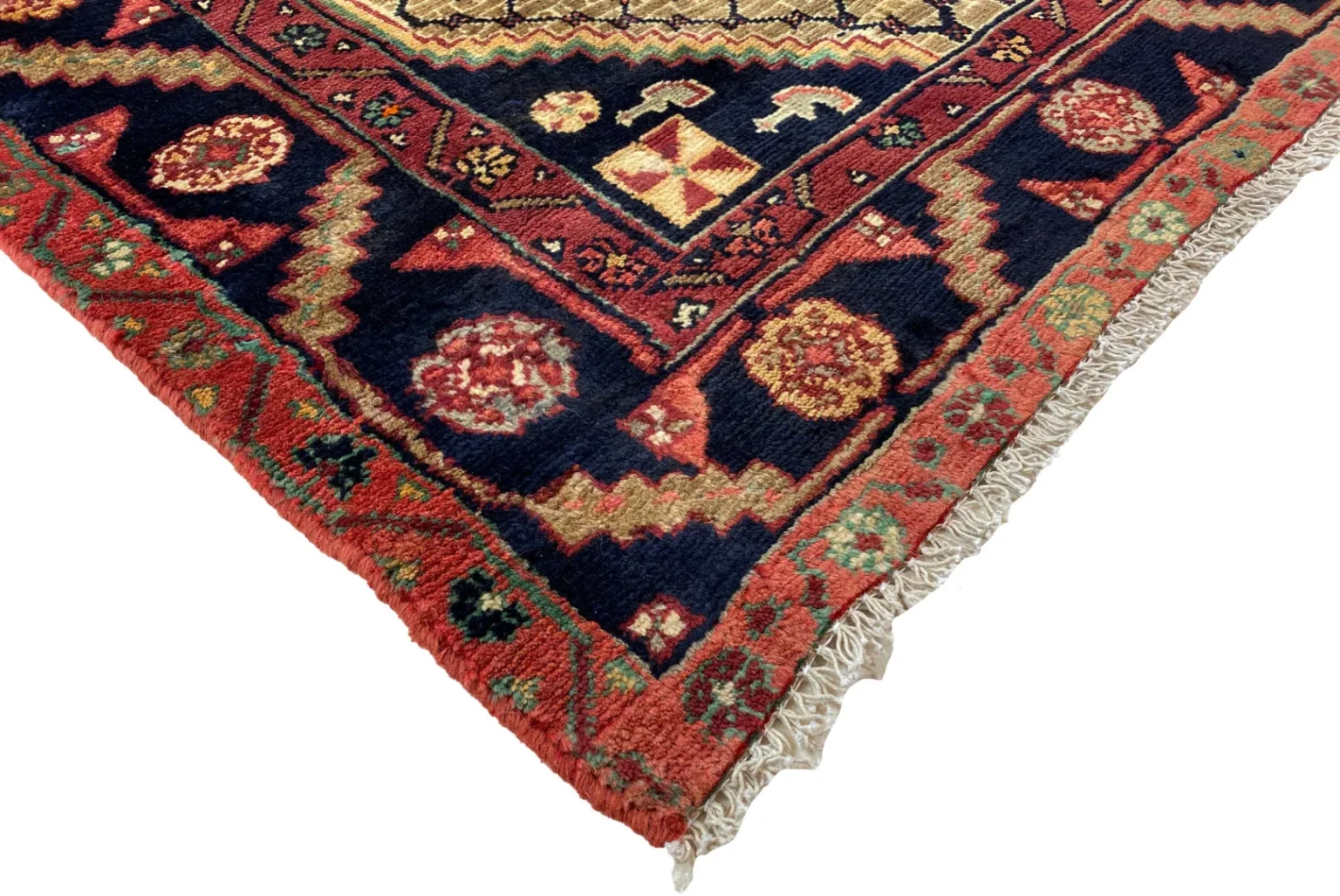
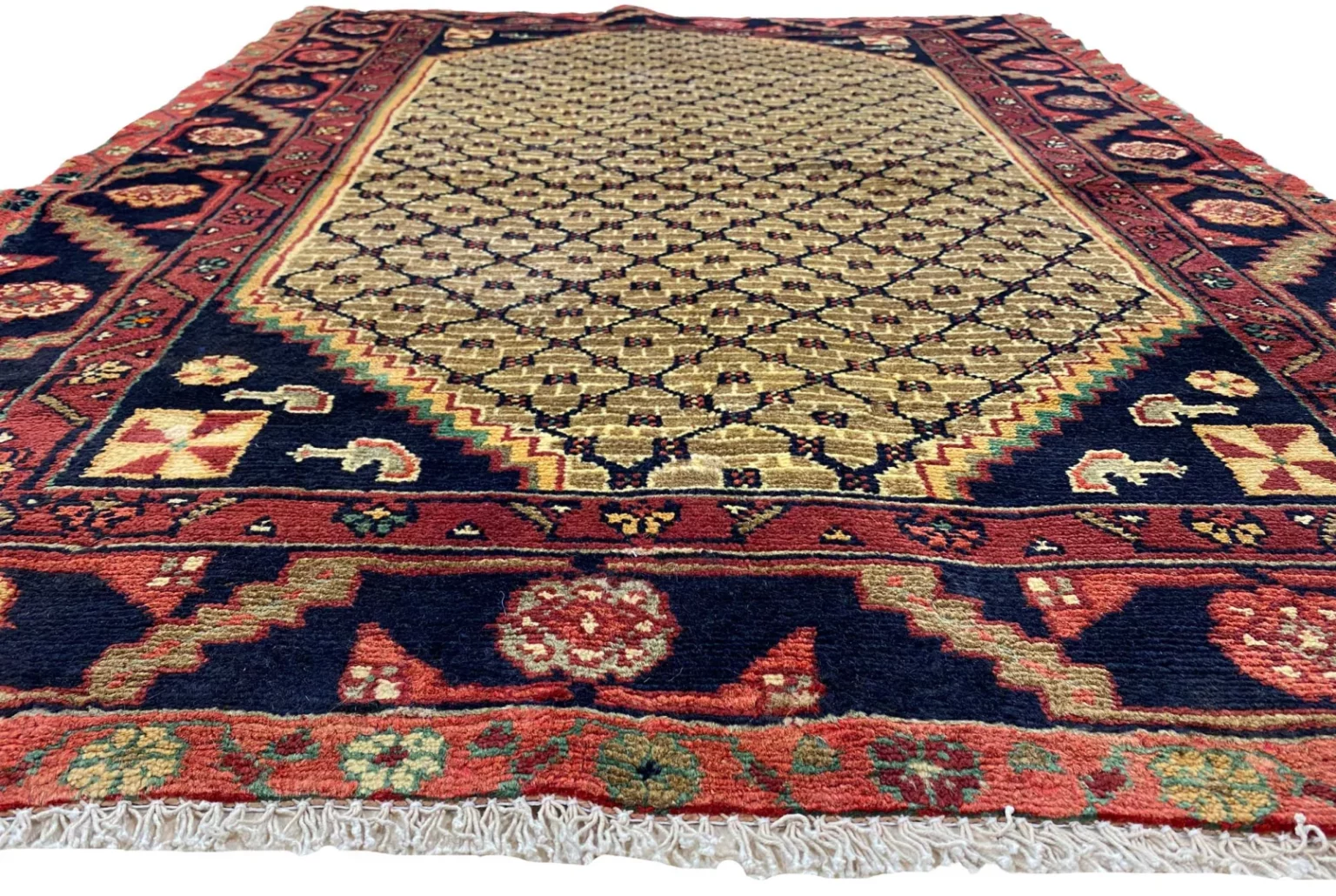
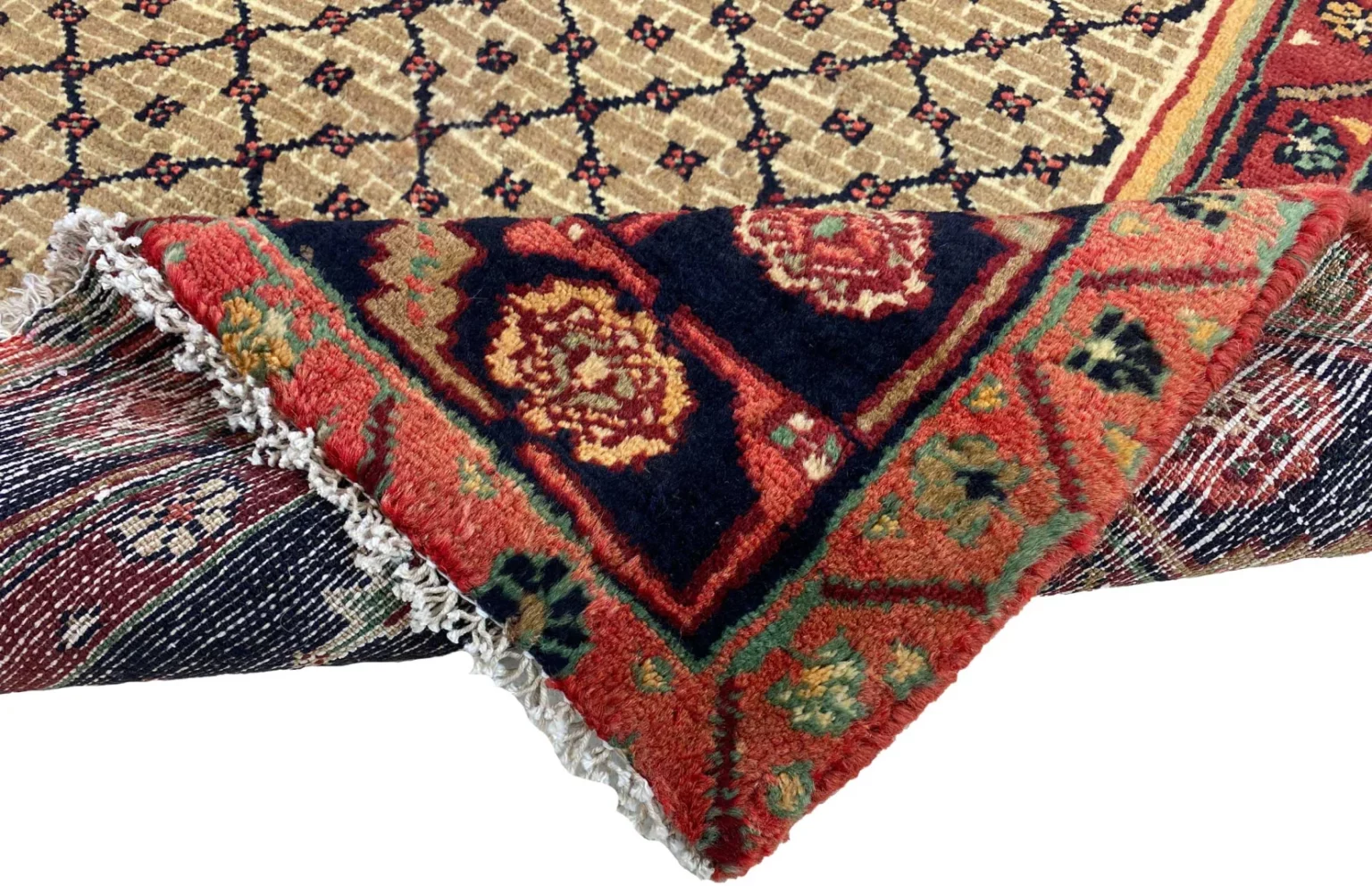
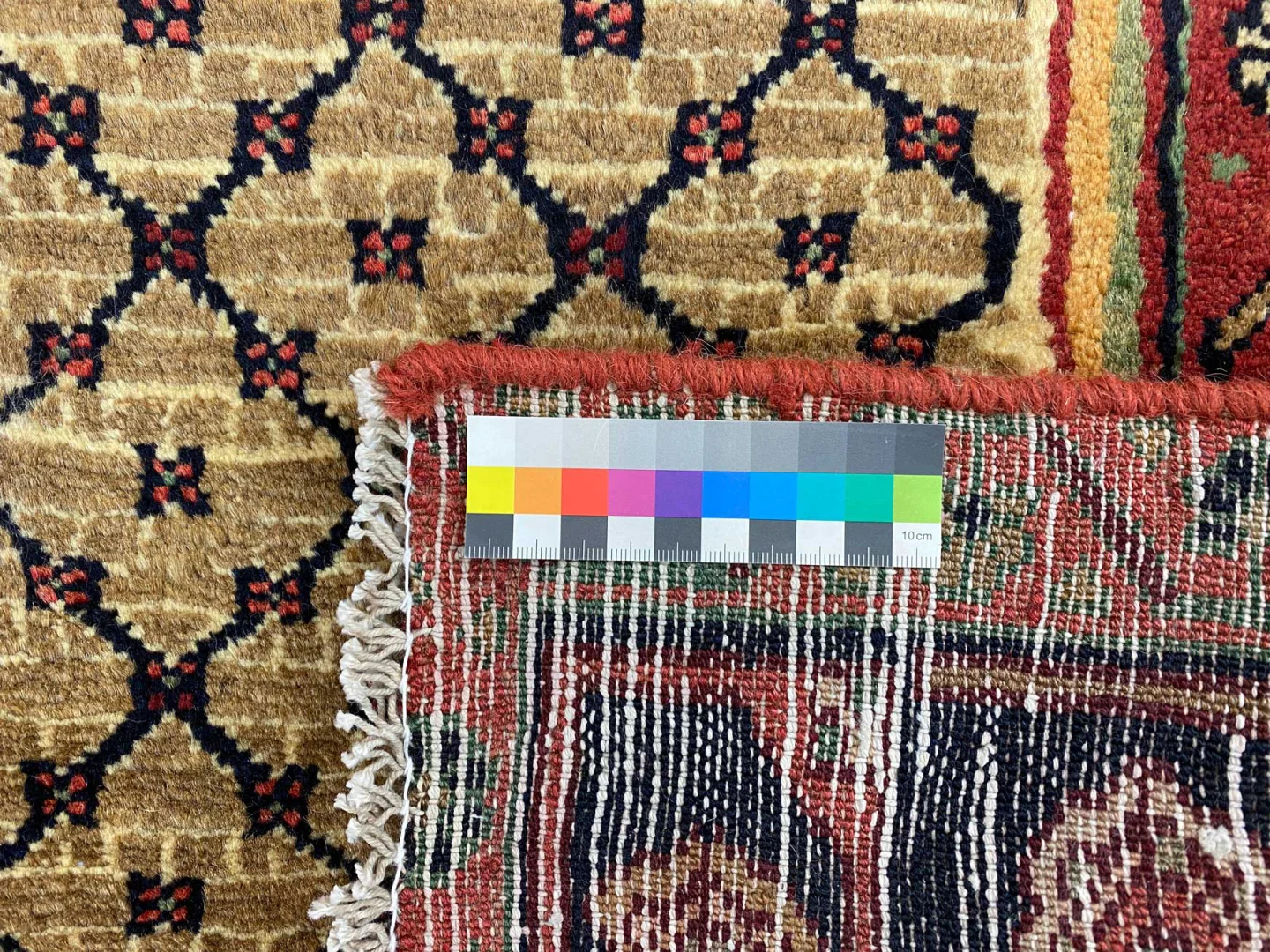
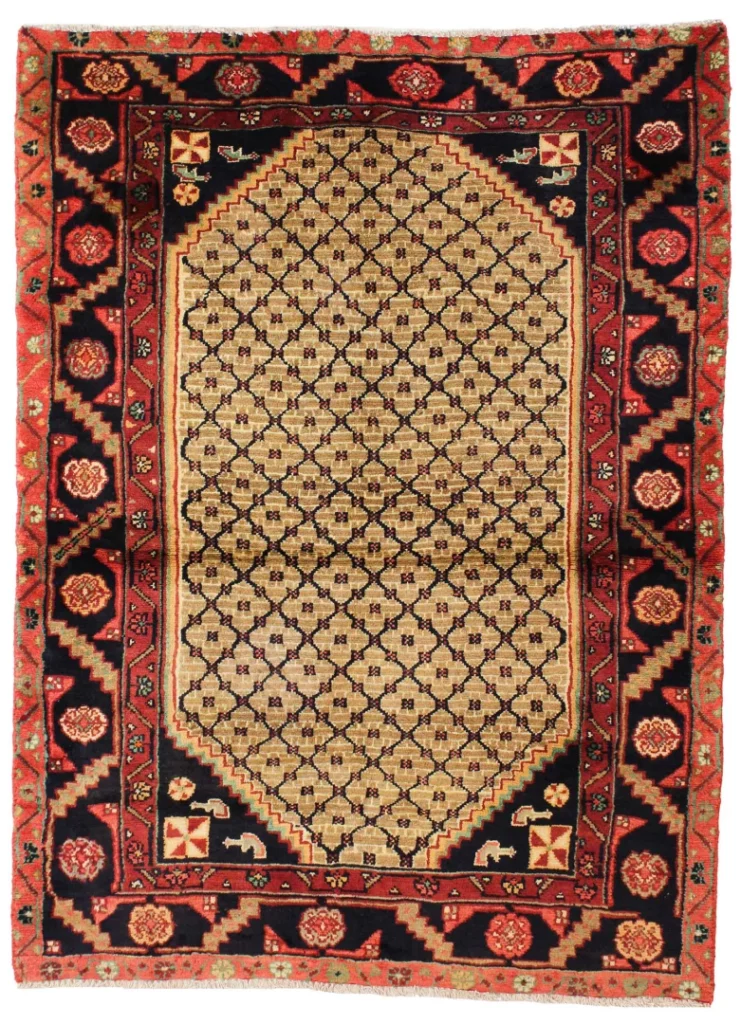
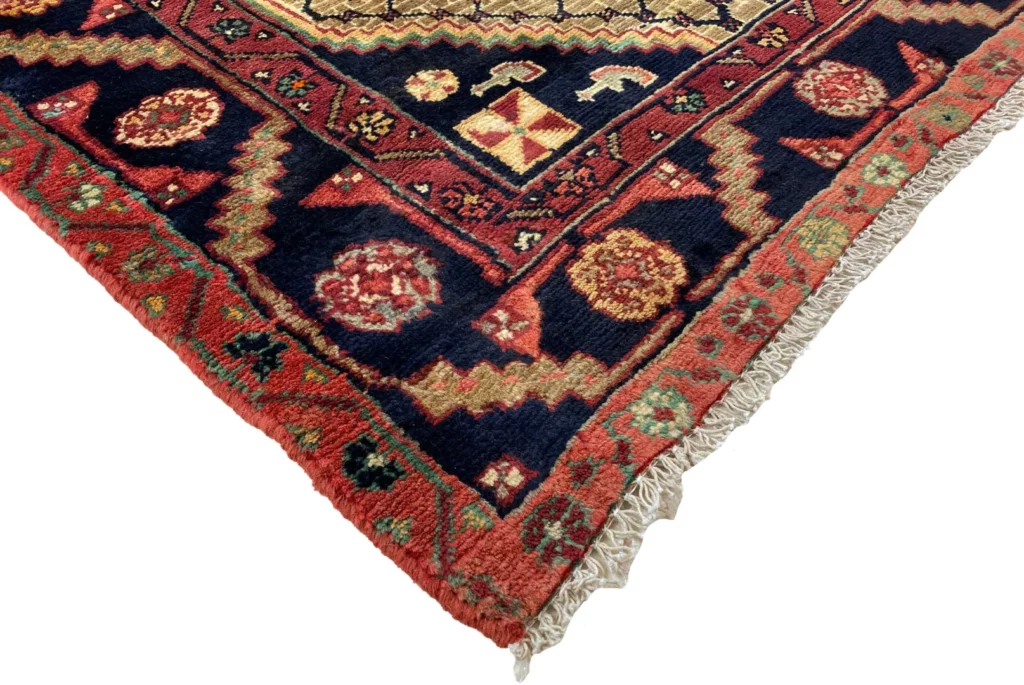
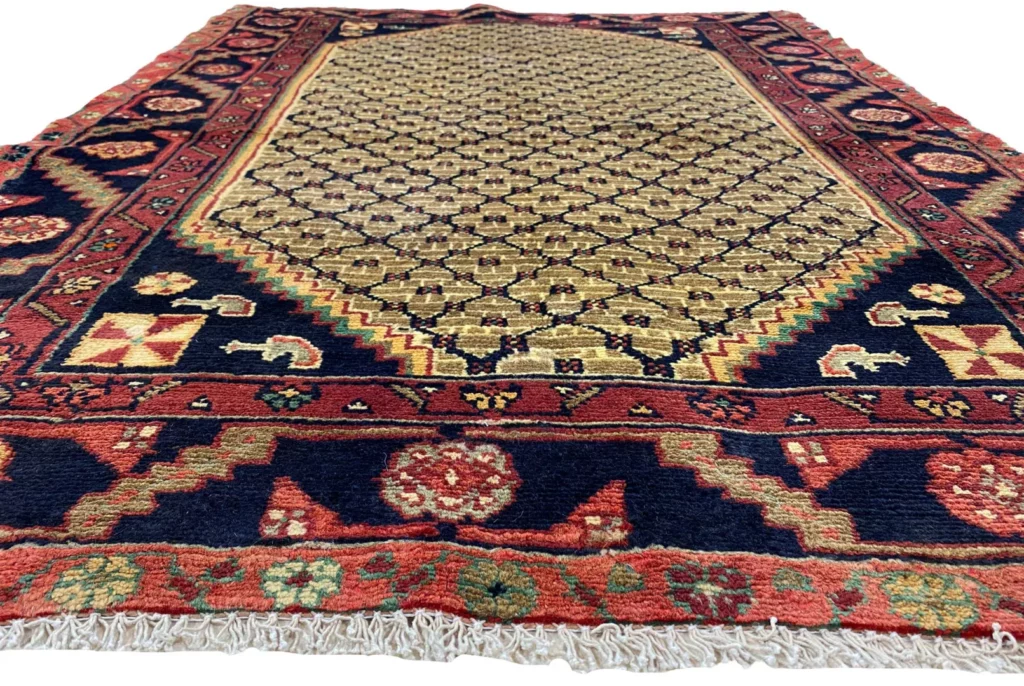
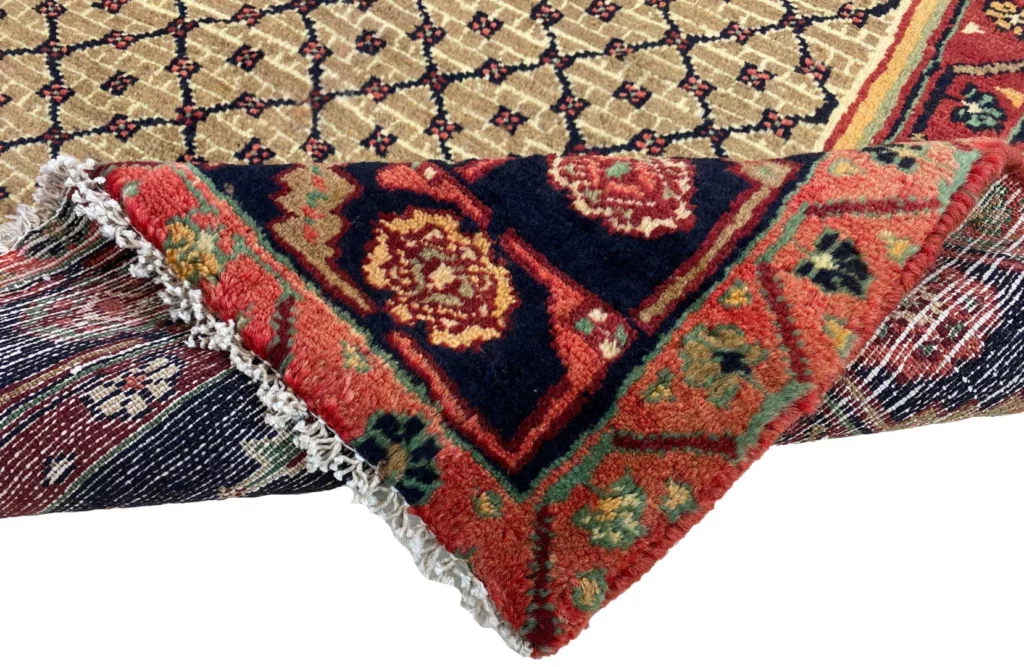
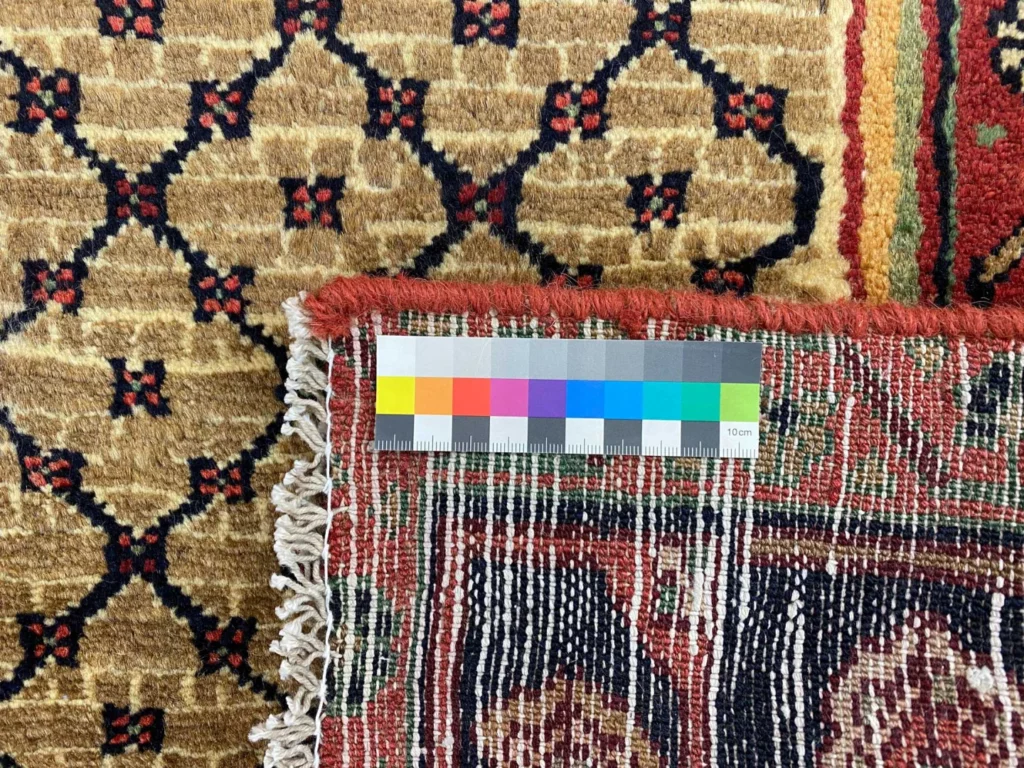
This Hamadan Persian rug is hand-knotted and made of wool. In hand knotting, each knot is formed individually around the warp threads and then secured within the developing structure. The rug grows row by row as the knotter works across the loom. Even tension, consistent knot formation, and the careful insertion of the weft all contribute to the construction. The finished surface is therefore created through a sequence of individual manual operations rather than through a printed or mechanically repeated pattern.
Wool has a long-established place in Oriental rug making. It can be spun into yarn, dyed, and worked into a durable pile. The natural character of the fibre gives the surface a distinct handle and makes wool suitable for rugs intended for ordinary interior use. In a hand-knotted rug, the material is part of the making process from the preparation of the yarn through to the finished pile. Its appearance is joined to the structure of the knots and to the design built into them.
The knot density of this rug is approximately 150,000 knots per square metre. Knot density records how many individual knots are set within a defined area and helps describe the fineness of the workmanship. It is a technical characteristic rather than a complete judgement of quality. Here it forms part of the rug’s construction together with the wool pile and hand-knotted technique. These details describe this particular Hamadan rug without reducing its workmanship to a single number.
Origin and Tradition
This rug originates in Iran and is identified as a Hamadan rug. Hamadan is a historic rug-producing area in western Iran. Its weaving culture developed across a broad landscape that included urban workshops, smaller settlements, and household production. The name Hamadan consequently refers to a regional group with varied local expressions rather than to one uniform design. Rugs from the wider area can differ in layout, colour arrangement, and the way individual motifs are drawn.
Rug making in the region grew from the combination of domestic work, local craft knowledge, and inherited visual traditions. Skills such as spinning wool, preparing dyed yarn, setting up the loom, and tying the knots were passed through families and workshops. A hand-knotted rug is not produced through a completely standardised industrial sequence. The maker develops the design knot by knot, working with the loom, the yarns, and the construction available for that individual piece.
Hamadan rugs are often associated with a direct and clearly structured visual language. Geometric forms, repeated diamonds, hooked elements, angular floral devices, and stylised plant shapes belong to the wider vocabulary of western Iranian weaving. Such elements may appear in a field, within borders, or in repeated rows. Their exact arrangement depends on the local tradition, the workshop, and the individual interpretation. The term Hamadan therefore gives this rug a regional identity, while its particular pattern remains an individual expression.
Iranian rugs are commonly distinguished by their place names because regional practices influence construction, composition, and the treatment of motifs. Tabriz, Isfahan, Kashan, Kerman, and other centres each developed recognisable traditions. Hamadan occupies its own place within this range as a western Iranian weaving region where practical handcraft and strongly outlined designs have long been important. The place name points to the cultural setting of the rug, not to a claim that every Hamadan rug follows one fixed template.
The continuity of these traditions is also connected to the nature of the loom. A design must be translated into successive rows of knots, and the maker has to maintain the intended sequence while building the textile from the bottom upwards. This process links the visual surface to the physical act of weaving. The result is a regional craft object whose appearance reflects both inherited design principles and the decisions made during its individual production.
Design and Pattern
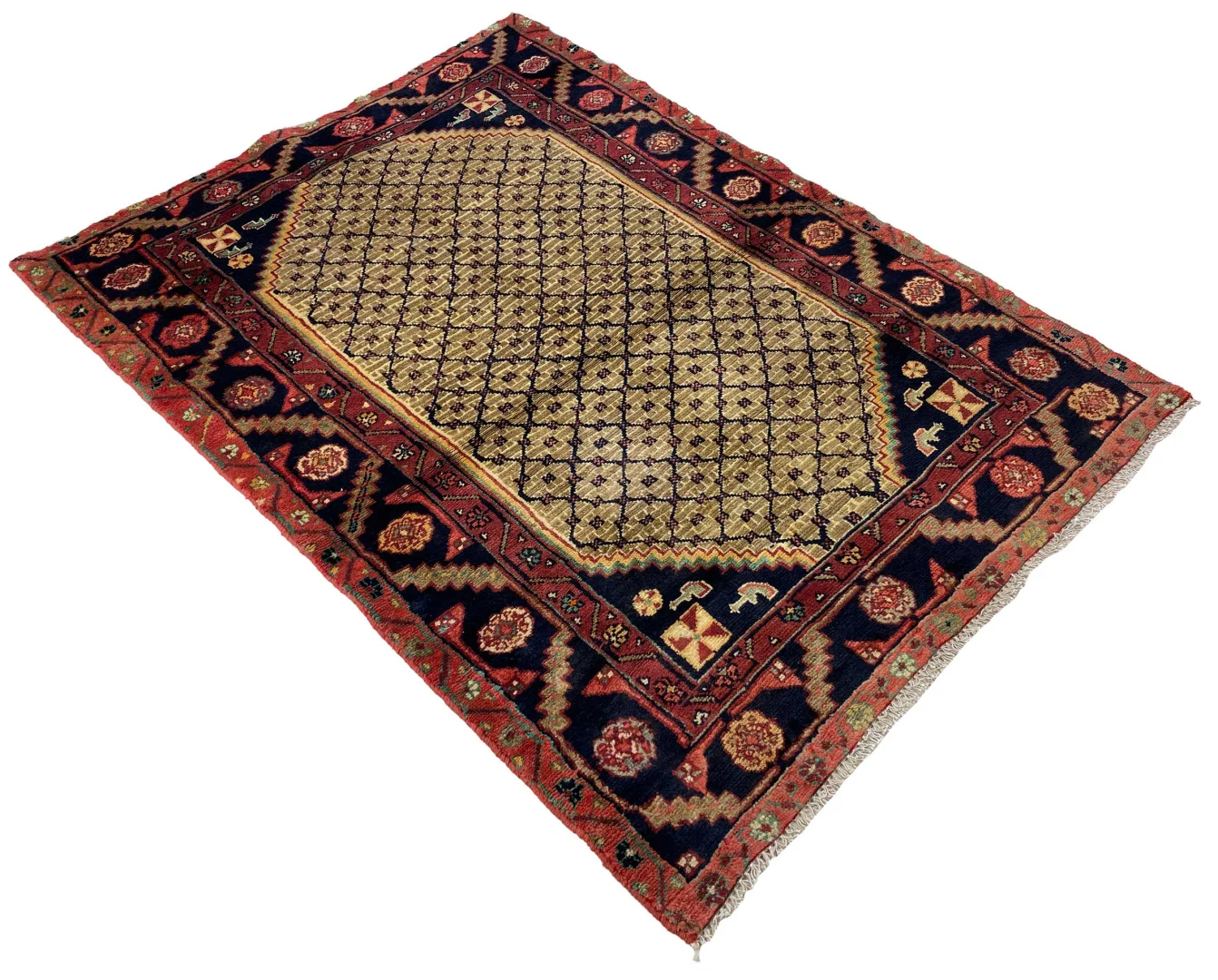
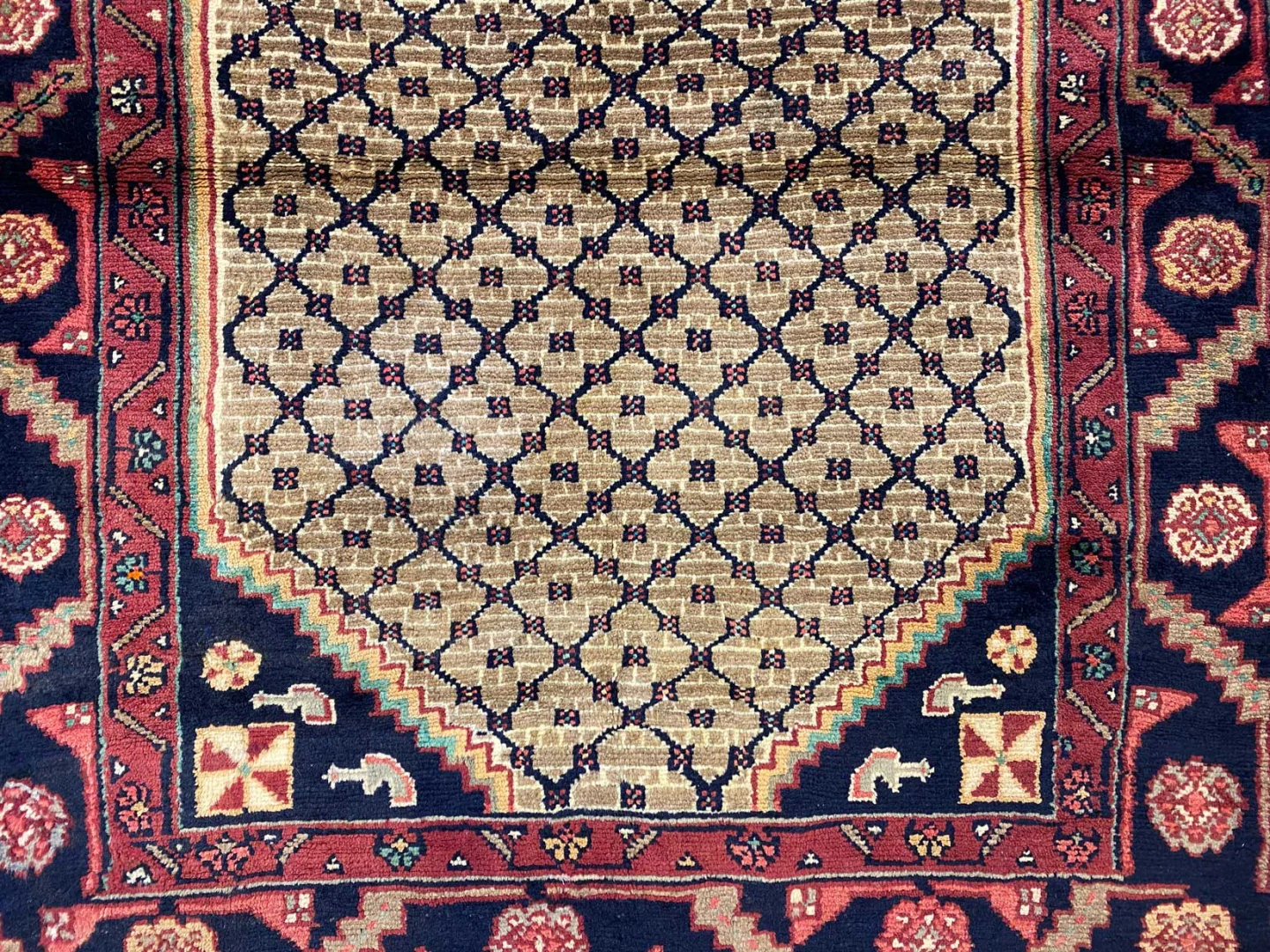
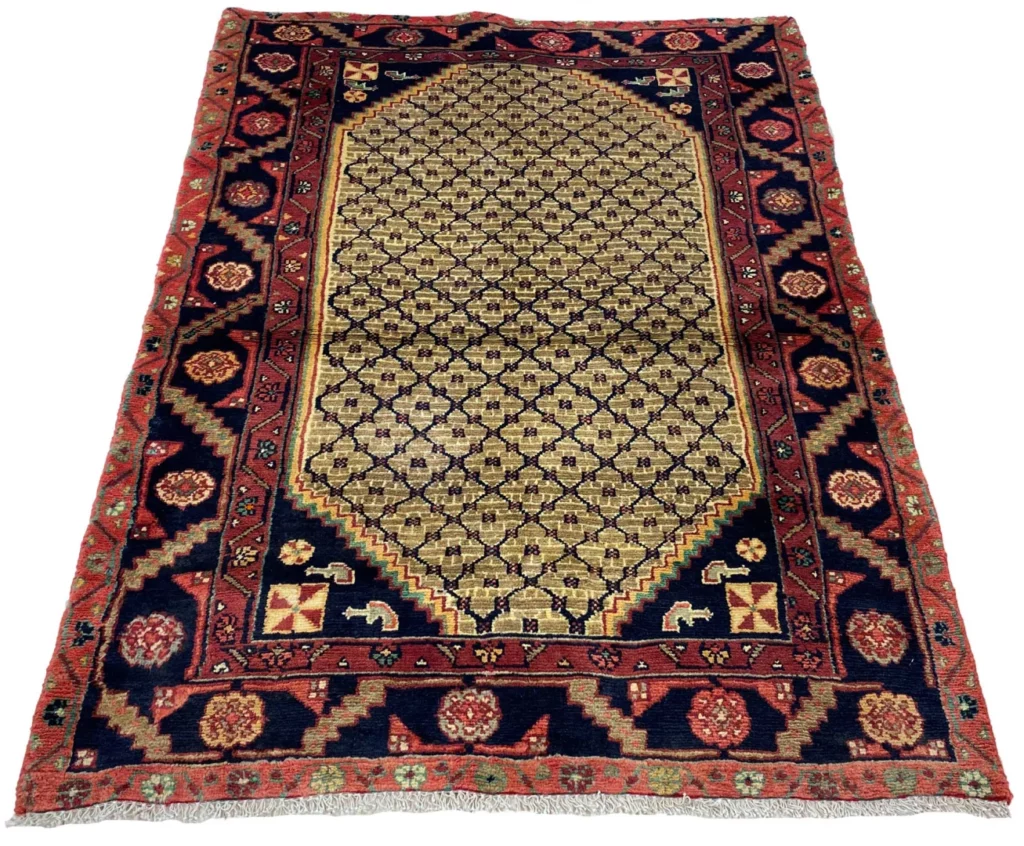
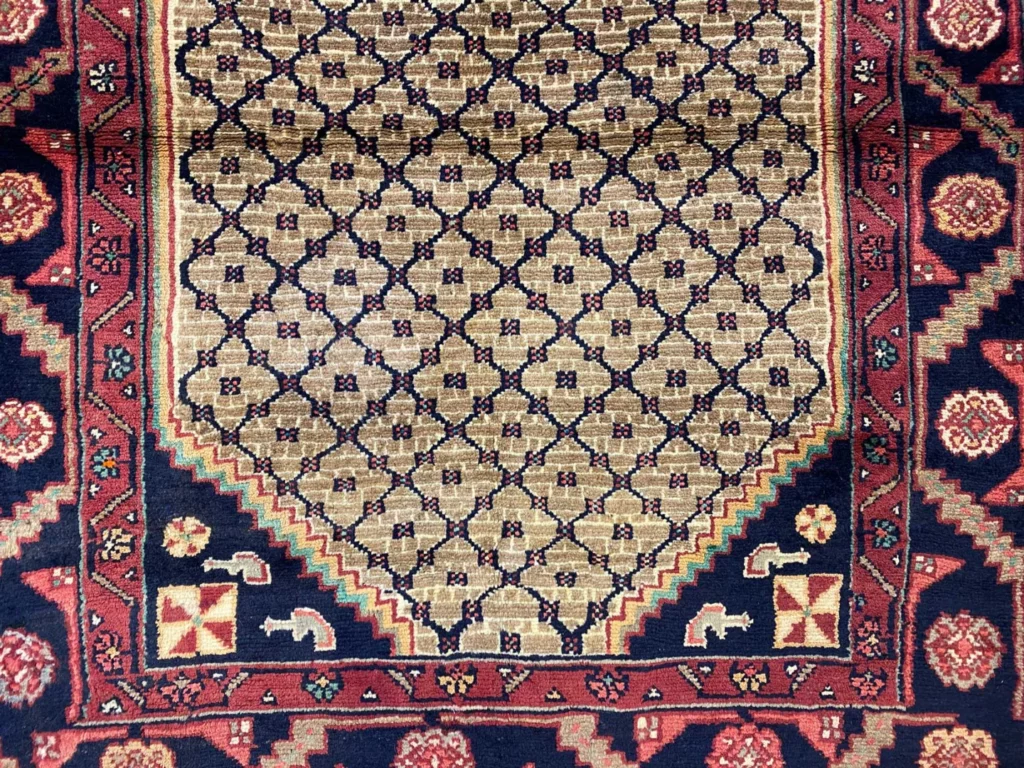
The pattern of this rug is described as a traditional geometric design. Geometric rug design is based on lines, angles, planes, and repeated shapes. A motif does not need to reproduce a plant or object in a naturalistic way. A flower may be reduced to a few angular contours, while a diamond, hooked form, or star remains legible through its outline. This approach creates order across the surface and allows motifs to be developed within the rows of knots.
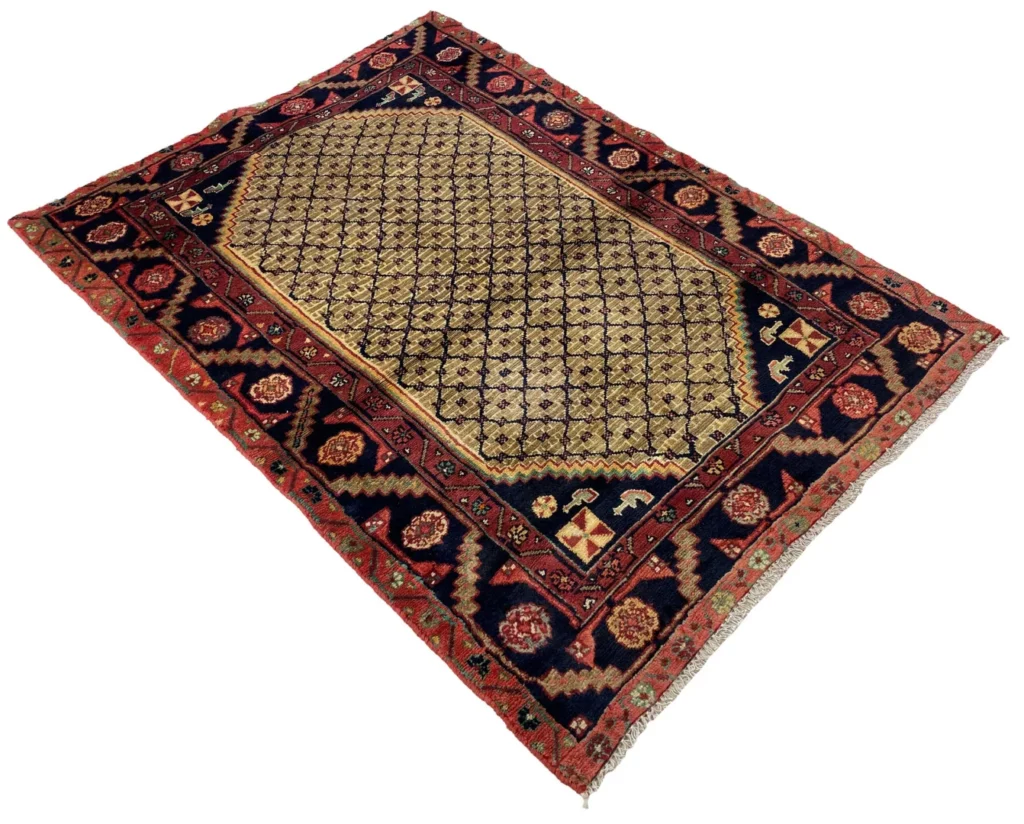
In western Iranian weaving, geometric elements are often combined to create a balance between repetition and variation. A composition may use a central field framed by borders, or it may distribute related motifs across the surface in a repeated arrangement. Borders can define the edge of the field, while smaller devices fill the spaces between larger forms. The available information identifies the rug’s design as traditional and geometric; the exact placement and colour relationships belong to the individual surface and should be read from the rug itself.
Geometric designs are well suited to the gradual working method of hand knotting. The knotter can establish a sequence of forms and carry it across the loom, using a cartoon, a memorised pattern, or a combination of planning and experience. Small differences in spacing or contour can occur naturally when a person builds the pattern by hand. These variations are part of the distinction between a hand-knotted textile and a mechanically reproduced image, while the overall design remains coherent.
The character of a geometric pattern depends on more than the symbols alone. Scale, rhythm, repetition, and the relationship between filled and open areas all influence the composition. A border can give the field a clear frame, while a repeated motif can create movement across the pile. Angular drawing may give the design a firm structure, but the wool surface softens the effect through its texture. In a Hamadan rug, regional design language and individual execution meet in the final arrangement.
Traditional patterns also carry a record of how visual knowledge travels through a weaving culture. Motifs can be retained, simplified, recombined, or adapted as they pass between makers and locations. Their meaning is not always limited to one fixed interpretation. What remains recognisable is the disciplined use of forms and the way they are organised within a textile. This rug’s geometric description places it within that long tradition of patterned Iranian weaving without assigning it a motif that is not named in the source.
Special Features
The rug is described as well preserved. This condition statement refers to the individual piece and forms part of its product description. With a hand-knotted wool rug, condition is considered in relation to the pile, knots, edges, and foundation. These areas are examined together when a rug is assessed, because the visible surface and the underlying structure work as one textile. The description well preserved provides the condition classification for this Hamadan rug.
Its defining combination is Iranian origin, Hamadan attribution, hand-knotted construction, wool material, and a traditional geometric design. The listed knot density adds a technical description of the workmanship, while the condition statement records the state in which the rug is offered. These characteristics belong to one individual textile. They should be considered together rather than treated as a generic description of every rug from Hamadan.
FAQ
How should a Hamadan Persian rug be cared for?
A hand-knotted wool rug benefits from regular, gentle vacuuming. Care should be taken not to place unnecessary stress on the pile or the edges. Strong direct sunlight is best avoided because prolonged exposure can affect fibres and the way colours are perceived. Spills and marks should be addressed promptly and carefully, without rubbing them further into the pile. For a thorough wash, a specialist cleaner experienced with Oriental rugs is appropriate. The cleaning method should take account of the wool material, the hand-knotted construction, and the actual condition of the individual rug.
What makes this Hamadan rug distinctive?
This rug combines an Iranian origin with the regional designation Hamadan. It is hand-knotted, made from wool, and has a traditional geometric design. Its stated knot density of approximately 150,000 knots per square metre describes the fineness of the knotting. The rug is also described as well preserved. Its character therefore comes from the relationship between regional identity, material, technique, technical construction, condition, and the clearly defined geometric pattern.
Where does this Hamadan Persian rug come from?
The rug comes from Iran and is attributed to the Hamadan region. Hamadan is one of the recognised western Iranian rug-producing areas and has a long tradition of handcraft production. The regional name can cover a range of related local practices rather than one single design. For this piece, the stated origin is determined by Iran and Hamadan. Its traditional geometric pattern is part of its own documented design and should not be replaced by the design names associated with other Iranian regions.
To provide the best experiences, we use technologies like cookies to store and/or access device information. Consenting to these technologies will allow us to process data such as browsing behavior or unique IDs on this site. Not consenting or withdrawing consent, may adversely affect certain features and functions.
Functional Always active
The technical storage or access is strictly necessary for the legitimate purpose of enabling the use of a specific service explicitly requested by the subscriber or user, or for the sole purpose of carrying out the transmission of a communication over an electronic communications network.
Preferences
The technical storage or access is necessary for the legitimate purpose of storing preferences that are not requested by the subscriber or user.
Statistics
The technical storage or access that is used exclusively for statistical purposes.The technical storage or access that is used exclusively for anonymous statistical purposes. Without a subpoena, voluntary compliance on the part of your Internet Service Provider, or additional records from a third party, information stored or retrieved for this purpose alone cannot usually be used to identify you.
Marketing
The technical storage or access is required to create user profiles to send advertising, or to track the user on a website or across several websites for similar marketing purposes.
 SECURE PAYMENT
 SHIPPING PARTNERS


