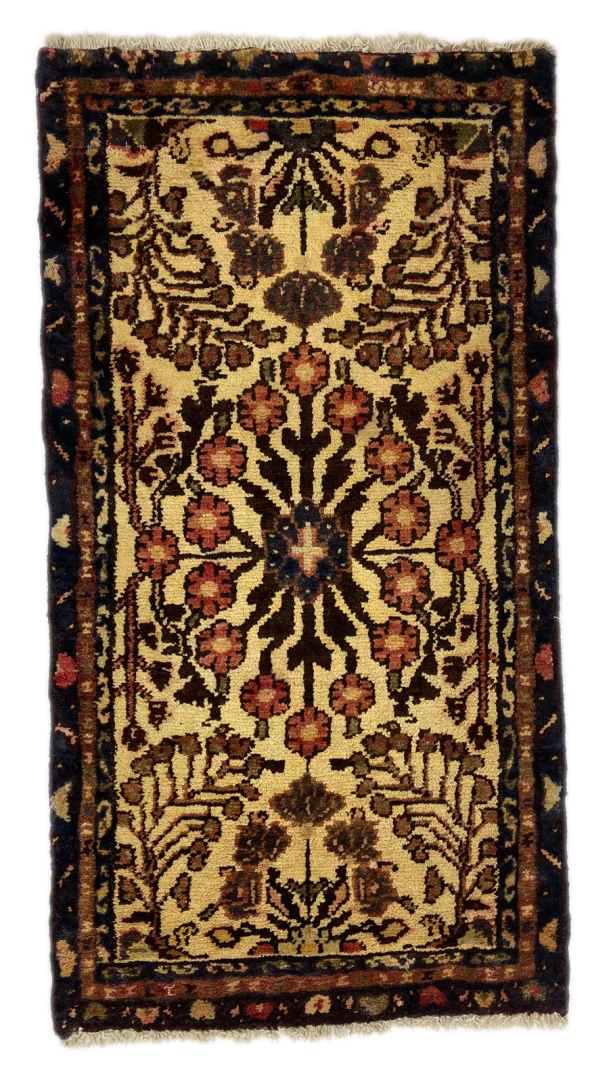
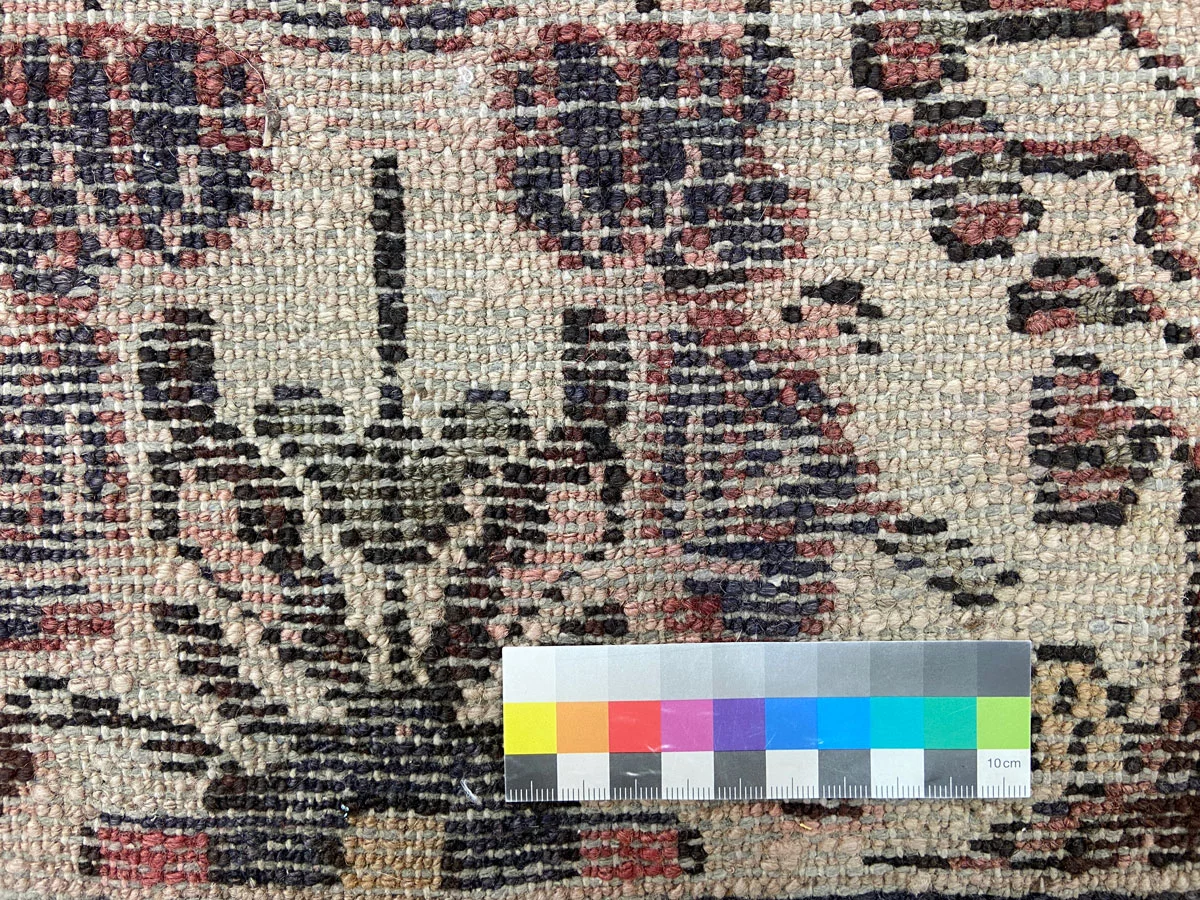
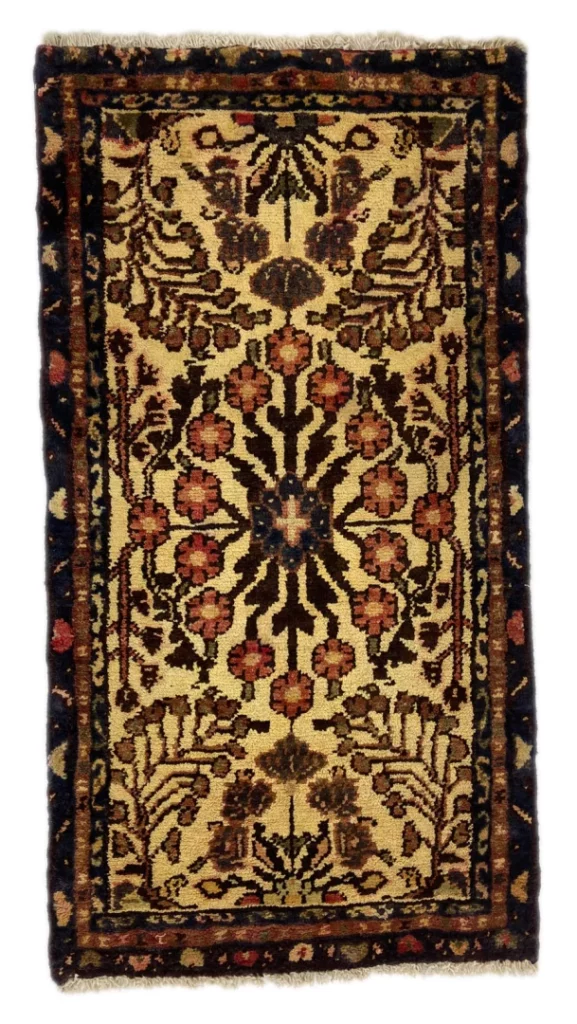
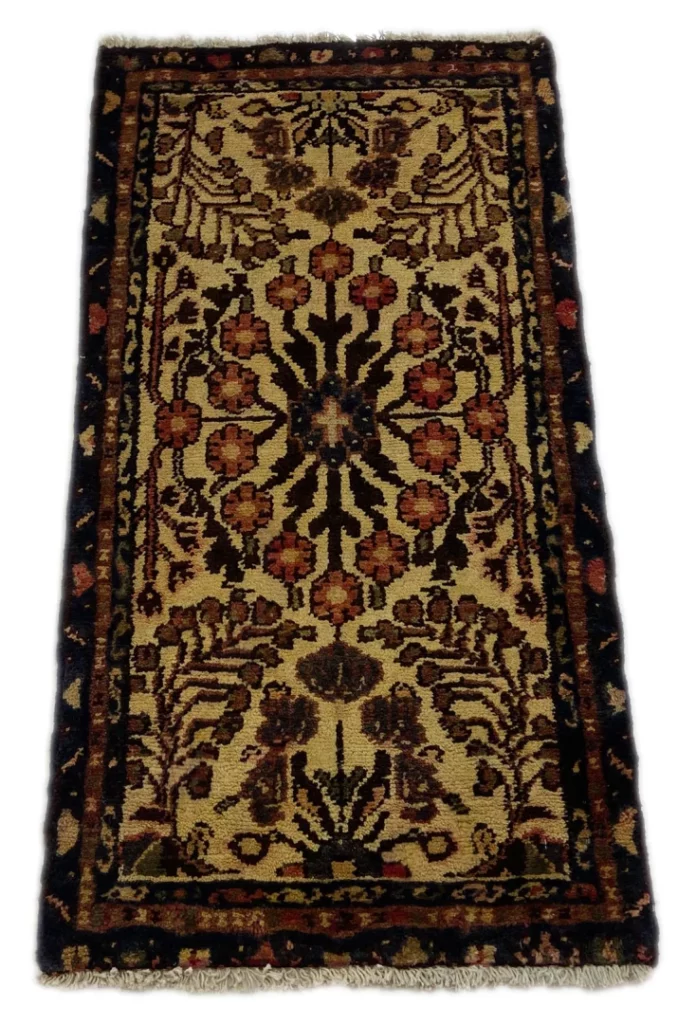
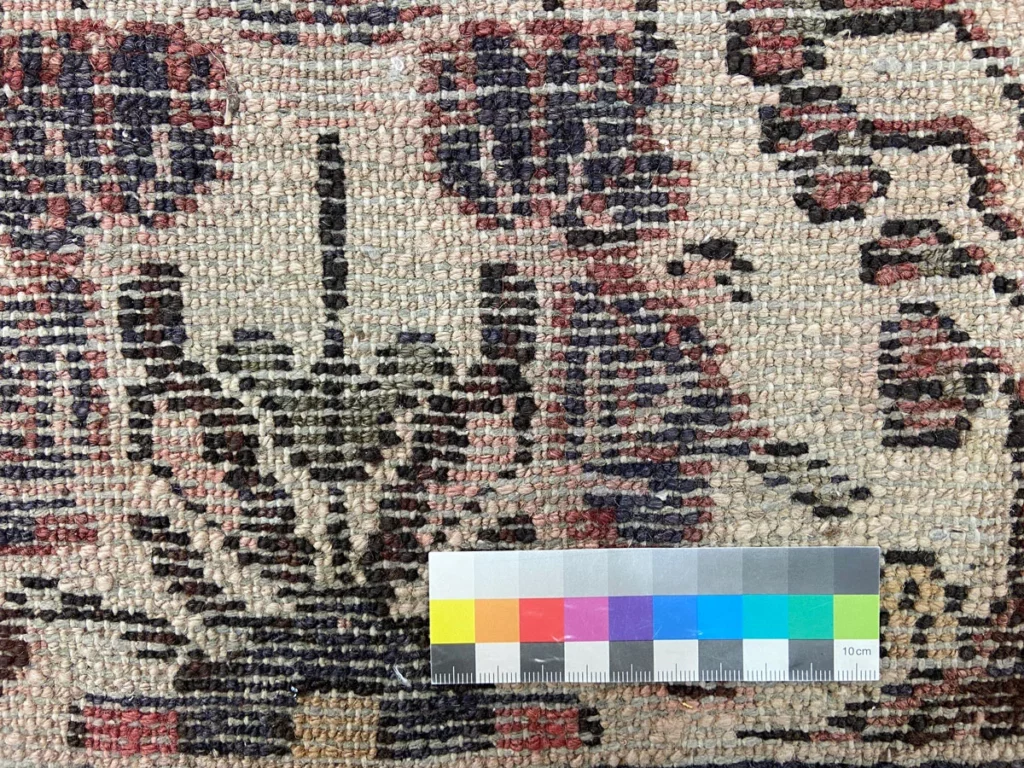
This Hamadan Persian rug is hand-knotted with a pile made from hard-wearing wool. Wool is a traditional material in Persian rug making, valued for a durable surface as well as a full, substantial pile. In a hand-knotted rug, the knots are placed by hand into the textile foundation, so the finished piece is made through a manual process rather than produced as identical machine-made yardage. The result is a distinct woven object shaped by the work of the maker.
The listed knot density is 100,000 to 350,000 knots per square metre. Knot density records how many knots are placed within a defined area and provides an indication of the structure and degree of detail possible in the pile. In Hamadan rugs, density belongs to the relationship between the hand-knotting process, the appearance of the design and the firmness of the woven surface. The hard-wearing wool supports the practical character associated with this type of rug.
Wool is used in Persian rugs for more than its resistance to everyday wear. It can hold colour clearly and gives geometric lines and floral details a defined textile surface. A wool pile also creates depth through its texture. The combination described here is hand-knotting, hard-wearing wool and the stated knot-density range. No additional material is attributed to this particular rug.
Origin and Tradition
This rug comes from the Hamadan region of Persia. Hamadan is in northwestern Iran and is recognised as a centre of Persian rug production. The name Hamadan refers to a broad weaving region rather than to one single design. Numerous towns and villages are connected with its rug-making tradition, and each place has contributed its own visual language to the wider Hamadan group.
Places associated with rug production in the Hamadan region include Assadabad, Khamseh, Maslaghan, Enjelas, Nahawand, Tuyserkan and Mousel. Each of these places produces characteristic designs and patterns. This local variety explains why Hamadan rugs can look very different from one another while sharing the same wider regional designation. The tradition is therefore defined by a network of communities and by the continuation of hand-knotting knowledge across the region.
Persian rug making brings together material, technique and ornament. In Hamadan, the appearance of a rug may reflect local preferences, established decorative forms and the individual work of the knotter. Geometric structures and plant-based motifs both belong to the region’s pattern vocabulary. The Hamadan designation consequently describes a geographical origin and a regional craft tradition with considerable visual range, rather than a rigid template applied to every rug.
Hamadan forms one part of the wider Persian rug landscape alongside other recognised weaving regions. Kerman is associated with its own styles, floral designs and light colours, while Nain is known for fine details and high knot densities. These names refer to separate regional traditions. A Hamadan rug remains distinct through the variety of settlements and designs linked to Hamadan, even though all belong to the broader history of Persian rug weaving.
The Hamadan tradition can also be set beside Persian Gabbeh and Qashqai rugs. Gabbeh rugs are often simpler and more minimalist in design. Qashqai rugs, by contrast, frequently show rich colours and complex patterns. Hamadan rugs cover a broad range between geometric and floral compositions. Their diversity is therefore a defining part of their regional identity rather than an exception to it.
Design and Pattern
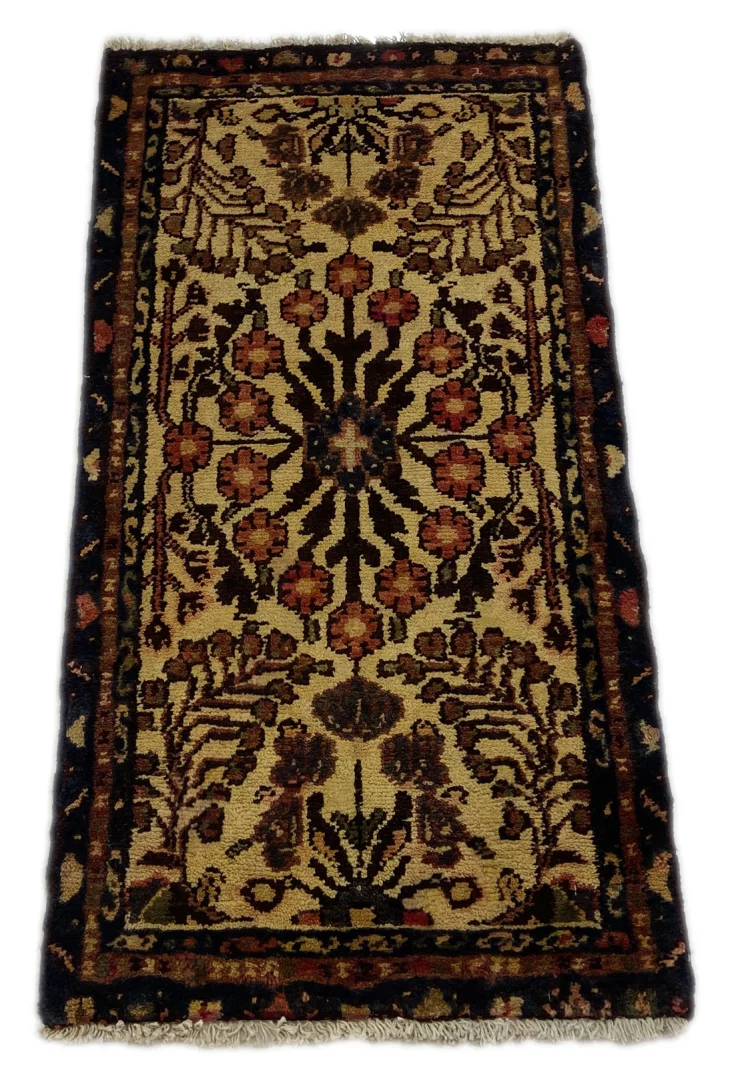
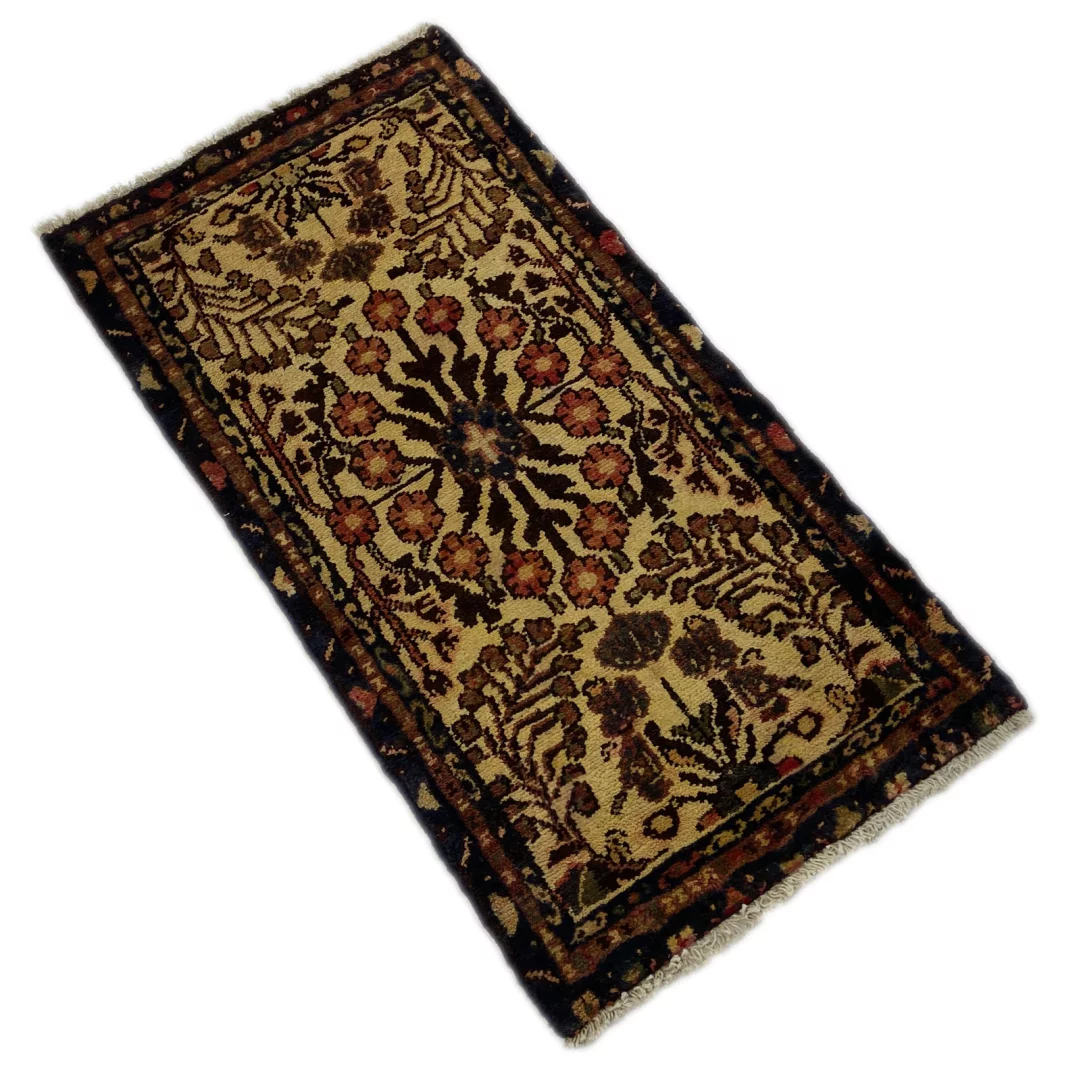
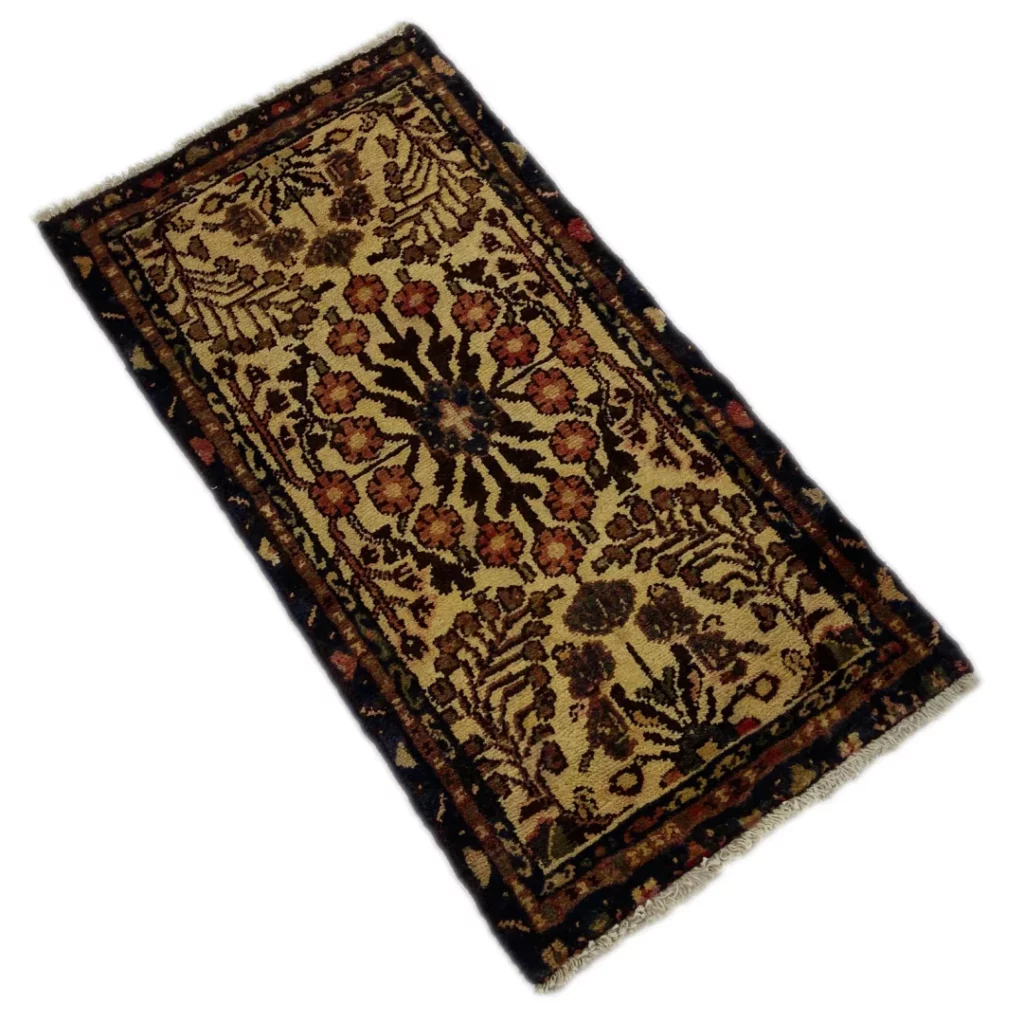
Hamadan rugs are known for a wide variety of designs. There is no single pattern that defines every rug from the region. Instead, different visual approaches come from the towns and villages connected with Hamadan weaving. Geometric patterns, floral motifs and traditional Persian styles may all appear, either separately or in combination. This gives the Hamadan group a broad range of layouts, ornaments and visual rhythms.
Geometric patterns use lines, angles, diamonds, repeated compartments and stylised forms to organise the field. These elements can create a measured rhythm across the surface. Floral motifs introduce references to plants, flowers, leaves and vines. In Persian rug design, such forms are commonly stylised as ornaments rather than copied as naturalistic illustrations. Hamadan compositions may bring the two approaches together, allowing geometric structure and botanical detail to support one another.
The pattern tradition is closely connected to the region’s local diversity. Assadabad, Khamseh, Maslaghan, Enjelas, Nahawand, Tuyserkan and Mousel are each associated with characteristic designs and patterns. Local distinctions may be visible in the arrangement of motifs, the treatment of geometric forms or the amount of floral detail. The many styles found under the Hamadan name therefore express the region’s internal variety while remaining part of a shared origin.
Colour is another part of the general Hamadan design vocabulary. The region’s rugs may use earthy tones as well as strong accents. Colour placement can alter the balance of a composition, making a geometric structure appear more restrained or more contrastive, and giving floral ornaments a different presence. Design variety consequently concerns not only the motif itself but also the relationship between colour, field and border.
Traditional Persian styles can also carry cultural associations through their ornaments and arrangements. Each design may have its own history and meaning, reflecting the cultural diversity of the region. A Hamadan rug can therefore be viewed on several levels: lines and repeated forms structure the surface, floral signs add ornamental detail, and local traditions provide the wider context. The regional name identifies the origin, while the individual pattern expresses one of the many design possibilities found within Hamadan weaving.
Special Features
The defining features of this rug are its classification as a hand-knotted Hamadan Persian rug, its pile of hard-wearing wool and its listed density of 100,000 to 350,000 knots per square metre. It also belongs to the wide design spectrum associated with Hamadan rugs. Its origin in the Hamadan region of Persia places it within a weaving landscape shaped by many towns and villages, each contributing characteristic patterns to the regional tradition.
The hard-wearing wool gives Hamadan rugs a practical character, while the hand-knotted construction identifies them as handmade textiles. Hamadan rugs are also described as relatively easy to care for. Regular vacuuming helps remove dust and loose particles from the pile. Professional cleaning can be used when needed, and stains should be treated promptly to help prevent lasting damage. Care should always be suited to a hand-knotted wool pile, especially when more intensive cleaning is required.
FAQ
How should I care for my Hamadan Persian rug?
Vacuum the rug regularly so that dust and loose particles do not remain in the pile. If cleaning is necessary, professional cleaning is recommended. Stains should be treated as soon as possible, since leaving them in place can lead to permanent damage. The hard-wearing wool makes Hamadan rugs practical and relatively easy to maintain, but cleaning should still be appropriate for a hand-knotted wool pile.
What material is used for Hamadan rugs?
Hamadan rugs are generally made from high-quality wool. Wool is known for its durability and full pile, which are important features in the traditional material choice for this rug type. Some rugs may also contain silk elements to add a different surface effect and further elegance. The rug described here has a pile made from hard-wearing wool.
Which designs are typical of Hamadan rugs?
Hamadan rugs are recognised for their broad range of designs. Typical categories include geometric patterns, floral motifs and traditional Persian styles. The settlements within the Hamadan region have developed characteristic patterns, so the visual appearance can vary from one rug to another. Geometric structures provide order and rhythm, while floral elements add stylised flowers, leaves or vines. Each design may carry its own history and meaning and can reflect the cultural variety of the region.
To provide the best experiences, we use technologies like cookies to store and/or access device information. Consenting to these technologies will allow us to process data such as browsing behavior or unique IDs on this site. Not consenting or withdrawing consent, may adversely affect certain features and functions.
Functional Always active
The technical storage or access is strictly necessary for the legitimate purpose of enabling the use of a specific service explicitly requested by the subscriber or user, or for the sole purpose of carrying out the transmission of a communication over an electronic communications network.
Preferences
The technical storage or access is necessary for the legitimate purpose of storing preferences that are not requested by the subscriber or user.
Statistics
The technical storage or access that is used exclusively for statistical purposes.The technical storage or access that is used exclusively for anonymous statistical purposes. Without a subpoena, voluntary compliance on the part of your Internet Service Provider, or additional records from a third party, information stored or retrieved for this purpose alone cannot usually be used to identify you.
Marketing
The technical storage or access is required to create user profiles to send advertising, or to track the user on a website or across several websites for similar marketing purposes.
 SECURE PAYMENT
 SHIPPING PARTNERS


