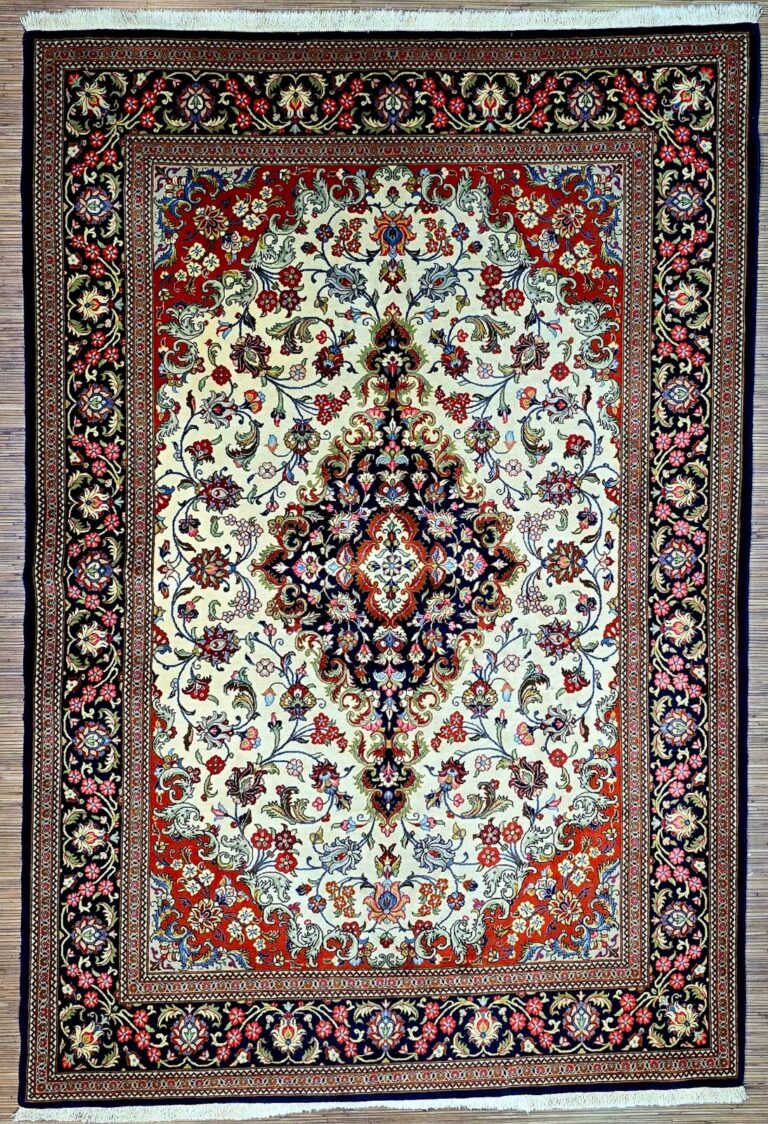
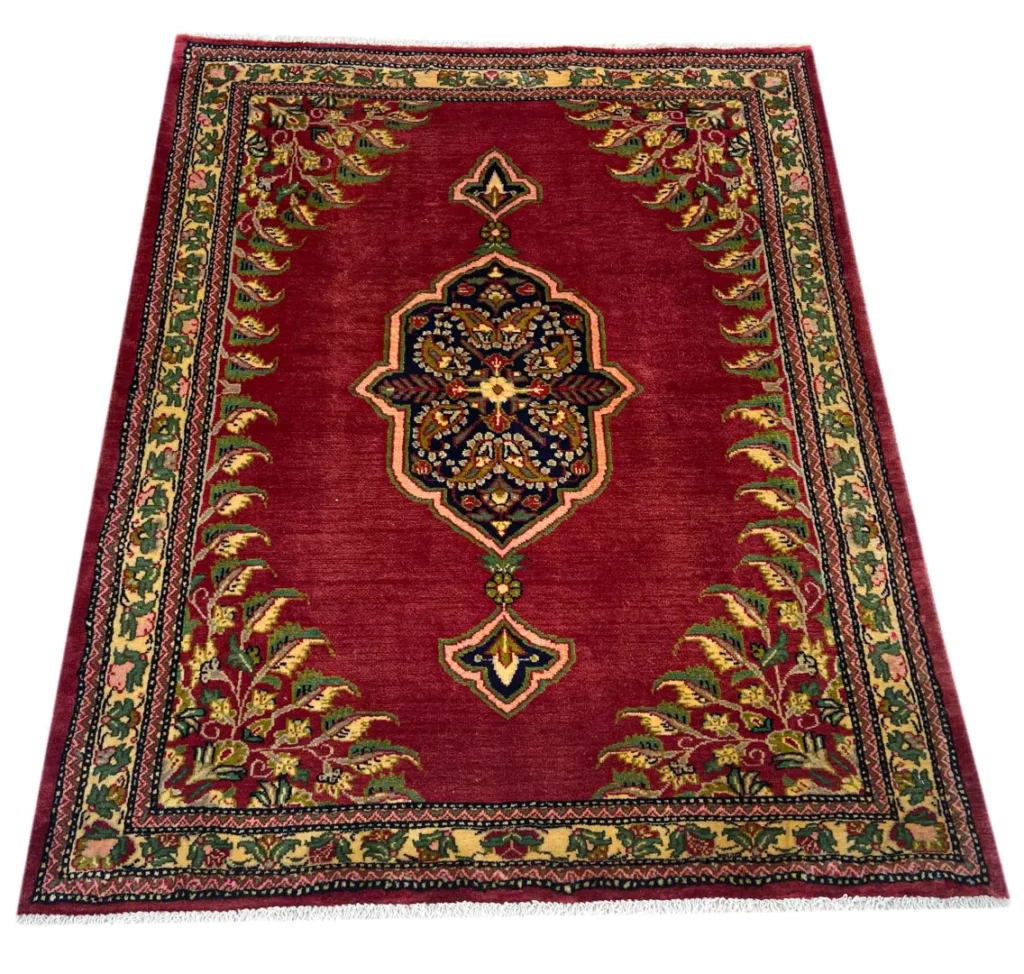
This Persian rug from Ghom is hand-knotted and has a pile made of high-quality wool. Its production combines the natural character of the fibre with a carefully built knot structure. Every knot is placed by hand into the foundation, row after row. The surface is therefore formed by the arrangement of individual knots rather than by a printed image. The pattern develops through the precise placement of coloured yarn across the woven ground.
Wool has been used in Persian rug making for centuries. It has natural resilience, making it suitable for a pile that can withstand everyday use. At the same time, wool feels warm and pleasantly textile underfoot. The fibre accepts colour clearly and can support both broad fields and finely divided ornament. In a hand-knotted rug, these qualities work together with the knot type, the density of the structure and the care taken during finishing.
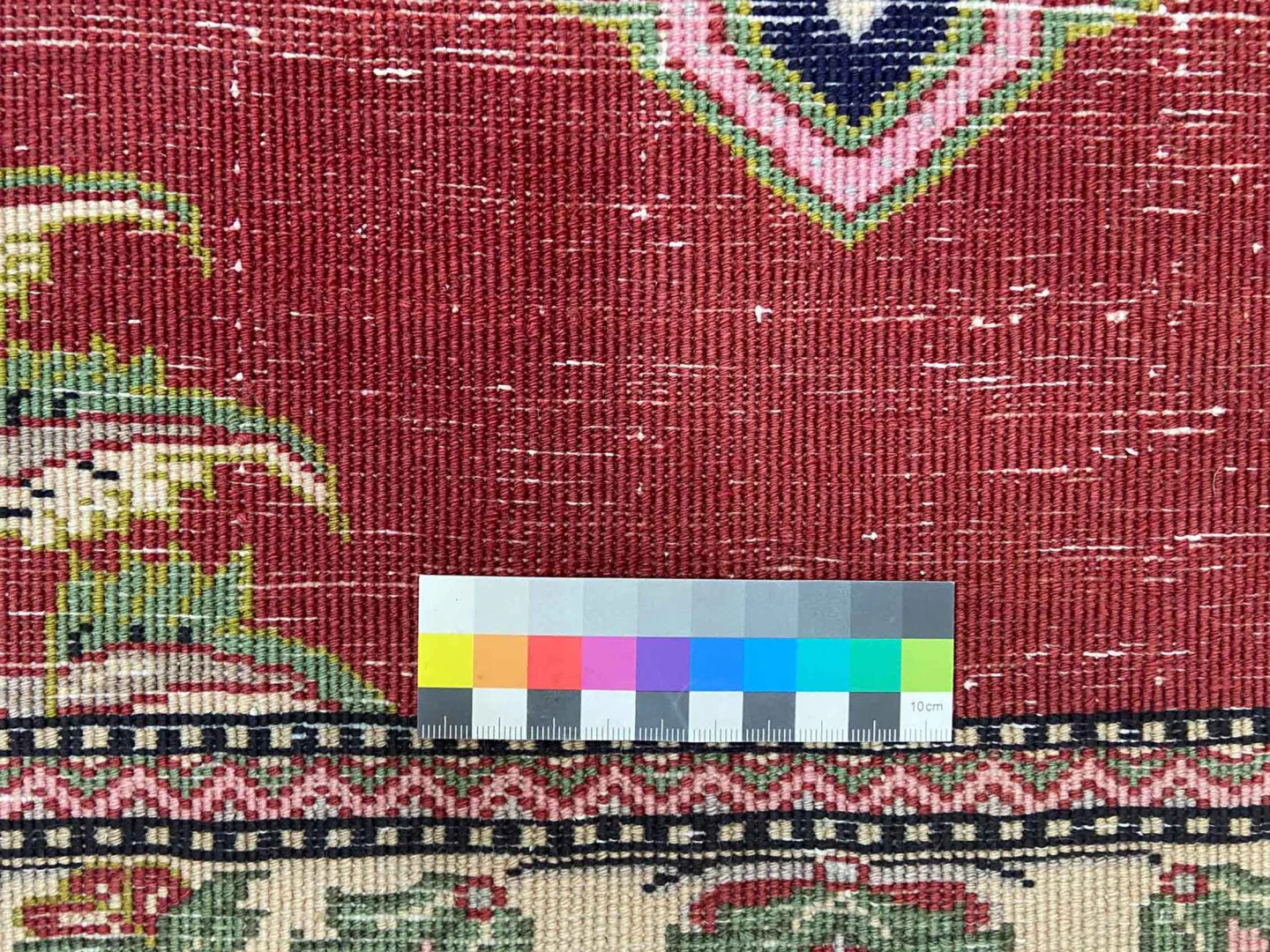
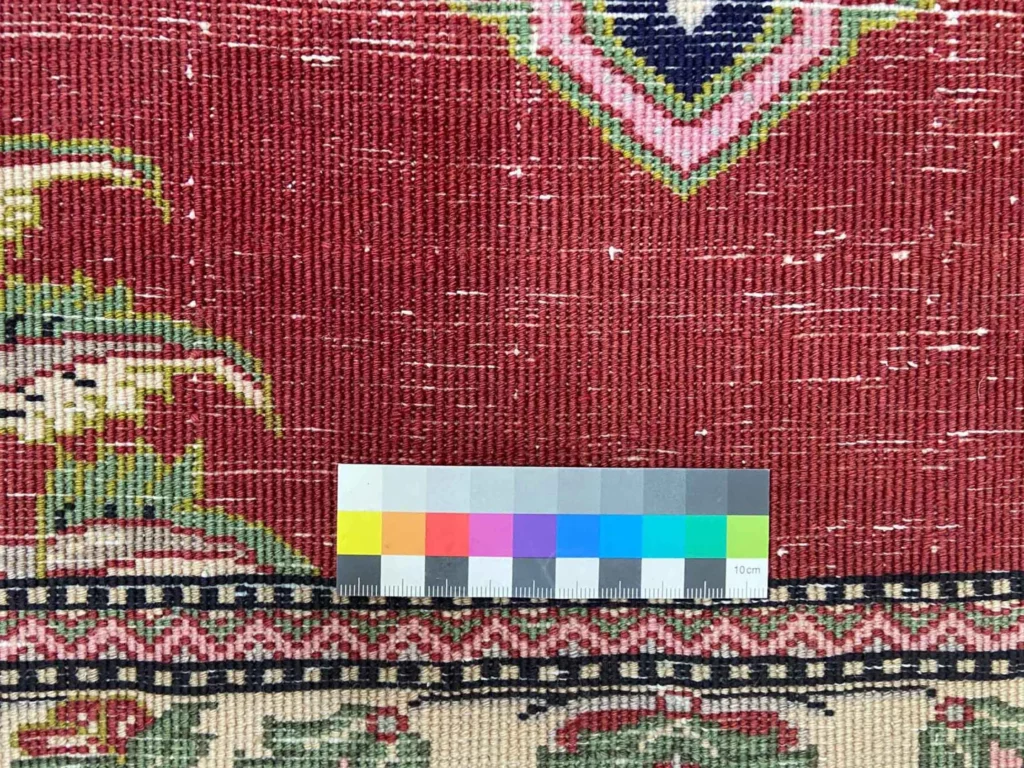
Ghom rugs are traditionally associated with precise, detailed workmanship. A dense knot structure allows contours to be placed close together and small floral details to remain legible. Wool rugs from Ghom commonly fall within a density of 300,000 to 400,000 knots per square metre. Wool gives the pile a different appearance from silk: it is generally more restrained in sheen and has a distinct, substantial texture. The material named for this rug is wool.
Making a hand-knotted rug involves several stages. The foundation is prepared first; knots are then tied and secured with weft threads. The pile is subsequently sheared to an even level so that the design can be read clearly. With a dense weave, the alignment of lines, blossoms and transitions requires particular control. This method explains why a hand-knotted rug has a surface with depth and variation, rather than the uniform appearance of a mechanically printed textile.
Origin and Tradition
Ghom, also written as Qom, is a city in Iran and an important centre of Persian rug production. It lies in central Iran and is also known as a major religious and cultural location. Rug making in the area developed into a distinct tradition especially during the twentieth century. Ghom is therefore used not only as a place name but also as an origin designation for rugs associated with careful finishing, fine drawing and richly developed ornament.
Persian rug making combines practical use with a highly developed visual language. A rug is created through the interaction of foundation, knots, pile, colour and design. In Ghom, these elements have been brought together in a tradition that can accommodate both classical models and newer compositions. Designs often draw on forms passed down through Persian ornamental art, while the arrangement and execution may be adapted to a particular workshop or individual rug.
The Ghom tradition is associated with patterns that are clearly organised and worked out in small detail. This requires careful planning before and during the weaving process. The design is not transferred as a flat picture. Instead, the maker translates lines and colour areas into sequences of knots. The result depends on command of the knot, consistent tension in the foundation, suitable materials and close attention to the drawn pattern.
Iranian rug centres are distinguished by their own regional approaches. Ghom is commonly linked with fine drawing, controlled compositions and detailed ornament. Tabriz is also known for complex designs and dense workmanship. Kashan is often associated with red and blue colour schemes and floral arrangements. Nain is recognised for the combination of wool and silk and for finely differentiated execution. These names describe separate chapters of Iranian rug history; they do not alter the Ghom origin of this particular rug.
Persian weaving traditions also depend on the transmission of knowledge. Understanding of pattern construction, colour relationships and working methods is preserved over long periods and adjusted by successive generations. A classical motif can therefore appear in a new arrangement while retaining its place within the broader culture of Persian design. A Ghom rug represents this relationship between inherited ornament and a method of production that places emphasis on accuracy.
Use has influenced the development of rugs as well. Small rugs, runners and larger formats have been made for different rooms and purposes. Designs range from strictly ordered fields to compositions with a more flowing floral character. This variety has allowed the Ghom tradition to work in different interior settings. Its regional identity remains visible in the character of the drawing, the fineness of the execution and the choice of material.
Design and Pattern
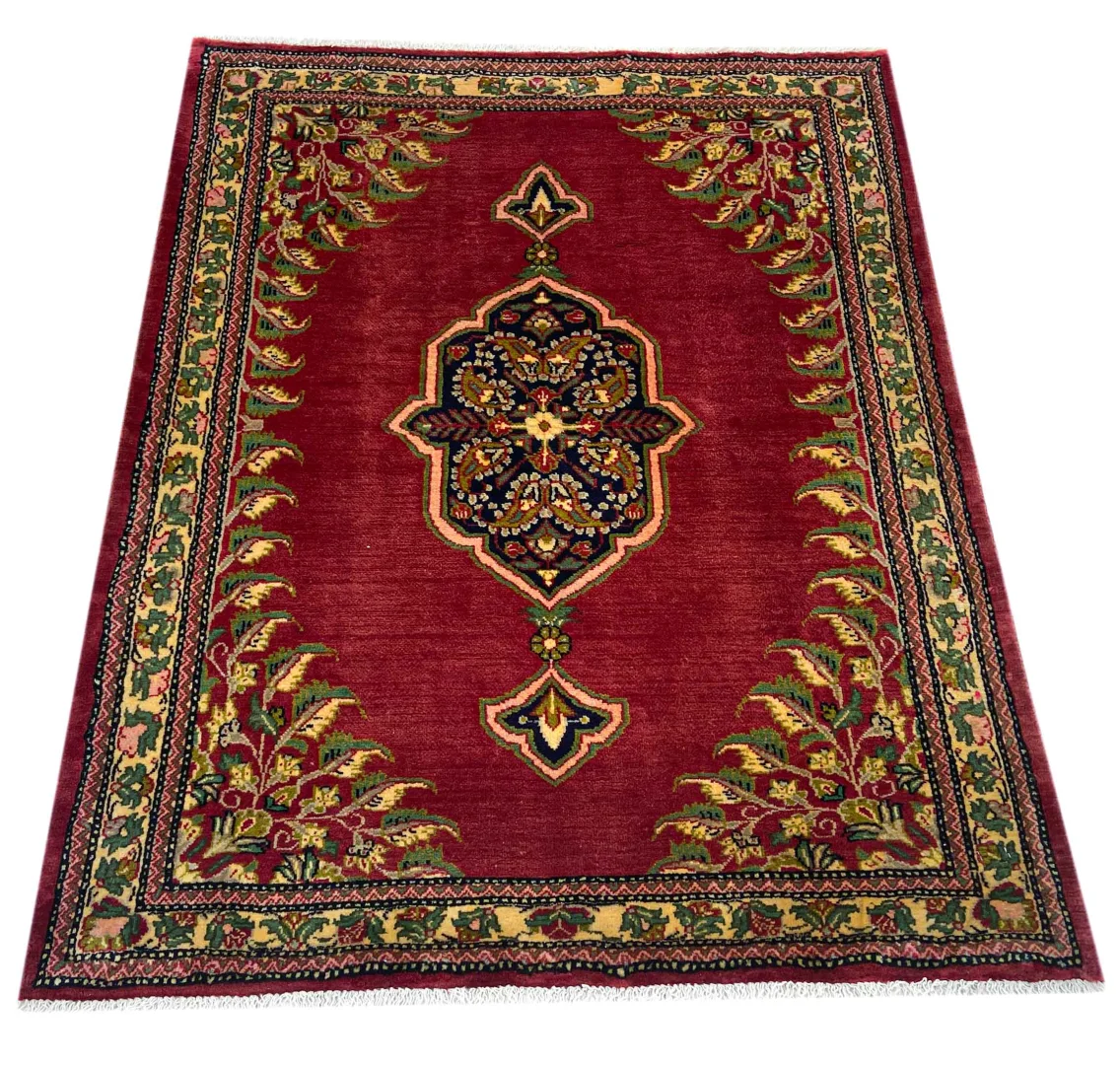
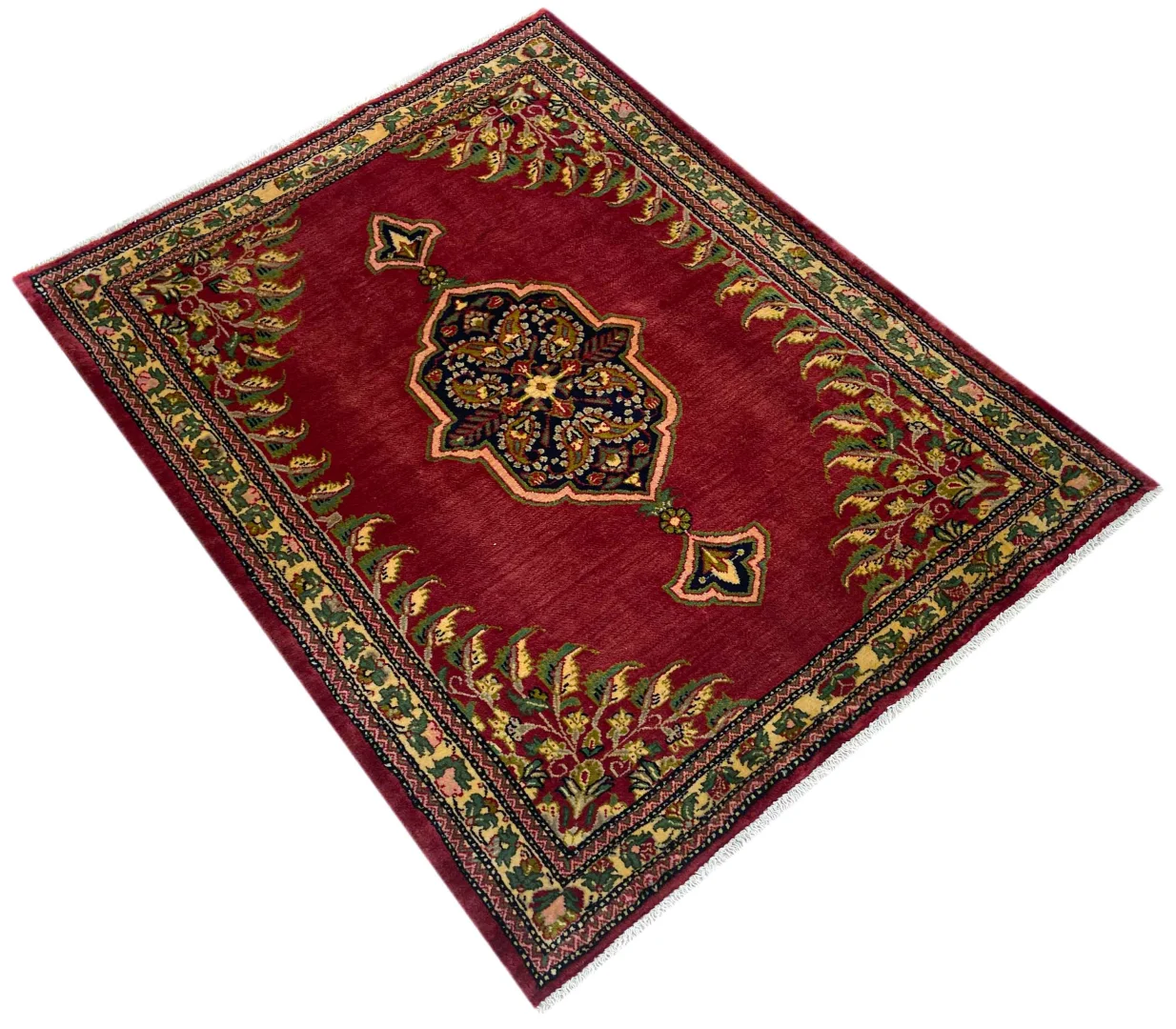
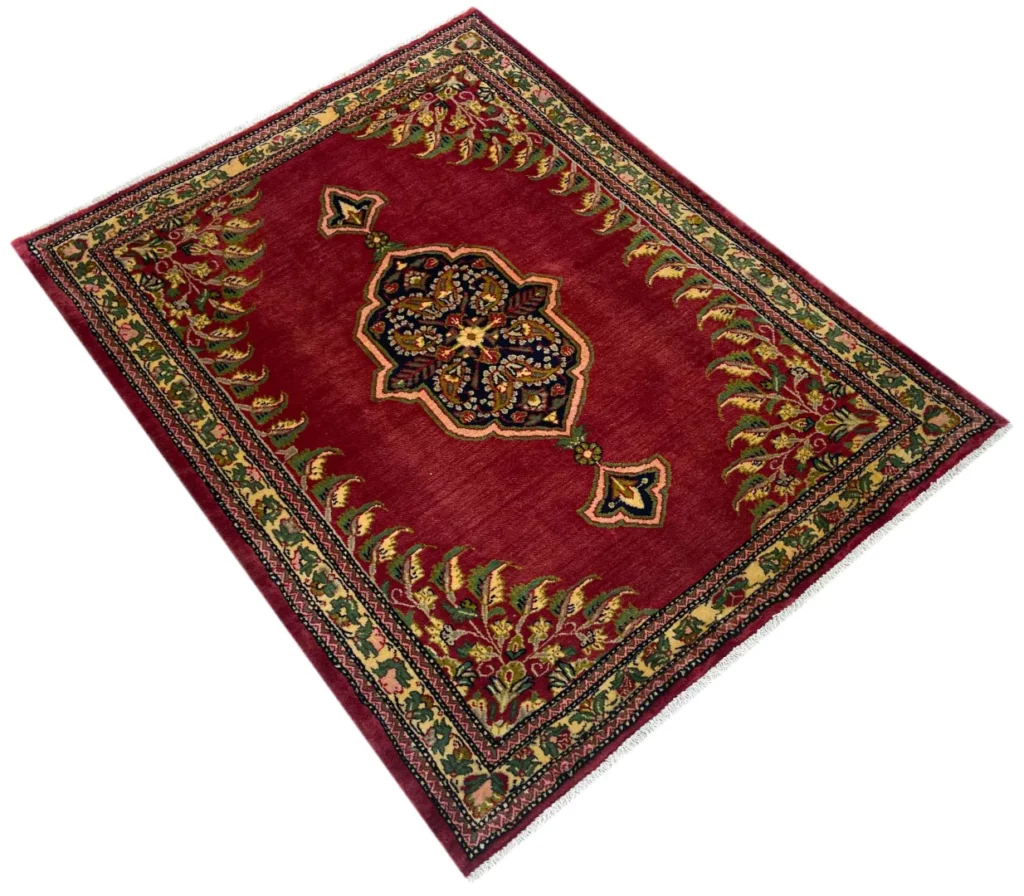
The pattern of this rug is defined by a medallion and floral motifs. In Persian design, a medallion often acts as the visual centre of the composition. It establishes a clear point of focus and organises the surrounding field. Floral forms then extend the design beyond that centre, connecting the main shape with the surrounding area. The result is a structure that balances a concentrated centre with a field enriched by ornament.
Floral ornament is one of the central forms of expression in Persian rugs. Blossoms, leaves, vines and stylised branches are not necessarily copied from nature; they are transformed into a decorative vocabulary. Shapes may be repeated, mirrored or arranged in measured rhythms. This allows a design with many separate elements to remain coherent. In a medallion rug, plants may frame the centre, lead towards the corners or occupy the space between the medallion and the border.
A medallion can be round, oval, polygonal or built from several nested forms. Its effect depends on the outline, the internal drawing and the way it relates to the rest of the field. Fine knotting makes it possible to articulate contours in close succession. Small leaves and blossoms can be positioned to frame the centre without overwhelming the surrounding pattern. The medallion consequently provides both a focal point and a system for balancing the composition.
In many Persian rugs, the border provides a visual transition between the inner field and the outer edge. It can frame the central design and give the composition a sense of completion. Floral borders may use continuous vines, repeated blossoms or alternating ornaments, sometimes accompanied by narrower guard borders. The precise colours and individual border forms of this rug are not specified in the product information. The documented design elements are the medallion and the floral motifs.
The appearance of a floral medallion design depends on distribution as much as on the individual ornaments. Repeated forms create rhythm, while variations in the size of leaves and blossoms create hierarchy. A considered balance between open ground and decorated areas keeps the field readable. Ghom weavers are traditionally associated with controlling these relationships carefully, allowing a complex design to retain clarity when viewed as a whole.
Persian motifs can carry cultural associations, but they should not be reduced to one fixed interpretation. Plant forms may suggest growth, order or the idea of a garden, while the medallion may be understood as the organising centre of the design. Such readings belong to the wider language of Persian rugs and are not a substitute for describing the actual pattern. For this rug, the identifiable design consists of a medallion accompanied by floral motifs.
The combination of a central medallion and plant ornament can work in both traditional and restrained contemporary interiors. The design has a defined structure, while the floral details provide visual movement. Hand-knotting gives the lines a textile depth that a printed representation does not produce in the same way. The overall character is therefore shaped by the relationship between the traditional composition and the tactile wool pile.
Special Features
The recorded features of this rug are its Ghom origin, hand-knotted construction, wool pile, medallion with floral motifs and very good condition. Its knot density is in the range of 300,000 to 400,000 knots per square metre. These details place a classical Persian design theme alongside a carefully executed hand-knotted structure.
The high-quality wool defines the character of the pile. It differs from Ghom rugs made wholly or partly with silk, where silk is used for its sheen and capacity for very fine drawing. Wool has a more substantial and generally quieter surface character. The material specified for this rug is wool; the broader material range found in Ghom weaving should not be taken to mean that this piece contains silk.
Regular, gentle vacuuming is suitable for routine care of a wool rug. Occasional beating can remove loose dust, but it should be carried out carefully. For heavier soiling, professional cleaning is recommended so that the treatment can be matched to the wool, the knotting and the colours. Harsh household cleaners, vigorous rubbing and unnecessary moisture should be avoided. The stated very good condition is best maintained through moderate, consistent care and by limiting the accumulation of dirt.
FAQ
How should I care for my Ghom Persian rug?
Regular vacuuming is the most useful everyday measure. Use a gentle setting and avoid pressing too heavily on the pile. Occasional beating can loosen dust, but it should be done with care. If the rug has a stain or needs a more thorough refresh, professional cleaning is advisable. A specialist can select a treatment appropriate for wool, the hand-knotted structure and the colours. Strong household cleaners, hard scrubbing and excessive moisture should be avoided because they may affect the fibres and the appearance of the dyes.
What materials are used for Ghom rugs?
Ghom rugs are made mainly from wool and silk. Silk is valued for its sheen and for the very high knot densities that it can support. Wool has a durable, pleasantly textured character and is used for rugs intended to have a resilient pile. The pile material specified for this particular rug is high-quality wool. The general material variety of the Ghom tradition does not mean that every Ghom rug contains both fibres. For this piece, the stated wool pile is the relevant material fact.
Where do Ghom rugs come from?
Ghom rugs come from the Ghom region of Iran. The area is known for Persian rug making, careful workmanship and detailed designs. Its tradition combines established Persian ornament with precise hand-knotting. Medallions, floral forms and other clearly organised motifs are frequently associated with the region. Tabriz, Kashan and Nain are also important Iranian rug centres, but each represents a separate regional tradition. The origin of this rug is Ghom.
To provide the best experiences, we use technologies like cookies to store and/or access device information. Consenting to these technologies will allow us to process data such as browsing behavior or unique IDs on this site. Not consenting or withdrawing consent, may adversely affect certain features and functions.
Functional Always active
The technical storage or access is strictly necessary for the legitimate purpose of enabling the use of a specific service explicitly requested by the subscriber or user, or for the sole purpose of carrying out the transmission of a communication over an electronic communications network.
Preferences
The technical storage or access is necessary for the legitimate purpose of storing preferences that are not requested by the subscriber or user.
Statistics
The technical storage or access that is used exclusively for statistical purposes.The technical storage or access that is used exclusively for anonymous statistical purposes. Without a subpoena, voluntary compliance on the part of your Internet Service Provider, or additional records from a third party, information stored or retrieved for this purpose alone cannot usually be used to identify you.
Marketing
The technical storage or access is required to create user profiles to send advertising, or to track the user on a website or across several websites for similar marketing purposes.
 SECURE PAYMENT
 SHIPPING PARTNERS