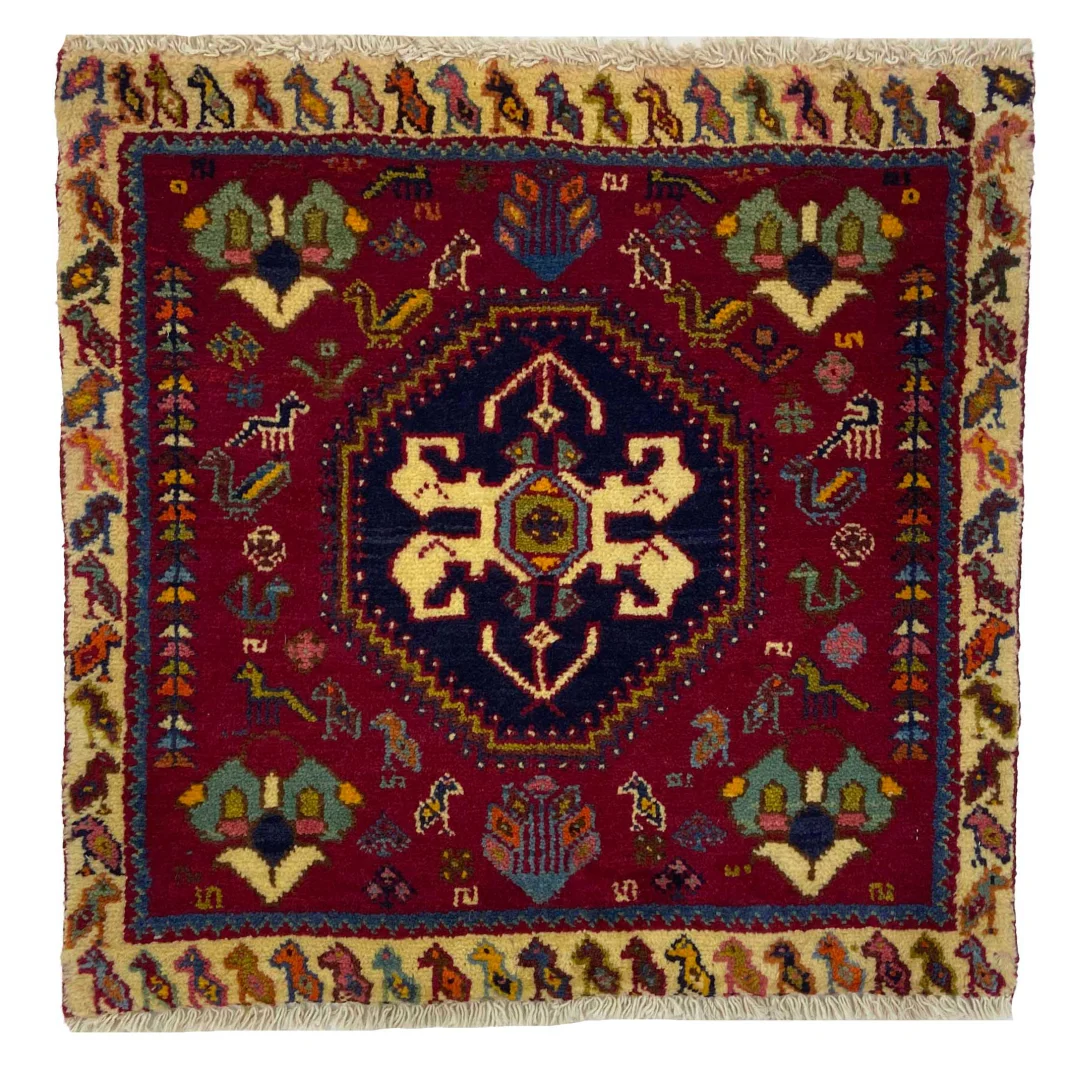
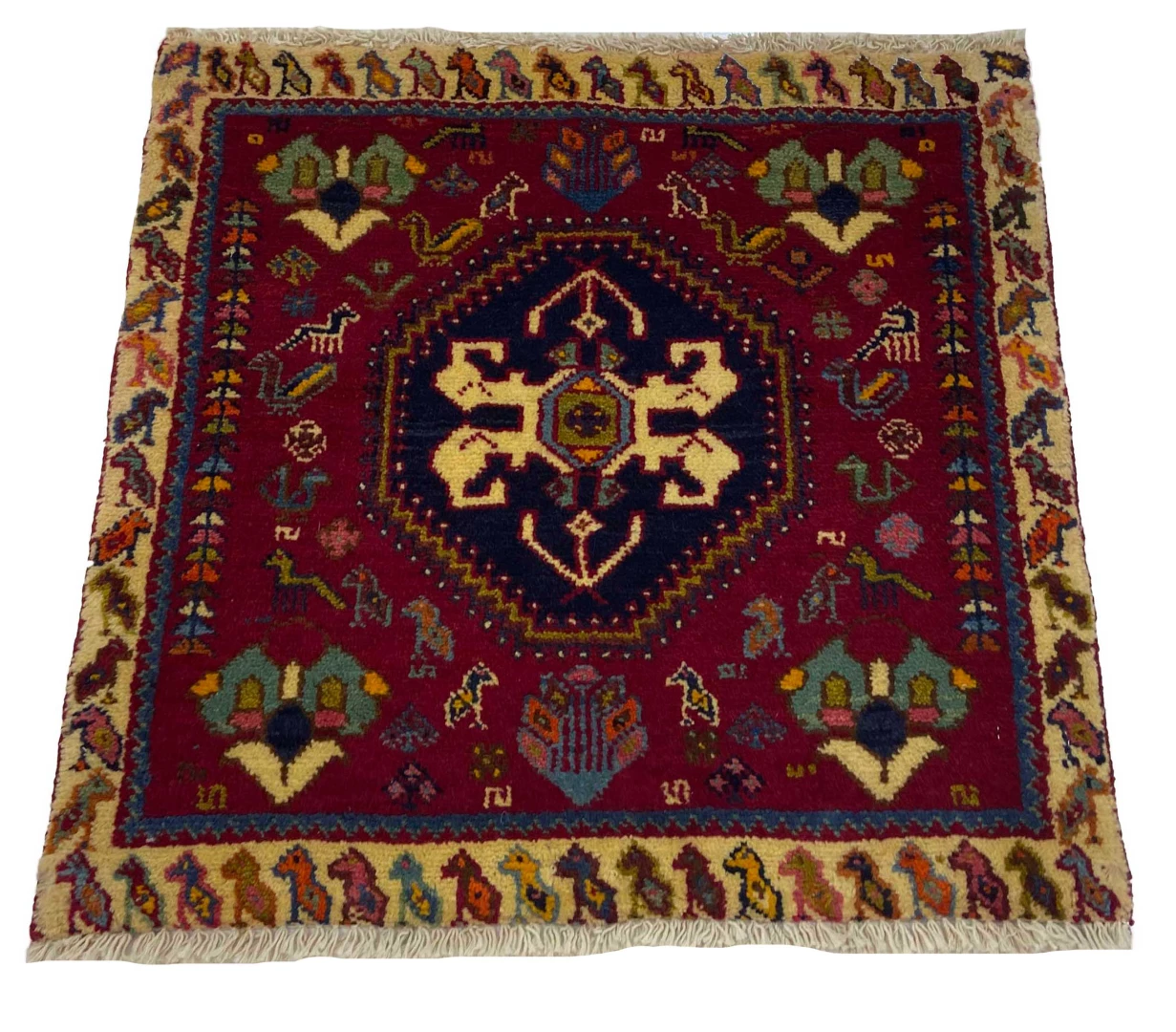
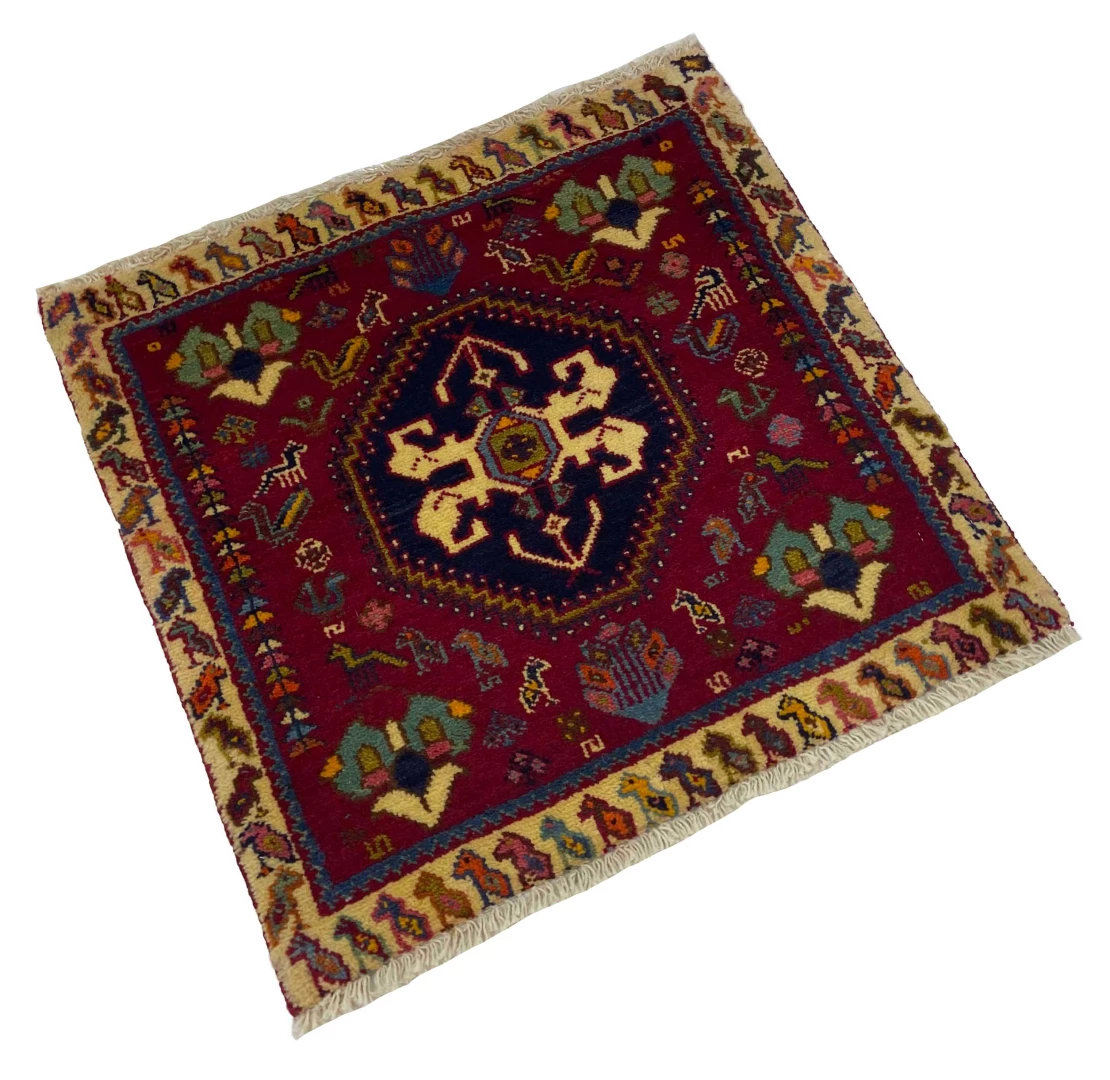
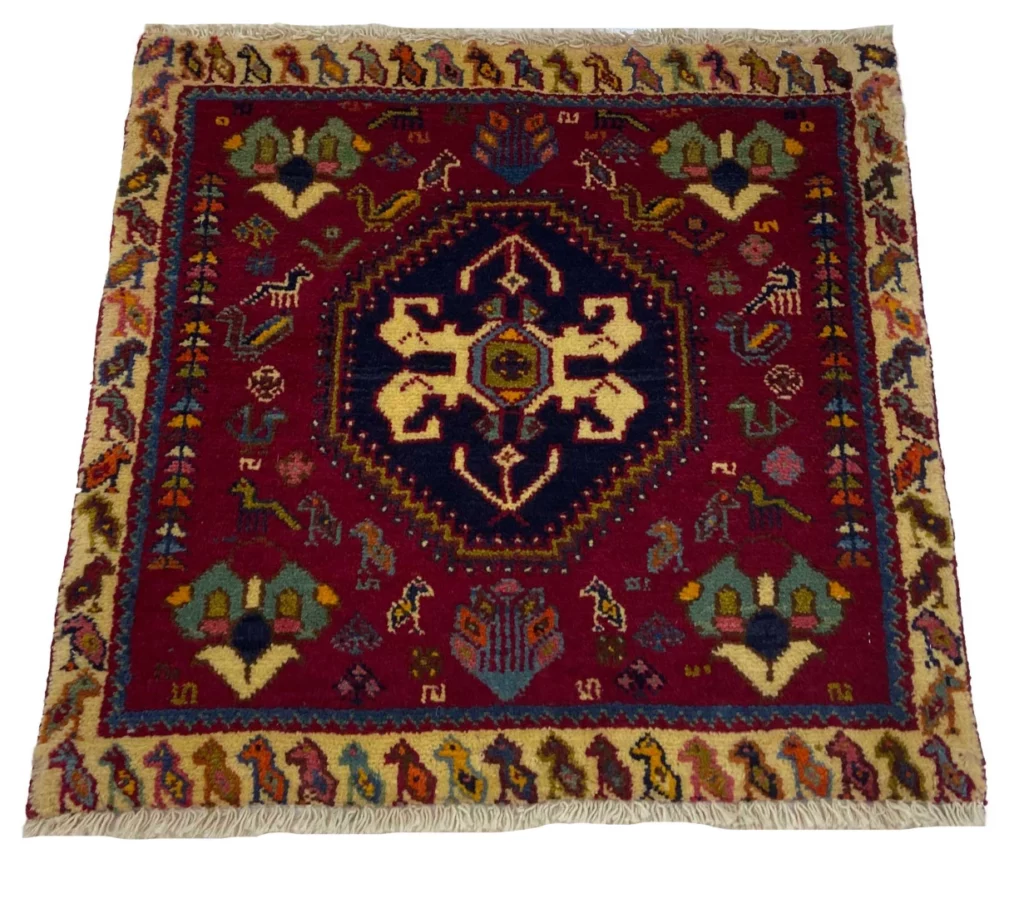
This Ghashghai Persian rug is hand-knotted and made from natural wool. Those two details place the piece within a textile tradition built on manual work and locally available natural fibres. Wool shapes the character of the pile, providing the material basis for the rug’s surface and for the definition of its geometric ornaments. The production method is not printed or mechanically reproduced: the design is formed knot by knot and then finished as a woven textile surface.
The listed knot density falls within a finely worked range of knotting. Knot density indicates how many individual knots are placed within a defined area and offers an insight into the compactness of the construction. In a hand-knotted rug, the arrangement of knots is directly connected with the drawing of the pattern. The geometric ornaments are therefore not separate decoration applied afterward; they are part of the structure created during the making of the rug.
Natural wool is a traditional material for Ghashghai rugs. It can produce a surface that feels soft while remaining suitably robust for a woven floor covering. The source describes this rug as having high-quality workmanship. That description belongs to the piece’s stated construction and does not require adding materials that are not named. No separate warp fibre is specified, and no further fibre composition is given.
Ghashghai weaving is associated with work carried out in a nomadic setting, often in the open air and with tools adapted to changing locations. This practical environment supported a direct form of production in which the weaver controlled the rhythm of the knotting and the development of the pattern. The hand-knotted character can remain visible in the way motifs are organized and in the individual decisions made during the work. For this rug, the recorded features are natural wool, hand knotting, geometric ornament and high-quality workmanship. Its age, signature and restoration history are not stated.
Origin and Tradition
The rug is identified as Ghashghai from southern Persia, in Iran’s Fars Province. Fars is one of the historic regions of Persian carpet making and is closely associated with both settled and nomadic textile cultures. The Ghashghai are a major nomadic confederation of the region. Their carpet tradition developed within a way of life in which mobility, family production and knowledge passed through generations were closely connected.
For nomadic communities, woven textiles had practical as well as cultural roles. A rug could furnish a living space, provide a durable surface and carry recognizable forms of community expression. Weaving skills were learned through observation and participation, with knowledge of wool preparation, colour use, loom work and knotting transmitted within families. The result was not a single uniform pattern but a regional vocabulary in which related motifs could be interpreted in different ways by individual weavers.
Ghashghai rugs are commonly associated with an immediate, hand-drawn quality. A composition might be remembered, adapted from an established design or built through a simple structural understanding of the field and borders. This differs from a strictly standardized production system in which every detail must reproduce a fixed model. Variations in scale, spacing and ornament are part of the broader character of nomadic weaving. The name Ghashghai therefore refers to a cultural and regional tradition, not only to a decorative appearance.
Fars contains several connected but distinct carpet traditions. Shiraz rugs are also linked with the province, although their designs and knotting can differ according to the particular workshop or area. The Ghashghai designation places this rug within the nomadic tradition of southern Persia. It does not turn every rug from Fars into a Ghashghai rug; the name describes a specific regional weaving culture and its associated visual language.
Persian carpet production also includes important urban centres with different methods and design histories. Tabriz rugs are often associated with detailed drawing and floral compositions, while Isfahan rugs are widely connected with refined motifs and the use of luxurious materials. These traditions demonstrate the range of Persian weaving rather than serving as alternative origins for this rug. The present piece remains a Ghashghai rug from Fars, characterized by hand knotting, natural wool and geometric ornament.
The nomadic background also influenced the practical organization of weaving. Equipment had to be usable in a mobile environment, and the work had to fit into the rhythm of daily life. This encouraged adaptable compositions and a reliance on the weaver’s knowledge rather than on a fully industrial process. Natural wool was well suited to the regional tradition because it could be prepared and worked within the community. The combination of material, technique and design allowed Ghashghai carpets to function as useful textiles while also preserving a distinctive regional identity.
Tradition in this context does not mean that every Ghashghai rug is identical. It means that certain principles remain recognizable across generations: the use of handwork, the importance of wool, the preference for strong visual organization and the transmission of motifs through lived practice. A finished rug records both continuity and individual making. Its geometric structure belongs to the wider Fars tradition, while the precise balance of its ornaments belongs to the particular work of the weaver.
Design and Pattern
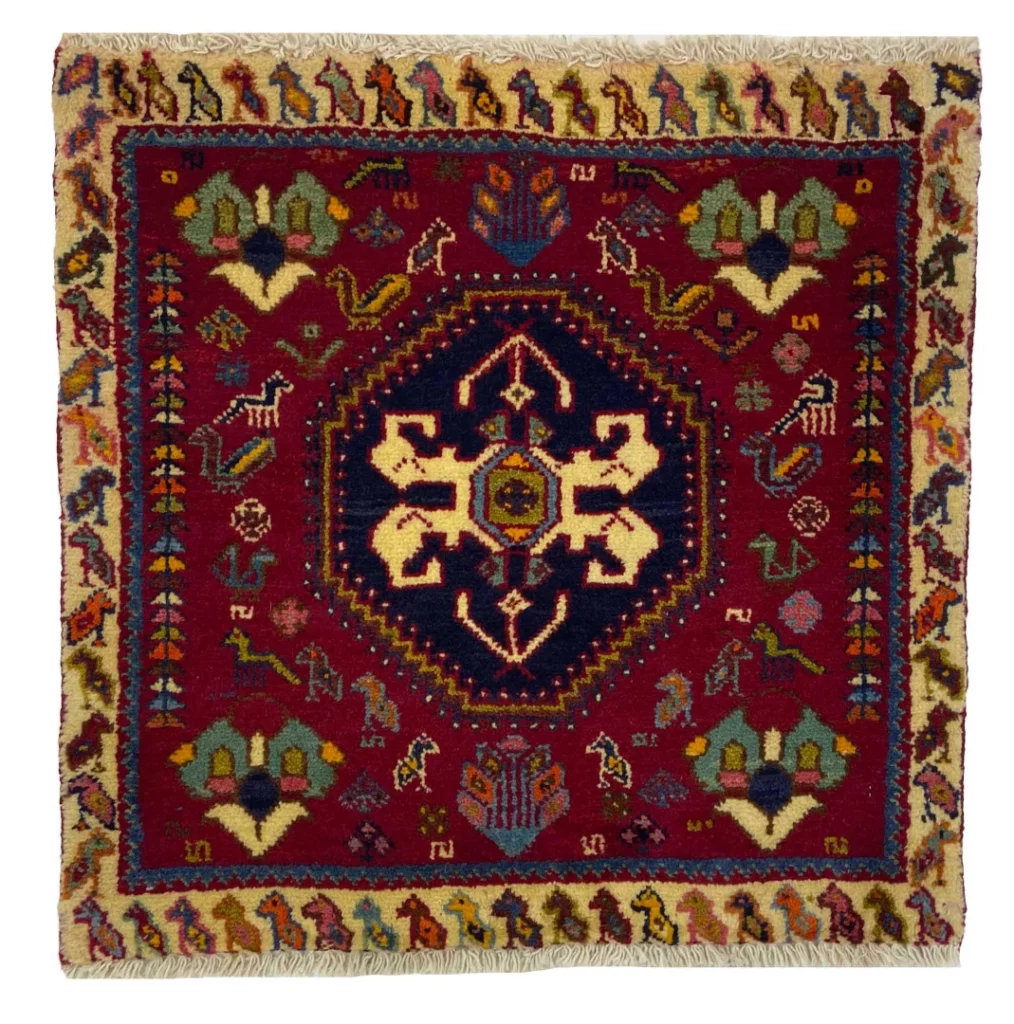
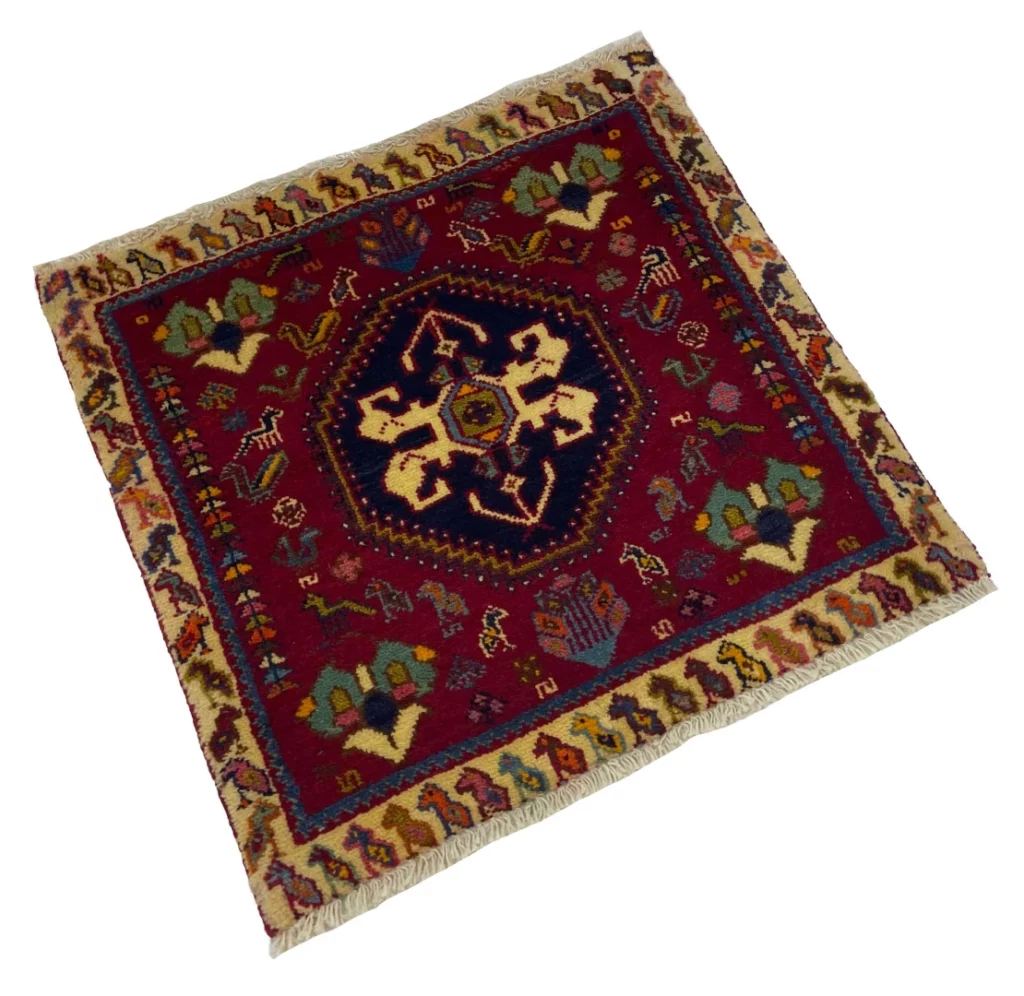
The pattern of this rug is described as geometric ornament. Geometry is one of the central visual languages found in many nomadic and village carpets from Persia. Angular lines, stepped forms, diamonds, hooks and repeated signs can be arranged into a field with a strong rhythm. Such motifs do not aim to reproduce a natural scene literally. Instead, they use simplification, repetition and clear boundaries to create an ordered textile composition.
In Ghashghai design, individual ornaments may appear as independent signs or as parts of a larger sequence. A border can frame the central field, while smaller forms connect the interior with the surrounding bands. Repetition creates continuity, but handwork allows small variations in spacing and drawing. The particular number, arrangement and colour distribution of the motifs on this rug are not specified. What is stated is its geometric character, which places the design within a recognizable Ghashghai vocabulary.
The traditional colour impression associated with Ghashghai carpets includes vivid reds and gentle browns. These colours can gain depth from the way wool absorbs and reflects dye, producing subtle changes across the surface rather than a perfectly uniform industrial tone. The source describes red and brown as characteristic colours of Ghashghai rugs. It does not provide a complete colour inventory for this individual piece, so the design should be understood through the stated colour family rather than through additional colour claims.
Geometric patterning is practical as well as decorative. Repeated forms can be developed across a field without requiring a detailed pictorial drawing, and the structure remains legible when the rug is viewed as a whole. This makes geometry suitable for a weaving tradition in which designs may be carried in memory or adapted during production. The weaver can preserve the identity of a motif while adjusting its size, spacing or relationship to neighbouring forms.
Many geometric symbols in regional carpet traditions have been connected with stylized plants, animals, protective signs or abstract ideas. Their interpretation is not always fixed, and a motif may be valued for its appearance and inherited use rather than for one universally agreed meaning. In Ghashghai weaving, the visual language is shaped by the community’s tradition and by the technical limits of the loom and knotting process. The result is a pattern that combines cultural continuity with the individual decisions of the maker.
Compared with urban floral compositions, geometric nomadic designs often appear more segmented and sign-like. Tabriz is frequently associated with floral detail and finely drawn pictorial structure, while Ghashghai rugs are known for a stronger geometric vocabulary and bold colour relationships. Isfahan represents another design tradition, often recognized for carefully arranged motifs and refined materials. These comparisons help explain the classification of the present rug without assigning it a different origin.
The pattern also contributes to the way the rug relates to an interior. Geometric forms can establish a clear visual rhythm and provide a defined centre or border without depending on a naturalistic image. The red and brown colour family associated with Ghashghai weaving supports a grounded, rustic design language. In this rug, the stated geometric ornaments are therefore both a decorative feature and an expression of the southern Persian tradition from which the Ghashghai name comes.
Special Features
The principal features of this rug are its Ghashghai origin, its connection with southern Persia and Fars Province, its hand-knotted construction and its use of natural wool. Its pattern is described as geometric ornament. The recorded knot density is 180,000 to 250,000 knots per square metre, and the workmanship is described as high quality.
These details work together to identify the piece: Fars provides the regional setting, Ghashghai names the associated weaving tradition, wool identifies the principal pile material, and hand knotting describes the technique. The geometric design distinguishes its visual language from the floral traditions often associated with other Persian centres. No production date, signature, repair record or separate provenance is provided, so none is added here.
FAQ
What are the main characteristics of a Ghashghai Persian rug?
A Ghashghai Persian rug is associated with the nomadic weaving tradition of southern Persia, especially Fars Province. Its commonly recognized features include hand knotting, natural wool, geometric ornament and a colour language often based on vivid reds and softer browns. This rug brings those elements together in one piece. Its recorded knot density is 180,000 to 250,000 knots per square metre, adding a specific indication of the compactness of its construction.
How should a Ghashghai Persian rug be cared for?
Regular gentle vacuuming helps remove loose dust before it becomes embedded in the wool surface. When deeper cleaning is needed, professional cleaning is recommended, preferably by a specialist familiar with hand-knotted wool rugs. Prolonged direct sunlight should be avoided because strong light can alter textile colours over time. The rug should also be protected from excessive moisture. Careful handling supports the preservation of the natural wool surface, the knotting and the visual clarity of the geometric pattern.
Where can a Ghashghai Persian rug be used?
A Ghashghai Persian rug can be used in several residential settings, including living rooms, bedrooms and hallways. In a living room, its geometric ornaments and strong colour character can define a specific area or provide a clear decorative accent. In a bedroom or hallway, its compact format can be integrated into the available floor plan. The appropriate placement depends on the room, furnishings and intended use. Its combination of hand-knotted wool and geometric design allows it to work with both traditional and contemporary interiors.
To provide the best experiences, we use technologies like cookies to store and/or access device information. Consenting to these technologies will allow us to process data such as browsing behavior or unique IDs on this site. Not consenting or withdrawing consent, may adversely affect certain features and functions.
Functional Always active
The technical storage or access is strictly necessary for the legitimate purpose of enabling the use of a specific service explicitly requested by the subscriber or user, or for the sole purpose of carrying out the transmission of a communication over an electronic communications network.
Preferences
The technical storage or access is necessary for the legitimate purpose of storing preferences that are not requested by the subscriber or user.
Statistics
The technical storage or access that is used exclusively for statistical purposes.The technical storage or access that is used exclusively for anonymous statistical purposes. Without a subpoena, voluntary compliance on the part of your Internet Service Provider, or additional records from a third party, information stored or retrieved for this purpose alone cannot usually be used to identify you.
Marketing
The technical storage or access is required to create user profiles to send advertising, or to track the user on a website or across several websites for similar marketing purposes.
 SECURE PAYMENT
 SHIPPING PARTNERS


