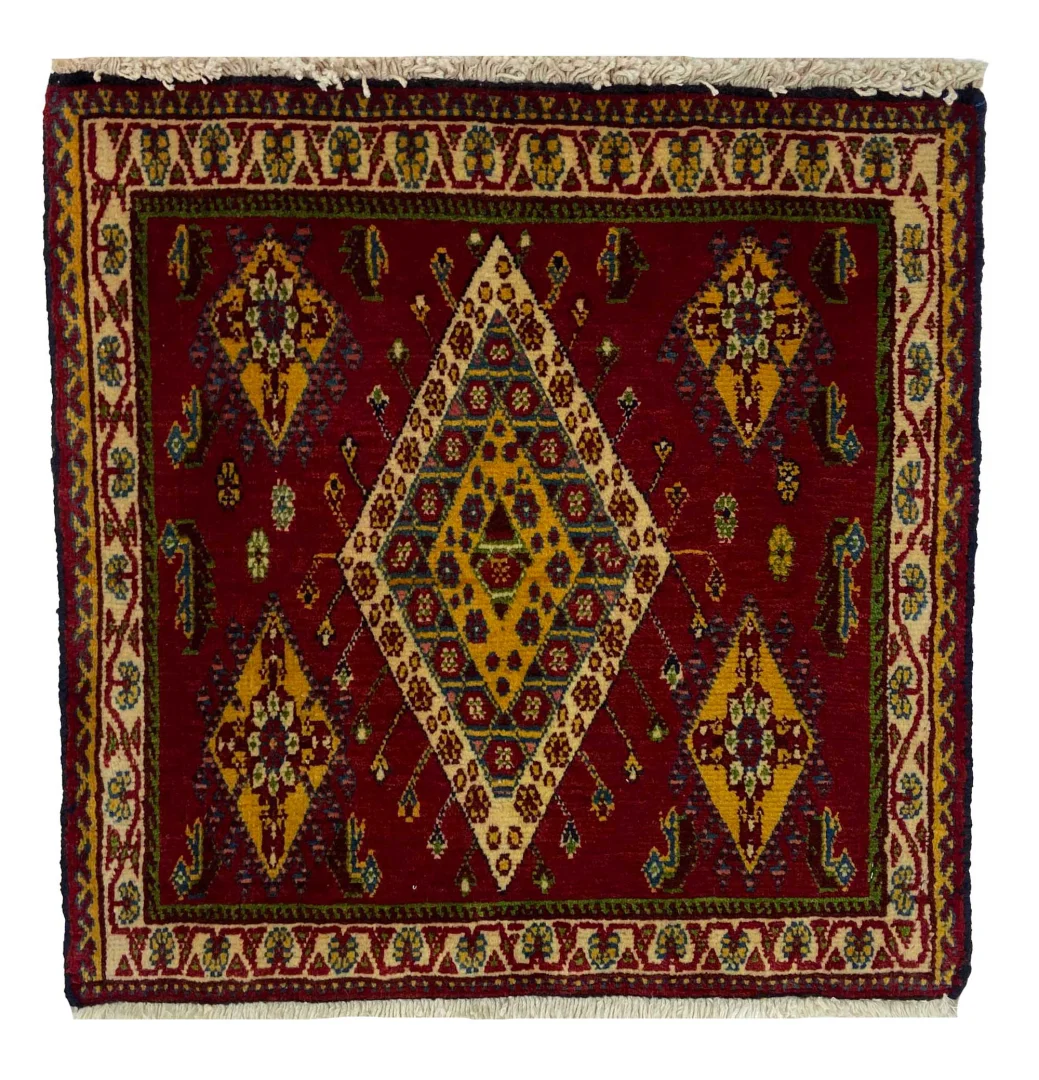
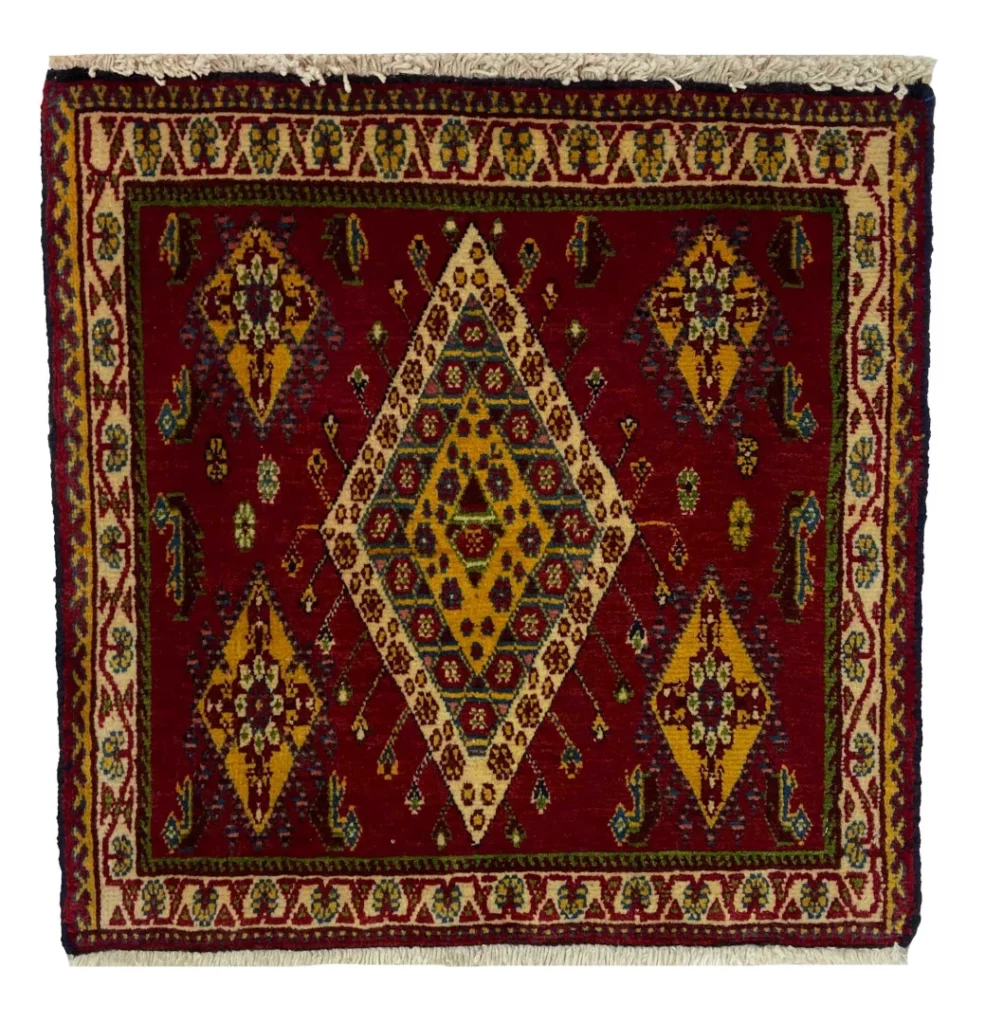
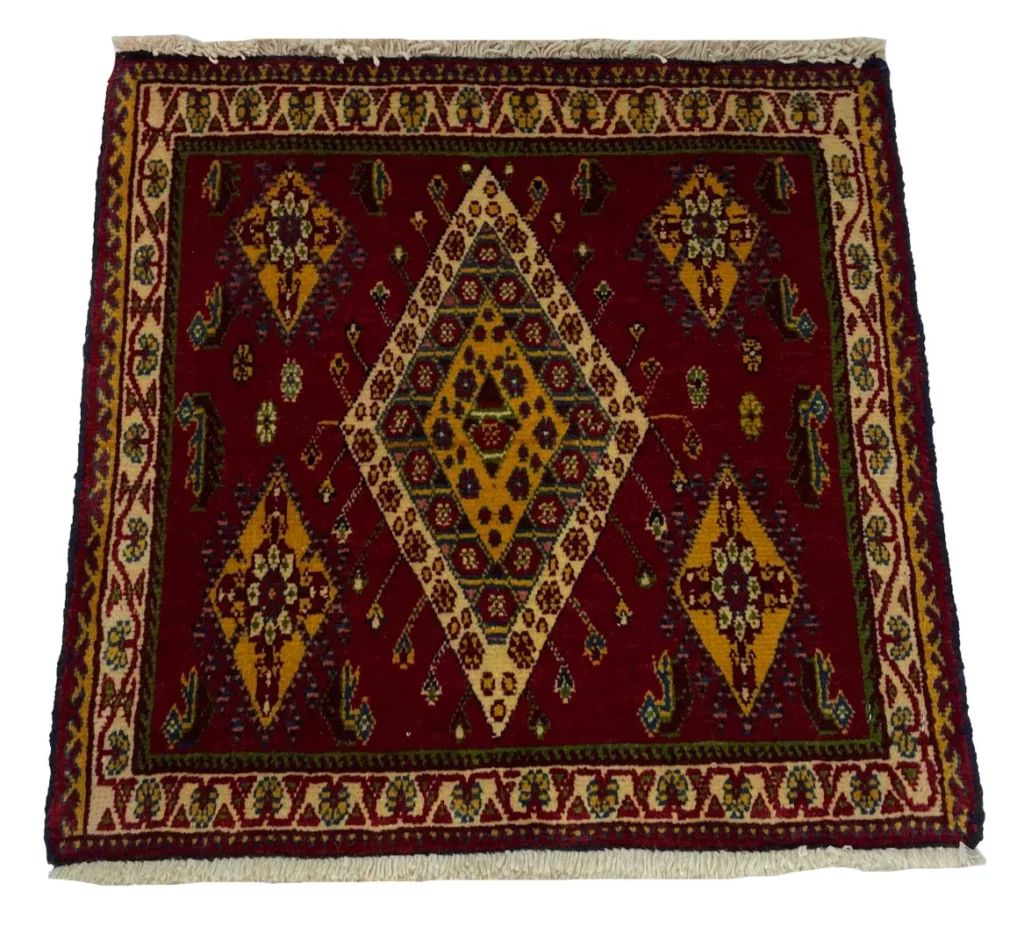
This Ghashghai Persian rug is hand-knotted and made of natural wool. In hand-knotting, each knot is inserted separately into the developing structure of the rug. The surface is therefore built gradually through many individual movements rather than produced as a uniform industrial sheet. The craft requires patience, visual control and experience, since the design is formed through the arrangement of the knots while the work progresses.
Natural wool is a traditional material in Ghashghai rug making. It combines a soft handle with the resilience needed for practical use. Wool is valued in regional rug production not only for its feel, but also for its ability to form a durable pile and accept the colours used to organise a design. The materials used for Ghashghai rugs are mainly natural. The wool comes from sheep from the region, giving the finished textile a direct connection with its local material tradition.
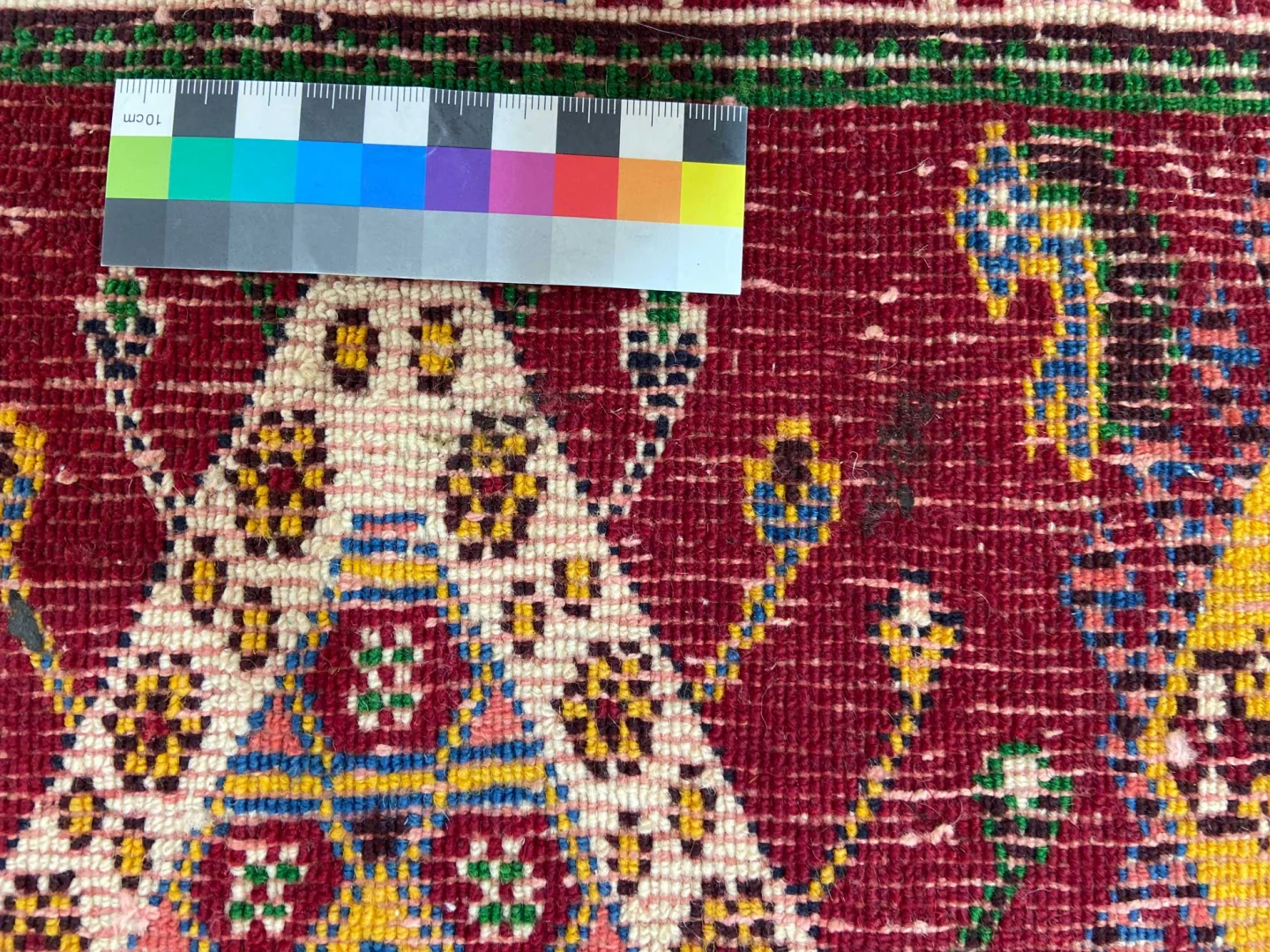
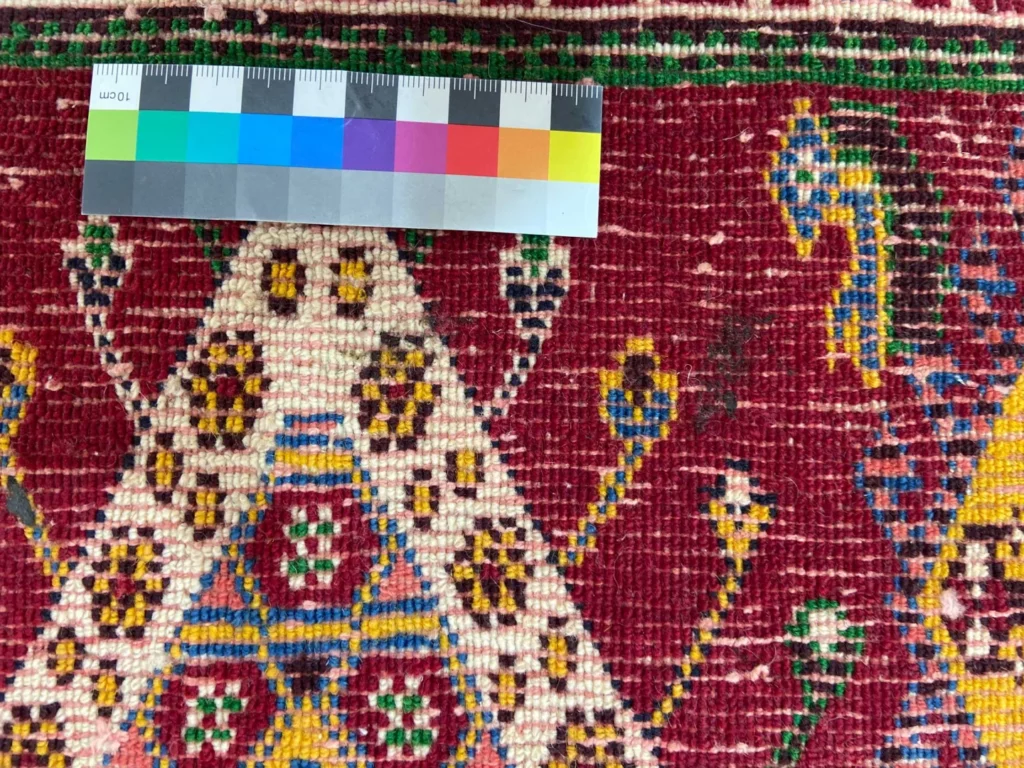
The knot density of this rug is between 180,000 and 250,000 knots per square metre. Knot density describes how closely individual knots are placed within an area. It is related to the ability to render ornaments in a differentiated way, although it does not by itself define the character of a rug. The wool, the quality of the handwork and the planning of the pattern are also important. This piece is new and made as a hand-crafted one-off.
Origin and Tradition
The rug comes from Southern Persia, from Fars Province, and belongs to the Ghashghai tradition. Ghashghai rugs are associated with the Ghashghai people, whose textile heritage developed in the south of Persia. Rug making and other textile crafts form part of a practical tradition in which knowledge of materials, colours and patterns has been passed down through generations. The rug is therefore identified not only by its shape or decoration, but also by the cultural region in which this form of knotting developed.
Fars is an important landscape within Persian rug culture. Over time, the province supported nomadic, village and urban forms of production alongside one another. This variety helps explain why rugs from Southern Persia can combine clearly organised ornaments with freer compositions that emerge directly from the craft process. In Ghashghai work, the relationship between everyday use, inherited signs and individual workmanship is particularly significant.
Ghashghai rugs are often knotted outdoors. This practice reflects a mobile and adaptable craft tradition that does not necessarily depend on a permanent workshop. The making of a rug can remain part of daily life and stay closely connected to available materials and inherited patterns. The execution may consequently develop a personal, non-mechanical line. That quality distinguishes the regional tradition from standardised industrial production.
Persian rug history also includes exchange between regions. Shiraz rugs are a well-known related tradition from the south. Nomadic rugs from Kerman are likewise appreciated for vivid colours and traditional patterns. Tabriz and Isfahan represent other Persian rug traditions, known for elaborate motifs and high knot densities. These comparisons place a Ghashghai rug within a broad Persian cultural history without changing its stated origin in Fars.
The tradition preserves more than a sequence of technical procedures. It also carries forward ways of arranging ornaments, dividing a field and balancing colours. A Ghashghai rug can therefore be read as a textile expression of a Southern Persian design language. Its classification results from the relationship between origin, material, technique and pattern vocabulary. For this rug, the stated origin is Southern Persia, Fars Province.
Regional rug traditions remain understandable through this combination of practical craft and inherited visual language. The outdoor setting associated with Ghashghai production, the use of regional wool and the hand-knotted technique all belong to that wider context. They explain why the rugs are considered part of a living textile heritage rather than merely examples of repeated decoration. The origin remains a specific fact about this piece: Southern Persia and Fars Province.
Design and Pattern
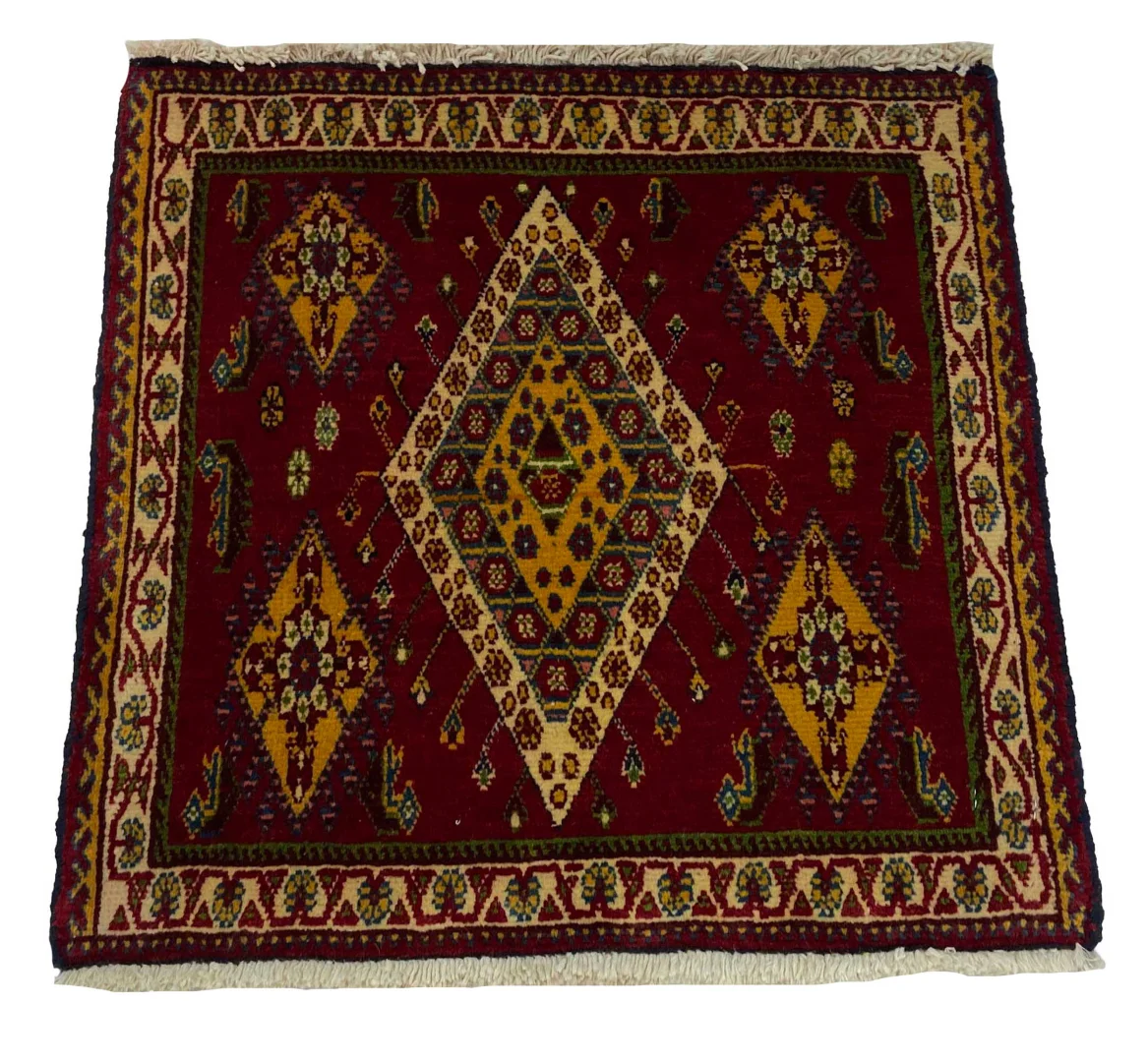
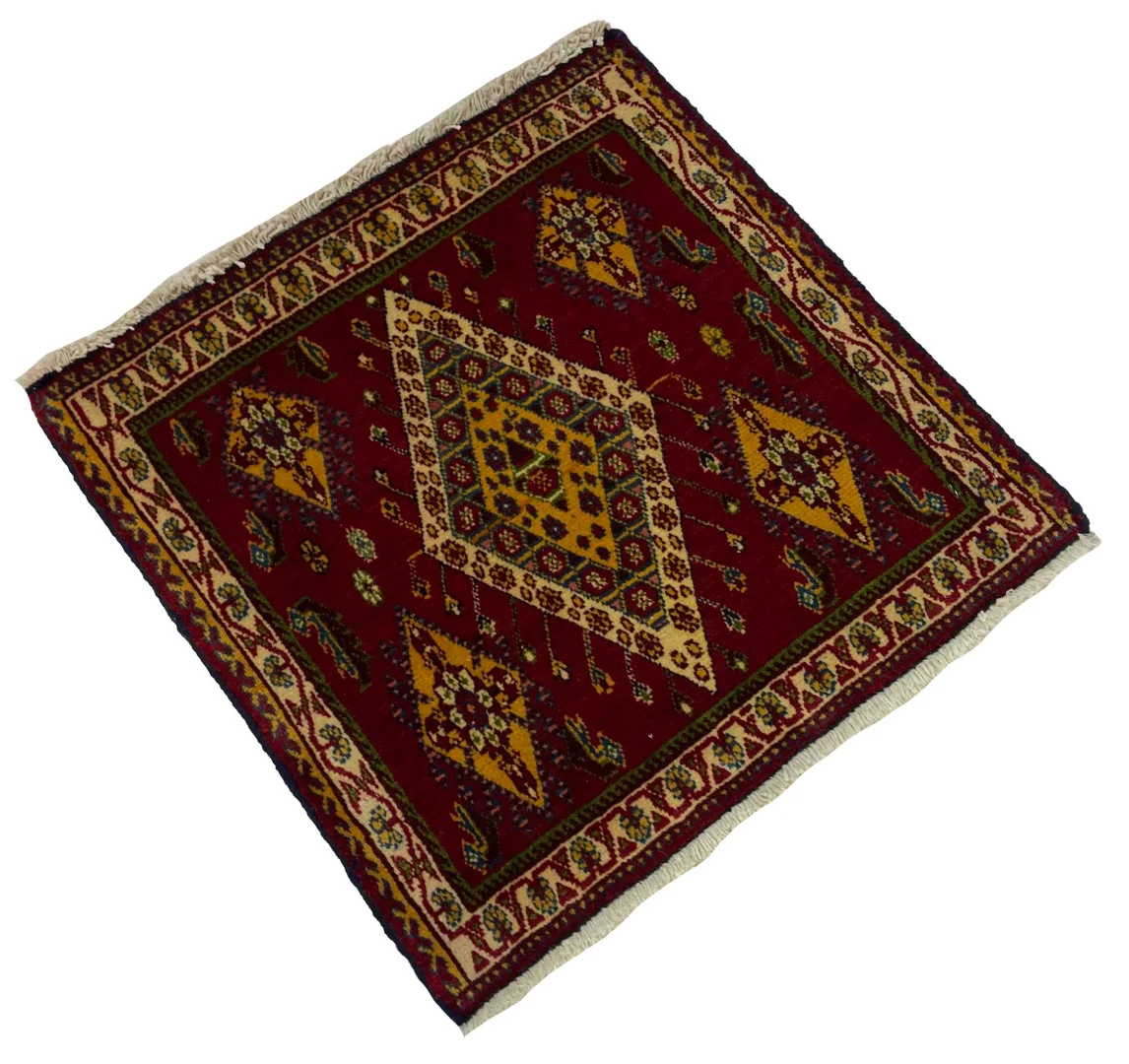
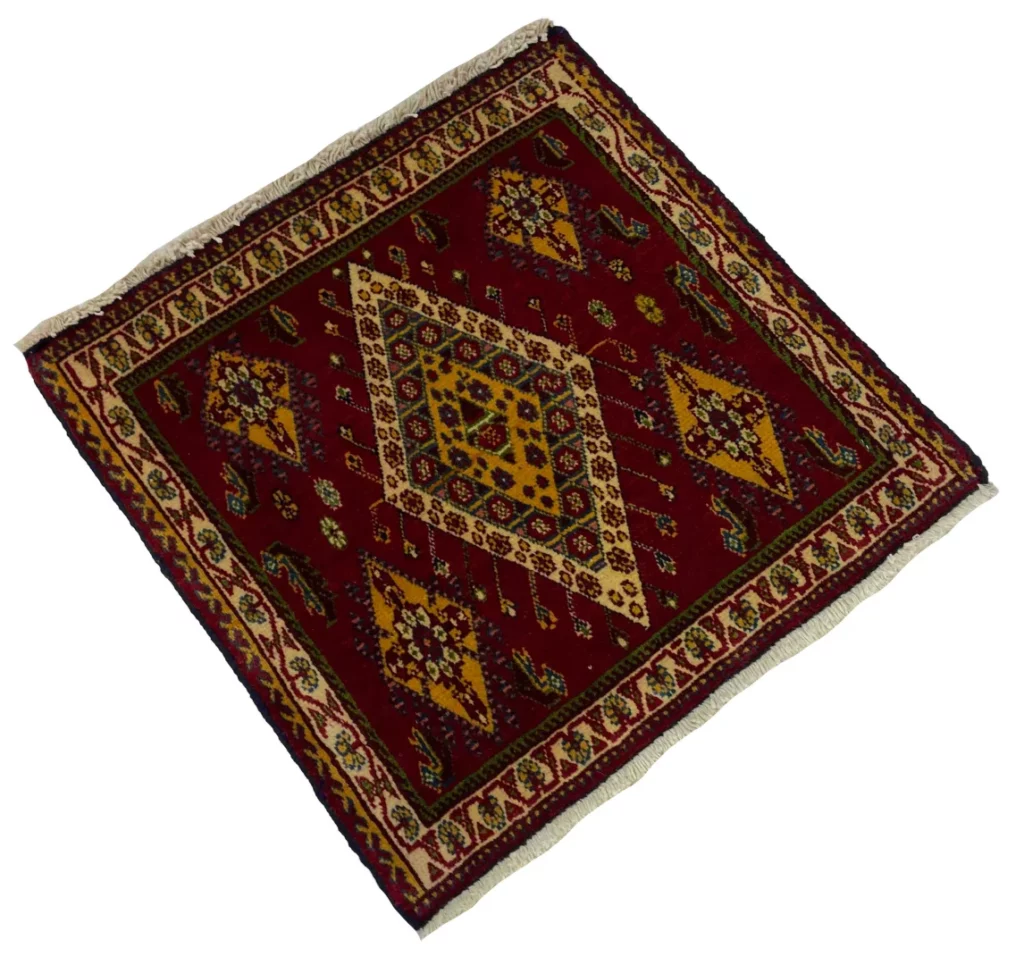
The pattern of this rug consists of geometric ornaments. Geometric design organises a surface through lines, angles, diamonds, hooked forms and recurring units. Such shapes may emphasise a centre, follow an axis or appear as a rhythm across the field. A clearly structured pattern can be built from individual knots while the rug is being made. At the same time, handwork allows small variations in line and spacing to arise from the process itself.
Geometric ornaments have an important place in the Ghashghai tradition. They may develop from simplified plant forms, animal references or abstract signs without retaining an immediately recognisable naturalistic image. Reducing a motif to outlines and areas makes it adaptable and allows it to appear in different compositions. The resulting visual language does not depend on pictorial representation. Repetition, contrast, balance and the relationship between larger shapes and smaller fillers are central to its effect.
Ghashghai rugs are often associated with vivid colour arrangements. Reds and browns are among the tones that frequently appear in this tradition and can give a composition a warm, connected appearance. The dyes are natural as well. Natural colourants are used in rug making to transform wool into nuanced tones. Depending on the fibre, the dyeing process and the handling of the wool, a colour can show subtle variation within a pattern. Colour is therefore not merely an addition to the ornament; it also helps make the geometric order legible.
A geometric pattern should not be understood as a completely rigid repetition. In a hand-knotted rug, the design is assembled knot by knot. Lines may shift slightly, intervals may change and individual ornaments may receive different visual weight. These qualities are part of the logic of handwork. They distinguish a hand-knotted composition from a printed or machine-reproduced surface in which every detail is repeated in exactly the same form.
The Southern Persian pattern tradition consequently combines decorative clarity with inherited signs and forms. An ornament may appear as a border element, within a central field or as a link between several areas. Repeated shapes establish rhythm, while changes of colour separate groups within the composition. A high knot density can generally support the differentiated rendering of such details. For this rug, the stated pattern is specifically “Geometric ornaments”; no individual motif or particular border design is named.
In an interior, geometric ornament can be read both as an independent drawing and as a structure that organises the visible surface. The clear forms do not rely on a naturalistic scene. Attention remains on the relationship between lines, colour fields and the hand-crafted execution. The combination of Ghashghai origin, natural wool and geometric ornament places this rug within the Southern Persian design tradition.
Special Features
The rug is new, hand-knotted and made as a one-off piece. Its knot density is between 180,000 and 250,000 knots per square metre. Natural wool is specified as its material. The wool is considered dirt-resistant and helps prevent dust and dirt from penetrating deeply into the fibres. Regular vacuuming and occasional beating are sufficient for routine care. For stains, mild cleaning agents and water may be used; professional rug cleaning is also recommended.
The compact square format, geometric ornamentation and Southern Persian origin define the stated characteristics of this rug. No signature, production year, detailed colour list or further information about the warp and weft is provided. Those details are therefore not added. The name Ghashghai here identifies the stated origin and tradition from Fars Province.
FAQ
How should I care for my Ghashghai Persian rug?
Regular vacuuming removes loose dust from the pile. The rug can also be gently beaten from time to time. If a stain occurs, mild cleaning agents and water are recommended. Treatment should be carried out carefully so that the wool and colours are not placed under unnecessary stress. Professional rug cleaning is suitable for a thorough or difficult cleaning. Natural wool is dirt-resistant and makes it harder for dust and dirt to move deeply into the fibres. Consistent, gentle care therefore helps preserve the surface and the freshness of this new rug.
What does the knot density of a Ghashghai rug indicate?
The knot density of this Ghashghai Persian rug is between 180,000 and 250,000 knots per square metre. It describes the number of knots within a defined area and therefore gives an indication of the fineness of the hand-knotted structure. A higher knot density generally means greater detail in the design and longer durability. It should nevertheless be considered together with the quality of the wool, the workmanship and the organisation of the pattern. With geometric ornaments, a closely set knot structure can help render contours and smaller elements clearly.
Where do the materials for Ghashghai rugs come from?
The materials for Ghashghai rugs come mainly from natural sources. The wool is obtained from sheep in the region and is known for its softness and durability. The dyes are also natural, which contributes to vivid and harmonious colours. Natural wool is specified as the material for this rug. Combining regional wool with inherited dyeing and knotting methods forms part of the craft foundation of the Ghashghai tradition. Material, origin and pattern are consequently connected parts of one textile practice rather than separate features.
To provide the best experiences, we use technologies like cookies to store and/or access device information. Consenting to these technologies will allow us to process data such as browsing behavior or unique IDs on this site. Not consenting or withdrawing consent, may adversely affect certain features and functions.
Functional Always active
The technical storage or access is strictly necessary for the legitimate purpose of enabling the use of a specific service explicitly requested by the subscriber or user, or for the sole purpose of carrying out the transmission of a communication over an electronic communications network.
Preferences
The technical storage or access is necessary for the legitimate purpose of storing preferences that are not requested by the subscriber or user.
Statistics
The technical storage or access that is used exclusively for statistical purposes.The technical storage or access that is used exclusively for anonymous statistical purposes. Without a subpoena, voluntary compliance on the part of your Internet Service Provider, or additional records from a third party, information stored or retrieved for this purpose alone cannot usually be used to identify you.
Marketing
The technical storage or access is required to create user profiles to send advertising, or to track the user on a website or across several websites for similar marketing purposes.
 SECURE PAYMENT
 SHIPPING PARTNERS


