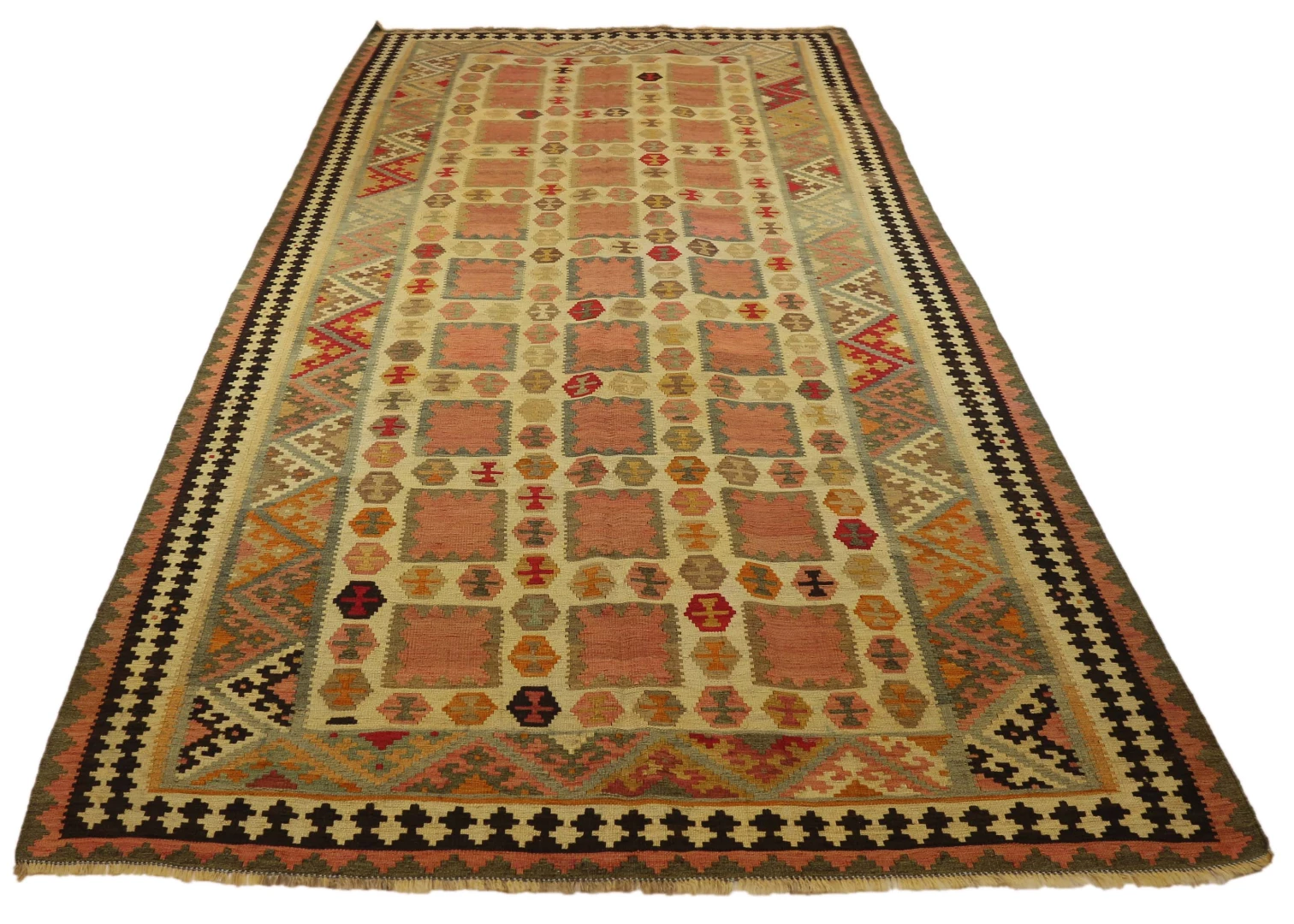
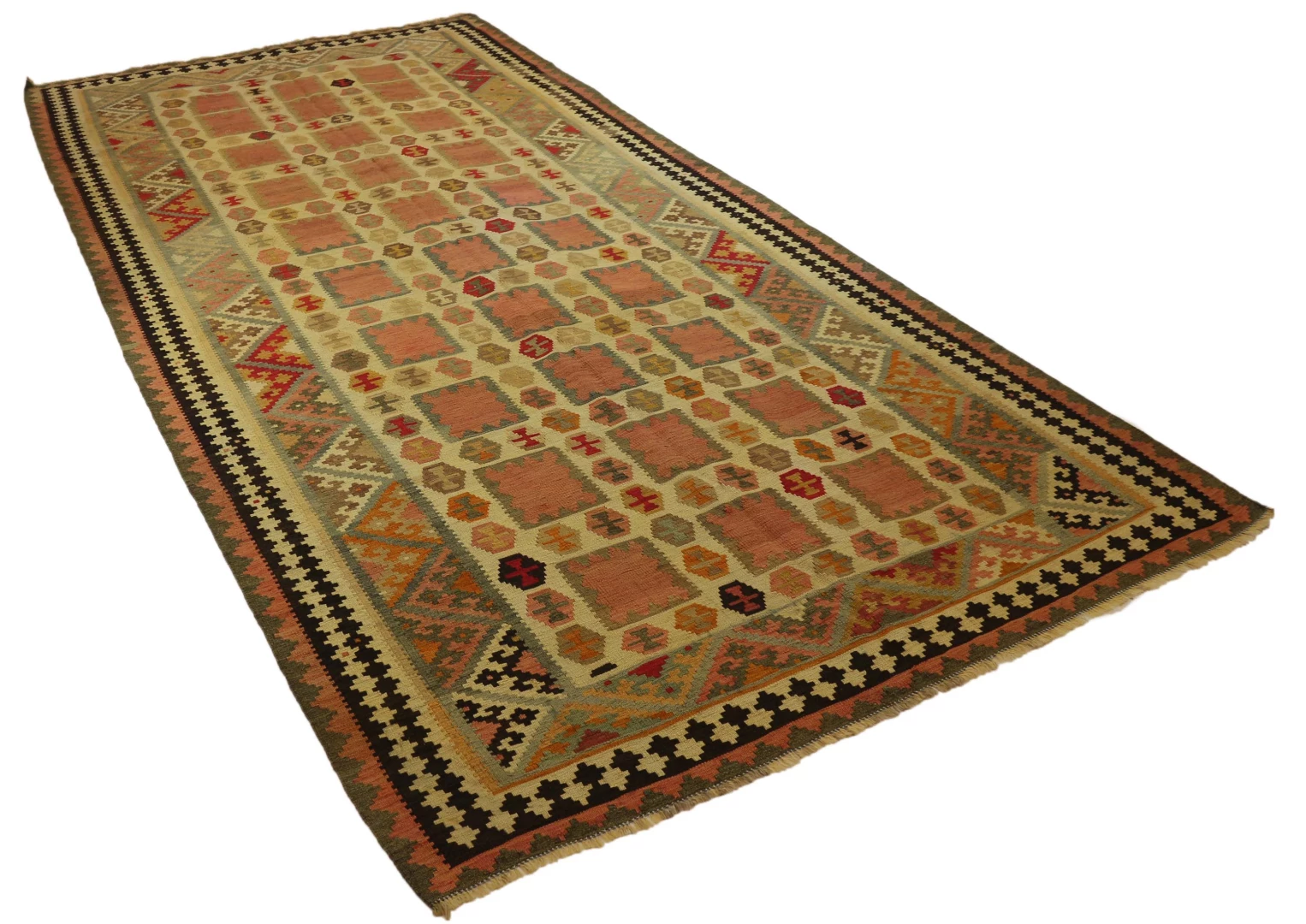
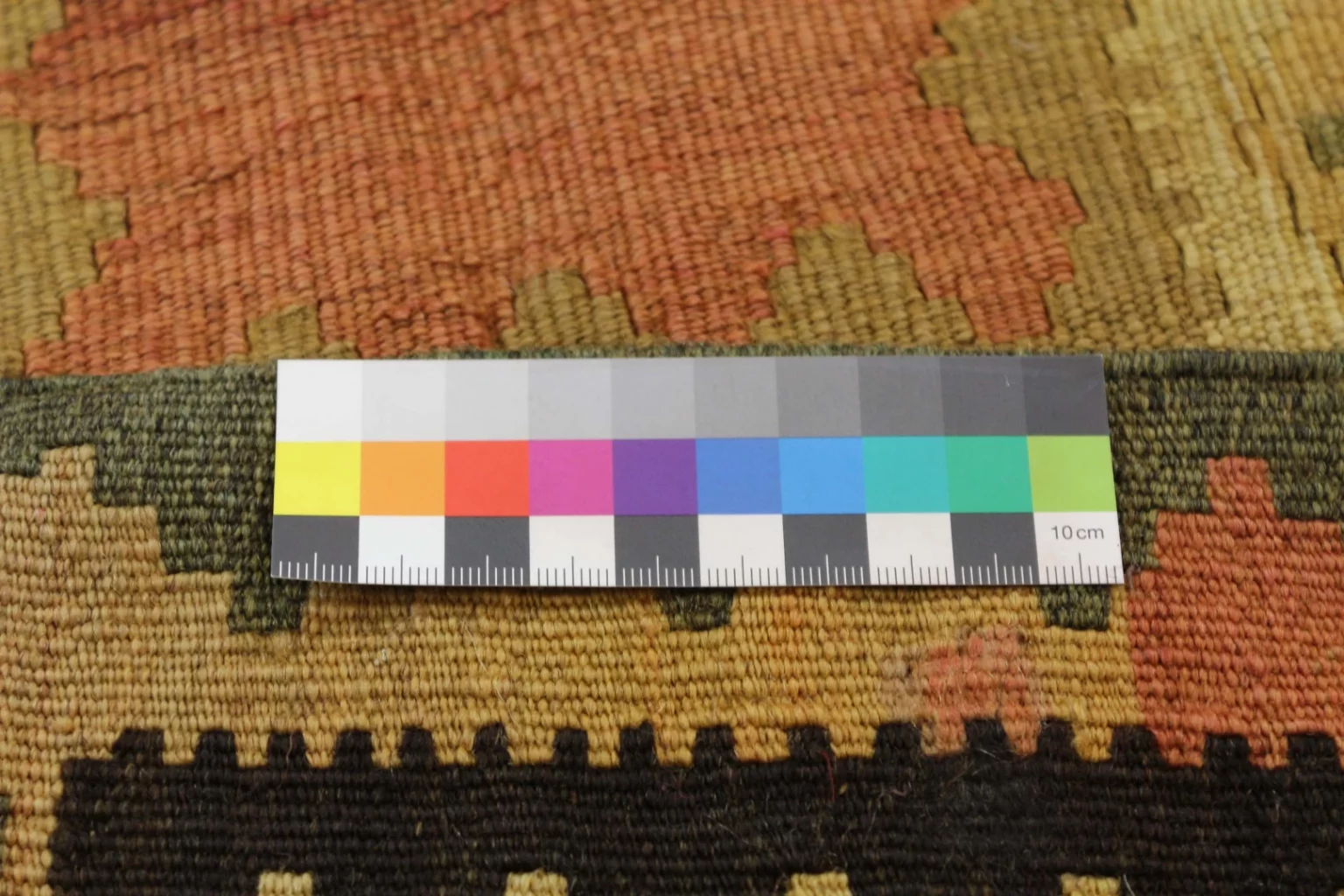
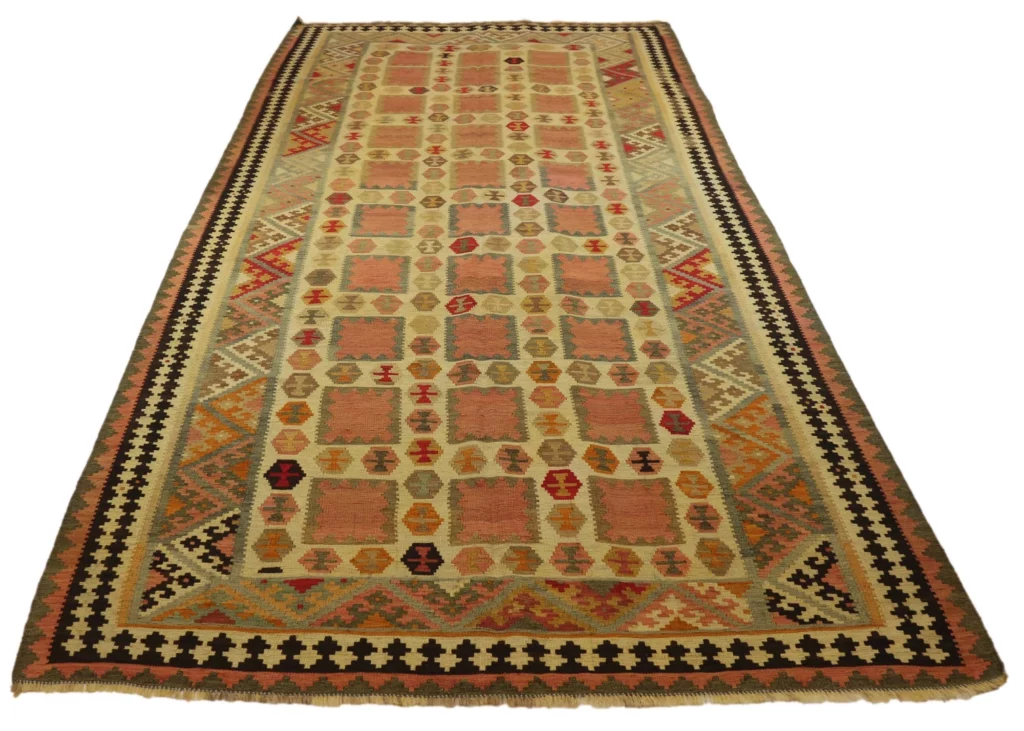
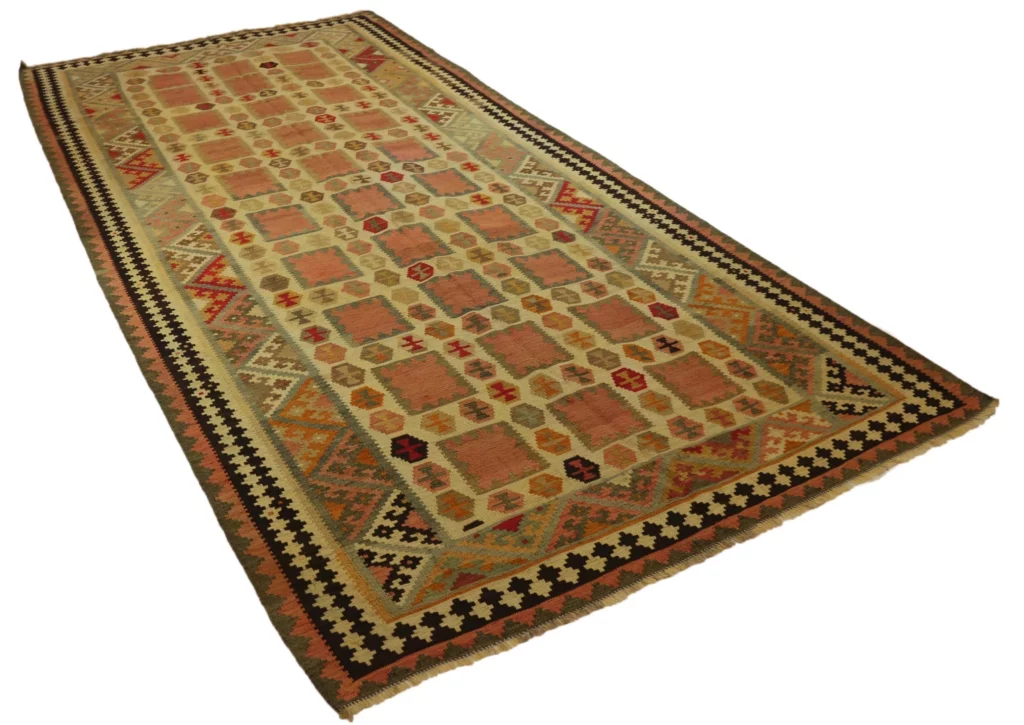
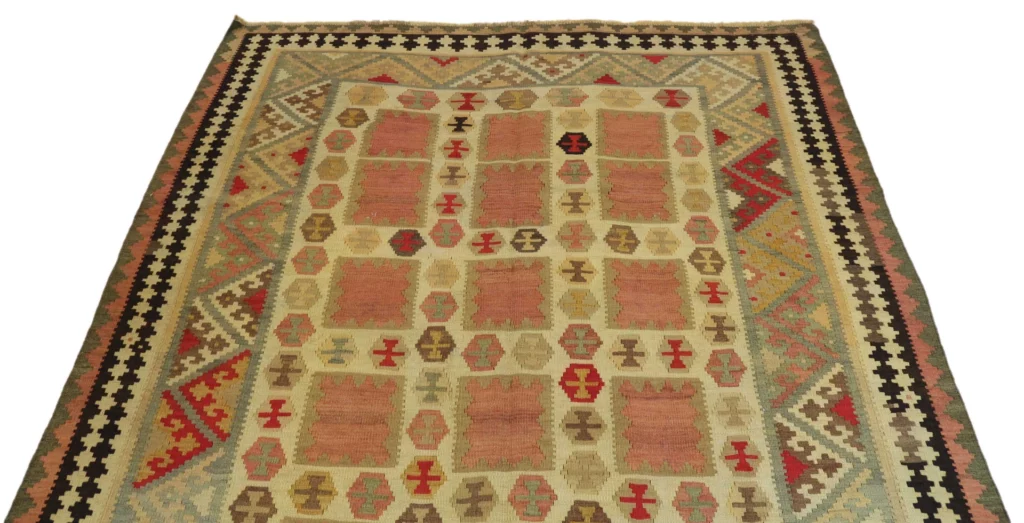
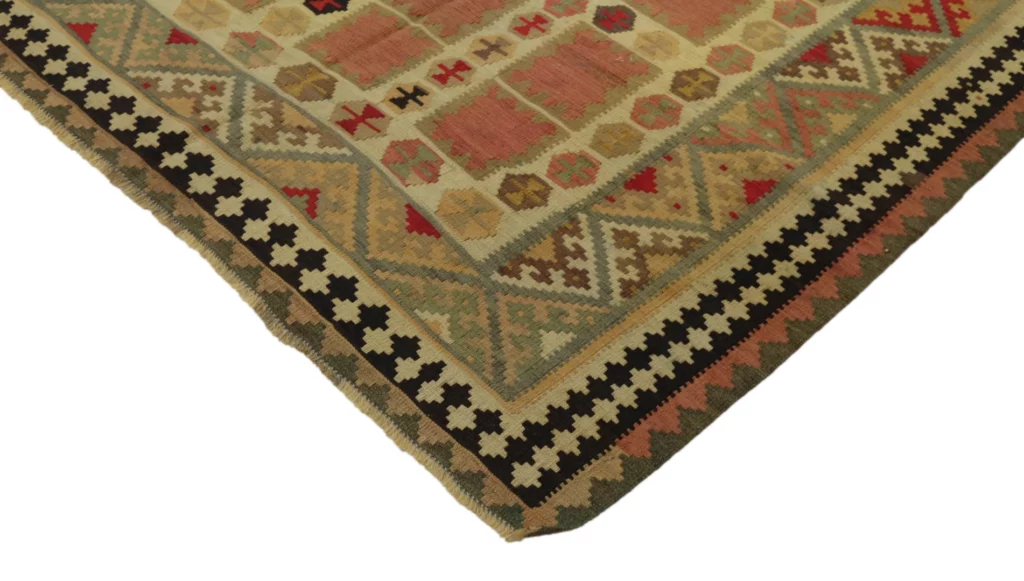
This Kelim from Fars is hand-woven and made of wool. A Kelim is constructed as a flat textile rather than as a pile rug formed from individual knots. The warp threads create the foundation, while coloured wefts are passed through them and compacted as the work progresses. The visible surface therefore comes directly from the weaving process, with its pattern and fields formed within the structure of the cloth.
Wool is a traditional material for many Oriental flatweaves. It can be spun, dyed and woven, and its natural fibre structure gives a Kelim a firm textile feel without a separate pile. Hand production means that every part of the textile results from successive operations at the loom. Preparing the yarn, keeping the warp under tension, placing the weft and pressing the rows together all contribute to the finished fabric.
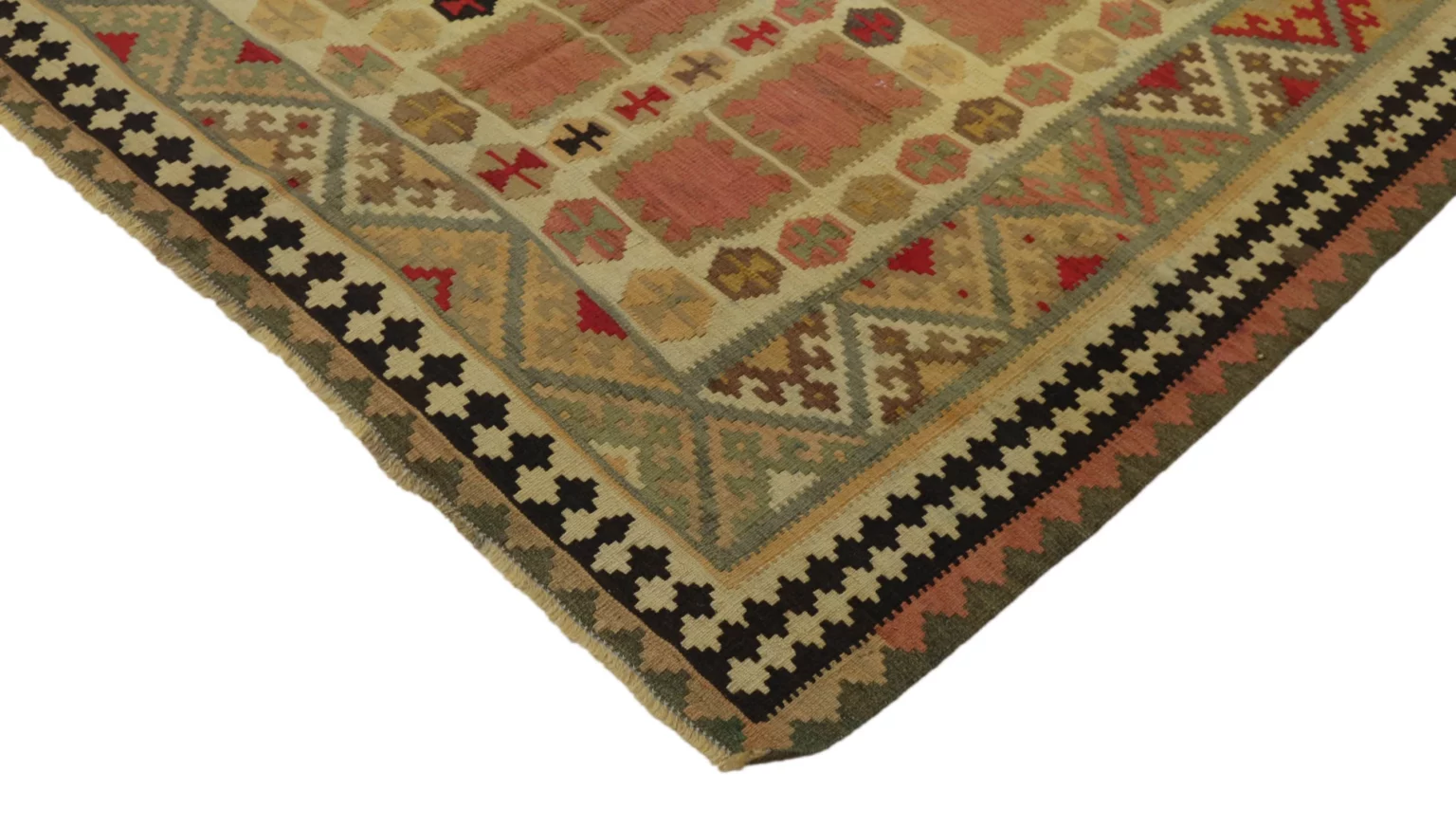
In weaving, the warp threads are first secured under tension on the loom. The weft is then carried across the warp from side to side. After each row, it is pushed against the preceding rows so that the textile becomes compact and stable. The way in which the threads are inserted, changed and arranged affects the formation of colour fields, outlines and repeated elements.
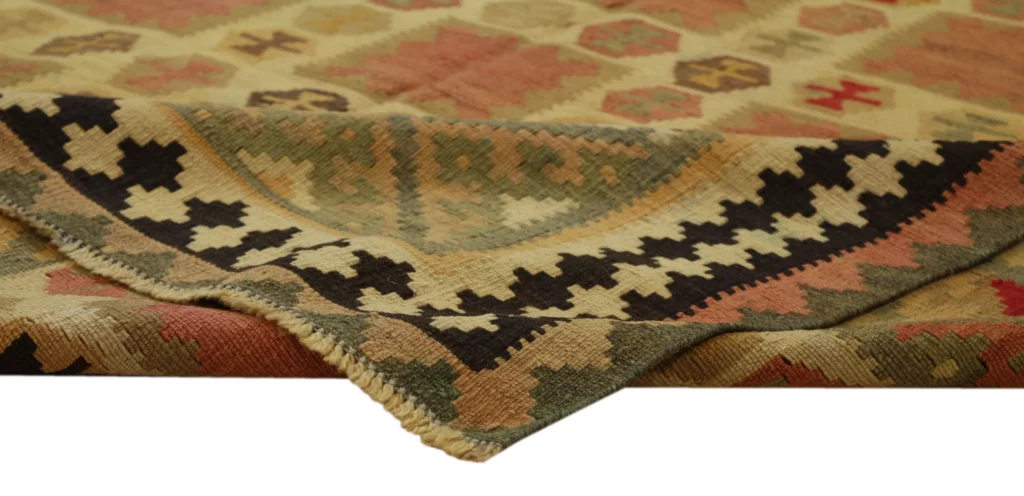
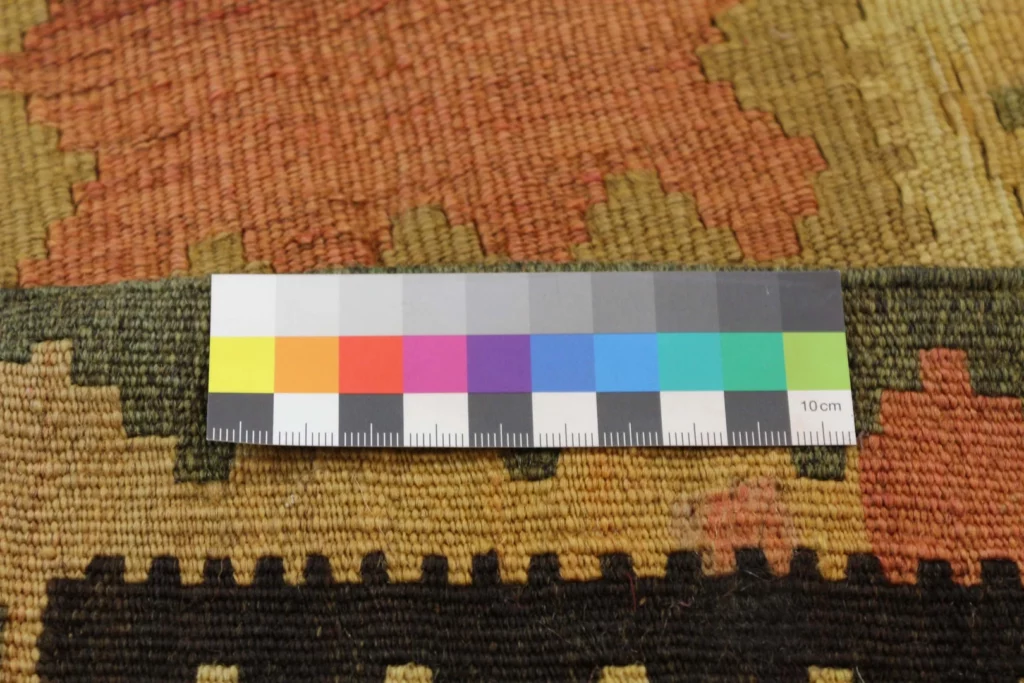
A hand-woven Kelim is fundamentally different from a hand-knotted rug. Knotting creates a pile from many individual knots, which may then be trimmed or levelled. In a Kelim, the surface remains flat because the weft is integrated into the woven structure. The construction is therefore directly legible in the textile and the decorative effect remains closely connected to the making of the fabric.
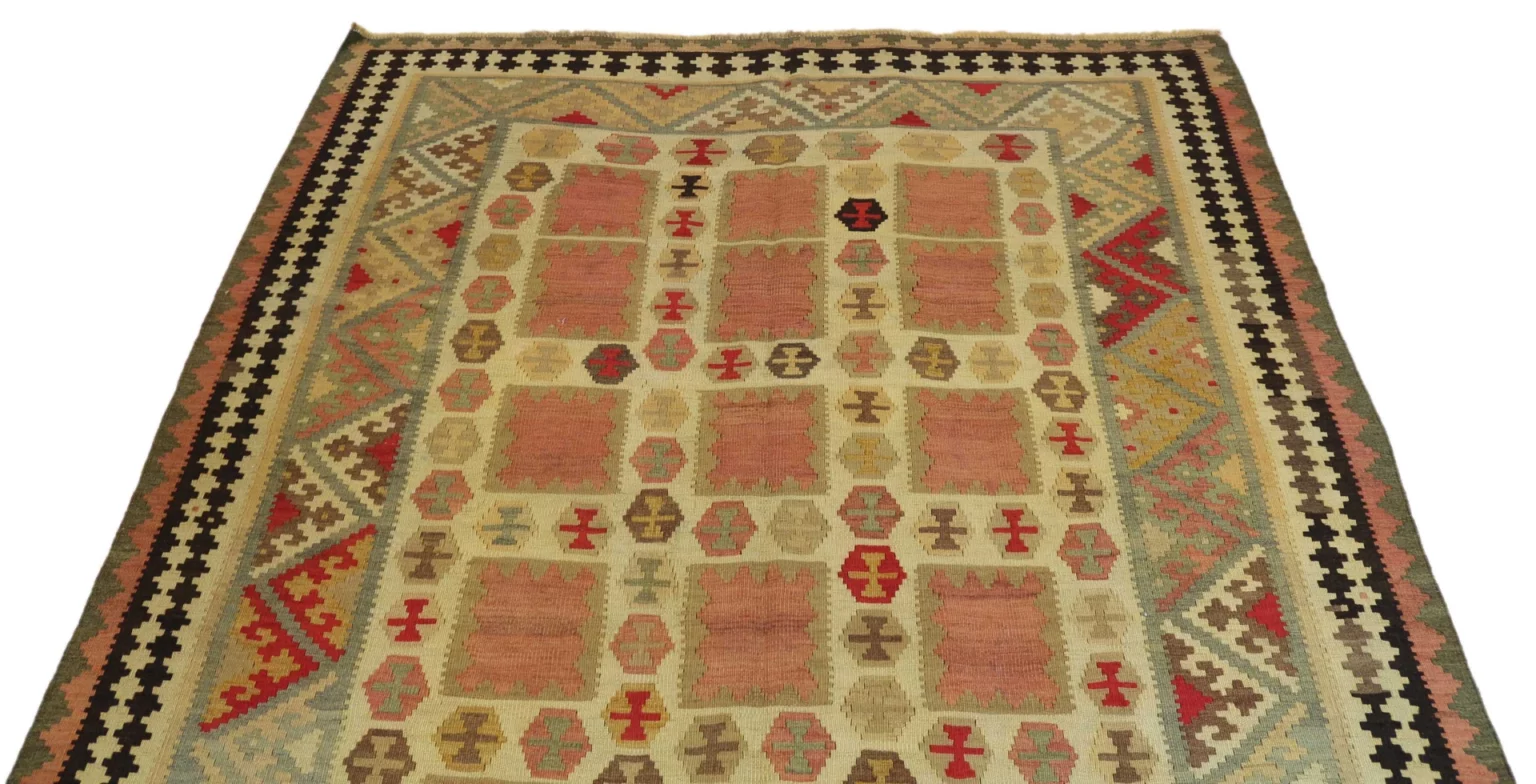
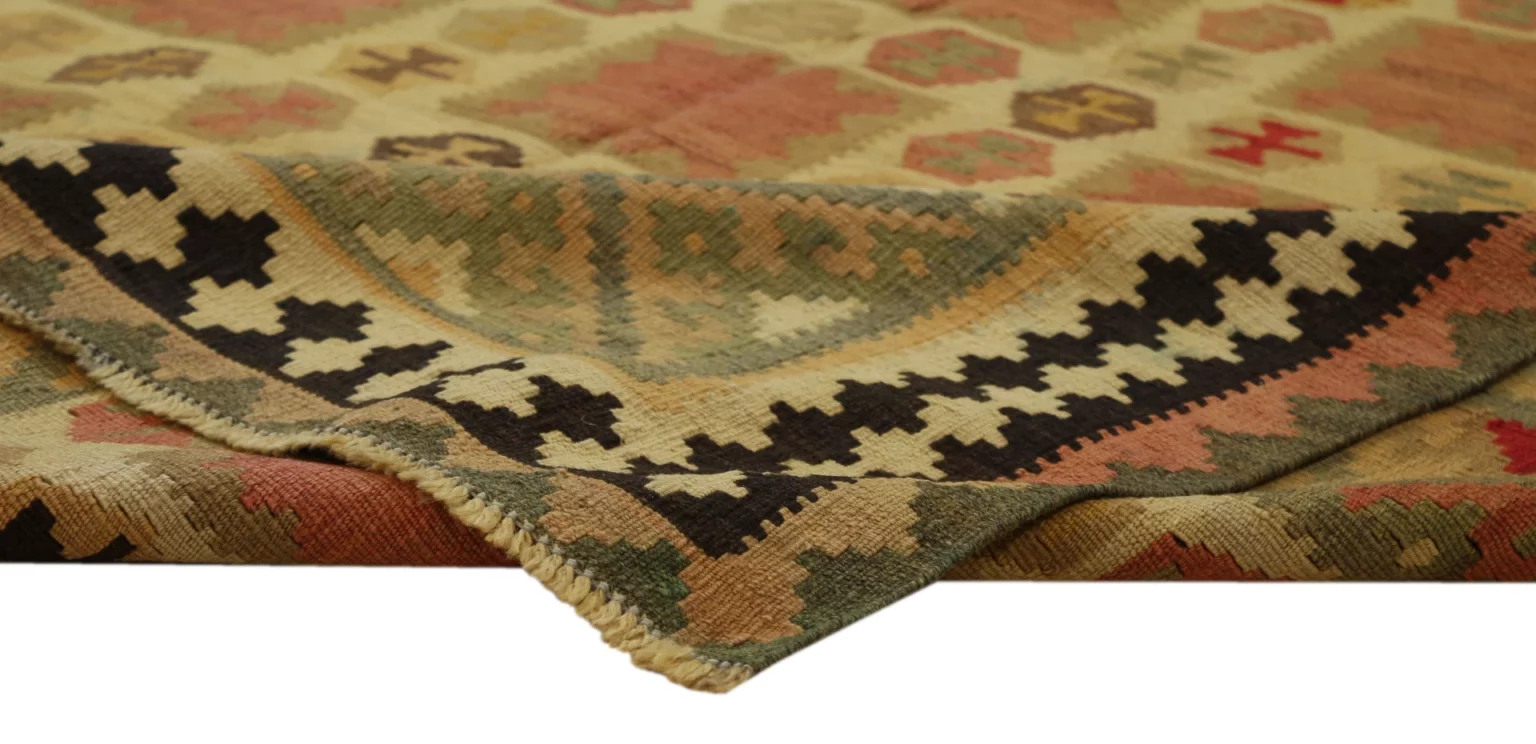
The pattern is identical on both sides. The Kelim can therefore be viewed and used from either side without a separate reverse design changing its described appearance. Its hand-woven construction and reversible pattern are specific features of this piece. The condition is very good.
Origin and Tradition
This Kelim comes from Fars in Iran. Fars is situated in the south of the country and is one of the regions where carpet making and flatweaving have long formed part of local textile practice. The province contains varied landscapes and ways of life. These different settings have supported a range of weaving methods, practical uses and approaches to design.
Fars has an established place within the history of Iranian textiles. The region has been associated with both pile rugs and flatwoven fabrics. Individual forms of work could respond to the needs of settled households as well as to the practical requirements of mobile communities. A Kelim was consequently not limited to decoration; it could serve several functions in everyday life.
Traditional flatweaves from Fars are made on looms where the warp is first stretched into place. Looms may differ according to local practice, but the interaction of warp and weft remains fundamental. The warp establishes the lengthwise framework, while the weft builds the visible surface. The weaver passes coloured threads through the warp and compacts them with a weaving comb.
Unlike a knotted rug, the visible textile surface is created directly while the weaving takes place. Changes in the path of the weft can establish outlines, stripes, fields and geometric forms. Colour changes are not painted onto the finished textile; they are introduced through the choice and placement of threads within the structure. The method permits efficient construction while allowing a design to be organised in considerable detail.
In rural and traditionally nomadic contexts of southern Iran, textiles were often produced for practical daily use. Kelims could serve as floor coverings, covers, dividers or wall hangings. Their flat construction makes them easier to fold and transport. At the same time, the compact woven surface gives them many possible uses in domestic settings. The term Kelim primarily identifies the flatweaving technique rather than one particular motif.
Producing a Kelim requires knowledge of wool preparation, warp setting and the sequence in which the wefts are inserted. These skills were traditionally transmitted through families and communities by working at the loom. The knowledge involved more than memorising a design: it also included maintaining tension, managing colour changes and keeping the woven rows compact. Finishing an edge and joining colour areas are further practical tasks within the process.
The wool had to be cleaned and spun into a suitable yarn before it could be woven. It could then be dyed and sorted by colour. Natural dyes played an important role in the history of Iranian textiles, although the available colours and procedures varied according to local resources and knowledge. The prepared threads were arranged so that individual rows became connected fields and motifs as the weaving advanced.
Fars is part of a broad Iranian textile culture with considerable local variation. Depending on regional practice, woven pieces may differ in construction, colour arrangement and visual vocabulary. Regional identification is therefore understood through the relationship between material, technique and design. This Kelim is offered as a piece from Fars in Iran. That origin identifies its region; it does not turn a pattern reference into a claim of origin from another carpet-producing area.
Craft knowledge is traditionally passed on through practical work at the loom. Preparing the wool, arranging the warp, distributing colour and compacting the weft are learned through repeated making. Small differences in working method can produce individual transitions and a distinct textile surface. In a one-off hand-woven piece, the connection between regional practice and its particular execution remains part of the object.
Design and Pattern
The stated design feature is that the pattern is identical on both sides. This sets the Kelim apart from textiles designed with one clearly differentiated front and back. It may be turned over while retaining the same described appearance. The visual effect therefore does not depend on a specially finished decorative reverse, but on a pattern carried through the woven construction.
Kelim designs are not painted onto a completed surface. They are created by arranging coloured wefts within the textile as it is woven. Geometric fields, lines, bands and repeated signs can be built by changing colours and modifying the path of the weft. Diagonal lines and stepped outlines are also possible within flatweaving. These forms arise from the structure of the fabric itself and remain connected to the order of the woven rows.
The weaving traditions of Fars form part of a broader Iranian design history. Regional flatweaves may include references to the household, stylised plant forms, geometric symbols or broad areas of colour. In a Kelim, a motif is often simplified and arranged rhythmically so that it can be constructed clearly during weaving. The design depends on the relationship between field, repetition, outline and colour rather than on ornament applied afterwards.
Geometric design is particularly compatible with many flatweaving methods because it can be developed through the sequence of warp and weft. A pattern may gain a regular order through repetition, or a more varied structure through changes in the width and direction of colour fields. Lines can mark boundaries, while larger fields organise the composition. The weaving technique also influences how finely a contour can be rendered and how a transition between colours appears.
A Kelim is consequently read differently from a finely knotted rug with a raised pile. Its flat surface places lines and colour changes directly beside one another. From a distance, the overall order and larger fields are generally most apparent; closer viewing reveals the textile structure and the individual weft rows. The identical design on both sides reinforces a clear composition carried by the fabric itself.
Iranian weaving may also connect motifs with domestic surroundings and the intended use of a textile. Simplified plants, stars, diamonds, bands and other signs are not always represented naturalistically; they are adapted to a woven order. In a Kelim, the effect comes from the repetition of forms and the relationship between different colour areas. A precise motif name should nevertheless only be used when it is specifically given for the individual piece.
Here, Persian Rug identifies the Iranian origin, while Kelim identifies the method of manufacture. The distinction matters: a Kelim is a hand-woven flat textile, not a knotted pile rug. Its design is therefore considered through weaving technique, material and the organisation of the pattern. For this piece, the specific pattern information is that both sides are identical; no additional motif name is assigned.
Special Features
The notable features of this piece are its hand-woven construction, its wool material and its identical pattern on both sides. These qualities allow the Kelim to be used not only as a rug but also as a textile wall hanging. Its flat structure is suitable for a presentation in which the weaving and the arrangement of the pattern remain visible. The Kelim is offered in very good condition.
The reversible design broadens the ways in which the textile can be displayed. Depending on the room and the intended setting, it can be considered as a floor covering or as a decorative wall hanging. Its classification as a Kelim also makes clear that the surface is produced by weaving. It is not a hand-knotted pile rug, but a hand-woven wool textile from Fars.
A wall hanging makes particularly clear that a Kelim need not be understood only as a floor covering. Its flat textile construction can be presented vertically while the pattern remains visible as a continuous surface. The identical execution on both sides is useful in this context because the decorative effect does not depend on a specially designated front. The woven structure remains part of what can be seen.
FAQ
How is this Kelim made?
This Kelim is woven by hand. Weft threads are passed through a stretched warp and compacted until a continuous flat textile is formed. The pattern develops during this process through the arrangement and changes of the weft threads. Unlike a hand-knotted rug, it does not have a pile made from individual knots. This Kelim is made of wool and has an identical pattern on both sides.
Where does this Persian Rug come from?
The Kelim comes from Fars in Iran. Fars has an established regional tradition of producing carpets and flatwoven textiles. The Iranian origin and the hand-woven Kelim technique are central details of this piece. Persian Rug refers here to its Iranian origin, while the precise construction is a hand-woven wool Kelim.
Can the Kelim be used as a wall hanging?
Yes. A flat-woven wool Kelim can be used both as a rug and as a wall hanging. The pattern on this piece is identical on both sides, so its design remains the same when viewed from either side in a hanging presentation. The hand-woven structure stays visible as an important textile feature. This Kelim is in very good condition.
To provide the best experiences, we use technologies like cookies to store and/or access device information. Consenting to these technologies will allow us to process data such as browsing behavior or unique IDs on this site. Not consenting or withdrawing consent, may adversely affect certain features and functions.
Functional Always active
The technical storage or access is strictly necessary for the legitimate purpose of enabling the use of a specific service explicitly requested by the subscriber or user, or for the sole purpose of carrying out the transmission of a communication over an electronic communications network.
Preferences
The technical storage or access is necessary for the legitimate purpose of storing preferences that are not requested by the subscriber or user.
Statistics
The technical storage or access that is used exclusively for statistical purposes.The technical storage or access that is used exclusively for anonymous statistical purposes. Without a subpoena, voluntary compliance on the part of your Internet Service Provider, or additional records from a third party, information stored or retrieved for this purpose alone cannot usually be used to identify you.
Marketing
The technical storage or access is required to create user profiles to send advertising, or to track the user on a website or across several websites for similar marketing purposes.

 SECURE PAYMENT
 SHIPPING PARTNERS


