
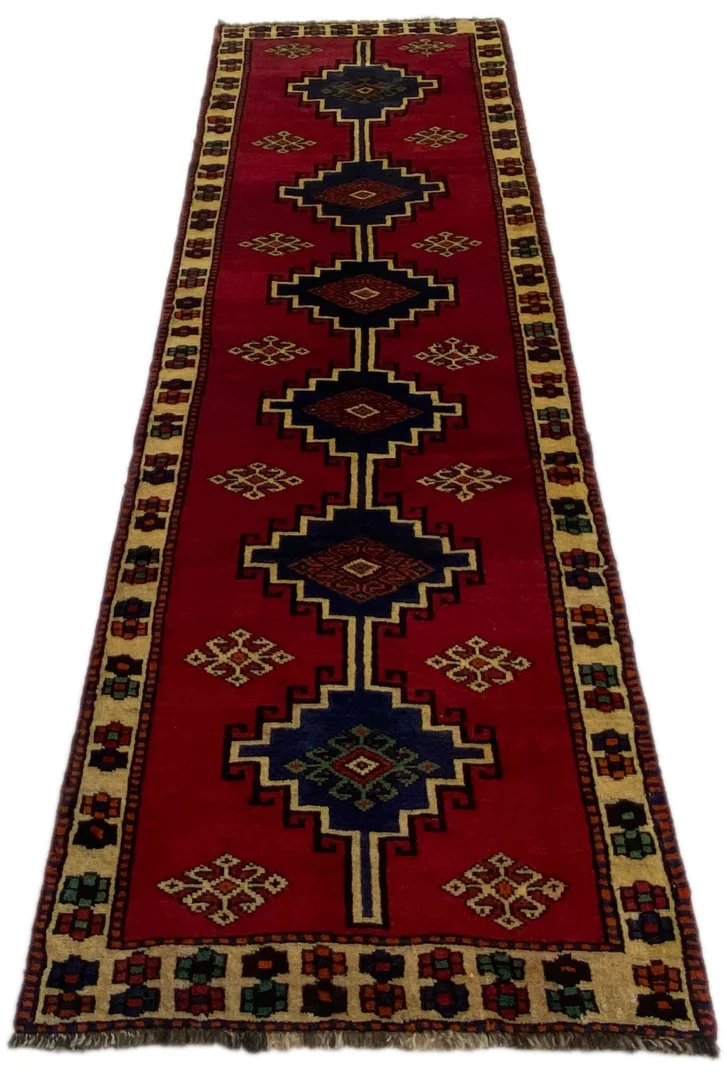
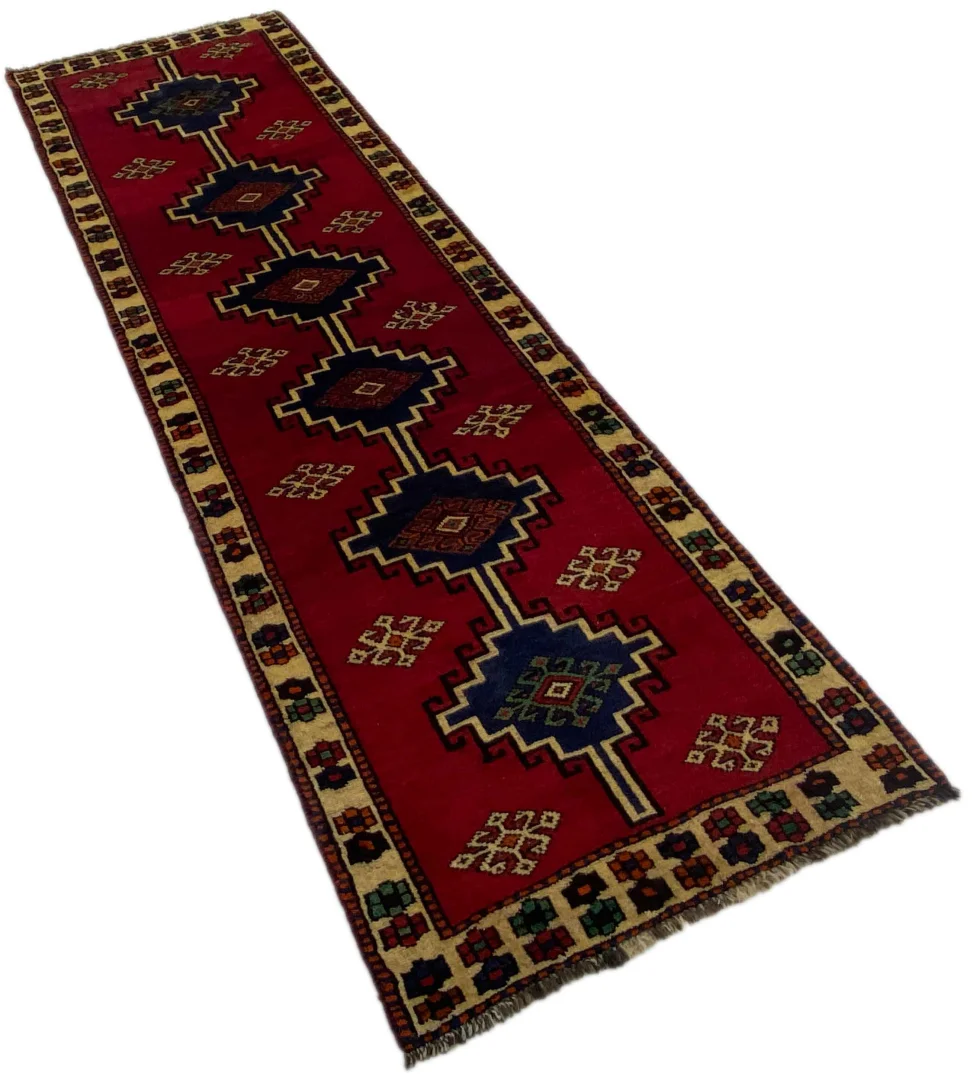
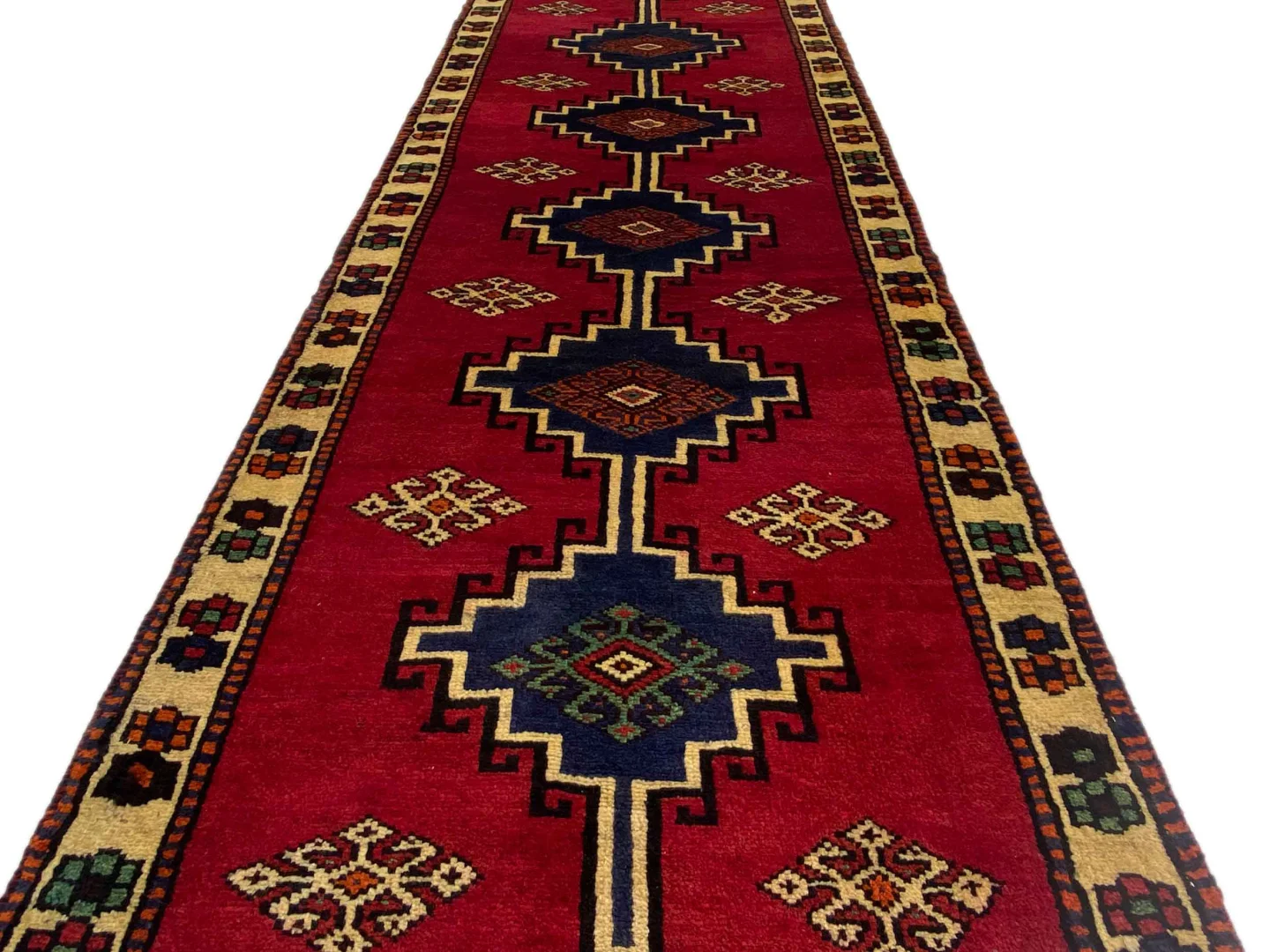
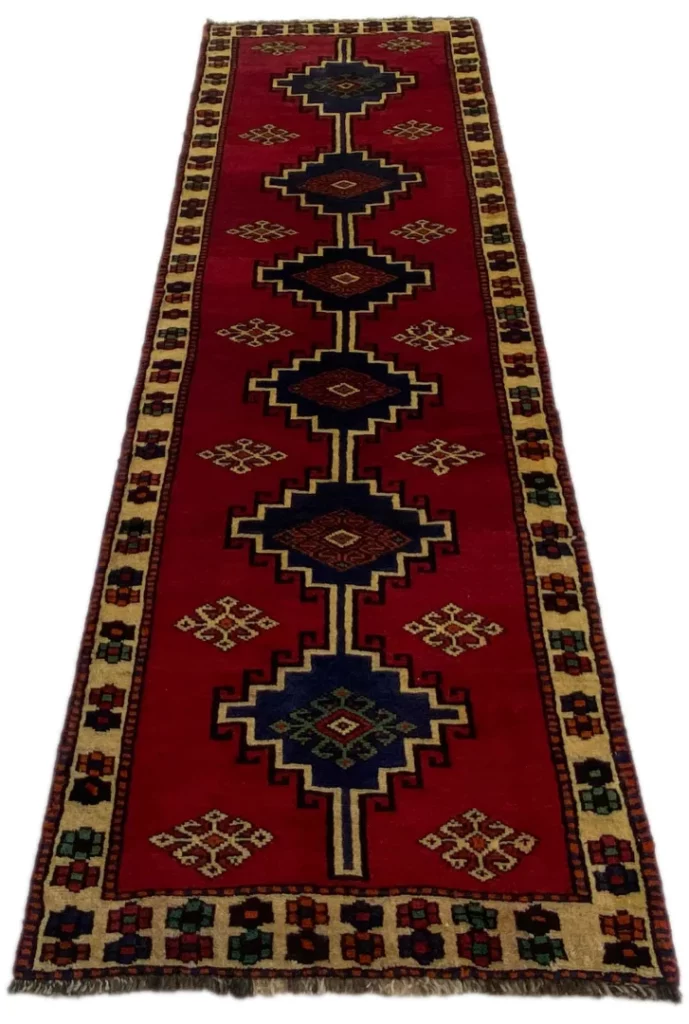
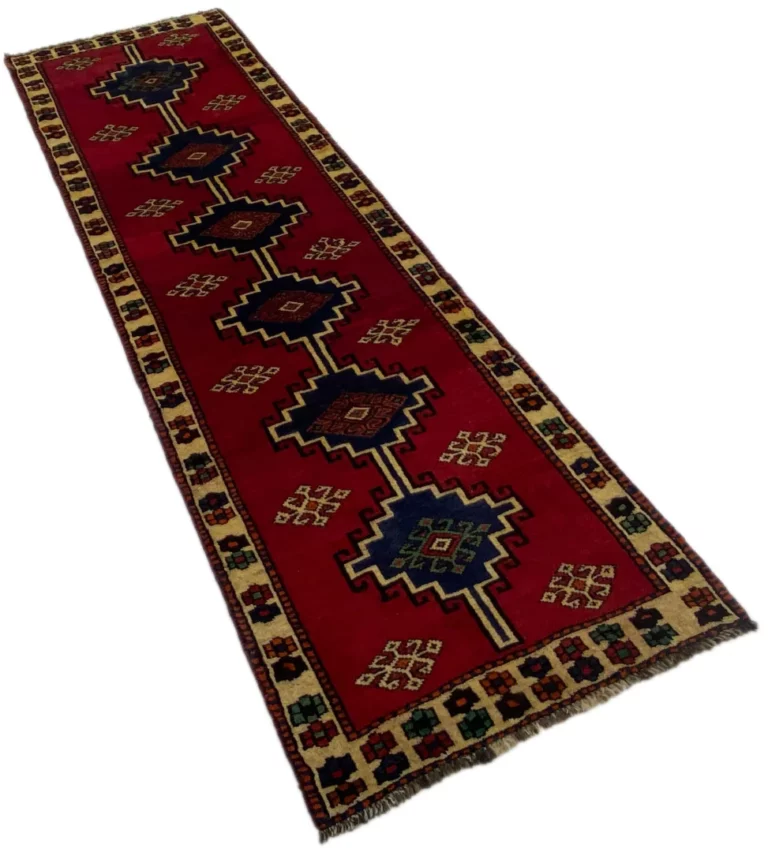
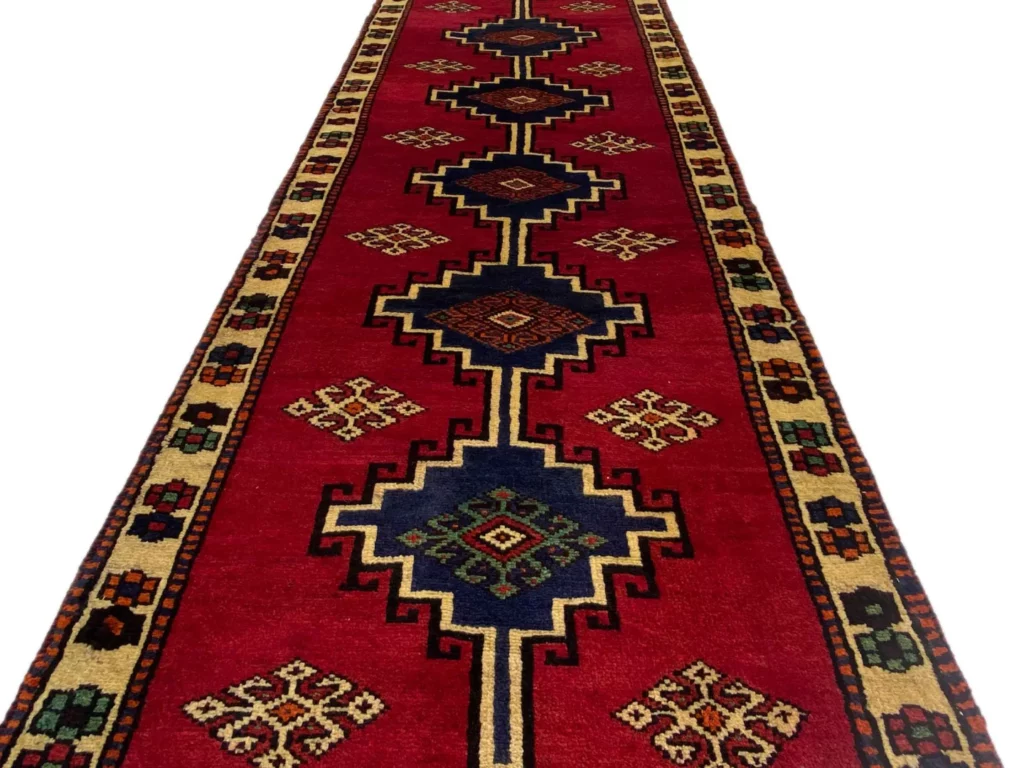
Persian Rug Fars 290 x 90 cm Wool Hand-knotted
€ 799
Hand-knotted Fars Persian Rug | Knot density: 90,000 – 180,000 knots/m² | Material: Pile pure new wool | Size: 290 x 90 cm | Pattern: Imaginative old nomadic designs | Condition: New
1 available
- ✓Free Shipping in EU
- ✓2-5 Business Days Delivery
- ✓14-Day Return Policy
- ✓Worldwide Shipping on request
 SECURE PAYMENT
 SHIPPING PARTNERS
Inventory number: 53082723
Description
Gabbeh Fars Persian Rug
Material and Craftsmanship
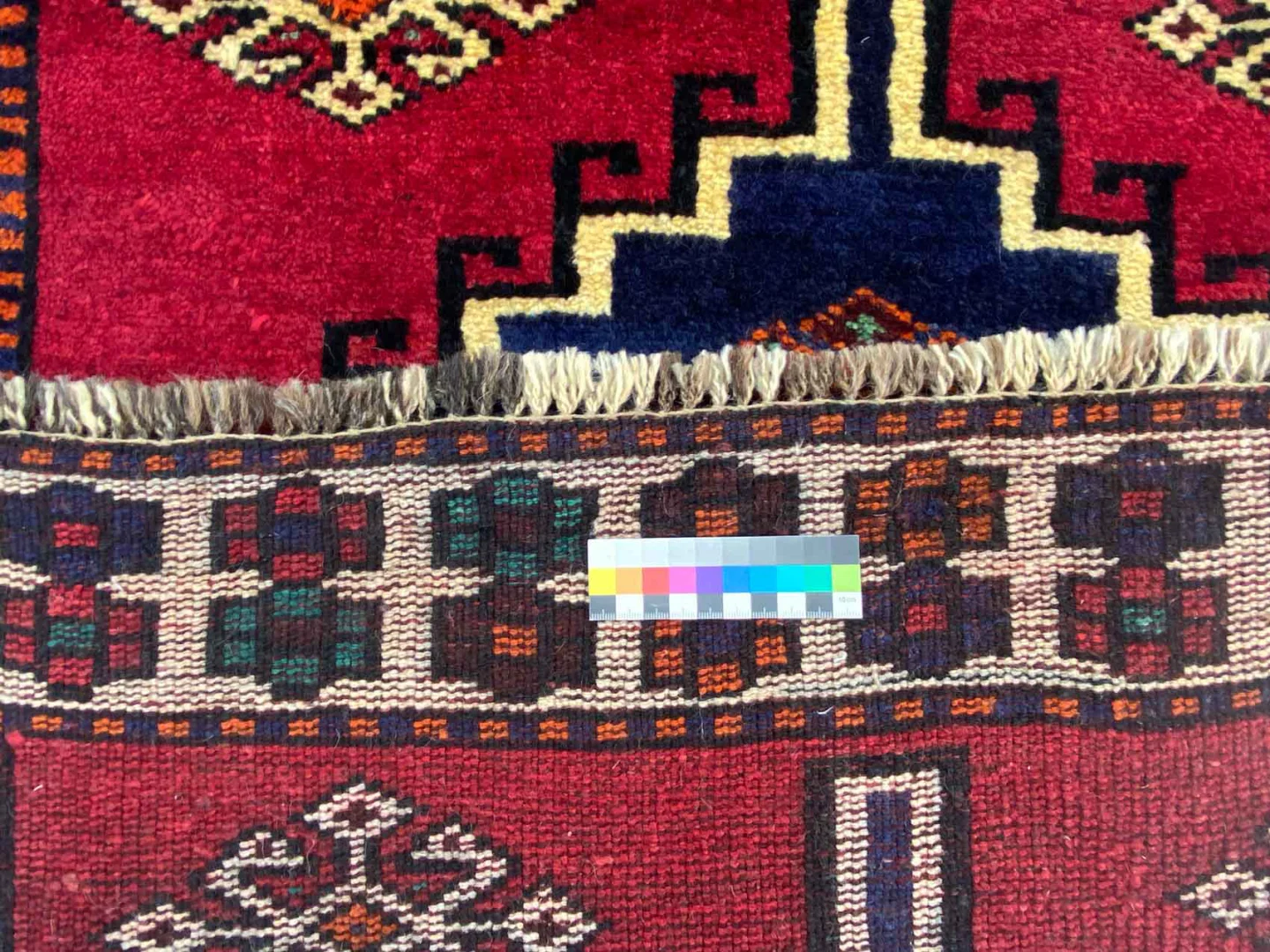
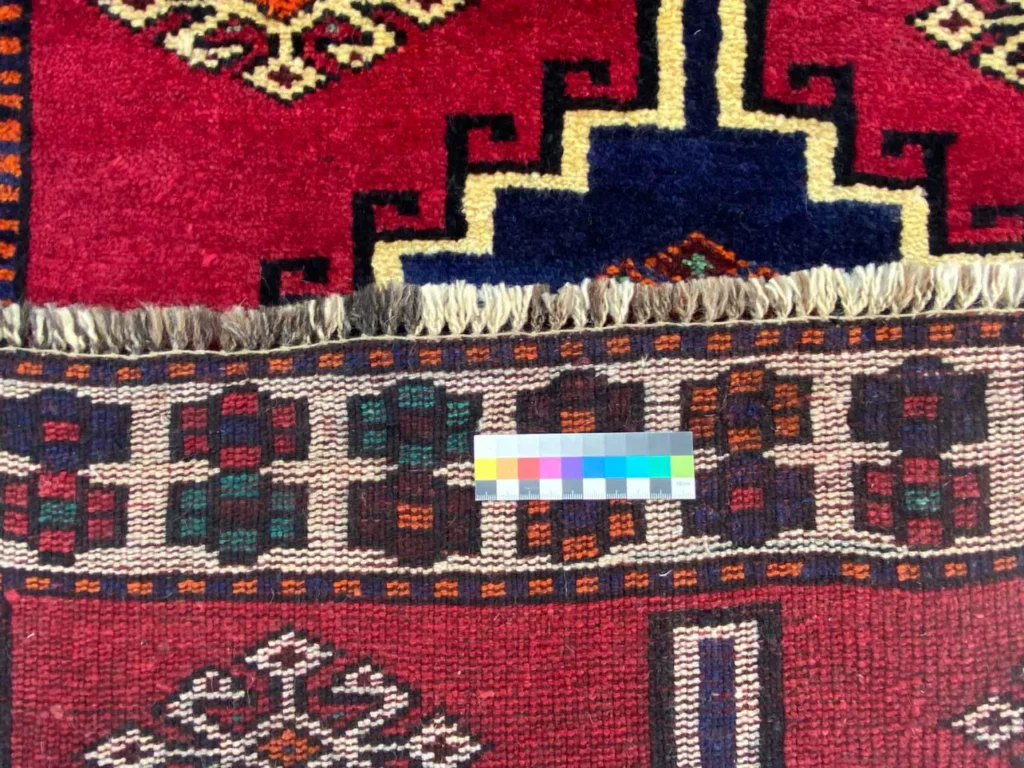
This Gabbeh – Shuli Persian rug is made from high-quality new wool and is hand-knotted. Wool forms the pile material and gives the rug the tactile, rustic character associated with Gabbeh weaving. New wool has long been used in hand-knotted rugs because it can be formed into a durable pile and accepts colour well. In a hand-knotted rug, each knot is placed individually as the design is built up. The pattern is therefore created through manual work rather than mechanically repeated.
The knot density of this rug is between 90,000 and 180,000 knots per square metre. Knot density indicates how many individual knots are worked into a defined area. It can influence the fineness of outlines, the treatment of colour fields and the visible structure of the pile. In Gabbeh – Shuli weaving, this technical aspect is combined with imaginative designs that are developed freely by the weavers.
The making of Gabbeh rugs belongs to a nomadic-influenced weaving tradition. New wool and manual knotting provide the basis for a rug that can function as a floor covering as well as a textile element within an interior. This particular rug is described as new. No information is provided about a separate warp material, so no additional warp claim is made.
Origin and Tradition
The Gabbeh – Shuli comes from the Fars region in southern Iran, Persia, near the historic city of Shiraz. Fars is one of the important landscapes in Persian carpet culture. The region is associated with both nomadic and settled communities whose textile traditions have been passed down over generations. Gabbeh weaving developed within this setting. Its appearance is shaped more by direct expression and individual craftsmanship than by the fixed courtly designs found in some other Persian rug traditions.
Gabbeh rugs are commonly associated with the nomadic culture of Fars. In carpet terminology, Gabbeh refers to a group of hand-knotted rugs traditionally distinguished by expressive and often deliberately free designs. There is no single compulsory pattern scheme. Designs may use simple fields, figures, stylised forms or compositions that appear to have grown directly from the act of weaving. This openness is part of the Gabbeh tradition and explains why individual pieces can differ noticeably from one another.
The connection with Shiraz places the rug within the cultural landscape of southern Fars. Shiraz has historically been a centre of the region and is associated with trade, craft and Persian art. The weaving traditions of Fars are not confined to one city, however. Nomadic weavers worked across different areas and brought their own ideas about colour, form and arrangement to their rugs. The Gabbeh – Shuli designation combines this regional origin with the Shuli expression of the Gabbeh tradition.
Persian rugs from different regions have their own structures, pattern languages and methods of execution. Tabriz rugs, for example, are known for fine designs and often high knot densities, and are frequently associated with floral motifs. Isfahan rugs often feature complex compositions and high knot densities. Nain and Kashan rugs also come from Iran and represent further traditional directions. These examples belong to the wider history of Persian carpets, but they are not the origin designation of this Gabbeh – Shuli rug.
Fars itself includes several carpet traditions. Gabbeh – Fars shares related characteristics and also belongs to the regional weaving context. The name Shuli identifies the particular Gabbeh expression presented here. Fars provides the historical and geographical framework, while the freely imagined design gives each rug its individual visual identity.
Design and Pattern
This Gabbeh – Shuli is described as having imaginative, old nomadic designs. The patterns are freely invented rather than being modern decorative layouts planned according to a strict repeat. Such freedom is a central feature of the Gabbeh tradition. It allows for simplified figures, unexpected arrangements and a direct visual language shaped by the hands of the weaver. Each piece can therefore develop its own character.
The Gabbeh pattern world ranges from quiet fields to lively compositions divided by forms and colour. Nomadic-influenced motifs are often not rendered naturalistically but reduced to strong, recognisable shapes. A figure may be expressed with only a few lines, while a recurring sign may grow from a simple geometric foundation. This reduction is not an absence of detail; it is a distinct way of translating imagery into wool.
The colours named for Gabbeh – Shuli include strong reds, soft beiges, restrained greys and warm brown nuances. These colour groups may be arranged in fields, figures and transitions. Red adds intensity, beige creates lighter areas, grey introduces a quieter note and brown connects the composition with the warm, natural character of wool. Together, these tones support the rustic impression associated with the old nomadic designs.
The free approach distinguishes Gabbeh – Shuli from rugs whose designs depend on finely drawn floral scrolls or repeated symmetrical ornament. A free pattern is not without structure. The weaver still makes deliberate decisions about the distribution of shapes and colours across the rug. That order is achieved with greater personal freedom than in a strictly prescribed design. The result is a composition that does not look like an identical printed repeat.
Persian carpet culture includes many pattern traditions. Floral drawings, medallions, scrolling vines, geometric borders and figurative signs are used differently according to region and rug type. Tabriz may be associated with floral motifs and fine detail, while Isfahan often presents complex pattern systems. Nain and Kashan likewise have their own traditional forms. Gabbeh – Shuli follows the freer, old nomadic visual language connected with Fars.
The colours and patterns allow the rug to work as a textile accent in different living areas. The source describes possible use as a colourful accent in a living room, as a runner in a hallway or as a stylish element in a bedroom. Its role depends on the relationship between the imaginative composition and the surrounding interior. It can provide contrast or pick up warm tones already present in the room.
Special Features
The Gabbeh – Shuli combines its Fars origin with hand-knotted construction, new wool and imaginative old nomadic designs. Its stated knot density of 90,000 to 180,000 knots per square metre is one of its defining details. The described colour range includes strong reds, soft beiges, subtle greys and warm browns. The condition is new. As a Gabbeh Persian rug, it brings together practical use, regional tradition and freely developed design.
Its individual appearance results from the interaction of material, handwork, knot density and pattern. Because the designs are described as freely invented rather than identical modern series motifs, each Gabbeh – Shuli has its own composition. The rug can consequently be viewed both as a functional floor covering and as a piece of textile craftsmanship.
FAQ
How should I care for my Gabbeh – Shuli rug?
Vacuum the rug regularly and protect it from direct sunlight. Treat spills promptly with a damp cloth and a mild cleaning product. For heavier soiling, professional carpet cleaning is recommended. Cleaning should be carried out gently so that the new wool and hand-knotted structure are treated with care.
Are Gabbeh – Shuli rugs suitable for underfloor heating?
Gabbeh – Shuli rugs are generally suitable for underfloor heating because they are made from natural materials that conduct warmth well. The temperature should not be set too high, however, in order to avoid damaging the wool. Moderate, even heat is the gentler choice for the material.
Could a Gabbeh – Shuli rug trigger allergies?
The rug is made from pure new wool, which is generally considered hypoallergenic. Some people can nevertheless be sensitive to wool. Anyone concerned about such a sensitivity should test the rug in a shop before purchase to make sure that no allergic reaction occurs.
Additional information
| Design Style | |
|---|---|
| Color | |
| Size | |
| Shape | |
| Origin | |
| Knot Density | |
| Material |
Related products

Oriental Rug Kelim 240 x 180 cm Wool Hand-woven
€ 2249
Persian Rug Gabbeh 250 x 180 cm Cashmere Hand-knotted
€ 1118
Persian Rug Tabriz approx. 350 x 245 cm Wool Hand-knotted
€ 1280
Persian Rug Qashqai 286 x 192 cm Wool Hand-woven
€ 944
Persian Rug Tabriz 388 x 295 cm Wool Hand-knotted
€ 1440
Persian Rug Qashqai 293 x 198 cm Wool Hand-woven
€ 798
Persian Rug Fars 292 x 206 cm Wool Hand-woven
€ 798
Persian Rug Qashqai 300 x 197 cm Wool Hand-woven
€ 798