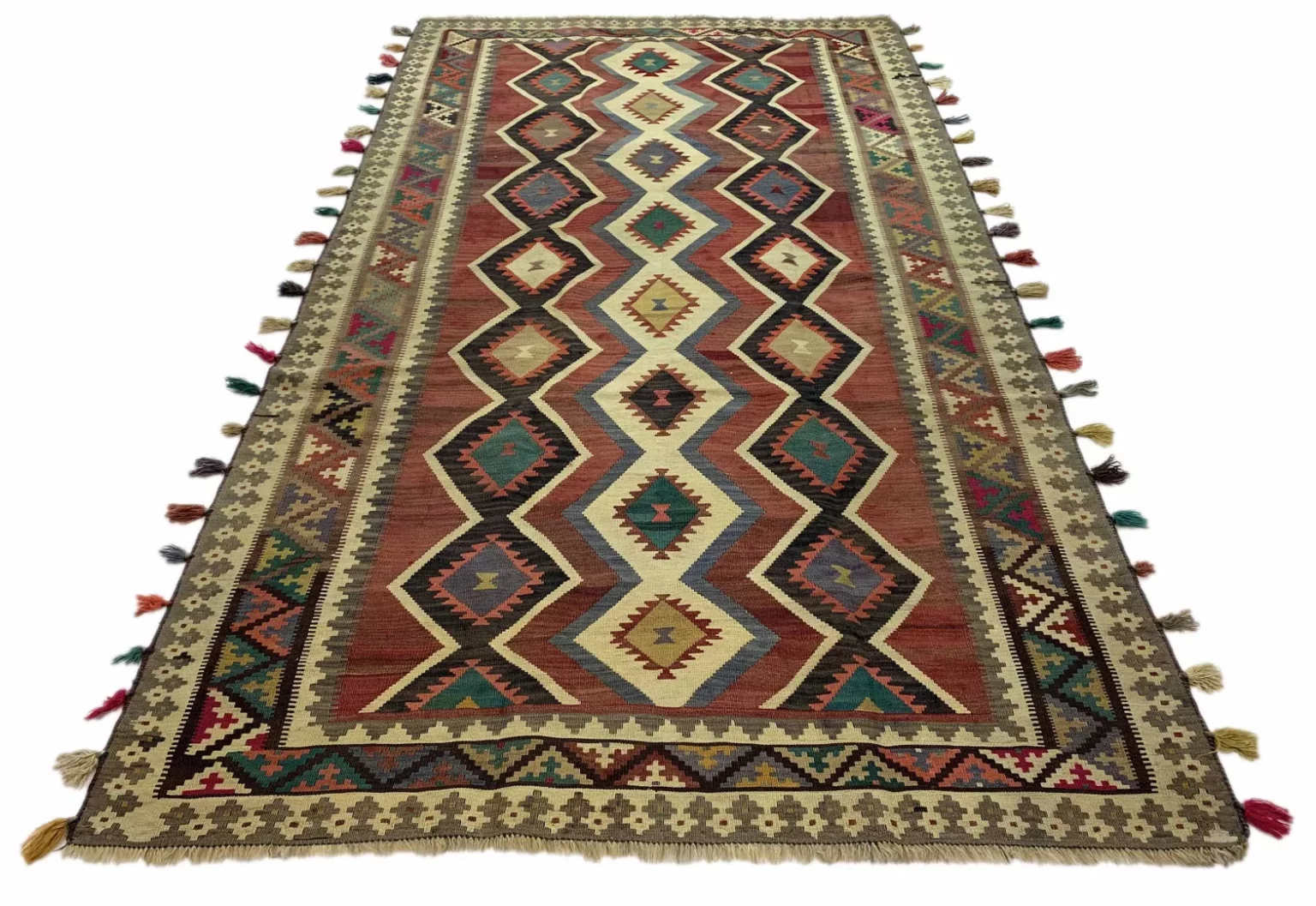
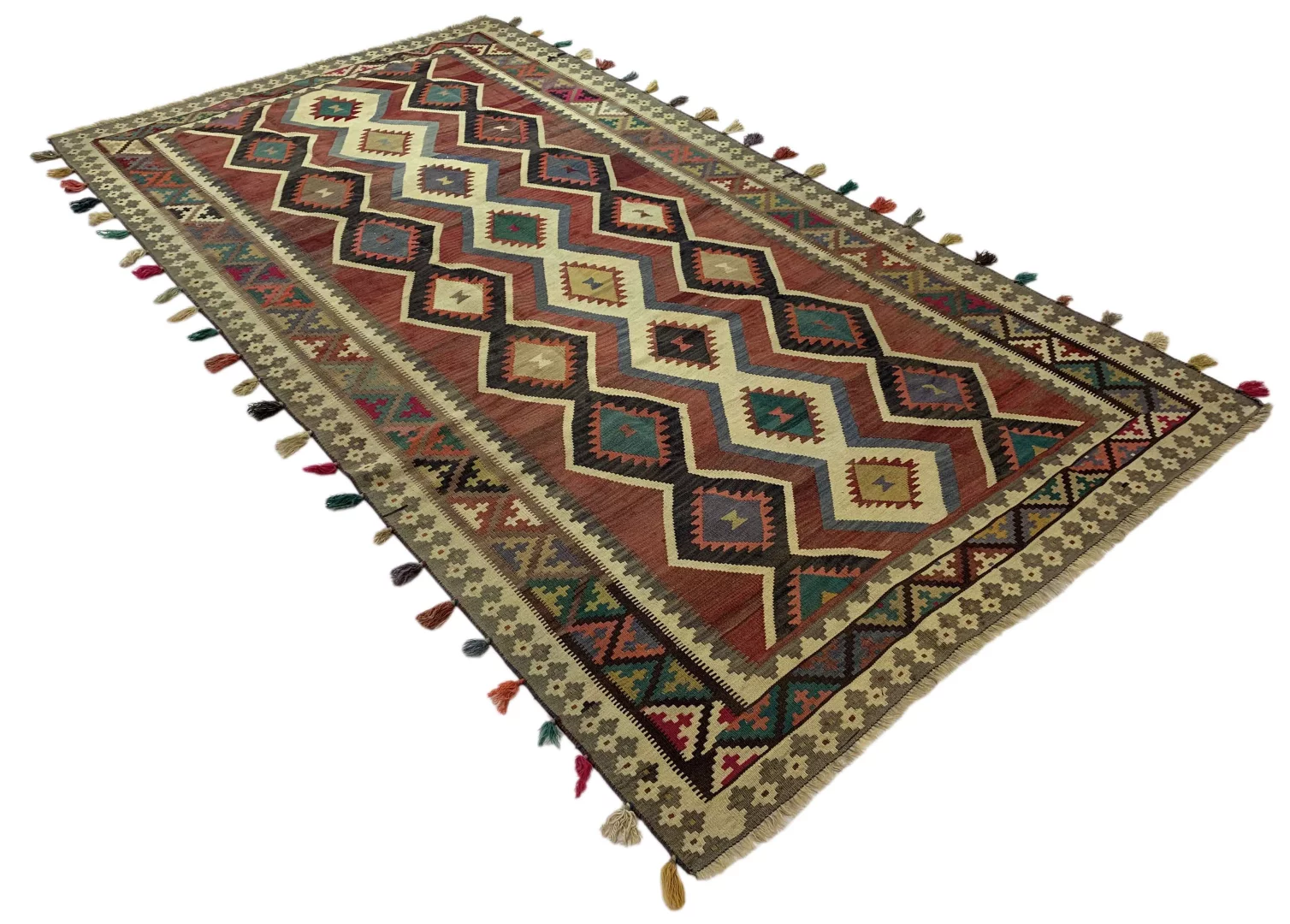
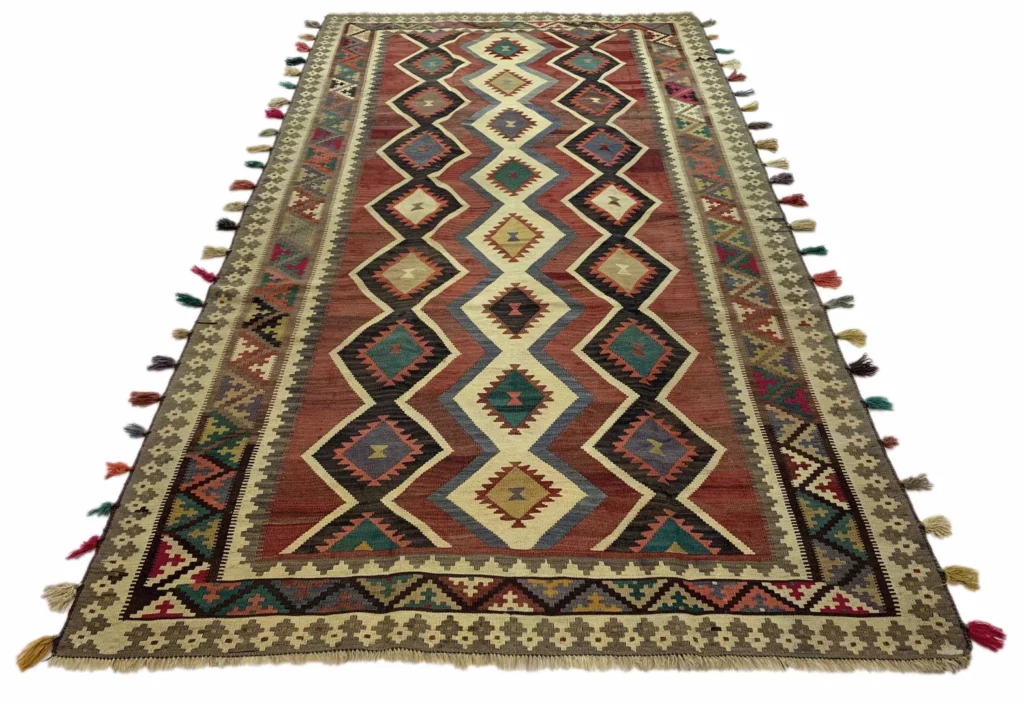
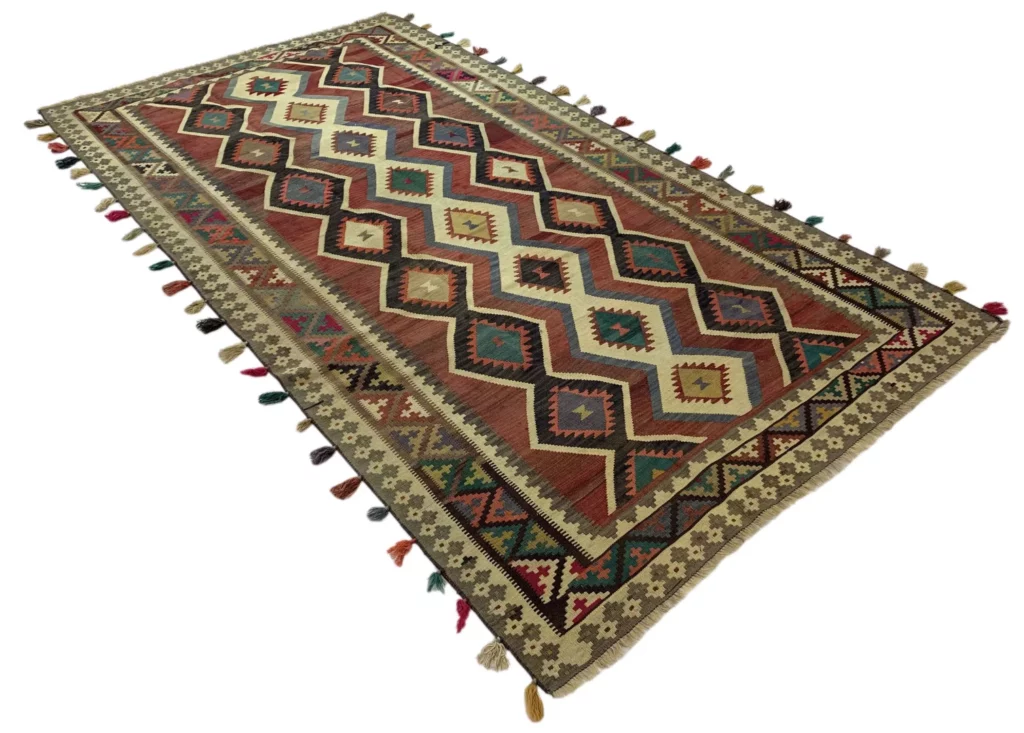
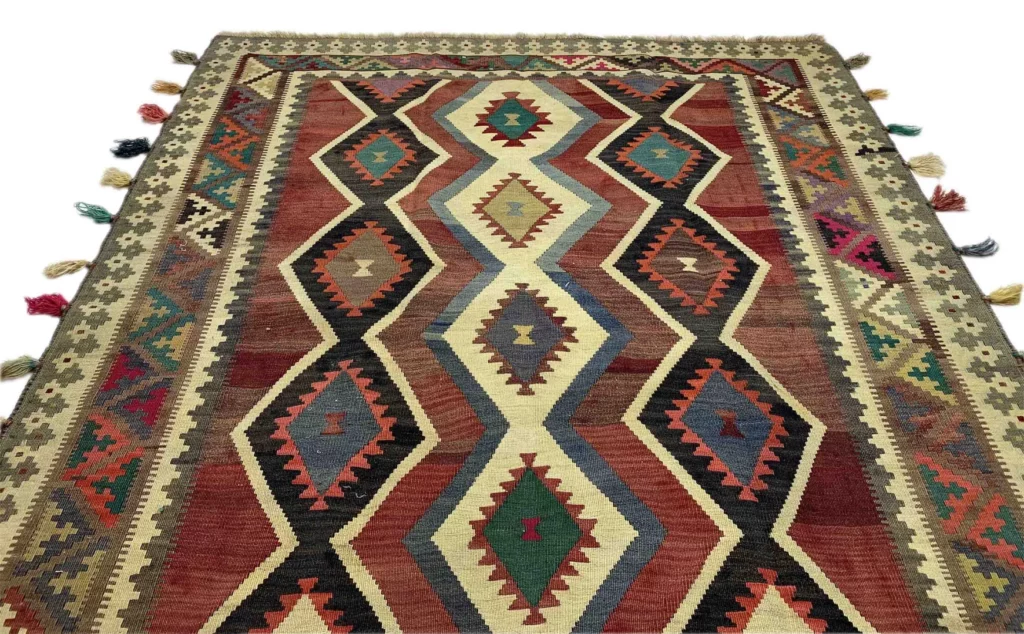
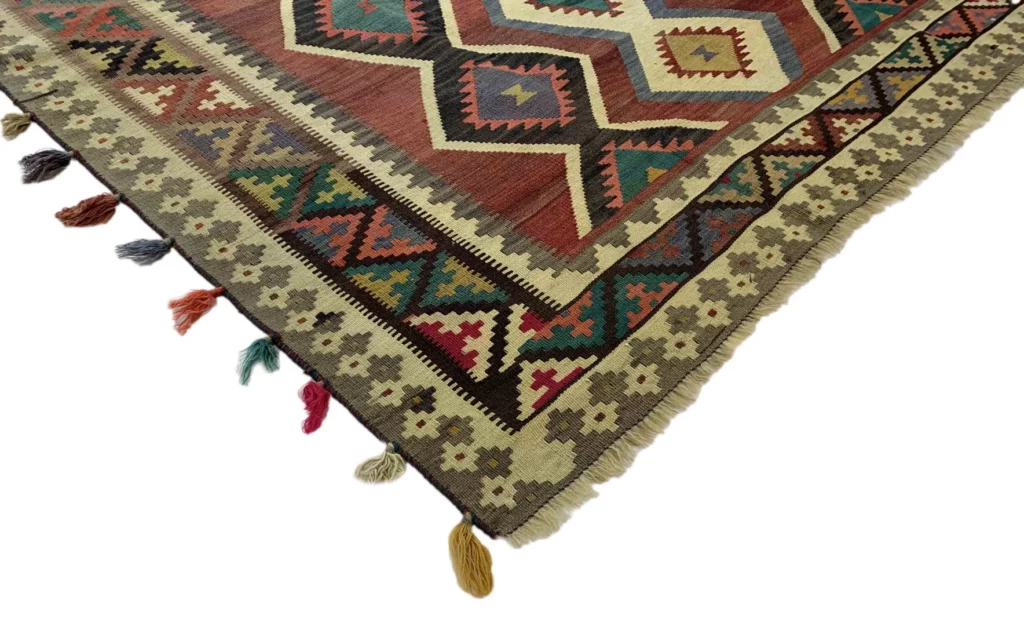
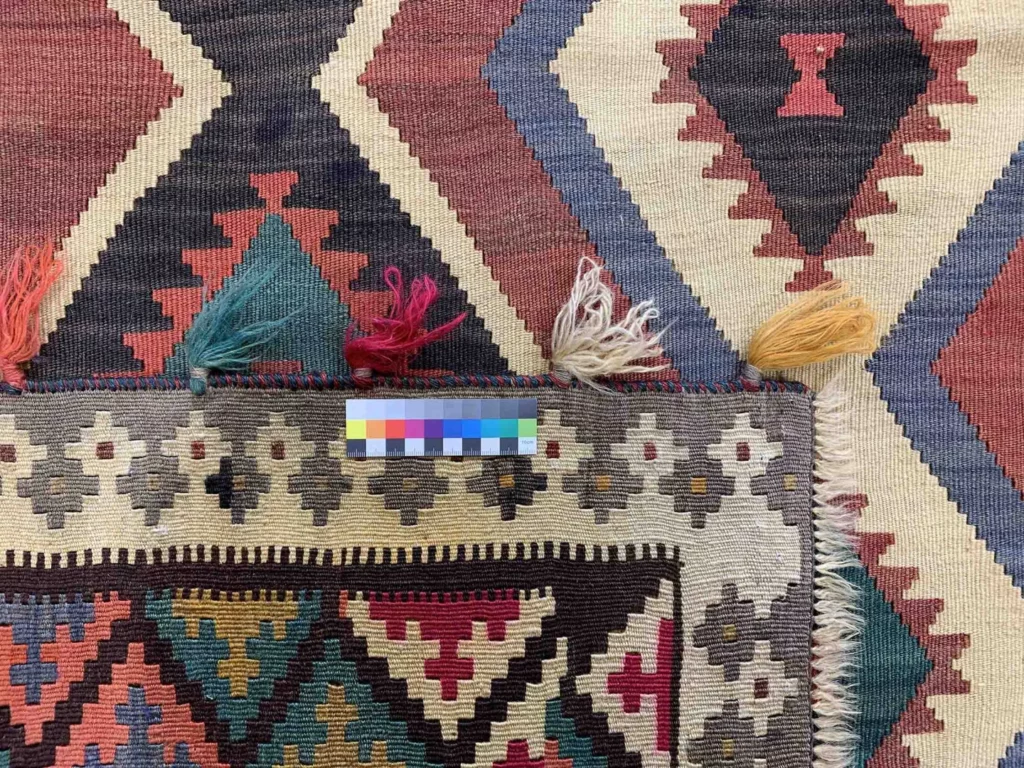
This Kelim from Fars is hand-woven and made of wool. Unlike a conventional pile or knotted rug, a Kelim is formed by interlacing warp and weft threads into a flat textile surface. There is no raised pile of the kind associated with knotted carpets. The hand-woven construction therefore remains part of the object’s visible character and allows the textile to function both as a floor covering and as a wall hanging.
Wool has a long-established place in the textile traditions of the Iranian cultural sphere. It can be spun into strong yarns and used to create flat-woven surfaces with clearly defined colour areas. In a Kelim, the material and the method of construction are closely connected: the wool provides the substance of the fabric, while the weaving determines its texture and appearance. This particular piece is described as hand-woven wool. No further details about warp, weft, yarn count or a specialised weaving method are provided.
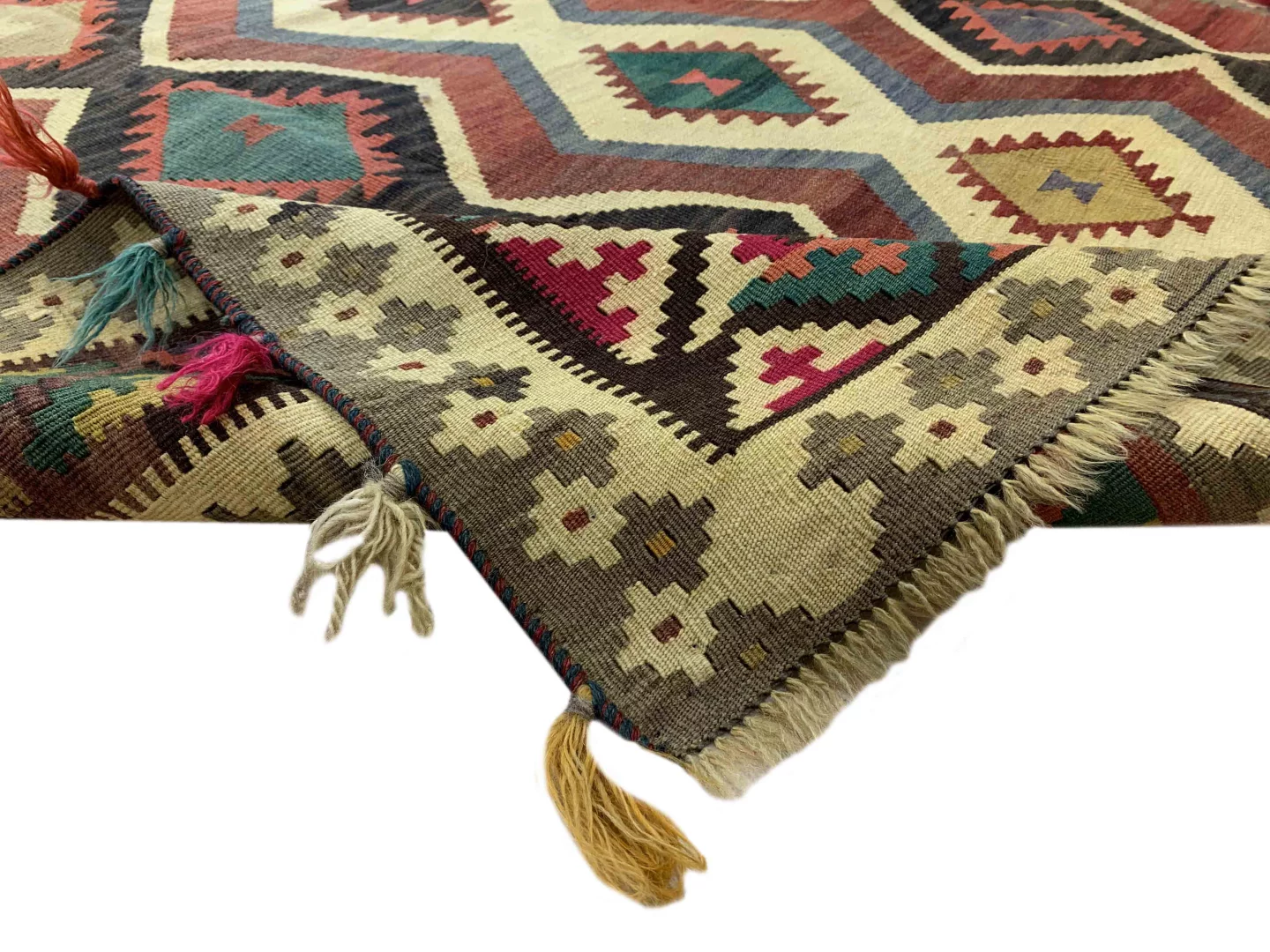
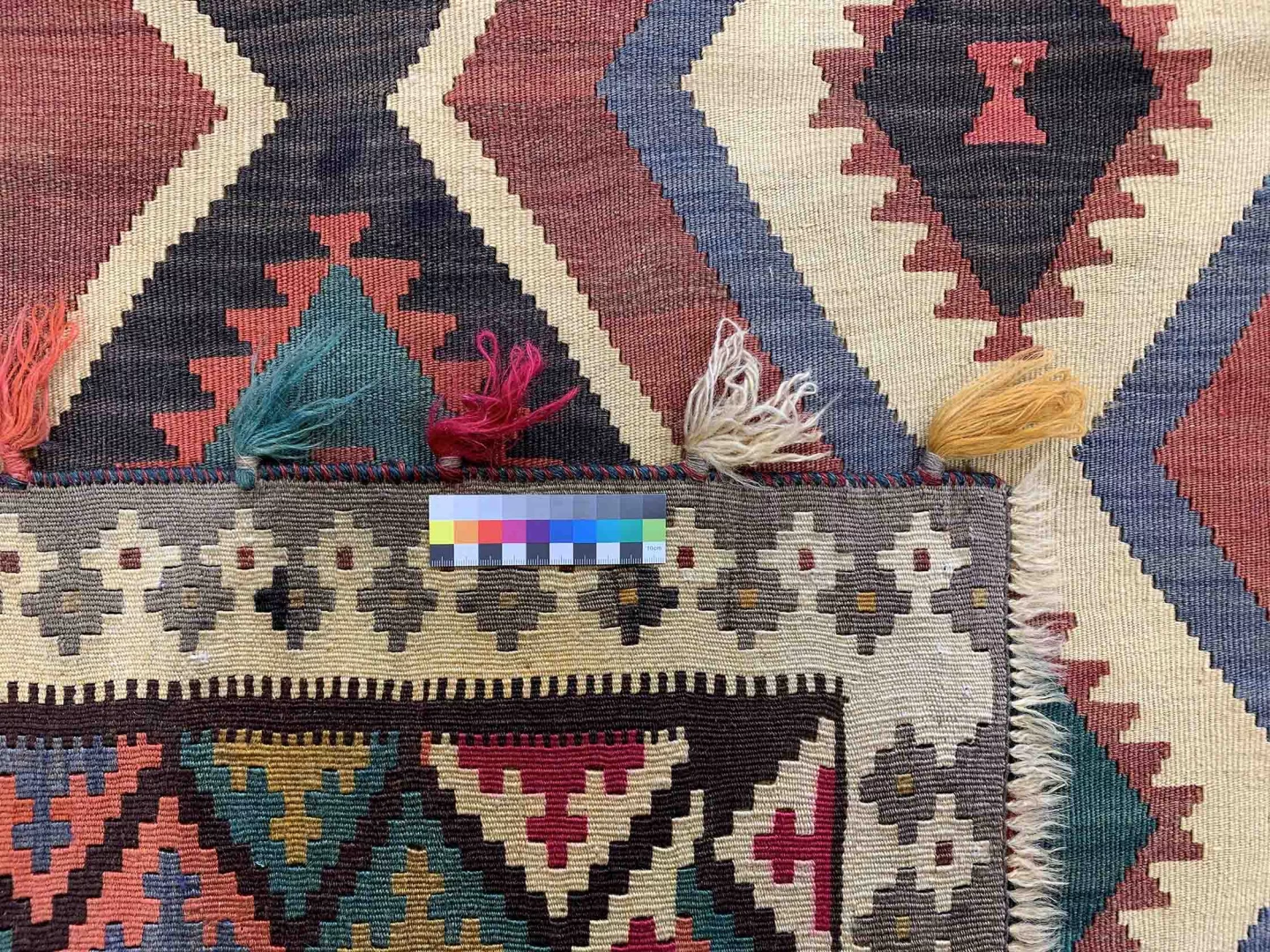
Its flat construction distinguishes a Kelim from a Persian rug made with a knotted pile. In knotting, individual knots create the surface, whereas in weaving the weft passes through the warp and builds the pattern within the textile itself. This difference accounts for the characteristic flat profile of a Kelim and helps explain why many such textiles can be displayed on either side. For this rug, the pattern is specifically described as identical on both sides.
The condition is given as new. No patina, repairs, wear or other signs of previous use are stated for this piece. There is also no information about a signature, a particular dyeing process or an additional fibre. The confirmed material and construction are wool and hand-weaving, with the rug identified as a Kelim from Fars.
Origin and Tradition
Fars is a region in southern Iran with a significant place in the country’s textile history. The area is associated with several forms of village and nomadic weaving. Alongside knotted rugs, flat-woven textiles have long formed part of this material culture. The word Kelim refers to a textile category in which the design is created through the arrangement of woven threads rather than through a raised pile.
The weaving traditions of Fars belong to the wider craft cultures of the Iranian plateau. In rural communities and among groups with nomadic traditions, textiles were made for practical use as well as for visual expression. This relationship between function and inherited pattern knowledge produced fabrics that could serve as rugs, coverings, bags or wall textiles. Their appearance varies with the place of production, the workshop environment and the patterns passed down within a particular community.
Persian rugs are produced in many parts of Iran, including Isfahan, Tabriz, Kashan and Kerman. Each region is linked with distinctive approaches to drawing, colour and craftsmanship. Fars has its own position within this broader variety. For a Kelim from Fars, the defining emphasis is not a knot count but the flat-weaving process and the interrelationship of warp and weft. It is an Oriental rug with a flat textile structure and a regional Iranian background.
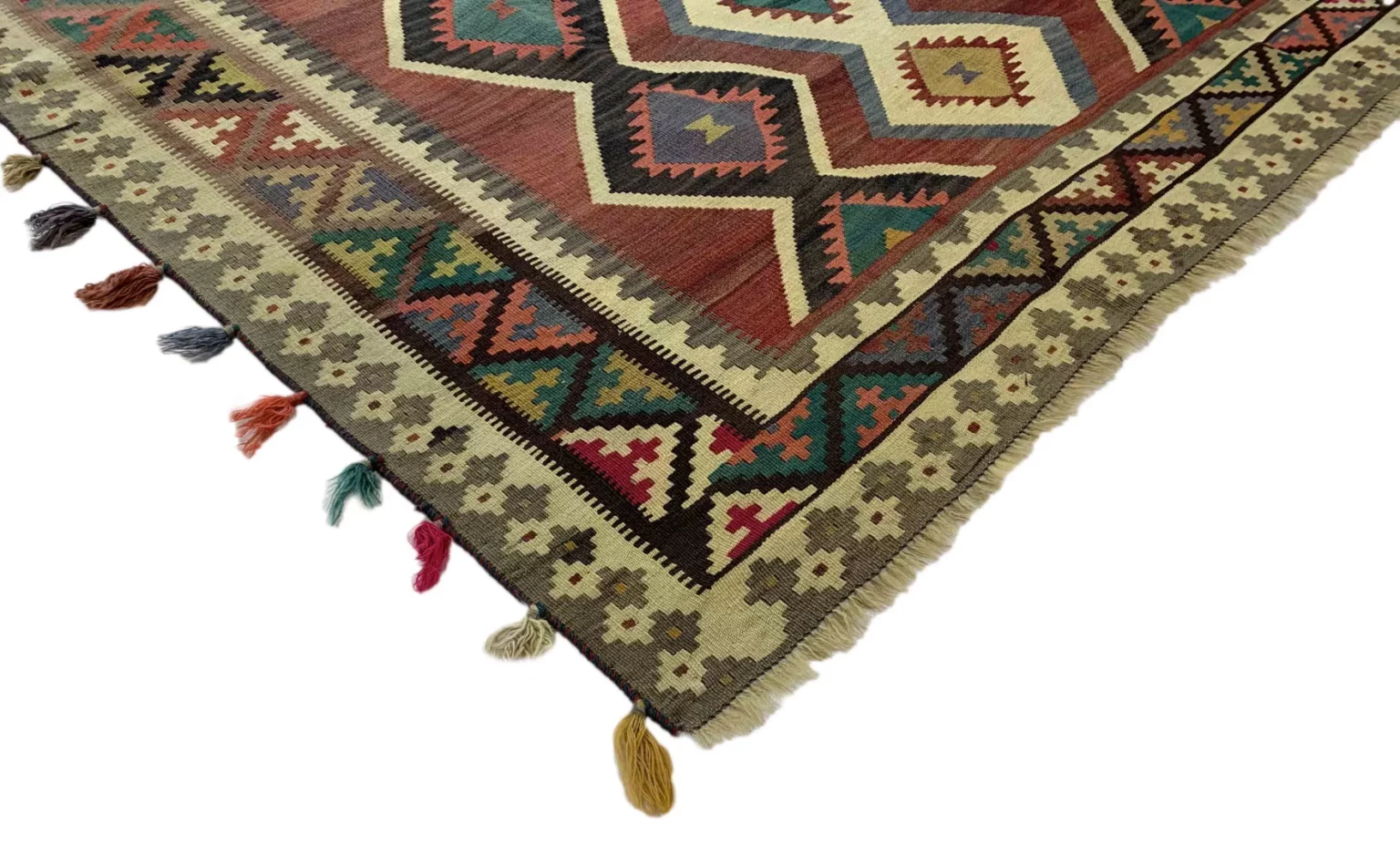
Hand-weaving requires control of thread tension, insertion and colour changes. A warp foundation is set up first, after which weft threads are passed through it and compacted. Depending on the design, colour fields may meet directly, interlock at their edges or be separated by lines and bands. The method makes the graphic organisation of the pattern clear and keeps the textile construction legible as part of the finished surface.
Fars is often discussed in connection with the varied textile cultures of southern Iran. Regional origin and decorative vocabulary should nevertheless be kept distinct. Origin identifies the area associated with production, while motifs and colour arrangements may reflect several influences. This rug is described as coming from Fars, Iran. No more specific attribution to a city, tribe, workshop or individual maker is given.
The Persian carpet tradition includes both knotted and woven work. Knotted rugs are recognised by their pile and knot structure, while Kelims create their surface through flat weaving. Both belong to the history of Iranian carpet making, but they differ in manufacture, feel and visual relief. This piece represents the flat-woven side of that tradition. Calling it a Persian rug refers to its Iranian origin and does not imply that it has a knotted pile.
Design and Pattern
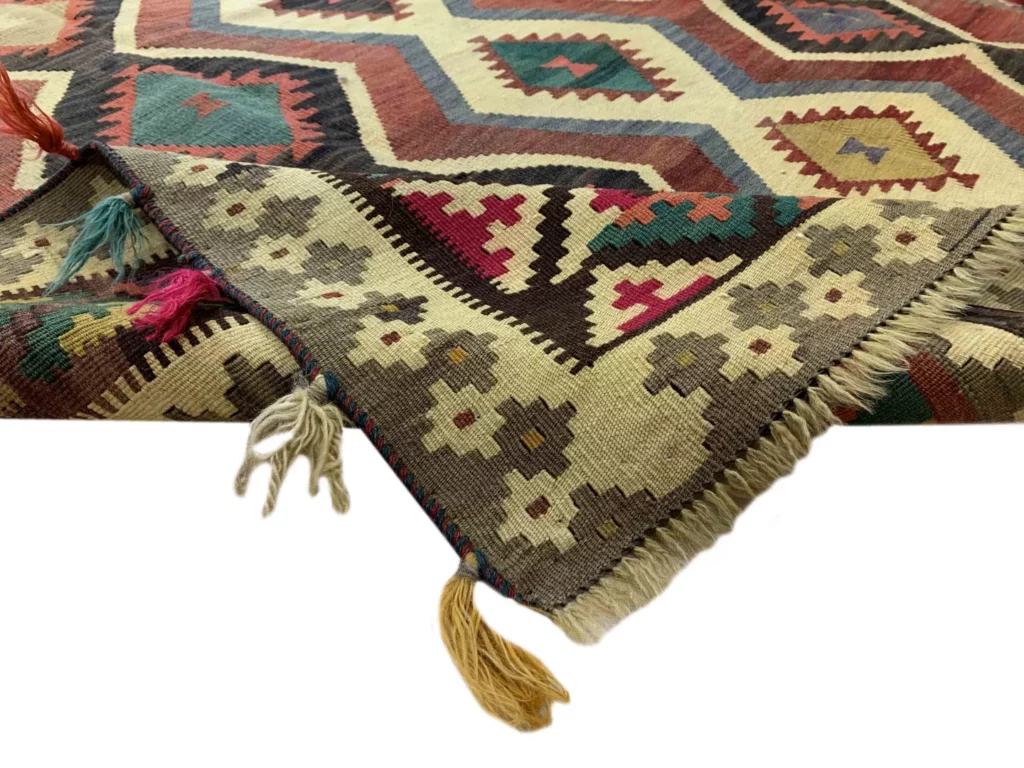
The pattern of this Kelim is identical on both sides. That feature is important when the piece is handled or displayed, because the front and back present the same design. On a flat-woven textile, the reverse can sometimes show a different balance of colour or construction. Here, however, both sides are described as identical. The visual arrangement therefore remains the same whichever side is facing outward.
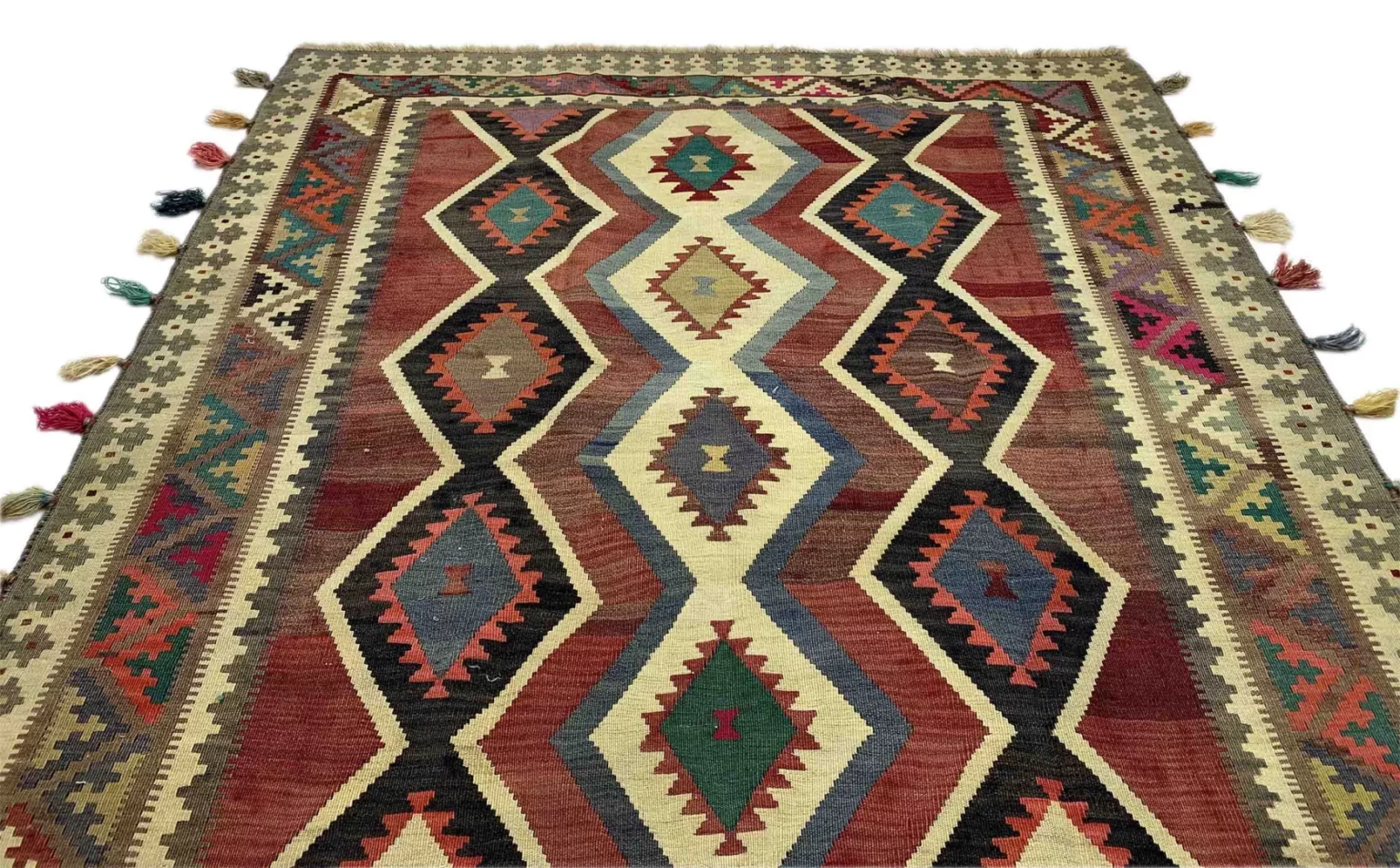
Kelim designs often depend on a broad, graphic organisation of the surface. Geometric shapes, repeated borders, rhythmic lines and divided colour fields can all be expressed effectively through weaving. Unlike the relief of a pile rug, the visual effect is created by outline, colour and the direction of the threads. This allows a flat-woven textile to appear traditional while also fitting into a more restrained contemporary interior.
Persian carpet design includes a wide vocabulary of inherited forms. Floral ornaments, scrolling vines, medallions, boteh shapes and geometric compositions appear alongside stylised references to nature and everyday life. When used in a Kelim, such ideas are translated into a flat structure. A traditional-looking motif does not by itself establish a particular provincial origin. For this rug, the stated pattern characteristic is its identical appearance on both sides; no more precise motif name or colour description is supplied.
Fars is known for diverse textile expressions. Regional designs may bring together strong lines, repeated forms and lively colour relationships. The precise result depends on the working environment, the chosen model and the wool available to the weaver. In a hand-woven Kelim, the design develops as the fabric is built. Differences in tension or hand movement may contribute to the individual appearance of a one-off textile, without allowing a specific motif to be assigned when none is named.
A Kelim can be used in a traditional setting or alongside contemporary furnishings. Its flat surface presents the pattern as a continuous textile field. On the floor, the design works as part of the arrangement of furniture and other textiles; on the wall, the Kelim is read as a woven decorative object. This particular piece is expressly described as suitable for use either as a rug or as a wall hanging. Its design thus supports both a practical and a textile-based form of display.
The identical pattern on both sides also makes the piece straightforward to position. When it is laid out or hung, there is no contrasting reverse that has to be concealed. The same visual order is retained on either side, which is useful when the textile is presented freely in a room or used as wall decoration. No specific information is given about colours, borders, figures or a central field, so these details are not assigned to this rug.
Special Features
The stated features are its origin in Fars, Iran, its hand-woven construction and its wool material. The pattern is identical on both sides. Together, these details place the piece within the flat-woven Kelim tradition of Iranian carpet making. Its condition is described as new.
Its possible uses are another defined feature. The Kelim can be placed as a rug on the floor or presented as a wall hanging. On the floor, the flat weave forms the textile surface underfoot; on the wall, the woven design becomes part of the room’s visual structure. Because both sides carry the same pattern, the textile retains the same appearance in either form of presentation.
No information is given about knot density, pile height, warp, signature, age, repairs or patina. There are also no details assigning the piece to a particular city or workshop within Fars. The description therefore remains with the identifiable characteristics: wool, hand-weaving, Fars as the Iranian origin, an identical pattern on both sides and new condition.
FAQ
What is a Kelim?
A Kelim is a flat-woven textile. Its surface is made by passing weft threads through a warp framework rather than by inserting individual pile knots. This distinguishes it from a conventional Persian rug with a raised pile. The weaving method can express geometric, floral or other stylised designs in a flat, clearly structured form. This piece is a hand-woven wool Kelim identified with Fars in Iran.
Can this Kelim be used as a wall hanging?
Yes. It is described as suitable for use both as a rug and as a wall hanging. Its flat textile construction allows the design to be displayed vertically, while the identical pattern on both sides means that the same arrangement is visible whichever side faces outward. The appropriate hanging method depends on the room and the chosen fixing system; no specific hanging hardware is stated for this piece.
What is known about the material and condition?
The Kelim is made of hand-woven wool and is described as new. No further material information, such as the composition of the warp or the presence of additional fibres, is provided. Knot density is not stated, which is consistent with the description of a flat-woven Kelim rather than a knotted pile rug. No details about wear, repairs or patina are given. The confirmed information is the wool, the hand-woven technique and the new condition.
To provide the best experiences, we use technologies like cookies to store and/or access device information. Consenting to these technologies will allow us to process data such as browsing behavior or unique IDs on this site. Not consenting or withdrawing consent, may adversely affect certain features and functions.
Functional Always active
The technical storage or access is strictly necessary for the legitimate purpose of enabling the use of a specific service explicitly requested by the subscriber or user, or for the sole purpose of carrying out the transmission of a communication over an electronic communications network.
Preferences
The technical storage or access is necessary for the legitimate purpose of storing preferences that are not requested by the subscriber or user.
Statistics
The technical storage or access that is used exclusively for statistical purposes.The technical storage or access that is used exclusively for anonymous statistical purposes. Without a subpoena, voluntary compliance on the part of your Internet Service Provider, or additional records from a third party, information stored or retrieved for this purpose alone cannot usually be used to identify you.
Marketing
The technical storage or access is required to create user profiles to send advertising, or to track the user on a website or across several websites for similar marketing purposes.

 SECURE PAYMENT
 SHIPPING PARTNERS


