This Fars Persian rug is made of wool. Its material is specified as modern wool and as 100 percent wool. Wool has long been used in oriental textiles because it offers a resilient, hard-wearing fibre with a tactile surface. It also accepts colour well, allowing a multicoloured design to remain clearly visible across the textile.
The product description identifies the piece as a hand-woven Kelim and as a flatweave. It also includes the statement that the rug is 100 percent hand-knotted. These details are retained together: the rug is described through the terms Kelim, flatweave, and fully hand-knotted construction. No particular warp material is given, so none is added here.
Hand production makes every individual piece unique. In a Kelim, the visible textile is formed by inserting and compacting weft yarns, while a knotted construction is formed by securing individual knots within the foundation. These are different traditional textile processes, each requiring control of tension, careful handling of yarn, and practical experience. The wool contributes to a sturdy surface suitable for regular use.
The modern wool quality is described as easy to care for and durable. The rug is suitable for busier rooms and can therefore be used in both domestic living spaces and offices. Its textile surface provides a pleasant tactile quality and adds warmth to the atmosphere of a room. The product description also states that it is suitable for underfloor heating.
Origin and Tradition
Fars is an Iranian province with a distinctive textile and rug-making tradition. Located in southern Iran, it has historically included different landscapes, settled communities, and nomadic ways of life. This variety has influenced the region’s material culture. Fars has produced both flatwoven textiles and knotted rugs, with local communities developing their own approaches to wool preparation, colour, structure, and pattern.
The history of rug making in Fars reaches back to the sixteenth century. Carpets and Kelims in the region were not solely decorative objects. They could serve as floor coverings, household textiles, blankets, or practical furnishings, while also carrying signs of identity and continuity. Craft knowledge was passed through families and local communities. The preparation of wool, spinning, dyeing, weaving tension, and pattern construction were learned through repeated work and close observation.
Fars does not represent one single visual formula. The province contains several regional traditions, so geometric forms, stylised vegetation, repeating borders, and symbolic signs may appear side by side. In a flatwoven Kelim, the design is created directly through the arrangement of coloured weft areas. In a knotted rug, it is built from rows of knots and the later treatment of the surface. These methods help explain the variety found in textiles associated with the region.
Fars motifs may refer to local mythology, everyday life, and the experience of the people who made them. Geometric signs can provide order and rhythm, while plant forms may reflect the natural environment through stylised representation. No specific symbolic meaning is assigned to any individual form in this rug. Its regional context is nevertheless part of an Iranian tradition in which textile patterns were refined and passed on across generations.
Wool preparation has been fundamental to the textile culture of Fars. Raw wool must be prepared, spun, and made suitable for further work. Depending on local practice and historical period, natural and later modern dyes could be used. Fibre selection, yarn preparation, and tension during weaving all affect a textile’s surface and visual character. This rug is identified with modern wool, but no particular dye process or workshop is specified.
The name Fars therefore refers both to an Iranian region and to a broad cultural setting in which several textile practices developed. It does not describe a single rigid pattern scheme. Instead, it points to a province where flatweaving and knotting, geometric order and stylised natural forms, practical use and visual expression have existed together. This Kelim connects wool and handwork with that regional tradition while presenting it in a modern design language.
The history of Fars also shows why a regional name should be understood as a context rather than as a guarantee of one exact motif. Local production has always allowed variation in construction, scale, colour, and ornament. The present rug is described as a Fars piece with a multicoloured Art Deco design. Its identity combines the named Iranian province, the stated textile techniques, and a contemporary interpretation of regional craft rather than a single prescribed historical pattern.
Design and Pattern
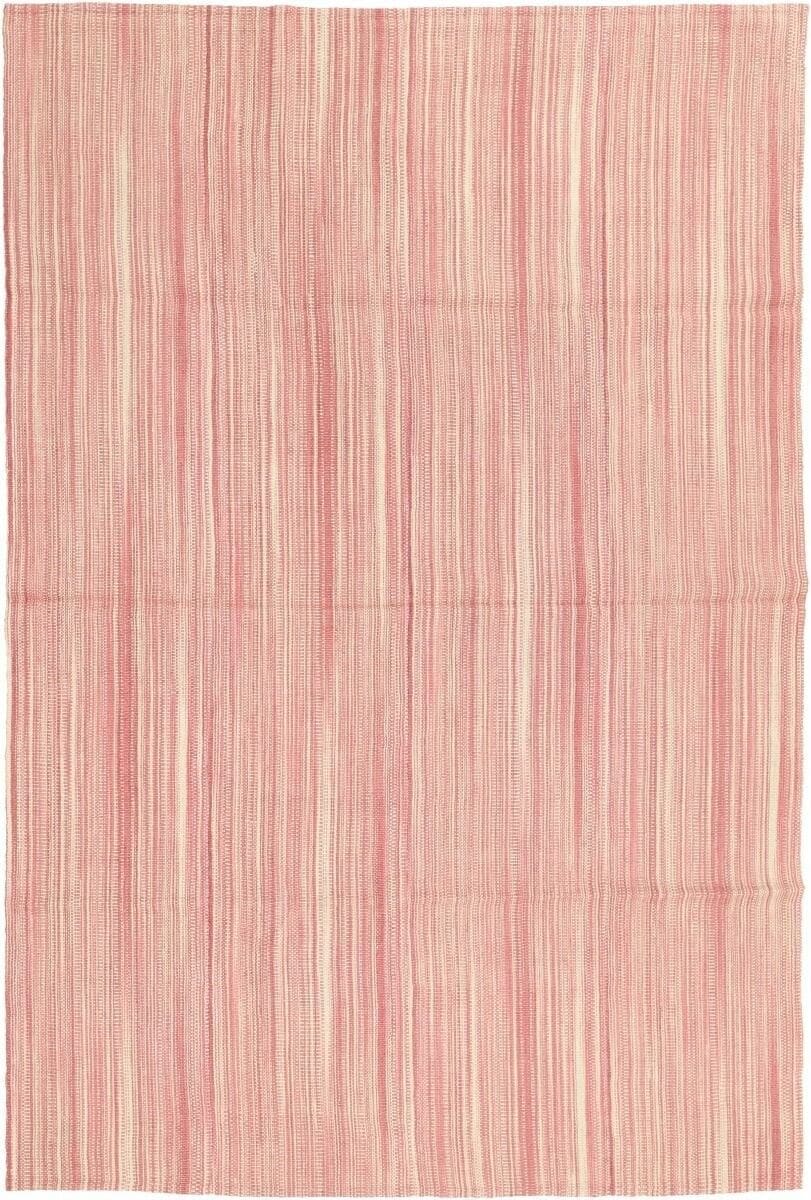
The rug is described as multicoloured and as having an Art Deco style. This places an Iranian textile tradition alongside a design language associated with clear contours, measured repetition, and an ordered arrangement of surfaces. Art Deco often uses geometric outlines, stepped lines, symmetry, and balanced blocks of colour. These characteristics can give a textile a structured decorative effect without requiring a single central medallion or one named ornament.
Fars is associated with both geometric and floral sources of design. Geometric patterns may be formed from diamonds, angles, stripes, stepped shapes, and repeated axes. Floral elements in rug design are commonly simplified, mirrored, or arranged rhythmically rather than rendered as botanical studies. The description of this rug refers to modern design with geometric and floral origins, but it does not identify a particular motif, medallion, border system, or named pattern.
Colour is an important part of the stated appearance. Several tones can separate areas, emphasise lines, and clarify the internal structure of a design. In a flatweave, colour and construction are closely linked because coloured weft sections form the visible surface directly. This can make a pattern appear graphic and clearly defined. The multicoloured character is therefore both a visual feature and part of the way the textile structure is read.
The Art Deco reference allows the rug to be placed in different interior settings. The description specifically mentions Scandinavian minimalism and classic country-house style. In a restrained room, the multicoloured surface can function as a clearly defined decorative element. In a more traditional setting, it can relate to the established use of oriental textiles as patterned furnishings. These are stylistic contexts, not claims about a particular room or installation.
Pattern traditions from Fars often rely on repetition and variation. Borders may frame a field, rows may divide a surface, and smaller marks may connect larger forms. In a Kelim, such structures are frequently built from linear areas of colour. Hand production can leave small variations in line, colour distribution, and tension. These variations are part of the visual character of handmade textiles and distinguish an individual piece from a mechanically uniform fabric.
A rug pattern does not necessarily communicate one fully decipherable story. Regional textiles can nevertheless contain references to daily life, the natural world, and mythology. No specific narrative, emblem, or symbolic reading is recorded for this rug. The documented features are its modern, multicoloured Art Deco style and its geometric and floral origins. Those elements provide the factual basis for understanding its appearance without assigning an unsupported meaning to individual shapes.
The combination of Fars, Kelim, and Art Deco brings regional craft and contemporary form together. Fars identifies the Iranian textile context, while Art Deco describes the modern visual direction. The flatwoven designation points to a surface in which colour and structure are closely connected. The result is a pattern language that can be read as both ordered and decorative, while remaining open to different furnishing contexts.
Special Features
The rug is described as new and as new without a label. It is suitable for underfloor heating. This characteristic is explicitly associated in the product description with the wool and the hand-knotted technique. Heat can pass through the textile into the room while the surface provides a comfortable feel underfoot.
Other stated features include modern wool, easy care, and durability. The rug is suitable for rooms with heavier foot traffic. It is also described as hypoallergenic and as resistant to dust and dirt. These are product details for this piece. No specific manufacturer treatment, certification, or additional finishing process is provided.
Care should consist of regular vacuuming on a low setting. Any marks should be dabbed immediately with a damp cloth rather than rubbed. For a more intensive clean, professional rug cleaning may be considered. These measures are suited to preserving the wool surface, the handmade textile structure, and the multicoloured design.
FAQ
How should I care for the Fars Persian rug?
Vacuum the rug regularly using a low setting. If a spill or mark occurs, dab it promptly with a damp cloth and avoid rubbing. Rubbing can place unnecessary stress on the surface and may affect the appearance of the colours. For a deeper clean, professional rug cleaning can be considered. The care approach is appropriate for the stated wool material and handmade construction.
Where can I use the rug?
The Fars Persian rug can be used in a living room, dining room, or office. Its modern, multicoloured Art Deco design can be combined with different furnishing styles. The description specifically names Scandinavian minimalism and classic country-house style as suitable settings. Because the wool quality is described as durable and easy to care for, the rug is also suitable for rooms with heavier foot traffic.
Is the rug suitable for underfloor heating?
Yes. The rug is explicitly described as suitable for underfloor heating. Its suitability is linked in the product description to the wool and the hand-knotted technique. Heat can pass through the textile into the room while the surface retains a comfortable feel. It can therefore be used in rooms equipped with underfloor heating.
To provide the best experiences, we use technologies like cookies to store and/or access device information. Consenting to these technologies will allow us to process data such as browsing behavior or unique IDs on this site. Not consenting or withdrawing consent, may adversely affect certain features and functions.
Functional Always active
The technical storage or access is strictly necessary for the legitimate purpose of enabling the use of a specific service explicitly requested by the subscriber or user, or for the sole purpose of carrying out the transmission of a communication over an electronic communications network.
Preferences
The technical storage or access is necessary for the legitimate purpose of storing preferences that are not requested by the subscriber or user.
Statistics
The technical storage or access that is used exclusively for statistical purposes.The technical storage or access that is used exclusively for anonymous statistical purposes. Without a subpoena, voluntary compliance on the part of your Internet Service Provider, or additional records from a third party, information stored or retrieved for this purpose alone cannot usually be used to identify you.
Marketing
The technical storage or access is required to create user profiles to send advertising, or to track the user on a website or across several websites for similar marketing purposes.
 SECURE PAYMENT
 SHIPPING PARTNERS


