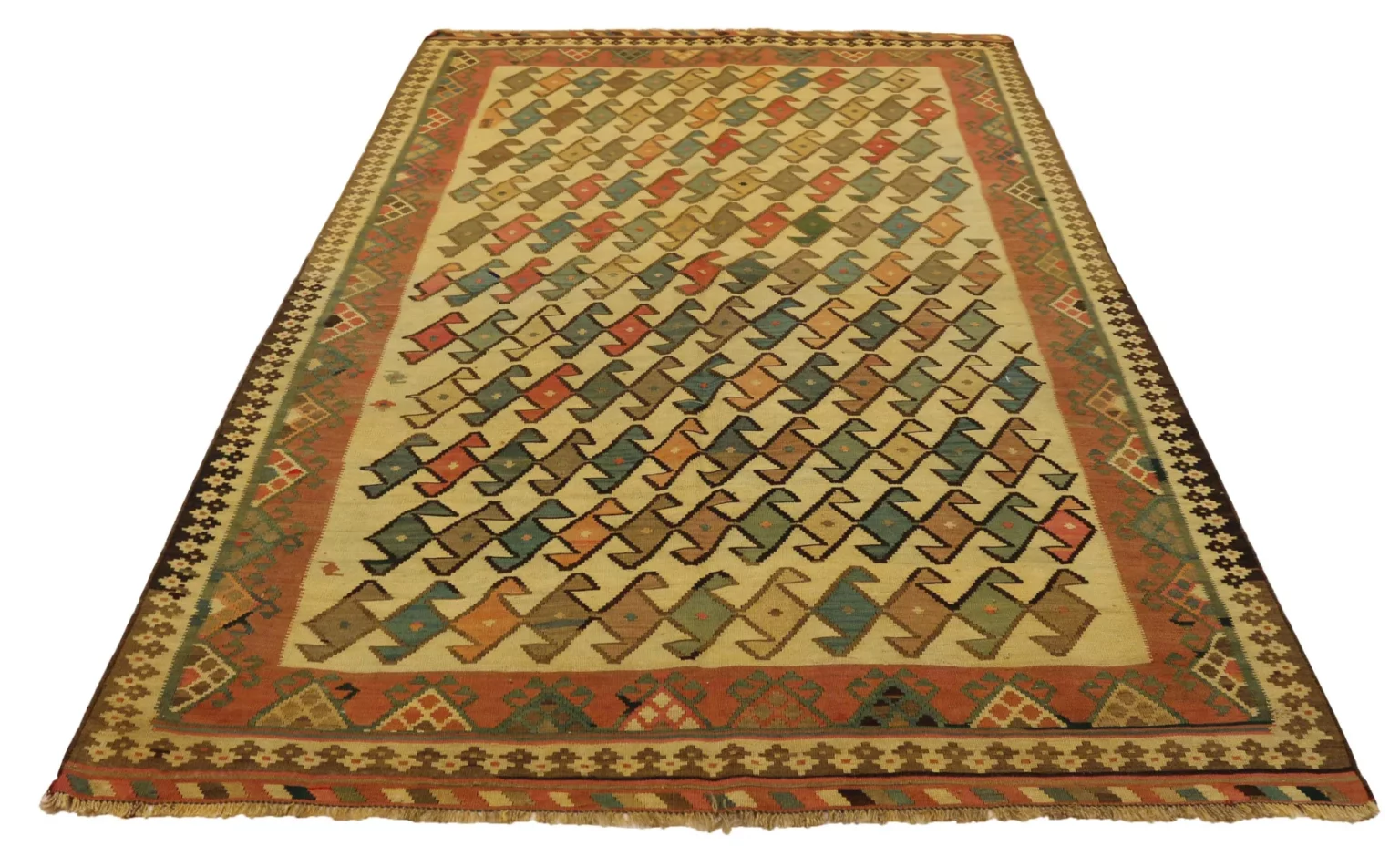
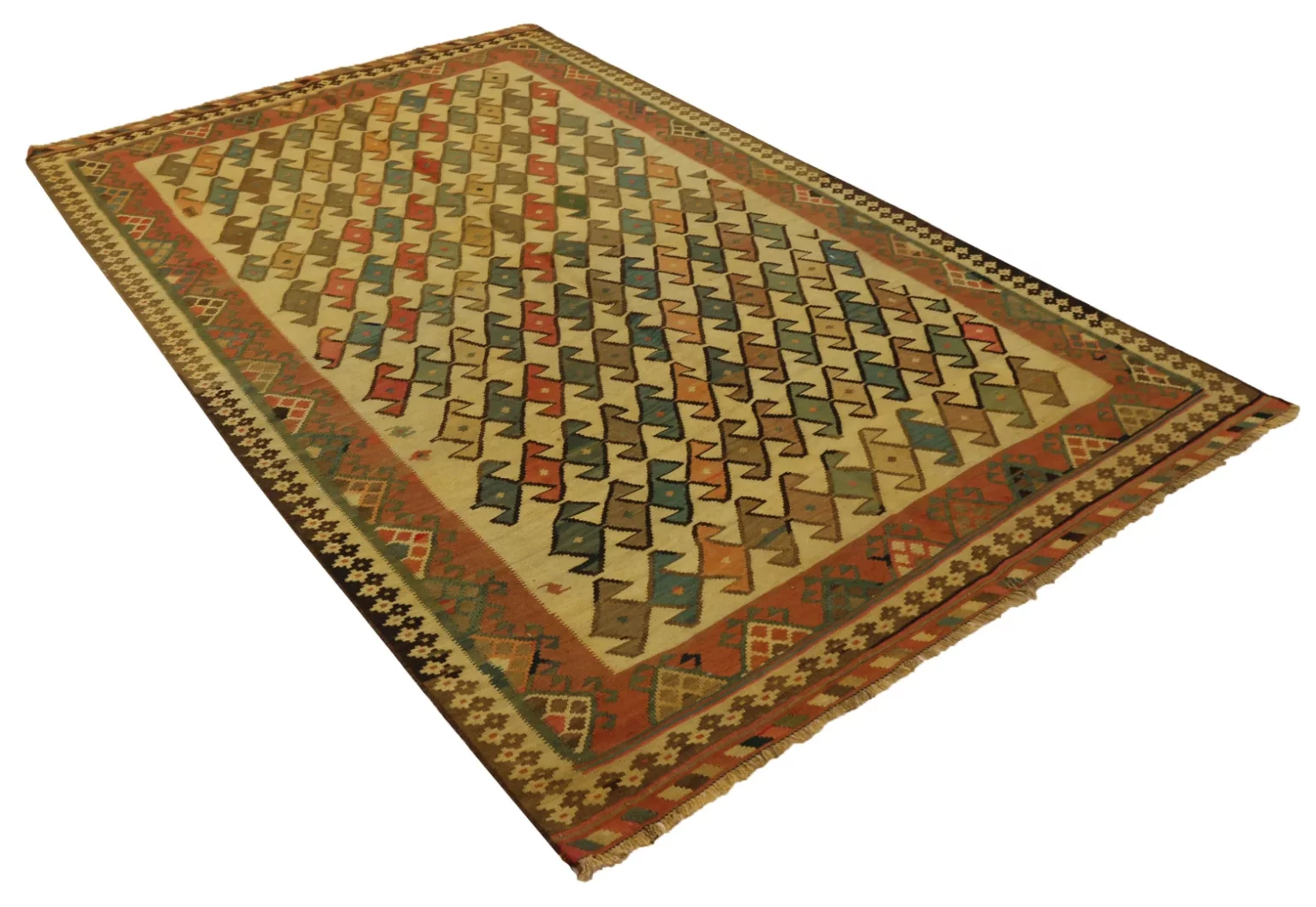
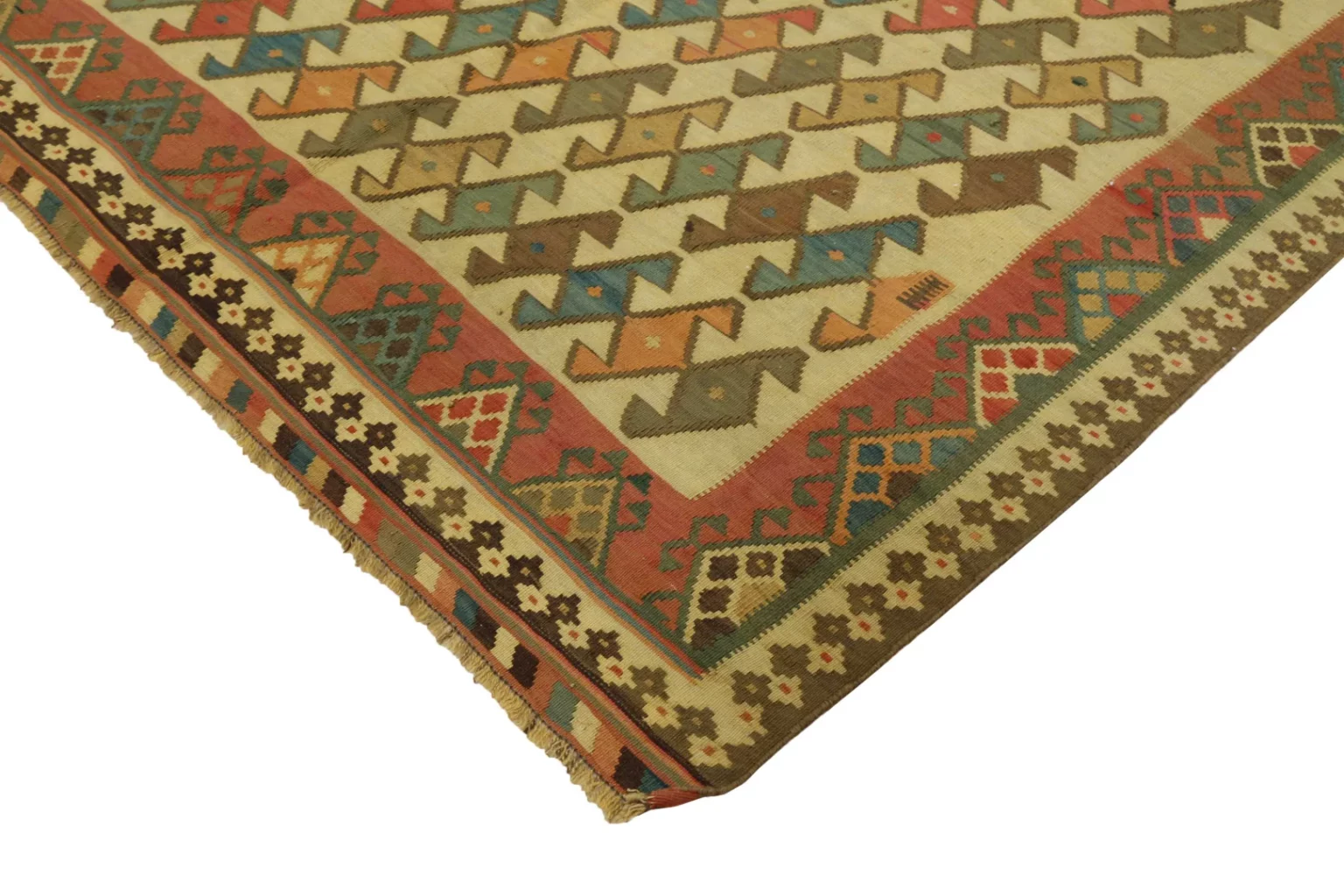
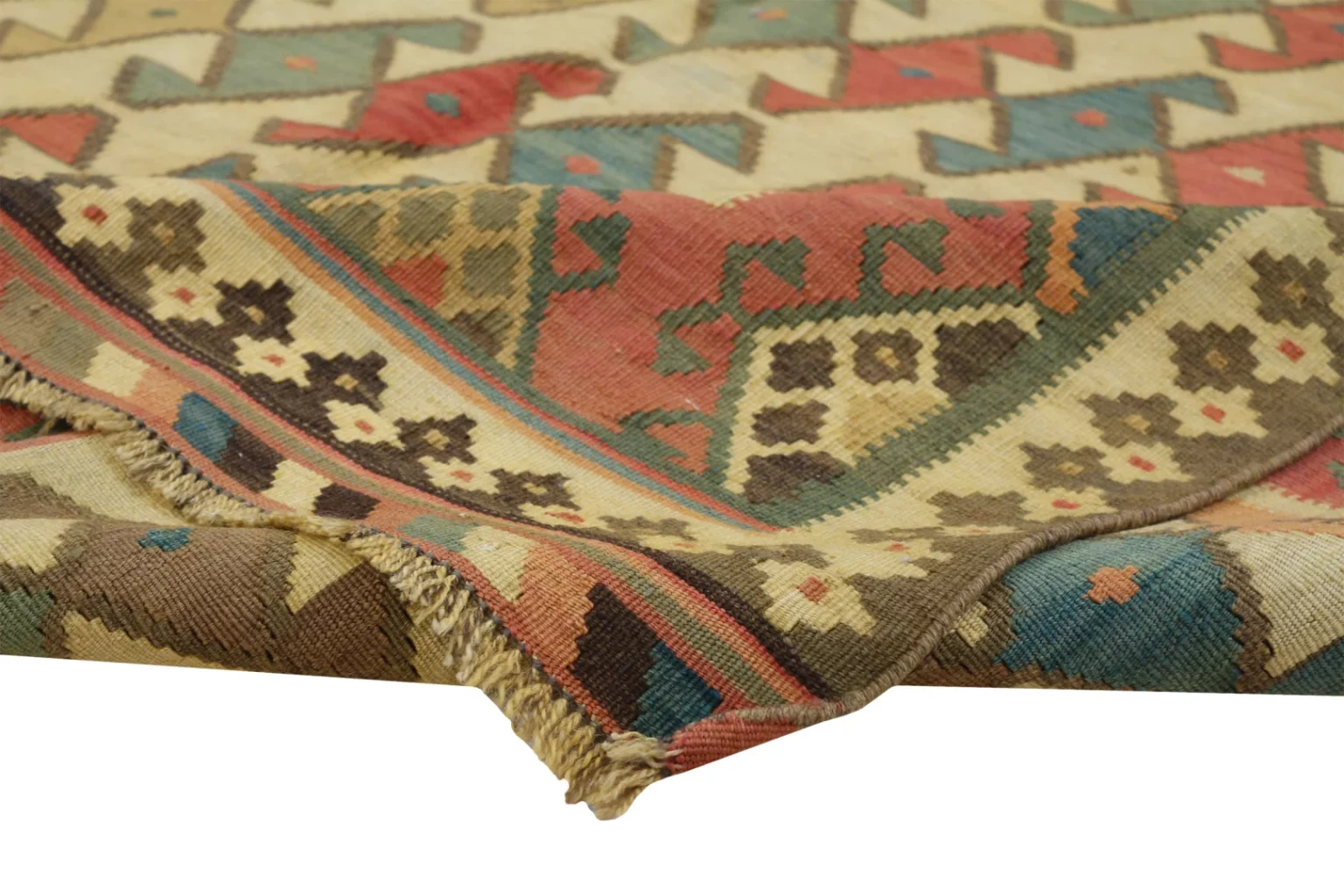
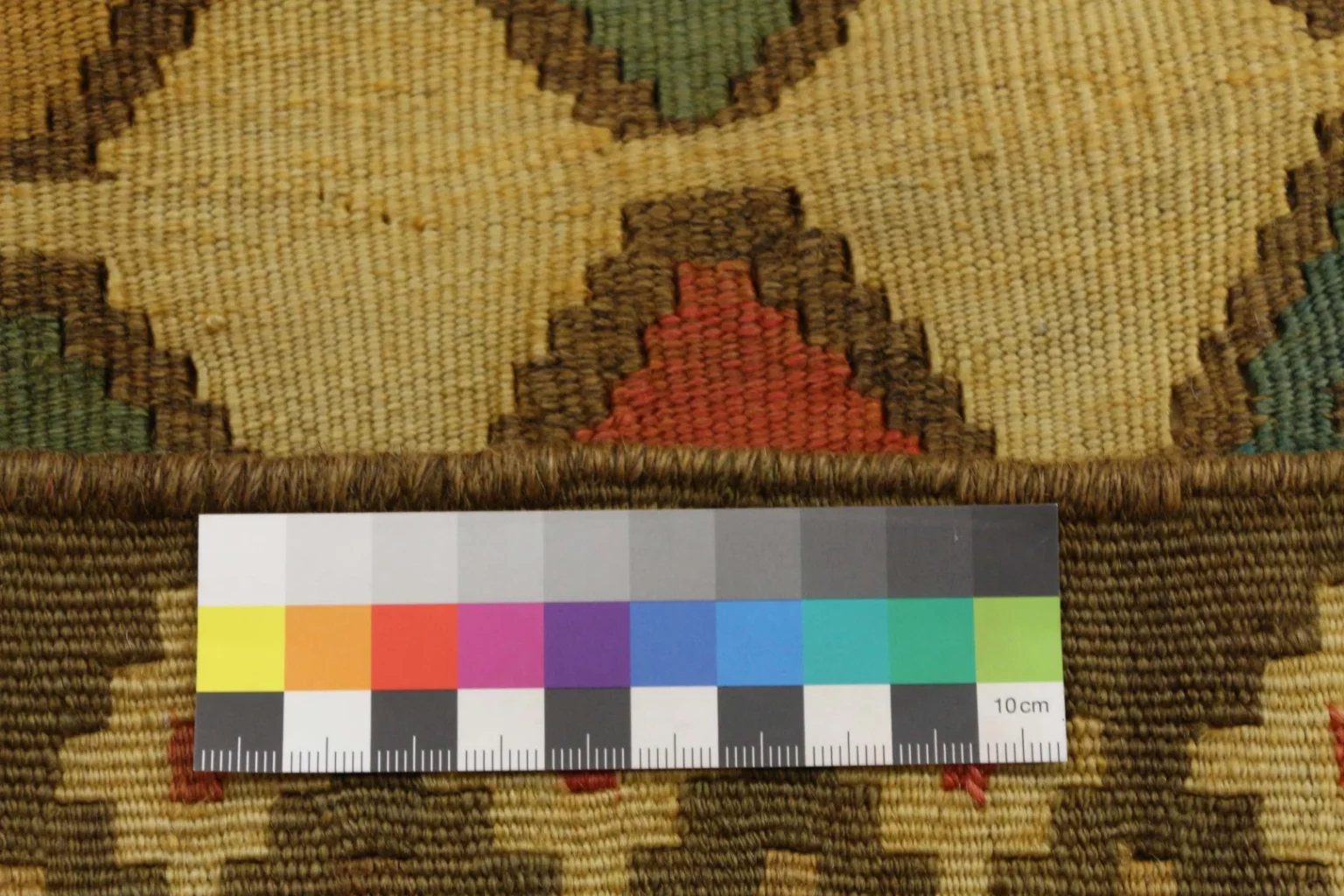
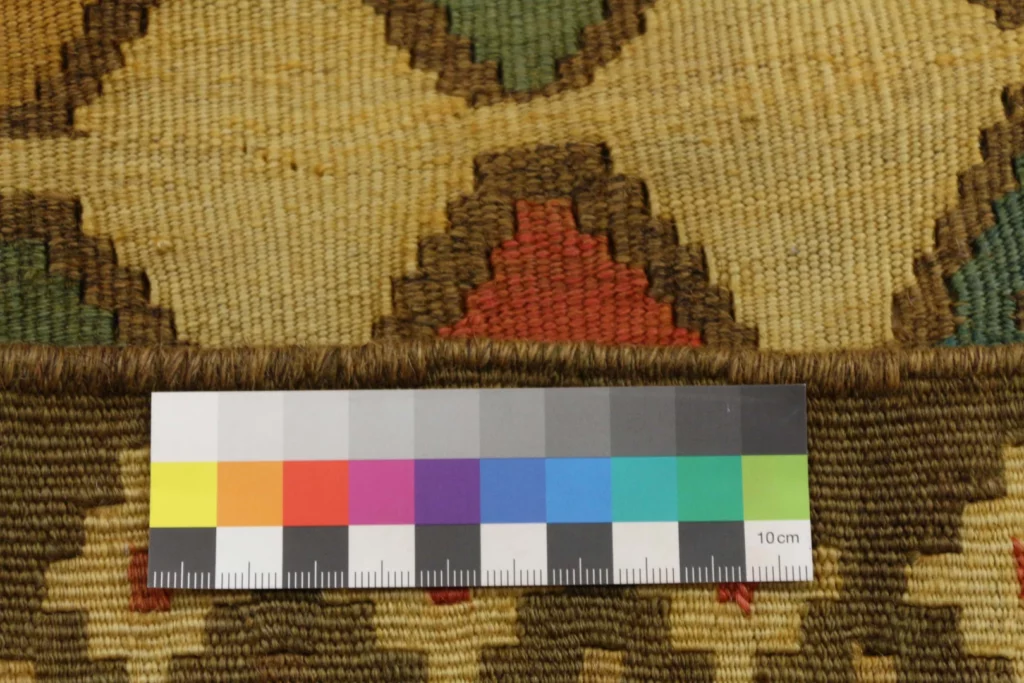
This Kelim is hand-woven and has no pile. Its surface is therefore formed as a flat textile rather than by rows of knotted tufts. In a Kelim, weft threads are woven through the warp to create a continuous plane. The pattern is built into the woven structure as the work progresses, instead of being added knot by knot as in a hand-knotted rug. The description identifies the piece as hand-woven and pileless; no further fibre specification is given.
Hand weaving requires continual control of the warp, the weft and the tension of the developing fabric. The weaver inserts the weft across the warp and packs it closely enough to form a coherent surface. Changes in colour and direction are made within this process, so the design and the construction are closely connected. The edges and transitions of a Kelim are part of its woven architecture rather than details applied after the main surface has been completed.
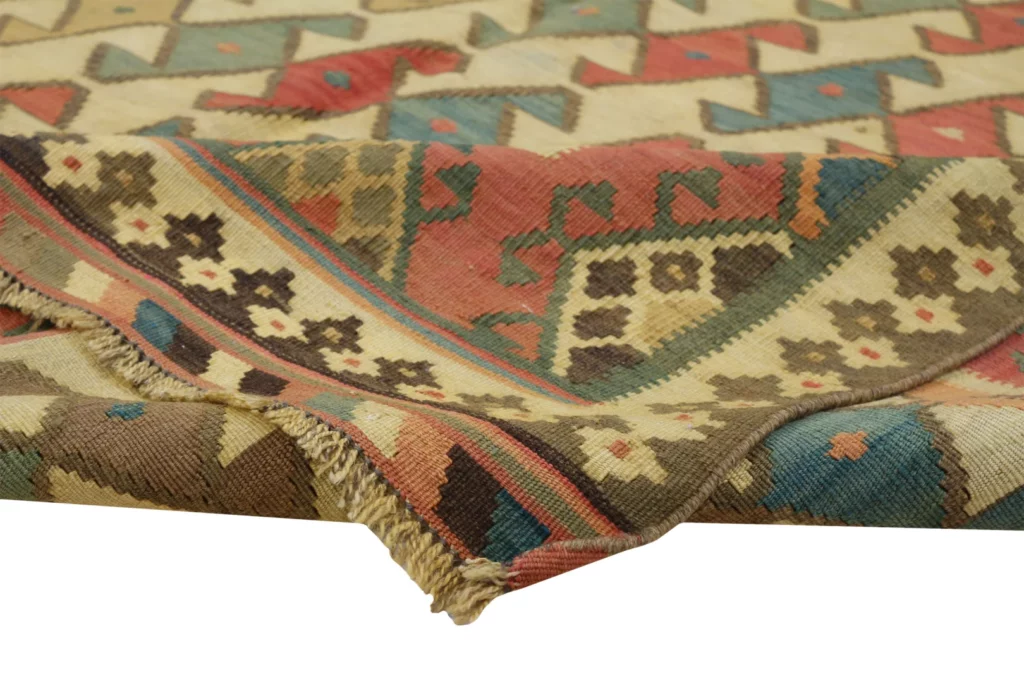
The absence of pile gives this piece its flat profile. There is no raised layer of cut or looped fibres over the woven foundation. This also makes the design readable as a textile arrangement of fields and lines rather than as a pattern created through pile height. The pattern is described as identical on both sides. That is a stated feature of this Kelim and relates to its woven form, in which the visible design is not dependent on a separate pile-facing side.
The condition is recorded as very good. This is the specific condition information supplied for the rug. No details are provided about fibre type, warp material, repairs, age, fringes or individual signs of use, so those points are not added here. The known craft facts are the hand-woven technique and the pileless Kelim construction. Together they place the piece within the long tradition of flat-woven Persian textiles.
Origin and Tradition
This Persian rug comes from Fars in Iran. Fars is a large region in the south of the country with a long and varied history of textile production. Its weaving culture has been shaped by settled communities as well as by groups with nomadic traditions. Flat-woven textiles form an important part of this regional history alongside knotted carpets. The name Fars indicates the origin region; it does not refer to one single pattern or one uniform workshop practice.
Textiles in Fars have historically served both practical and decorative purposes. A flat-woven Kelim could be used as a floor covering, a covering textile, a divider or part of portable household equipment. Its lack of pile makes it comparatively flat and easy to fold, which suits forms of use in which textiles need to be moved or stored. Such practical contexts encouraged a broad range of formats and designs rather than a single standard model.
The craft tradition begins with the preparation of the warp. Weft threads are then passed through it in successive rows, and the surface is built gradually from one section to the next. The maker must maintain an even relationship between the threads while also following the planned pattern. In a hand-woven piece, this process leaves room for small variations in line, spacing and rhythm. Those variations belong to the nature of manual textile production and do not turn the work into a mechanically repeated product.
Fars is often discussed as a meeting place of different weaving environments. Nomadic work may be associated with portable textiles and a direct geometric vocabulary. Village production can develop within a settled local context, while urban workshops may draw on more formalised design traditions. These categories overlap and should not be treated as rigid boundaries. They help explain why Fars textiles can differ considerably in structure and appearance while still sharing a connection to the southern Iranian weaving landscape.
Persian flat weaving is based on knowledge passed through practice. Skills include setting up the warp, controlling the spacing of the weft, building a border and keeping the composition coherent as the textile grows. The pattern is not simply printed onto a finished cloth. It is created during weaving through the selection and placement of threads. This makes the construction inseparable from the visual language of the finished Kelim.
The regional tradition also shows how textiles can carry both use and identity. Geometric arrangements may be connected to local habits of design, the requirements of a particular format or the experience of the individual weaver. A Fars Kelim should therefore be understood as part of a diverse southern Iranian textile culture, not as the product of one universal Fars template. The origin stated for this piece is specifically Fars, Iran, and no more detailed provenance is assigned.
Design and Pattern
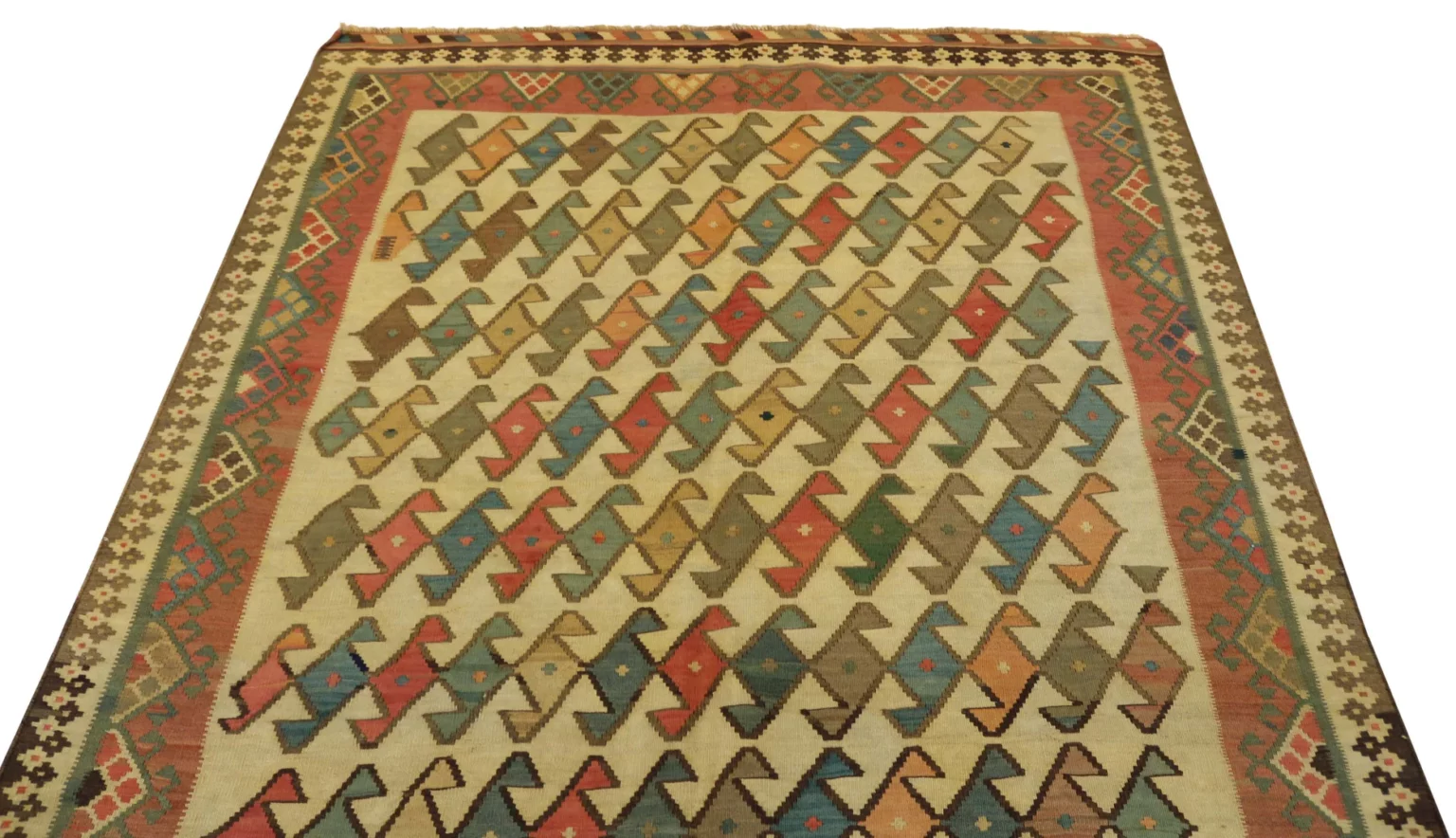
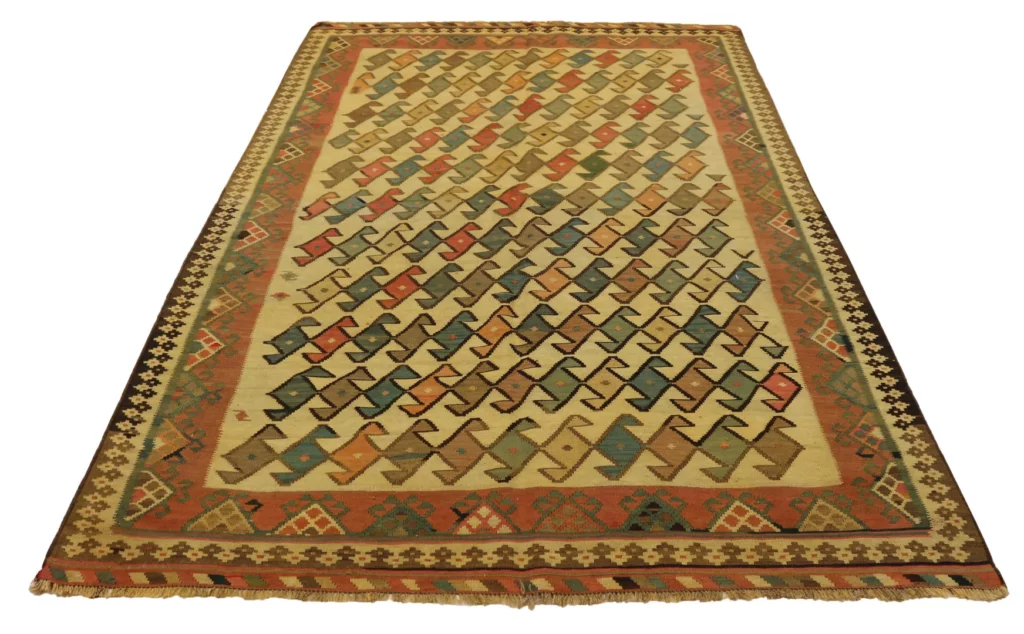
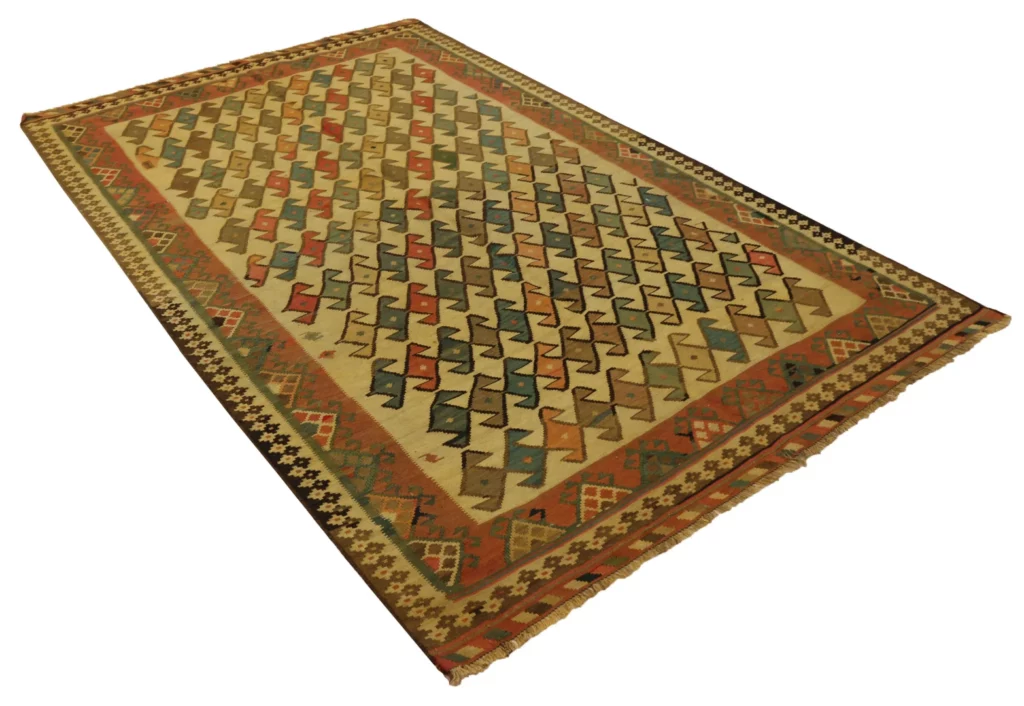
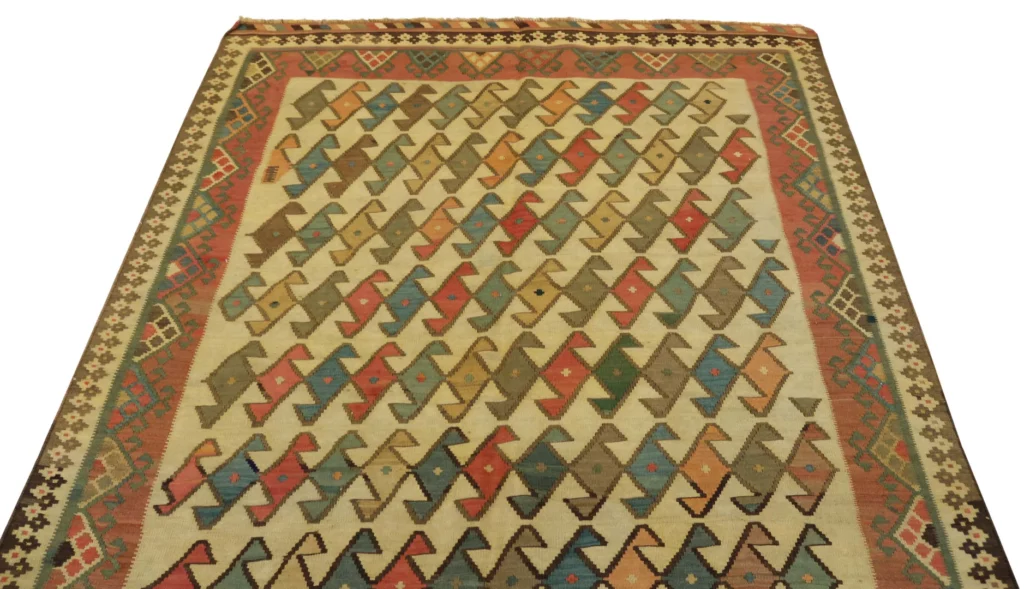
The pattern of this Kelim is identical on both sides. This is the defining design information supplied for the piece. Because the rug has no pile, its visual character comes from the distribution of woven areas, lines and colour passages within the flat surface. There is no directional pile to create a different appearance when viewed from the opposite end. Both sides are described as showing the same design.
Persian Kelims often use a geometric language that can be developed directly through the interlacing of warp and weft. Diamonds, stepped contours, angular bands, hooked forms and repeated compartments are common possibilities in the broader tradition. Straight lines and angled shapes are also practical ways of transferring a design into a woven structure. These general features describe the vocabulary of flat weaving, not additional motifs claimed for this individual Kelim.
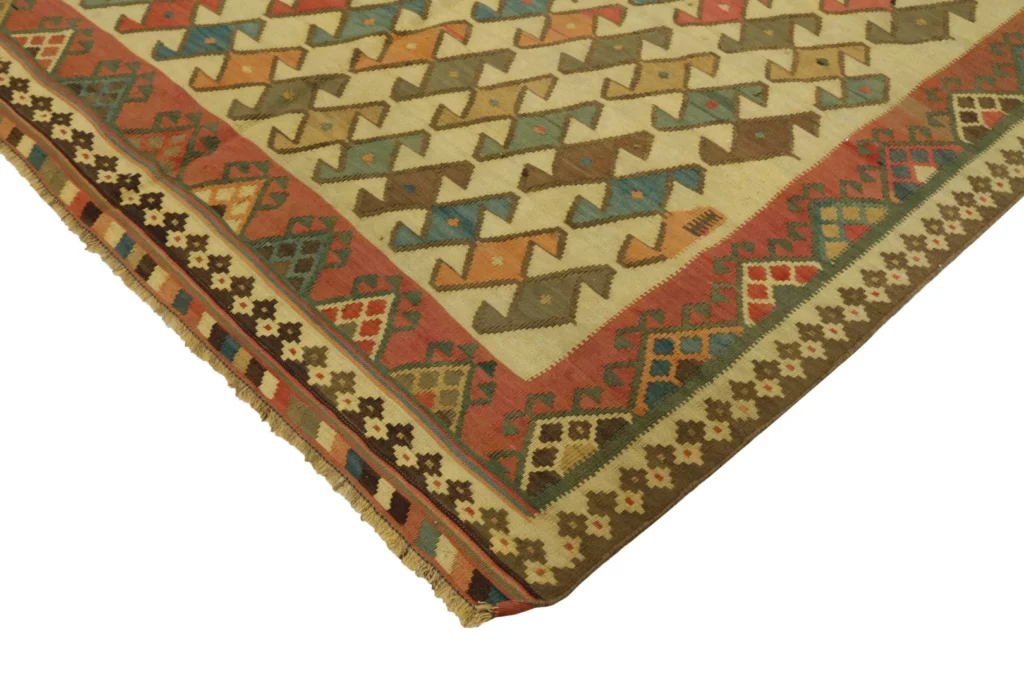
Regional Fars textiles may organise their surfaces in several ways. Some use a central field, while others divide the composition into bands, repeated compartments or sequences of geometric forms. Borders can frame an interior area and mark the transition toward the edge. In flat weaving, however, the relationship between field and border can be more fluid than in a formal workshop carpet. Bands may follow one another across the surface, and a repeated rhythm can provide the main sense of order.
The identical appearance on the two sides is significant when considering the design as a textile structure. It means that the reverse is not described as a separate technical side with a different visible arrangement. Instead, the same pattern effect belongs to both faces of the woven piece. This makes the rug legible as a reversible flat textile. No particular colours, medallion, border motif or named pattern is supplied, so none is assigned to it here.
Geometric design in a Kelim can combine regular repetition with the subtle movement created by handwork. A sequence may be clearly ordered without being mechanically uniform. The weaver adjusts the thread placement as the fabric develops, and the final rhythm is produced by the interaction of plan, material and manual execution. This is one reason flat-woven Persian textiles can look structured while retaining the direct character of a woven object.
The Fars origin provides the cultural setting for understanding the design tradition. It connects the piece with the southern Iranian history of hand-woven textiles, while the product information supplies the more specific statement that the pattern is identical on both sides. These two levels should remain distinct. Regional background explains the context of the Kelim; it does not justify adding a particular tribal, village or named motif that has not been identified.
Special Features
The main special feature is the combination of hand weaving and a pileless Kelim construction. The surface is flat because it has no pile. The pattern is identical on both sides, so the two faces have the same stated visual arrangement. These characteristics describe the textile itself and distinguish it from a hand-knotted rug with a raised pile surface and a clearly differentiated reverse.
The condition is specified as very good. No additional claims are made about restoration, wear, age, edge finishing or previous use because those details are not included in the description. The confirmed features remain the hand-woven technique, the absence of pile, the identical pattern on both sides and the very good condition.
The origin is Fars, Iran. This identifies the rug as a Persian rug from a named Iranian region. It does not identify a particular village, tribe, workshop or date of manufacture. The piece can therefore be described precisely through the facts that are known: a hand-woven, pileless Kelim from Fars with an identical design on both sides.
FAQ
What is a Kelim?
A Kelim is a flat-woven textile without a knotted pile. The surface is made by passing weft threads through a prepared warp, so the design is created within the weave itself. This rug is described as a hand-woven Kelim without pile. Its construction is therefore different from that of a hand-knotted rug, where individual knots form a raised pile above the foundation.
Where does this Persian rug come from?
The stated origin is Fars, Iran. Fars is in southern Iran and has a diverse history of textile production, including flat-woven Kelims as well as knotted carpets. The origin identifies the regional setting of this piece. It does not specify a particular village, tribe or workshop, so the precise provenance remains Fars, Iran.
Can the Kelim be viewed from either side?
The pattern is described as identical on both sides. Both faces therefore have the same stated design effect. This feature is consistent with the flat-woven, pileless character of a Kelim, where the design is part of the woven surface rather than dependent on a directional pile. The rug is also described as being in very good condition.
To provide the best experiences, we use technologies like cookies to store and/or access device information. Consenting to these technologies will allow us to process data such as browsing behavior or unique IDs on this site. Not consenting or withdrawing consent, may adversely affect certain features and functions.
Functional Always active
The technical storage or access is strictly necessary for the legitimate purpose of enabling the use of a specific service explicitly requested by the subscriber or user, or for the sole purpose of carrying out the transmission of a communication over an electronic communications network.
Preferences
The technical storage or access is necessary for the legitimate purpose of storing preferences that are not requested by the subscriber or user.
Statistics
The technical storage or access that is used exclusively for statistical purposes.The technical storage or access that is used exclusively for anonymous statistical purposes. Without a subpoena, voluntary compliance on the part of your Internet Service Provider, or additional records from a third party, information stored or retrieved for this purpose alone cannot usually be used to identify you.
Marketing
The technical storage or access is required to create user profiles to send advertising, or to track the user on a website or across several websites for similar marketing purposes.

 SECURE PAYMENT
 SHIPPING PARTNERS


