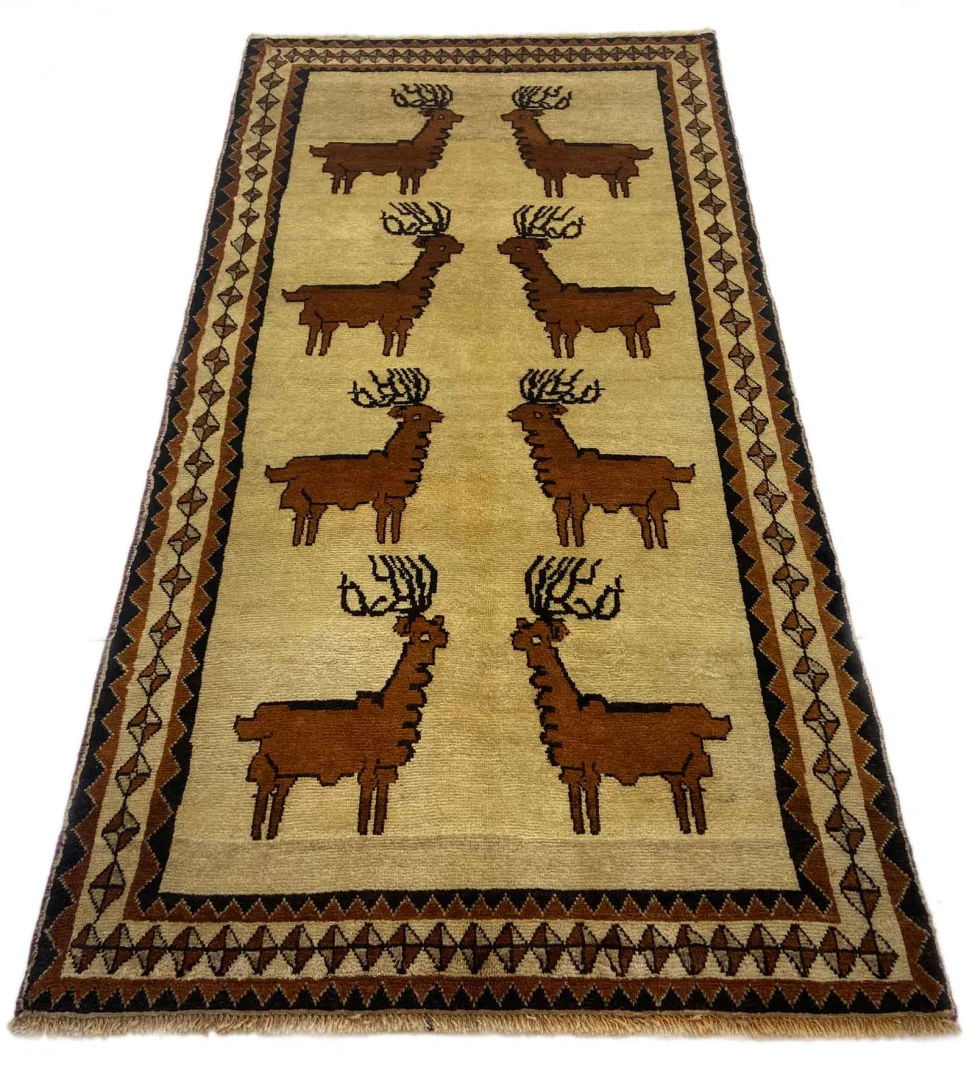
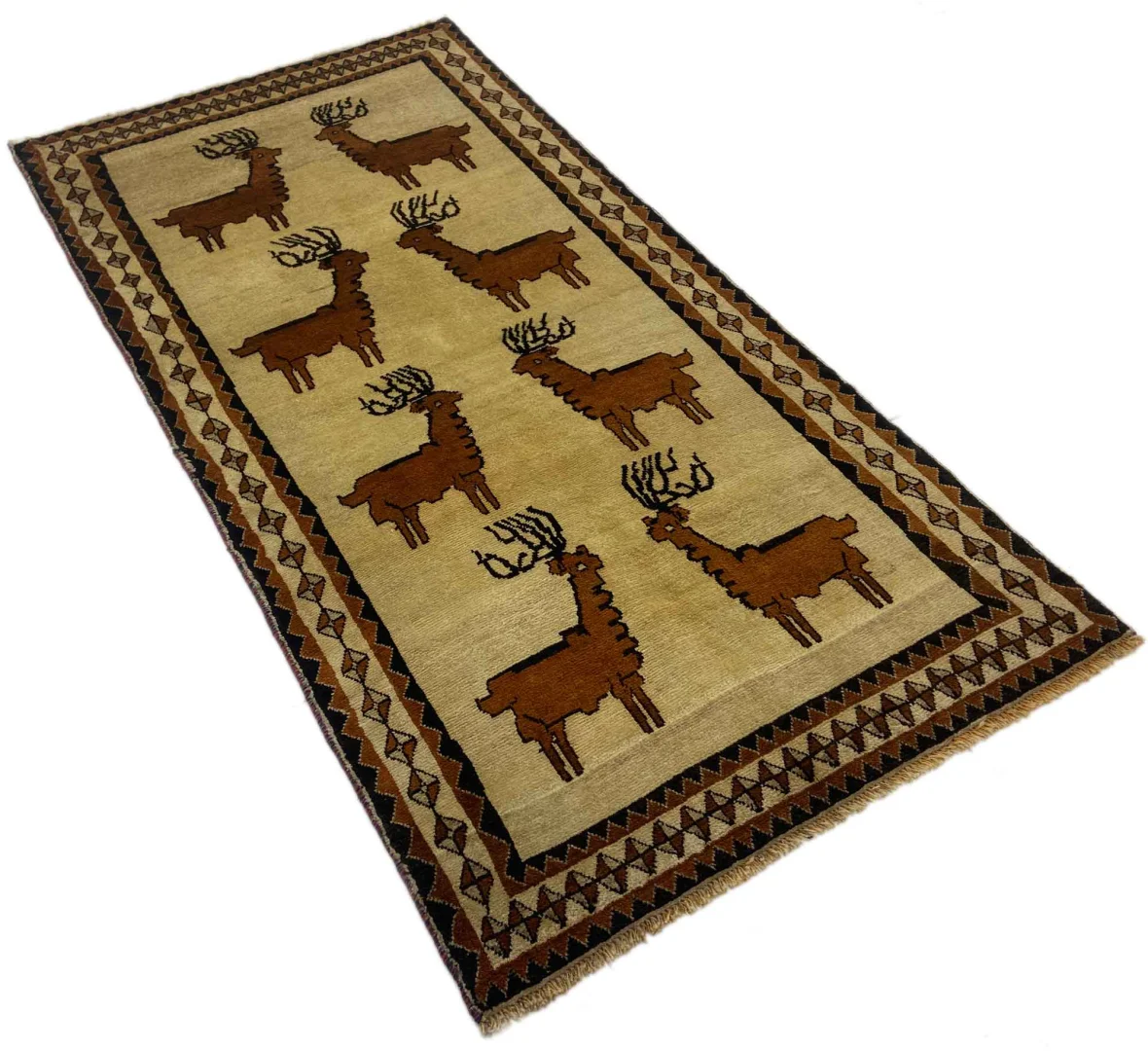
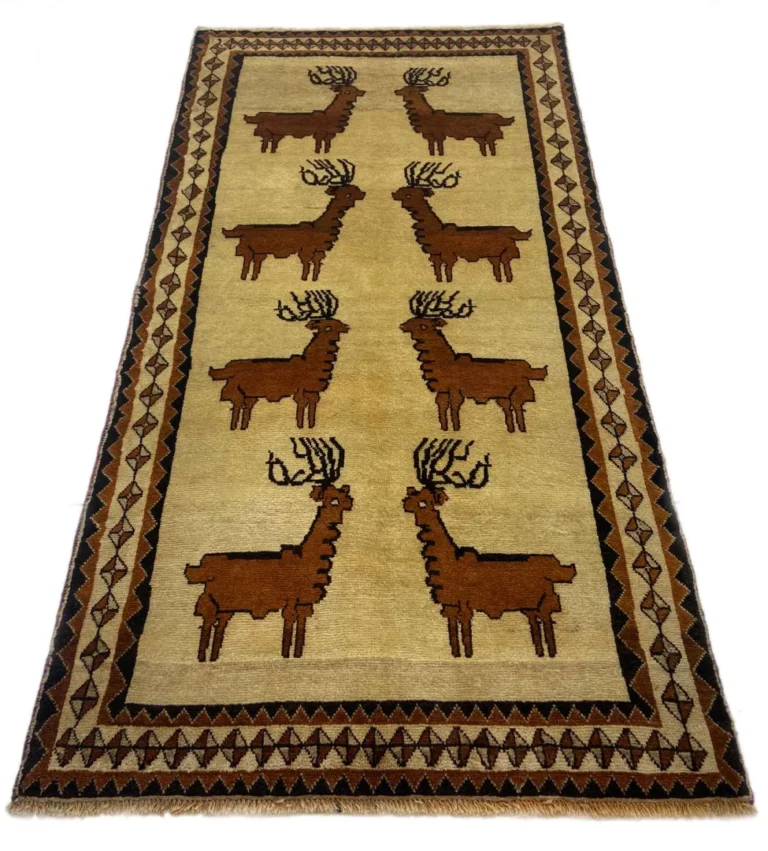
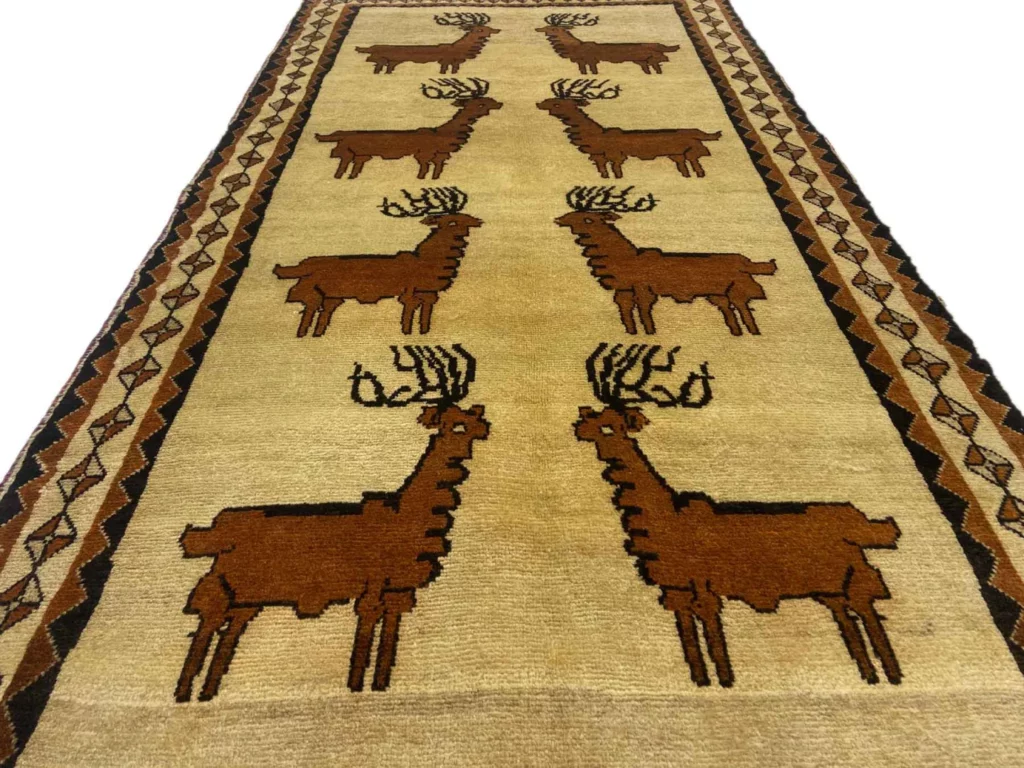
Hand-knotted Fars Persian rug | Knot density: 90,000 – 180,000 knots/m² | Material: Shiny virgin wool pile | Size: 224 x 114 cm | Pattern: Unusual, imaginative designs | Condition: Artwork with an individual character
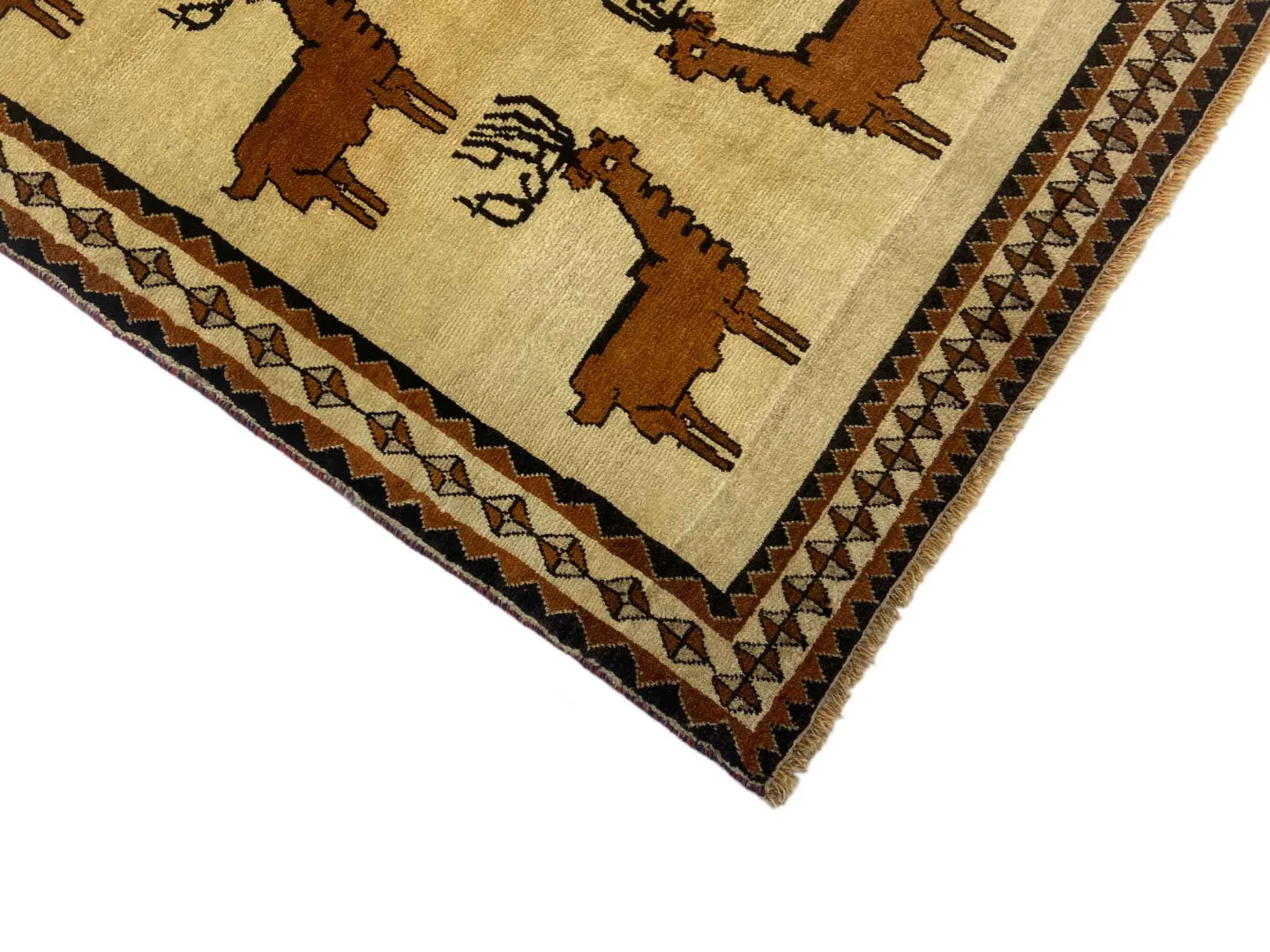
This Gabbeh Shuli Persian rug from the Fars region is made of shiny virgin wool and is hand-knotted. The wool gives the pile a pleasant feel and a visible sheen. As a natural fibre, wool has long been used in rug making because careful workmanship can combine a comfortable surface with a resilient structure. In a hand-knotted rug, each piece is created through a sequence of manual stages: knots are placed individually, rows are built up, and the pile is developed into a coherent textile surface.
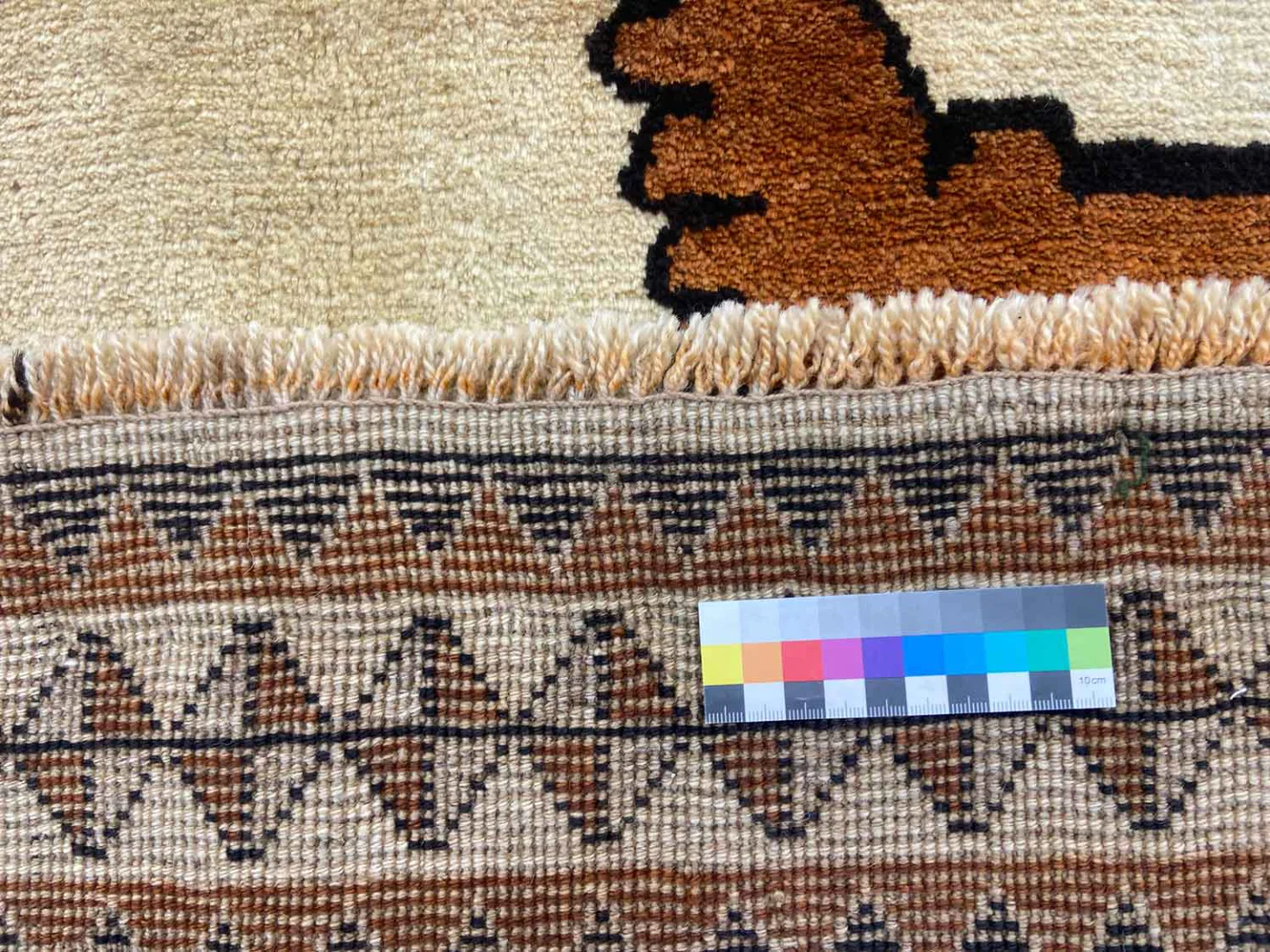
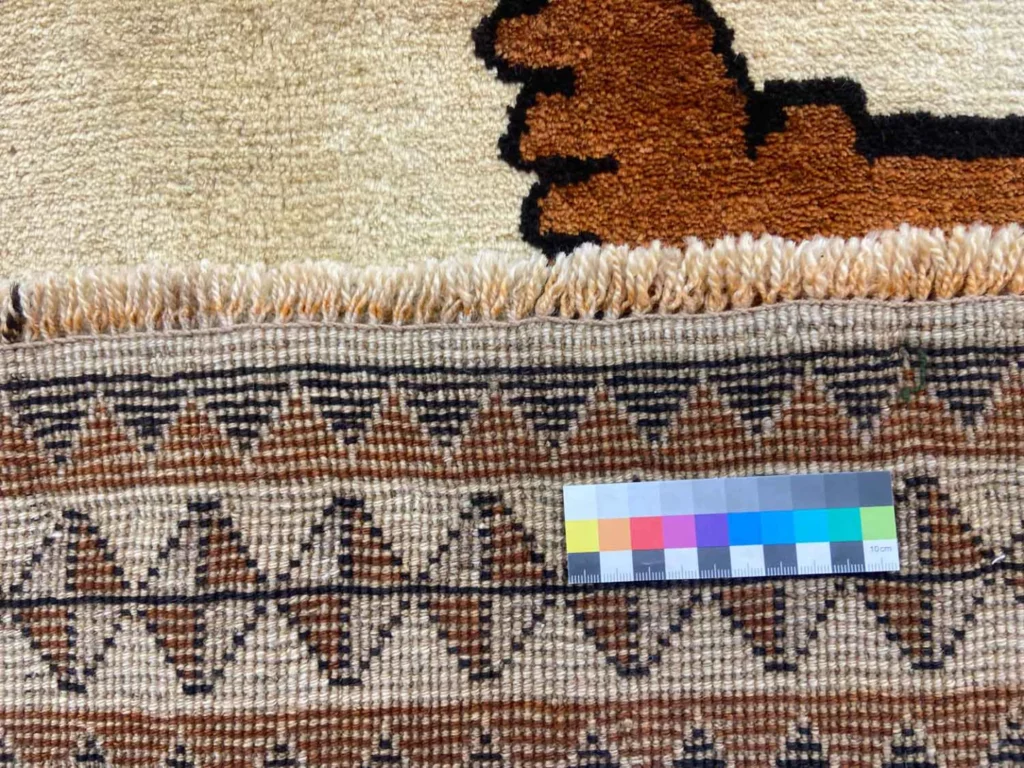
The stated knot density ranges from 90,000 to 180,000 knots per square metre. Knot density records the number of knots within a defined area and therefore forms part of the technical description of the rug. It also indicates the amount of handwork involved in creating the pile and the pattern. The knots, together with the wool, establish the rug’s tactile structure and provide the foundation on which its design is formed.
Hand-knotting differs from machine production because the work remains directly connected to the person making the rug. Small variations in rhythm, colour placement and drawing can remain visible rather than being eliminated by mechanical repetition. This rug combines that craft process with shiny virgin wool and the Gabbeh Shuli tradition. Its role is therefore not limited to covering a floor; it is also described as an individually distinctive artwork shaped by manual production.
Origin and Tradition
The rug comes from the Fars region in southern Persia, with Shiraz identified as an important carpet centre in the area. Fars is one of the historic landscapes of Persian rug culture. Its weaving heritage has been influenced by settled workshops as well as nomadic and semi-nomadic communities. These different ways of life have contributed to a varied regional tradition in which practical wool rugs and expressive patterns developed alongside one another.
In Fars, rug making has traditionally been closely connected with family and community life. Wool, technical knowledge and visual ideas were passed from one generation to the next. Knotting was not merely a production method; it was also a way of preserving experiences, local forms and images drawn from everyday surroundings. A weaver could follow an inherited concept while still allowing personal memory and individual judgement to influence the final arrangement.
Gabbeh rugs are particularly associated with the nomadic rug-making culture of southern Persia. Their roots lie in a practical tradition in which thick wool textiles were made for everyday use. The designs did not have to follow a rigid pattern book. Simplified figures, open fields and freely arranged forms could be created from memory or from the weaver’s own imagination. This helps explain why Gabbeh rugs can look direct and spontaneous while remaining firmly connected to a long-established regional craft.
The name Shuli is associated with a Gabbeh variant known for imaginative, childlike and abstract visual ideas. Such rugs unite the simplicity of nomadic design with a strong sense of personal expression. A motif may resemble a small scene, a sign or a remembered figure without attempting a fully realistic representation. The result is a visual language that can suggest a story while leaving the interpretation open.
The Fars tradition also belongs to a wider Persian history of rug production. Different areas produced rugs for different purposes: some were primarily practical household textiles, while others served more decorative or representative roles. In Fars, the relationship between usefulness and personal design remained especially visible. The Gabbeh Shuli type preserves this relationship by joining a functional wool construction with a free and individual approach to pattern.
Shiraz is important within this regional context because it has long served as a centre for trade and carpet culture in southern Persia. Through commercial routes, rugs from rural and nomadic areas could reach wider markets and be encountered alongside work from other parts of the region. The designation Fars therefore points to a diverse cultural and weaving landscape rather than to one uniform style. Gabbeh Shuli rugs are part of that wider landscape, with their own reduced and imaginative design vocabulary.
Design and Pattern
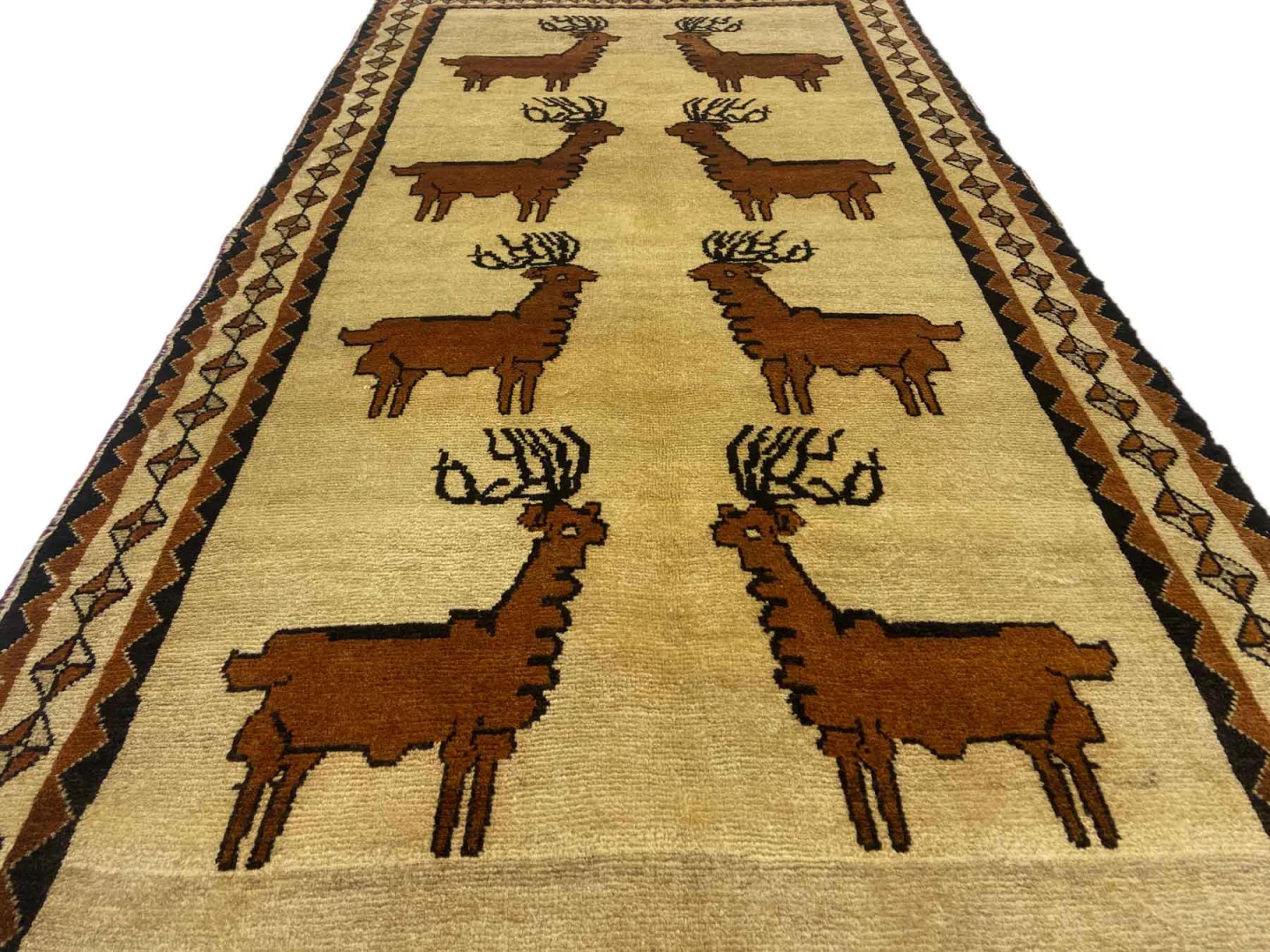
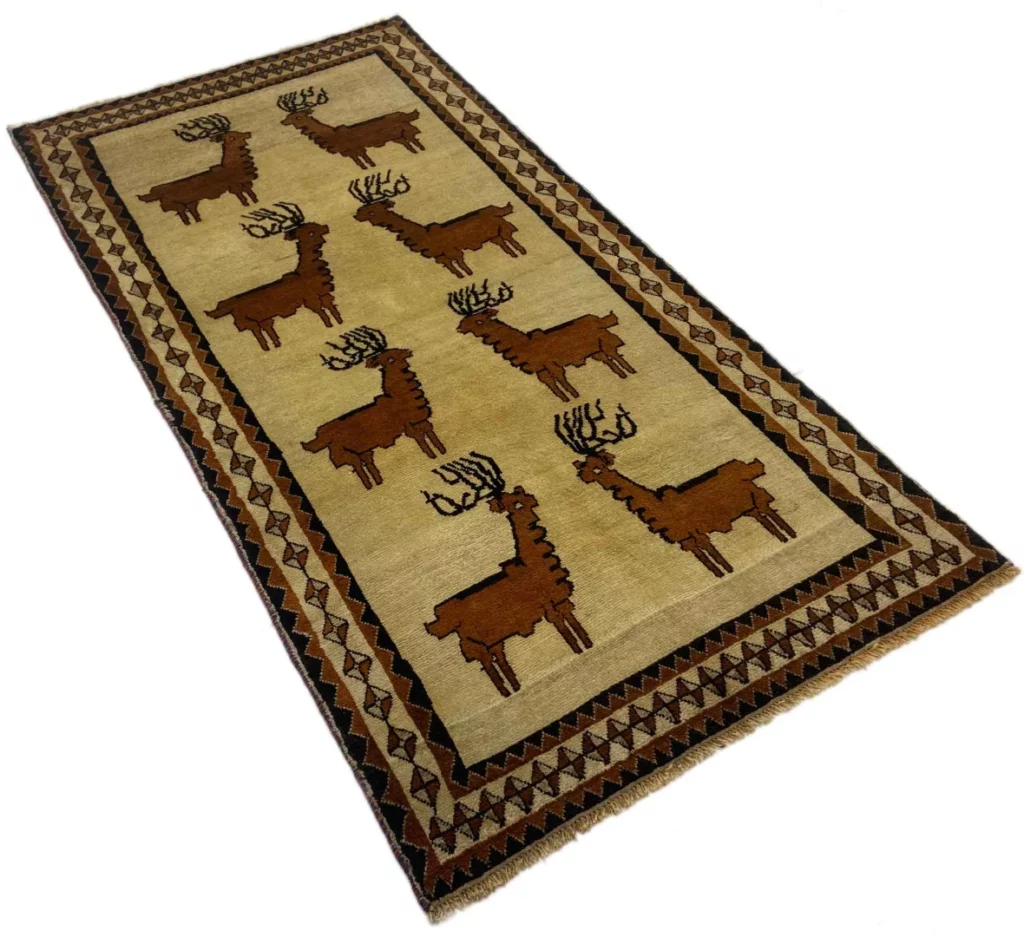
The pattern of this rug is described as unusual and imaginative. Gabbeh Shuli designs are known for childlike and abstract compositions that can resemble freely developed pictures. Unlike highly formal ornamental rugs, where the main aim may be the precise repetition of a prescribed decoration, this approach permits individual figures, signs and fields to stand beside one another in a less rigid arrangement.
Its abstract visual language allows for several readings. A shape may recall an animal, a person, a plant or a symbolic mark without presenting a literal image. This simplification is part of the Gabbeh Shuli character. Forms are reduced to essential lines and areas, keeping the composition accessible while giving the viewer room to complete the image through personal association.
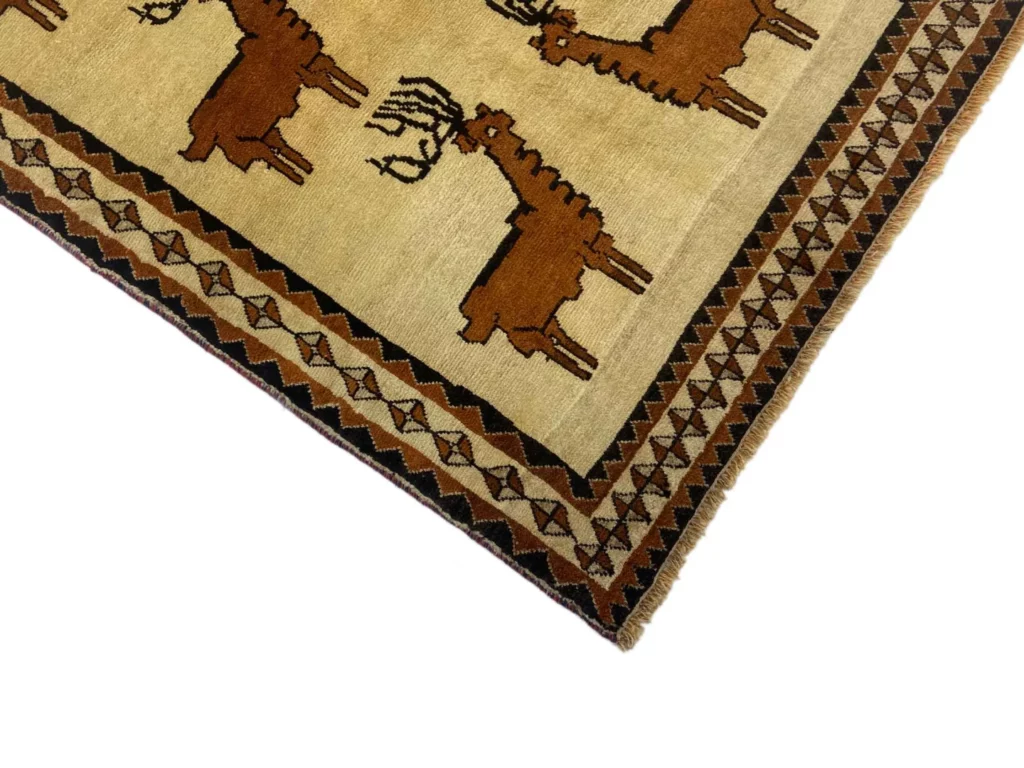
The colour palette named for the rug comprises red, beige, grey and brown. Red introduces a strong and warm note, while beige offers a lighter, quieter field. Grey adds a restrained tone, and brown brings an earthy element to the composition. Together these colours create a balance between vivid accents and natural, subdued shades. Their combination supports the directness of the pattern without requiring a large number of separate colours.
In Gabbeh Shuli rugs, the imaginative quality often comes from the relationship between a motif and the surrounding open space. A single figure can be allowed to stand clearly on its own, while other areas remain deliberately simple. This gives the composition a concentrated presence rather than relying on dense ornament. The design can consequently be read as an abstract arrangement of forms or as a small narrative image.
Traditional nomadic rugs often preserve the creativity of the individual weaver. Designs were not always produced by following an exact, mechanically repeated plan. Memories, observations from daily life and inherited shapes could be combined in a new way. This explains the variety found among imaginative Gabbeh patterns: a shared tradition can produce different visual solutions while retaining its regional identity.
The palette and pattern language can also be placed in different interior contexts. Red, beige, grey and brown can relate to a traditional setting with an interest in Persian craft, while the reduced abstract motifs can sit naturally within a more contemporary room. This is a general quality of the design vocabulary rather than a claim about a particular setting. The rug’s individual character remains central to the Gabbeh Shuli concept.
Special Features
This rug is described as an artwork with an individual character. That description reflects the combination of hand-knotting, shiny virgin wool and unusual, imaginative designs. The childlike and abstract visual language associated with Gabbeh Shuli gives each composition an independent interpretation of the regional tradition.
The virgin wool is described as pleasant, durable, resilient and naturally resistant to dirt. These rugs are also presented as easy to maintain and able to withstand everyday wear. Regular vacuuming and occasional beating are recommended for routine care. If a stain occurs, it should be addressed promptly with a mild cleaning product. These care instructions complement the rug’s visual and technical description by explaining how its wool surface may be looked after in daily use.
The combination of red, beige, grey and brown with the free pattern arrangement gives the piece a recognisable Gabbeh Shuli identity. It brings together its Fars origin, traditional handwork and imaginative design. Because the rug is hand-knotted, its individual execution remains an important part of the object rather than being separated from the pattern.
FAQ
How should I care for my Fars Persian rug?
Regular vacuuming helps remove loose dirt from the pile. Occasional beating can supplement this routine care. If a stain appears, deal with it as soon as possible and use only a mild cleaning product. Work carefully so that the virgin wool and the colour effect are treated gently. Consistent, appropriate care supports the preservation of the surface and of the rug’s imaginative red, beige, grey and brown design.
Where does the Persian rug come from?
The rug comes from the Fars region in southern Persia. Shiraz is located in this region and is an important reference point for its carpet tradition. Fars is known for a varied craft culture that includes regional workshops as well as nomadic-influenced weaving and knotting practices. Gabbeh Shuli rugs are especially associated with this southern Persian and old nomadic rug-making tradition, including its open approach to pattern.
What makes Gabbeh Shuli rugs distinctive?
Gabbeh Shuli rugs are distinguished by unusual, imaginative and often childlike abstract designs. Their motifs may resemble simplified figures, signs or small pictorial ideas, reflecting the individual creativity of the weaver. Combined with vivid red and quieter beige, grey and brown tones, this produces a distinctive visual language. The hand-knotted construction in shiny virgin wool connects that design approach with the inherited tradition of old nomadic rug making in Fars.
To provide the best experiences, we use technologies like cookies to store and/or access device information. Consenting to these technologies will allow us to process data such as browsing behavior or unique IDs on this site. Not consenting or withdrawing consent, may adversely affect certain features and functions.
Functional Always active
The technical storage or access is strictly necessary for the legitimate purpose of enabling the use of a specific service explicitly requested by the subscriber or user, or for the sole purpose of carrying out the transmission of a communication over an electronic communications network.
Preferences
The technical storage or access is necessary for the legitimate purpose of storing preferences that are not requested by the subscriber or user.
Statistics
The technical storage or access that is used exclusively for statistical purposes.The technical storage or access that is used exclusively for anonymous statistical purposes. Without a subpoena, voluntary compliance on the part of your Internet Service Provider, or additional records from a third party, information stored or retrieved for this purpose alone cannot usually be used to identify you.
Marketing
The technical storage or access is required to create user profiles to send advertising, or to track the user on a website or across several websites for similar marketing purposes.

 SECURE PAYMENT
 SHIPPING PARTNERS


