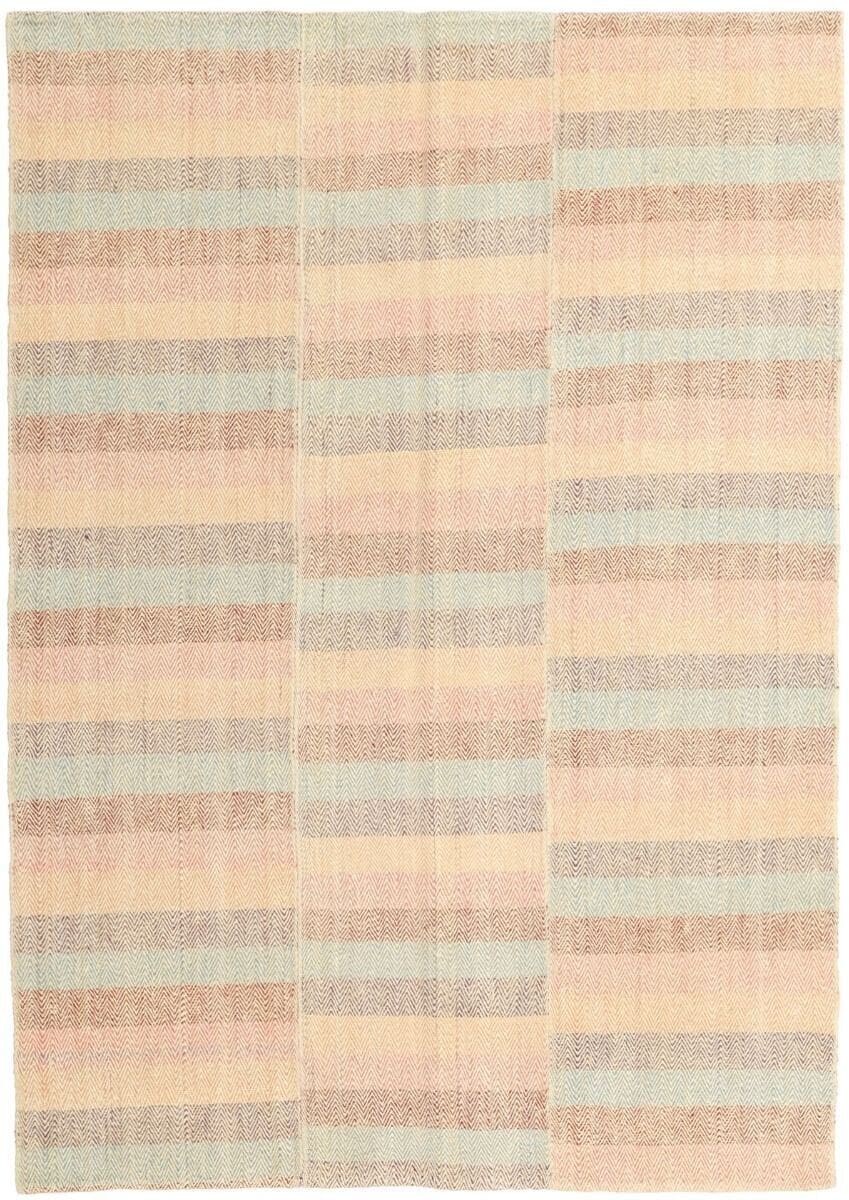
Hand-woven Fars Persian rug | Material: pile 100% wool | Size: 207 x 114 cm | Pattern: Solid, style: modern | Condition: New without label | Short pile, reversible, suitable for allergy sufferers and underfloor heating
This Fars kilim is hand-woven and made from 100% wool. Its flat-weave construction sets it apart from a hand-knotted pile rug: the yarns are interlaced into a compact textile surface rather than being built up through individual knots. With a kilim, the character of the piece lies in the woven structure itself. The stated pile is short, giving the surface a low, restrained profile.
Wool is a traditional material in Oriental rug making. It is used for its resilient fibres, comfortable handle and broad range of possible applications. For this rug, wool is the stated pile material. The specification of 100% wool describes the material composition of the offered piece; no additional information about a cotton warp or other fibres is provided.
Hand-weaving makes every kilim an individual woven textile. Even a modern solid design is shaped by the movement of the weaver and by the way the fabric is built across the loom. The short pile keeps the surface visually close to the flat weave. This rug is reversible, so both sides can be used. That two-sided usability is part of the practical character of this hand-woven kilim.
The rug is new and offered without a label. It is not described as an antique or historical piece. Its execution combines the established kilim technique with a modern, solid appearance. The material and craftsmanship remain clearly defined: hand-woven, wool and short pile.
Origin and Tradition
Fars is an Iranian region with a significant history of carpet and kilim weaving. The name Fars identifies the regional origin assigned to this piece. Iranian textile traditions include varied regional methods, materials and approaches to decoration. Kilims occupy a distinct place within those traditions because they are made by weaving a flat surface rather than by inserting individual pile knots.
Oriental rug making is closely connected with the transmission of practical knowledge. Understanding yarn, tension, colour interaction and finishing methods has traditionally been passed from one generation to another. Different Iranian areas developed their own textile expressions as a result. Fars belongs to the regions associated with both decorative and useful woven work. In commercial terms, Persian rugs are rugs from Iran, while a kilim is the flat-woven form within that wider tradition.
In a hand-woven kilim, the design is built during the weaving process. The warp provides the framework and the weft forms the visible field. Depending on the intended result, changes in colour, surface and weaving direction may be incorporated into the work. Unlike a knotted rug, a separate knot is not required for every point of pile. The result is a lighter, flatter textile structure characteristic of kilims.
The history of Persian rugs includes courtly, urban and regional workshops as well as textile work shaped by pastoral and nomadic communities. For that reason, the term does not describe one single appearance. Pile, density, materials, colours and patterns can vary widely. A Fars kilim can be understood within this broad tradition as a hand-woven piece with a flat surface. In this case, the modern style adds a contemporary direction rather than a deliberately historical ornamental layout.
Fars is also associated with the cultural history of southwestern Iran. Regional textiles have been produced for everyday use as well as for interior furnishings. Their function could change over time: a woven piece might serve as a floor covering, a room textile or a decorative surface. Contemporary use in the home continues that versatility without turning every piece into a historical object. This rug is described as a new kilim, representing a current combination of regional identity, traditional technique and modern design.
The tradition of flat weaving is also important because it demonstrates how useful textiles can carry regional knowledge. The loom, the handling of wool and the treatment of the finished edges all influence the character of a kilim. These elements are part of the wider craft background rather than claims about an unrecorded detail of this particular rug. What is established here is its Fars attribution, its Iranian Persian classification and its hand-woven kilim construction.
Design and Pattern
The pattern of this rug is solid and its style is modern. The design therefore centres on one continuous colour field rather than on a collection of ornaments. A solid kilim can allow the weave itself to remain visible and create a calm, unified appearance. It does not depend on a floral medallion, a border or a repeated geometric sequence. The defining visual information is the continuous, unornamented field.
Modern kilims retain the traditional flat-weave technique while often moving away from inherited ornamental arrangements. This can result in reduced fields, clear outlines and a restrained decorative language. In a solid design, order comes less from multiple symbols and more from the relationship between material, weave and colour field. The simple treatment can sit alongside furniture and other textiles without competing with them through a small-scale pattern.
Patterns have long served an organising role in Persian and Oriental rugs. Borders frame a field, central medallions establish a focal point and repeated motifs create rhythm across a surface. Kilims use such devices differently according to region and execution. For this Fars kilim, however, a solid pattern is expressly stated. Specific symbols, exact colours or individual ornaments are therefore not part of its description.
Flat weaving affects how a modern kilim is seen. Light meets a woven surface differently from a high pile, and the textile remains visually closer to the floor. The short pile supports this understated surface. Because the rug is reversible, its design is not limited to one specified direction of use. Its appearance comes from the solid field and hand-woven texture rather than from elaborate pictorial detail.
A kilim can work with many interior approaches because its design language is not tied to one particular room. A modern solid piece may be used in clearly structured interiors as well as in spaces where several materials are already present. The description that it is suitable for all rooms points to this broad usability. It does not assign the rug to a particular room; it summarises the versatile way in which the piece can be used in the home.
The absence of a detailed motif does not mean that the design lacks structure. In a flat-woven textile, the interaction of warp, weft, wool and surface tension provides its own visual order. A solid field makes this construction easier to perceive than a densely decorated composition might. Here, the regional name Fars and the traditional kilim method provide the cultural context, while the modern solid style determines the visible design direction.
Special Features
The rug is new and is offered without a label. It is reversible, allowing both sides to be used. It is also described as suitable for allergy sufferers and for underfloor heating. These are practical product features. The short pile and flat-weave construction reinforce this functional character.
The material is specified as 100% wool. The rug is additionally described as environmentally friendly and easy to clean. These statements are presented as product properties, without adding a claim about a particular cleaning process or environmental certification. Its solid modern design makes it suitable for different rooms and furnishing contexts.
Reversibility is a useful feature of a flat-woven kilim. It allows the textile surface to be used without restricting everyday use to one designated front side. Together with the short pile, this gives the rug a straightforward character distinct from a deep-pile carpet. No special treatment or signature is stated.
The combination of wool, hand-weaving and a solid modern design keeps the description focused on material and construction rather than on elaborate ornament. Its Fars attribution places it within an Iranian weaving context, while its new condition identifies it as a contemporary offering rather than an old or antique textile. The practical details complete the profile: reversible use, suitability for allergy sufferers and underfloor heating, environmental friendliness and easy cleaning.
FAQ
How should I care for this Persian rug?
Vacuum the kilim regularly so that loose dirt does not remain in the textile structure. When a spill or mark occurs, treat it promptly rather than allowing it to settle. Avoid vigorous rubbing, which can put unnecessary stress on a woven surface. Direct sunlight should also be avoided because it can fade colours. As this rug is made of wool and hand-woven, a thorough or intensive cleaning should be discussed with a suitable rug-care professional. The description “easy to clean” indicates a practical product property, but it does not replace careful handling of individual stains. Since the rug is reversible, both sides may be used; before turning it over, ensure that the textile is clean and dry.
What makes a Fars kilim distinctive?
Its distinctive character comes from the combination of a regional Fars attribution, traditional hand-weaving and a modern solid design. A kilim is woven as a flat textile rather than hand-knotted, so the structure of the weave remains central to its appearance. This rug is made from 100% wool, has a short pile and can be used on both sides. It is new and offered without a label. Its design is not defined by a complex ornament, but by one solid field. The Fars name places it within an Iranian regional textile context, while the modern style shows how the kilim technique can be used in contemporary interiors. The stated features of suitability for allergy sufferers and underfloor heating, environmental friendliness and easy cleaning add practical information to the traditional craft background.
Where can I buy an authentic Persian rug?
Authentic Persian rugs and kilims can be found through specialist rug dealers or reputable online retailers that describe each piece clearly by origin, technique, material and condition. In any listing, regional terms and construction terms should be kept distinct. Fars identifies the regional attribution of this piece, while kilim describes its flat-weave technique. A hand-woven textile should not be presented as hand-knotted. Clear information about fibre content and condition is also useful when comparing rugs. This rug is offered as a new hand-woven Fars kilim made from 100% wool and supplied without a label. Details such as its solid pattern, short pile, reversible construction and suitability for underfloor heating make it possible to assess the piece factually alongside other Oriental rugs.
To provide the best experiences, we use technologies like cookies to store and/or access device information. Consenting to these technologies will allow us to process data such as browsing behavior or unique IDs on this site. Not consenting or withdrawing consent, may adversely affect certain features and functions.
Functional Always active
The technical storage or access is strictly necessary for the legitimate purpose of enabling the use of a specific service explicitly requested by the subscriber or user, or for the sole purpose of carrying out the transmission of a communication over an electronic communications network.
Preferences
The technical storage or access is necessary for the legitimate purpose of storing preferences that are not requested by the subscriber or user.
Statistics
The technical storage or access that is used exclusively for statistical purposes.The technical storage or access that is used exclusively for anonymous statistical purposes. Without a subpoena, voluntary compliance on the part of your Internet Service Provider, or additional records from a third party, information stored or retrieved for this purpose alone cannot usually be used to identify you.
Marketing
The technical storage or access is required to create user profiles to send advertising, or to track the user on a website or across several websites for similar marketing purposes.
 SECURE PAYMENT
 SHIPPING PARTNERS


