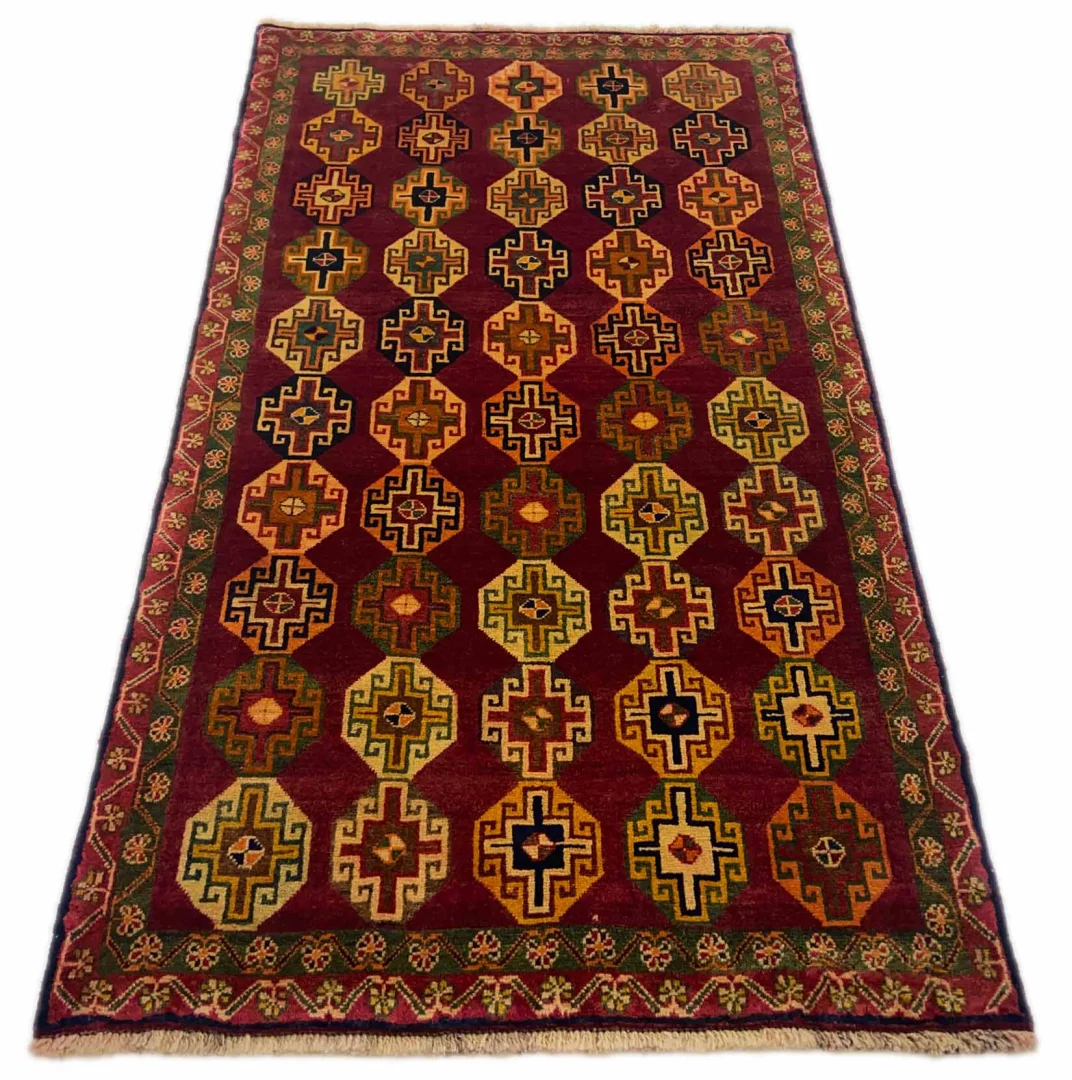
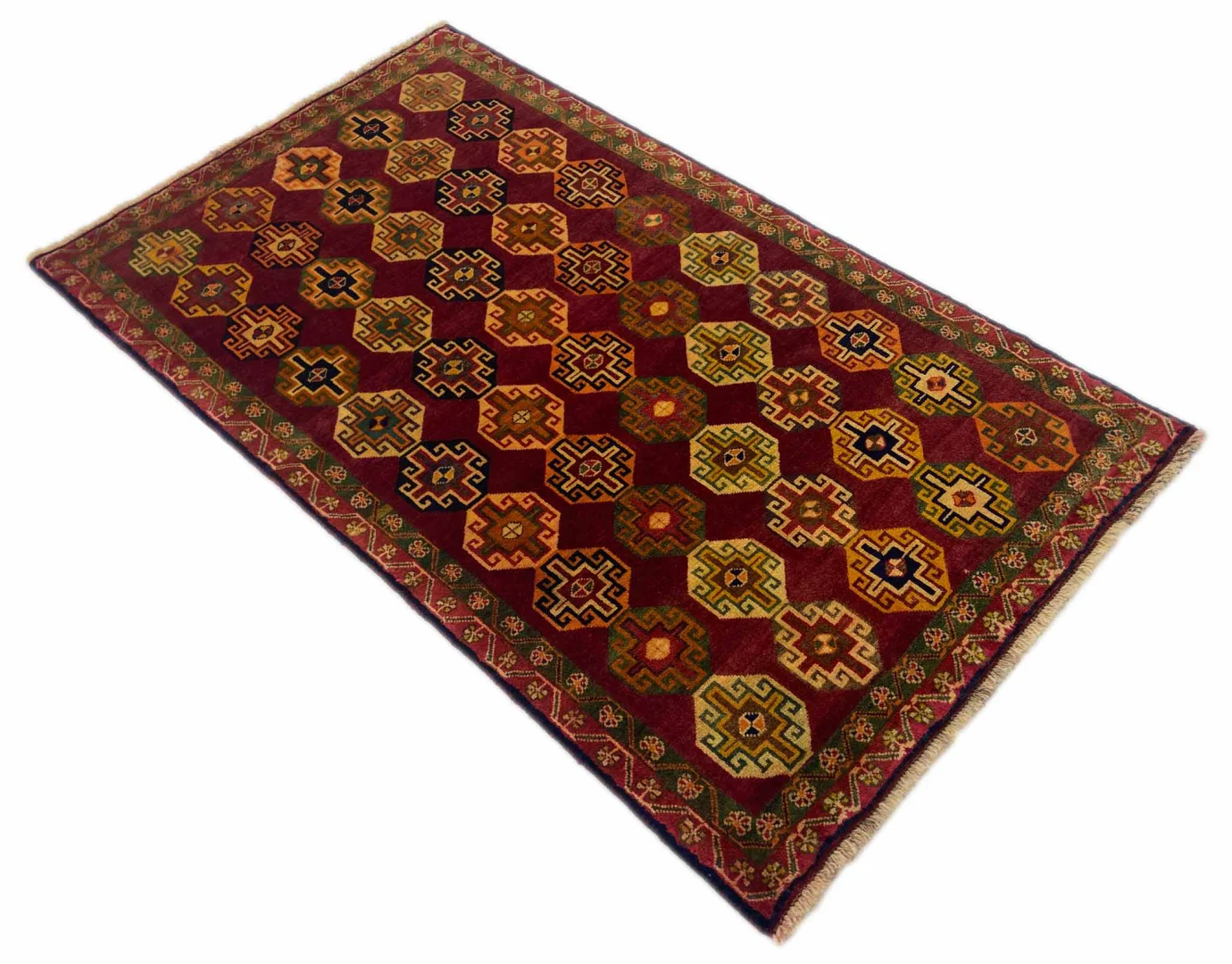
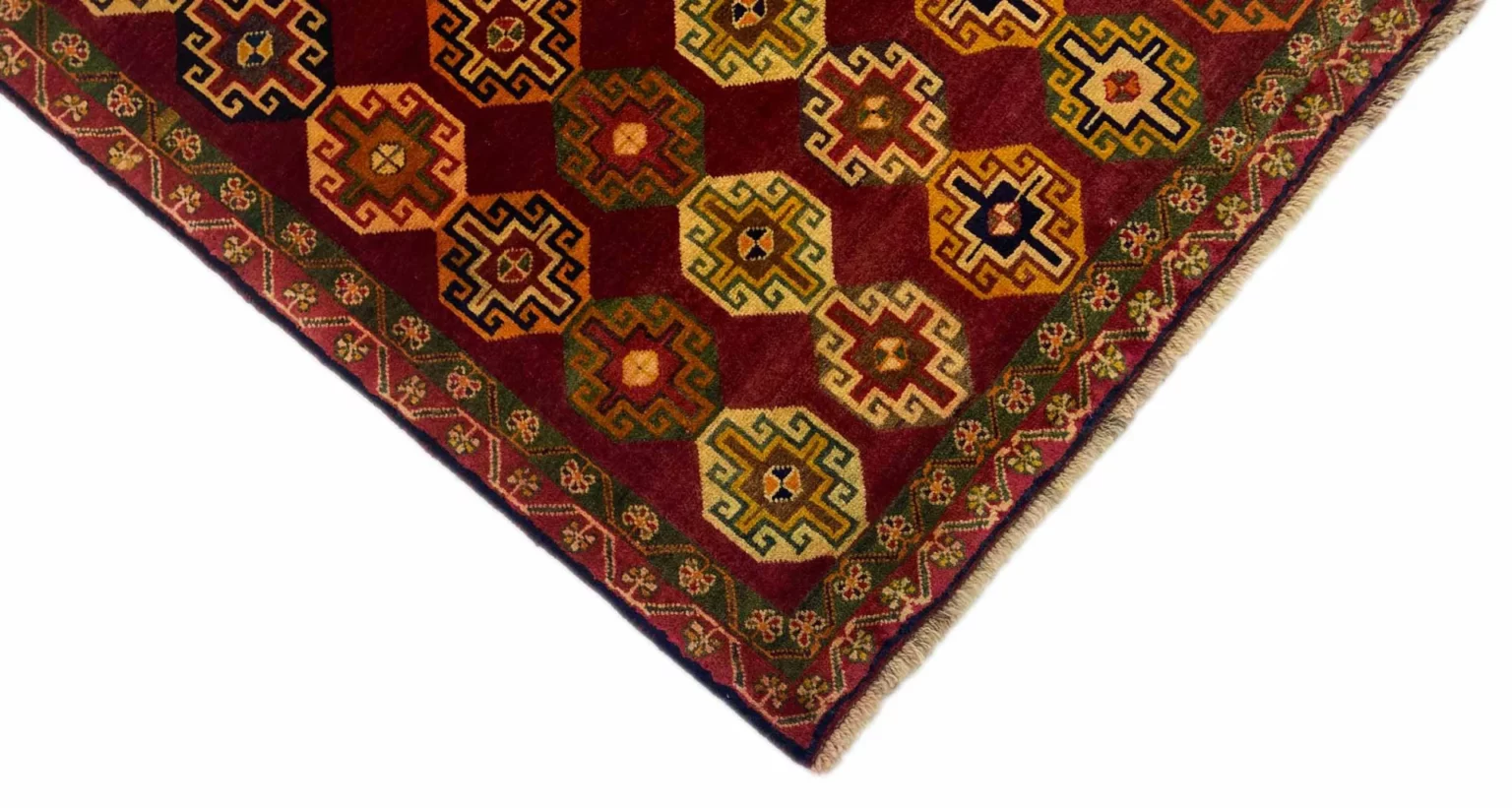
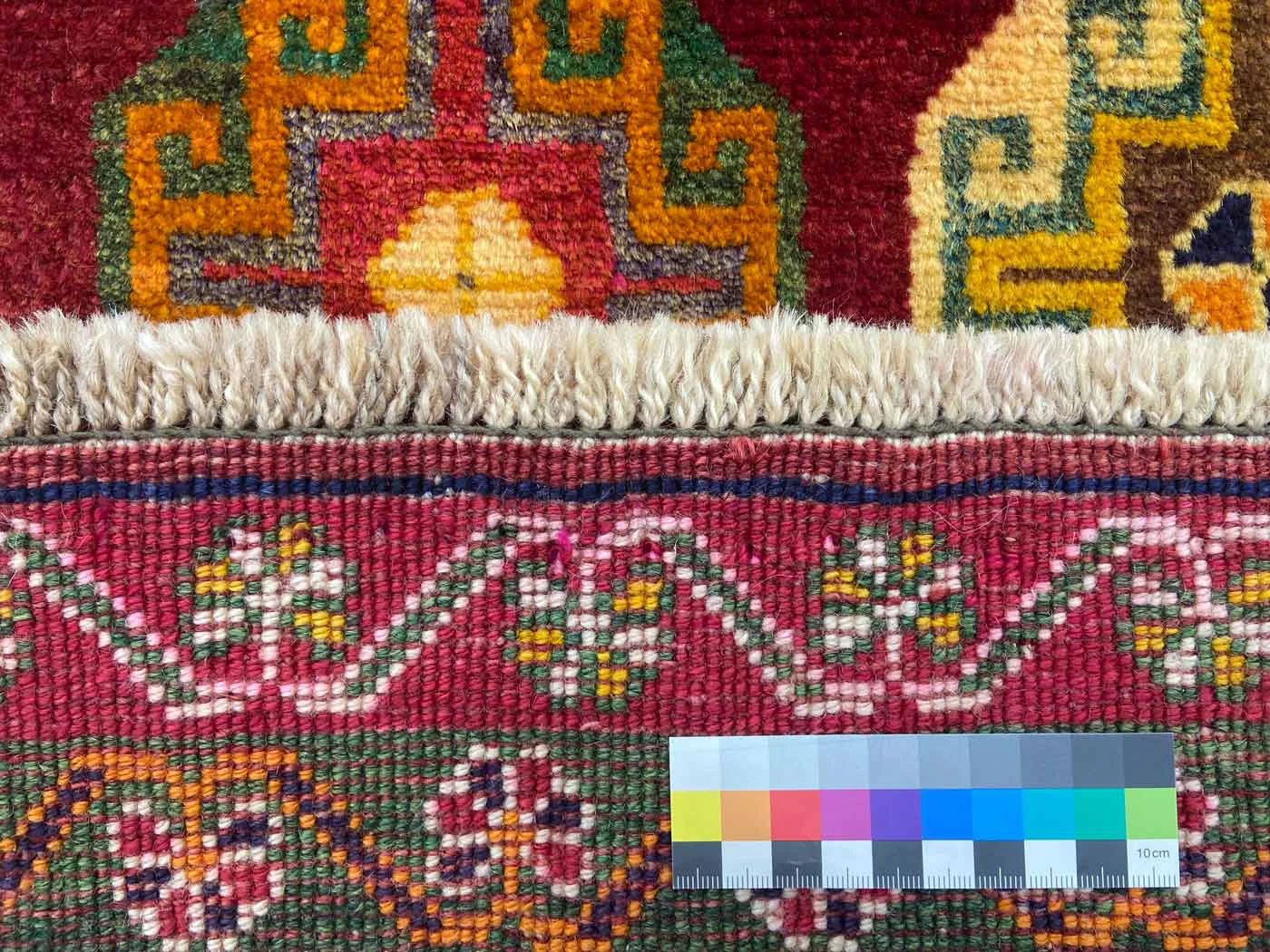
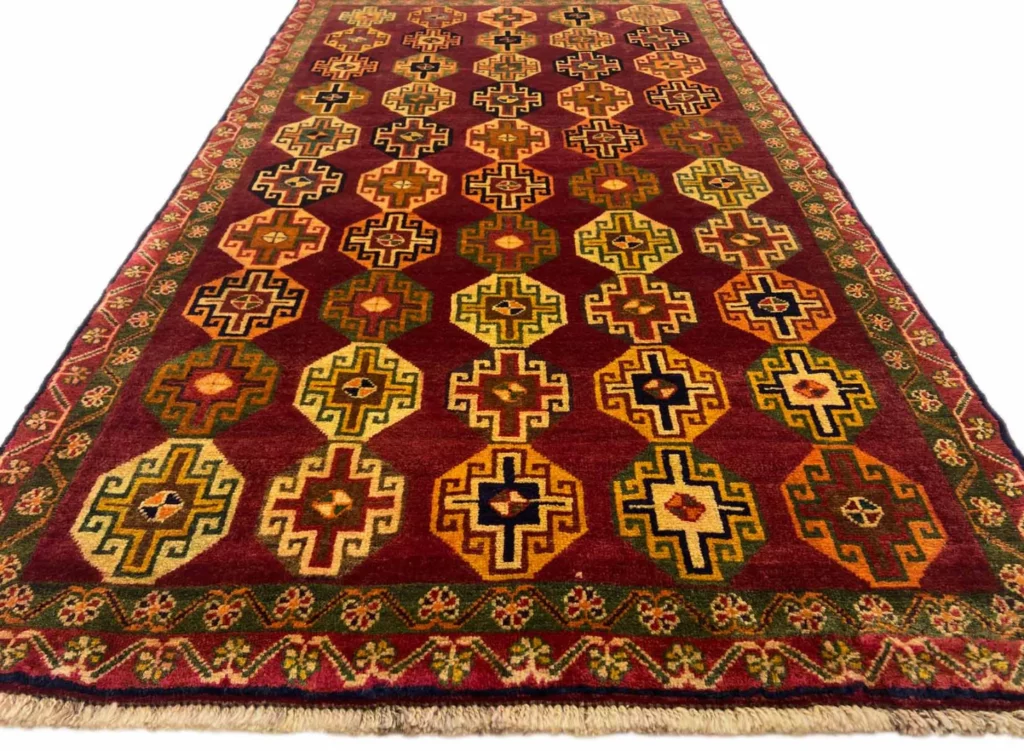
This Gabbeh Persian rug comes from the Fars region and is hand-knotted with a pile made of virgin wool. The wool gives the surface a naturally substantial feel and a warm textile character. Virgin wool has been used for handmade rugs for centuries because it can provide a resilient pile while retaining a comfortable, tactile structure. In a hand-knotted rug, each knot is made individually and inserted into the foundation row by row. The pile is then levelled and finished so that the design can be read across the surface.
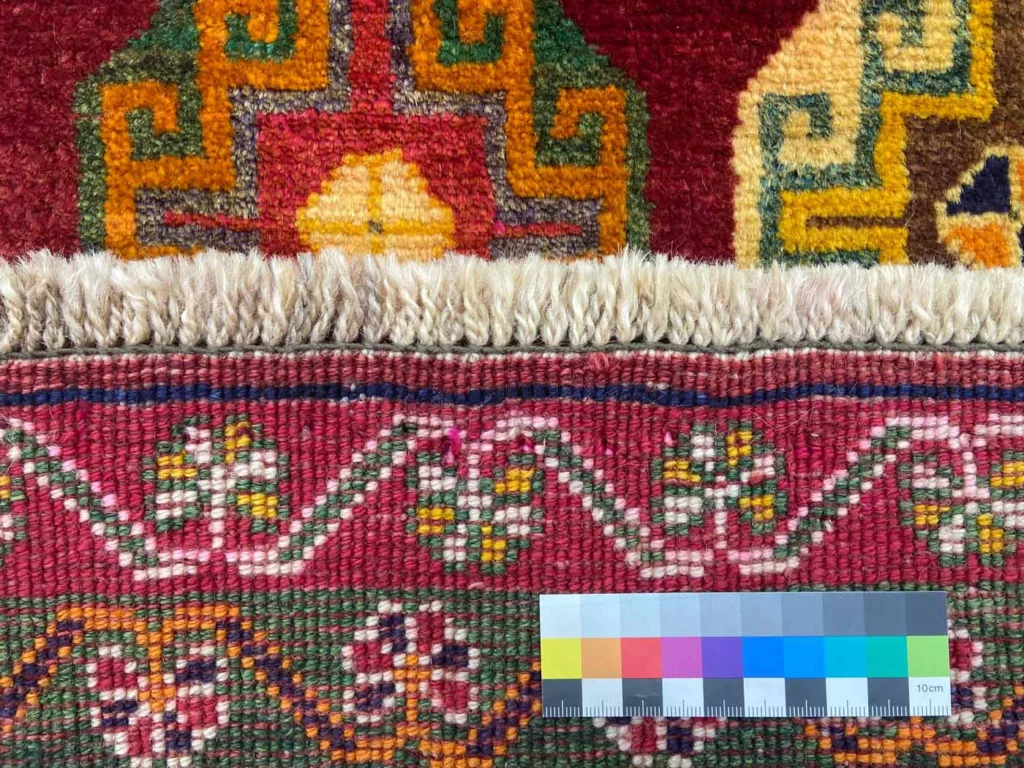
The knot density of this rug is stated as 90,000 to 180,000 knots per square metre. Knot density records the number of knots within a defined area and helps indicate how finely a design can be worked. In handmade rugs, it is an important part of the construction because it affects the possible precision of outlines, transitions and small details. The visible pile material of this piece is virgin wool; no other pile fibre is specified.
The workmanship combines the traditional hand-knotting process with the freer approach to shape and colour associated with Gabbeh rugs. This rug is described as new. Its listed colours are red, beige, grey and brown. Together with the wool pile, these colours create a surface in which the handmade structure can remain part of the visual character. Every hand-knotted rug has its own sequence of knots and minor variations resulting from manual work. That is a general feature of the technique and does not constitute an additional claim about the age or provenance of this particular rug.
Origin and Tradition
The rug originates in the Fars region of Persia. Fars lies in southern Iran and is closely associated with the history of Persian textile production. Its landscape includes different geographical environments, from open country to mountainous areas. Over time, this variety supported several forms of weaving and knotting. Rugs from Fars are often discussed in connection with rural, nomadic and semi-nomadic textile traditions, where practical construction and individual expression developed alongside one another.
Within the wider Persian rug tradition, Gabbeh refers to a recognisable type of rug rather than simply to a decorative effect. Gabbeh weaving is traditionally connected with nomadic and semi-nomadic communities in south-western Iran. The design is usually more direct and less formally regulated than the dense floral compositions of many urban workshop rugs. A Gabbeh may use simplified figures, geometric signs and open fields. Its apparent simplicity can be the result of a considered visual language shaped by long experience with hand weaving and hand knotting.
Making a hand-knotted rug involves a sequence of skilled operations. The foundation is prepared first, after which the knotter follows the intended structure and introduces the coloured areas one row at a time. The pile is worked and adjusted as the rug progresses, allowing the outlines of the design to become visible. The edges are then organised and the finished surface is prepared for use. The time and degree of detail depend on factors such as knot density, the complexity of the pattern and the materials selected. These are characteristics of the craft process rather than additional specifications of this individual rug.
Persian rugs are made in many regions of Iran, each with its own established vocabulary of colour, drawing and construction. Kerman, Isfahan, Tabriz and Nain are well-known examples of other Persian production centres. Their traditions can differ in the arrangement of medallions, floral drawing, borders, palette and technical refinement. Fars has a distinct place within this landscape through its association with regional and nomadic forms of textile making. A Gabbeh from Fars therefore belongs to a particular branch of Persian rug culture and should not be classified solely by the presence of a simplified pattern.
The regional background also helps explain why Gabbeh designs often appear less formal than rugs made in urban workshops. A nomadic or rural weaver could develop a design from memory, daily surroundings and inherited visual signs without following a fixed cartoon or strictly repeating programme. This left room for changes in scale, spacing and motif. A composition might be built around a few clearly recognisable forms rather than a dense field of ornament. Such historical context describes the rug type and its tradition; it does not add an unrecorded story about the maker or the exact circumstances in which this rug was produced.
The history of Persian rugs includes both highly structured courtly and urban styles and more spontaneous regional traditions. Their differences reflect available materials, local customs, intended use and the organisation of production. Gabbeh is associated with a direct, robust approach in which the textile itself and the clarity of the drawing remain important. The hand-knotting method gives the weaver control over every section of the surface, while the design tradition allows greater freedom than a strictly prescribed ornamental layout. This combination remains central to the identity of Gabbeh rugs from Fars.
Design and Pattern
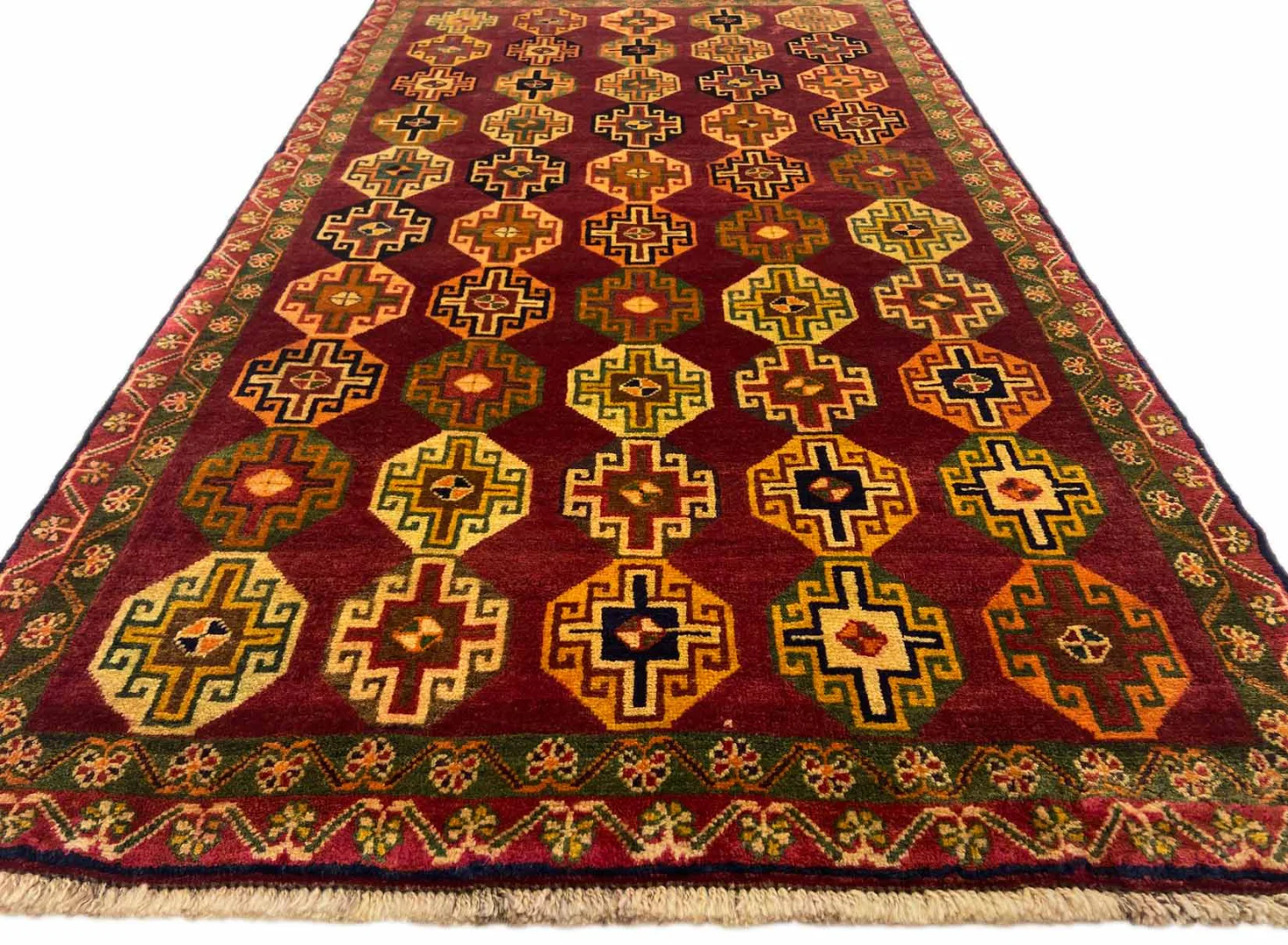
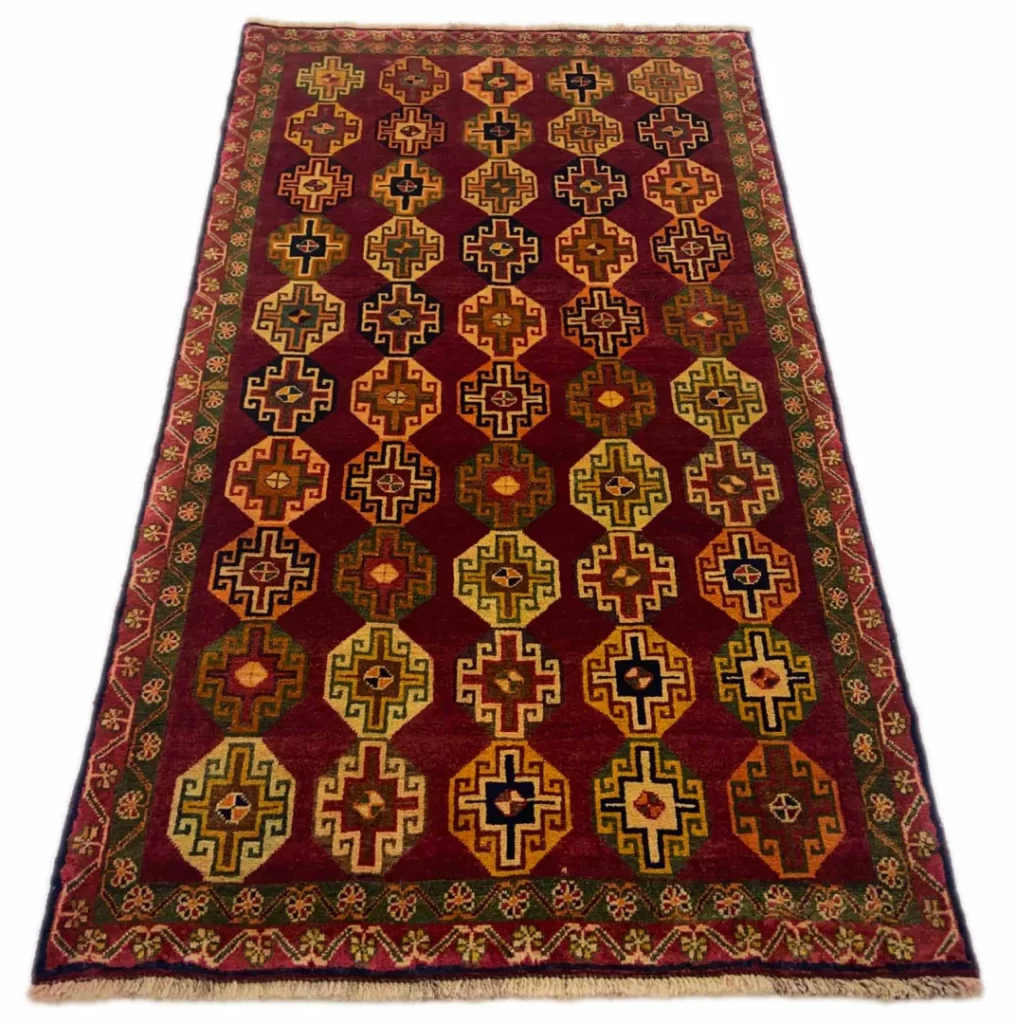
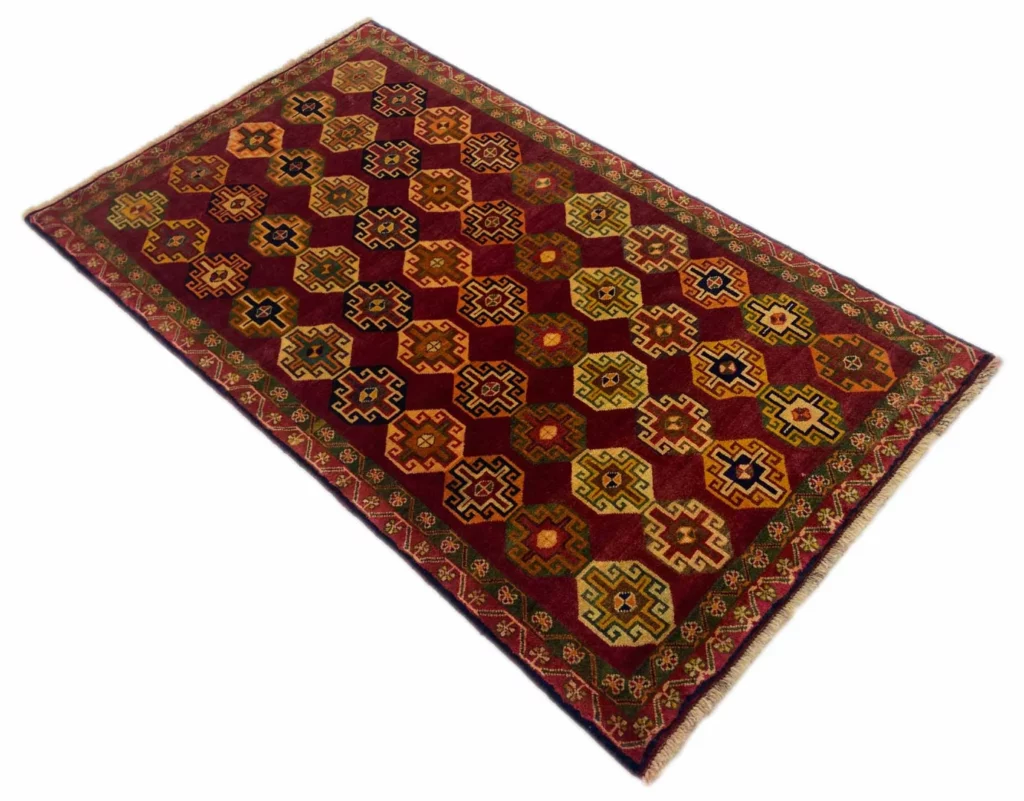
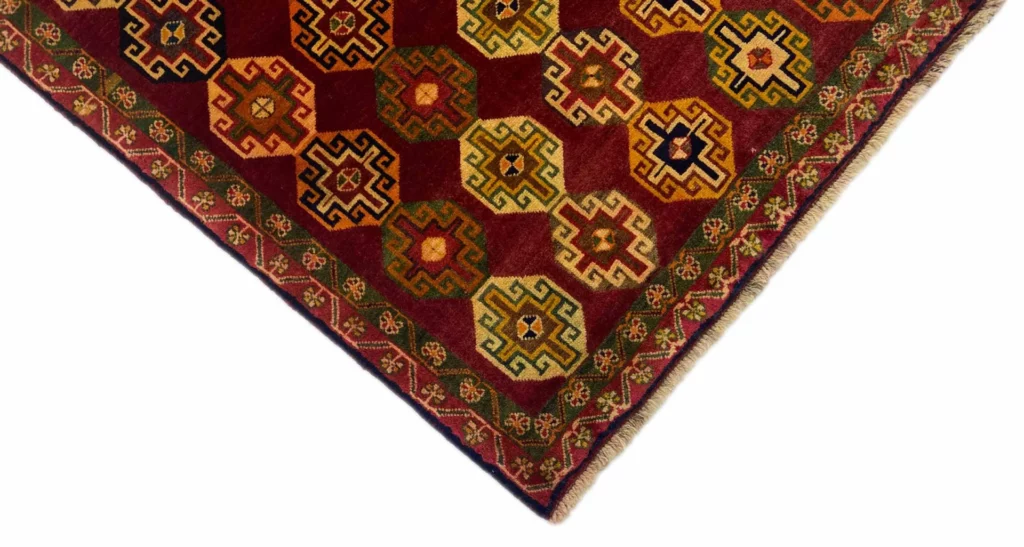
The pattern of this rug is described as unusual and imaginative. Gabbeh rugs are also generally characterised by coarse, rustic designs and bright colours. These descriptions point to a visual language based less on dense ornamental detail and more on clearly visible forms, colour blocks and individual ideas. The colours recorded for this rug are red, beige, grey and brown. They may function as fields, figures or simplified design elements, but their precise distribution is not specified.
Gabbeh design commonly places geometric forms beside simplified images drawn from the everyday world of the weavers. Animals, people, plants or landscape references may appear as reduced signs rather than naturalistic pictures. A figure can be understood through a few characteristic lines, while a geometric motif can organise an open area without filling it completely. Imagination in this tradition is therefore expressed not only through the number of motifs, but also through their scale, spacing and relationship to quieter parts of the composition.
Open space is an important feature of many Gabbeh layouts. Classical Persian designs may rely on scrolling vines, repeated ornaments, formal borders and a central medallion. A Gabbeh can instead leave more room around individual signs, allowing each shape to remain easy to recognise. Its rustic quality comes from this directness as well as from the visible handmade surface. The composition need not be perfectly symmetrical or governed by a strict repeat. Small variations can support the impression of a design developed through handwork rather than mechanical reproduction.
The named colours offer several possible contrasts within this kind of pattern. Red can provide a strong visual accent, while beige may create a light connection between surrounding forms. Grey and brown add quieter, earthy tones. These observations explain the role such colours can play in Gabbeh design, without claiming a particular placement in this rug. In general, Gabbeh palettes are often discussed in terms of clear, lively or earthy colour relationships because they complement the simple forms and the rural character associated with the tradition.
Persian rug design ranges from tightly organised floral compositions to open geometric and figurative arrangements. A Tabriz rug, for example, is associated with complex patterns and high knot density, whereas Gabbeh rugs are often more restrained and immediate in their drawing. These are differences between rug traditions, not a reason to assign another origin to this piece. The present rug is identified through Fars, its Gabbeh designation and its unusual, imaginative designs. No more specific individual motif is stated.
Technique and design are connected in a hand-knotted textile. Knot density affects the fineness with which a line can be drawn and the clarity with which a small shape can be separated from its surroundings. A simplified Gabbeh design can nevertheless gain strength from broad fields, strong contours and the relationship between contrasting colours. Fineness does not by itself determine a rug’s style. Gabbeh character comes from the interaction of the handmade structure, independent signs and a composition that is not bound to an academic ornamental system.
The four listed colours can be read as part of a palette rather than as a complete description of every visual detail. Red, beige, grey and brown allow the rug to balance stronger and quieter areas. In a hand-knotted design, the knots give these areas their textile depth, while the wool pile softens the transitions between adjacent shades. The unusual and imaginative quality named for this rug therefore belongs to the overall design language. It should not be expanded into a specific floral, tribal or figurative motif that has not been identified.
Special Features
The defining features of this rug are its origin in the Fars region, its classification as a Gabbeh Persian rug, its hand-knotted construction and its virgin-wool pile. The knot density is given as 90,000 to 180,000 knots per square metre. The pattern is unusual and imaginative, and the listed colours are red, beige, grey and brown. The condition is new. These points describe the specific rug in terms of material, technique, design and condition.
The combination of virgin wool and hand knotting makes the production method visible in the character of the surface. Unlike a mechanically reproduced pattern, a hand-knotted rug is built through individual manual decisions at the knot level. The Gabbeh design adds a free, rustic and colour-led expression to that construction. Technical information and a deliberately unconstrained visual language therefore form the main distinguishing aspects of this piece.
Routine care for a Persian wool rug includes regular vacuuming to remove dust and loose dirt from the pile. Occasional beating can also help remove particles, provided it is carried out appropriately and in a clean setting. A professional cleaning every few years can help preserve the colours and the textile surface. Cleaning should be entrusted to a specialist familiar with hand-knotted virgin wool and Gabbeh construction. These are general care recommendations for the rug type and do not alter the stated condition of this new rug.
FAQ
What makes a Gabbeh Persian rug from Fars distinctive?
A Gabbeh Persian rug from Fars combines Persian knotting traditions with a freer, reduced and often rustic visual language. Unlike many formally organised city rugs, it does not necessarily centre on a medallion, dense scrolling foliage or a regularly repeated ornament. Gabbeh designs may use simple geometric forms, stylised figures and clearly separated colour fields. Their effect comes from direct drawing and from the individual treatment of scale, spacing and motif. This rug brings together its Fars origin, hand-knotted construction, virgin-wool pile and unusual, imaginative designs. Red, beige, grey and brown are the colours specified for this particular piece.
How should I care for a hand-knotted Persian wool rug?
Regular vacuuming is suitable for routine care and helps remove dust and loose dirt from the pile. The setting should be appropriate for a rug so that the surface is treated gently. Occasional beating may also be useful for releasing particles, provided it is done correctly and in a suitable clean location. Stains should not be treated with harsh products without checking their suitability, because wool and dyes can respond differently to cleaning agents. Professional cleaning every few years supports the preservation of the colours and the pile. Since this rug is hand-knotted and made with virgin wool, a specialist should adapt the cleaning method to the material and the construction of a Gabbeh. The stated condition of the rug is new.
How do Gabbeh rugs differ from other Persian rug types?
Persian rug types can differ in origin, knot density, material, pattern structure and cultural background. Gabbeh rugs from Fars are commonly associated with coarser, rustic and more freely drawn designs as well as vivid colours. Other Persian rugs may be defined more strongly by floral ornament, central medallions, formal borders or highly complex pictorial arrangements. Construction also varies: knot density affects the level of detail that can be produced, while the material influences the feel and appearance of the pile. Tabriz rugs, for example, are associated with complex patterns and high knot density. Those distinctions describe the range of Persian rug traditions; for this piece, Fars, Gabbeh, virgin wool, hand knotting and the specified knot density are the relevant identifying facts.
To provide the best experiences, we use technologies like cookies to store and/or access device information. Consenting to these technologies will allow us to process data such as browsing behavior or unique IDs on this site. Not consenting or withdrawing consent, may adversely affect certain features and functions.
Functional Always active
The technical storage or access is strictly necessary for the legitimate purpose of enabling the use of a specific service explicitly requested by the subscriber or user, or for the sole purpose of carrying out the transmission of a communication over an electronic communications network.
Preferences
The technical storage or access is necessary for the legitimate purpose of storing preferences that are not requested by the subscriber or user.
Statistics
The technical storage or access that is used exclusively for statistical purposes.The technical storage or access that is used exclusively for anonymous statistical purposes. Without a subpoena, voluntary compliance on the part of your Internet Service Provider, or additional records from a third party, information stored or retrieved for this purpose alone cannot usually be used to identify you.
Marketing
The technical storage or access is required to create user profiles to send advertising, or to track the user on a website or across several websites for similar marketing purposes.

 SECURE PAYMENT
 SHIPPING PARTNERS


