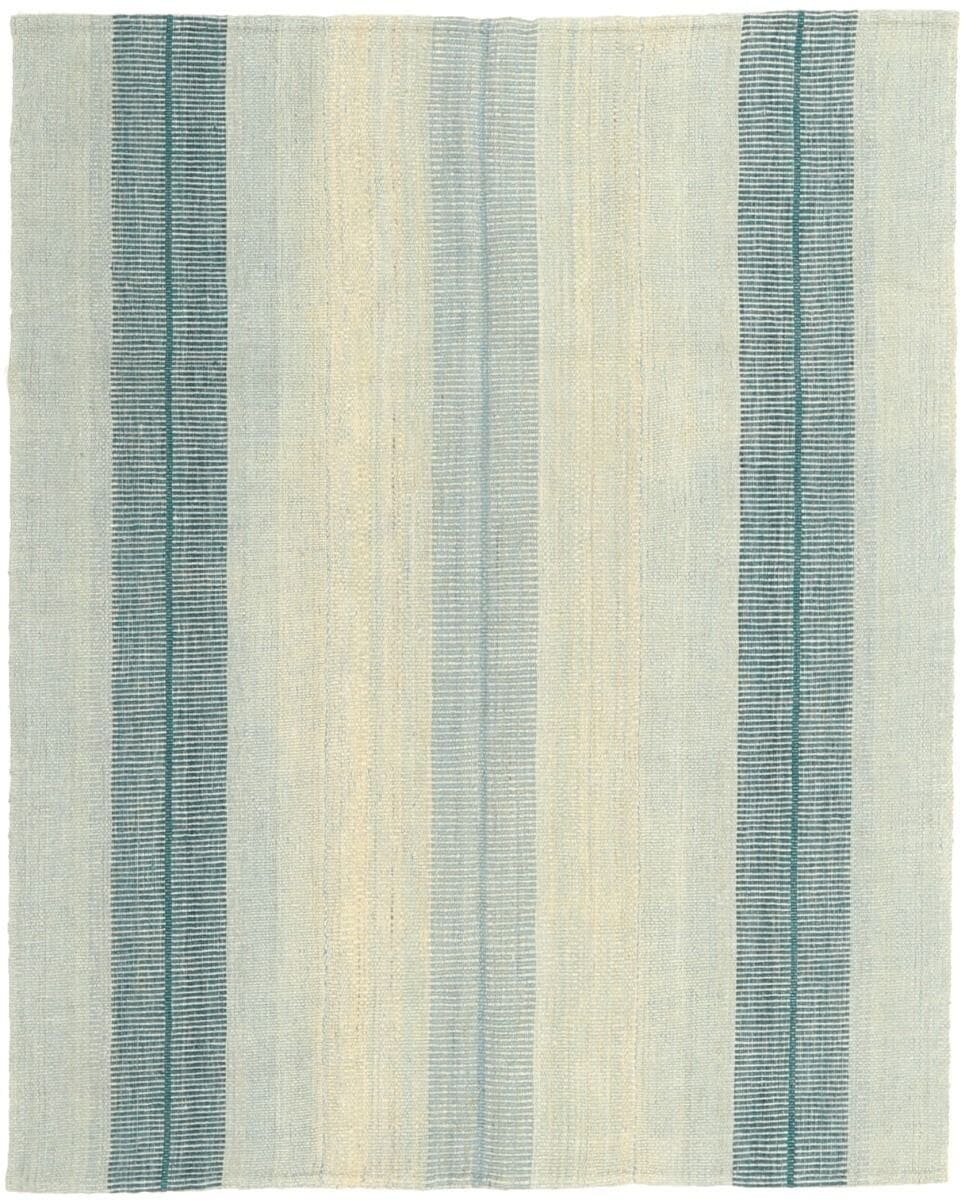
This Fars Persian rug is made as a hand-woven Kelim. In a Kelim, the surface is formed by weaving weft yarns through the warp rather than by tying individual pile knots. The result is a flat textile structure with a clearly readable construction. Hand weaving makes the sequence of the work part of the finished surface and sets a Kelim apart from a hand-knotted rug.
Wool is specified as the material. In rug making, wool is valued for its resilient and versatile textile character. It can be spun, dyed and worked into different weaving structures. Here, the pile is short. A short surface supports the flat profile associated with a Kelim and keeps the solid design visually clear. The material and construction therefore remain visible rather than being concealed by a deep pile.
The term Kelim identifies the manufacturing technique, not simply a decorative look. During weaving, the weft is inserted by hand and compacted as the textile area develops. Unlike a knotted rug, the surface does not depend on rows of upright knots. Its appearance comes from the relationship between warp, weft and colour. The manual process can be seen in the character of the woven field.
The recorded features are hand weaving, wool, a short pile and a modern style. No knot density or warp composition is specified. For that reason, the rug is described through the documented characteristics: a hand-woven wool Kelim with a flat, short-surface construction and a contemporary solid-colour design. No additional technical composition is assigned to it.
Origin and Tradition
Fars is a region in southern Iran and one of the landscapes associated with Persian textile and rug culture. It is a broad region with varied environments, settlements and craft communities. Textile production in Fars has taken place in village, urban and nomadic contexts. These different settings mean that rugs and woven textiles from Fars cannot be reduced to one single appearance or one fixed technique.
The textile traditions of Fars have a strong relationship with wool. In many weaving communities, wool was a practical and adaptable material that could be spun, coloured and worked in several ways. Persian textile culture therefore includes both knotted rugs and flat-woven Kelims. A Kelim has its own purpose and visual language: it combines a useful woven surface with a design shaped by colour, rhythm and the structure of the weave.
Hand weaving is among the older methods of making textile floor coverings. The process begins by preparing the warp on the loom. Weft yarns are then passed through by hand and beaten into place with a weaving tool. Depending on the construction, colour areas may meet directly or be separated by small structural transitions. Maintaining even tension and a firm, closed surface requires control throughout the work.
Fars brings together several cultural influences. Nomadic groups developed textile objects for everyday use, often favouring practical construction, strong colour fields and clear forms. Villages and workshops maintained their own weaving practices, while urban production developed more deliberately planned compositions in other contexts. These strands do not represent one universal Fars pattern. Instead, they form the historical background for the variety associated with the region.
Persian rug tradition is carried forward through knowledge of yarn, colour, loom setup, pattern organisation and working methods. A Kelim should not be regarded as a simplified version of a knotted rug. Flat weaving has its own history and its own design principles. It can produce broad, quiet fields as well as repeated geometric arrangements. The continuity of the craft lies in the transmission of practical knowledge from one generation of weavers to the next.
This rug combines the regional name Fars with a modern execution. The word Modern describes its contemporary style, while Kelim identifies the traditional hand-woven technique. Regional craft and restrained present-day design therefore appear together. The origin indicates a cultural and textile context; it does not mean that every rug from Fars shares the same pattern or construction. Here, the documented regional reference is paired with wool, hand weaving and a solid green design.
Design and Pattern
The pattern of this rug is solid green. Its design is therefore based on one continuous colour field rather than on a medallion, border or repeated ornament. This approach allows the woven structure to become part of the visual impression. In a Kelim, the colour can appear to shift subtly with the direction of the fibres, the light and the tension of the weave. Such variation does not constitute an additional motif.
Green is a familiar colour in Persian and wider Oriental textile design. It can suggest plants, cultivated land and landscape, and it has been used both for backgrounds and for accents in traditional compositions. In a solid design, however, green does not function as one isolated motif. It establishes the character of the entire visible field. This creates a different effect from a densely ornamented rug made up of many separate elements.
Persian rug design traditionally uses several systems of visual order. A central medallion can organise the field, floral vines can connect areas across the surface, and geometric repeats can create a measured rhythm. Borders can distinguish an inner field from its surrounding frame. These are general elements of Persian rug vocabulary. The documented design of this rug is specifically solid green, so no further motif, border or ornament is attributed to it.
The modern style concentrates the visual statement on a small number of essential features: the green colour, the flat woven structure and the woollen textile surface. Modern Kelims can combine an established weaving technique with a deliberately reduced composition. The construction is not hidden; it contributes to the appearance. The absence of dense ornament can make the design compatible with different interior approaches without assigning it to a particular historical pattern tradition.
A flat surface reinforces the impression of a unified colour field. In a knotted rug, pattern is often built through the arrangement of many individual knots and changes in pile direction. In a Kelim, the design is created directly through the placement of woven weft yarns. Colour and construction are consequently closely linked. This is a central feature of Kelim aesthetics and explains why a simple solid design can still show a distinct handmade textile character.
The green colour and modern style offer a reduced interpretation of a regionally connected technique. The rug refers to its textile tradition not through a named historic motif, but through the combination of Fars, wool and hand weaving. Its design remains limited to the documented statement: a solid green surface with no further specified pattern features.
Special Features
The rug is described as new and without a label. Its listed special features are suitability for allergy-sensitive users, reversible use and suitability for underfloor heating. Reversible use is a practical characteristic associated with flat-woven Kelims. Because no deep upright pile is specified, both sides can be used, although the woven structure and the effect of light may make the two sides appear slightly different.
Suitability for allergy-sensitive users is given as a product feature. The rug is also specified as suitable for rooms with underfloor heating. In addition, it is described as suitable for all rooms. Its short pile, hand-woven construction and modern solid-colour design combine practical use with a clear appearance. These statements describe the stated uses and do not add an unstated fibre blend or technical treatment.
A gentle care routine is appropriate for a flat-woven wool surface. Careful regular vacuuming can remove loose particles. Spilled liquids should be blotted promptly rather than rubbed vigorously into the weave. For deeper cleaning, a method intended for wool rugs and handled by a specialist is appropriate. These are general care principles for the material and construction; they do not alter the recorded condition, which is new without a label.
FAQ
What is a Kelim?
A Kelim is a flat-woven rug. Its surface is made by passing and compacting weft yarns through a warp by hand. Unlike a hand-knotted rug, it is not built from rows of upright pile knots. This rug is described as a hand-woven wool Kelim and has a short pile.
Can this rug be used on both sides?
Yes. The rug is specified as reversible. Flat-woven Kelims can generally be used on both sides because their construction is not dependent on a single direction of cut pile. The two sides may look slightly different according to the weave and the light, while the documented pattern remains solid green.
Is the rug suitable for underfloor heating?
Yes. It is specified as suitable for underfloor heating. It is also described as suitable for all rooms. The rug should lie flat and should be kept free of loose dirt through gentle regular care. The heating suitability applies to the stated use of this rug, while the hand-woven wool surface should still be treated with appropriate care.
To provide the best experiences, we use technologies like cookies to store and/or access device information. Consenting to these technologies will allow us to process data such as browsing behavior or unique IDs on this site. Not consenting or withdrawing consent, may adversely affect certain features and functions.
Functional Always active
The technical storage or access is strictly necessary for the legitimate purpose of enabling the use of a specific service explicitly requested by the subscriber or user, or for the sole purpose of carrying out the transmission of a communication over an electronic communications network.
Preferences
The technical storage or access is necessary for the legitimate purpose of storing preferences that are not requested by the subscriber or user.
Statistics
The technical storage or access that is used exclusively for statistical purposes.The technical storage or access that is used exclusively for anonymous statistical purposes. Without a subpoena, voluntary compliance on the part of your Internet Service Provider, or additional records from a third party, information stored or retrieved for this purpose alone cannot usually be used to identify you.
Marketing
The technical storage or access is required to create user profiles to send advertising, or to track the user on a website or across several websites for similar marketing purposes.
 SECURE PAYMENT
 SHIPPING PARTNERS


