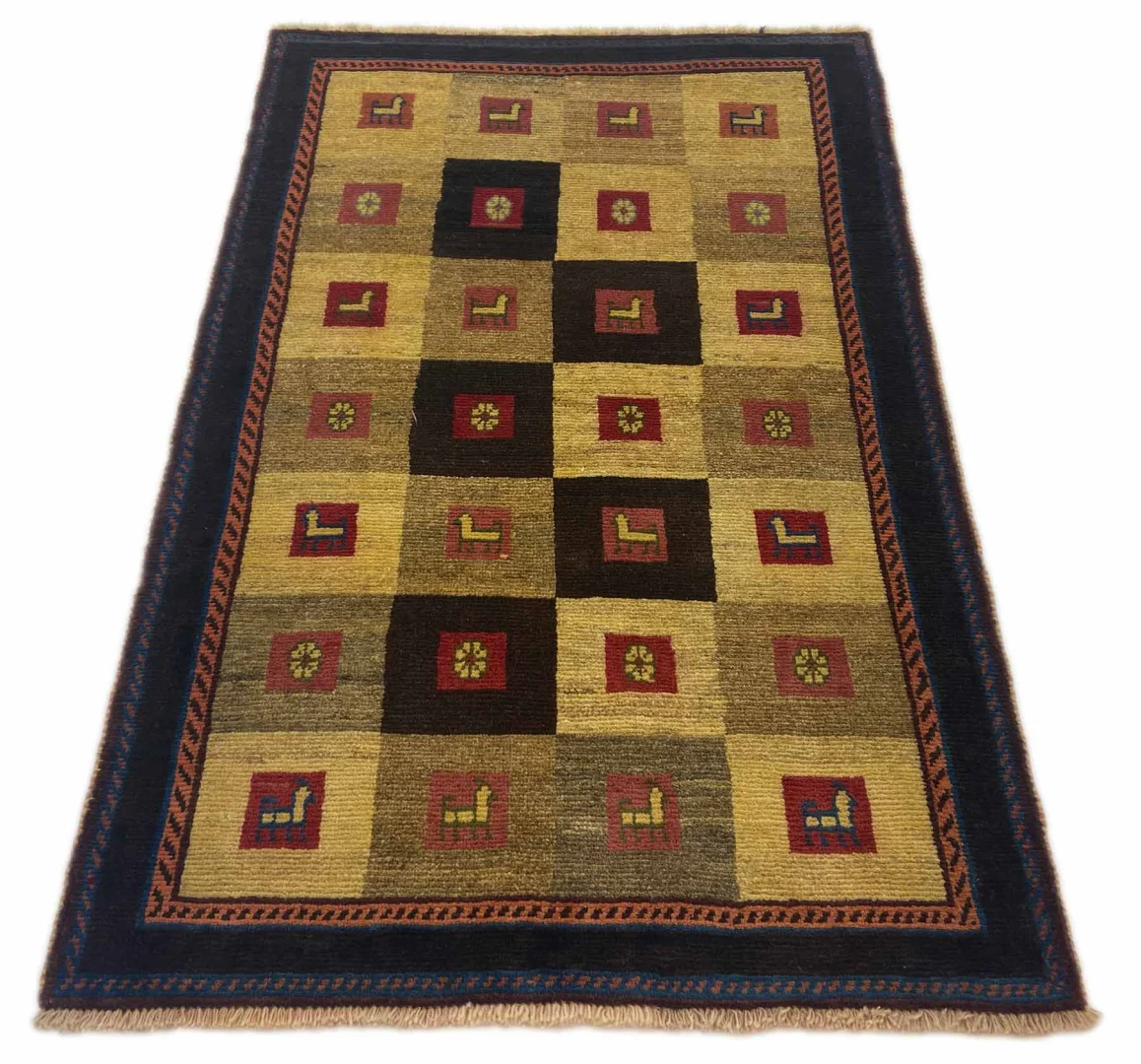
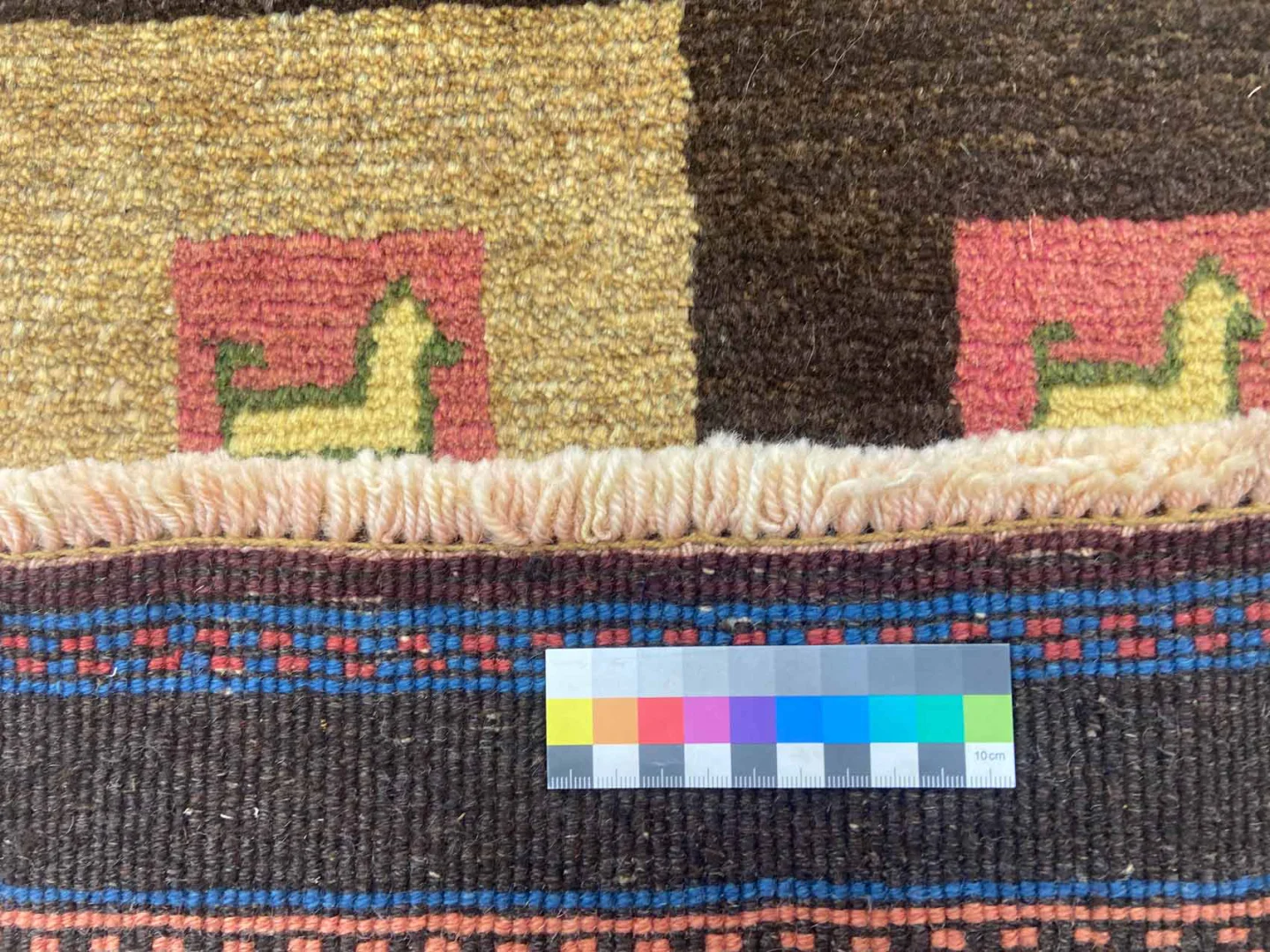
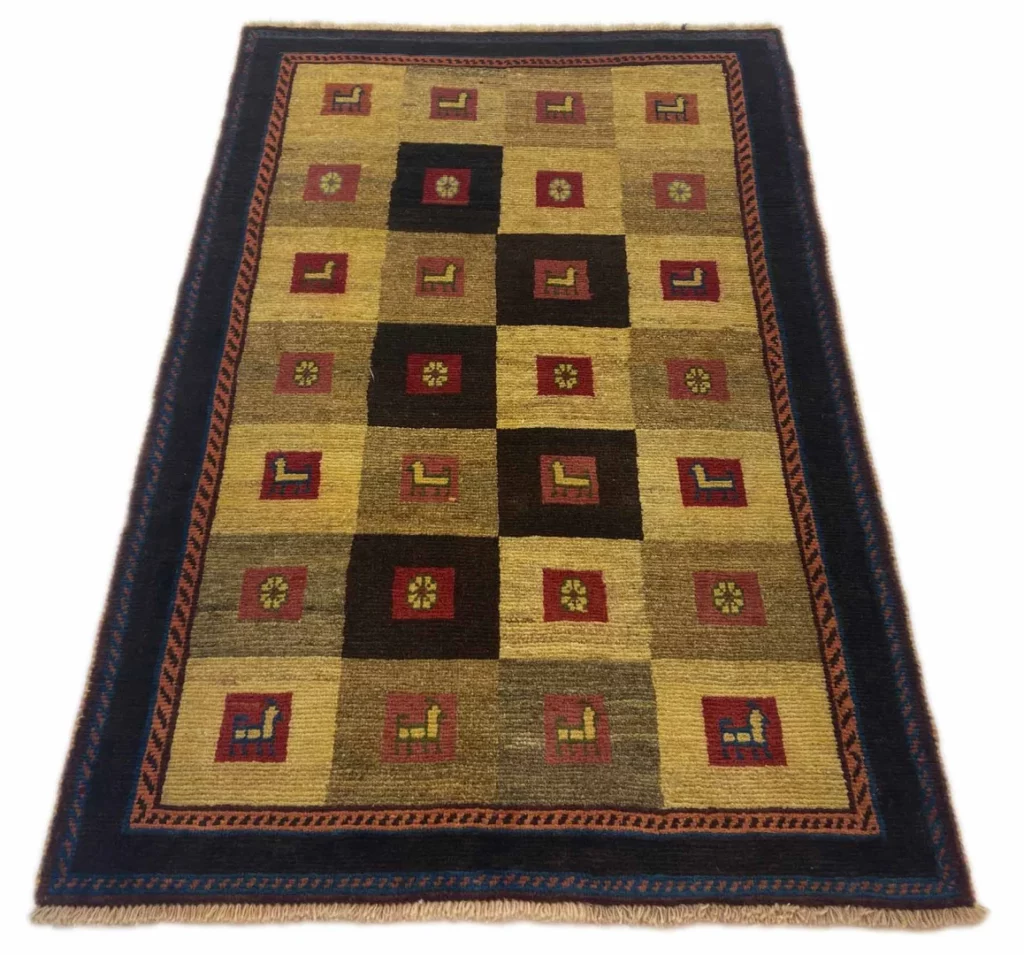
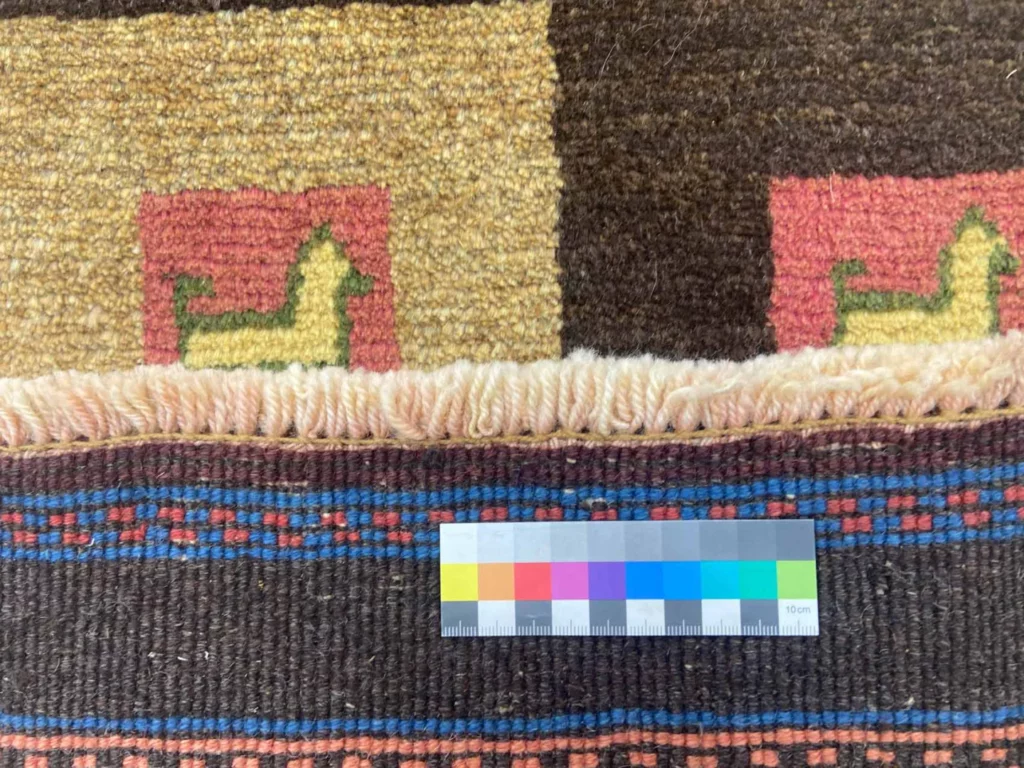
This Gabbeh-Shuli rug is hand-knotted with lustrous virgin wool in the pile. The wool gives the surface its visible sheen and contributes to the way the colours appear across the design. Virgin wool is valued in Gabbeh weaving for its resilient natural character and soft handle. Here, that material is combined with a hand-made knotting process in which the rug is built knot by knot rather than produced as an industrial surface.
The rug has a knot density of 90,000 to 180,000 knots per square metre. Knot density records how many knots are placed within a defined area and is one of the technical characteristics of a hand-knotted rug. In Gabbeh weaving, this type of construction can support a clearly readable design while retaining the tactile presence associated with wool. The lustrous pile also affects the appearance of the stated colours: red, beige, grey and brown can show different nuances as the surface catches the light.
The condition is new and unused. This identifies the rug as a piece that has not previously been used in a living space. Its hand-knotted construction, virgin wool pile and recorded knot density describe the workmanship without adding an unsupported claim about age or the identity of an individual weaver. Each Gabbeh-Shuli rug is treated as a unique piece because its design is carried out by hand, so the finished result is not an interchangeable machine-made repeat.
Origin and Tradition
The rug comes from the Fars region in southern Persia. Fars is one of the important landscapes in Persian carpet culture. The region lies in the south of the country and is associated in the description with the historic city of Shiraz. Within this cultural setting, rugs developed that reflect the knowledge, visual experience and working practices of nomadic weavers.
Gabbeh rugs occupy a distinctive place in Persian weaving. The tradition combines practical handcraft with a direct and imaginative approach to the image. Gabbeh designs are often less dependent on the tightly ordered courtly compositions found in other Persian rug families. Instead, they can present simplified forms, open arrangements and ideas drawn from the weaver’s own visual world. The Shuli designation in this rug is connected with that creative Gabbeh character.
Nomadic weavers in Fars pass knowledge from one generation to the next. This knowledge includes the handling of wool, the creation of a balanced colour scheme and the translation of an idea into a knotted surface. A hand-knotted rug is not the identical output of a machine. It combines inherited skills with the individual decisions made while the pattern is being worked. That process helps explain why each rug is regarded as a one-off and why closely related pieces can still differ in their details.
Fars is home to several rug types and design traditions. Gabbeh-Fars is produced in the same region and has related qualities, although it often presents more traditional designs. Qashqai and Luri rugs are also associated with Fars and reveal other regional approaches to pattern, colour and weaving culture. These related traditions show that Fars cannot be reduced to one fixed appearance. The regional name identifies a cultural and craft context, while individual groups and designs give each rug its own visual language.
Natural dyes are also part of the wider description of Fars rugs. They can create depth in colour and reflect a connection with locally available materials and inherited methods. The Fars origin therefore places this Gabbeh-Shuli within a broad regional tradition rather than assigning one identical design to every rug from the area. Variation, reinterpretation and the continuation of knowledge through generations are central to understanding the region’s carpet culture.
Design and Pattern
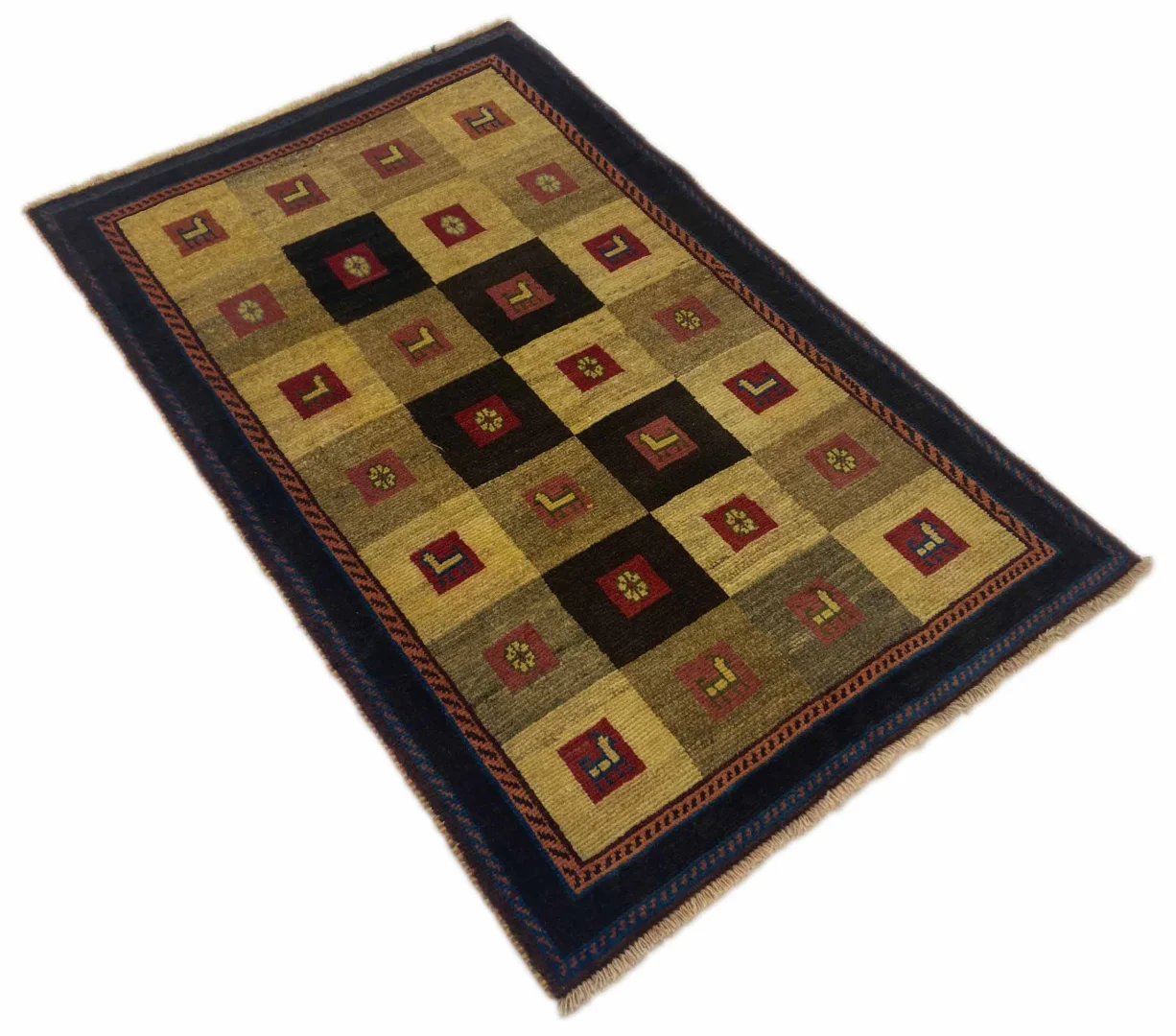
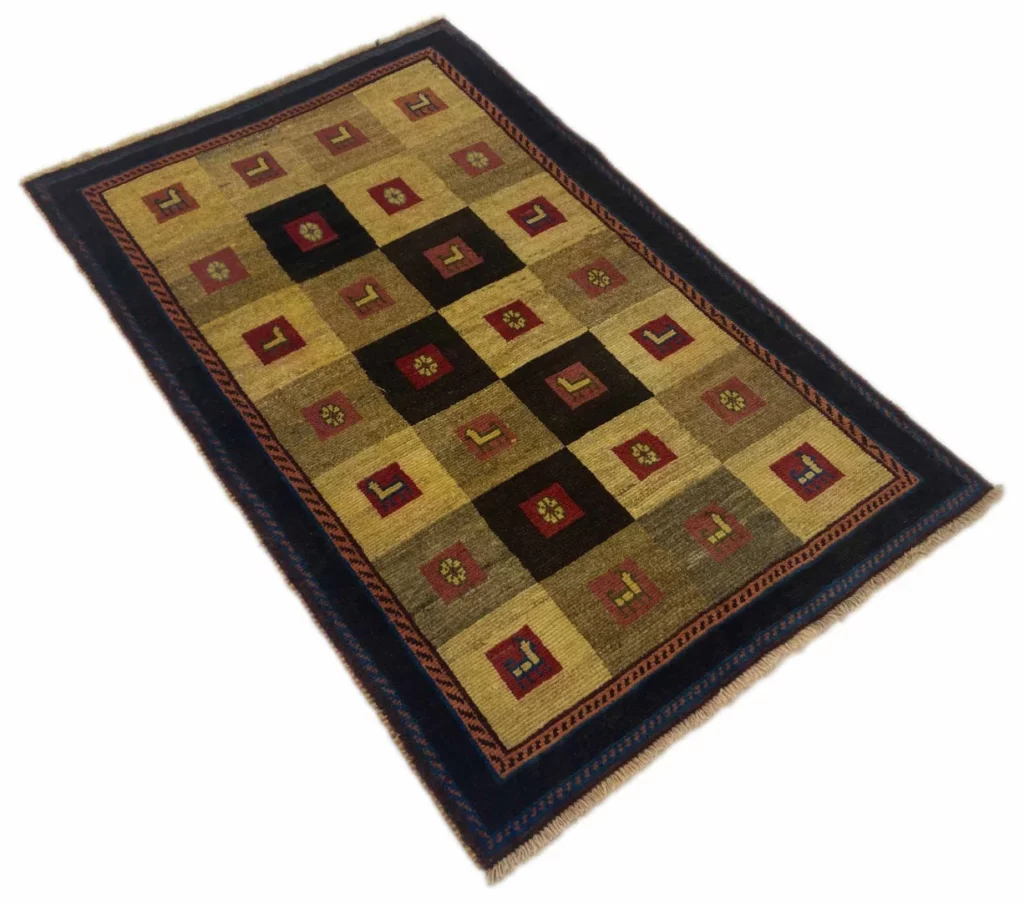
The pattern of this rug is described as unusual and imaginative. It therefore belongs to a visual language that does not rely only on restrained fields or strictly repeated ornament. Gabbeh-Shuli designs may draw inspiration from nature, animals and traditional ways of life. Such subjects do not have to be rendered realistically. They can be simplified, symbolic or transformed through the personal imagination of the weaver.
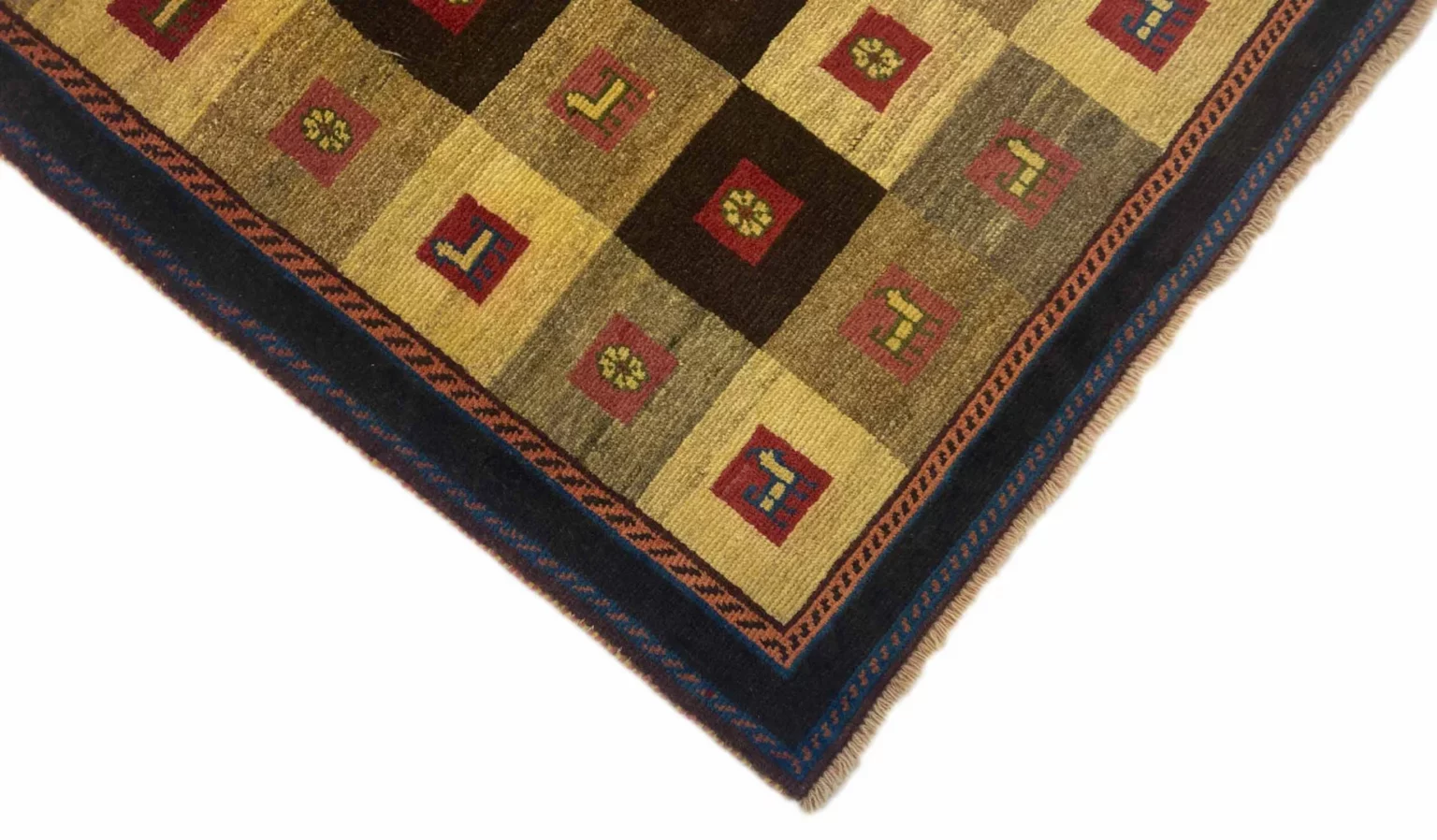
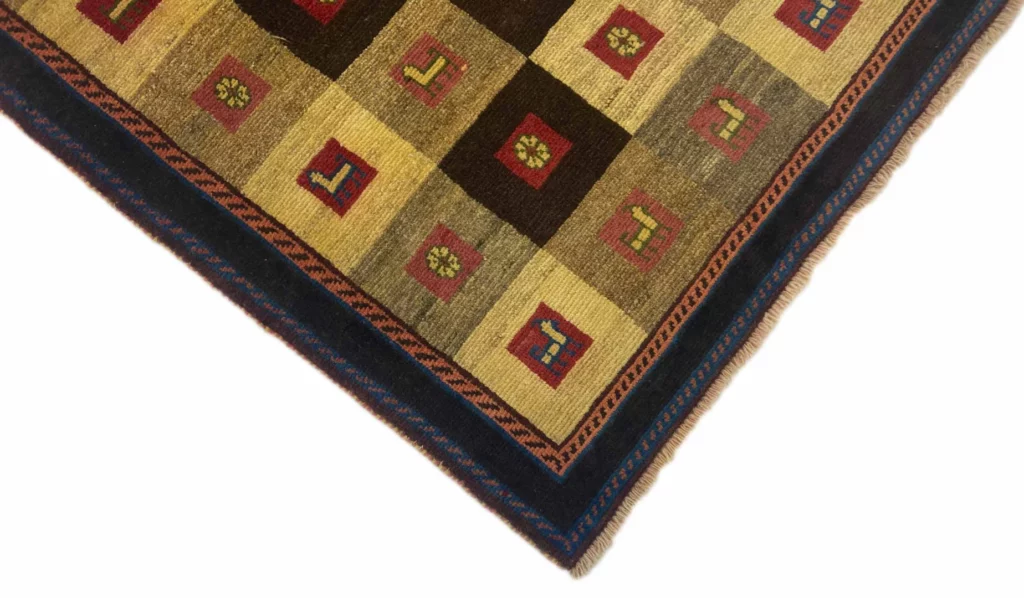
The colour palette contains red, beige, grey and brown. Red can provide a strong warm field or a distinct accent within a Gabbeh composition. Beige introduces a quiet natural tone, while grey and brown add more earthy notes. Together, these colours allow both contrast and softer transitions. They belong to the documented appearance of this rug and are further shaped visually by the sheen of the virgin wool pile.
Imaginative Gabbeh motifs may include animals, people, plants, landscape references or geometric signs. The aim is not necessarily a detailed reproduction of one object, but an individual interpretation. A figure can be reduced to a simple sign so that it reads clearly within the woven field. This approach gives the motif an immediate presence while preserving its connection with the handcraft and storytelling traditions of the region.
The designs of Fars are often discussed in relation to the everyday world of the people who made them. Nomadic life, close observation of nature and familiar inherited signs provide a cultural background for many regional patterns. That background does not mean that every symbol occurs in every Gabbeh. Rather, it offers a framework in which personal designs can develop. The result is the marked variety found among Gabbeh-Shuli rugs and the individual character of each hand-knotted piece.
Unlike a strictly regulated repeat, an imaginative Gabbeh design may use a freer arrangement of motifs. The field can be organised around individual visual ideas instead of being filled solely with a recurring ornament. This makes the rug legible as a unique work of handcraft. At the same time, red, beige, grey and brown keep the composition within a warm, earthy palette associated with the described design.
Gabbeh-Fars, Qashqai rugs and Luri rugs demonstrate the range of pattern traditions found in Fars. Other examples may place greater emphasis on established ornaments or recognisable regional signs, whereas this Gabbeh-Shuli is defined by unusual and imaginative designs. Its appearance brings together Persian origin, the colours named for the piece and the creative freedom associated with the weavers of the region.
Special Features
The rug’s particular features are its Gabbeh-Shuli character, unusual pattern and lustrous virgin wool pile. Its knot density of 90,000 to 180,000 knots per square metre is another explicitly described technical detail. Red, beige, grey and brown make up the stated colour range. As a hand-knotted one-off, the rug also carries the individual execution of its design rather than the uniform appearance of a mass-produced decoration.
The rug is new and unused. This condition distinguishes it from a rug that has already been used and records that it has not previously served in a living space. Its origin is also clearly identified: it is a Persian rug from the Fars region in southern Persia. Its appearance belongs to the Gabbeh-Shuli tradition and is not presented as an anonymous decorative pattern without regional context.
Regular vacuuming is recommended for routine care. If a deeper clean is needed, professional rug cleaning can be considered. Direct sunlight should be avoided because it can contribute to colour fading. These measures are intended to help preserve the described surface and the colour effect of red, beige, grey and brown while treating the lustrous wool pile carefully.
FAQ
What makes the Gabbeh-Shuli rug special?
Its unusual and imaginative designs are a defining feature. The rug is hand-knotted and made with lustrous virgin wool in the pile, and it is regarded as a unique piece. Red, beige, grey and brown form its stated colour palette. Its origin in the Fars region of southern Persia connects it with a Persian knotting tradition in which nomadic weavers pass skills and visual ideas from one generation to the next.
How should I care for my Gabbeh-Shuli rug?
Vacuum the rug regularly as part of normal care. If more intensive cleaning becomes necessary, professional rug cleaning may be considered. Avoid direct sunlight, as it can cause colours to fade. These precautions help care for the visual effect of red, beige, grey and brown and for the surface character of the lustrous virgin wool without adding unnecessary treatment.
What sizes are Gabbeh-Shuli rugs available in?
Gabbeh-Shuli rugs are available in different sizes, making them suitable for a range of rooms and interior styles. The selection includes smaller runners as well as larger rugs for living rooms or bedrooms. This variety gives the rug type flexible placement options. This particular piece has its own separately stated size; the broader range refers to Gabbeh-Shuli rugs as a category.
To provide the best experiences, we use technologies like cookies to store and/or access device information. Consenting to these technologies will allow us to process data such as browsing behavior or unique IDs on this site. Not consenting or withdrawing consent, may adversely affect certain features and functions.
Functional Always active
The technical storage or access is strictly necessary for the legitimate purpose of enabling the use of a specific service explicitly requested by the subscriber or user, or for the sole purpose of carrying out the transmission of a communication over an electronic communications network.
Preferences
The technical storage or access is necessary for the legitimate purpose of storing preferences that are not requested by the subscriber or user.
Statistics
The technical storage or access that is used exclusively for statistical purposes.The technical storage or access that is used exclusively for anonymous statistical purposes. Without a subpoena, voluntary compliance on the part of your Internet Service Provider, or additional records from a third party, information stored or retrieved for this purpose alone cannot usually be used to identify you.
Marketing
The technical storage or access is required to create user profiles to send advertising, or to track the user on a website or across several websites for similar marketing purposes.

 SECURE PAYMENT
 SHIPPING PARTNERS


