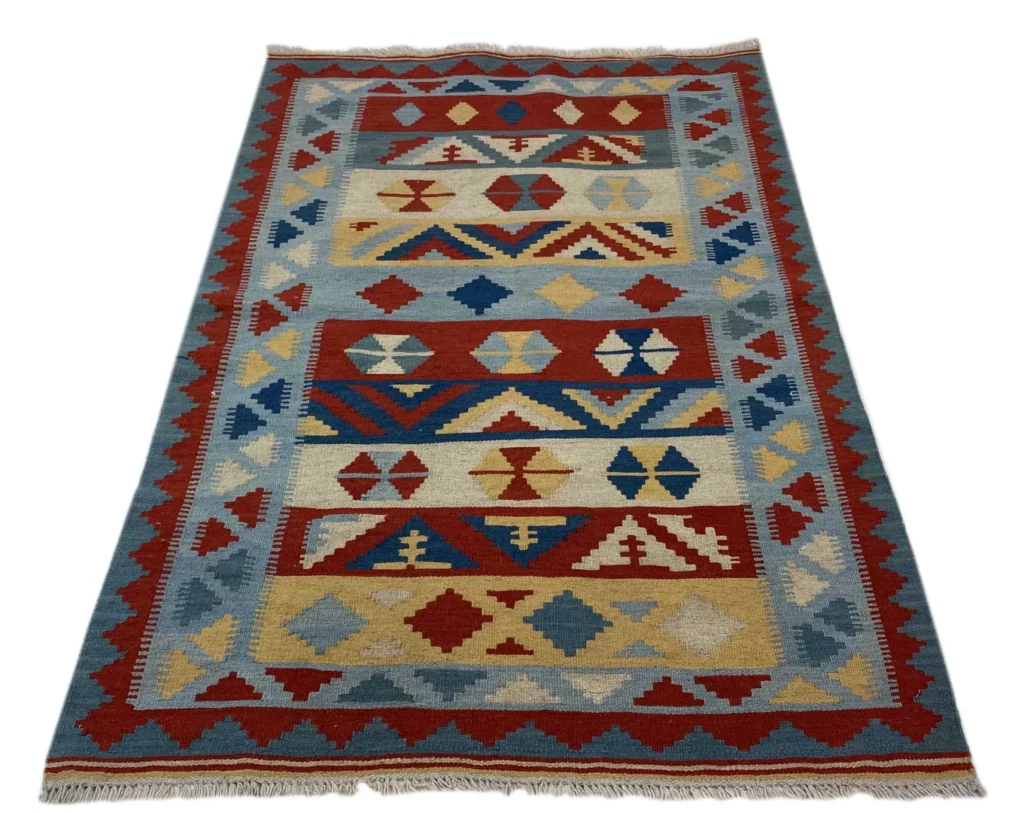
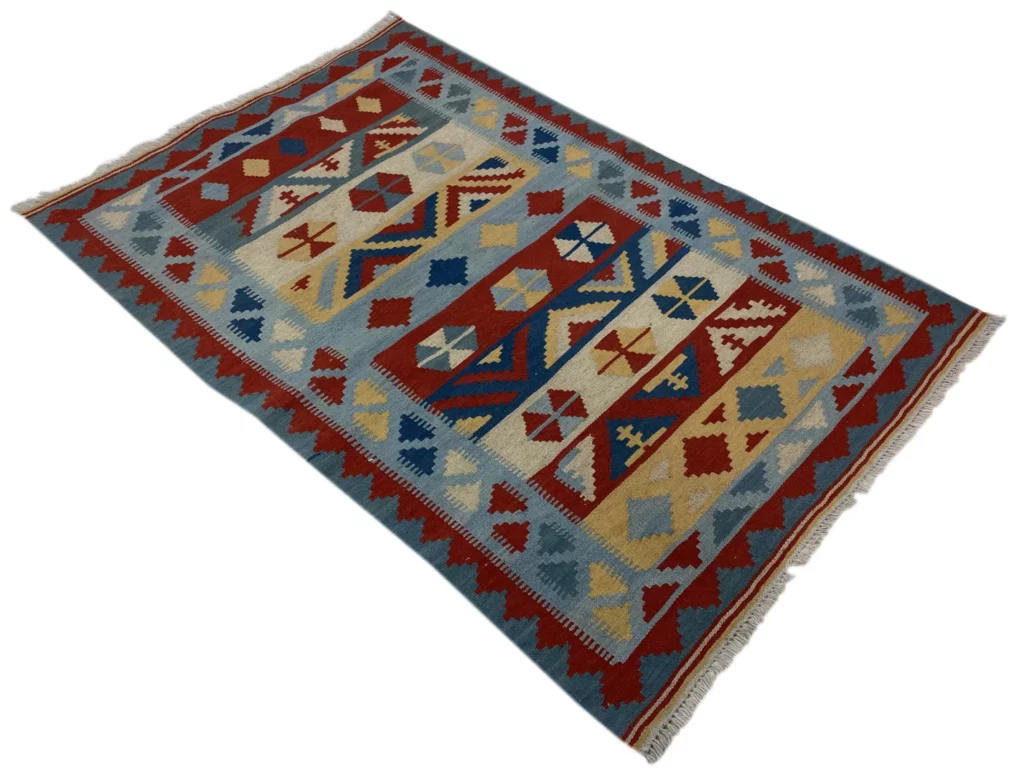
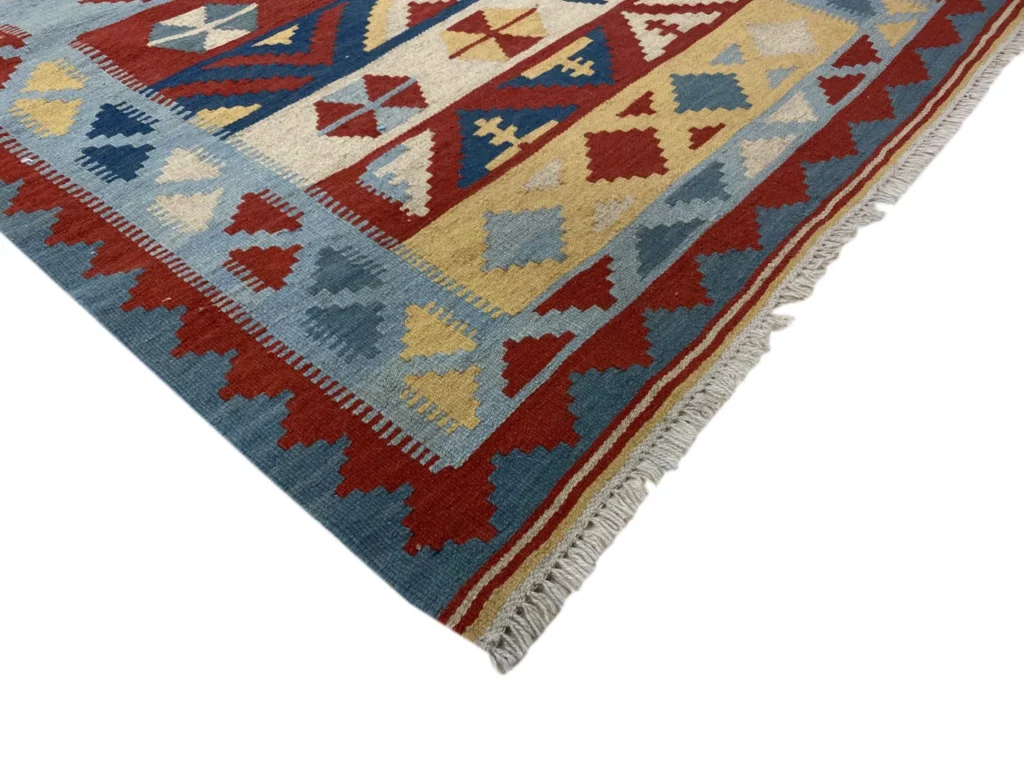
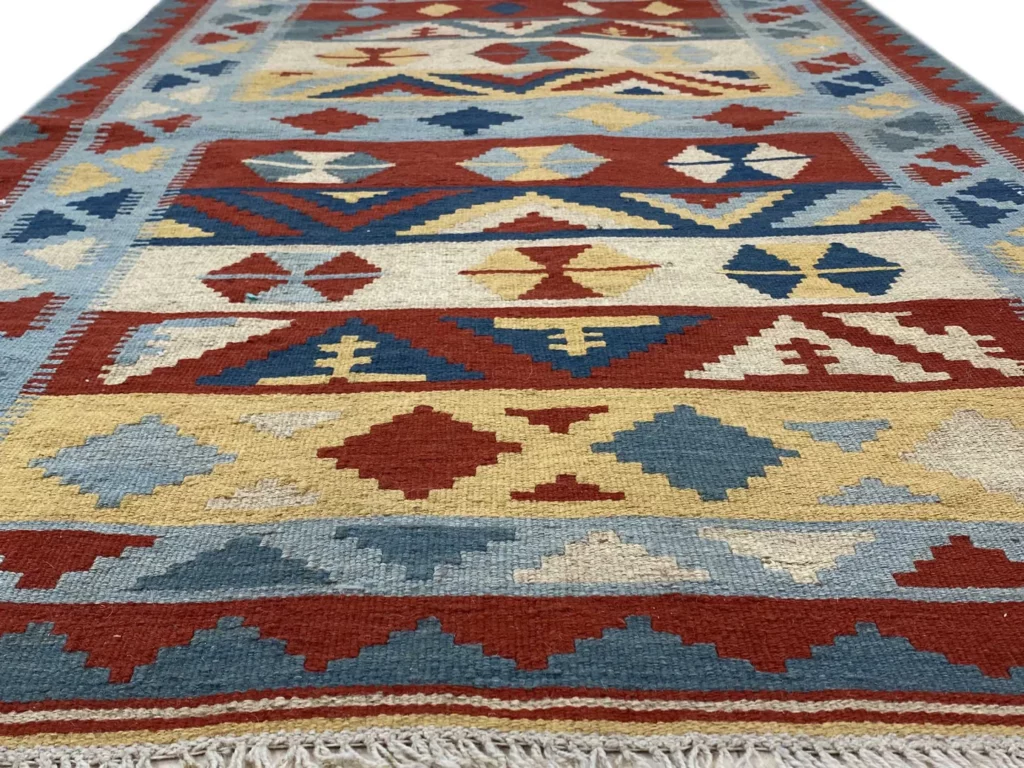
This Kelim from the Fars region is hand-woven. Unlike a knotted carpet, a flatweave is made by passing weft threads across the warp and compacting them by hand. The result is a flat textile surface rather than a layer of tied knots. Wool is specified as the material used for this piece. In traditional Kelim weaving, wool is used for its suitability for durable textile work and for the clear arrangement of coloured areas. Every part of a hand-woven textile is formed through a continuous manual process at the loom.
The weaving method defines the structure of a Kelim. The weaver guides the weft through the warp, building the surface row by row. Changes in colour and direction create the design within the weave itself. No individual pile knots are added. This piece is described as hand-woven, so no knot density is given. The construction should therefore be understood as flatweave work rather than as a knotted pile carpet.
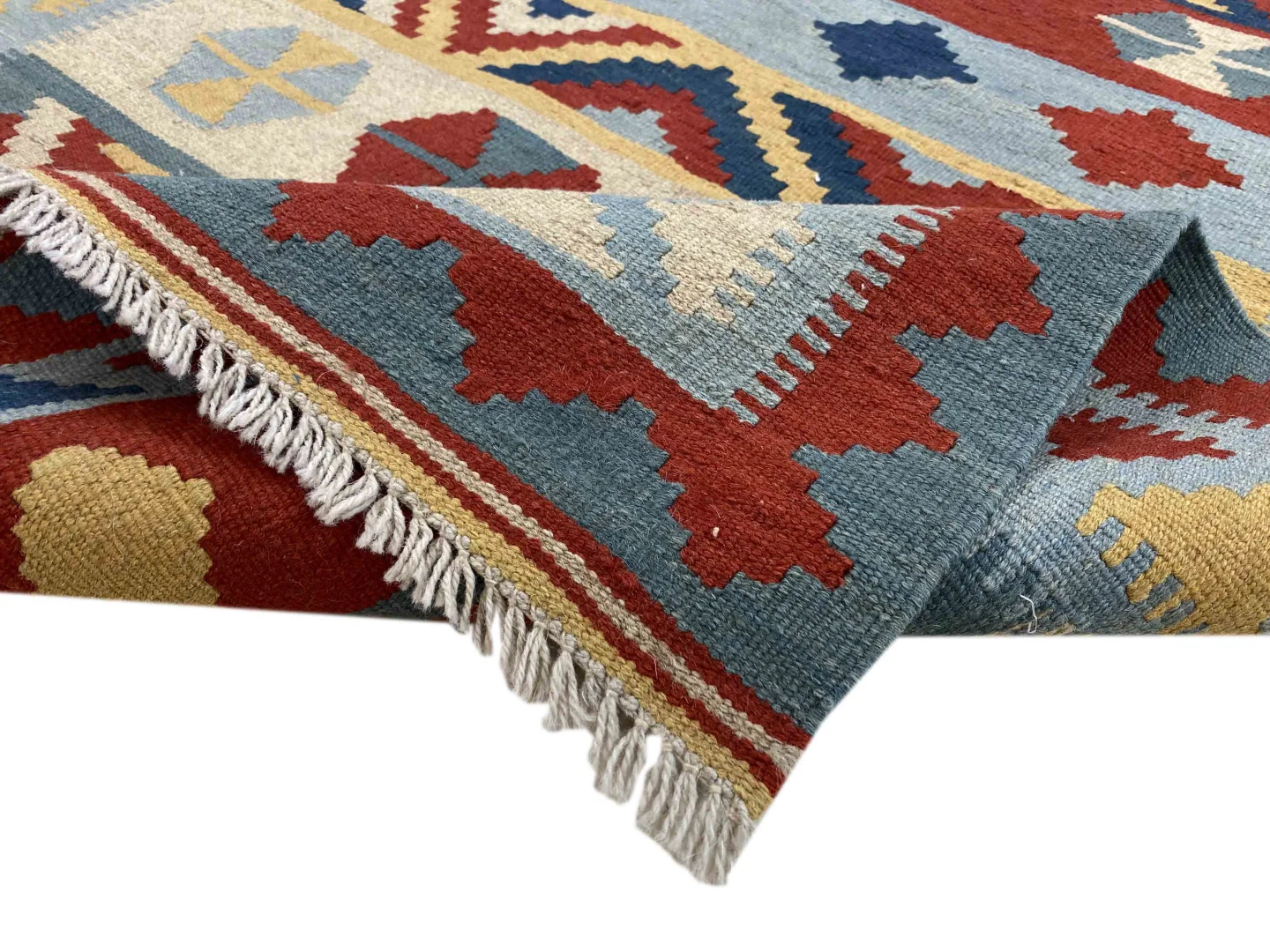
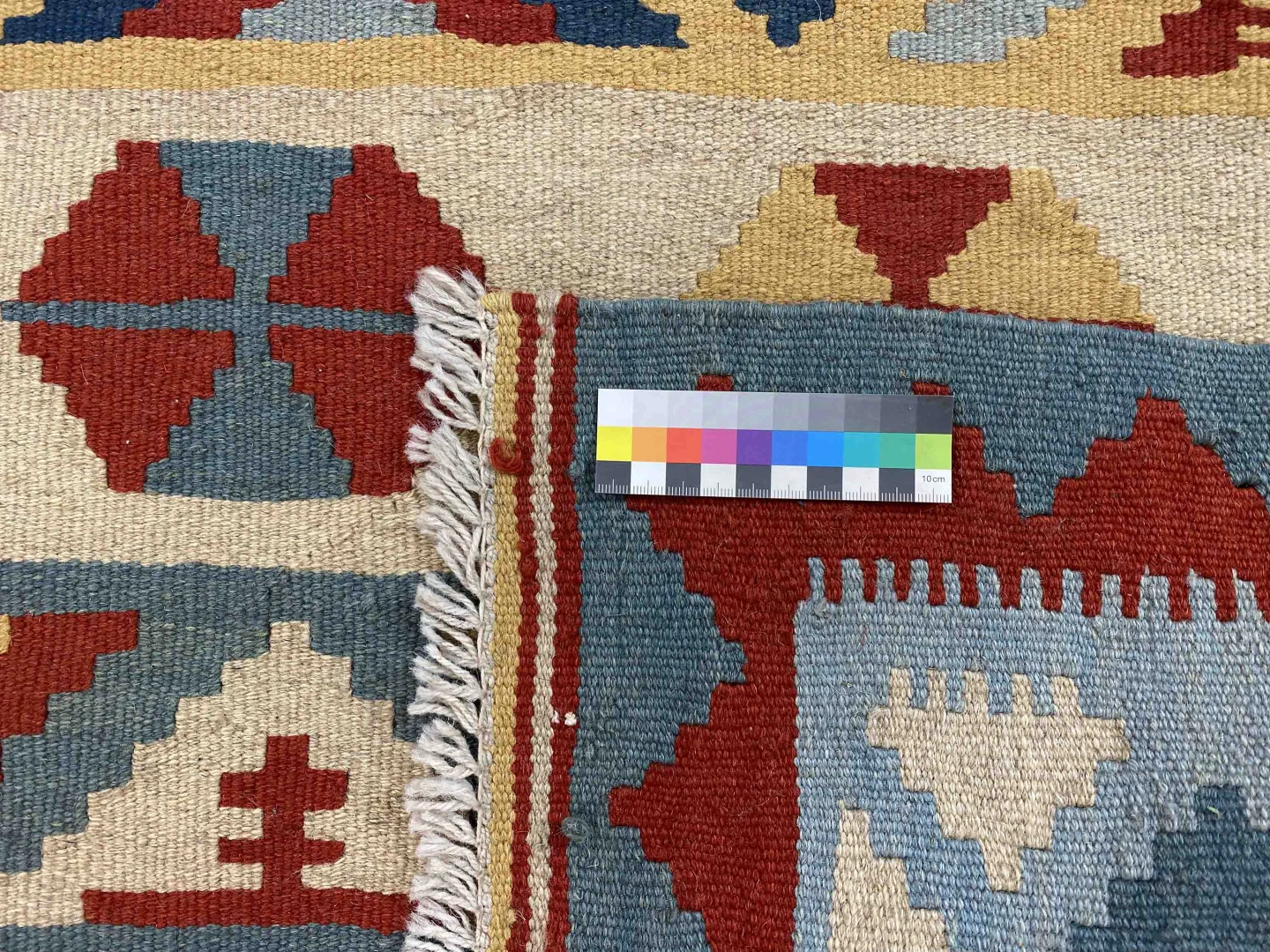
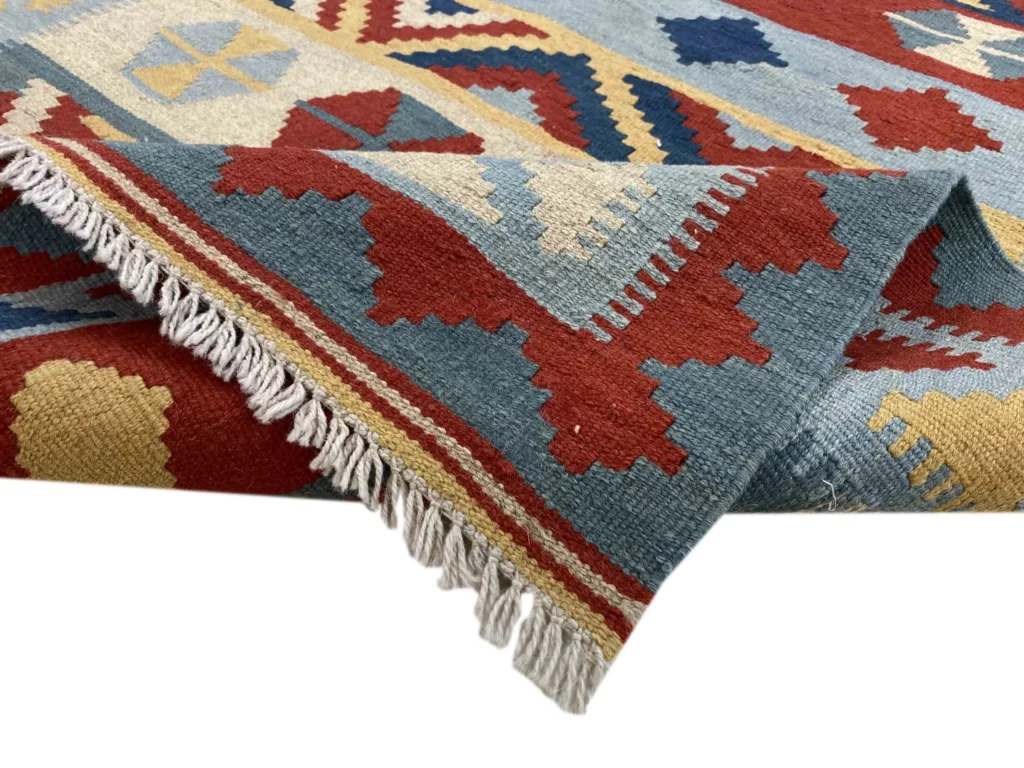
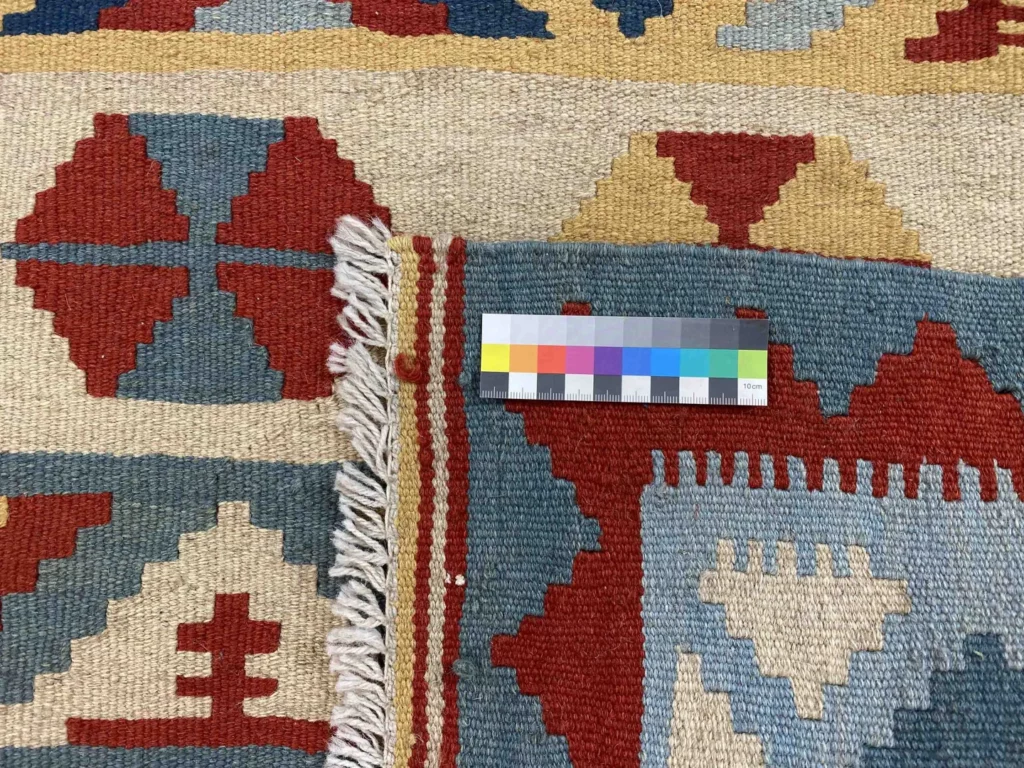
The pattern is identical on both sides. This feature can result from the way a Kelim is made, since the design is formed by woven threads rather than applied only to a visible pile surface. Both usable sides of this piece show the same pattern. Hand-woven wool is the stated material; no additional information about the warp or other fibres is provided.
Origin and Tradition
Fars is a region in southern Iran with a long tradition of textile production and flatweave work. Its cultural landscape includes different forms of settled and mobile life, and regional weaving reflects that variety. Kelims are suited to a range of uses because they are flat textiles that can be produced on a loom and handled with relative ease. Their history belongs to the wider Persian tradition of making useful household textiles by hand.
The name Fars identifies the region associated with this Kelim. It does not identify a particular village, workshop or individual weaver. Styles within a region can differ in their colours, motifs, proportions and technical details. The shared basis lies in the use of warp and weft threads and in the creation of the design during weaving. No more specific local attribution is given for this piece.
Persian Kelims have traditionally served practical as well as decorative purposes. Flatwoven textiles could be placed on the floor, used as coverings, or displayed as wall textiles. Their low profile makes them straightforward to spread out, fold and move. Related weaving traditions also produced bags, seating textiles and other household objects. The Kelim therefore belongs to a form of craft in which the textile is both a designed surface and a useful object.
Technically, the warp establishes the lengthwise framework of the weave. The weft then passes across it and joins the threads into a continuous field. Colour changes may be made by introducing different weft colours or by dividing the work into separate areas. The way adjoining colour fields meet depends on the weaving method. This process explains the flat character of the Kelim and separates it from a Persian rug whose surface is formed by rows of knots.
Fars is part of the broader history of Persian rugs and textiles, but a Fars Kelim should be read according to its own technique. Its design is expressed through flat areas, rhythm, geometry and the handling of the woven edges. Regional tradition is therefore not limited to one visual formula. It also includes the knowledge of selecting threads, maintaining tension and organizing a pattern while the textile is being made. This Kelim combines the Fars attribution with that established hand-weaving tradition.
Design and Pattern
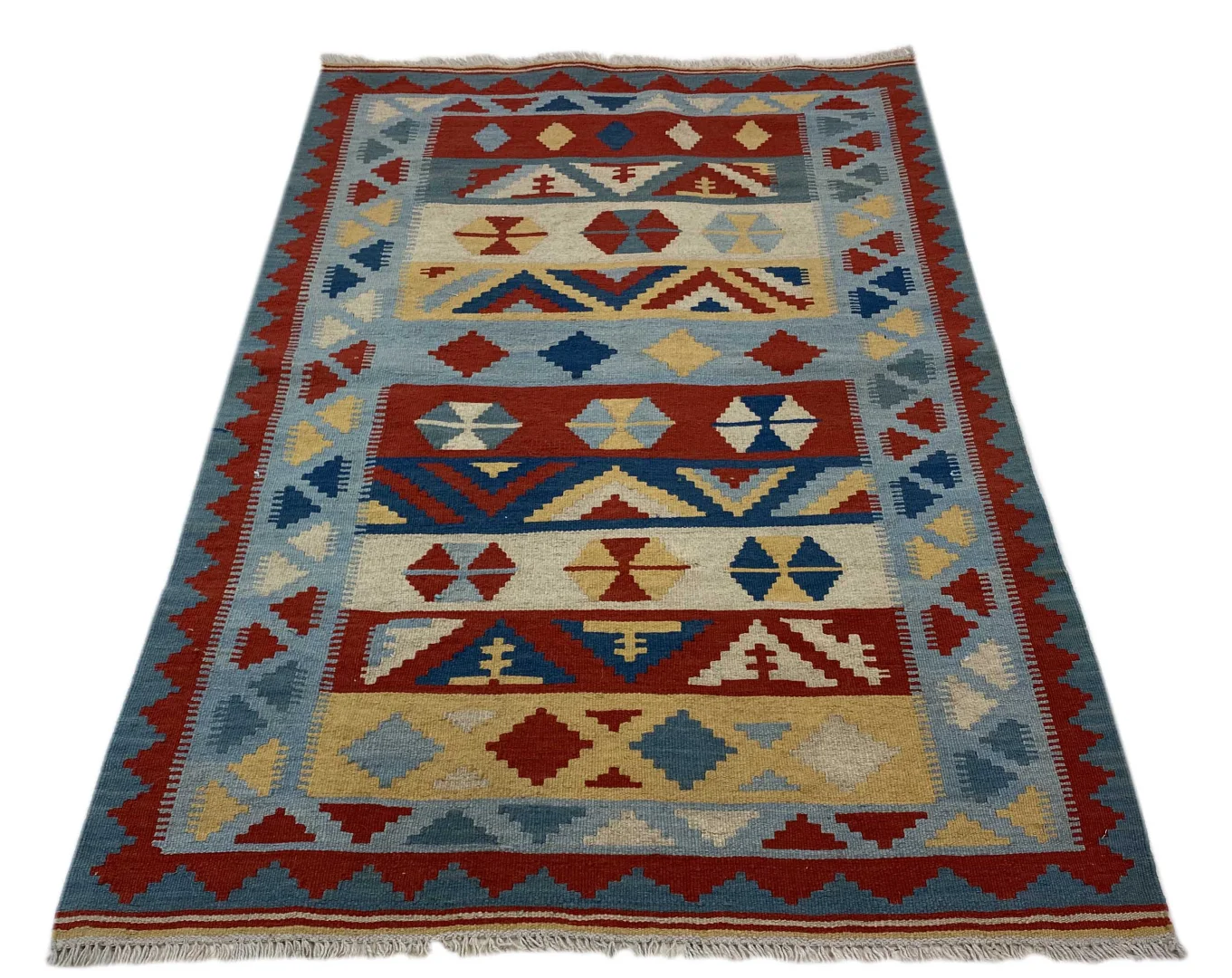
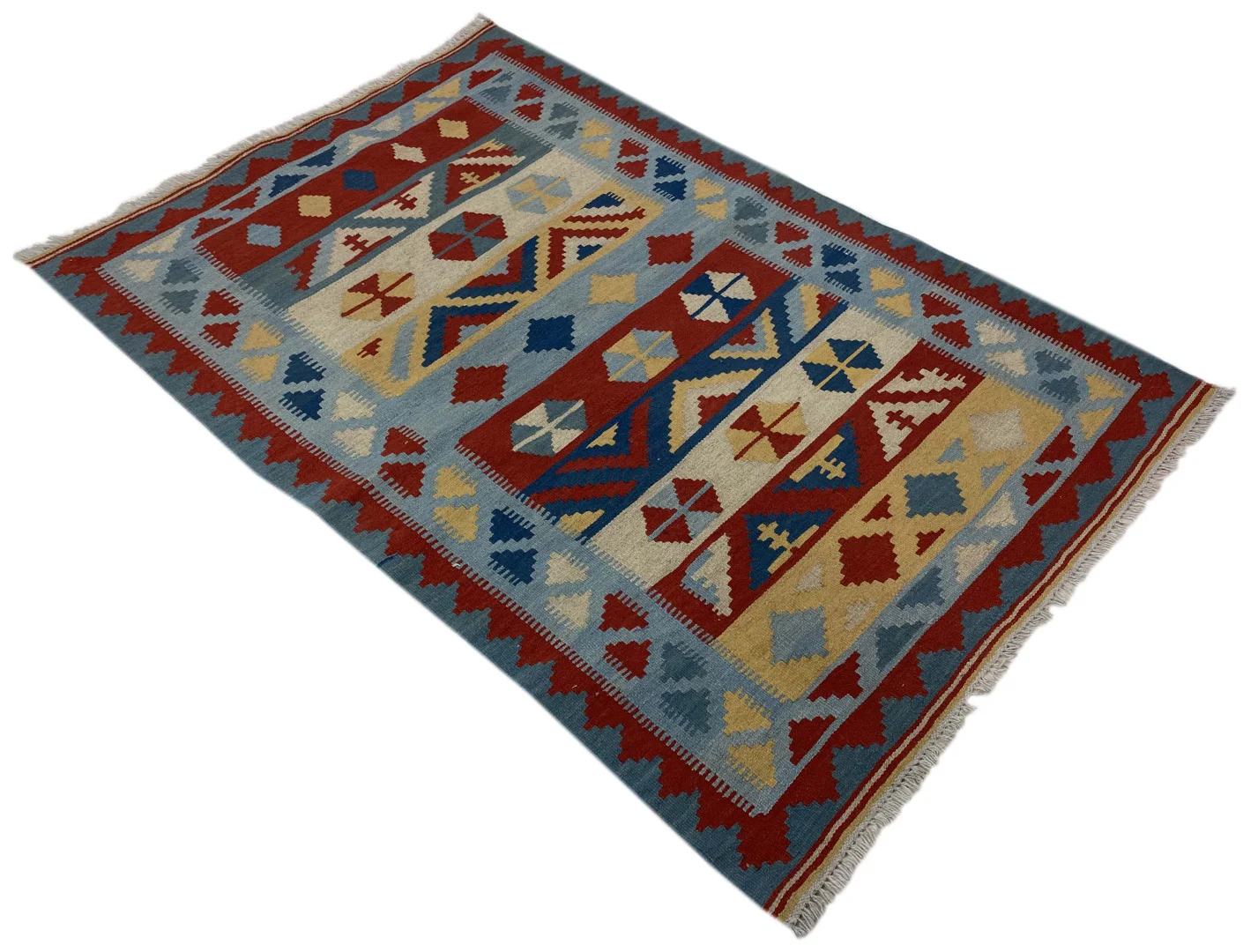
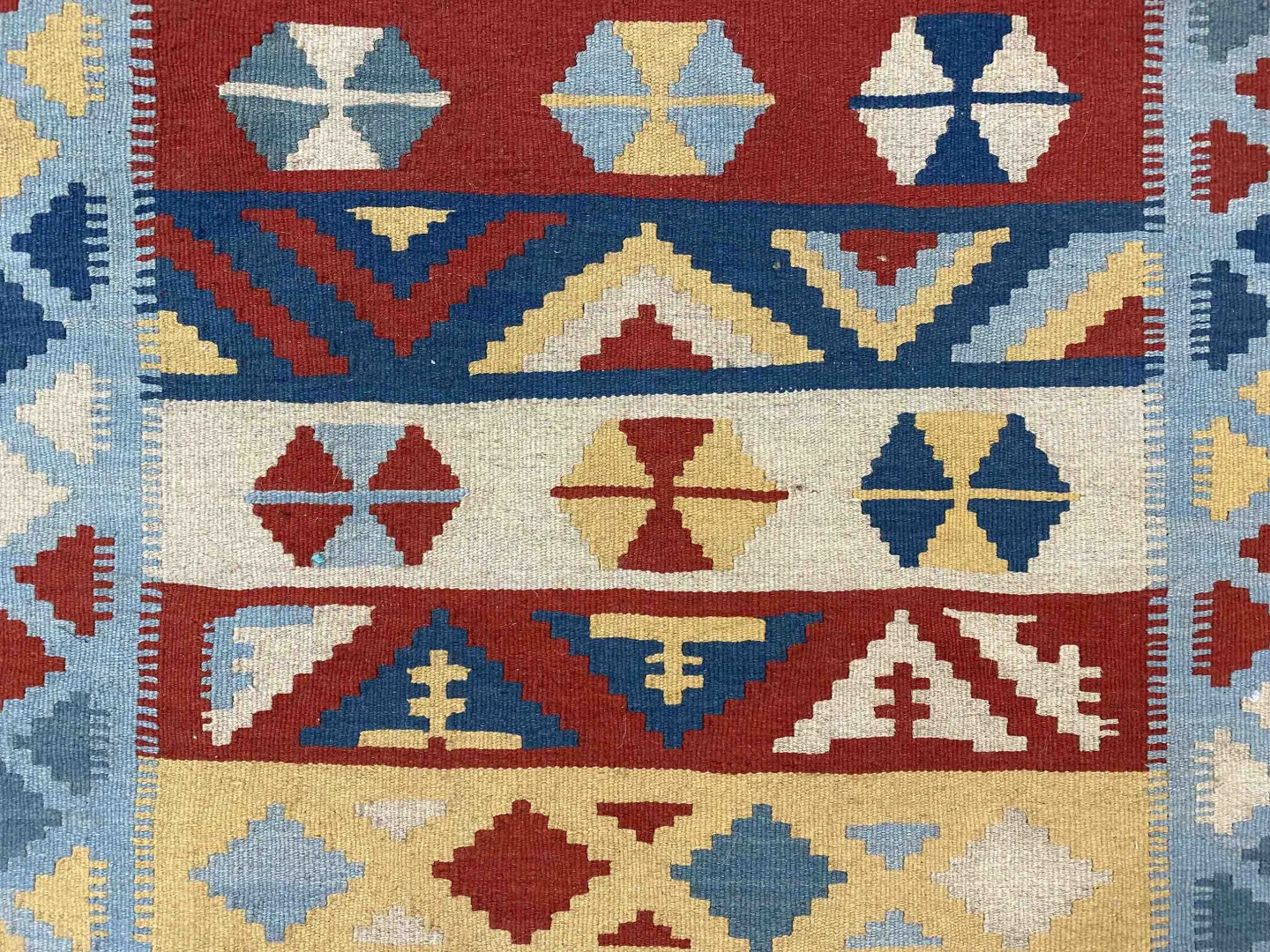
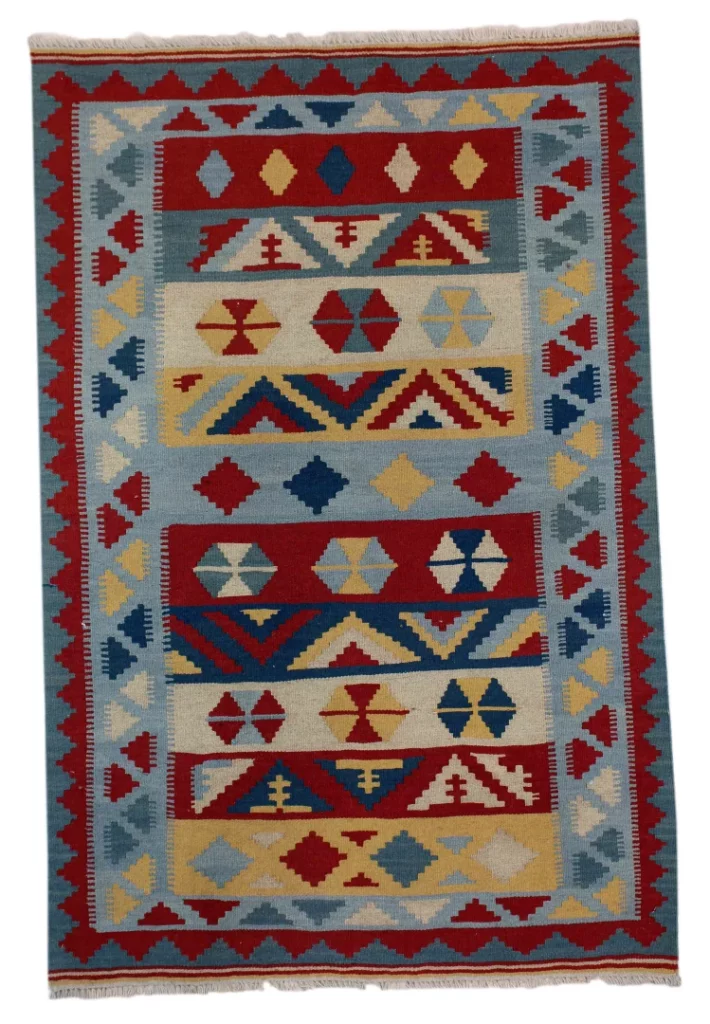
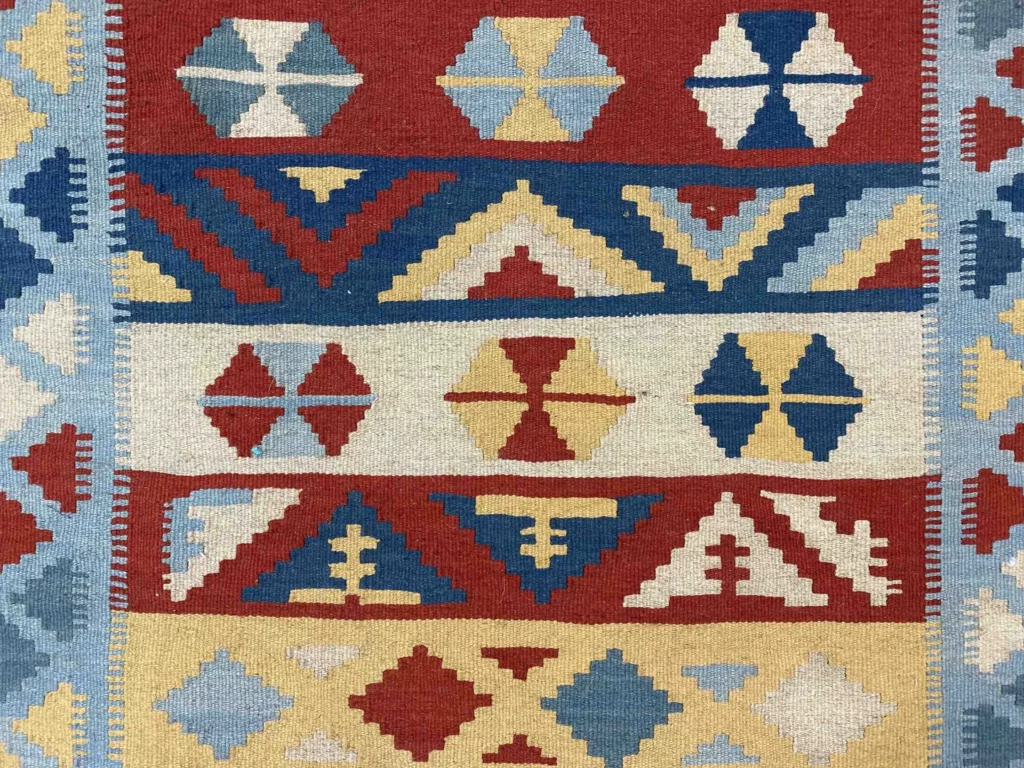
The specific design feature recorded for this piece is that its pattern is identical on both sides. There is no separate front whose pattern alone defines the textile. The Kelim can be turned over while retaining the same stated pattern. This quality is consistent with the structure of a flatweave, where the design is integrated into the woven surface rather than placed on top of a one-sided pile.
Traditional Persian Kelim design often uses clearly bounded fields, lines, bands and repeated geometric units. Diamonds, stepped forms, hooked details and stylised plant shapes are part of the wider vocabulary of regional flatweaves. These are general characteristics of Kelim design and do not assign a particular motif to this individual piece. The source does not provide a more precise name for its pattern, so no specific ornament is added here.
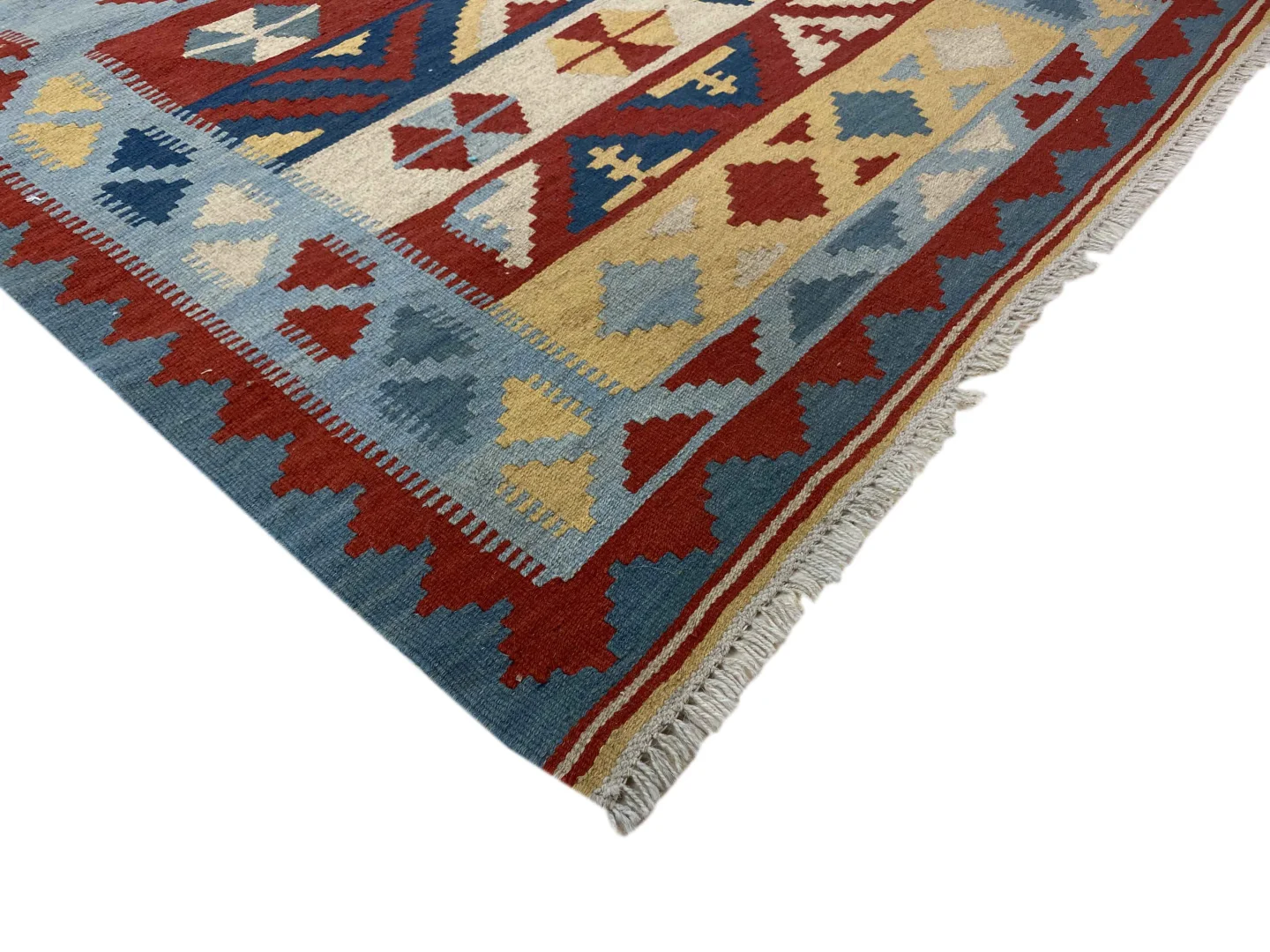
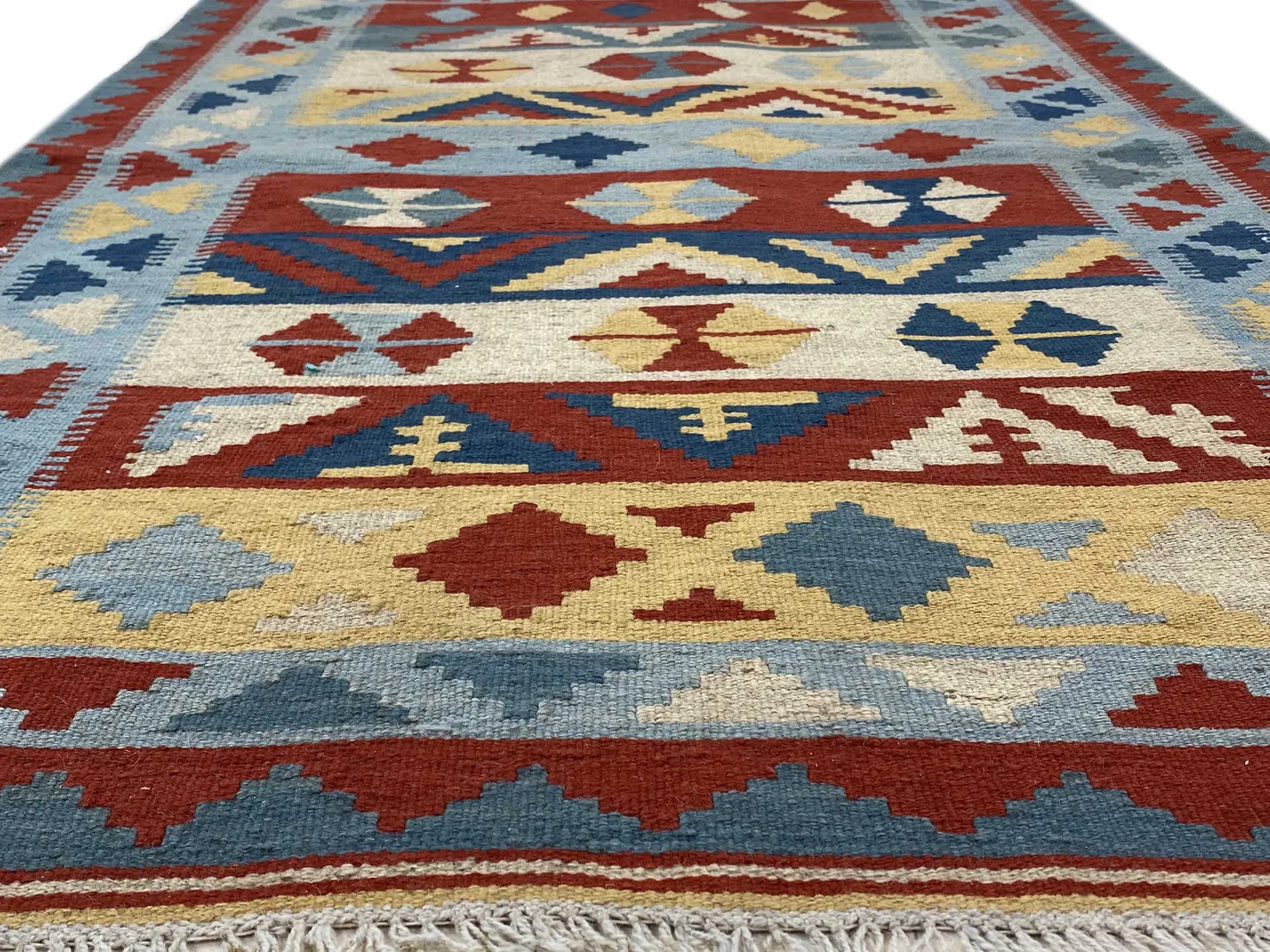
When a Kelim is examined, the arrangement of motifs and the balance between the ground and patterned areas are central. The contours are made by changes in woven colour and by the sequence of the weft. Small variations in line or field can reflect the manual process. They distinguish hand-woven work from a mechanically printed surface, where the design is applied after the textile has been made.
The identical pattern on both sides also supports flexible use. Either side can face upwards when the Kelim is placed as a rug, and the same visual arrangement remains available when it is turned. The textile can also be used as a wall hanging. Both uses are specifically stated for this piece. No particular colour scheme, individual motif or room effect is recorded, so the description remains with the confirmed feature of the double-sided pattern.
In Persian textile traditions, patterns can serve more than a purely decorative role. Repetition organizes the working process, divides the surface and gives the weaver a visual rhythm to follow. Geometric structures may be adapted to the width of the loom and to the sequence of the woven rows. The resulting image is created through the interaction of material, technique and pattern. For this Fars Kelim, the documented design characteristic is its identical appearance on both sides.
Special Features
This piece has an identical pattern on both sides. Both faces can therefore be viewed and used without changing the recorded design. The pattern is part of the woven textile rather than being limited to a single pile surface. This affects how the Kelim can be handled and gives it a practical quality associated with flatwoven textiles.
The condition is described as well preserved. The Kelim is also specified for versatile use as either a rug or a wall hanging. Its flat construction allows it to function as a floor textile while also making vertical display possible. No information is provided about its age, signature, repairs or particular signs of wear.
FAQ
How should I care for a hand-woven wool Kelim?
Dust and loose dirt can be removed carefully with a vacuum cleaner without a brush attachment. Strong rubbing should be avoided so that the woven surface is not unnecessarily stressed. If a spill occurs, it is best to absorb it promptly with a slightly damp cloth rather than soaking the wool. Harsh cleaning products may affect fibres or colours. For thorough cleaning, a professional service experienced with hand-woven wool textiles is appropriate. When the Kelim is displayed as a wall hanging, its weight should be supported evenly by the hanging system.
How can I identify a Kelim?
A Kelim is a flatwoven textile and does not have a knotted pile. Its surface is created by interlacing warp and weft threads. The pattern is woven into the fabric and may be visible on both faces. In this example, the pattern is explicitly identical on both sides. The Fars attribution and the hand-woven construction are part of its description. Knot count is not the relevant identifying measure for a Kelim in the way it is for a hand-knotted rug.
How can this Kelim be used?
This Kelim is suitable for use as a rug or as a wall hanging. On the floor, its flat construction works where a low textile profile is preferred. On the wall, it becomes a woven textile element for display. Since both sides have the same pattern, turning it over does not alter the stated appearance. The most suitable placement depends on the interior and intended use; no additional room assignment or restriction is specified.
To provide the best experiences, we use technologies like cookies to store and/or access device information. Consenting to these technologies will allow us to process data such as browsing behavior or unique IDs on this site. Not consenting or withdrawing consent, may adversely affect certain features and functions.
Functional Always active
The technical storage or access is strictly necessary for the legitimate purpose of enabling the use of a specific service explicitly requested by the subscriber or user, or for the sole purpose of carrying out the transmission of a communication over an electronic communications network.
Preferences
The technical storage or access is necessary for the legitimate purpose of storing preferences that are not requested by the subscriber or user.
Statistics
The technical storage or access that is used exclusively for statistical purposes.The technical storage or access that is used exclusively for anonymous statistical purposes. Without a subpoena, voluntary compliance on the part of your Internet Service Provider, or additional records from a third party, information stored or retrieved for this purpose alone cannot usually be used to identify you.
Marketing
The technical storage or access is required to create user profiles to send advertising, or to track the user on a website or across several websites for similar marketing purposes.

 SECURE PAYMENT
 SHIPPING PARTNERS


