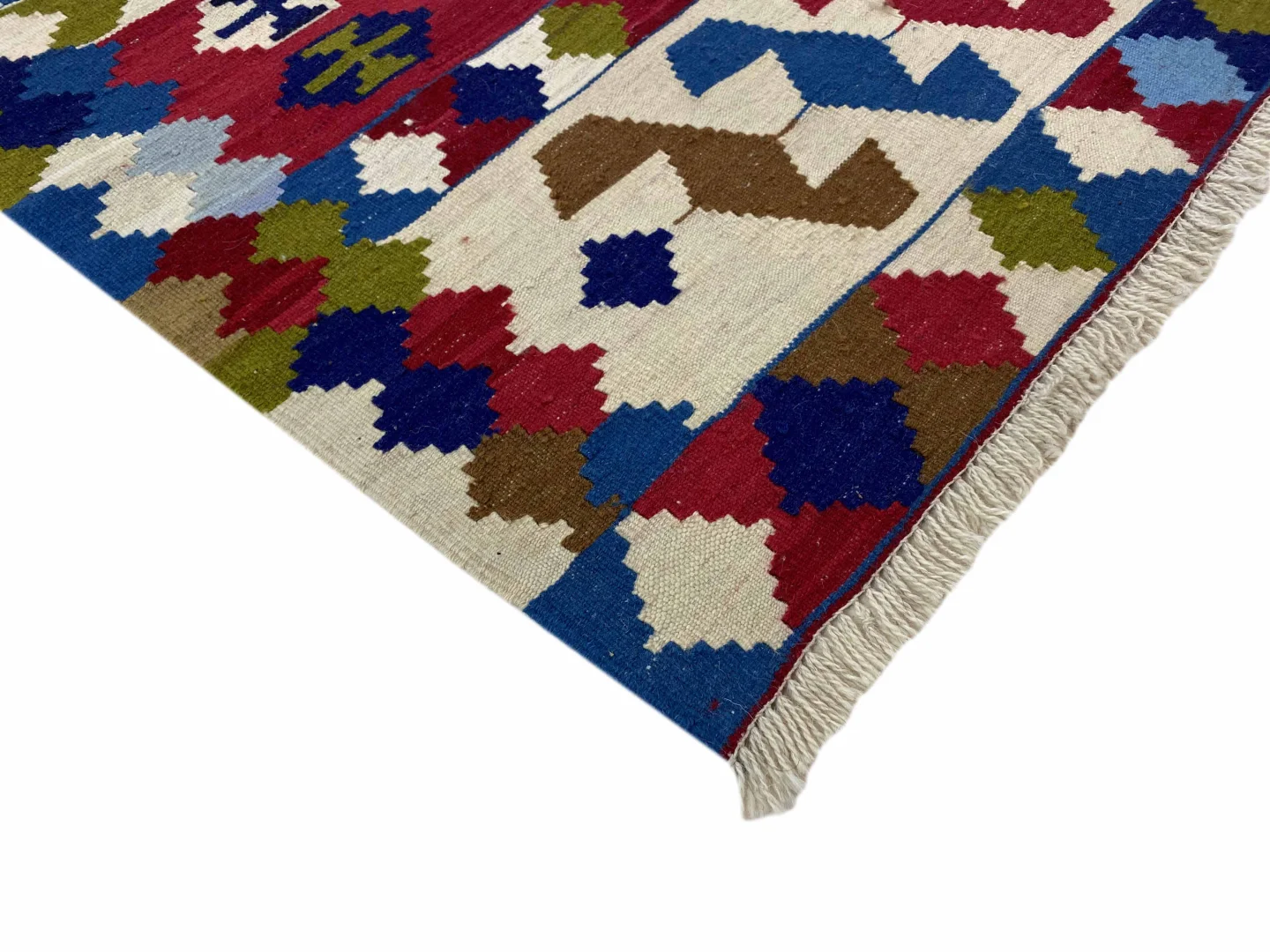
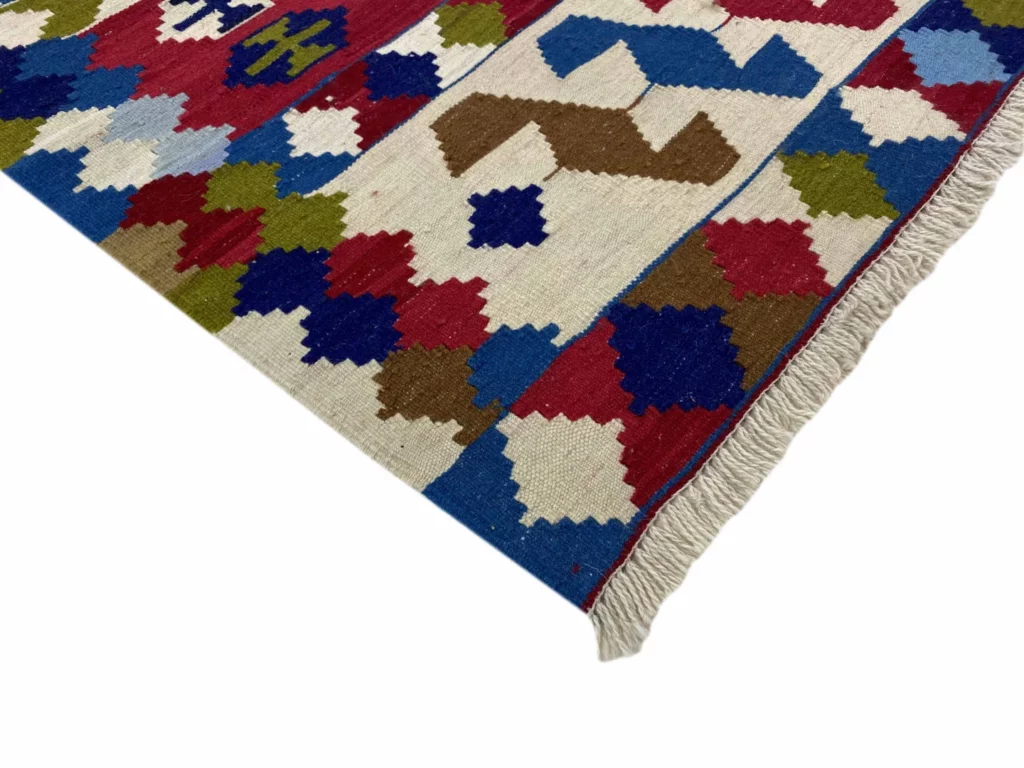
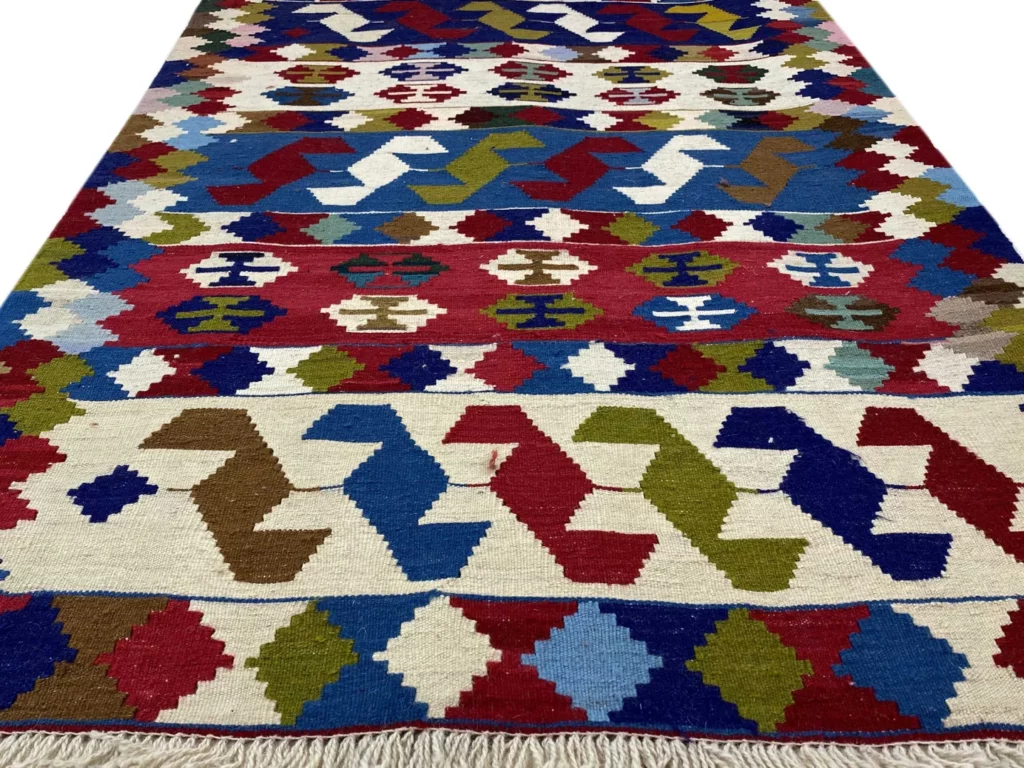
This kelim is hand-woven and made of wool. Unlike a pile rug, a kelim is formed as a flat textile surface rather than through rows of individually knotted pile. Weft threads are passed through the warp and compacted to create the woven field. The construction remains visible on the surface and gives a kelim its distinct technical identity.
Wool has traditionally been valued in woven rugs because its fibres are resilient, flexible and suitable for producing durable yarn. It can also receive colour effectively. During weaving, the tension of the warp, the movement of the weft and the compactness of the individual passages all influence the finished textile. Because there is no raised pile covering the structure, the relationship between the threads remains an important part of the appearance.
In a hand-woven kelim, coloured wefts must be guided so that they create both the surface and the intended design. Changes of colour, outlines and transitions are developed while the textile is being made. The process requires control of thread tension and an understanding of how colours meet within a flat plane. Minor variations resulting from manual work are generally part of handmade textile production rather than evidence of a repeated industrial process.
This item is identified as a hand-woven wool kelim. No separate information is given about a cotton warp, silk or any additional fibre. Knot density is not stated either. For a kelim, the principal technical feature is the woven relationship between warp and weft, not a count of pile knots. The documented material and construction are therefore limited to wool and hand weaving.
Origin and Tradition
The rug comes from Fars, near Shiraz. Fars is in southern Iran and has a broad textile heritage shaped by nomadic, village and urban communities. Its varied landscapes have supported different forms of local production. Woven textiles could be used in domestic spaces, during travel, for storage or as practical furnishings. The kelim belongs to this wider tradition of making useful objects with a strong textile presence.
Shiraz is the best-known centre of the region and has long been associated with trade, craftsmanship and cultural exchange. Fars refers to a large historical area rather than to one single workshop style with identical characteristics everywhere. Textiles from different parts of the region may therefore differ in technique, colour relationships and pattern structure. What connects them is a shared body of knowledge concerning wool, yarn preparation, dyeing, loom preparation and weaving.
In many rural and nomadic traditions, kelims were first made for practical use within a household or community. A flat weave could function as a floor covering, blanket, cover, divider or wall textile. Its low profile was convenient for folding, carrying and storing. For mobile groups, a loom that could be set up and taken down with relative ease was also useful. The intended purpose of a textile often influenced its format and design as much as its decorative role.
Traditional production began with the preparation of wool. The fibres had to be selected, cleaned and spun into yarn. The warp was then arranged on the loom, after which the weft was inserted in successive passages and pressed into place. Depending on the local practice, different methods could be used for colour fields, edges, outlines and transitions. The process combined practical skill with continual attention to tension and the developing surface.
Iranian flat weaves form part of a larger carpet culture that also includes knotted rugs, bags, saddle bags, covers and other textile objects. The distinction between a practical article and a decorative textile has not always been strict. An object could serve an everyday purpose while also carrying regional forms, colours and symbols. Kelims express this connection between function, technique and design particularly clearly because their woven structure is directly visible.
Fars has also been a meeting ground for different visual and technical influences. Nomadic design language, village production and urban trade could interact over time. This did not create one uniform style; instead, it produced a wide range of individual approaches. Geometric fields, stripes, diamonds, stylised plants and abstract signs may all occur in regional textiles. Their use depends on the specific tradition, the purpose of the piece and the experience of the person who made it.
Knowledge was often transmitted within families and local communities through practical work. Skills in spinning, dyeing, warping and weaving were learned by observation and repetition. A design did not necessarily require a written chart. Many compositions were based on remembered forms, recurring structures and familiarity with the loom. This method of transmission helps explain why related regional ideas can appear in numerous individual variations rather than in identical copies.
Design and Pattern
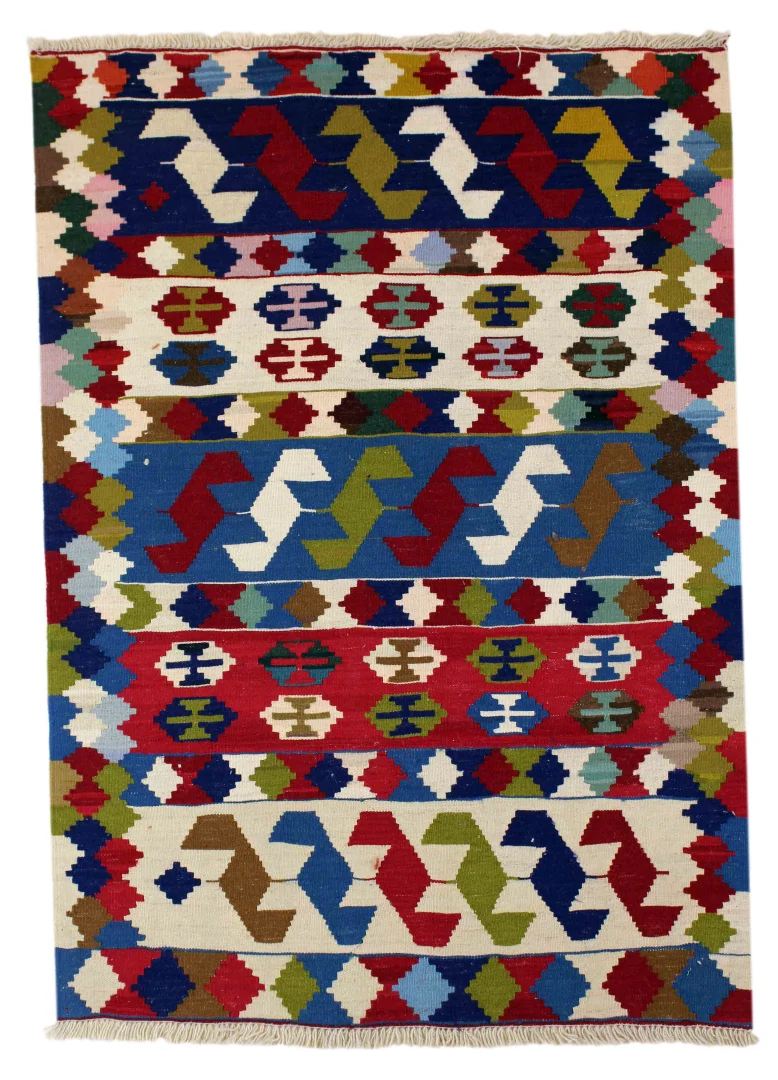
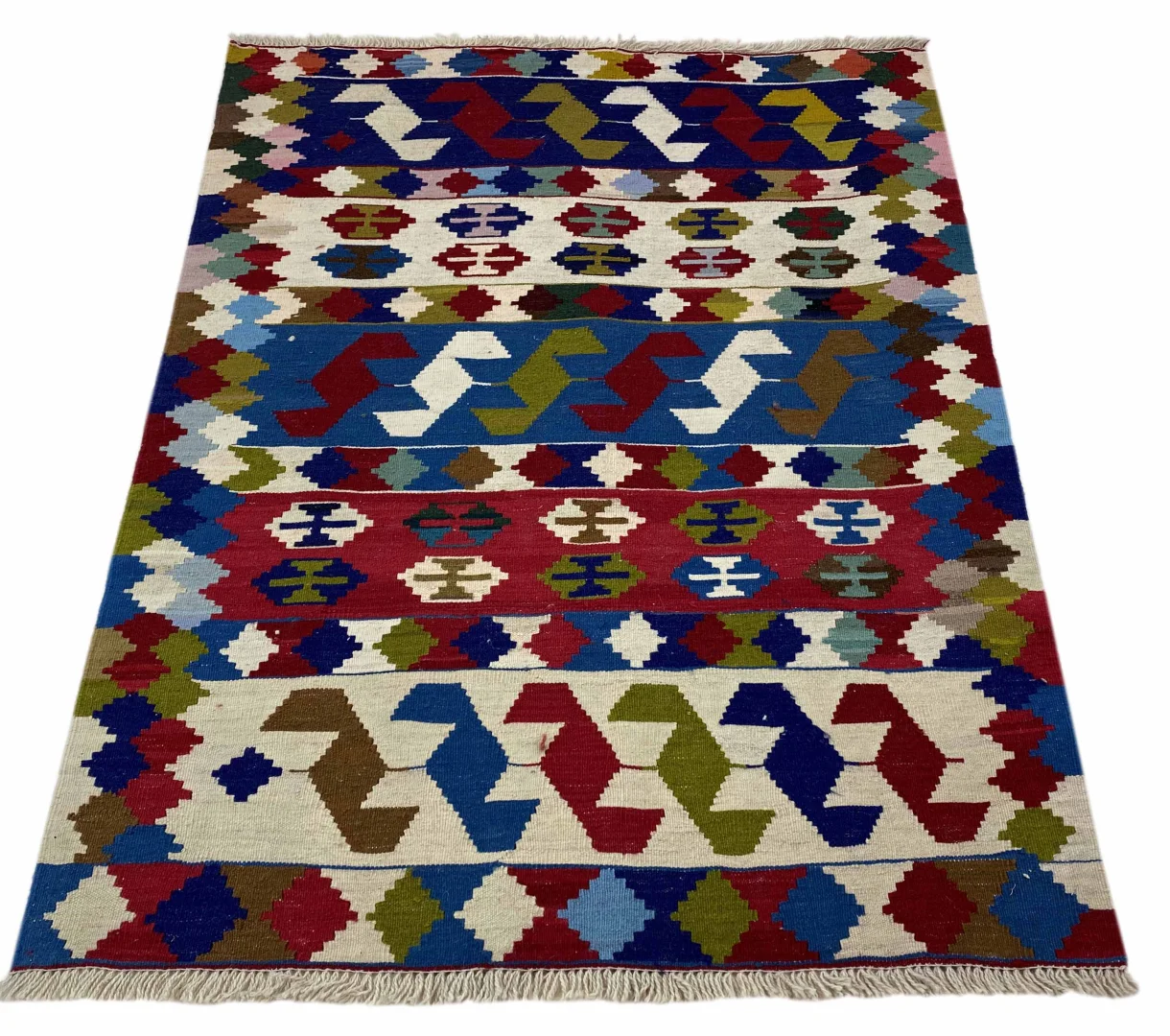
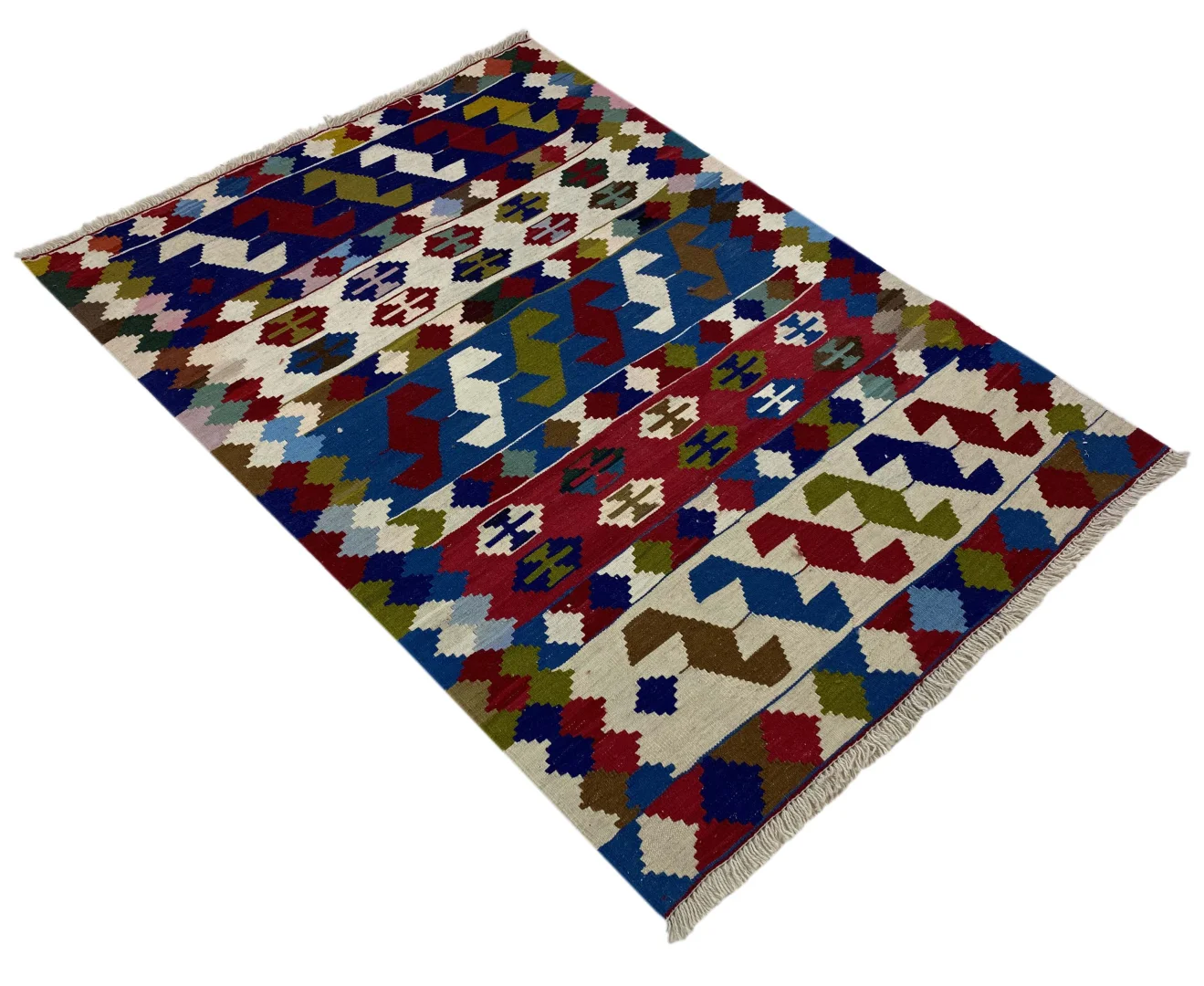
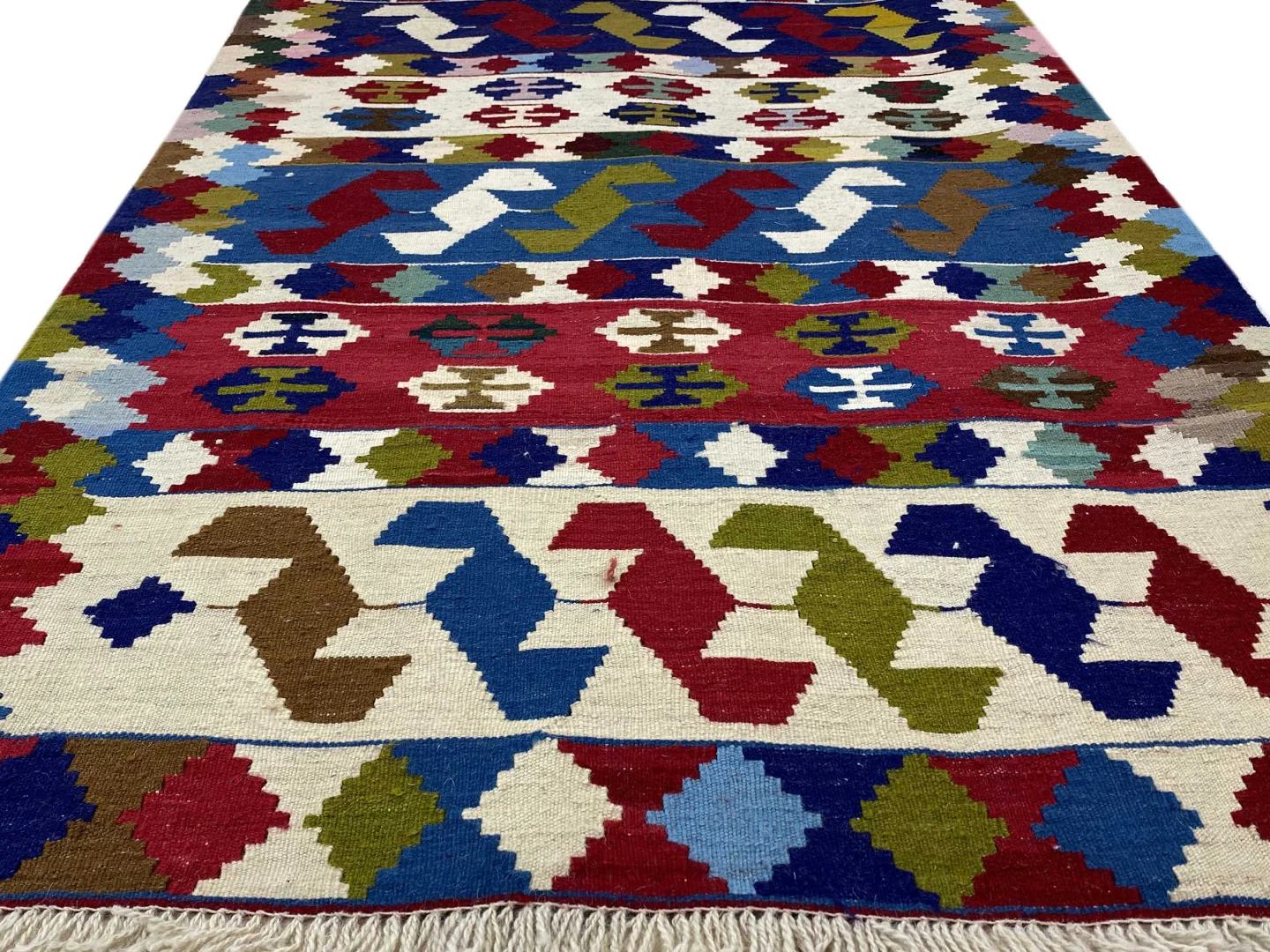
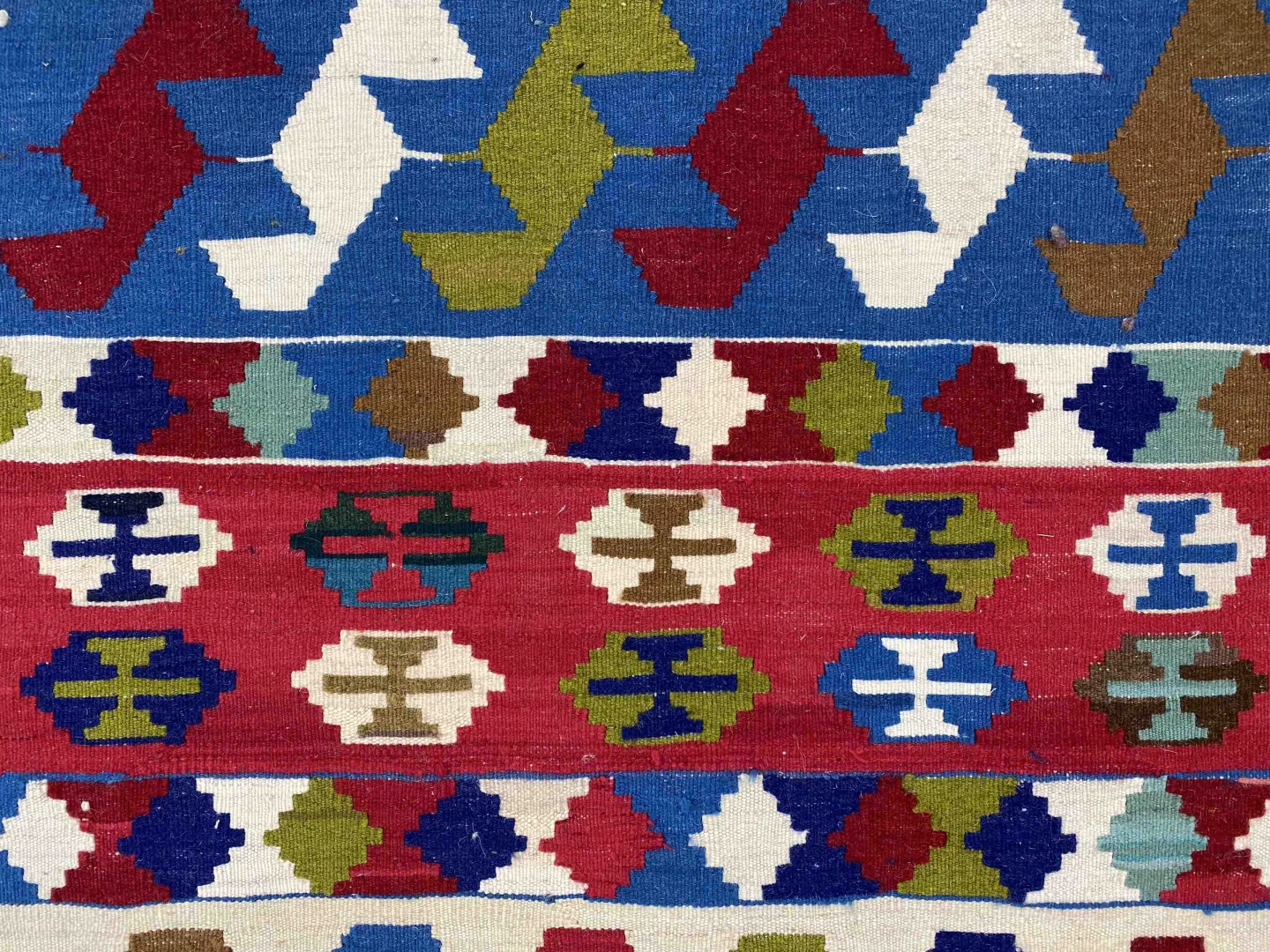
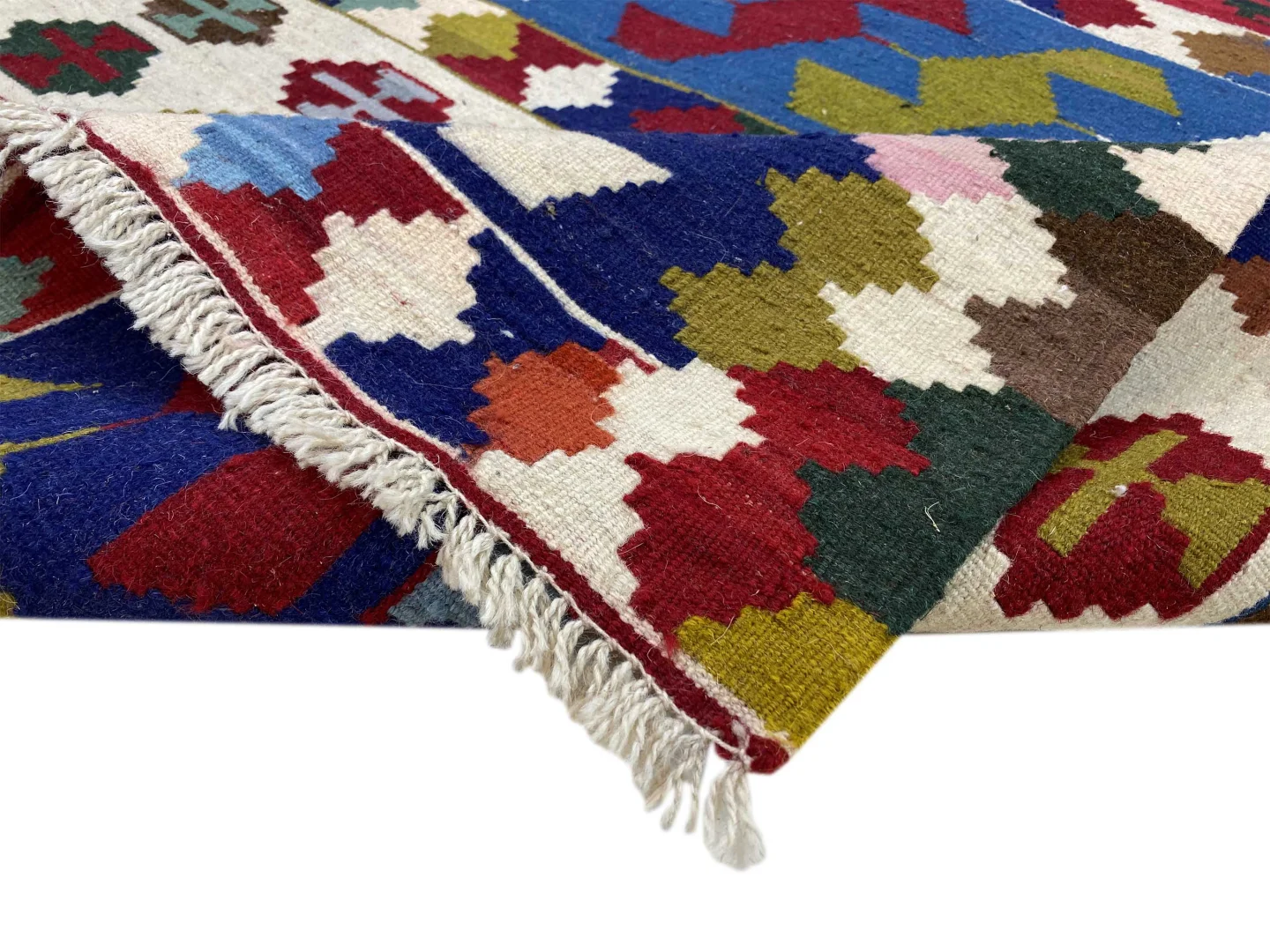
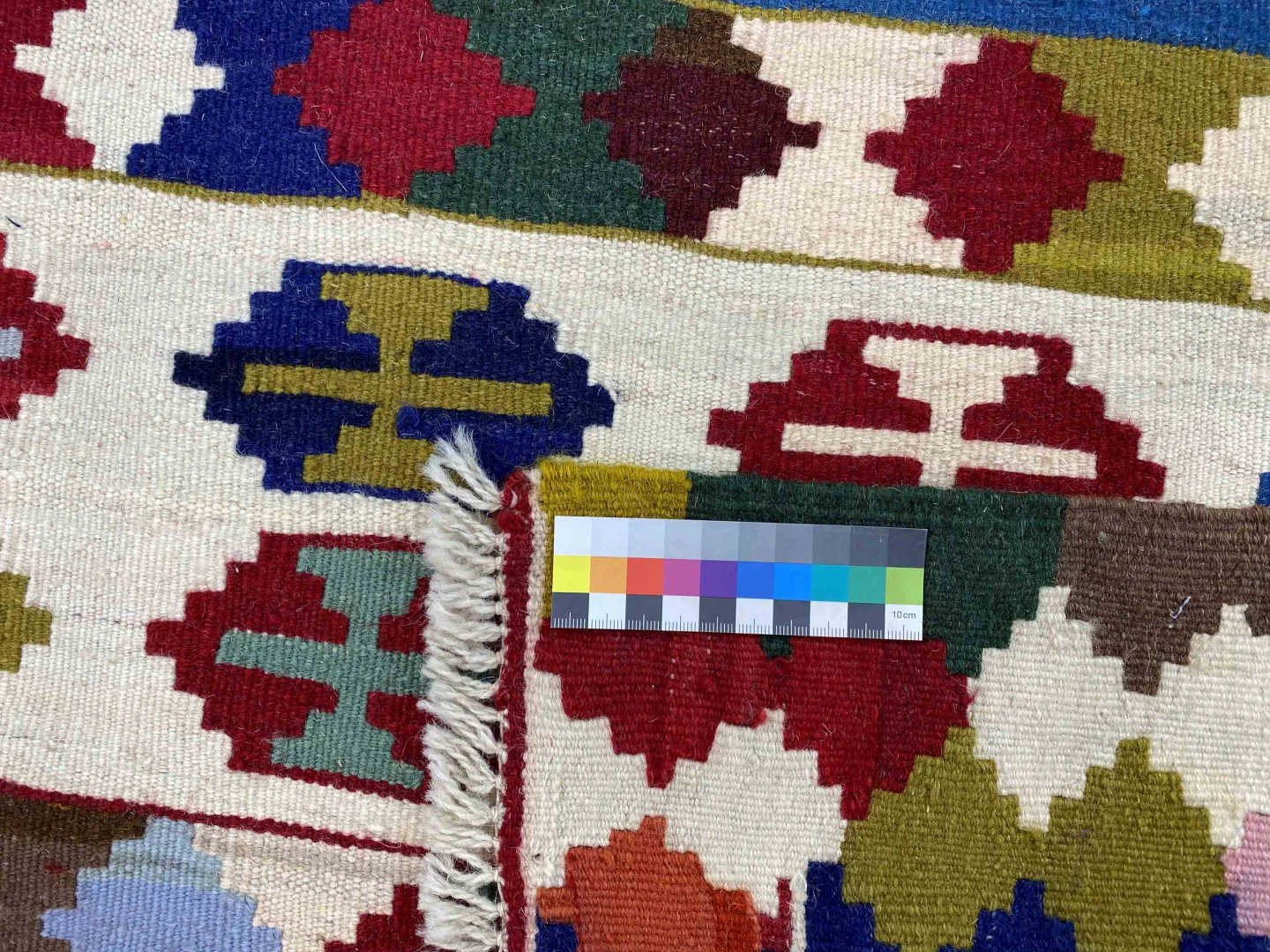
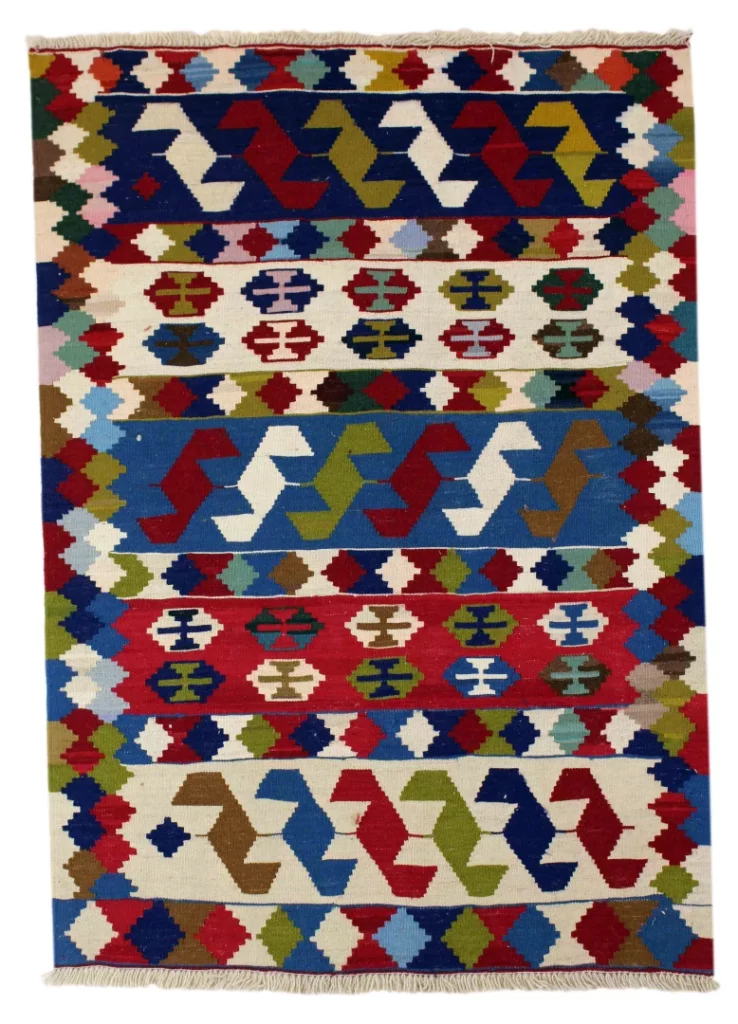
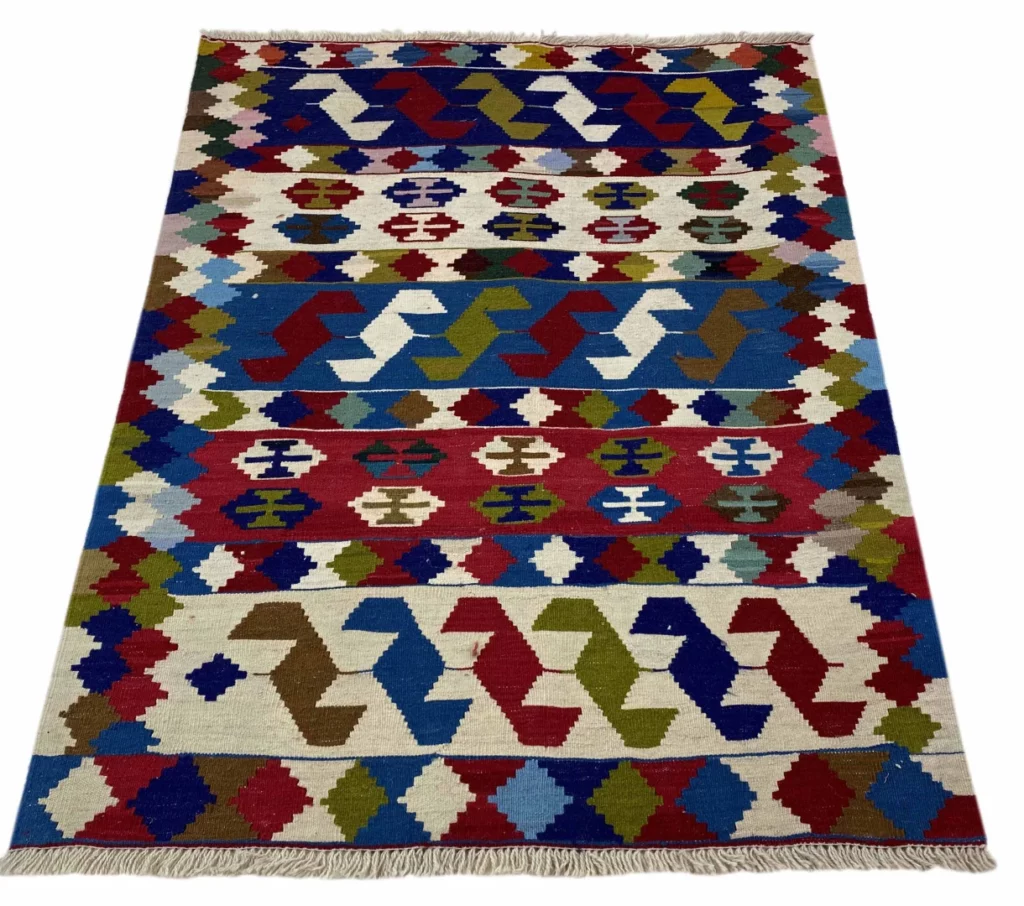
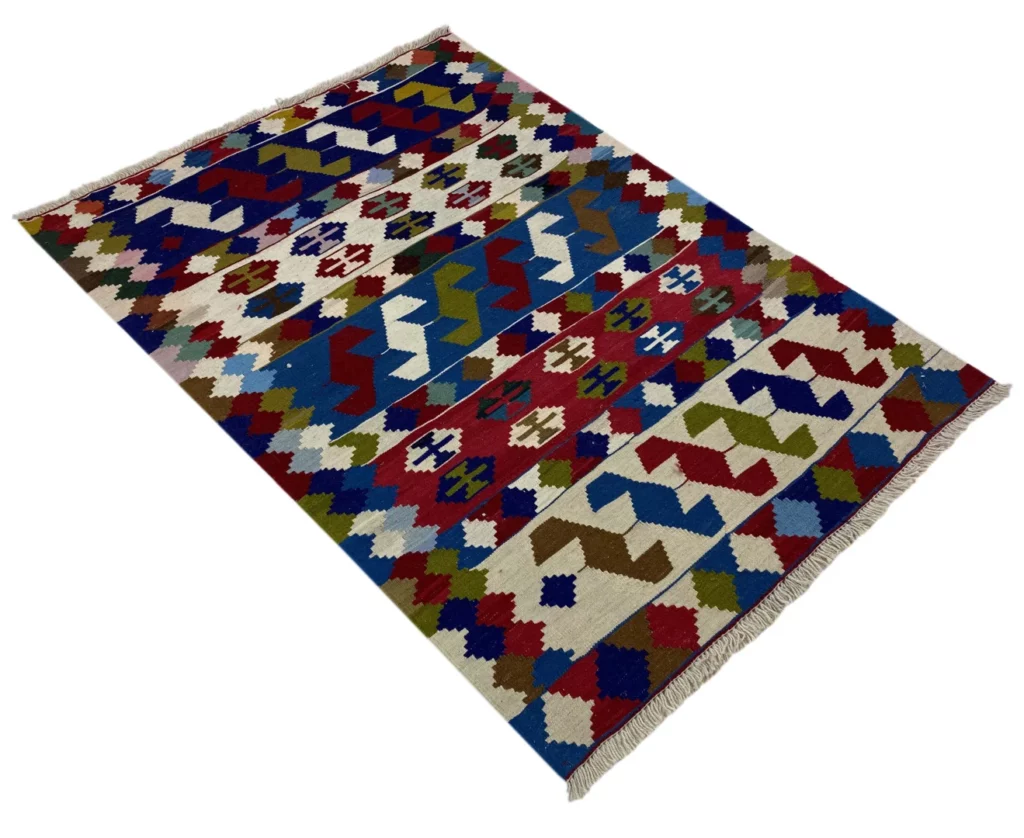
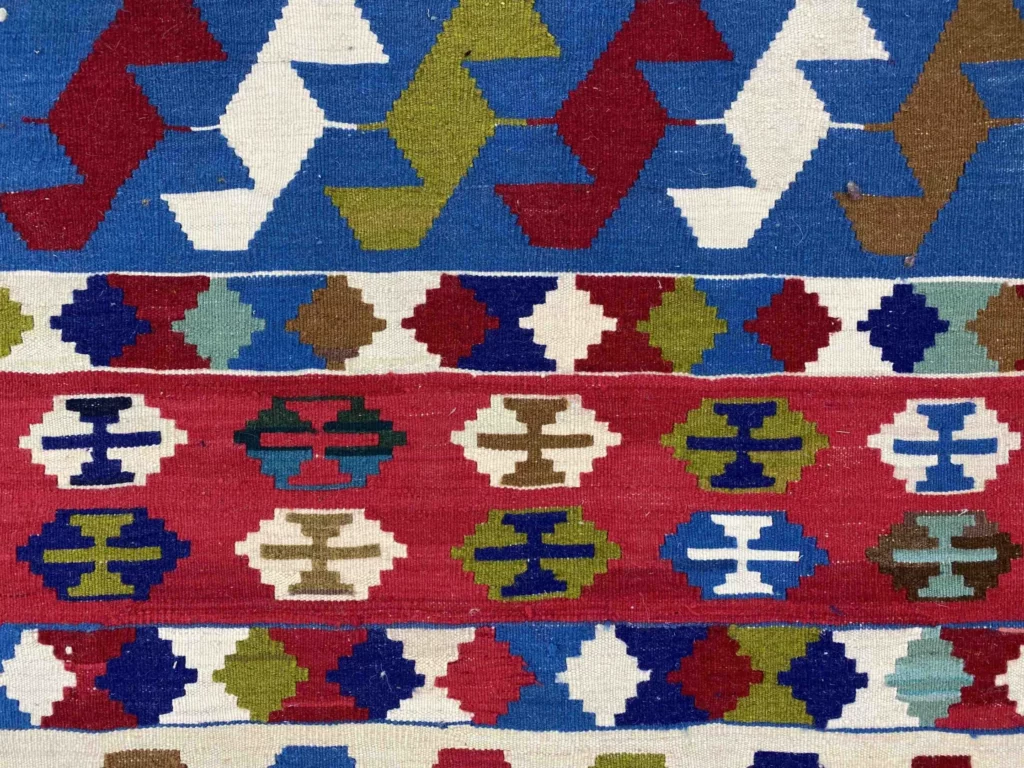
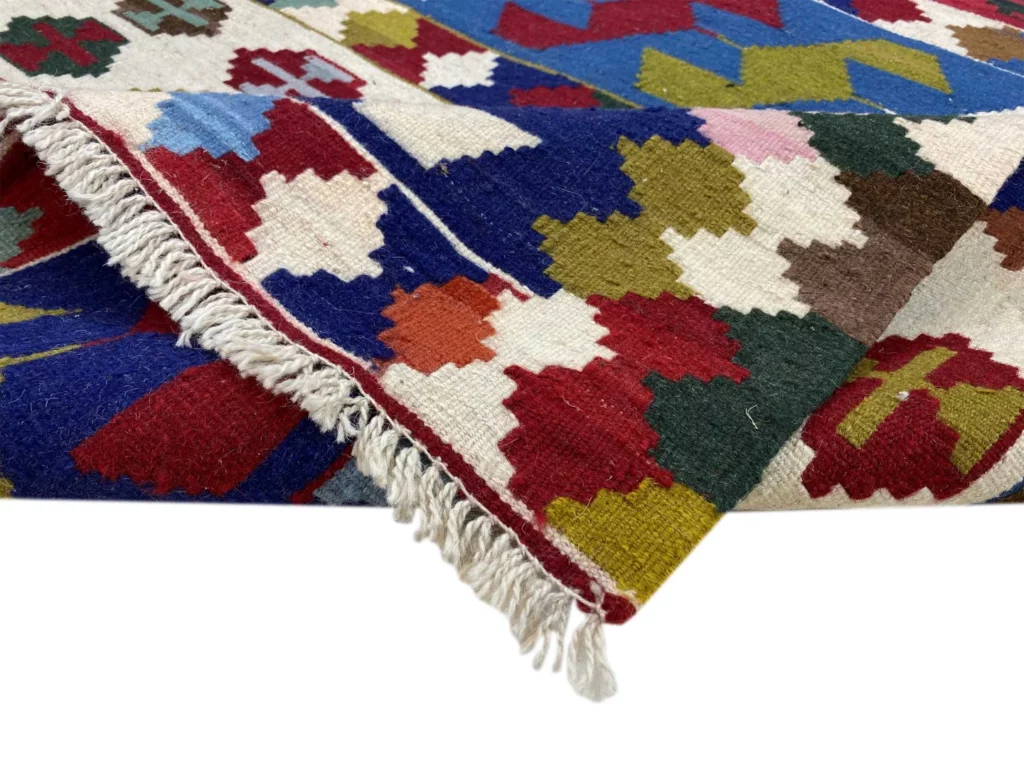
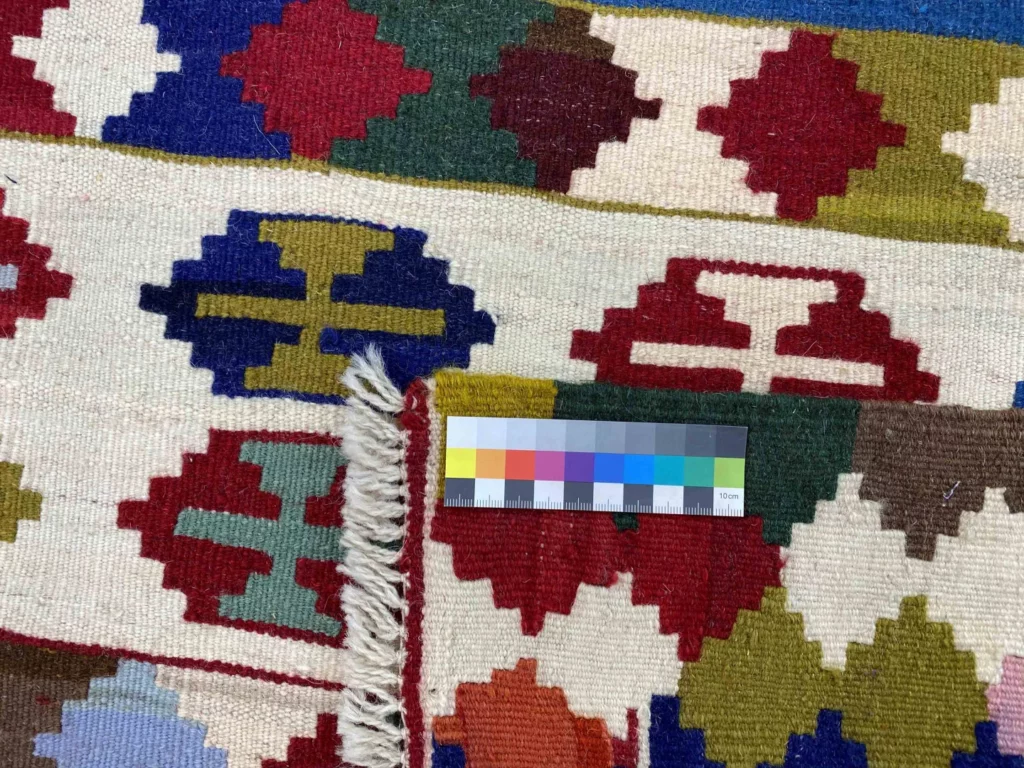
The pattern of this kelim is identical on both sides. This feature is technically understandable in a flat weave because the design is formed within the woven surface and is not covered by a cut pile that would create a strongly differentiated front and reverse. The coloured wefts make up the visible areas, while the warp supports the textile structure. As a result, the design can be read from either side in the same way.
The exact pattern type is not specified. This individual piece is therefore not assigned a medallion, Herati design or another named motif. In the broader Iranian kelim tradition, designs range from clearly organised geometric compositions to stylised plants, animals and figurative forms. Repeated diamonds, stepped lines, hooked shapes, stripes and borders are among the devices found in regional flat weaves. These examples describe the wider vocabulary and do not identify an unrecorded motif on this particular rug.
With a kelim, design is created directly through the mechanics of weaving. A change of colour can be made by bringing differently coloured weft areas together. Diagonal lines are often built in steps because the yarn is placed through the textile in successive movements. The resulting contours are both visual elements and traces of the weaving method. Repetition may establish rhythm, while narrow borders can frame the central field and organise the composition.
Geometric forms are especially suited to flat weaving because they can be built from defined colour areas and short changes of direction. Diamonds, zigzags and stepped angles follow naturally from the movement of the weft. Stylised plant forms may likewise be simplified so that they remain legible within the woven surface. This abstraction is not simply a reduction of detail; it is part of a design language shaped by the loom, the available yarn and the structure of the textile.
The effect of a woven pattern depends on more than individual symbols. The spacing between forms, the repetition of colour fields, the proportions of stripes and borders and the balance between an interior field and its frame all contribute to the composition. A kelim may consequently appear calm and ordered, strongly rhythmic or densely structured. Since no specific colours or motif are recorded for this piece, the concrete description remains limited to the fact that its pattern is identical on both sides.
Fars has a varied regional language of colour and form. Textiles from the area may use strong contrasts or more restrained relationships, depending on local practice and purpose. Wool gives a flat weave a tactile surface and can produce a subdued response to light. The visible structure of the weave also affects how colours are perceived. These general characteristics explain the role of material and technique in regional design without adding colours or motifs to the individual rug.
A kelim can look different from a knotted rug even when both belong to the Iranian carpet tradition. In a knotted rug, the design is built from individual knots and the pile above them. In a kelim, coloured yarn creates the image within one flat plane. Lines, fields and transitions may therefore appear more direct, while the woven structure remains prominent. The identical design on both sides is a further consequence of this construction and is a documented feature of this particular piece.
Special Features
The recorded features of this item are its hand-woven construction, its wool material and its origin in Fars near Shiraz. The pattern is identical on both sides. The kelim is also described as very well preserved. These statements concern this individual rug and summarise its documented characteristics.
The matching design on both sides is practical because neither face has to be selected as the only patterned side for ordinary use. The flat construction also makes kelims adaptable to different areas and furnishings. For care, a clean and dry floor and gentle vacuuming without a hard brush are sensible general measures. Spills should not be rubbed into the weave. If more intensive treatment is needed, specialist cleaning is preferable so that the wool and flat structure are handled appropriately.
FAQ
How should a hand-woven wool kelim be cleaned?
Loose dirt can first be removed with low suction and without a stiff brush. If liquid is spilled, it should be dabbed carefully with a clean, absorbent cloth rather than rubbed into the weave or allowed to soak the wool. Harsh cleaning products may affect fibres and colours, so they should not be used casually. For heavier soiling or a complete wash, a professional cleaner familiar with flat-woven wool textiles is the appropriate choice. After any damp treatment, the kelim should dry completely and evenly before being used again.
What does it mean that the pattern is identical on both sides?
It means that the front and reverse show the same pattern. In a kelim, the design is created by weft yarns inserted into a flat woven structure rather than by a cut pile. There is therefore no pile face that creates a strongly different reverse. The piece can be viewed and used from either side. The statement concerns the agreement of the two patterns; it does not make an additional claim about different material qualities or a separate reversible decoration.
What does the origin Fars near Shiraz indicate?
It places the rug in the Iranian region of Fars, in the area near Shiraz. Fars contains varied nomadic, village and urban weaving traditions, so an individual motif or colour should not be treated as exclusive proof of origin by itself. The place name, the weaving method and the wider textile context are considered together when describing regional provenance. This piece is described as a hand-woven wool kelim from Fars near Shiraz, without assigning it an additional named pattern.
To provide the best experiences, we use technologies like cookies to store and/or access device information. Consenting to these technologies will allow us to process data such as browsing behavior or unique IDs on this site. Not consenting or withdrawing consent, may adversely affect certain features and functions.
Functional Always active
The technical storage or access is strictly necessary for the legitimate purpose of enabling the use of a specific service explicitly requested by the subscriber or user, or for the sole purpose of carrying out the transmission of a communication over an electronic communications network.
Preferences
The technical storage or access is necessary for the legitimate purpose of storing preferences that are not requested by the subscriber or user.
Statistics
The technical storage or access that is used exclusively for statistical purposes.The technical storage or access that is used exclusively for anonymous statistical purposes. Without a subpoena, voluntary compliance on the part of your Internet Service Provider, or additional records from a third party, information stored or retrieved for this purpose alone cannot usually be used to identify you.
Marketing
The technical storage or access is required to create user profiles to send advertising, or to track the user on a website or across several websites for similar marketing purposes.
 SECURE PAYMENT
 SHIPPING PARTNERS


