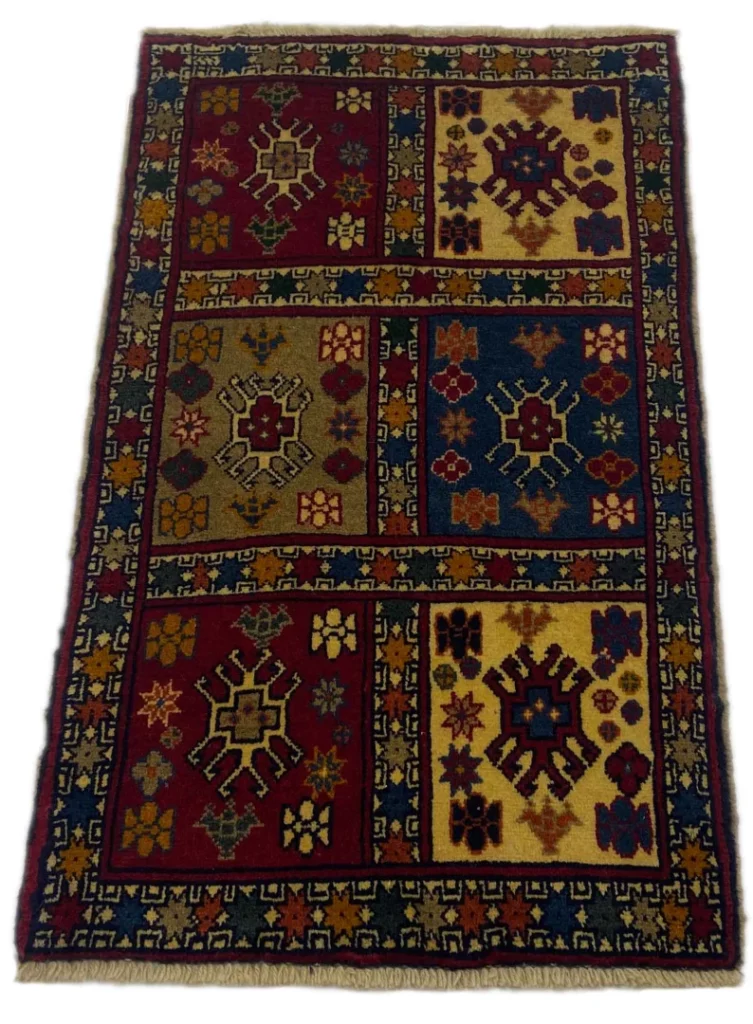
This Gabbeh Shuli is a hand-knotted Persian rug from the Fars region. Its pile is made of virgin wool, the principal textile material identified for this piece. Virgin wool comes from a sheep’s first shearing and is valued in rug making as a natural fibre with a resilient structure. The fibre contributes to the way the pile feels, reflects light and receives colour. Here, the wool is specifically described as having a lustrous appearance.
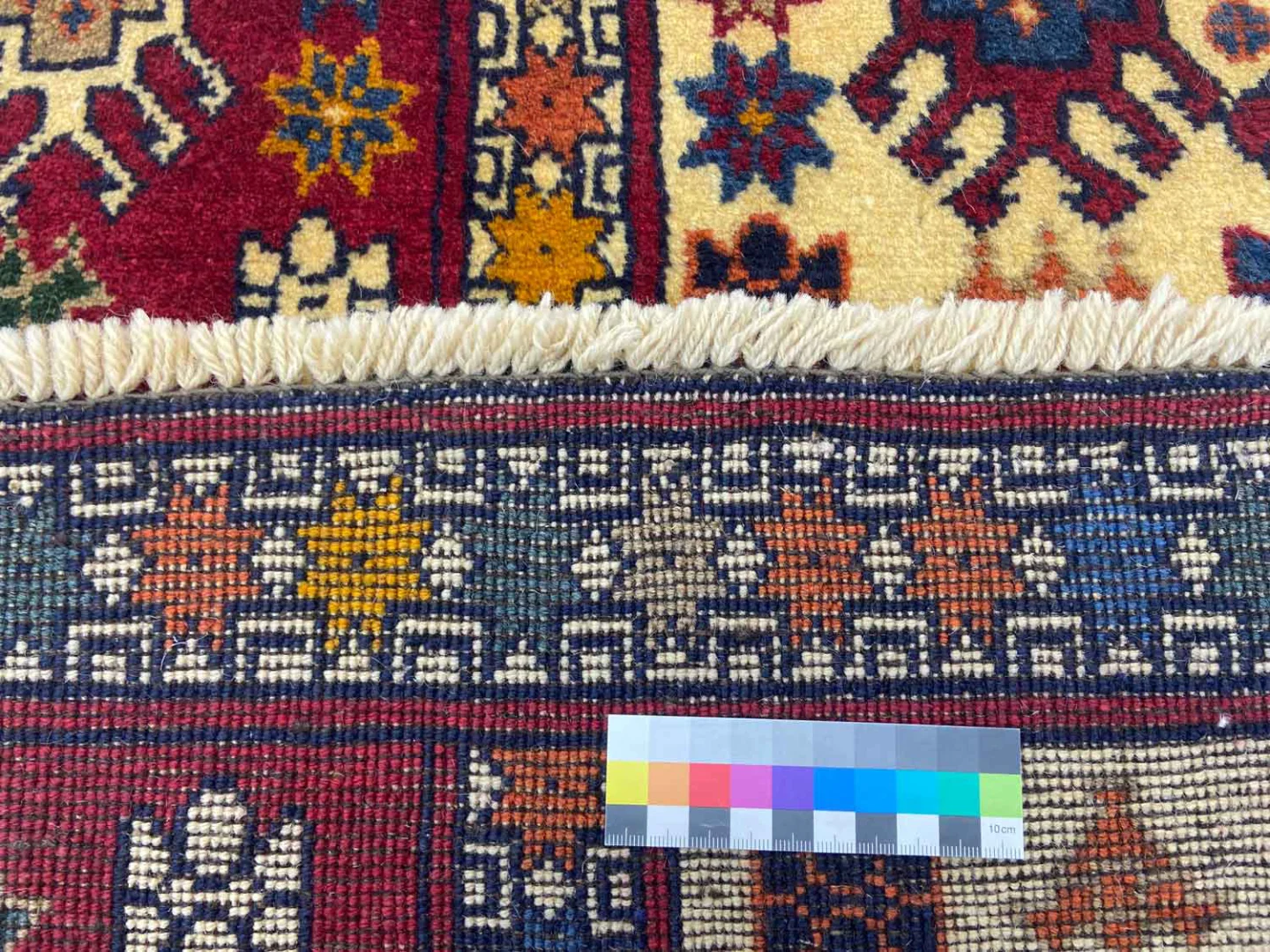
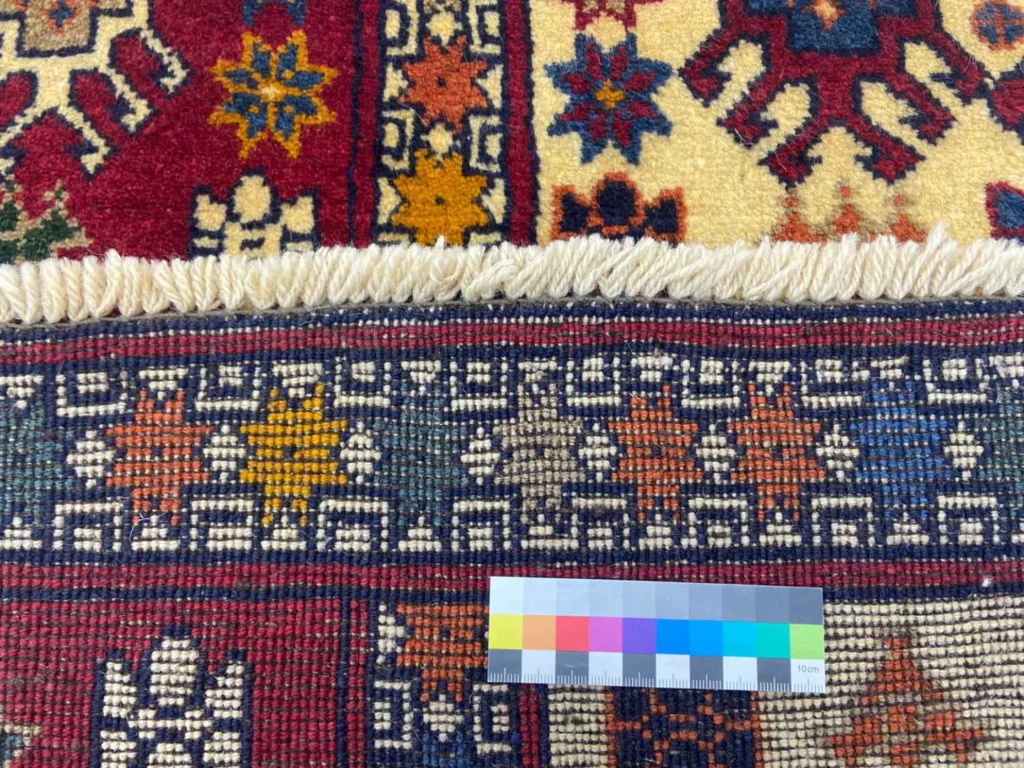
Hand-knotting is a form of construction carried out one knot at a time rather than by an industrial machine. Each knot connects the pile with the underlying structure, while successive rows build the surface and the design. The maker must continuously coordinate thread tension, colour placement, knotting and the progression of the pattern. The finished textile therefore records a long sequence of individual craft operations rather than a mechanically repeated surface.
The knot density of this rug is between 90,000 and 180,000 knots per square metre. Knot density indicates how many knots are contained within a defined area and provides a technical description of the fineness of the work. It is not the same thing as the visual complexity of a design, although it helps explain how closely the pile elements are arranged. In a Gabbeh, the effect of the wool, the colour scheme and the design concept remains just as important as the numerical density.
The rug is new. This means that its hand-knotted construction, virgin-wool pile and described surface are presented in an unused condition. No additional warp material is specified for this piece, so the material description is limited to the stated virgin wool in the pile. The documented qualities are the wool pile, hand-knotted technique, the stated knot-density range and the new condition.
Origin and Tradition
This rug comes from Fars in Persia. Fars is located in southern Persia and is closely associated with Shiraz in the history of carpet production. The region has developed a varied textile culture shaped by settled communities as well as nomadic influences. Local wool, inherited weaving knowledge and regional design habits have all contributed to the range of rugs associated with Fars. It is therefore more accurate to view the region as a group of related traditions than as a single uniform style.
Gabbeh rugs occupy a distinct place within this setting. The term Gabbeh is generally used for hand-knotted rugs whose designs are not restricted to densely repeated ornament or rigidly formal compositions. Simplified fields, spare forms and imaginative pictorial ideas are all possible within the tradition. This openness is one of the reasons Gabbeh is recognised as a separate design direction within the wider world of Persian rugs.
The source identifies Gabbeh Shuli, also called Gabbeh Fars, as a particular subcategory of Gabbeh rugs. Shuli is associated here with creative freedom and imaginative, often abstract patterns inspired by the maker’s own imagination. The design does not have to follow a fixed repeat with identical units across the entire surface. Instead, forms and colour areas can be arranged with a greater degree of independence. That individual approach is central to the description of this group.
Traditional production in Fars depends on practical knowledge passed from one generation to the next. Such knowledge includes preparing wool, managing the foundation, selecting a knotting method and keeping the developing pattern coherent during the work. In hand production, the rug is built through many separate decisions. The person knotting it has to monitor the tension of the threads, the order of colours and the relationship between the emerging shapes. This process gives the craft tradition its direct connection with the maker.
Shiraz provides an important regional reference point. Shiraz rugs are described as a related group known for geometric designs and strong colours. Qashqai rugs also belong to the broader cultural landscape of Fars and are associated with nomadic tribes, lively colours and traditional designs. These comparisons help place a Gabbeh Shuli within the region’s textile history, but they do not change its classification. This rug is described as a Gabbeh Shuli from Fars, not as a Shiraz or Qashqai rug.
Bakhtiari and Tabriz are also named among other recognised rug traditions in the general overview. Each represents its own historical and regional development. They should not be treated as alternative origins for this piece. The relevant origin here is Fars, while Gabbeh Shuli identifies its place within that regional tradition. The distinction matters because similar colours or an abstract design do not by themselves establish a different provenance.
Design and Pattern
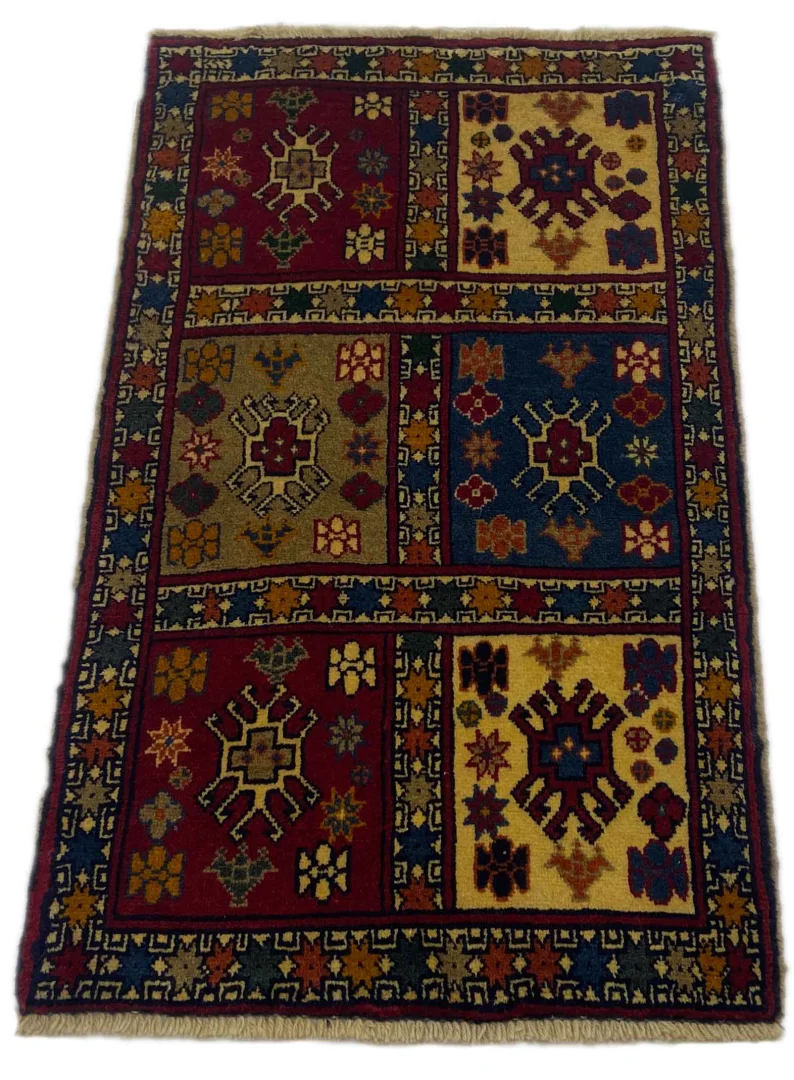
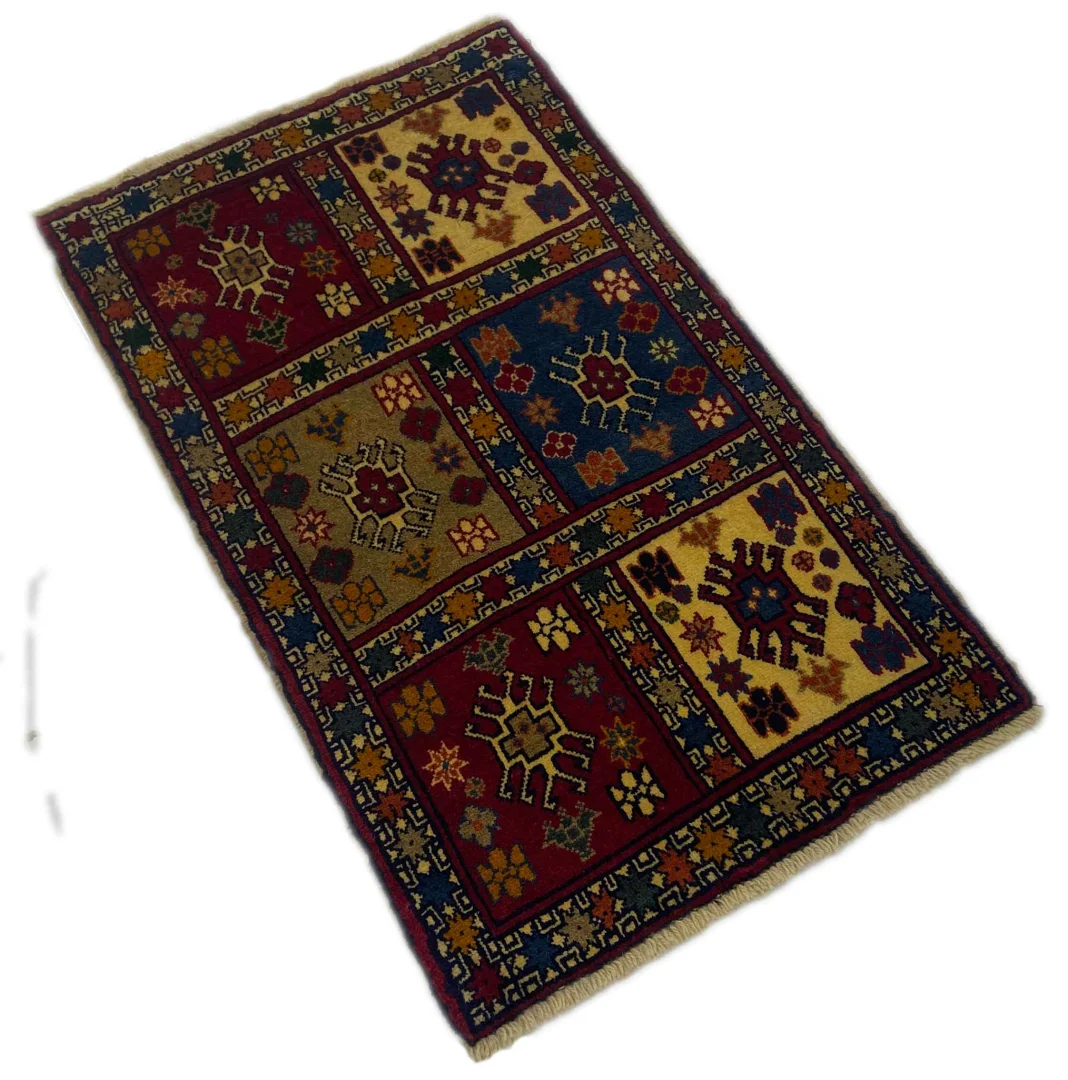
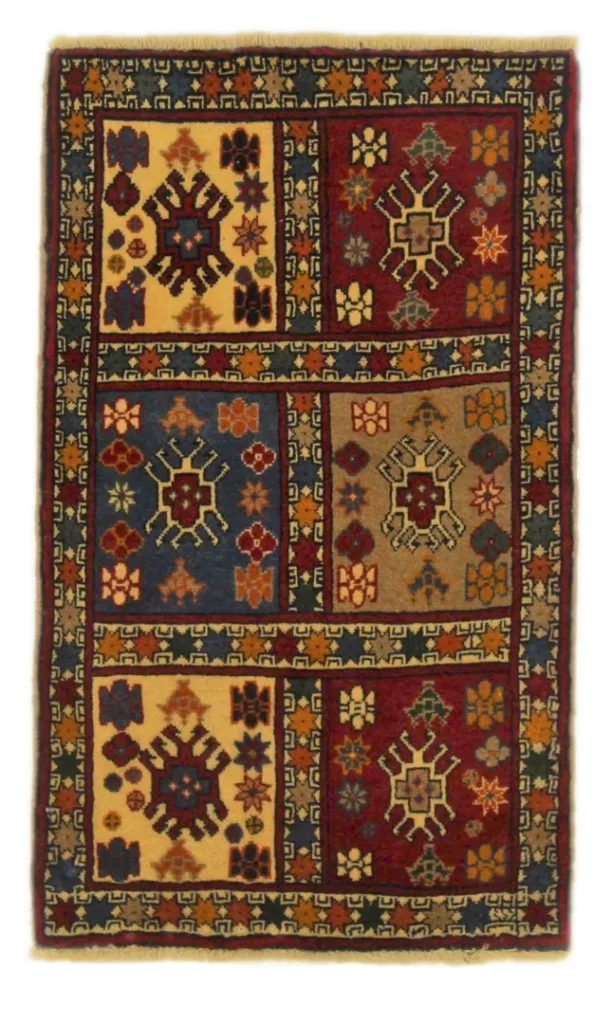
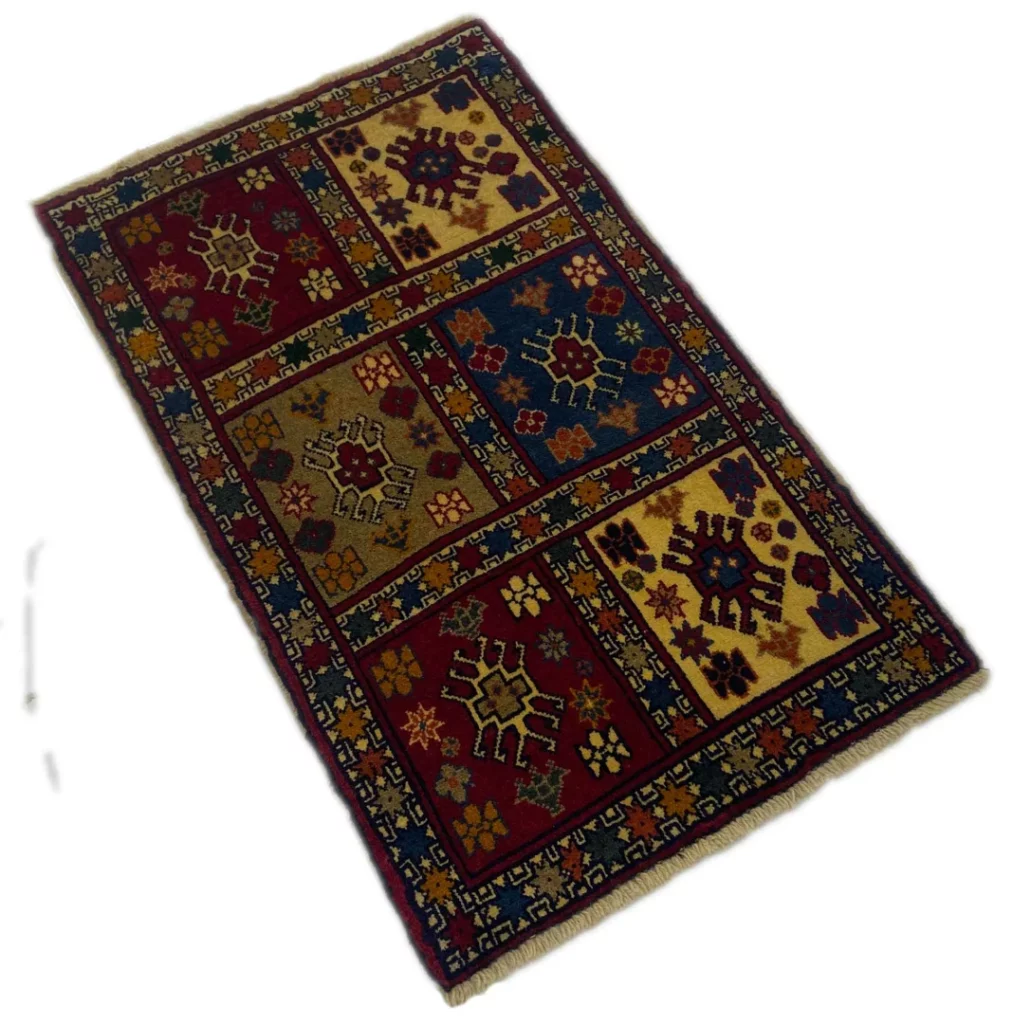
The pattern of this rug is described as unusual and imaginative. The longer description adds that Gabbeh Shuli designs allow creative freedom and are often abstract, growing from the weaver’s imagination. The emphasis is therefore on an individual visual language rather than on one named ornament. Forms, colour fields and the spacing between them may work together to create the composition, but no specific single motif or border is identified for this rug.
In general, abstract Gabbeh design makes use of reduction. Shapes can be clearly separated, suggest basic geometric elements or be arranged in a freer, more pictorial order. This explains why Gabbeh rugs can appear less densely ornamented than rugs built around elaborate floral decoration or a tightly organised medallion. It does not mean that every Gabbeh follows the same layout. Variety and the personal interpretation of the maker are part of the tradition.
The colours recorded for this rug are red, beige, grey and brown. Red may serve as a strong field or accent, while beige brings a lighter and quieter value to the palette. Grey and brown introduce neutral and earthy notes. Together, these four colours create a combination of warm and subdued tones. No further colours are specified. The precise distribution of the named colours belongs to the individual design of this one hand-knotted piece.
The appearance of colour in a hand-knotted rug depends on the relationship between fibre, dye, knotting and light. Wool has its own way of taking up colour and can give a pile surface a varied visual character. In an imaginative Gabbeh composition, colour is not only decorative; it also helps separate fields, define abstract shapes and establish visual rhythm. The recorded palette gives the colour information for this rug without assigning it a motif that has not been named.
Gabbeh Shuli is not defined by one compulsory symbol system. The category brings together Gabbeh construction, a Fars regional context and a freer approach to design. Individual examples can therefore differ considerably. Some may rely on broad fields, while others may use contrasts or more clearly divided forms. For this particular rug, the relevant pattern description is the one supplied: unusual, imaginative, often abstract design shaped by creative freedom.
Hand-knotting also allows small variations to become part of the making process. A free design need not look like a perfectly repeated industrial pattern. The composition develops through the maker’s decisions as the rug is knotted, and the final arrangement reflects that process. The distinctive feature of this Gabbeh Shuli is thus the combination of individual design, imaginative abstraction, the named red, beige, grey and brown palette, and traditional hand-knotted production.
Special Features
The notable features of this rug are its origin in Fars, its classification as Gabbeh Shuli, its hand-knotted construction and its pile of lustrous virgin wool. It also has a stated density of 90,000 to 180,000 knots per square metre. The pattern is described as unusual and imaginative, with often abstract design ideas, and the listed colours are red, beige, grey and brown. The condition is new.
The name Shuli refers here to the creative and abstract side of the Gabbeh tradition. It is not an additional origin outside Fars, but the subcategory identified in the source description. The rug can therefore be described precisely through its region, type, technique, pile material, knot density, colour range, pattern character and condition. No signature, age beyond the new condition, or further construction detail is stated.
FAQ
What defines a Persian rug from Fars?
A Persian rug from Fars belongs to a southern Persian tradition associated with the region around Shiraz. Fars includes several related forms of rug making rather than one single design formula. In a Gabbeh Shuli, the central features are hand-knotting, virgin wool and imaginative, often abstract patterns. This rug is identified as a Gabbeh Shuli from Fars. Its regional origin and its open design approach provide a more precise description than a general comparison with all Persian rugs.
How should a virgin-wool Persian rug be cared for?
Virgin wool is a durable natural fibre, but it should still be treated gently. Regular careful vacuuming helps remove loose surface dirt. If a spill occurs, it is better to absorb the moisture carefully rather than rub it into the pile. A lightly damp cloth may be used when necessary. For deeper marks or a thorough cleaning, professional rug cleaning is appropriate. Since this rug is new, avoiding unnecessary soaking, harsh chemicals and rough treatment helps preserve its hand-knotted wool surface.
Why are Gabbeh rugs considered a distinct tradition?
Gabbeh rugs are recognised for a freer and often simpler approach to design than many heavily ornamented rug groups. Gabbeh Shuli may place imaginative abstract forms and individual colour fields ahead of fixed repeated motifs. The hand-knotted technique connects that design approach with the traditional craft of Fars. A possible increase in value should not be treated as automatic. The relevant qualities of an individual rug are its actual workmanship, materials, knot density, design and condition.
To provide the best experiences, we use technologies like cookies to store and/or access device information. Consenting to these technologies will allow us to process data such as browsing behavior or unique IDs on this site. Not consenting or withdrawing consent, may adversely affect certain features and functions.
Functional Always active
The technical storage or access is strictly necessary for the legitimate purpose of enabling the use of a specific service explicitly requested by the subscriber or user, or for the sole purpose of carrying out the transmission of a communication over an electronic communications network.
Preferences
The technical storage or access is necessary for the legitimate purpose of storing preferences that are not requested by the subscriber or user.
Statistics
The technical storage or access that is used exclusively for statistical purposes.The technical storage or access that is used exclusively for anonymous statistical purposes. Without a subpoena, voluntary compliance on the part of your Internet Service Provider, or additional records from a third party, information stored or retrieved for this purpose alone cannot usually be used to identify you.
Marketing
The technical storage or access is required to create user profiles to send advertising, or to track the user on a website or across several websites for similar marketing purposes.

 SECURE PAYMENT
 SHIPPING PARTNERS


