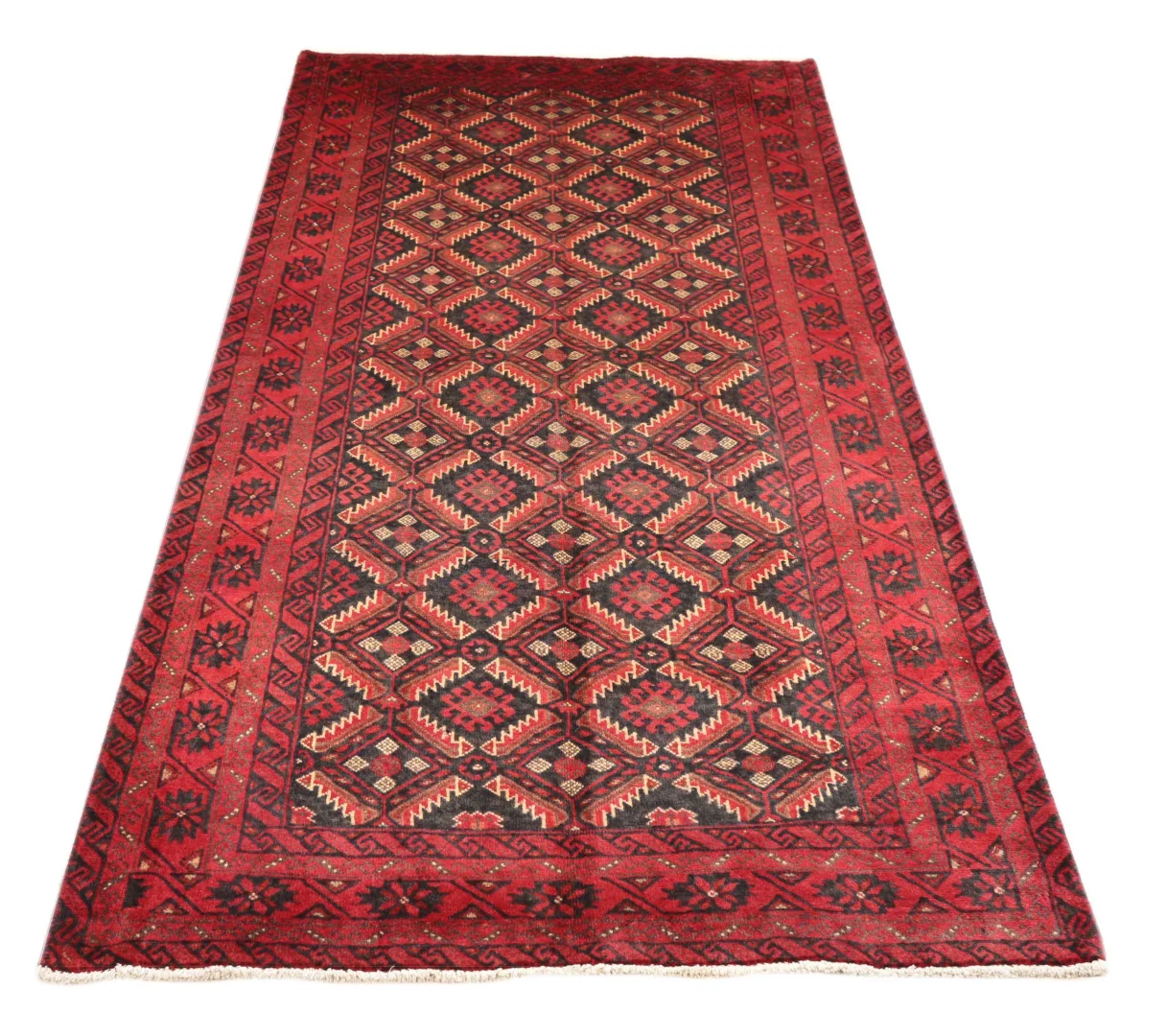
Hand-knotted Balutsch Persian Rug | Knot density: 120.000 – 250.000 knots/m² | Material: pile natural wool from own production | Size: 215 x 105 cm | Pattern: geometric forms and stylised floral motifs | Condition: dirt-resistant, ideal for hallways and kitchens
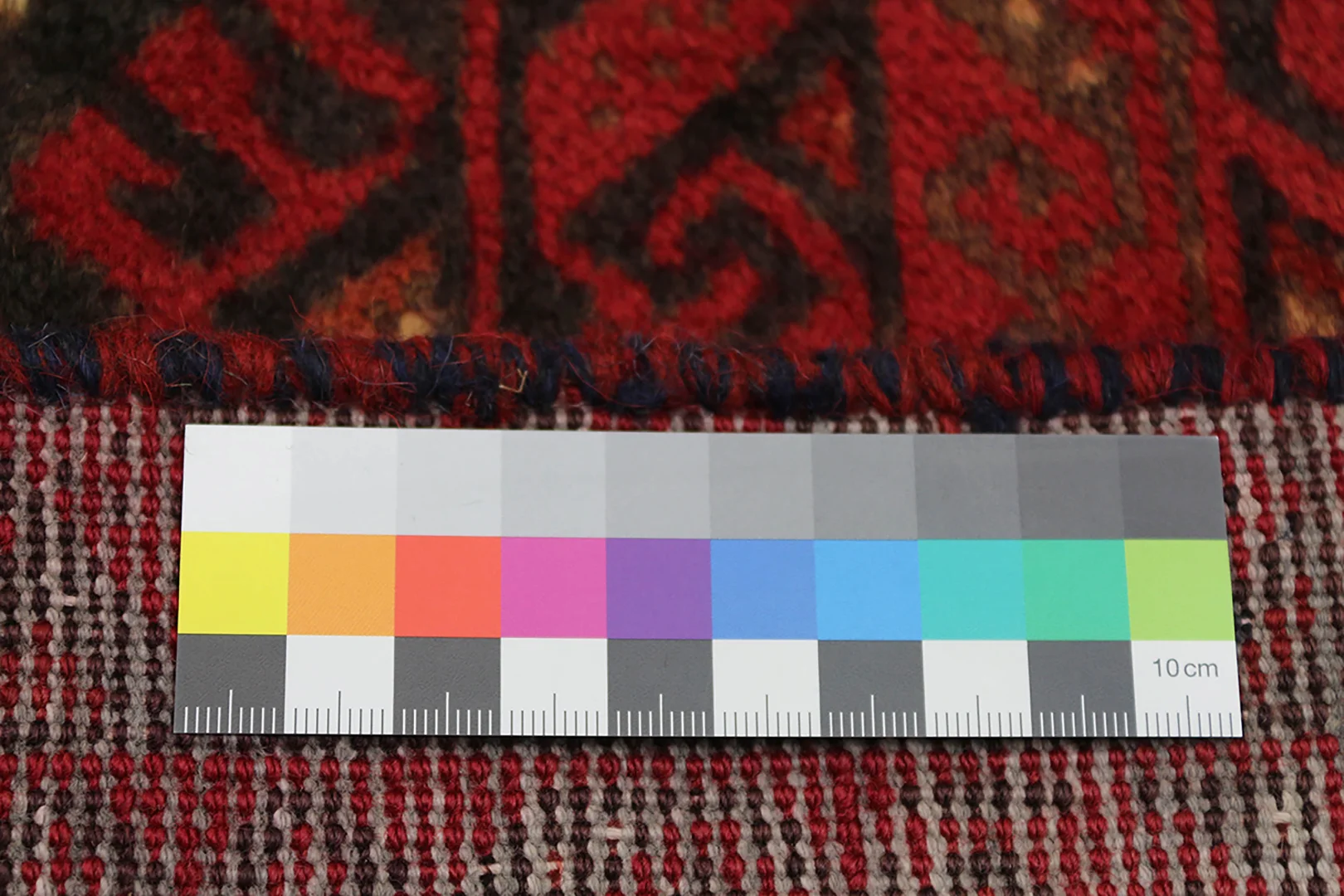
This Balutsch Persian rug is hand-knotted and made from natural wool from the producer’s own production. Its material and construction therefore belong to a traditional form of rug making. In hand-knotting, individual knots are inserted by hand into the foundation, and the pile is built gradually across the surface. The pattern develops through this same process rather than being printed onto a completed rug. Each working stage requires control of the construction as well as attention to the intended arrangement of the design.
The pile material is identified as natural wool from own production. Wool has a long role in rug making because its fibres are naturally resilient and flexible. When worked into a pile, it can provide a robust textile surface for everyday use. The material information for this rug names natural wool and does not add another pile fibre. A cotton warp or another additional material is not stated and is therefore not included in the description.
The knot density is given as 120.000 to 250.000 knots per square metre. This figure describes how many knots are contained within a defined area and is used to characterise the fineness of a knotted construction. Knot density can influence the amount of detail that can be expressed in lines and ornaments, although the visual result also depends on the wool, the knotting method and the pattern itself. Here it forms part of the rug’s technical profile alongside hand-knotting and natural wool.
A hand-knotted rug is assembled through repeated manual work. The maker follows the intended drawing while building rows of knots and maintaining the relationship between the pattern and the underlying structure. Geometric elements can be formed from lines, angles and repeated fields. Stylised floral motifs can be reduced to compact signs and integrated into the same arrangement. The craft lies in keeping the construction consistent while preserving the character of the regional design language.
This rug is also described as dirt-resistant. That quality is particularly relevant to hallways and kitchens, where a floor covering may be used frequently during everyday routines. Dirt resistance supports practical use but does not eliminate the need for regular care. It complements the hand-knotted construction and the natural wool rather than replacing either of them. The stated material, technique, knot density and dirt-resistant property together define the specific features described for this piece.
Origin and Tradition
Balutsch rugs originate in the area between Afghanistan, Iran and Pakistan, a region often described as a three-country border area. The name is associated with the Baluch people, also written as Balouch. Their textile culture developed across a broad territory with varied landscapes, communities and connections between local markets. A Balutsch origin therefore refers to a regional tradition rather than necessarily to one named village or one individual workshop.
For the Baluch, handmade textiles formed part of daily material culture. Knowledge about wool, colour, knotting and ornament was acquired through practice and passed on within the community. A rug could be useful as a household object while also carrying signs of cultural identity. This combination of function and expression is an important way to understand Balutsch rugs within the wider field of Oriental and Persian rug making.
The area between Afghanistan, Iran and Pakistan has been shaped by movement and exchange. People, goods and ideas travelled along routes linking settlements and markets, and textile practices could be influenced by contact with neighbouring communities. Local traditions nevertheless retained their own character. Balutsch rugs are recognised as a distinct regional group through the relationship between their handwork, their use of natural materials and their ordered but strongly coloured ornament.
Traditional rug making is both a technical and cultural activity. The maker must understand how the wool behaves, how the foundation receives the knots and how the design can be maintained across the surface. At the same time, the chosen forms relate to inherited visual conventions. The work demands patience, repetition and close attention to proportion. In Balutsch craftsmanship, this practical knowledge is connected with patterns that have meaning within the regional textile tradition.
Everyday requirements also influenced the development of handmade rugs. A useful textile needed to withstand handling and remain manageable in the household, while its colours and ornaments could give it a decorative role. The use of wool and the hand-knotted method fit this relationship between utility and design. Dirt-resistant qualities are especially relevant to practical placement, but the tradition itself is broader than one use: it includes the material knowledge, manual process and cultural forms through which Balutsch rugs are made.
Balutsch rugs belong to the larger history of Persian and Oriental carpets. Tabriz, Kashmir, Kurdistan, Nain and Isfahan are also associated with established rug traditions, each with its own pattern vocabulary and technical history. They provide useful points of comparison, but references to them do not alter the origin of this rug. This piece is described as a Balutsch Persian rug from the area between Afghanistan, Iran and Pakistan. Iranian nomadic rugs likewise show how regional history and practical needs can shape textile design, while the Balutsch tradition retains its own identity.
Handmade traditions allow inherited forms to be interpreted differently from one rug to the next. The shared regional language can remain visible even when the exact placement of ornaments or the balance of colours changes. This is a normal consequence of manual production, not a sign of industrial inconsistency. Balutsch rugs consequently unite continuity with individual execution. Their cultural identity lies in the tradition, while their particular appearance is formed through the work of the makers.
Design and Pattern
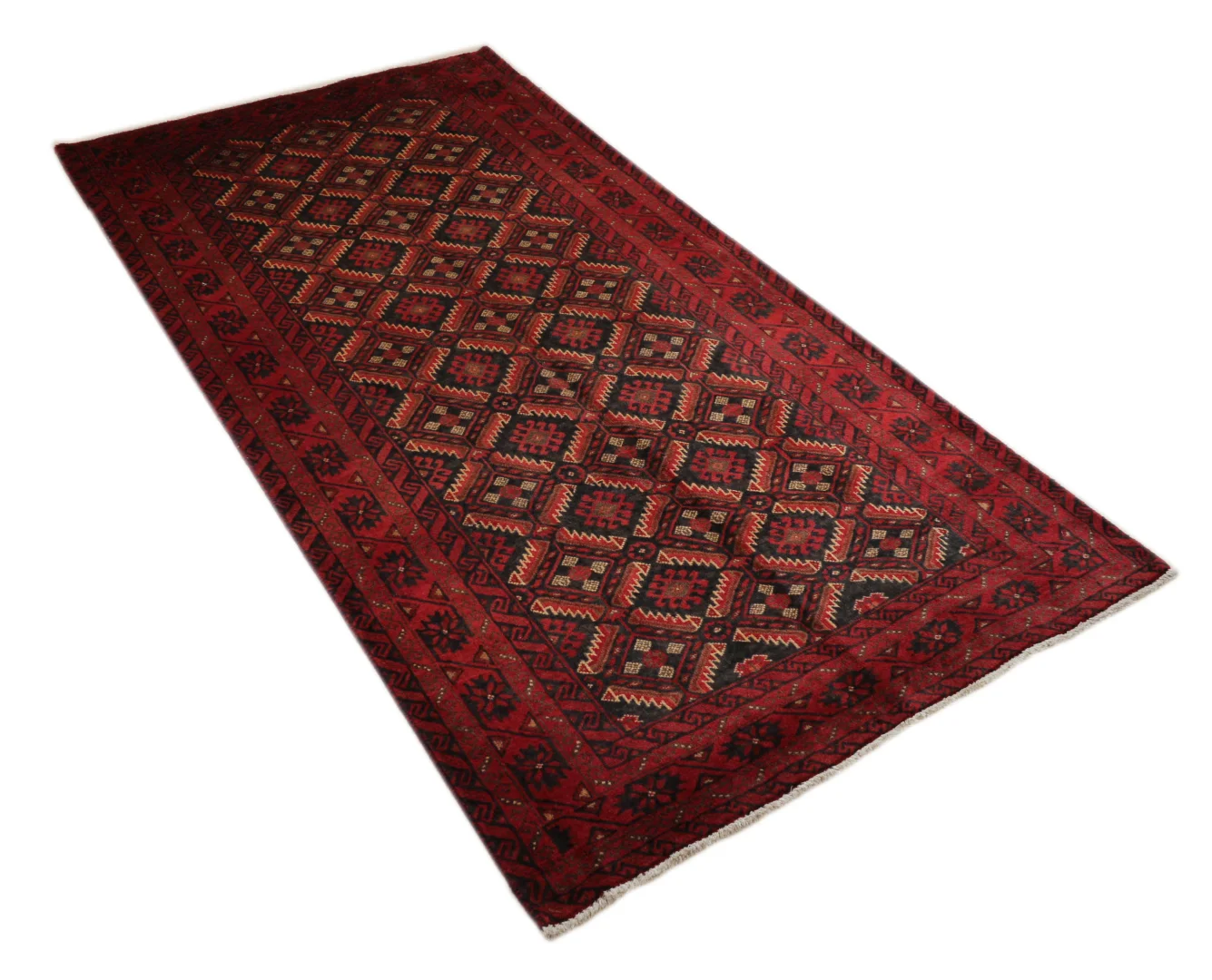
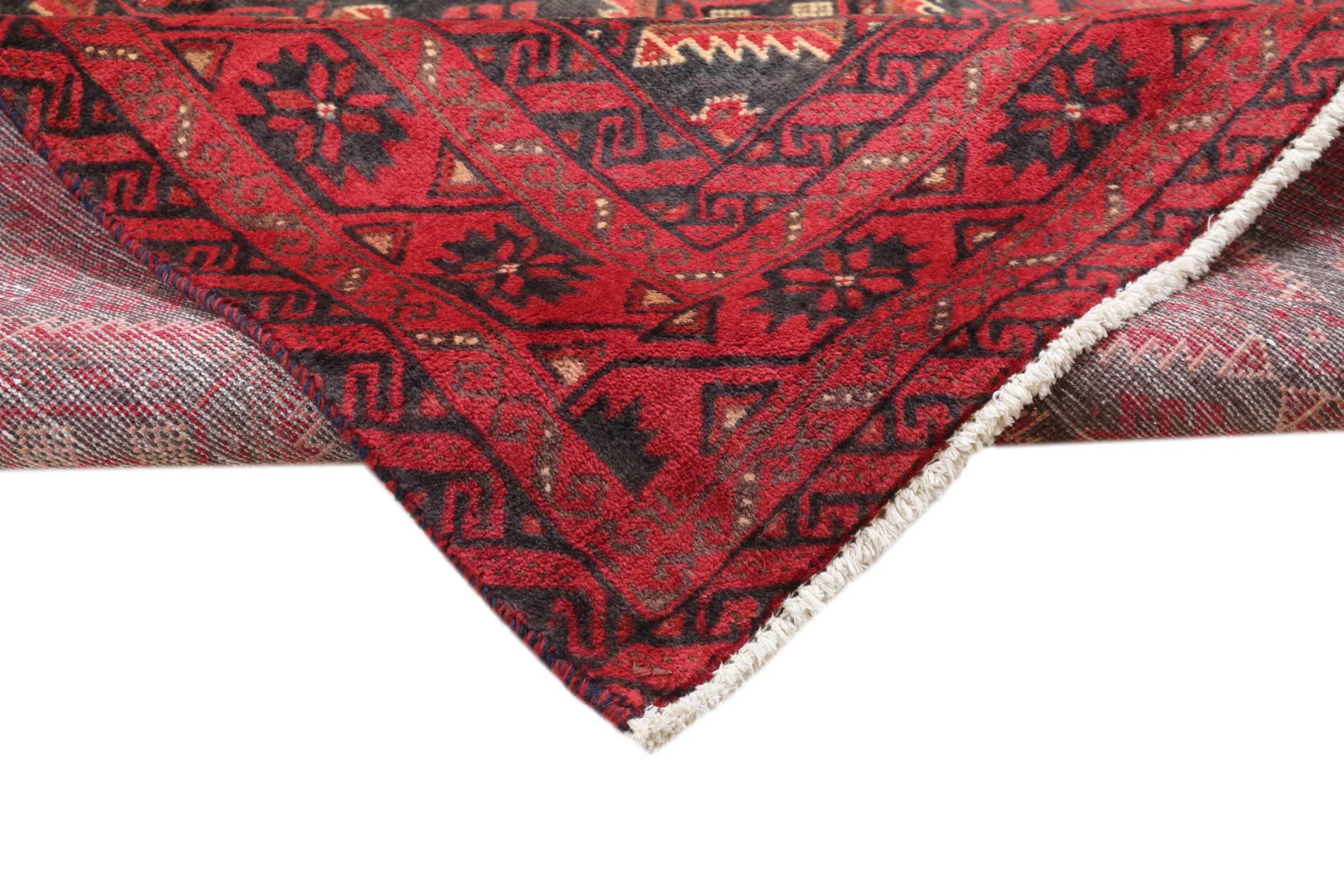
The colour scheme of this rug is dominated by red and brown tones. The reds provide a strong and warm presence, while the earthy browns give the composition a natural foundation. In traditional carpet design, colour helps organise the surface as well as decorate it. Contrasting tones can separate fields, clarify borders and make ornaments legible. The relationship between red and brown gives the named pattern language a coherent colour framework.
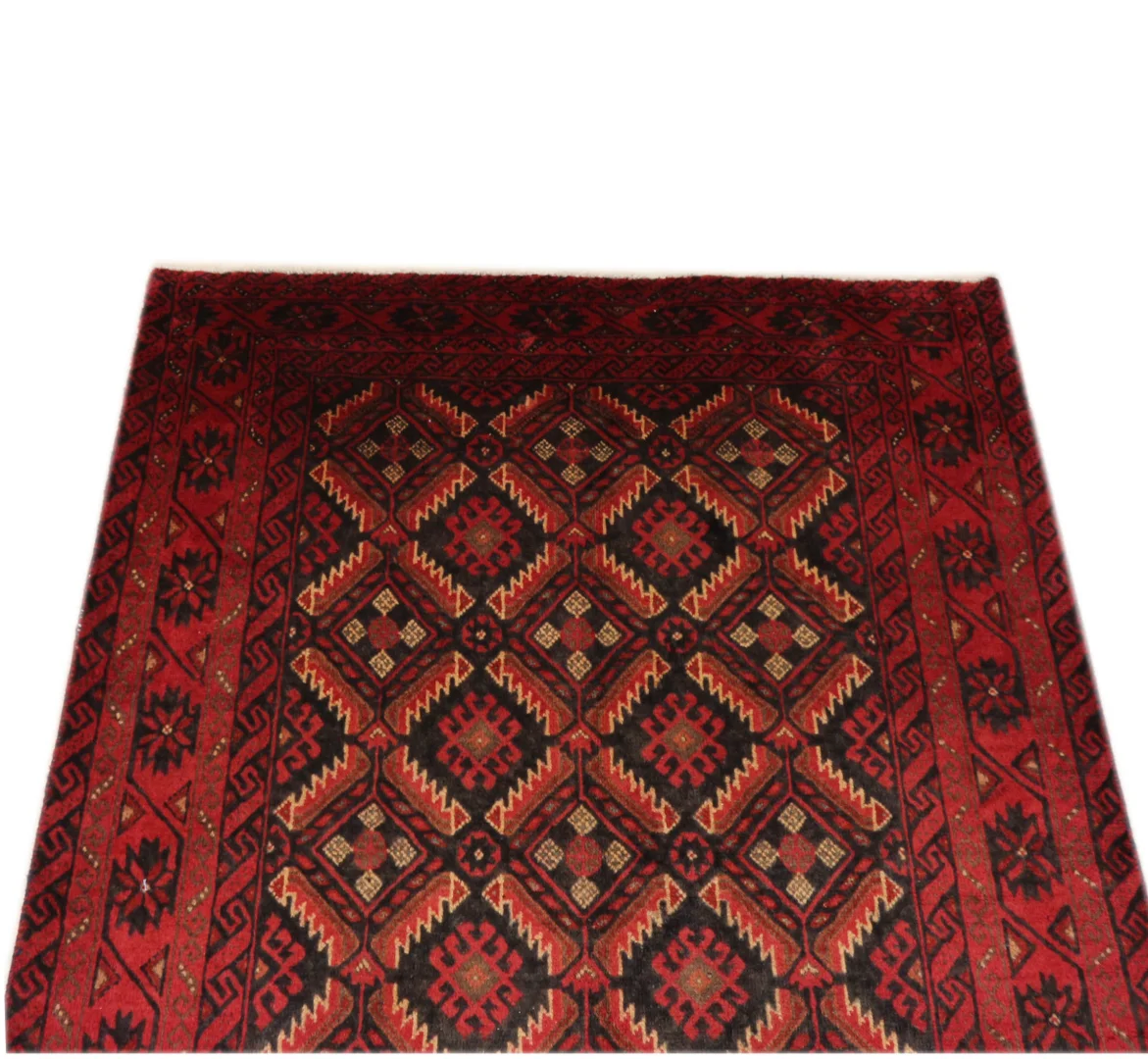
The stated design includes geometric forms and stylised floral motifs. Geometry may appear through straight lines, angular outlines, diamonds, stepped contours or repeated compartments. Such forms create order and rhythm across a rug. Stylised floral motifs refer to simplified signs based on flowers, leaves or tendrils rather than botanical copies. They can be repeated, framed or combined with linear ornaments. The two forms of expression can work together within one composition.
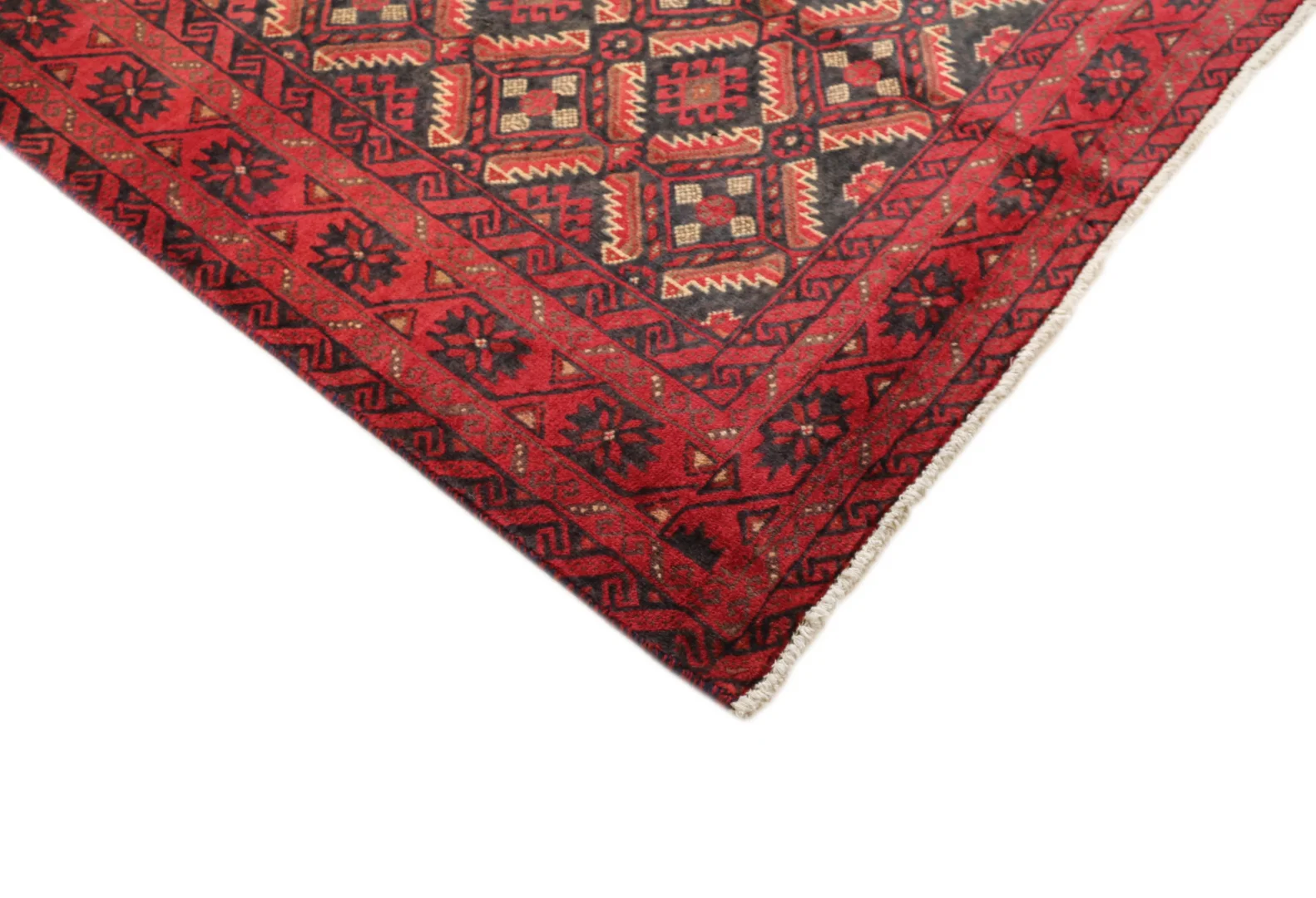
A regional rug design often depends on the balance between a field, its borders and the ornaments placed within them. Repetition can guide the eye across the surface, while divisions create a clear relationship between separate areas. Because this rug is hand-knotted, the drawing is constructed knot by knot. The pattern is consequently integrated into the textile structure instead of being applied as a separate printed layer. This gives the design a material connection to the craft process.
Red and brown can perform different visual tasks within the same arrangement. A saturated red may bring attention to a central geometric element or a repeated ornament. Brown can connect neighbouring areas and strengthen the earthy character of the palette. The effect depends on the position of the colours and on the shapes around them. The described red-brown palette belongs to the stated Balutsch design and is not evidence of a different regional origin.
Floral stylisation transforms references to the natural world into a more abstract textile vocabulary. A flower can be reduced to several lines, a leaf can become a repeated sign, and a vine can be arranged along a border or within a geometric field. This kind of simplification makes repetition possible while keeping a connection to plant forms. Straight lines and angular structures can frame these motifs, producing a composition that combines organic references with disciplined geometry.
The hand-knotted process gives the design an individual character. Traditional forms and colour relationships provide continuity, while the precise execution depends on the maker and the arrangement being followed. A Balutsch rug can therefore preserve a recognisable regional language without becoming a mechanically identical image. The red and brown tones, geometric forms and stylised floral motifs describe the pattern character of this rug while avoiding claims about an unstated workshop, date or narrower place of manufacture.
Within the broader history of Oriental rugs, pattern names and regional styles often travel beyond their original areas. A floral or geometric idea may be recognised in several weaving cultures, and comparisons between regions can be useful when discussing design history. Such similarities should not be confused with provenance. The pattern described here remains part of the Balutsch presentation of the rug, and the place name identifies the rug tradition rather than an additional origin hidden within one motif.
Special Features
The clearest practical feature of this rug is its dirt-resistant quality. It is specifically described as suitable for hallways and kitchens, including areas with frequent foot traffic. These rooms require a floor covering that can take part in everyday use while retaining a traditional textile appearance. The red and brown palette and the combination of geometric and stylised floral motifs give the rug its visual identity, while the dirt-resistant quality supports its practical role.
Natural wool from own production, hand-knotting and a knot density of 120.000 to 250.000 knots per square metre define the material and technical profile. Together with the Balutsch origin, these details describe a rug whose regional craft tradition and everyday usability are presented side by side. The piece can also be used in living rooms or bedrooms as a design element. No age, signature, restoration history or additional condition detail is stated, so none is added here.
FAQ
What makes a Balutsch Persian rug distinctive?
A Balutsch Persian rug combines hand-knotting with natural wool from own production and a design language associated with the Baluch tradition. Its origin is the area between Afghanistan, Iran and Pakistan. This rug is defined by dominant red and brown tones, geometric forms and stylised floral motifs. Its knot density is 120.000 to 250.000 knots per square metre, and it is described as dirt-resistant. These characteristics bring together regional craft, a natural material and practical suitability for hallways, kitchens and other frequently used spaces.
How should I care for a Balutsch Persian rug?
Regular cleaning is recommended to support the rug’s longevity. If more intensive treatment is required, professional rug cleaning can be used. Direct sunlight should be avoided where possible so that the red and brown tones remain as even as possible. A rug pad can help protect the rug from unnecessary wear and keep it stable on the floor. Dirt resistance is helpful in daily use, but it does not replace appropriate maintenance. The natural wool and hand-knotted construction should be treated with a suitable cleaning method rather than with unnecessarily aggressive treatment.
Where can this Balutsch Persian rug be used?
The rug is especially suitable for hallways and kitchens because it is described as dirt-resistant and intended for areas with frequent use. It can also be placed in a living room or bedroom, where the red and brown tones and the geometric and stylised floral motifs can serve as an interior design element. Its hand-knotted construction and natural wool give it the character of a traditional textile while supporting practical use. Placement should take account of the room’s traffic, exposure and the care required for a wool rug.
To provide the best experiences, we use technologies like cookies to store and/or access device information. Consenting to these technologies will allow us to process data such as browsing behavior or unique IDs on this site. Not consenting or withdrawing consent, may adversely affect certain features and functions.
Functional Always active
The technical storage or access is strictly necessary for the legitimate purpose of enabling the use of a specific service explicitly requested by the subscriber or user, or for the sole purpose of carrying out the transmission of a communication over an electronic communications network.
Preferences
The technical storage or access is necessary for the legitimate purpose of storing preferences that are not requested by the subscriber or user.
Statistics
The technical storage or access that is used exclusively for statistical purposes.The technical storage or access that is used exclusively for anonymous statistical purposes. Without a subpoena, voluntary compliance on the part of your Internet Service Provider, or additional records from a third party, information stored or retrieved for this purpose alone cannot usually be used to identify you.
Marketing
The technical storage or access is required to create user profiles to send advertising, or to track the user on a website or across several websites for similar marketing purposes.

 SECURE PAYMENT
 SHIPPING PARTNERS


