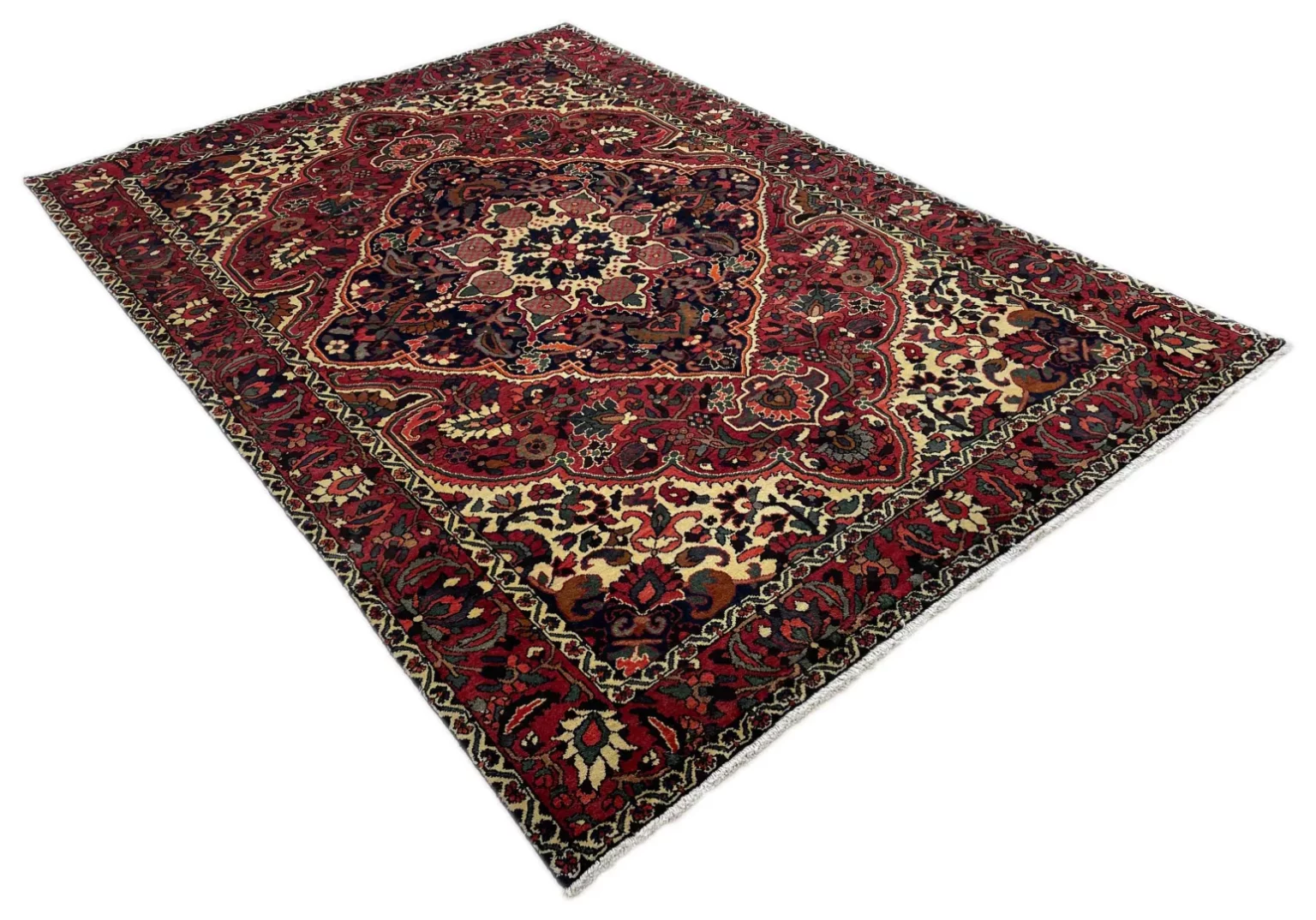
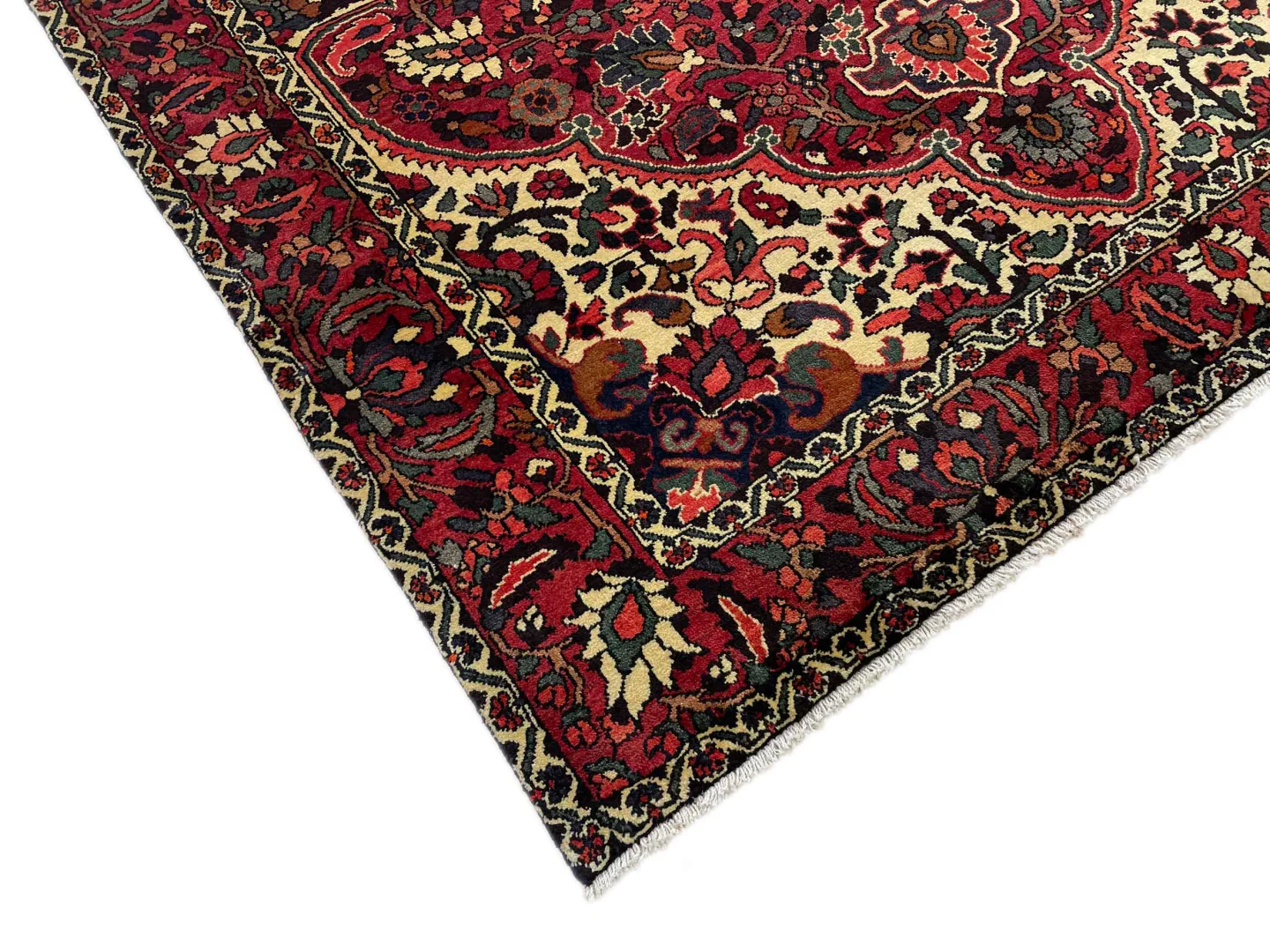
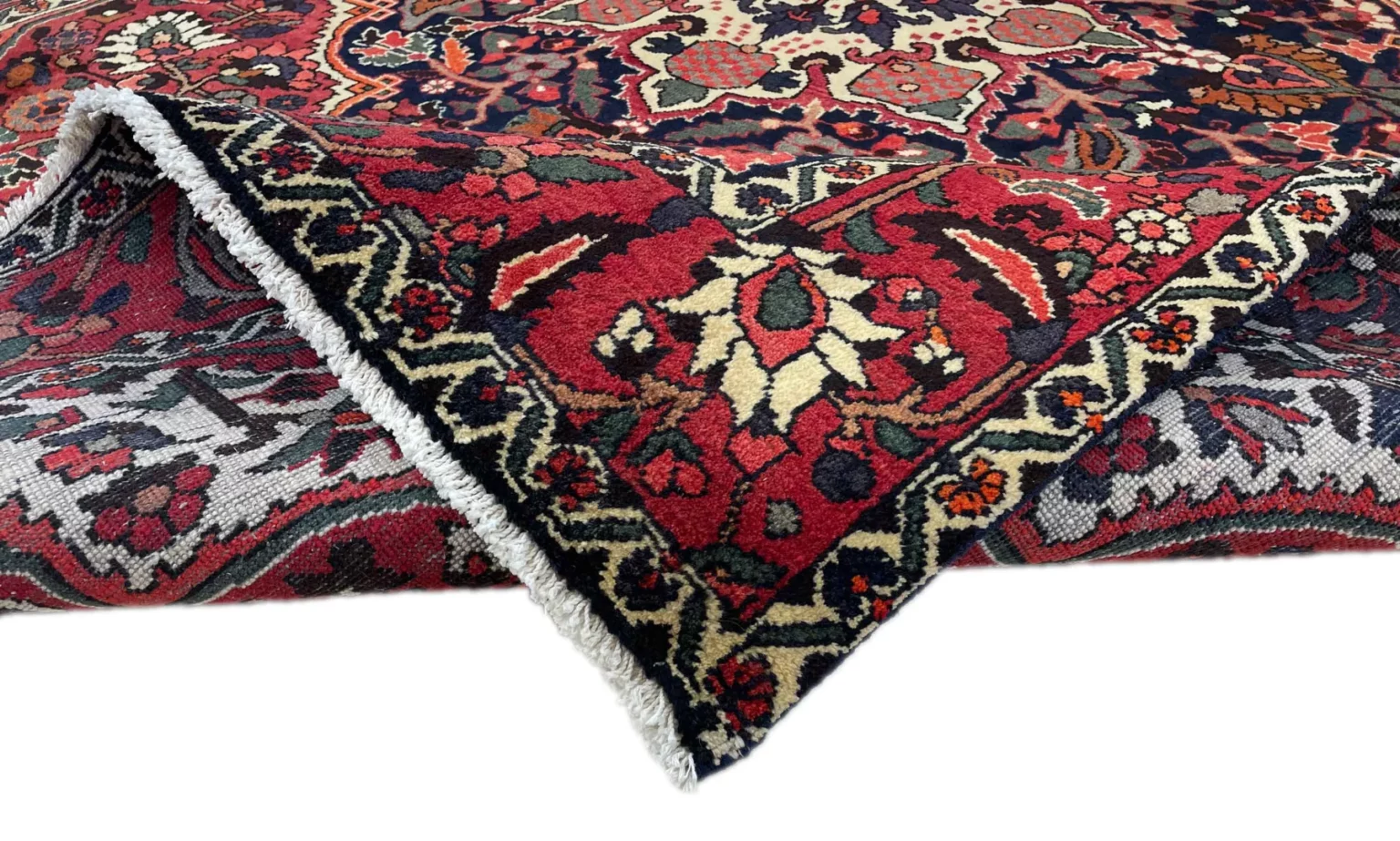
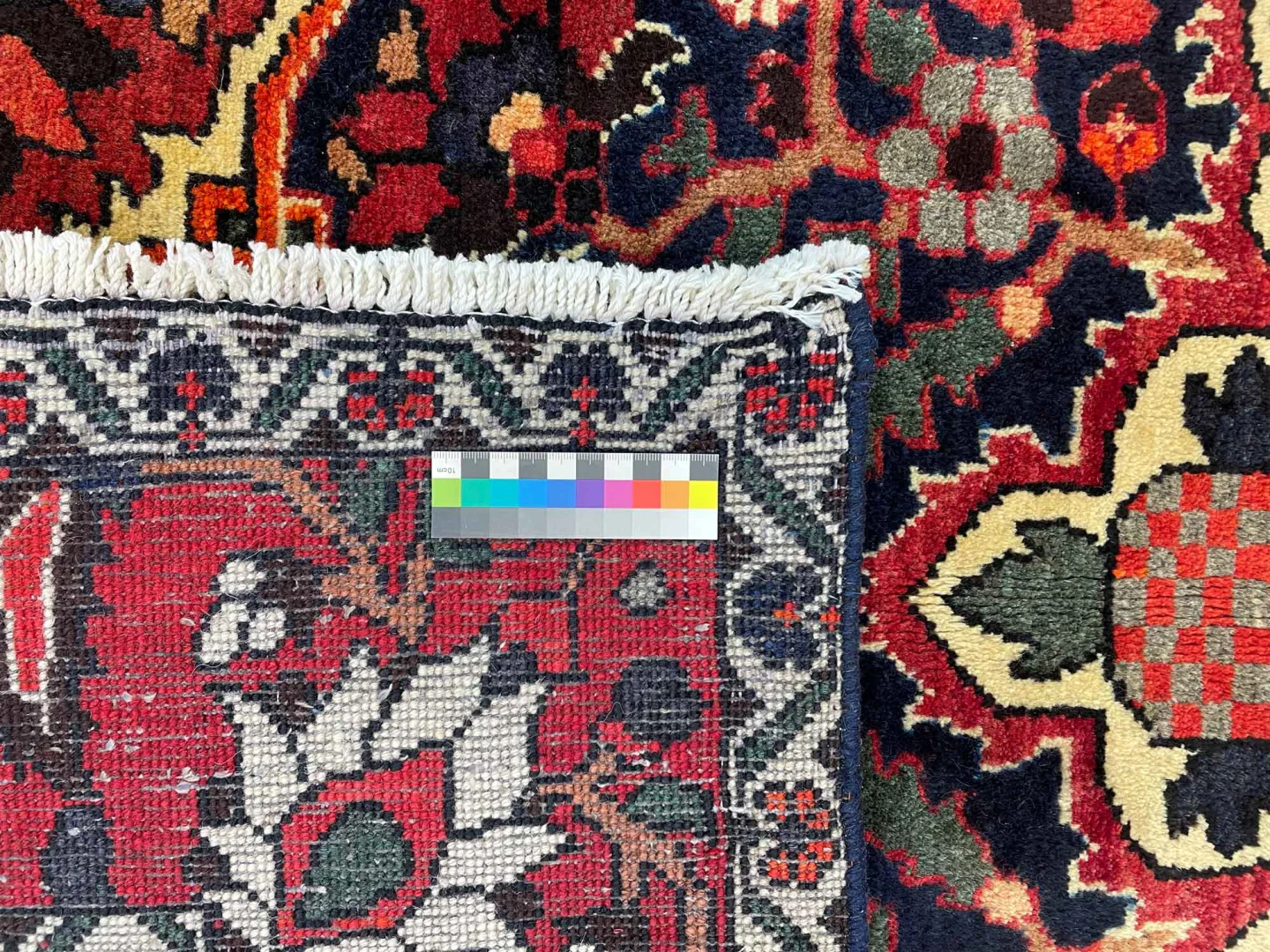
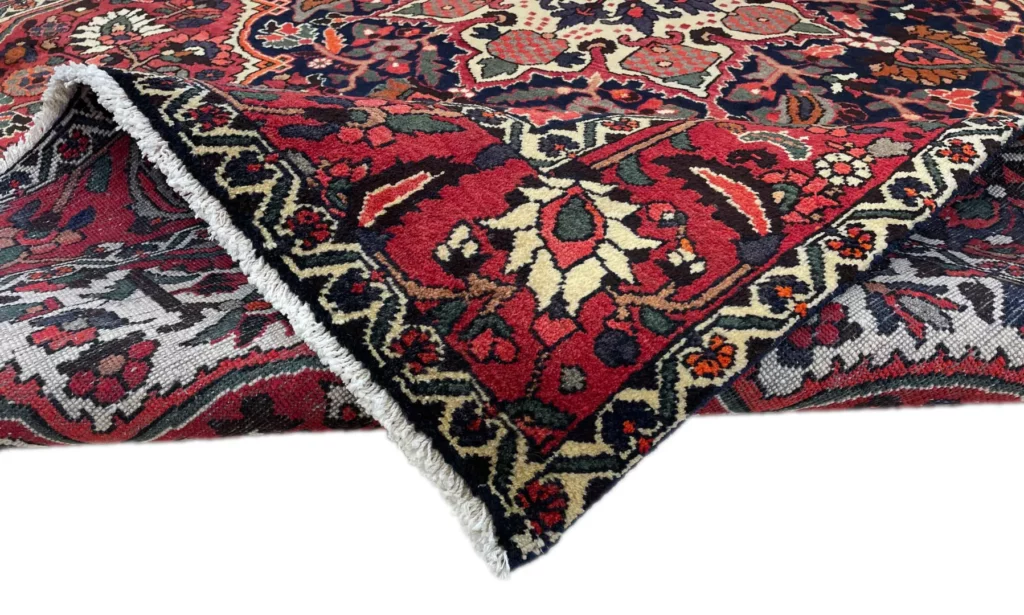
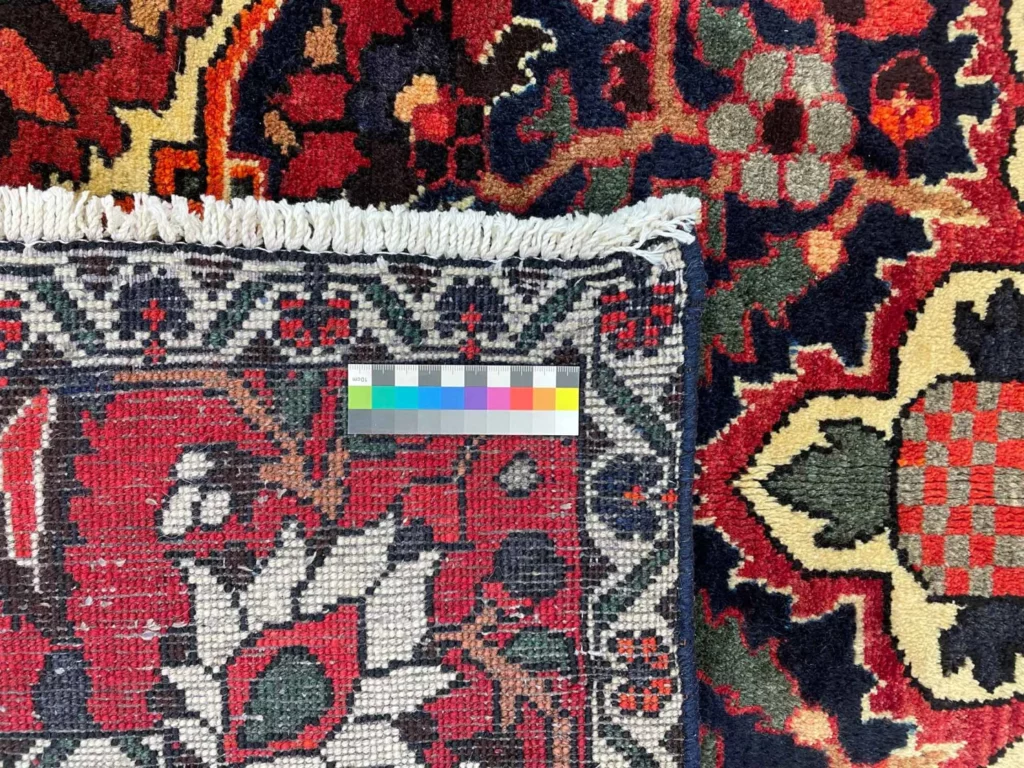
This Bakhtiar Persian rug is hand-knotted and has a pile made of high-quality wool. Wool has long been used in Persian rug making because it can combine a resilient fibre with a pleasantly tactile surface. In a hand-knotted rug, the design is built knot by knot. Individual knots are tied around the warp and secured with weft threads, gradually creating a complete textile surface from the planned composition.
The stated knot density is between 150,000 and 200,000 knots per square metre. Knot density records the number of individual knots within a defined area and therefore offers an indication of the fineness of the work. It does not describe the whole character of a rug by itself. Wool quality, the evenness of the knotting, the tension of the structure and the handling of the pattern all contribute to the finished result.
Bakhtiar wool is traditionally valued for its firm fibre. In rug making, this type of wool can create a pronounced texture and a surface suited to regular use when cared for appropriately. The pile of this particular rug is described as high-quality wool. Its condition is very good; this statement concerns the offered piece and is not a general condition claim about Bakhtiar rugs as a group.
Handwork naturally permits small variations in the sequence of knots, the contours of motifs and the distribution of colour. These details are part of the making process and distinguish a knotted rug from an industrial floor covering. In a Bakhtiar with a garden design, separate compartments must be filled individually, so the craft involves both the field structure and the many smaller botanical and zoological forms within it.
A hand-knotted rug is also built through a relationship between drawing and material. The design has to be translated into coloured knots, and the contours must remain legible within that textile method. The result is a surface in which the visual order of the Kheshti pattern and the tactile character of wool belong together. No fibre other than the wool pile is specified for this rug.
Origin and Tradition
Bakhtiar rugs are associated with the Bakhtiar people and with traditional weaving areas in western Iran. This region lies near Isfahan and the Zagros Mountains. The name therefore identifies a Persian regional weaving tradition, not merely a decorative theme. The Zagros landscape, with its mountains and valleys, has long supported varied ways of life. Both nomadic and settled communities contributed to the textile traditions connected with the area.
Bakhtiar weaving developed in circumstances where textiles had to be useful as well as visually ordered. In communities with nomadic traditions, woven and knotted objects needed to be durable and manageable. At the same time, motifs, colour combinations and methods were transmitted through families and communities. This combination helps explain why Bakhtiar rugs can use clear arrangements while also containing numerous small details.
The proximity to Isfahan places Bakhtiar weaving within a major Persian environment of art, trade and craft. Isfahan has long been an important centre for design and textile culture. Regional traditions did not develop in complete isolation: ideas, techniques and knowledge could travel between places, workshops and communities. Bakhtiar nevertheless remains a distinct designation for rugs associated with the western Iranian area near the Zagros and Isfahan.
The Zagros region brought together different forms of settlement, movement and production. Rugs could be made for domestic use and also enter systems of exchange. These conditions favour designs that can be organised through repeatable fields and recognisable shapes. The Kheshti principle fits such an arrangement by dividing the surface into garden-like compartments, each of which can contain its own selection of plant and animal forms.
Persian rugs from other areas have their own approaches to drawing, structure and refinement. Isfahan rugs are known for complex floral compositions and often higher knot densities. Tabriz rugs frequently present larger, detailed layouts. Nain and Qom are also associated with fine workmanship and elegant designs. These comparisons describe regional traditions; they do not change this rug’s identity as a Bakhtiar Persian rug from western Iran near Isfahan and the Zagros Mountains.
Persian rug history is therefore not one single style but a collection of regional visual languages. Field divisions, borders, colours and figurative elements can participate in those languages. In Bakhtiar designs, the garden-compartment structure is especially recognisable as an organising idea. It joins a practical repeatable layout with a varied decorative vocabulary that can change from one compartment to the next.
The transmission of tradition does not require every rug to look identical. A regional pattern can be adapted through colour, scale, drawing and the choices of the individual weaver. What connects this rug to the Bakhtiar tradition is the combination of its stated western Iranian origin, its hand-knotted construction and its Kheshti garden design with natural motifs.
Design and Pattern
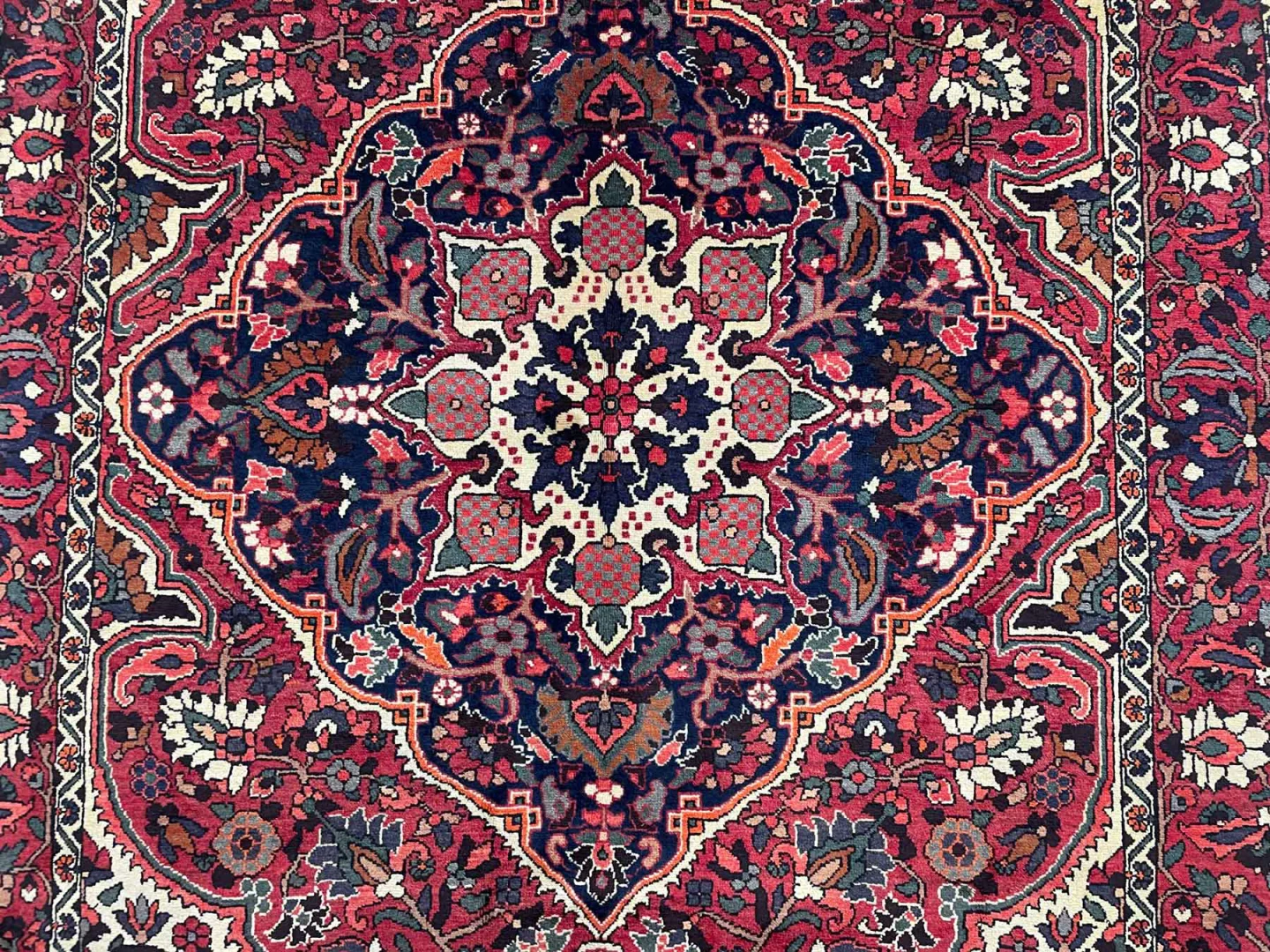
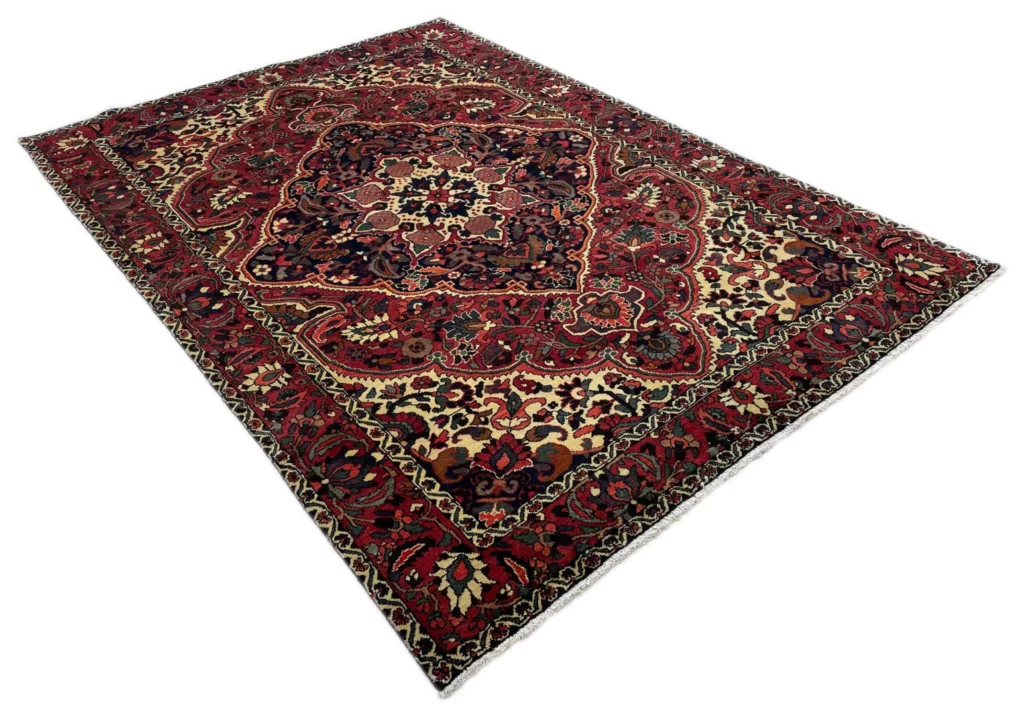
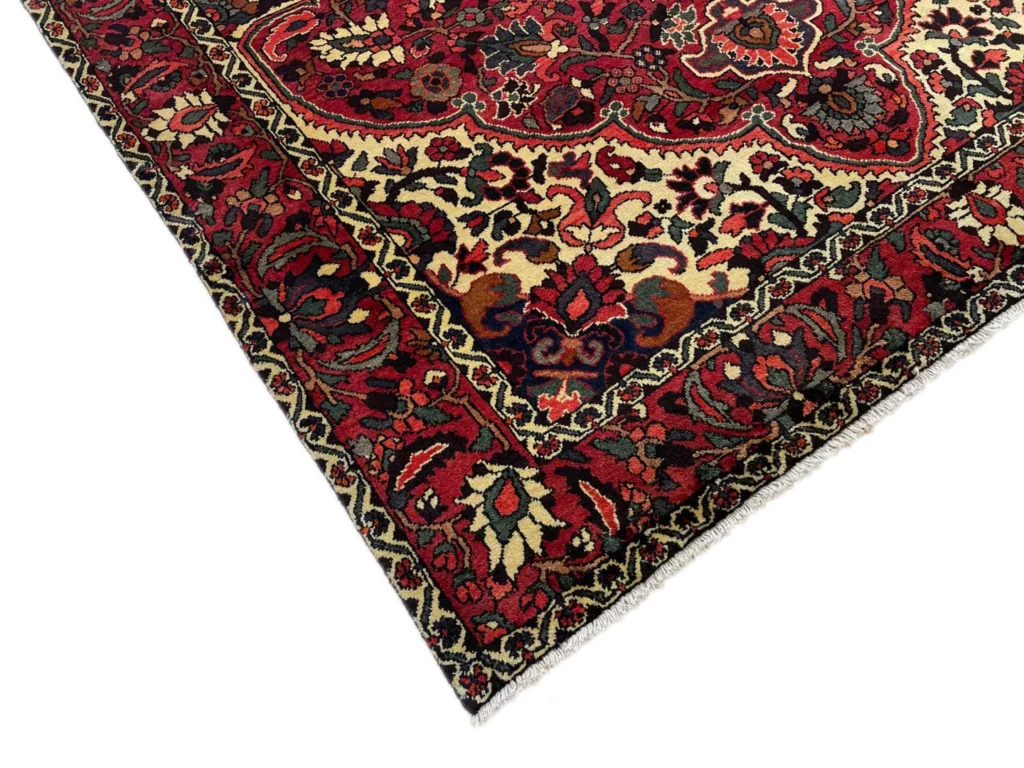
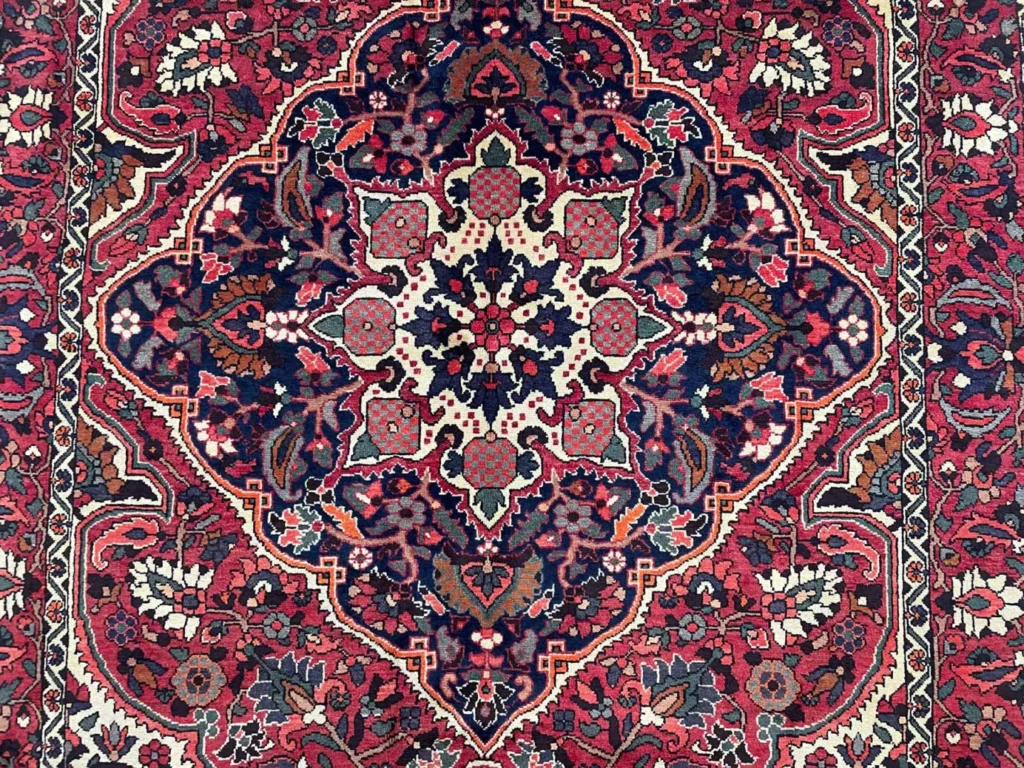
The specific design of this rug is a garden pattern known as Kheshti. The word is used for a composition arranged in separate compartments, often with a geometric or rectangular logic. Each compartment can be read as an individual section of a garden. On this rug, the fields are associated with plant and animal motifs. The result is not one isolated scene but a sequence of related images contained within an ordered overall layout.
Botanical imagery may be expressed through stylised branches, leaves, blossoms or trees, while zoological imagery introduces animal forms into the garden world. In traditional rug drawing, these elements are not intended to reproduce nature as a photographic view. They are converted into contours that can be made with individual coloured knots. Their forms therefore tend to be rhythmic, simplified and clearly organised across the surface.
The Kheshti arrangement balances boundaries with variety. The divisions give the eye a stable framework, while the contents of the separate fields create movement and change. A garden design can consequently feel regular without appearing uniform. Repetition is an important device: similar leaves, flowers or animals may recur in several compartments, while each field can still have its own combination of details.
The colours specified for this rug are red, brown and cream. Red may serve as a strong ground colour or as an accent in Persian compositions. Brown introduces an earthy, subdued note, and cream can create lighter intervals and contrast. These are the colours recorded for this piece. No additional colours or precise distribution of the colours within the compartments are specified.
Garden imagery has a long place in Persian visual culture. The garden can be understood as an ordered living space in which plants, paths, water and animals relate to one another. In a Kheshti rug, this idea is not presented as a perspective landscape. Instead, it is translated into repeated bounded fields. The textile therefore combines a geometric framework with references to the natural world.
The effect of a pattern is also shaped by the density of its knotting. A greater number of knots in an area can support finer contours and smaller details, although the overall design may still be governed by large compartments and distinct borders. Here, the stated knot density works together with the Kheshti organisation. Plant and animal forms remain part of a clearly divided composition rather than becoming an unstructured scattering of motifs.
Bakhtiar designs can include other regional arrangements, such as geometric layouts, floral elements and abstracted representations of nature. The name Bakhtiar therefore does not describe one unchanging pattern. For this particular rug, the relevant combination is the Bakhtiar regional identity, the Kheshti garden structure and the presence of plant and animal motifs in the fields.
Pattern and colour also influence how the rug relates to a room. The warm red and brown tones can reinforce natural materials and traditional furnishings, while cream areas can provide visual relief. A modern setting may emphasise the geometry of the compartments, whereas a more traditional room may draw attention to the garden symbolism. These are ways of reading the design rather than claims about a required interior style.
Special Features
The notable features of this rug are its hand-knotted construction, its pile of high-quality wool and its knot density of 150,000 to 200,000 knots per square metre. The wool is described as strong while also being soft in feel. This combination gives the rug a substantial textile character together with a comfortable surface. The Kheshti garden design provides the clear field structure and brings plant and animal motifs into the composition.
The red, brown and cream palette supports the relationship between the natural subject matter and the geometric order of the fields. The rug is described as resistant and is in very good condition. Bakhtiar rugs are traditionally considered suitable for areas that receive regular use because of their robust wool character. Actual use should still be matched with appropriate care and with the conditions of the room.
This piece can be considered in different furnishing contexts. A Kheshti pattern can sit naturally within a classic interior, while its compartmental geometry can also work with a modern or rustic setting. The important point is not a fixed style label but the combination of regional origin, hand craftsmanship, wool pile and a structured garden motif. Those features give the rug its particular identity without requiring additional provenance claims.
Its visual character comes from the interaction of several elements rather than from one isolated detail. The regional Bakhtiar tradition supplies the context, the hand-knotting supplies the making method, the wool gives the pile its material presence, and the Kheshti fields organise the design. Red, brown and cream then establish the recorded colour language of this individual rug.
FAQ
How should I care for my Bakhtiar Persian rug?
Regular, gentle vacuuming helps remove dust and loose dirt from the pile. For a household, vacuuming at least once a week is recommended. The appliance should be used carefully so that the wool surface is not subjected to unnecessary stress. Spilled liquids and isolated marks should not be left in the pile for a prolonged period. Professional rug cleaning is appropriate when dirt has penetrated more deeply. Because this is a hand-knotted wool rug, cleaning should be entrusted to a specialist familiar with hand-knotted Oriental rugs. Routine care and professional treatment serve different purposes, and strong household chemicals should not be applied without specialist advice.
Which room is best suited to a Bakhtiar Persian rug?
A Bakhtiar Persian rug is particularly suitable for living rooms and dining rooms. Its Kheshti garden pattern introduces a clearly structured decorative surface, while red, brown and cream can be coordinated with a range of interiors. Because the rug is described as resistant, it can also be used in areas with more frequent foot traffic. A level floor, a suitable underlay and regular care are important in such locations. Whether a hallway is appropriate depends on the amount of use and the available space. The rug can be considered in rustic, modern or classic rooms, provided that the room’s furnishings and practical conditions are taken into account.
How can I identify an authentic Bakhtiar rug?
Several characteristics should be considered together when assessing a Bakhtiar rug. These include hand-knotted construction, the materials used, the regional design tradition and the quality of the knotting. A high knot density is a relevant technical feature, but it does not establish origin on its own. The combination of garden compartments with plant and animal motifs may also support a stylistic assessment. For a reliable examination, an experienced specialist should inspect the pile, reverse side, knot structure, colours and drawing. An authenticity certificate can assist with documentation. The name Bakhtiar refers to a regional Persian tradition and should not be assigned solely because a rug contains one isolated motif.
To provide the best experiences, we use technologies like cookies to store and/or access device information. Consenting to these technologies will allow us to process data such as browsing behavior or unique IDs on this site. Not consenting or withdrawing consent, may adversely affect certain features and functions.
Functional Always active
The technical storage or access is strictly necessary for the legitimate purpose of enabling the use of a specific service explicitly requested by the subscriber or user, or for the sole purpose of carrying out the transmission of a communication over an electronic communications network.
Preferences
The technical storage or access is necessary for the legitimate purpose of storing preferences that are not requested by the subscriber or user.
Statistics
The technical storage or access that is used exclusively for statistical purposes.The technical storage or access that is used exclusively for anonymous statistical purposes. Without a subpoena, voluntary compliance on the part of your Internet Service Provider, or additional records from a third party, information stored or retrieved for this purpose alone cannot usually be used to identify you.
Marketing
The technical storage or access is required to create user profiles to send advertising, or to track the user on a website or across several websites for similar marketing purposes.

 SECURE PAYMENT
 SHIPPING PARTNERS


