This Bachtiari rug is hand-knotted. Its pile is made of 100% wool, while the warp is 100% cotton. The recorded knot density is 160000/Qm. The piece therefore combines a wool surface with a cotton foundation, a construction associated with Bachtiari rugs. The warp provides the textile framework, and the wool knots form the visible pile in which the pattern is expressed.
Bachtiari rugs are traditionally built on a cotton foundation with a wool weft. The wool has often come from the herds belonging to the weaving tribe. Its character may range from relatively dull to highly lustrous, and the resulting pile may be cut from medium to high. For this particular rug, the specified materials are 100% wool in the pile and 100% cotton in the warp. Its hand-knotted construction means that the surface is formed knot by knot rather than by a mechanical process.
Within the Bachtiari tradition, knot density is one factor used when discussing quality. Pattern and dyes also influence the way a rug is assessed. Pieces with the highest knot densities are often called Bibibaff. Chapel Shotur and Saman are ranked somewhat below Bibibaff production, while still being regarded as good to excellent. Hori rugs are more loosely woven and are generally placed at a lower quality level. These terms describe distinctions within Bachtiari weaving. This rug is specifically documented as a hand-knotted example with a knot density of 160000/Qm.
Origin and Tradition
Bachtiari rug weaving is an important art form of the Bachtiari tribe. The tribe is based in the Chahar Mahaal and Bachtiari region of western Persia. Bachtiari rugs have been exported throughout the world since the beginning of the nineteenth century. Their history consequently connects a regional tribal craft with the wider circulation of Persian rugs.
Bakhtiari nomads originally made these rugs. Today, however, most authentic Bakhtiari rugs are woven in settled Bakhtiari communities in central western Persia. These communities lie south-west of Isfahan, in Chahar Mahaal and Bakhtiari, and in parts of Isfahan, Lorestan and East Khuzestan. The city of Shahr-Kurd is particularly associated with production. The tradition is therefore maintained across a network of settlements and areas rather than being confined to one single workshop.
Bakhtiari rugs were also known by place names such as Saman or Hureh, written Hori as well. In present-day classification, Saman and Hori are more often treated as quality terms within Bakhtiari weaving than as strictly geographical labels. A place-associated name may refer to a design tradition, a production group or a quality level. These names remain part of the specialist vocabulary used to describe the history and internal variety of Bachtiari rugs.
Bakhtiari designs were copied in other weaving centres in Persia, Pakistan, India and China. In such cases, a regional name may point to the source of a pattern and to an understood level of quality rather than identifying the actual place where every individual rug was made. This spread reflects the influence of Bakhtiari design beyond its original communities. The central link of the tradition, however, remains the settled Bakhtiari weaving communities of central western Persia.
Rugs from different tribal and regional groups can vary in wool, colour, structure and ornament. Wool may have a different degree of sheen, and knotting can be tighter or looser. For that reason, the name Bachtiari alone does not describe every technical or visual detail of a rug. Knot density, design and dyes also contribute to its classification. Older rugs are often sought by collectors, while unusually large pieces are rarer and more difficult to find. Bachtiari weaving thus combines local knowledge, changing materials and a long-established export tradition.
Design and Pattern
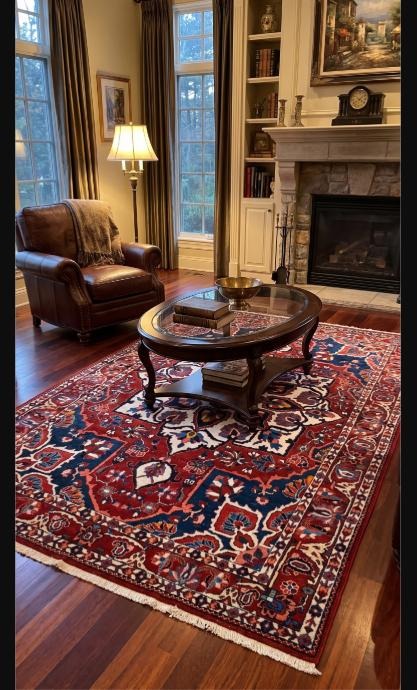
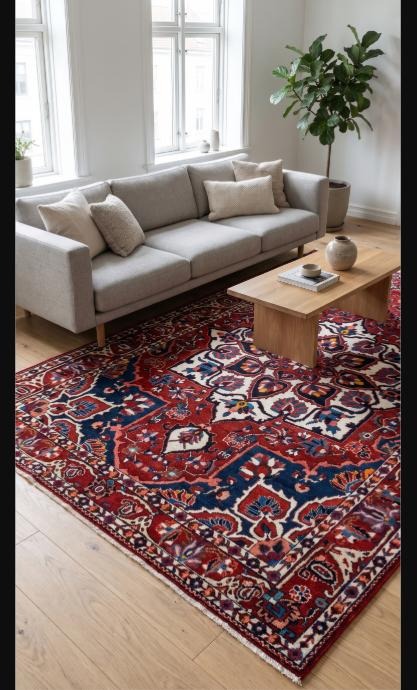
The pattern of this rug is described as a symmetrical floral medallion. A medallion creates a central point of organisation, while floral forms supply the botanical character of the decoration. Symmetry distributes the design in a balanced and regular manner. In this piece, a central medallion, floral ornament and ordered structure are therefore the defining elements of the recorded pattern.
Bachtiari designs are generally inspired by flowers and gardens. Garden imagery is one of the best-known themes in the region’s rug vocabulary. Plants may be arranged across an entire field or placed within clearly separated compartments. A floral medallion belongs to this wider decorative tradition, even though it has a different layout from a compartmentalised garden design.
The Khesti pattern is a particularly influential Bachtiari garden design. It divides the field into individual squares, with animals and plants serving as symbolic elements. Another important arrangement uses a field decorated with latticework and floral ornaments. These formats are distinct from a medallion composition, but they share the same interest in vegetation, ordered space and garden imagery. They show how the Bachtiari tradition uses recurring natural themes in more than one formal structure.
Colour choices vary according to the styles of particular tribes. In general, Bachtiari rugs include shades of white, red, brown, green and yellow. Natural dyes can create variations in colour, which are especially apparent in the oldest Bibibaff rugs. Colour is therefore part of both the visual design and the material history of the weaving tradition. Variations may arise from the dyes themselves and from the different practices of individual tribal groups.
A symmetrical floral medallion places emphasis on the relationship between centre and surrounding field. The floral elements establish the nature-based vocabulary, while the mirrored arrangement creates visual order. Bachtiari weaving also includes garden squares, lattice fields and other floral systems. The design of this rug is specifically identified as a symmetrical floral medallion, so it is presented as that pattern rather than being assigned to the separate Khesti, lattice or compartmentalised formats.
Special Features
The rug is in top condition. It has been renovated and professionally washed. These details describe the documented treatment and present condition of this one-off piece. The renovation and professional washing are part of the rug’s recorded condition information. It is offered as a hand-knotted Bachtiari Persian rug with a pile of 100% wool and a warp of 100% cotton.
Its further stated characteristic is a knot density of 160000/Qm. Together with the symmetrical floral medallion, this provides a concise technical and visual identification of the rug. Bachtiari rugs vary within their tradition according to knot density, design and dyes. In this example, the Bachtiari designation is combined with the specified wool pile, cotton warp, renovated condition and professional washing.
FAQ
Where did the Bachtiari rug tradition originate?
Bachtiari rug weaving is an important art form of the Bachtiari tribe, which is based in the Chahar Mahaal and Bachtiari region of western Persia. The craft is connected with the tribe’s own weaving communities and their long-established textile practices. Bachtiari rugs have been exported throughout the world since the beginning of the nineteenth century, allowing this regional tradition to become known far beyond its original area.
Where are most authentic Bachtiari rugs made?
Most authentic Bakhtiari rugs are woven in settled Bakhtiari communities in central western Persia, south-west of Isfahan. Production is associated particularly with Chahar Mahaal and Bakhtiari, as well as parts of Isfahan, Lorestan and East Khuzestan. Shahr-Kurd is an especially noted centre. Bakhtiari rugs were often given the origin names Saman or Hureh, also written Hori. Today, these names are generally understood more as quality designations within Bakhtiari weaving than as exclusive geographical terms.
How do Bachtiari construction and patterns differ?
Bachtiari rugs are based on a cotton warp with a wool weft. Quality varies according to factors including knot density, design and dyes. The highest knot densities are often associated with the term Bibibaff, whereas Hori rugs are more loosely woven and ranked lower in quality. The designs are usually inspired by flowers or gardens. The Khesti pattern is especially well known: it is a garden design divided into squares in which animals and plants appear as symbols.
To provide the best experiences, we use technologies like cookies to store and/or access device information. Consenting to these technologies will allow us to process data such as browsing behavior or unique IDs on this site. Not consenting or withdrawing consent, may adversely affect certain features and functions.
Functional Always active
The technical storage or access is strictly necessary for the legitimate purpose of enabling the use of a specific service explicitly requested by the subscriber or user, or for the sole purpose of carrying out the transmission of a communication over an electronic communications network.
Preferences
The technical storage or access is necessary for the legitimate purpose of storing preferences that are not requested by the subscriber or user.
Statistics
The technical storage or access that is used exclusively for statistical purposes.The technical storage or access that is used exclusively for anonymous statistical purposes. Without a subpoena, voluntary compliance on the part of your Internet Service Provider, or additional records from a third party, information stored or retrieved for this purpose alone cannot usually be used to identify you.
Marketing
The technical storage or access is required to create user profiles to send advertising, or to track the user on a website or across several websites for similar marketing purposes.




 SECURE PAYMENT
 SHIPPING PARTNERS


