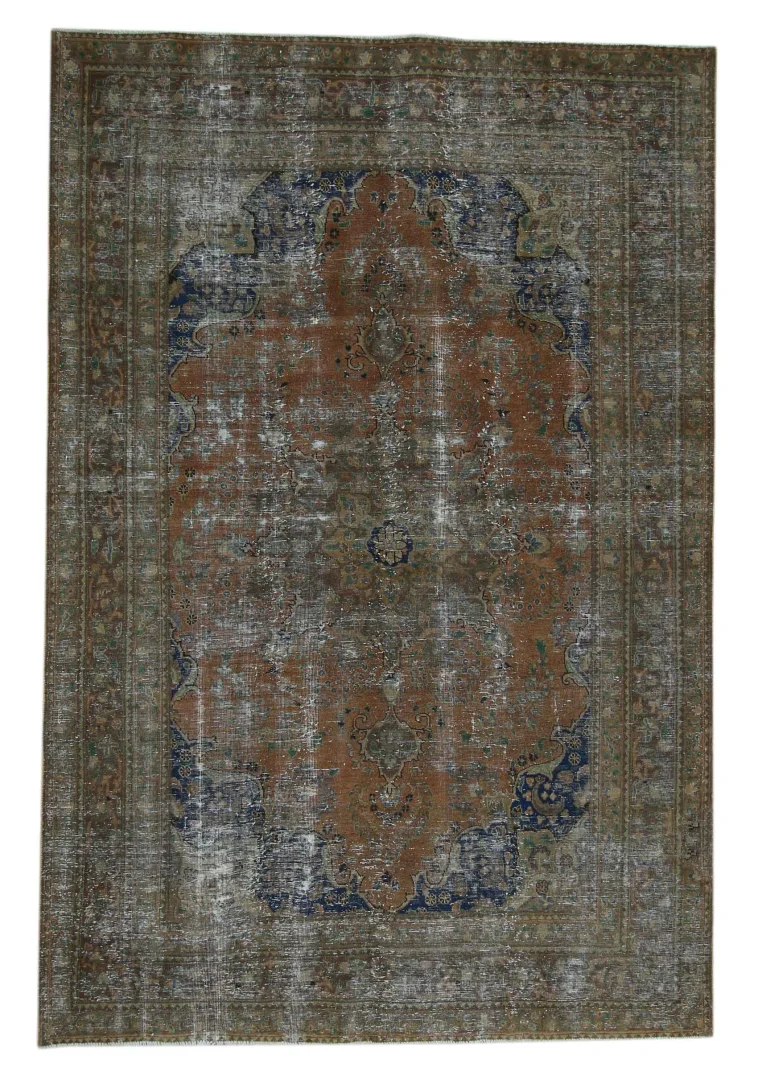
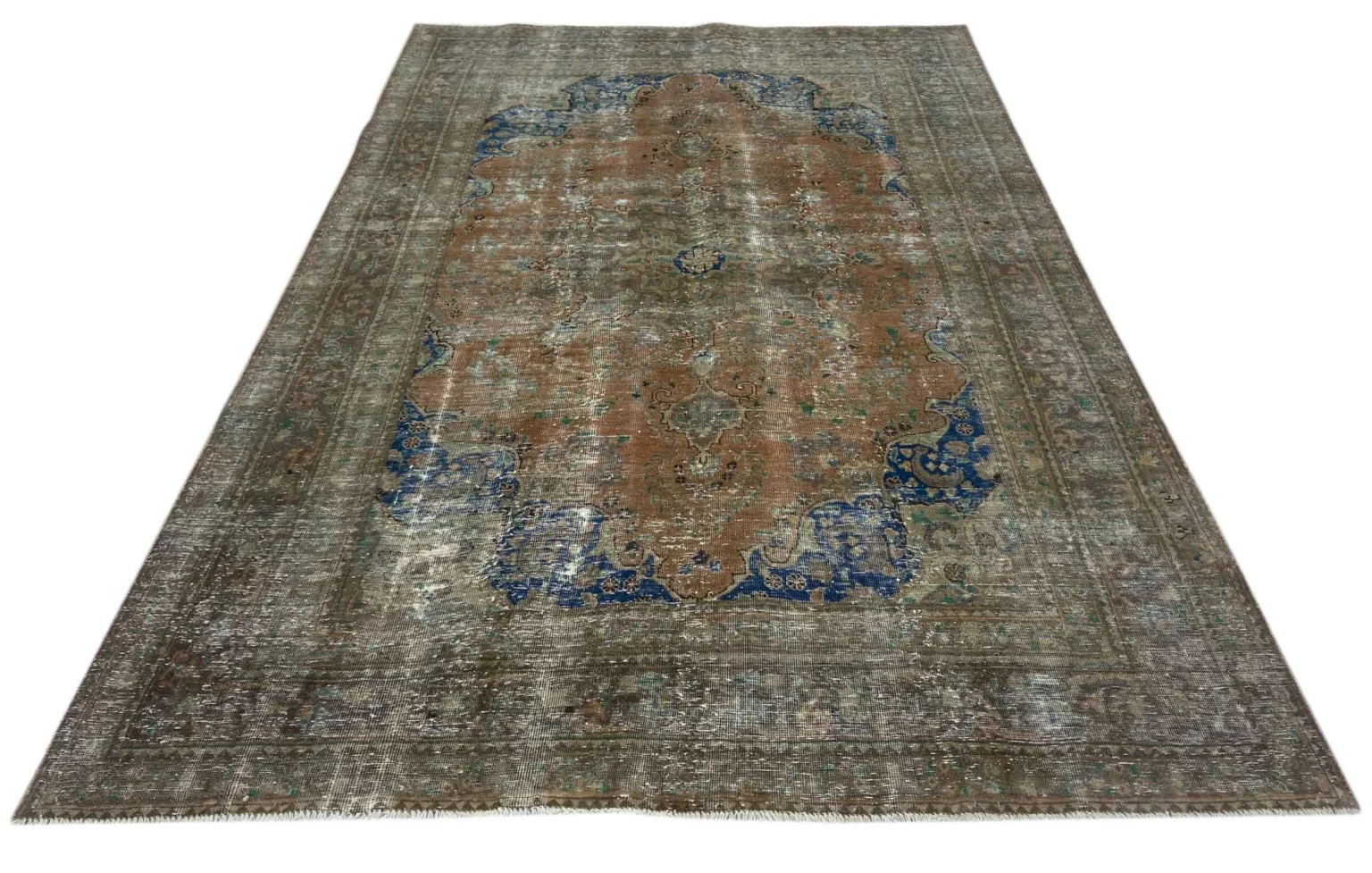
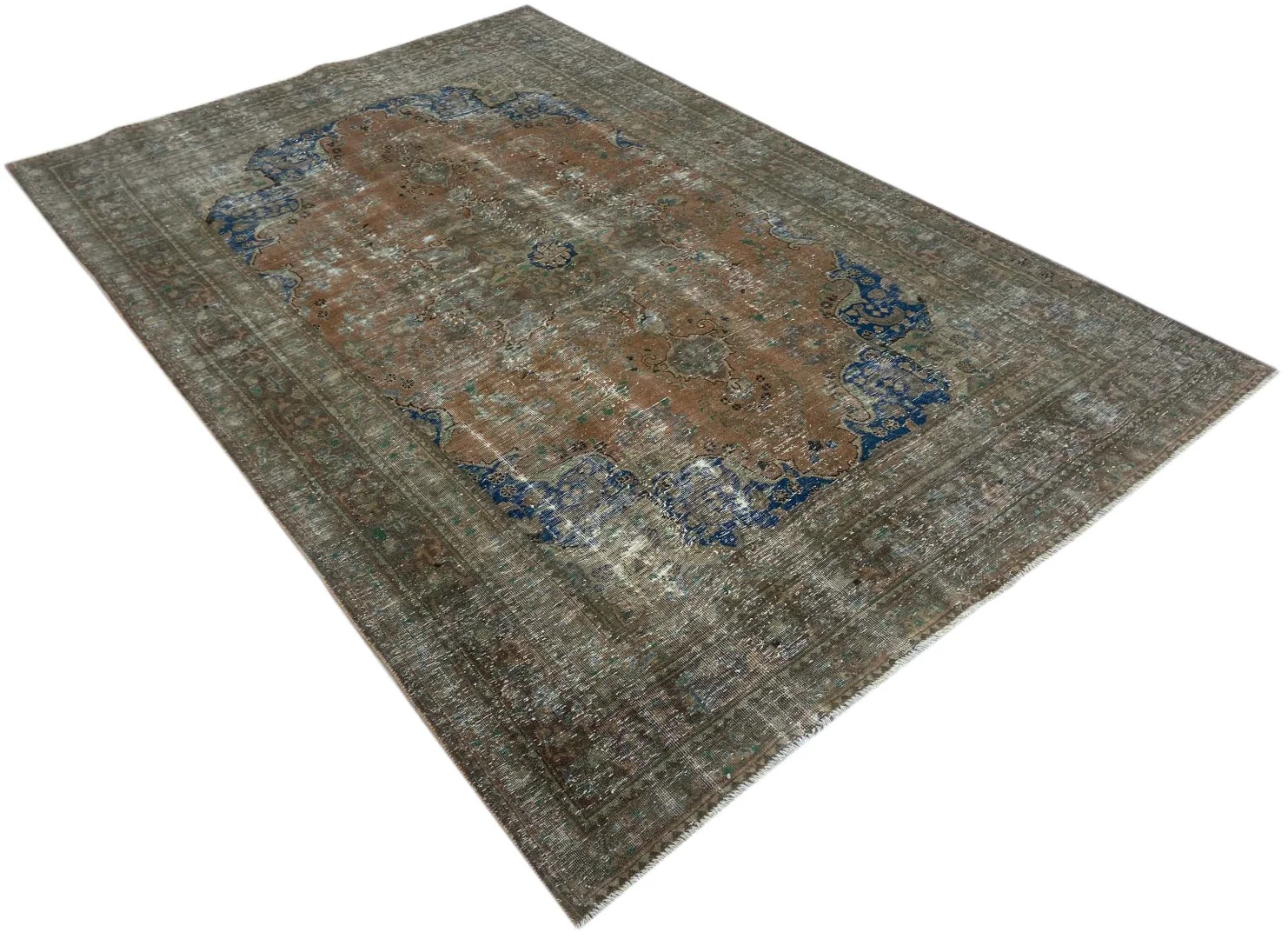
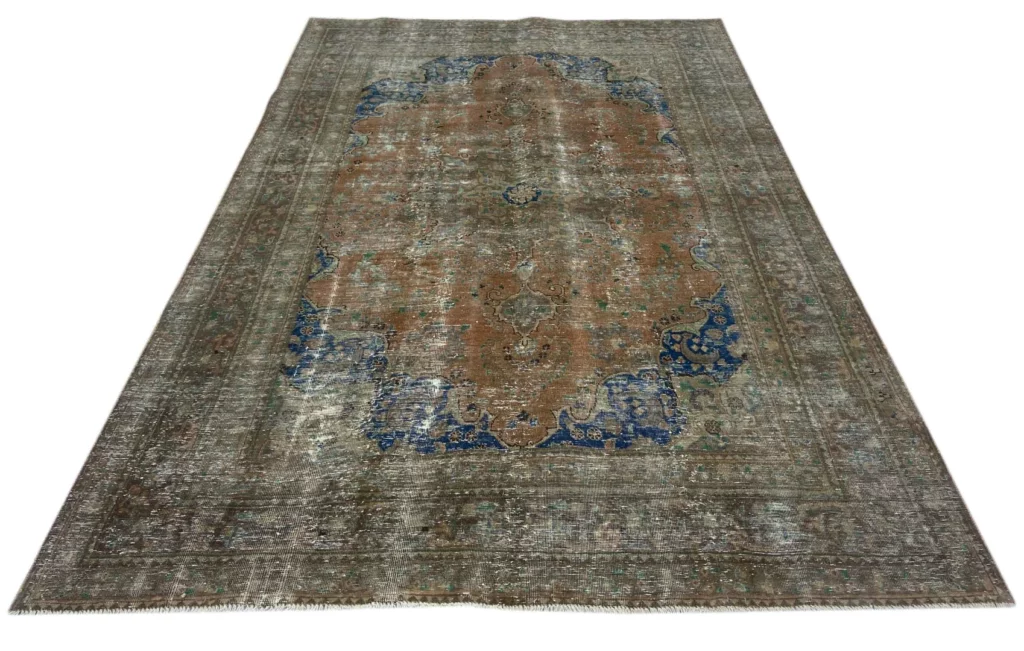
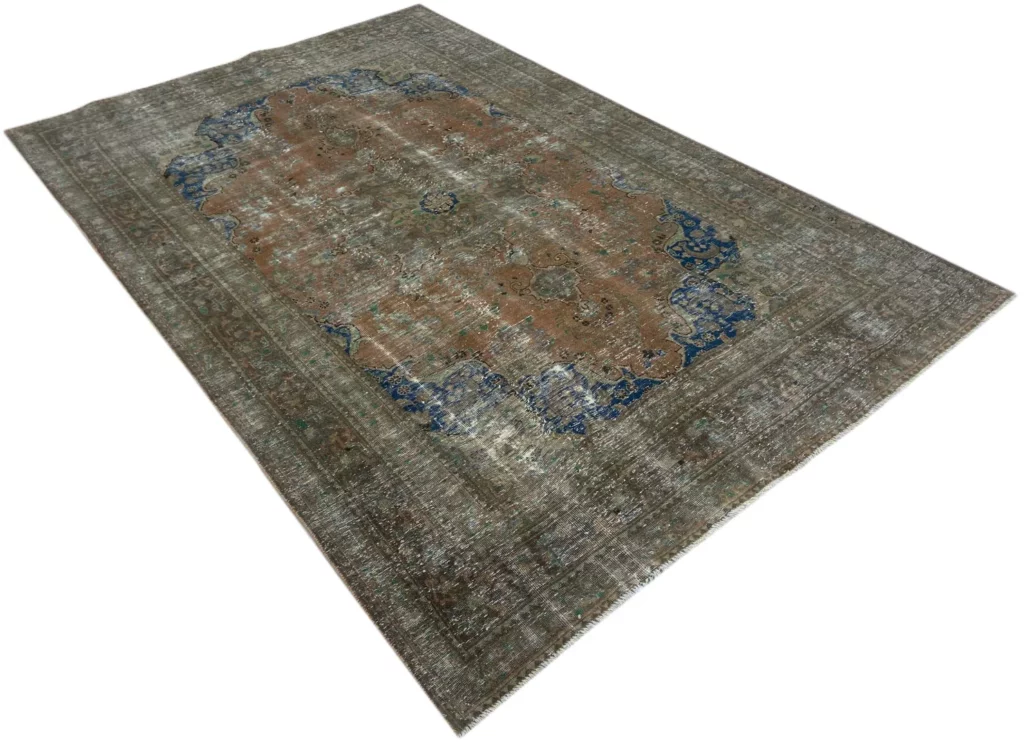
Hand-knotted Persian Rug | Material: Wool pile | Size: 293 x 195 cm | Pattern: Traditional Oriental design with a modern touch, original ornaments partly visible | Condition: Good, redesigned through restoration
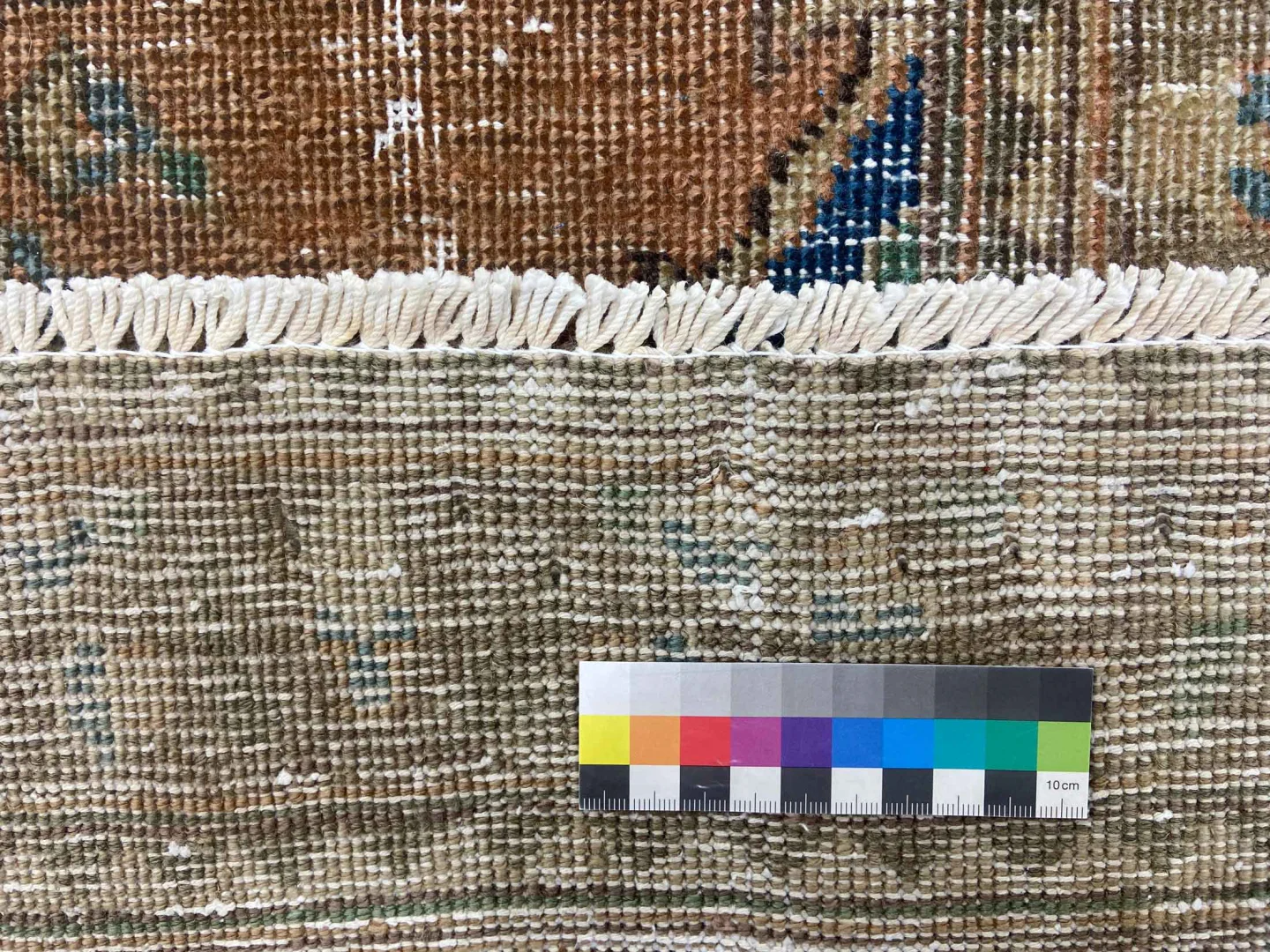
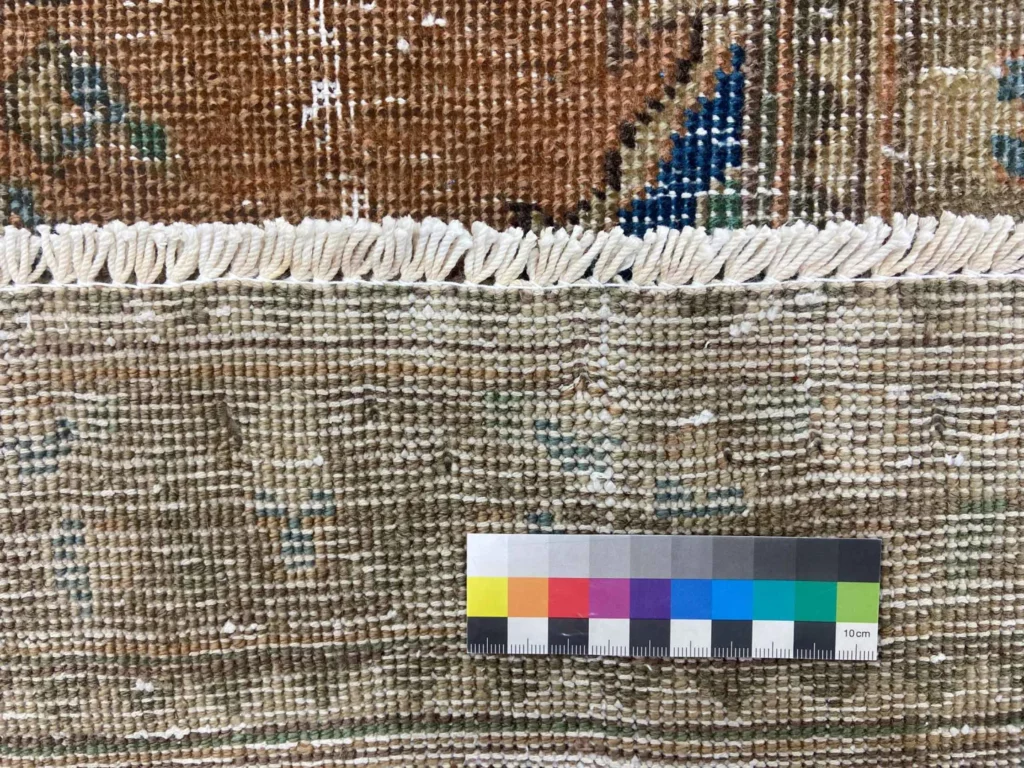
This Persian rug is hand-knotted and has a wool pile. Hand-knotting builds the textile one knot at a time. Each knot is inserted into the foundation and secured by the rows that follow. This is fundamentally different from industrial production, in which a design is produced mechanically in a continuous process. In a hand-knotted rug, the surface develops gradually through the work carried out at the loom.
Wool is widely used in rug making because it combines several practical qualities. The fibre can be spun, dyed and made into a resilient pile. It can also create a tactile textile surface with a distinct handle. The exact feel of a pile depends on the knotting method, the shearing and the later care. For this rug, wool is specified as the pile material; no further material details are given.
Handwork also affects the way a design appears. Minor differences in yarn tension and in the execution of individual knots are part of making a rug by hand. They can keep a surface from looking entirely mechanical. Craft and design are therefore closely connected: the drawing, colour fields and ornaments are built row by row while the rug is being knotted.
This piece has also been restored and redesigned through that process. The restoration forms part of its present appearance. It stands alongside the original hand-knotted construction and explains the combination of traditional elements with a more contemporary overall effect. The rug is described as being in good condition and as having been newly designed through restoration.
Origin and Tradition
The rug is identified as a Persian rug from Iran. Iran is one of the historic centres of Oriental rug production. Over many centuries, different regional methods, visual languages and colour traditions developed there. Rugs were made in urban workshops as well as in smaller settlements and communities shaped by nomadic life. The term Persian rug therefore covers a broad cultural and technical tradition rather than one single pattern shared everywhere.
In Iranian weaving regions, designs are commonly transferred to a loom and built into a foundation. The knots create the pile, while the underlying structure supports the finished surface. After knotting, a rug may be sheared, inspected and otherwise finished according to its construction. The relationship between knotting, yarn, shearing and finishing influences how clearly a design can be read. Historically, these stages were performed by specialised craftspeople, linking drawing, dyeing, knotting and final preparation.
Places such as Tabriz, Isfahan and Kashan are often associated with distinct design traditions. Tabriz is frequently linked with refined compositions, including designs organised around a central structure. Isfahan has an important place in rug history through finely worked floral and symmetrical arrangements. Kashan is often connected with floral layouts and medallion-based compositions. These examples show how strongly Persian rugs can reflect local practice. They are general points of rug history, not additional origin information for this particular piece.
Qom, also known as Ghom, is likewise recognised for finely knotted rugs and elegant designs. Gabbeh is generally associated with simpler, more open compositions and a tradition influenced by nomadic weaving. Nain and Tabriz are also commonly discussed as distinctive directions within Persian rug art. These traditions can be compared without treating a motif name as proof of a rug’s place of manufacture.
The history of Persian rugs includes both formal urban carpets and practical pieces made for everyday use. Geometric shapes, vines, flowers, medallions and borders have been reinterpreted across regions and periods. Dyes have come from plant and mineral sources, and later from synthetic materials. In every case, the result depends on the relationship between design, fibre and workmanship. This rug brings that wider tradition together with later restoration and a redesigned appearance.
Design and Pattern
The design is described as traditional Oriental design with a modern touch. Two levels are therefore present: the foundation belongs to the decorative vocabulary common to Oriental rugs, while the restoration gives the piece a changed contemporary direction. A restored rug does not have to lose its earlier imagery. Existing elements may remain visible, be softened or be incorporated into a different relationship of colour and open space.
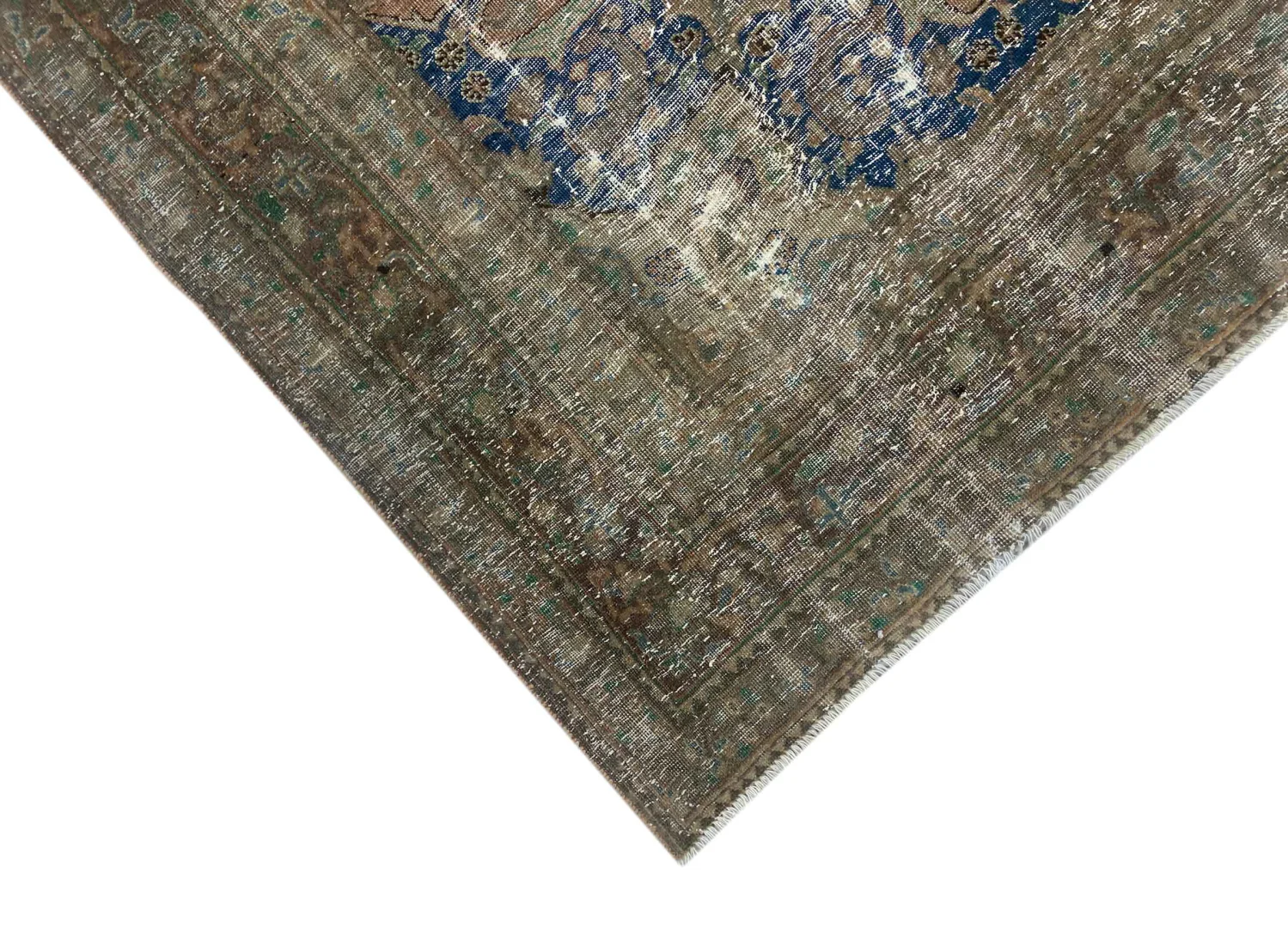
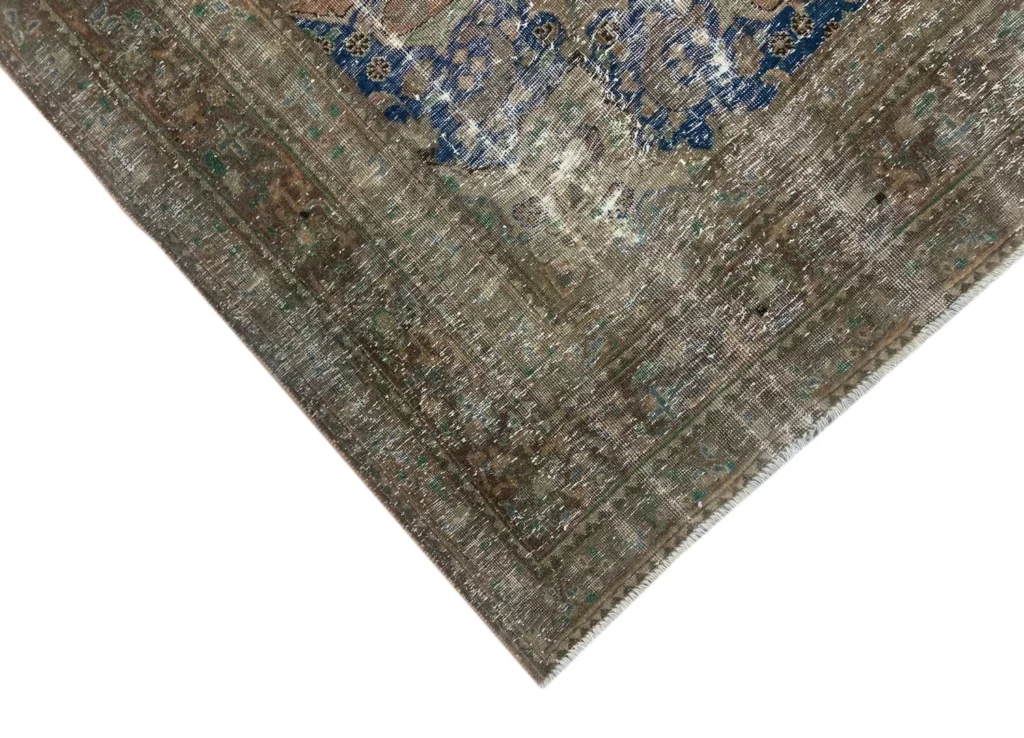
Original ornaments are partly visible on this rug. They point to the earlier design without establishing a particular regional pattern name. In Persian rug traditions, ornaments may be floral, geometric or arabesque in character. Vines can connect separate forms, flowers can punctuate a field and borders can frame the composition. Depending on the design, these elements may be arranged with strict repetition or placed in a more flowing manner.
A classical rug composition is often divided into several zones. The centre may be organised around a medallion, a field pattern or a continuous ornament. One or more borders separate the central area from the outer edge. This structure gives the eye a way to read the surface. On a restored rug, the original organisation may remain recognisable while the intensity and distribution of colour have been changed.
The colour scheme of this piece is unique through a dyeing process. Colour in a rug is not merely decoration; it also affects the perception of depth, contrast and age. A dyeing process can alter existing tones and bring separate areas into closer visual relation. The result depends on the starting colour, the fibre, the application and the finishing treatment. The particular colour effect is therefore a direct part of the rug’s redesigned appearance.
The modern touch does not necessarily mean that the pattern is entirely modern. It can arise from a more restrained visual effect, a changed palette or the deliberate visibility of earlier ornaments. The combination of recognisable tradition and subsequent alteration is characteristic of restored rugs. For this piece, the traditional ornaments, the dyeing process and the new design are all identified as important aspects of its appearance.
Persian rug colours and forms may carry cultural and technical associations, but their precise effect always depends on execution. Red can act as a strong accent, blue can create depth, and earth tones can connect separate fields in a quieter way. Such general colour impressions are not a substitute for a detailed colour analysis of one rug. Here, the central documented point is the individual colouration created through the dyeing process.
Special Features
This rug is distinguished by the meeting of original and redesigned elements. Original ornaments remain partly visible, while restoration has given the rug a new appearance. The earlier design can therefore still be read without making the overall effect exclusively traditional. The rug is presented as a combination of a hand-knotted foundation, a restored surface and a contemporary interpretation of Oriental design.
The colouration is another defining feature. It was created through a dyeing process and is described as unique. The resulting surface effect cannot be explained by the original ornaments alone. Restoration and altered colour are explicit parts of the rug’s description. Its condition is good, and the new appearance created through restoration is central to how this individual piece is characterised.
Every hand-knotted rug is a single textile object. In this example, hand-knotted wool, partly visible original ornaments and later redesign come together. No information is provided about knot density, age, signature or a more precise Iranian province, so those details are not added.
FAQ
How should I care for a hand-knotted wool rug?
Regular, gentle cleaning helps remove dust and loose dirt. Prolonged direct sunlight should be avoided because light can alter the way colours appear. A professional cleaning at suitable intervals can support the rug’s condition. With a restored rug, the cleaning method should take account of the existing surface and the dyeing process. Harsh products, vigorous scrubbing and uncontrolled moisture should be avoided. Care should always respect the properties of wool, the hand-knotted structure and the redesigned finish.
What makes this Persian rug distinctive?
Its distinctive character comes from the combination of hand-knotted wool, traditional Oriental design and a modern redesign. Original ornaments are partly visible, while restoration has given the rug a new visual direction. The unique colouration produced through a dyeing process adds another defining element. It is therefore not described simply as an unchanged traditional rug or solely as a modern design object. Its identity lies in the interaction between original ornament, hand craftsmanship, restoration and changed colour.
Where can I buy an authentic Persian rug?
Authentic Persian rugs are available from specialist rug dealers and reputable online retailers. When buying, check that origin, material, technique, condition and any restoration are clearly described. For this rug, Iran is given as the origin, wool as the pile material, hand-knotting as the technique and restoration as part of its present design. Certificates or additional provenance documents may provide further support where they are available. It is important not to confuse a pattern description with a place of manufacture and to assess the specific information for each individual rug.
To provide the best experiences, we use technologies like cookies to store and/or access device information. Consenting to these technologies will allow us to process data such as browsing behavior or unique IDs on this site. Not consenting or withdrawing consent, may adversely affect certain features and functions.
Functional Always active
The technical storage or access is strictly necessary for the legitimate purpose of enabling the use of a specific service explicitly requested by the subscriber or user, or for the sole purpose of carrying out the transmission of a communication over an electronic communications network.
Preferences
The technical storage or access is necessary for the legitimate purpose of storing preferences that are not requested by the subscriber or user.
Statistics
The technical storage or access that is used exclusively for statistical purposes.The technical storage or access that is used exclusively for anonymous statistical purposes. Without a subpoena, voluntary compliance on the part of your Internet Service Provider, or additional records from a third party, information stored or retrieved for this purpose alone cannot usually be used to identify you.
Marketing
The technical storage or access is required to create user profiles to send advertising, or to track the user on a website or across several websites for similar marketing purposes.
 SECURE PAYMENT
 SHIPPING PARTNERS


