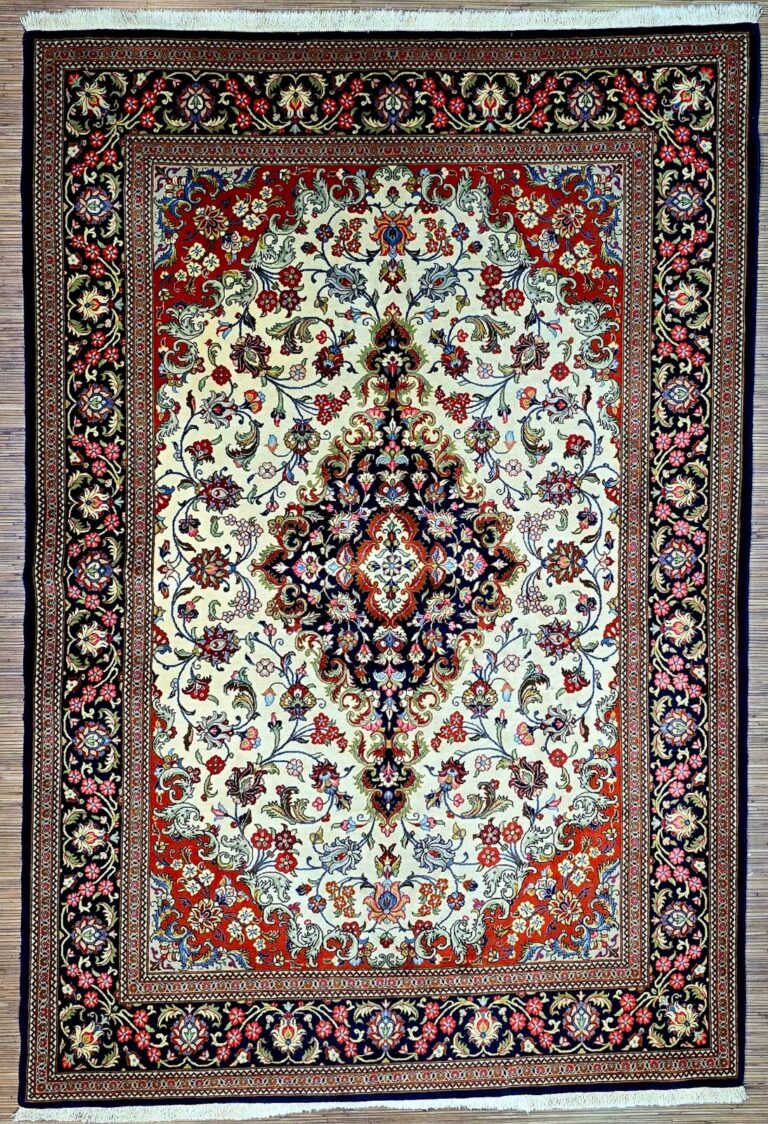
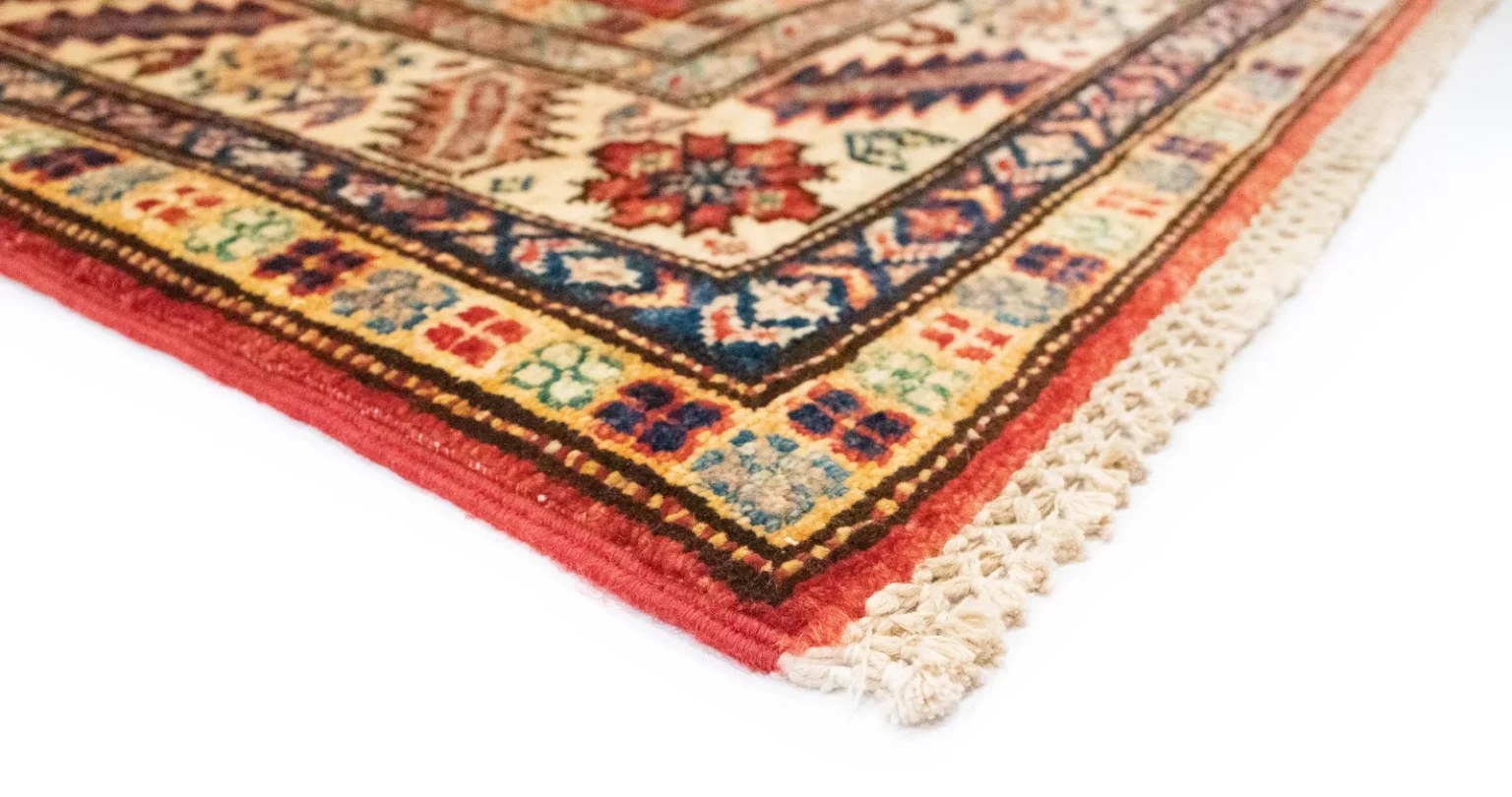
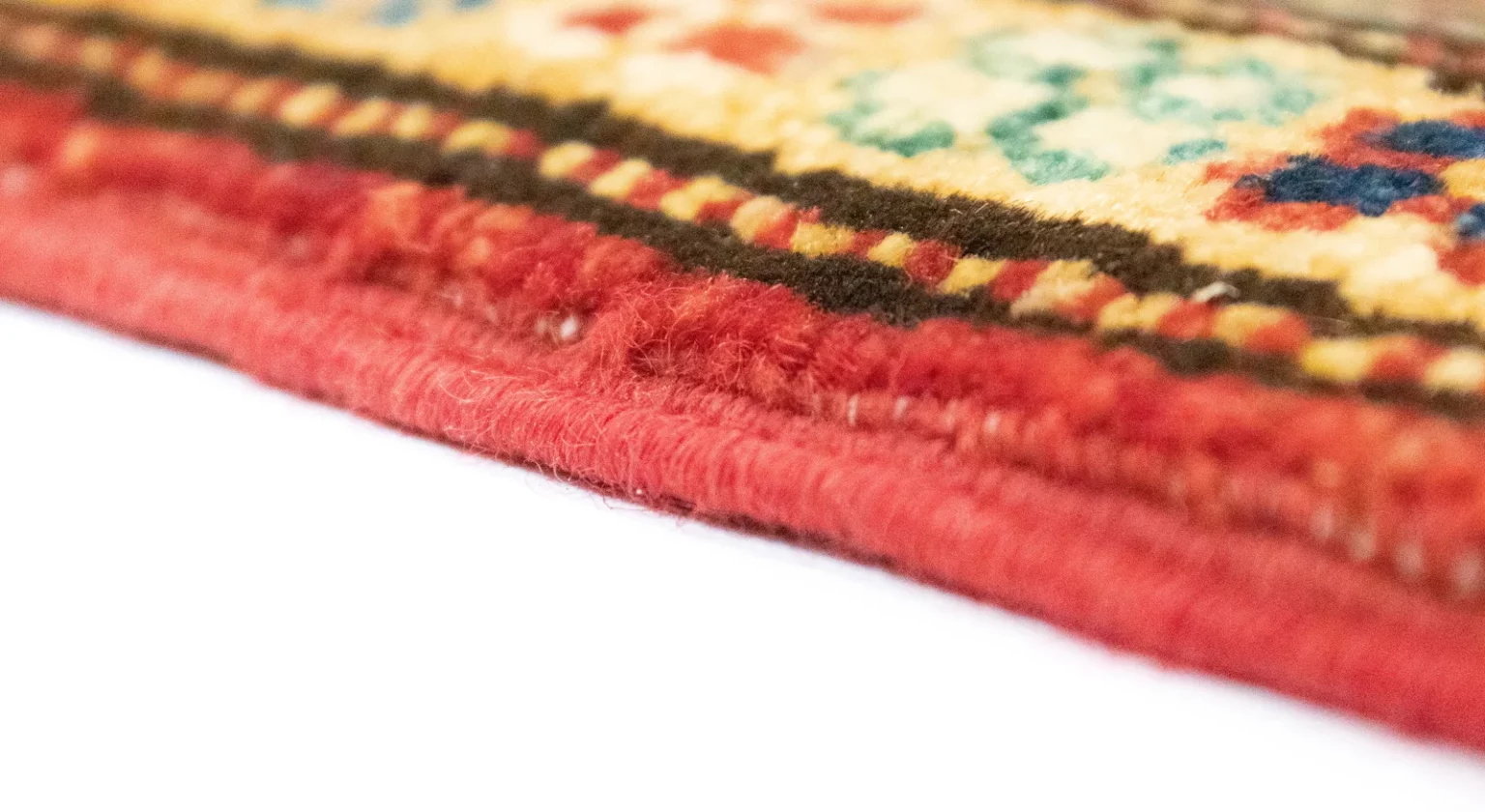
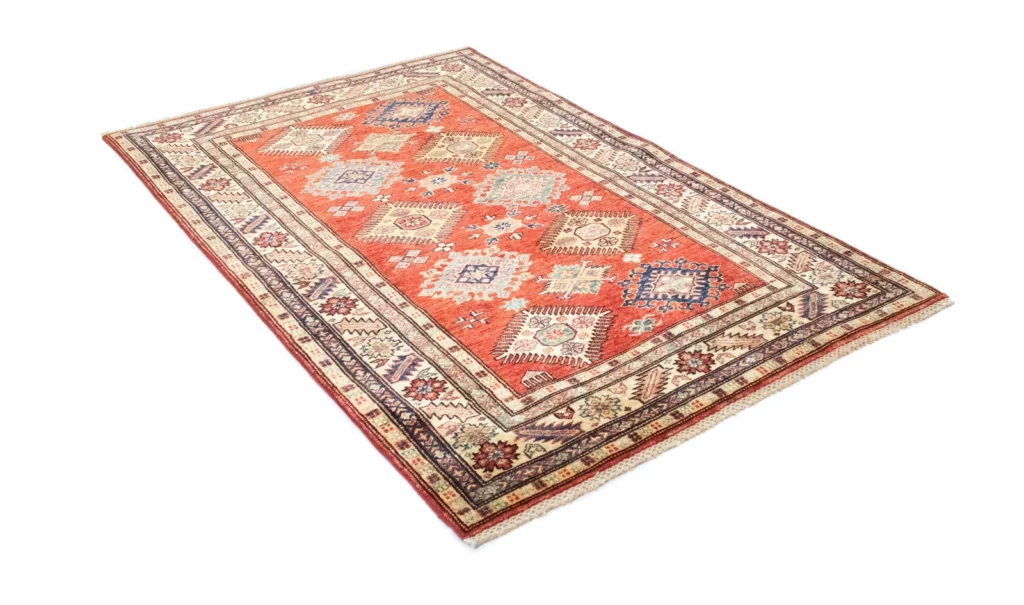
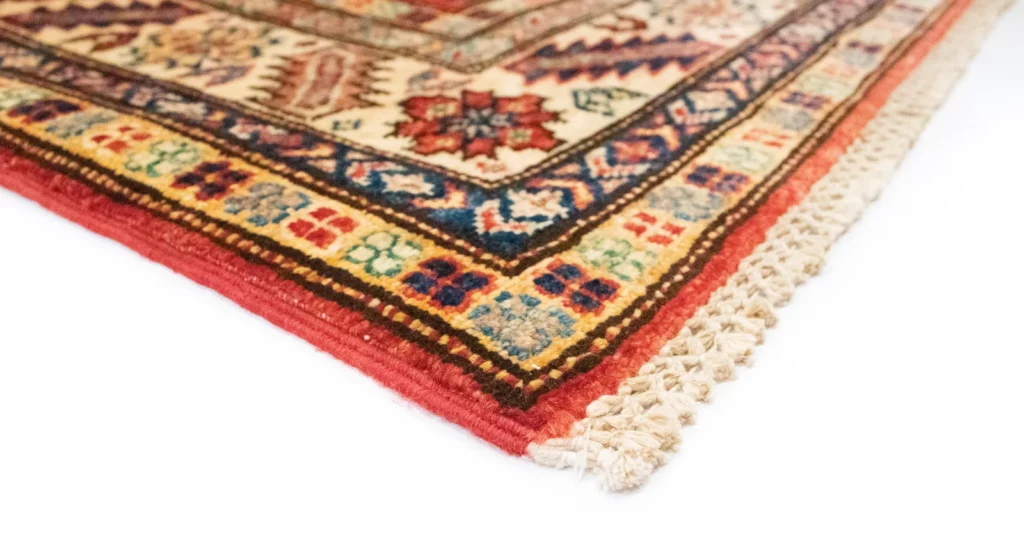
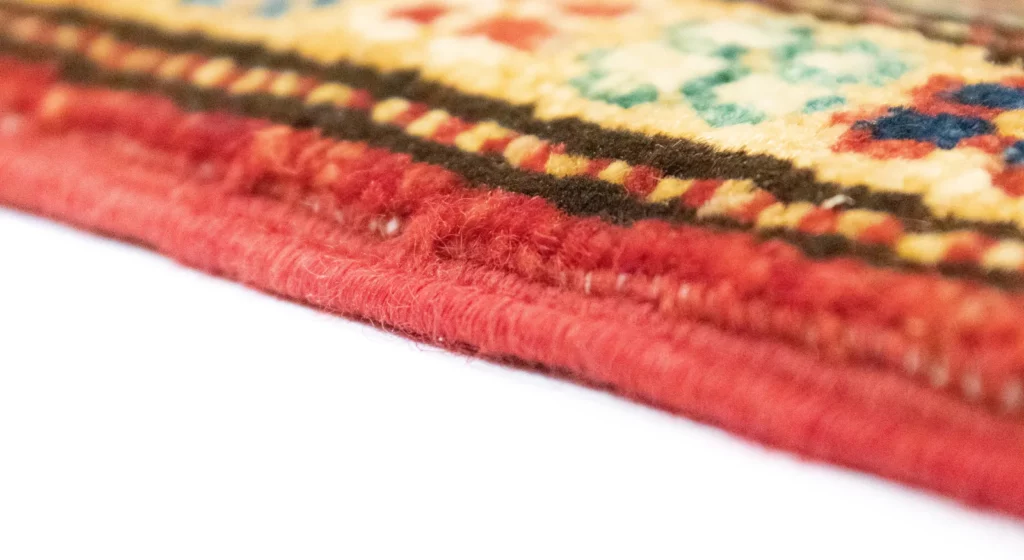
This Kazak Oriental rug has a wool pile and is hand-knotted. Wool is the stated pile material. The pile is short, giving the surface a compact and clearly defined appearance. High knot density is also listed as one of the rug’s characteristics. A dense knot structure places the individual knots closely together and can support a well-organised presentation of the design.
In hand-knotting, each knot is formed individually within the prepared foundation. The rows are then secured and the pile is brought to an even height. This process distinguishes a hand-knotted rug from an industrially machine-made floor covering. Wool has long been used for hard-wearing rugs because it is a natural fibre capable of forming a resilient surface. On this piece, the short pile, high knot density and hand-knotted construction define the stated technical character.
Handmade construction is not perfectly uniform in the same way as industrial production. Minor variations in knot placement, colour distribution or line direction are generally associated with manual work. They should not, however, be used to add unrecorded claims about this particular rug. The specific details are its wool pile, hand-knotted technique, short pile and high knot density. Its condition is described as very good.
Origin and Tradition
The name Kazak refers to a carpet tradition associated with the Caucasus. Caucasian rugs are widely recognised for an independent visual language in which strong geometric elements often play a central role. Historical examples from the region may contain sharply organised fields, prominent medallions, hooked forms, diamonds and stepped outlines. Kazak therefore identifies an established stylistic tradition and pattern vocabulary; it does not automatically mean that every individual rug carrying the name was made in the Caucasus.
The origin of this rug is given as the Caucasus. At the same time, its manufacture is stated as taking place in Pakistan or Afghanistan. Style and place of manufacture must therefore be kept distinct. A rug can draw on the geometric language of the Caucasian Kazak tradition while being produced outside the Caucasus. For this piece, both details are relevant: the Caucasus is named as its origin or stylistic reference, while Pakistan or Afghanistan is given as the place of knotting.
The Caucasus has historically connected several cultural areas. Over many centuries, local weaving traditions developed carpet forms built around recognisable geometric structures. Diamonds, stars, hooks, stepped lines and angular borders could be arranged in many combinations. Such motifs were not merely decorative; they were transmitted through regional craft practices and adapted by successive generations. Their visual effect comes from the relationship between geometric clarity, repeated rhythm and a carefully divided field.
Pakistan and Afghanistan also have extensive traditions of carpet weaving and knotting. Their production includes a wide range of regional designs as well as interpretations of established styles from other carpet cultures. Caucasian-influenced patterns can therefore be made in these countries. A factual description should consider the origin statement, the named style and the actual place of manufacture together. This rug is consequently described as a Kazak Oriental rug with a Caucasian origin and knotting in Pakistan or Afghanistan, rather than as an Iranian Persian rug.
The traditional importance of a hand-knotted rug lies in the connection between design, material and manual labour. The pattern is not printed onto a completed surface; it is built up during the knotting process. With geometric designs, this construction is particularly easy to understand because angles, lines and repetitions emerge directly from the sequence of knots. High knot density can support a more differentiated rendering, while a short pile keeps the surface relatively compact and the outlines comparatively legible.
Design and Pattern
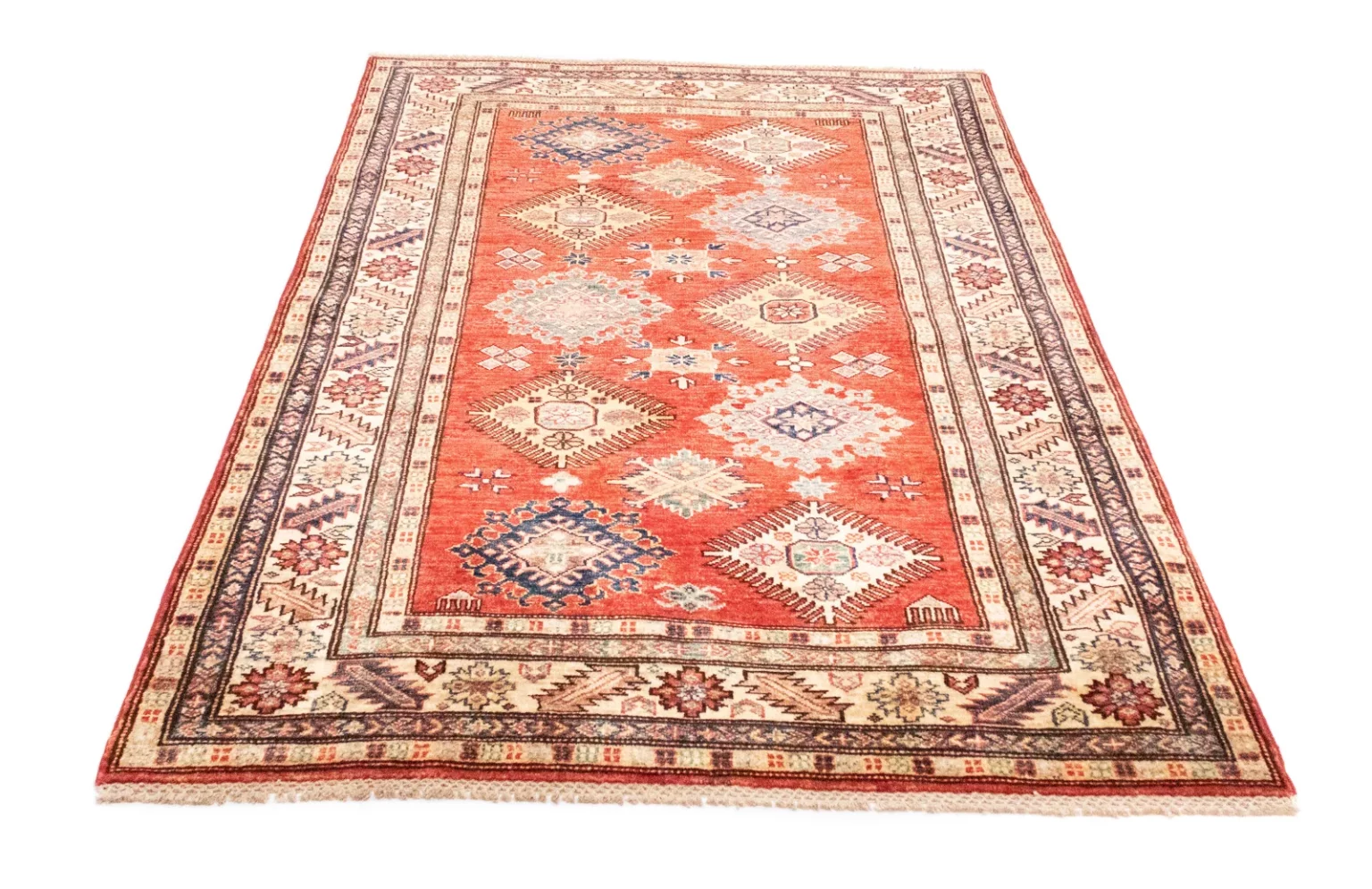
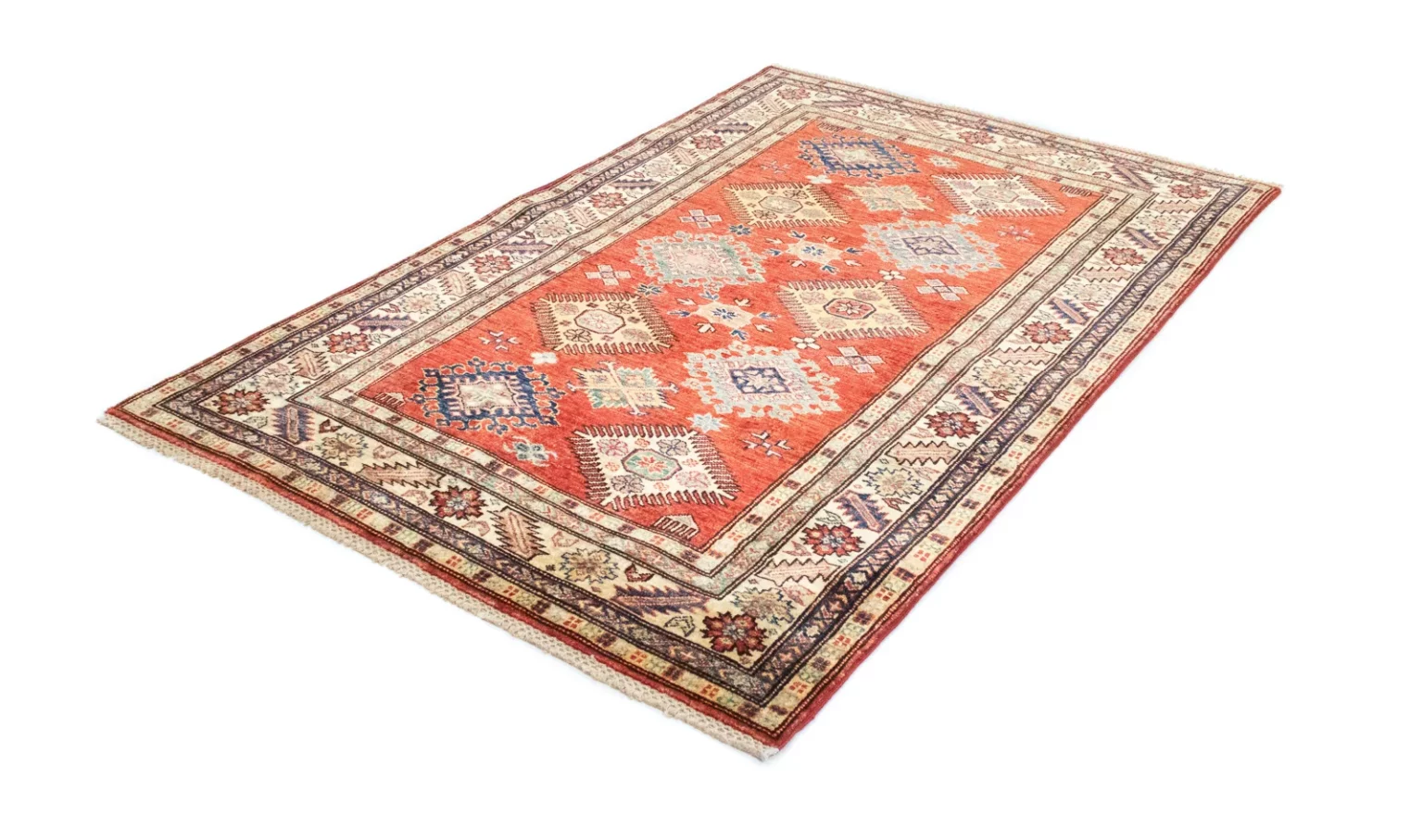
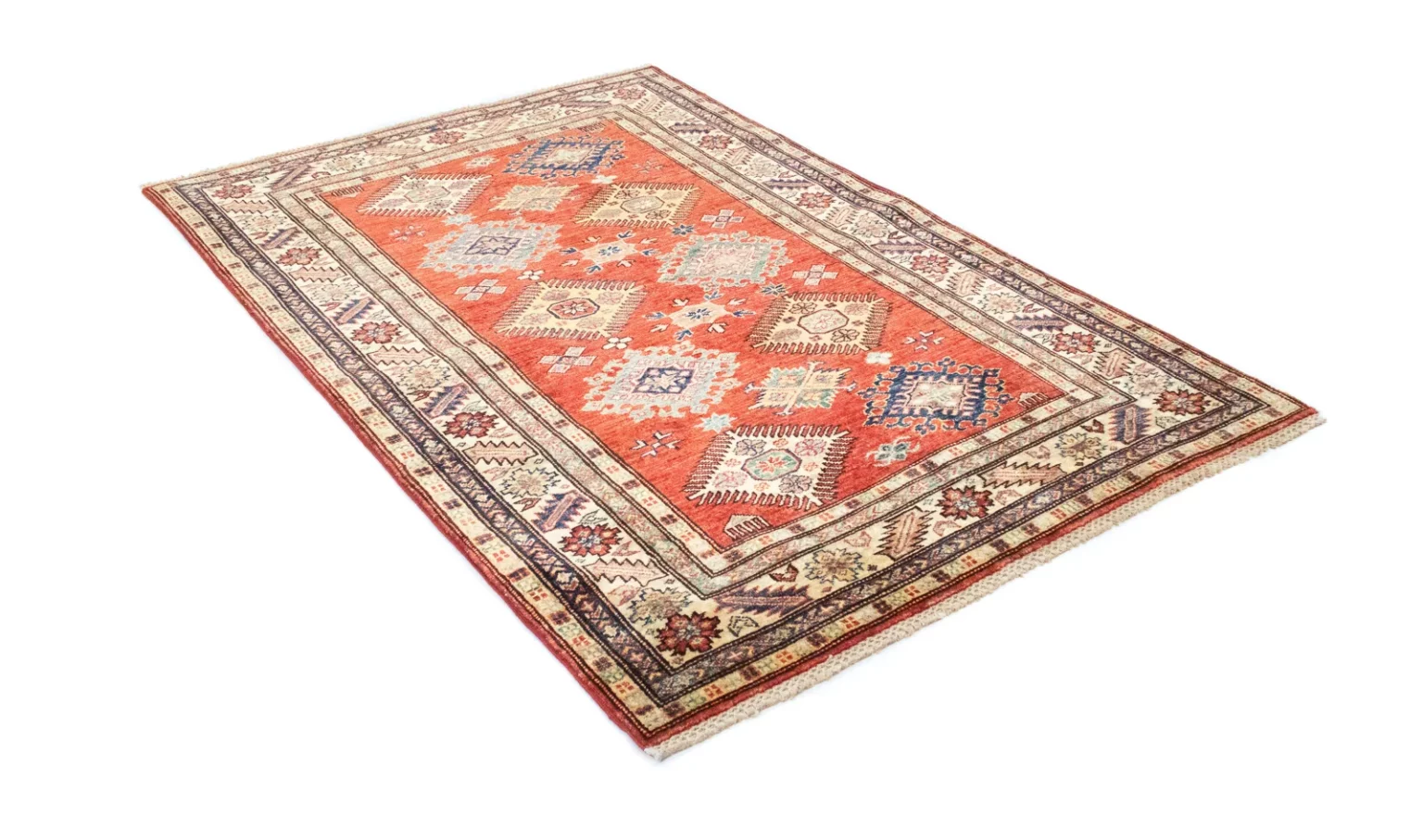
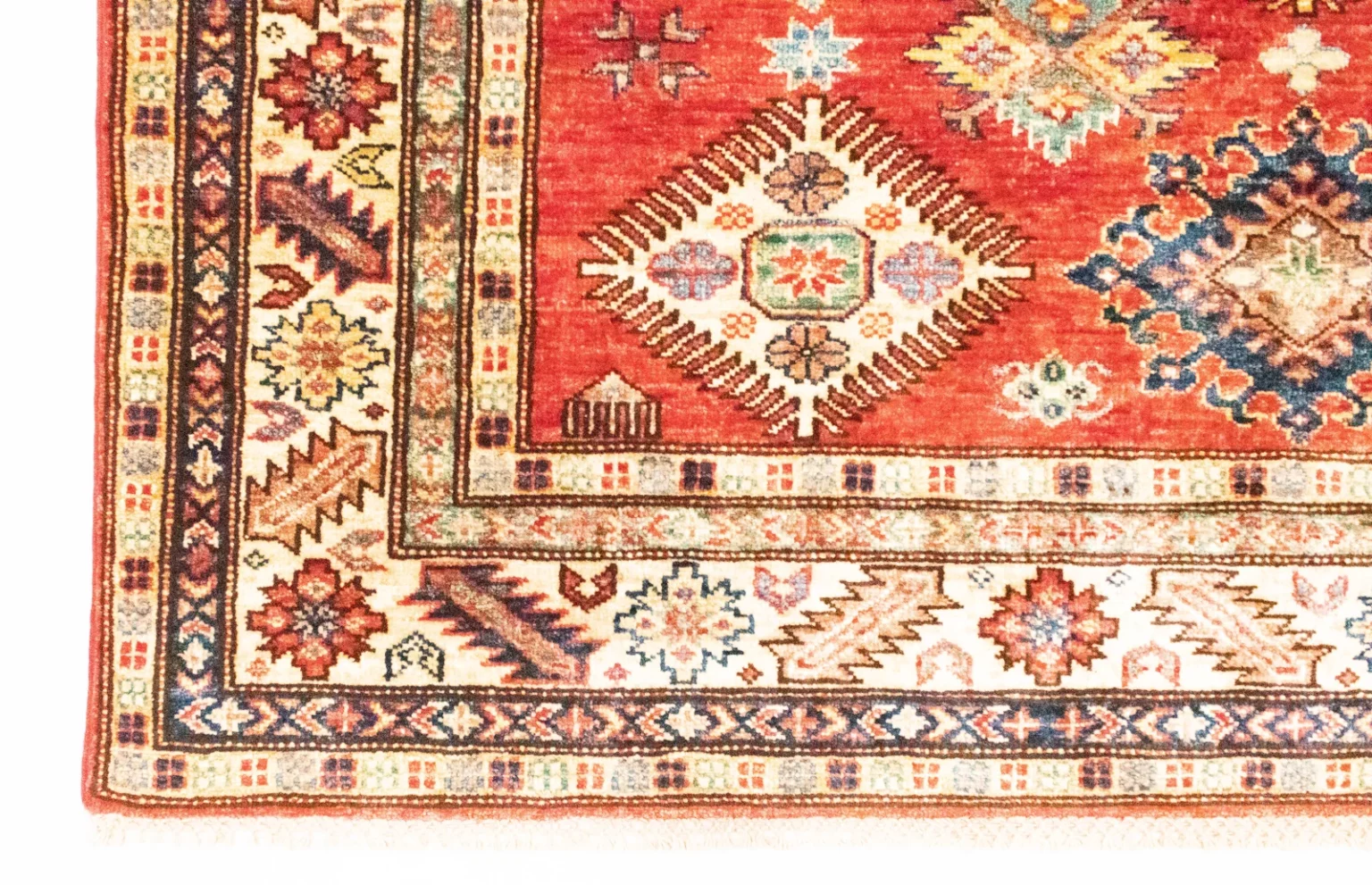
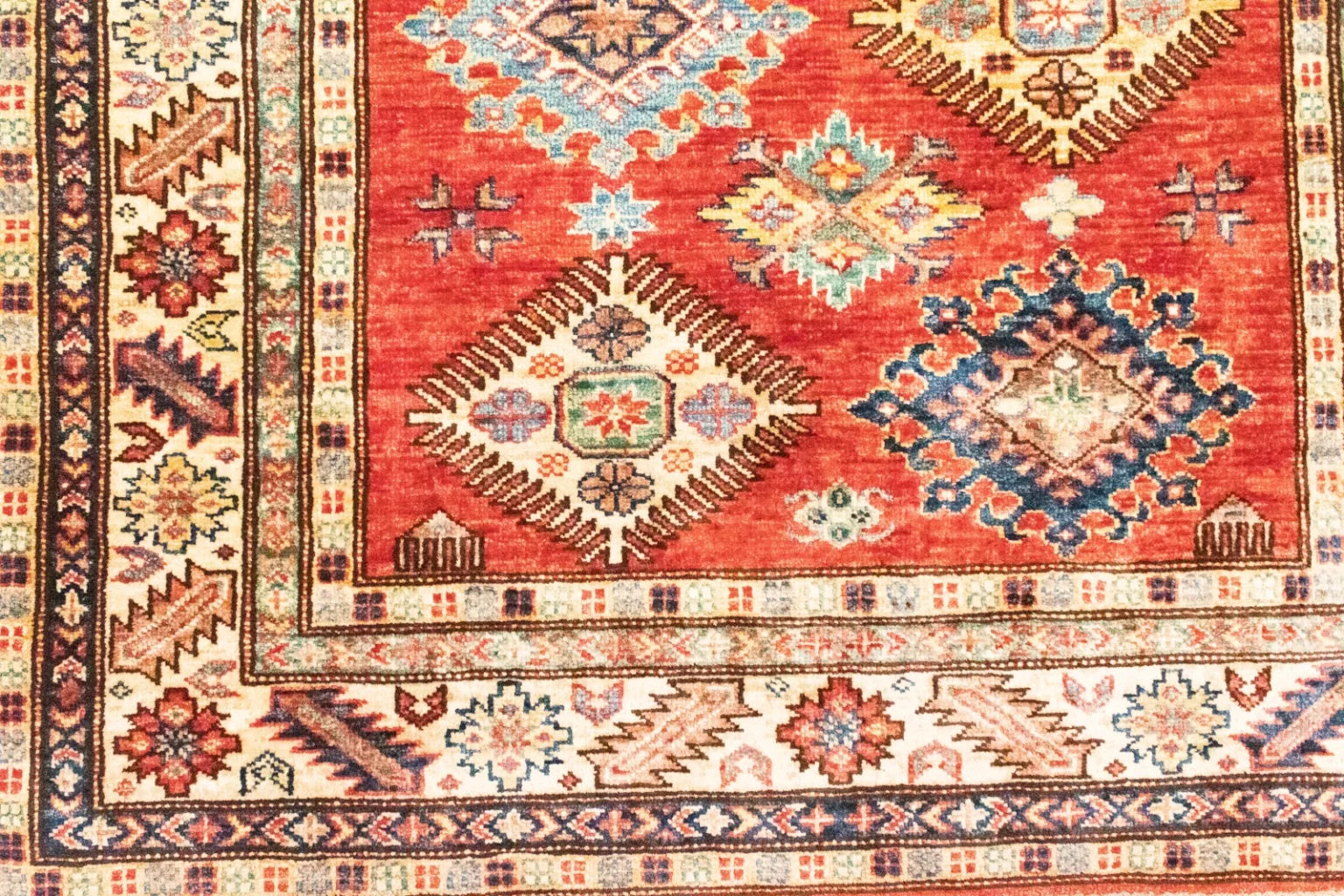
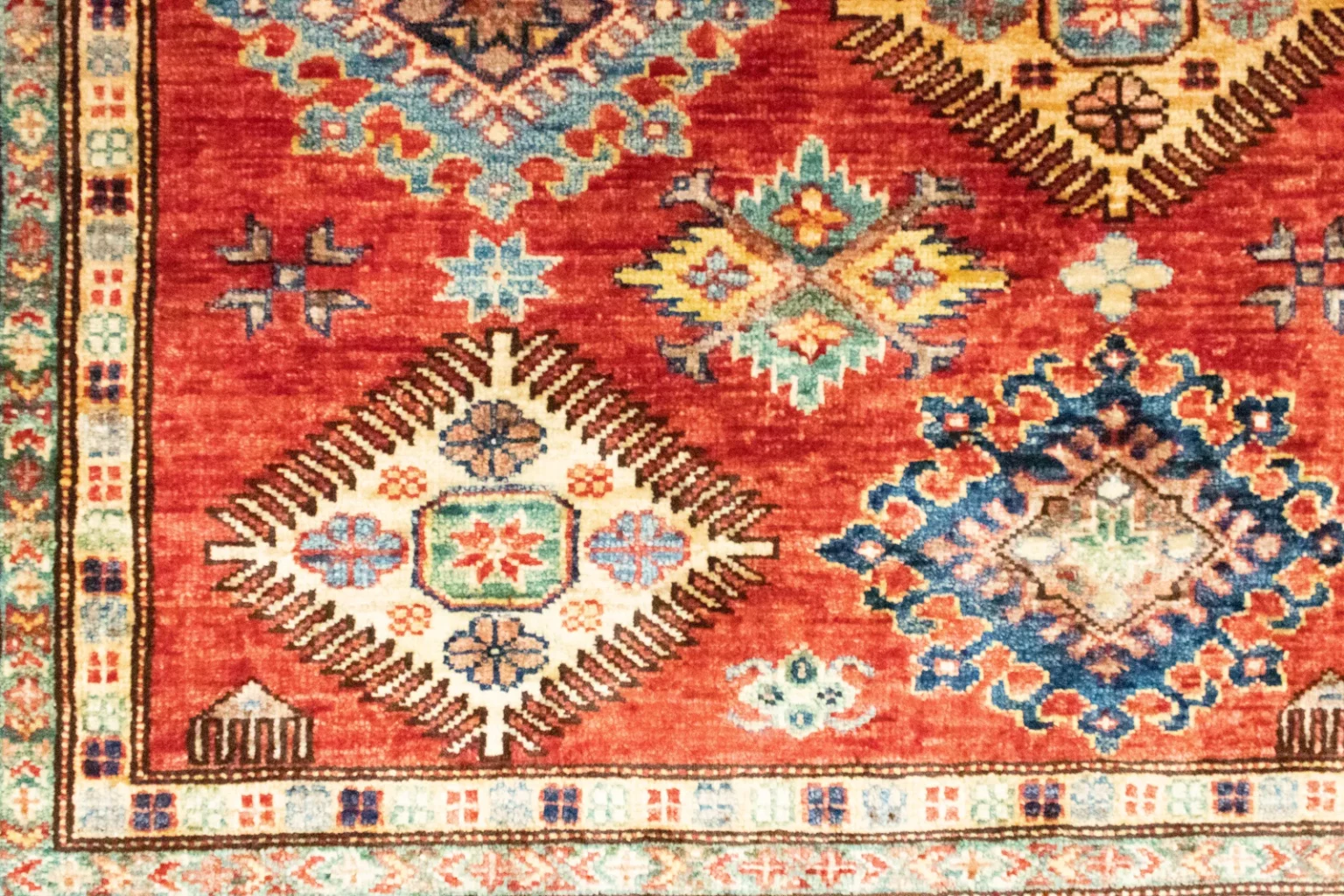
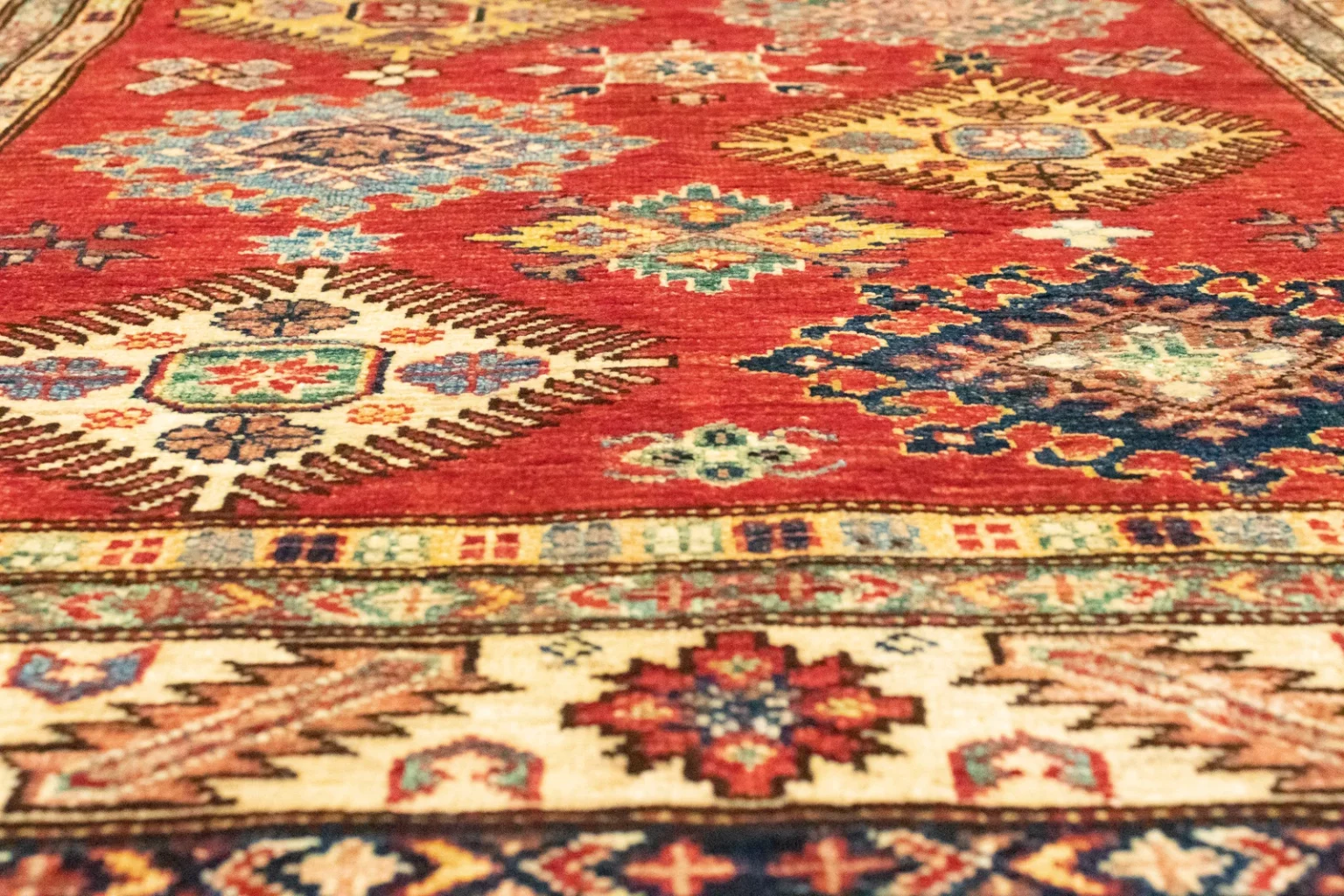
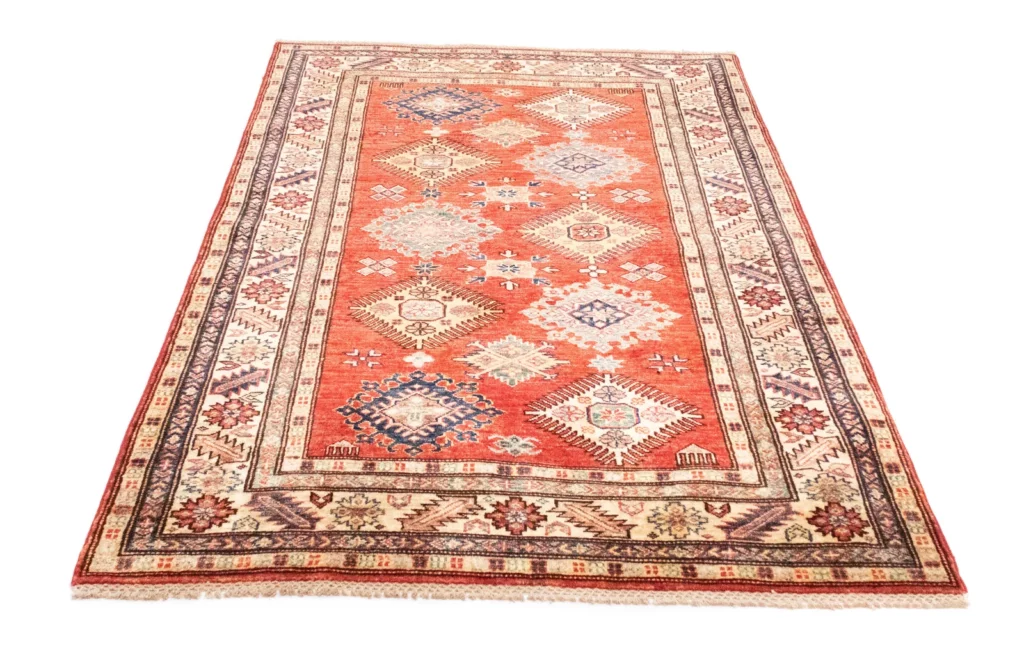
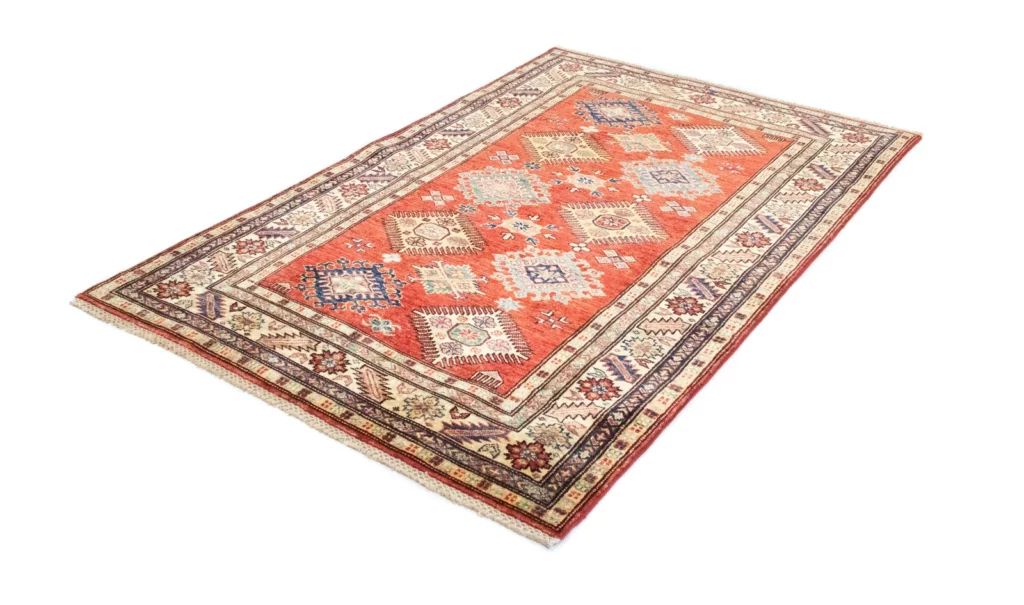
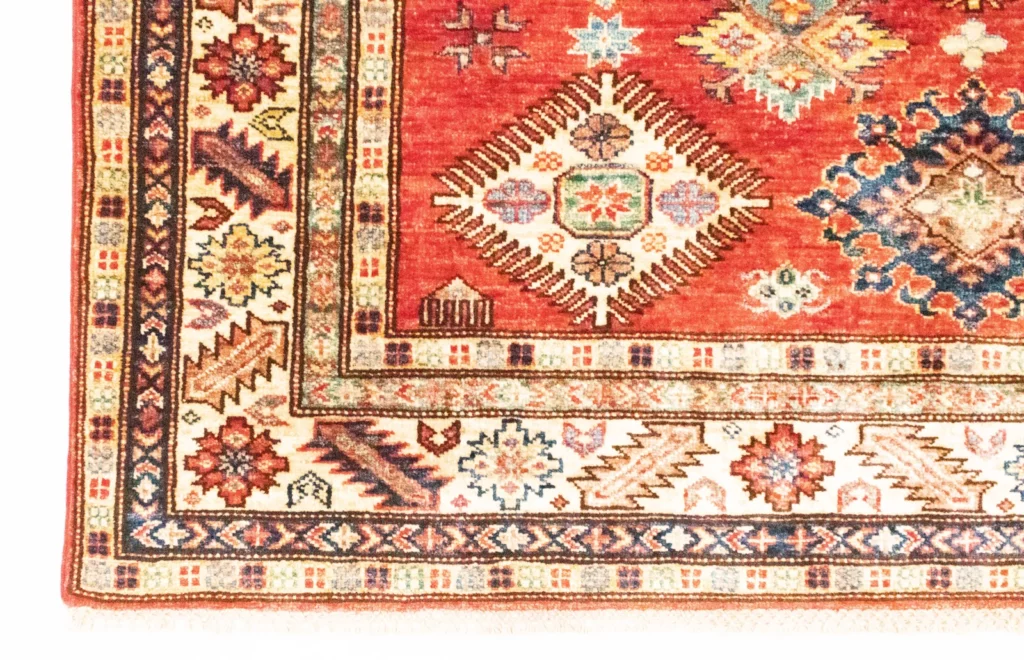
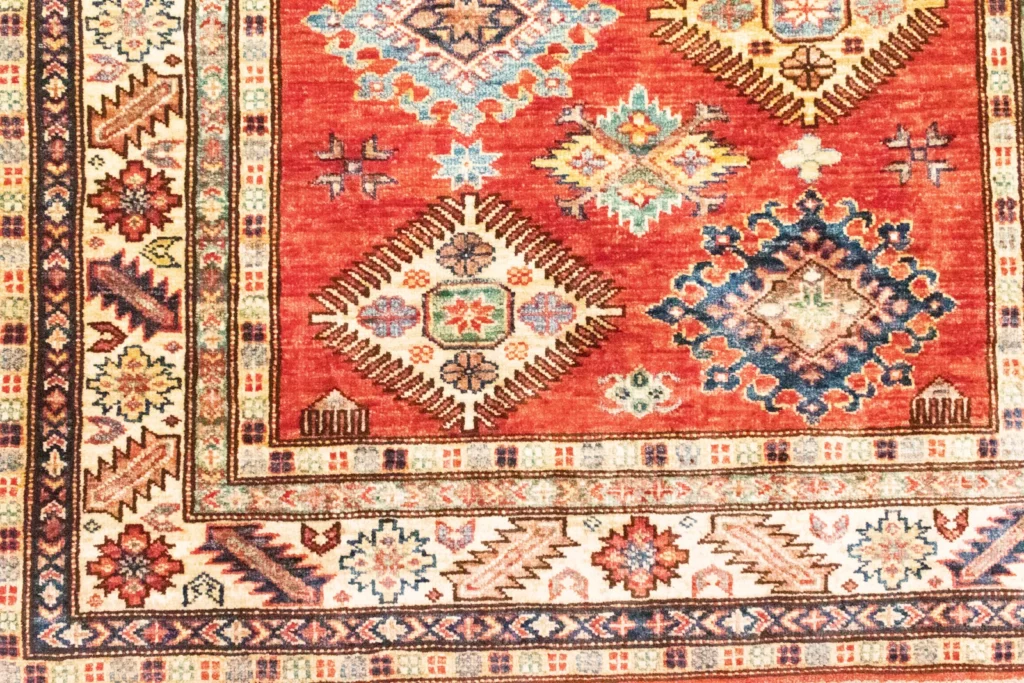
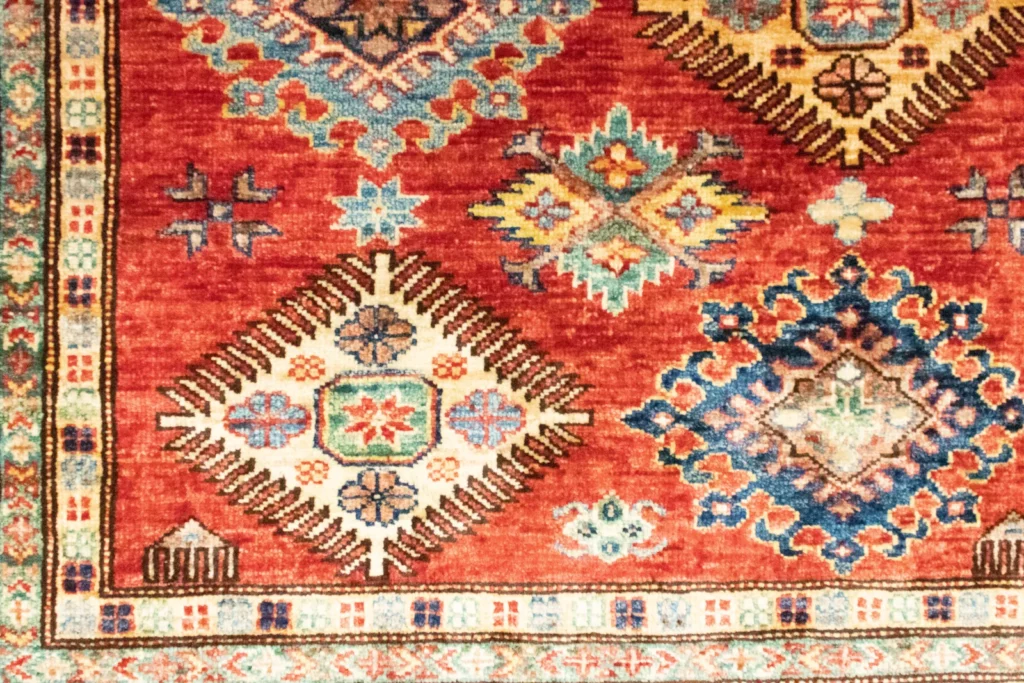
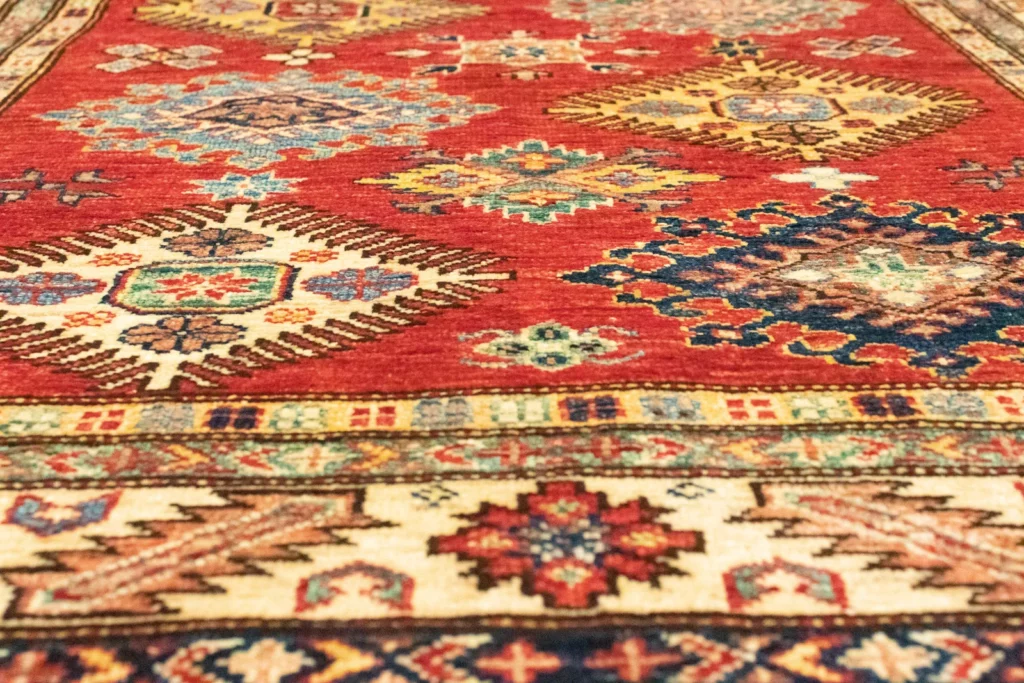
The pattern of this rug is described as geometric. Geometric carpet designs use forms, axes, repetition and defined boundaries to organise the field. Instead of a freely flowing pictorial composition, the surface is formed by separate elements that relate to one another. Depending on the design, these may include diamonds, polygons, stepped lines, hooks or stylised botanical shapes. No more detailed list of individual motifs is given for this piece; the confirmed pattern description is geometric design.
Kazak-style carpets often present geometric ornaments with distinct outlines and strong division of space. A central field may be arranged around a medallion, or several ornaments may follow a central axis. Repeated diamonds, bands and smaller fillers are also common possibilities within the wider tradition. These principles explain the structured appearance frequently associated with Kazak patterns. They provide background on the style and are not additional claims about specific motifs that have not been recorded for this rug.
Geometric patterns have their own visual order. Repeated forms create rhythm, while contrasts between an inner field and border areas can hold the composition together. In some designs, a large central form provides the focus; in others, a sequence of smaller shapes determines the movement across the surface. The effect depends less on naturalistic representation than on proportion, repetition and the relationship between lines and areas.
Caucasian carpet traditions are often associated with direct, reduced ornament. Leaves, flowers, animals or symbolic signs may be translated into angular and abstract shapes. As a result, a motif can suggest a recognisable subject while retaining a strongly geometric appearance. For this rug, only the geometric design is stated as a specific pattern feature. Claims about particular colours, a medallion, a border structure or individual symbols would therefore go beyond the recorded description.
A short pile affects how a geometric design is read because the surface does not rise as high and the lines can appear more compact. High knot density describes the close construction of the rug and may support the orderly definition of geometric forms. Here these are not assumptions but stated characteristics of this individual piece. Together with the hand-knotted technique, they form the technical basis of its described appearance.
Geometric Kazak patterns can be placed in a variety of interiors because their visual language is based on clearly defined forms. Such a design can work alongside traditional furniture as well as simpler contemporary arrangements. Its classification as Kazak remains separate from the fact that the rug was knotted in Pakistan or Afghanistan. Style and manufacturing location are distinct pieces of information, and both belong in a complete description of this rug.
Special Features
The distinguishing features of this one-off piece are its high knot density, short pile, hand-knotted construction and geometric design. Wool is specified as the pile material. The condition is very good. The origin is associated with the Caucasus, while the knotting took place in Pakistan or Afghanistan. These details should all be considered when the rug is described and classified.
The word Kazak identifies the stated carpet type or Caucasian-influenced design. It does not mean that this particular rug was knotted in the Caucasus. The origin is given as the Caucasus, but the place of knotting is identified as Pakistan or Afghanistan. Keeping style and production location separate makes the description precise and avoids treating a pattern tradition as proof of a manufacturing location.
FAQ
How should I care for this Kazak Oriental rug?
Regular vacuuming is recommended so that dust and loose particles do not remain in the short pile. When deeper cleaning is needed, it should be carried out professionally. Direct sunlight should be avoided because it can contribute to colour fading. A hand-knotted wool rug should be cleaned in a way that takes its material, pile and knotting structure into account. Spilled liquids should be absorbed promptly without unnecessary rubbing of the surface. The basic care guidance stated for this rug is regular vacuuming, occasional professional cleaning and protection from direct sunlight.
Can this Oriental rug be used in any room?
Oriental rugs can generally be used in different living areas, including living rooms, dining rooms and bedrooms. Suitability depends on the room’s use, the level of traffic and the intended placement. The geometric design can be combined with classic, modern or rustic interiors because clearly defined forms work with several furnishing styles. Before placement, a suitable level surface and adequate clearance should be considered. This rug is described as being in very good condition, although its use should still be matched to the practical conditions of the room.
How can I tell whether a Kazak Oriental rug is authentic?
Several characteristics are relevant when classifying a rug. These include the quality of the wool, the knot density and the fineness of the workmanship. It is also important to distinguish between style, origin and place of manufacture. For this piece, a Caucasian origin is stated, while the knotting took place in Pakistan or Afghanistan. The name Kazak therefore describes the stylistic tradition and does not automatically identify where the rug was made. If its classification or authenticity is uncertain, consultation with a specialist is advisable. A single feature is generally not enough to determine the origin or style of a hand-knotted rug conclusively.
To provide the best experiences, we use technologies like cookies to store and/or access device information. Consenting to these technologies will allow us to process data such as browsing behavior or unique IDs on this site. Not consenting or withdrawing consent, may adversely affect certain features and functions.
Functional Always active
The technical storage or access is strictly necessary for the legitimate purpose of enabling the use of a specific service explicitly requested by the subscriber or user, or for the sole purpose of carrying out the transmission of a communication over an electronic communications network.
Preferences
The technical storage or access is necessary for the legitimate purpose of storing preferences that are not requested by the subscriber or user.
Statistics
The technical storage or access that is used exclusively for statistical purposes.The technical storage or access that is used exclusively for anonymous statistical purposes. Without a subpoena, voluntary compliance on the part of your Internet Service Provider, or additional records from a third party, information stored or retrieved for this purpose alone cannot usually be used to identify you.
Marketing
The technical storage or access is required to create user profiles to send advertising, or to track the user on a website or across several websites for similar marketing purposes.

 SECURE PAYMENT
 SHIPPING PARTNERS