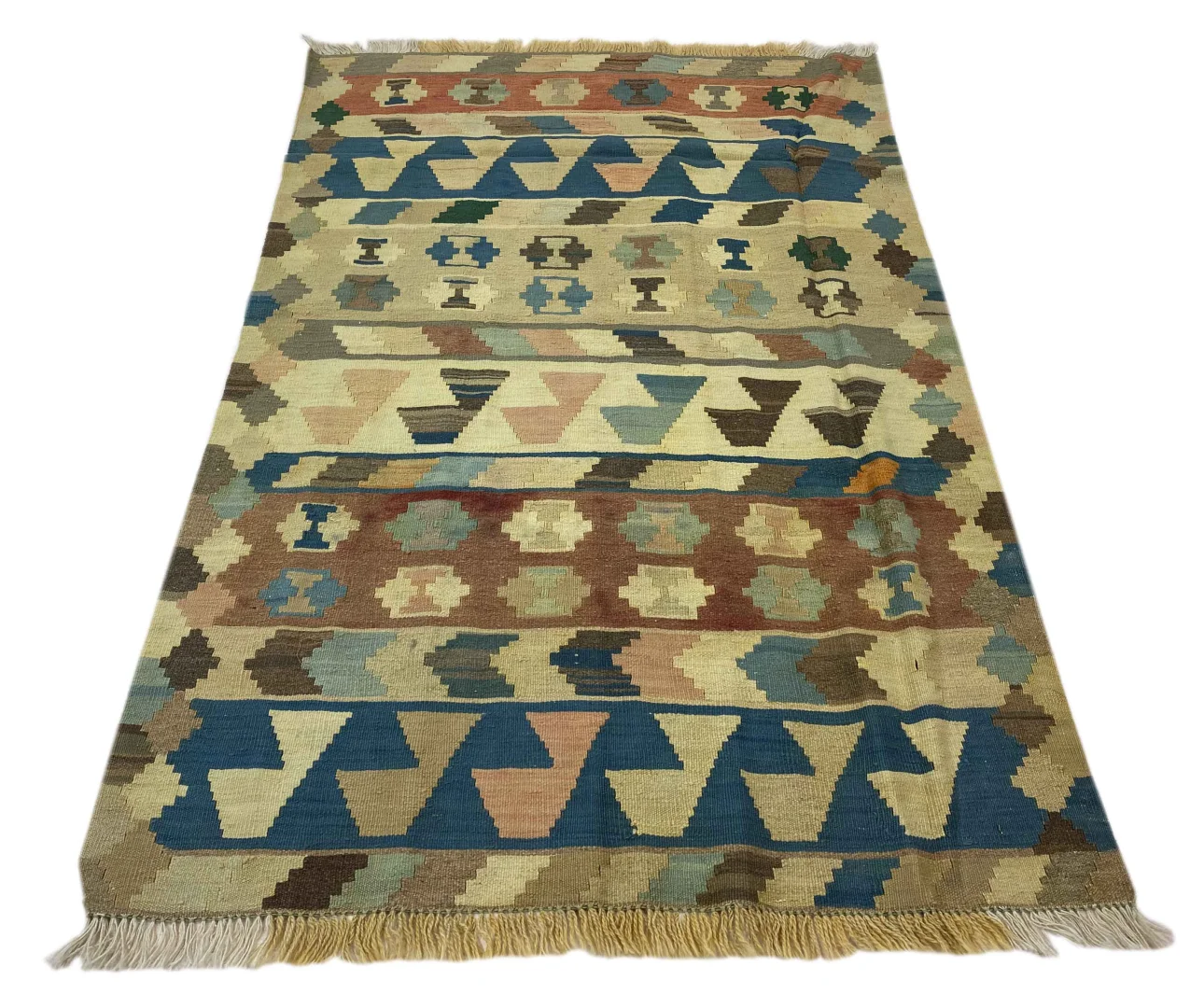
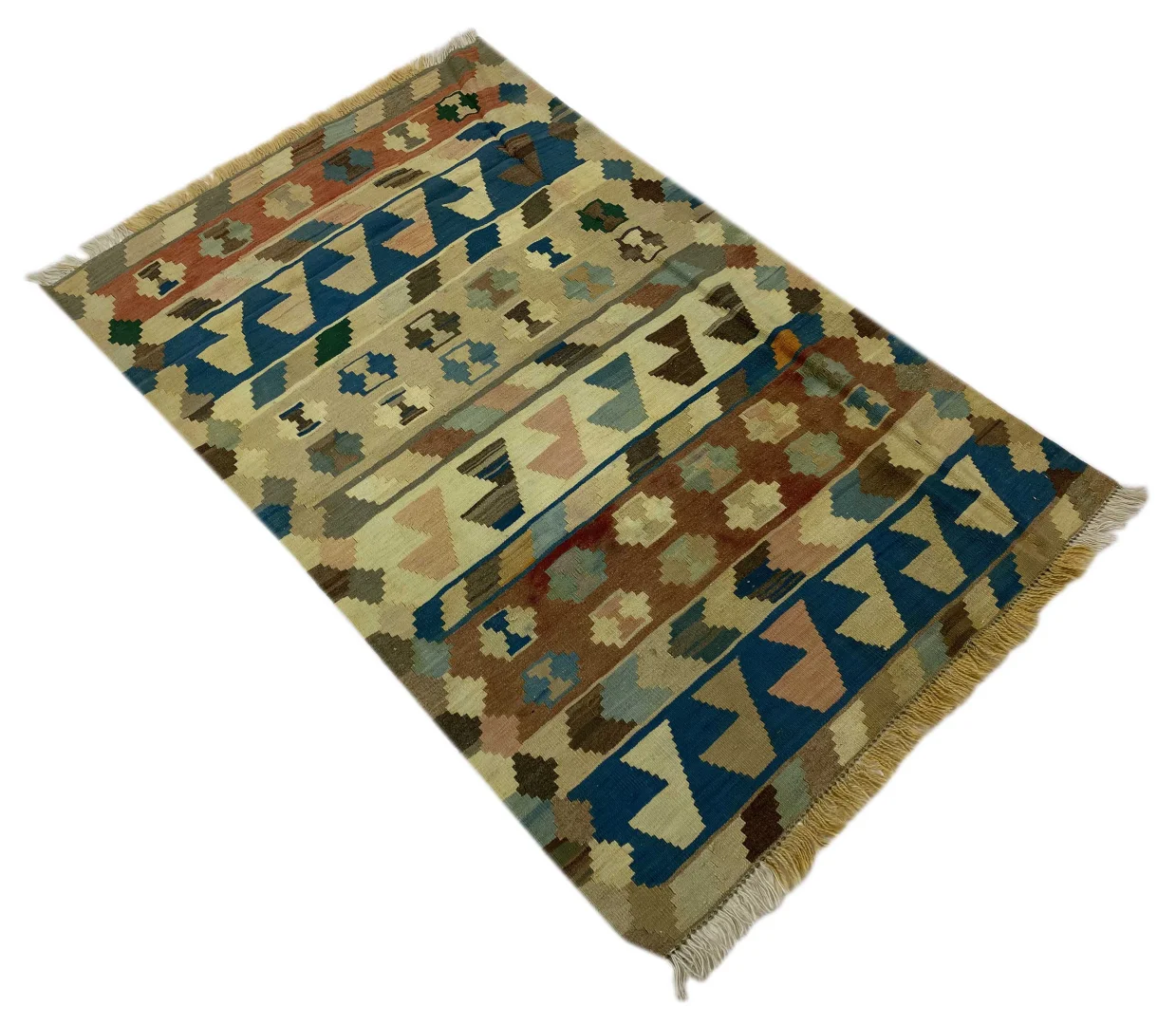
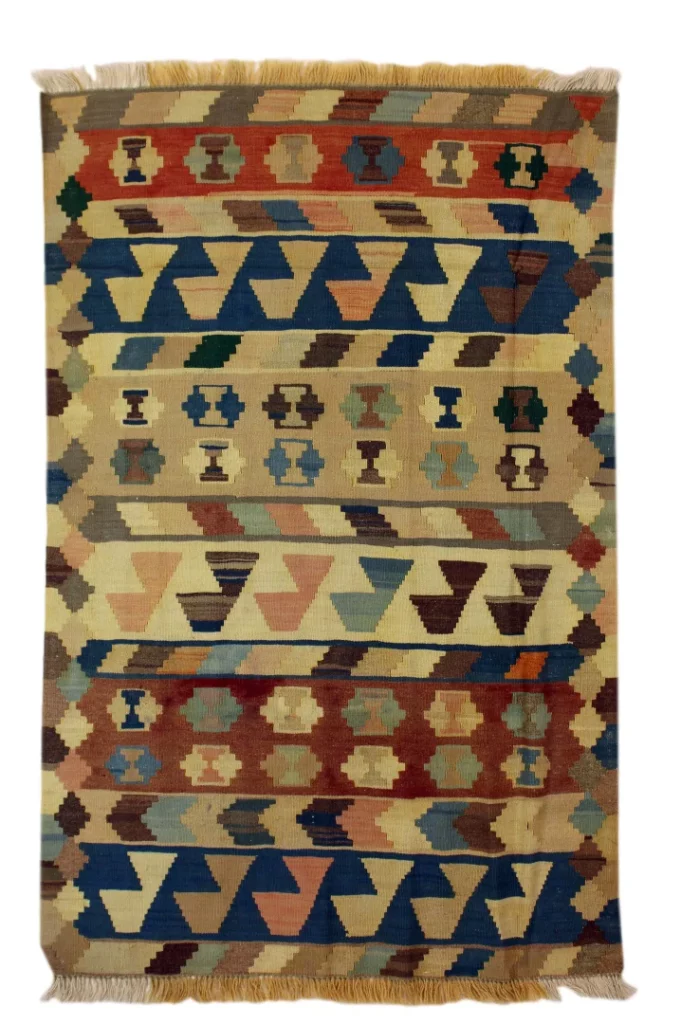
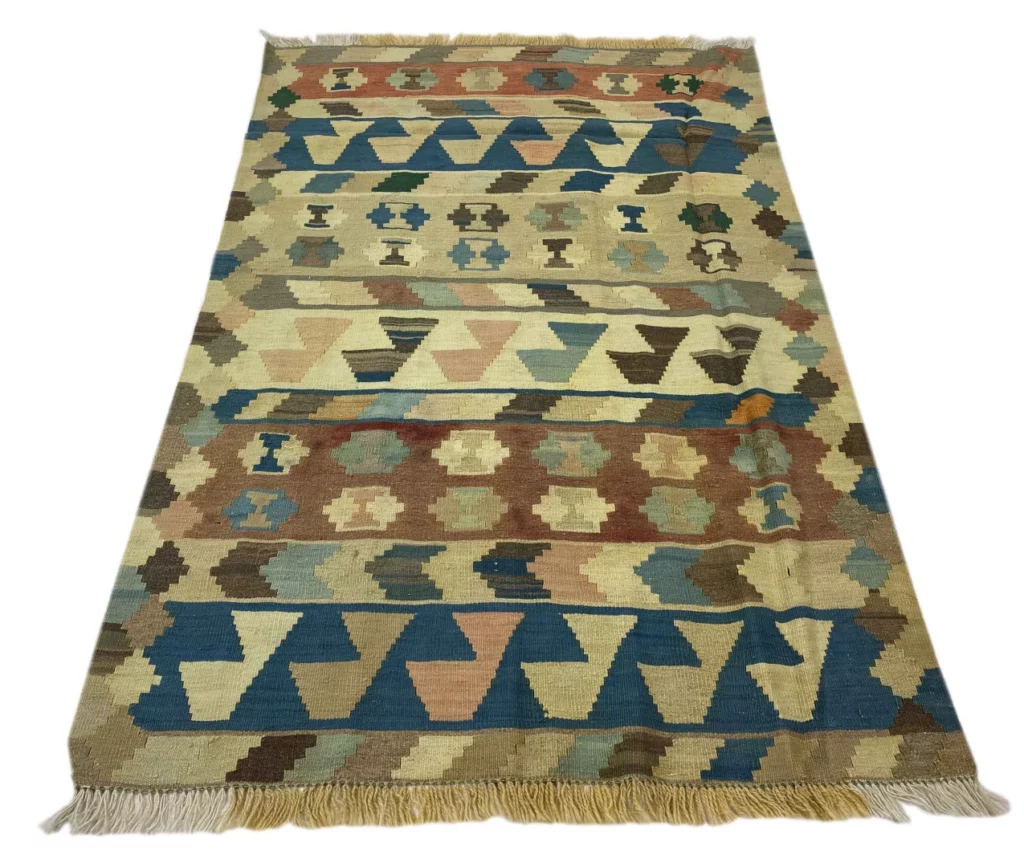
Hand-woven Fars Oriental rug | Origin: Fars, near Shiraz | Material: wool, pileless | Size: 149 x 98 cm | Pattern: identical on both sides | Condition: Very good
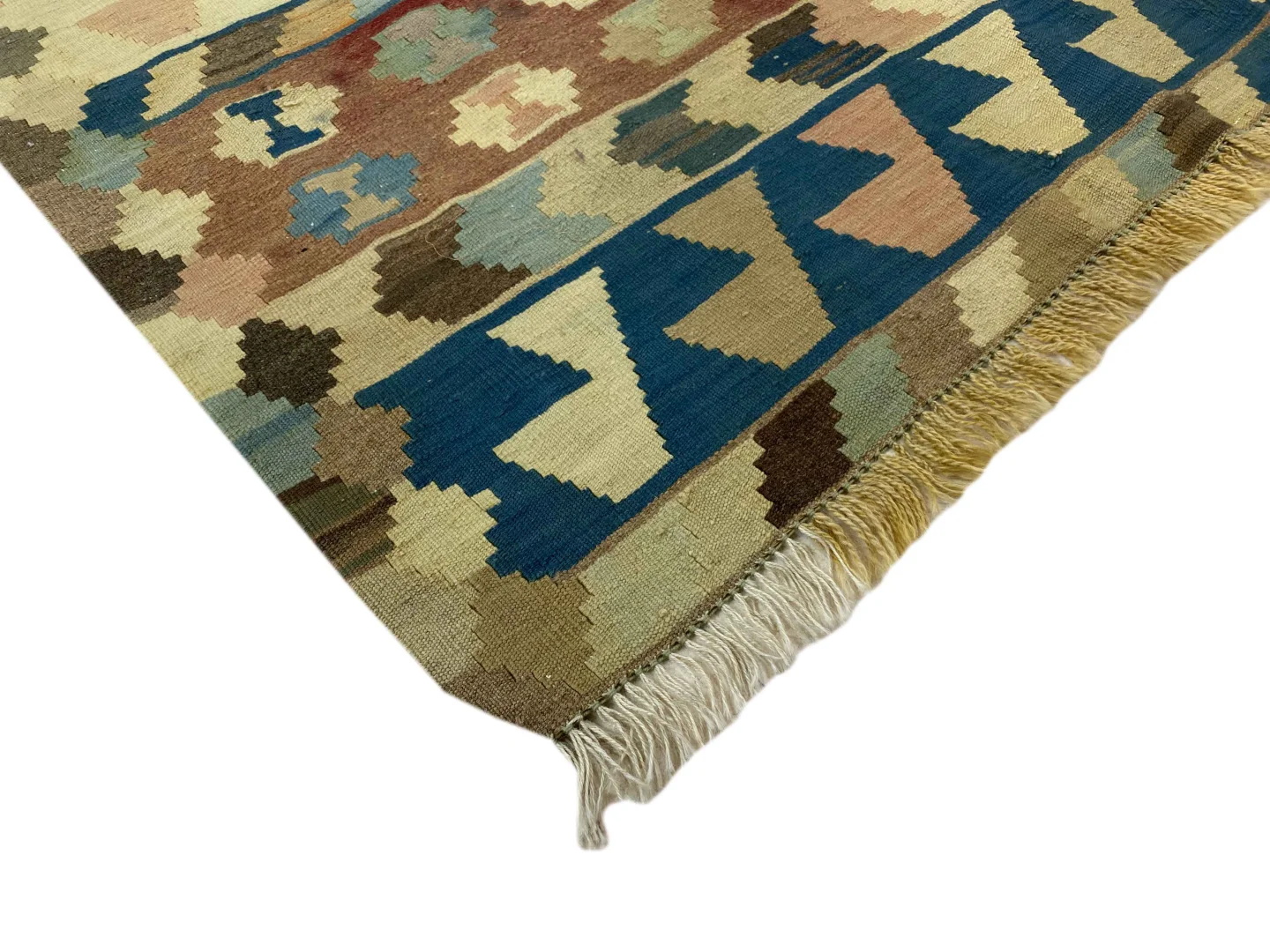
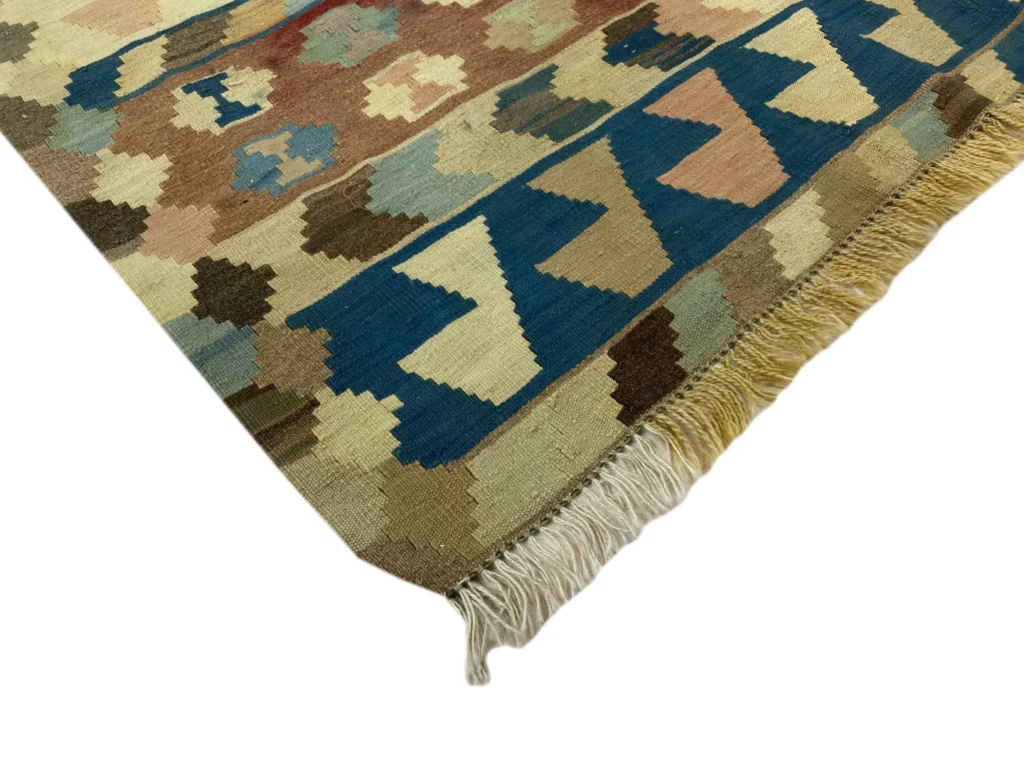
This Kelim from Fars is hand-woven from 100% pure new wool. A Kelim does not have a raised pile; its surface is formed as a flat textile structure. The wool therefore appears as part of the woven ground rather than as separate tufts. Hand production makes the relationship between warp and weft central to the rug’s character, while the pileless construction gives the surface its level, practical appearance.
The rug is described as an Oriental rug with a weft thread. In flat weaving, the weft passes across the warp and helps create the visible fields, lines and colour areas. Unlike a hand-knotted rug, there are no individual pile knots producing a tufted upper surface. The absence of pile is an explicit feature of this Kelim. Its texture comes from the woven wool and from the way the weft is worked through the foundation.
Wool has long been used for Kelims because it combines resilience with a warm, tactile feel. It also has natural moisture-regulating properties, allowing it to take up and release moisture and thereby contribute to a balanced indoor atmosphere. In this piece, those properties belong to the material itself; they are combined with a flat weaving method rather than with a knotted pile construction.
The technique also explains why a Kelim is generally lighter and flatter than a hand-knotted rug. The design is built while the textile is being woven instead of being added through rows of knots and later finishing. The careful workmanship and robust construction described for this piece suit both living spaces and areas with frequent use. Its flat format also makes routine vacuuming comparatively straightforward.
Flat weaving requires control of the warp, the weft and the tension maintained throughout the work. The weaver builds the design into the textile, allowing the colour sequence and the geometry to develop together. The result is not a printed surface and not a pile clipped after knotting. It is a woven composition in which structure and appearance are inseparable.
Origin and Tradition
This Kelim comes from Fars, near Shiraz. Fars is a region in southern Iran with a deeply established textile tradition. Shiraz provides an important cultural reference point for the area, while Fars itself is associated with several forms of village, tribal and nomadic weaving. The regional name therefore identifies both a place and a broad history of working with wool, colour and geometric textile design.
Fars has long brought together different ways of life and different weaving environments. Textiles were made in settled communities as well as among nomadic groups, and a flat-woven piece could serve many practical purposes. Kelims might be used as floor coverings, coverings, partitions or other household textiles. Their relatively light, flexible construction was useful in a mobile setting, while the woven surface offered a durable way to combine utility with pattern.
Traditional knowledge was passed through families and communities. It included preparing and spinning wool, arranging the warp, selecting colours and inserting the weft. In hand weaving, every stage influences the finished textile. The tension of the foundation, the rhythm of the weft and the transitions between coloured sections determine both the appearance and the physical character of the Kelim. This continuity of practical knowledge is an important part of the weaving tradition of Fars.
The region’s textile vocabulary reflects the coexistence of Persian urban culture with village and tribal traditions. This helps explain why Fars is associated with a wide range of compositions rather than one single fixed pattern. Some pieces use strong geometric structures; others draw on plants, animals or inherited symbolic forms. The precise arrangement can vary from one community and one weaver to another, while the regional connection remains visible through the technique and the broader design language.
Weaving in Fars is not only a method of making a useful object. It is also a means of preserving visual knowledge. Motifs can be repeated, adapted and simplified as they move through generations. The maker’s decisions about spacing, colour and emphasis give each woven work its own appearance, even when it uses familiar regional forms. The hand-woven character of this Kelim places it within that living tradition rather than treating the pattern as a separate surface decoration.
The weft is particularly important in a flat-woven textile. It runs across the warp and carries much of the visible colour and structure. Depending on the technique, changes in weft colour can define geometric areas, outline motifs or create transitions across the field. The construction described here is therefore closely tied to the visual result. A Fars Kelim demonstrates how a practical textile technique can also support an expressive regional design vocabulary.
Fars is also known for the use of earthy tones combined with vivid accents. Such relationships can be connected with the natural environment and with the colour preferences of particular weaving communities. They should not be reduced to one universal symbolic code: meanings vary by context. What remains consistent is the importance of colour as a structural part of the woven image, working together with line, shape and rhythm.
Design and Pattern
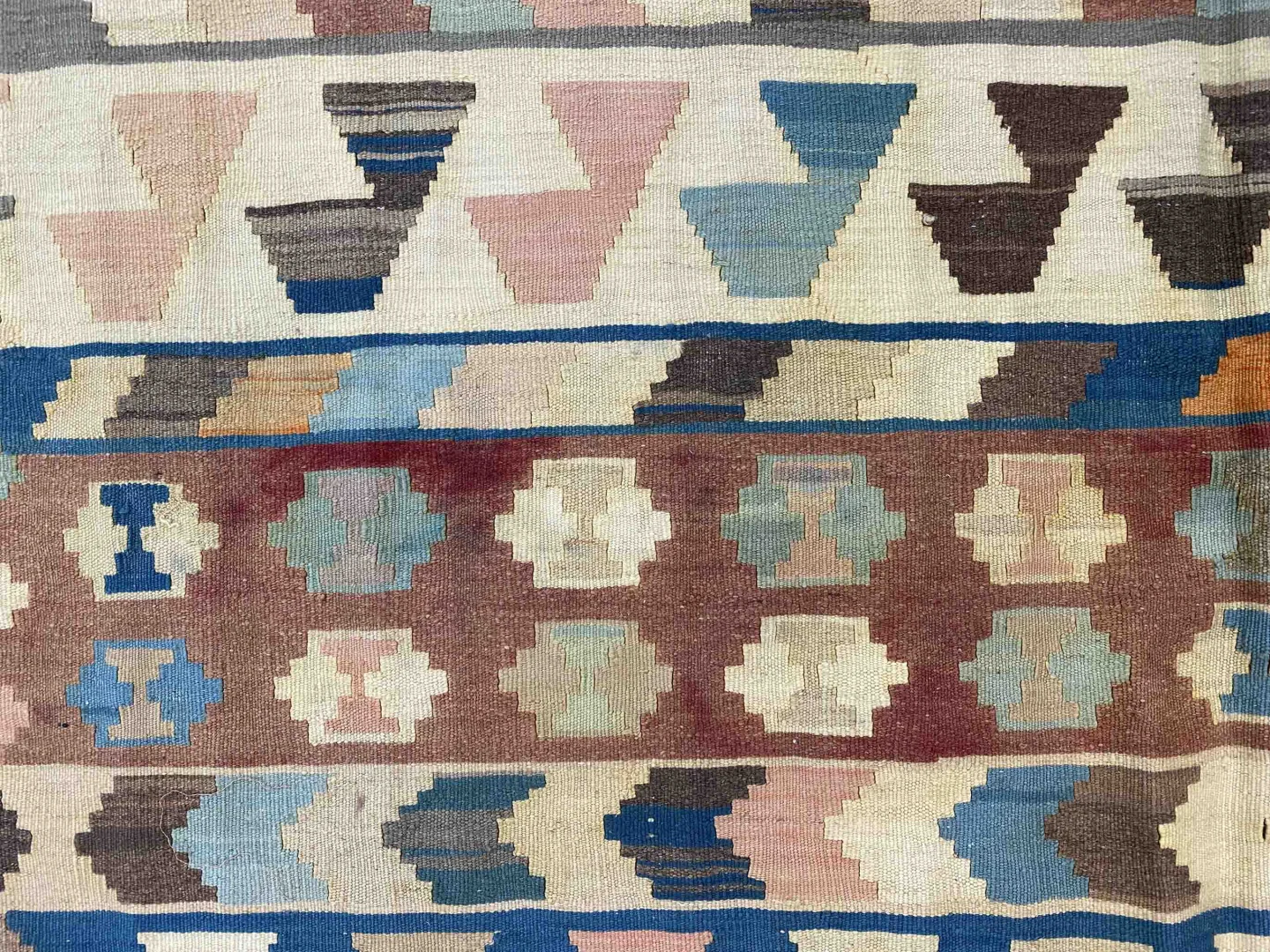
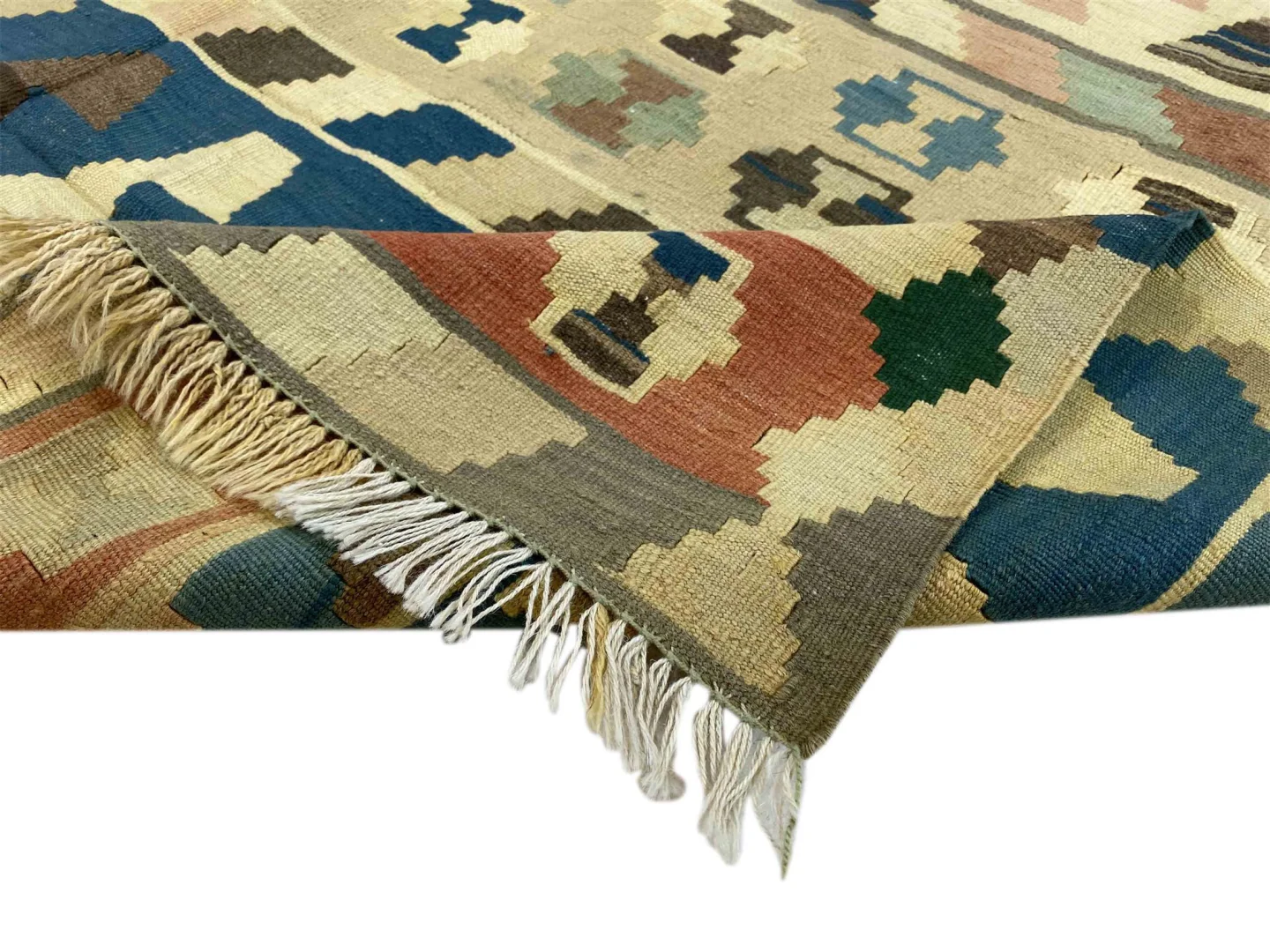
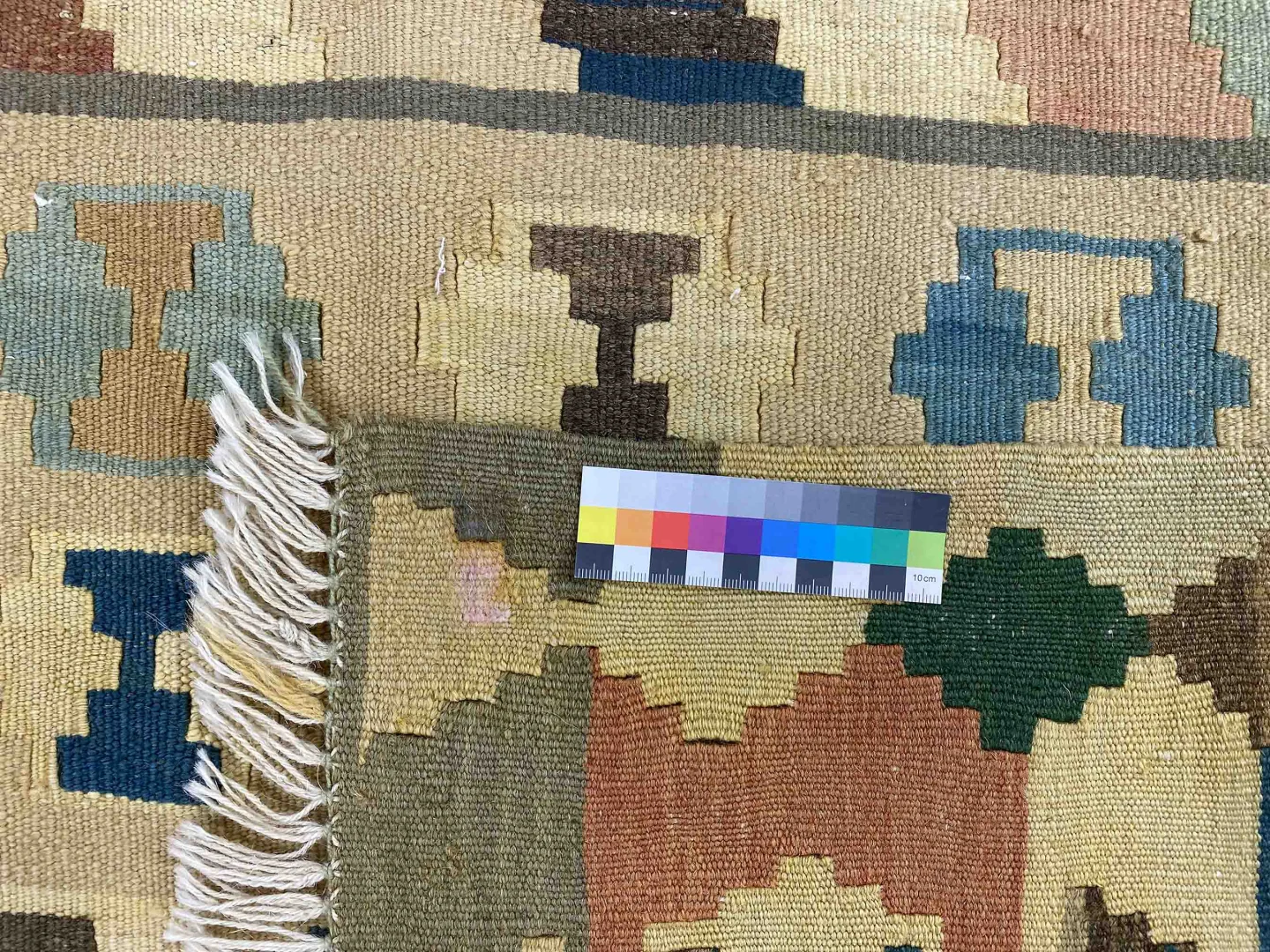
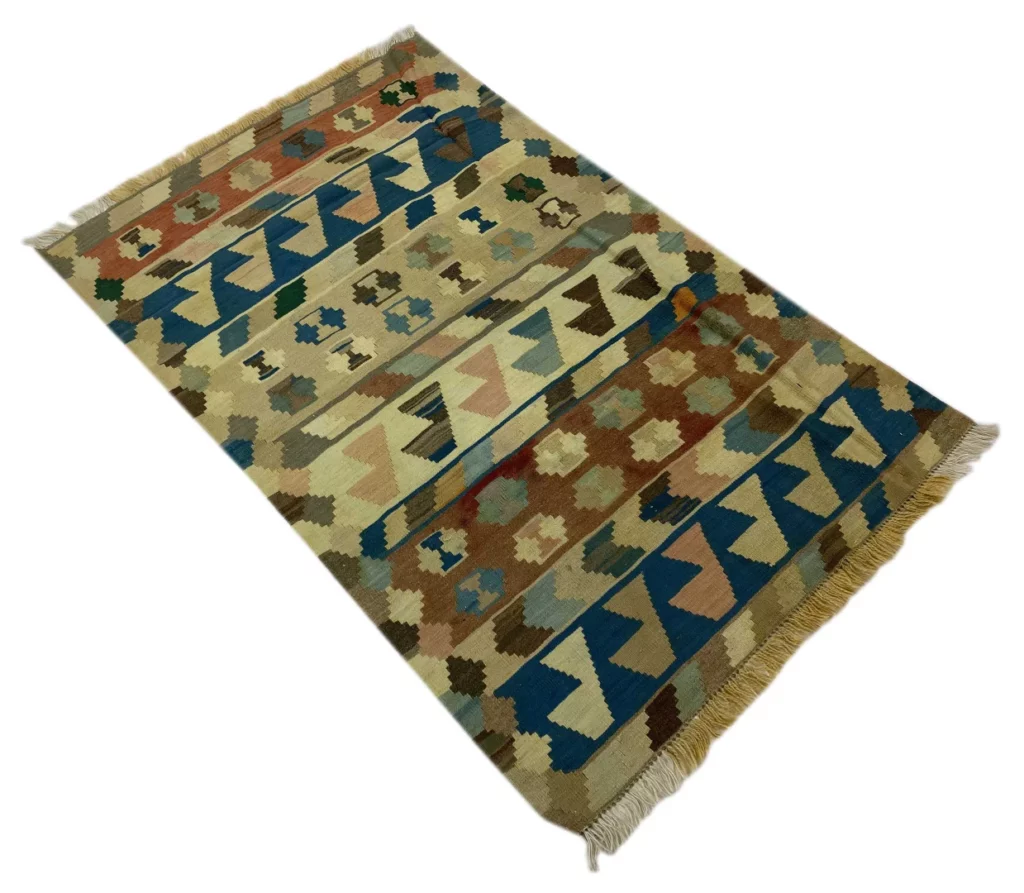
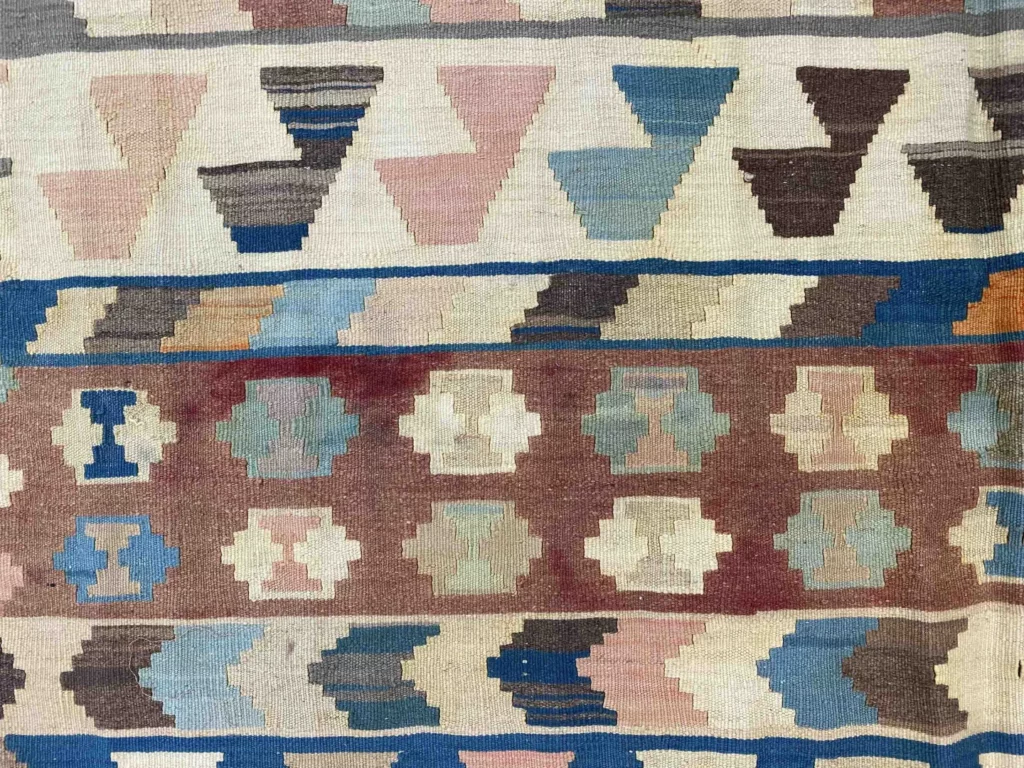
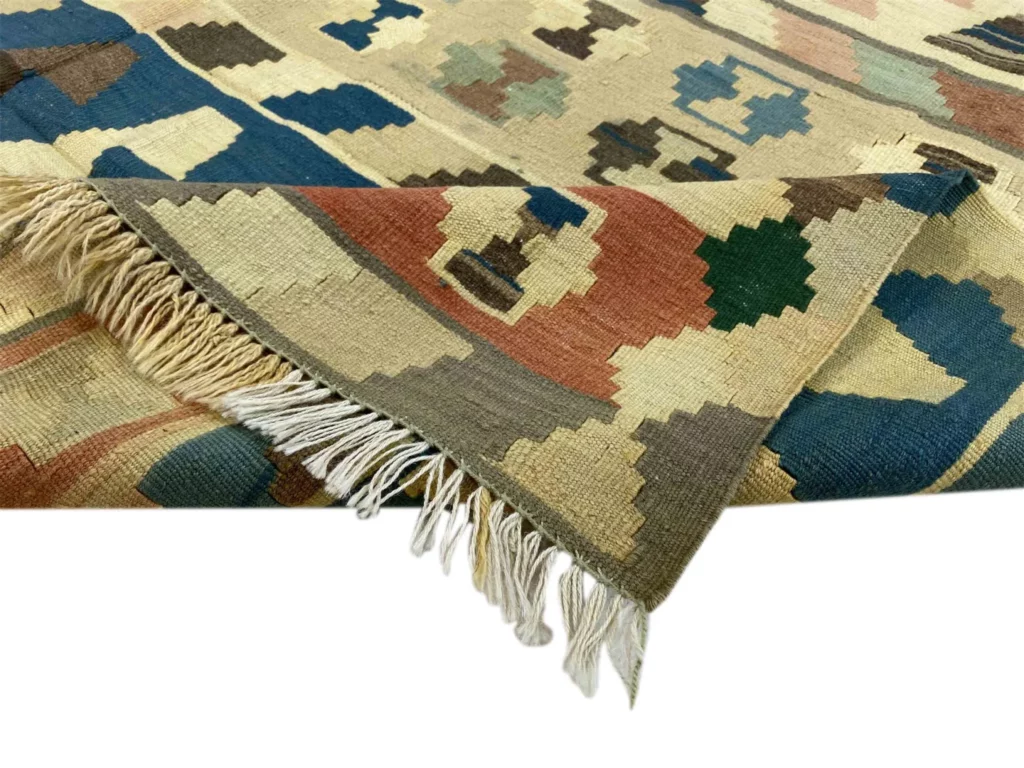
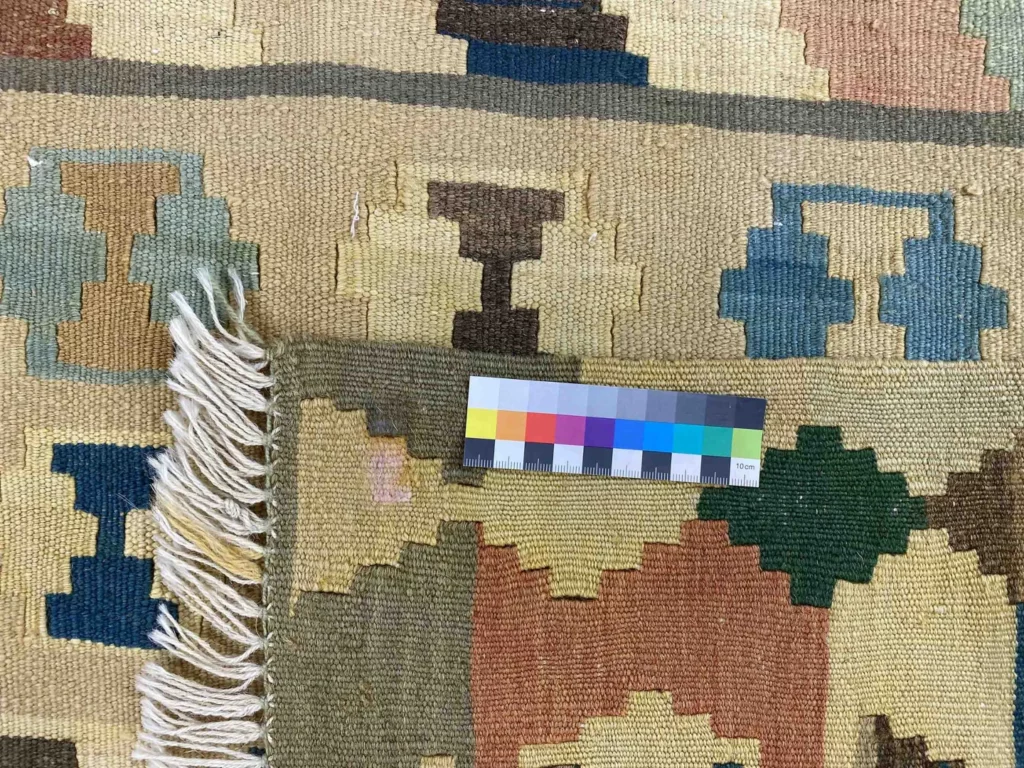
The pattern of this Kelim is identical on both sides and the surface is pileless. These two characteristics describe more than its appearance. Because there is no raised pile to cover or alter the drawing, the design is read directly from the woven plane. Its identical presentation on both sides is consistent with the nature of flat-woven textiles and makes the construction visible from either direction.
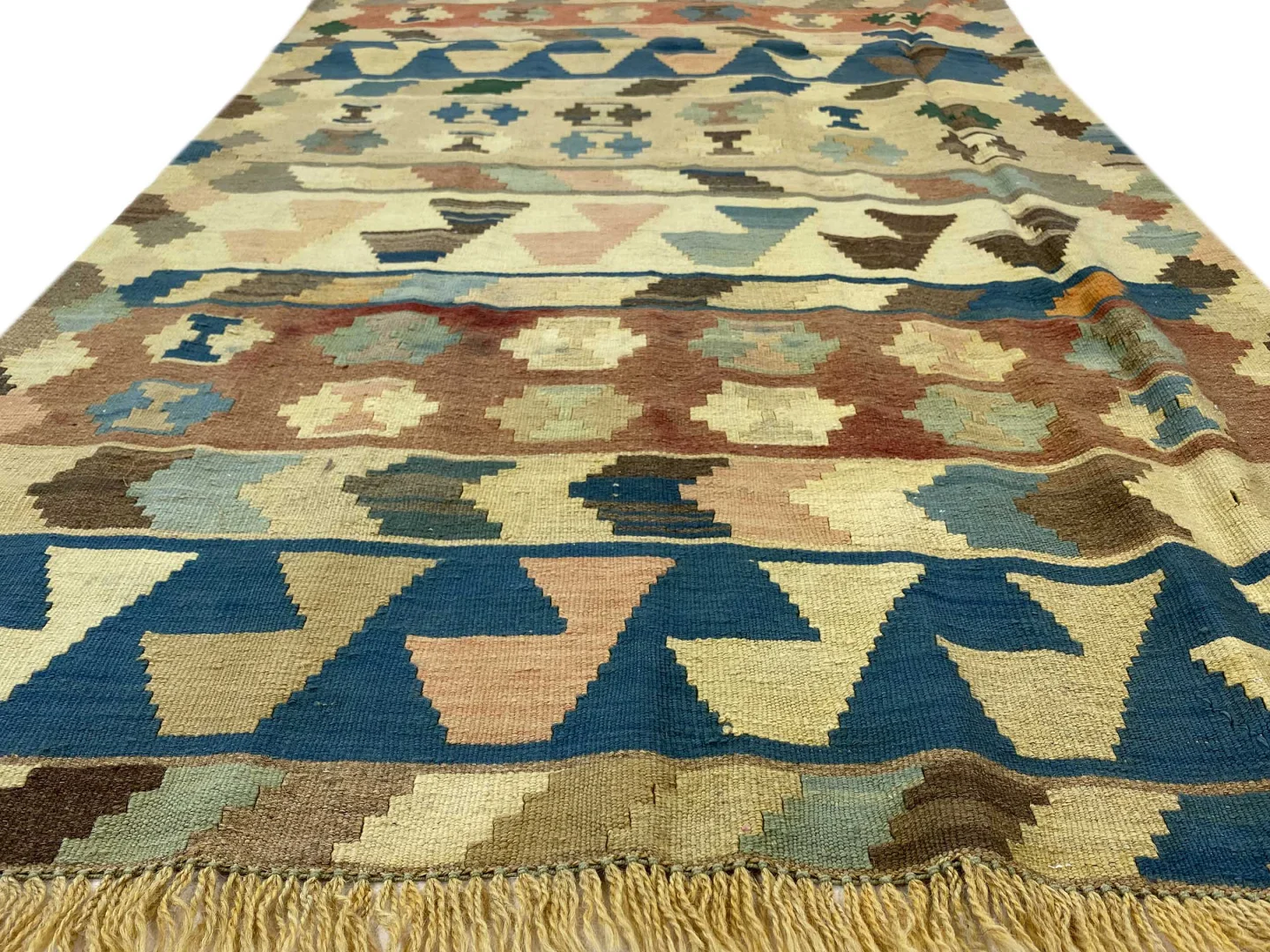
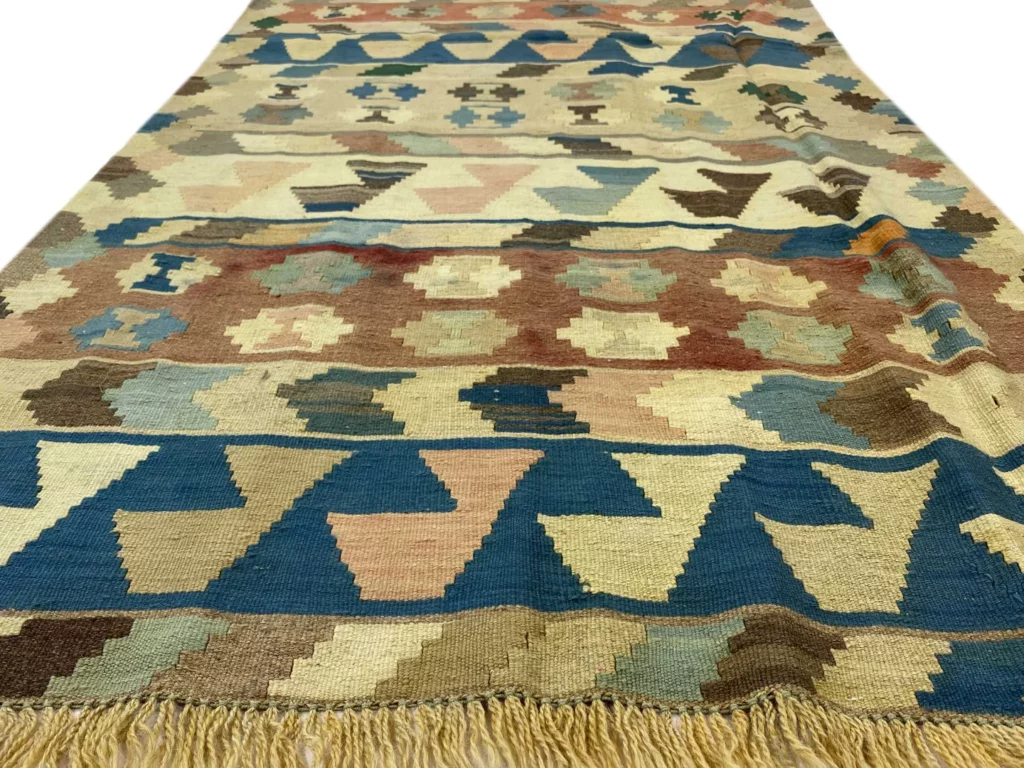
The source describes the design as colourful and geometric. Geometric compositions may be built from diamonds, stepped lines, angular borders, zigzags, bands and repeated fields. In a Kelim, these forms are created through the arrangement of coloured woven areas. The clarity of the contours is therefore connected to the weaving process itself, not only to an artistic preference for ordered shapes.
Regional Fars designs often use a strong relationship between earthy shades and lively accents. The contrast can give the composition rhythm without requiring a raised pile. Natural references are also common in the textile language of the region. Plants, animals and elements of the surrounding landscape may be reduced to signs, angular figures or repeated ornaments. Such abstraction allows a motif to remain recognisable as an idea without becoming a literal picture.
Traditional symbols in Persian textiles can carry associations with nature, animals, protection, fertility or continuity, although their interpretation may differ between regions and communities. It is more accurate to understand them as part of an inherited visual vocabulary than to assign one fixed meaning to every individual shape. In a Fars Kelim, geometric ordering and symbolic suggestion can coexist within the same woven field.
A design that is identical on both sides has no preferred viewing direction created by a changing pile. There is no difference between looking with or against the pile, because the rug is explicitly pileless. This gives the composition a direct, even quality. Colour, line and proportion become the principal means of organising the surface, and the weft remains part of the visual logic rather than disappearing beneath a tufted layer.
The colourful geometry can work beside traditional furniture as well as in a more modern interior. Its adaptability comes from the interaction of clear shapes, earthy tones and brighter accents, not from a claim about any particular room. The Fars origin and hand-woven technique remain legible in either setting. The design thus connects a regional tradition with contemporary ways of arranging a living space.
In flat-woven art, the pattern also contributes to the sense of movement across the textile. Repeated borders can frame a central field, while angular motifs can lead the eye from one area to another. Even when the composition is symmetrical or repeated, small changes in handwork may influence the balance of colour and line. The important point here is that the visual effect comes from woven patterning and not from a separate pile treatment.
Special Features
The stated special features are its origin in Fars near Shiraz, its hand-woven Kelim construction and its wool material. The rug is pileless, and its pattern is identical on both sides. These details belong together: a flat woven structure makes it possible for the design to remain visible in the same way from either side. The weft thread is also highlighted as an important element of the rug.
The condition is very good. This gives a clear description of the present condition without adding an age or a history that has not been provided. The robust construction, the wool and the flat surface make the Kelim suitable for living rooms and areas with frequent traffic. The source specifically names living rooms, hallways and dining areas as possible places of use.
No knot density is given for this Kelim, and a flat weave is not described through a pile height in the same way as a hand-knotted rug. Its character is instead defined by the relationship of warp, weft, colour and geometric pattern. The identical design on both sides reinforces the textile’s functional construction and distinguishes it from a directional pile rug.
<n
FAQ
What is the difference between a Kelim and a hand-knotted rug?
A Kelim is a flat-woven rug. Its surface is made by interlacing warp and weft, usually with wool or a wool blend, and it has no raised pile. A hand-knotted rug is built from individual knots that hold pile yarns in place. This produces a softer, often more tufted surface and requires a different, more time-consuming technique. Kelims are generally lighter, flatter and easier to maintain. With this piece, the distinction is especially clear because it is explicitly pileless and its pattern appears identically on both sides.
How should I care for my hand-woven Kelim?
Vacuum the Kelim regularly to remove dust and loose dirt from the flat wool surface. If a spill occurs, dab it promptly with a slightly damp cloth and a mild cleaning product. Avoid vigorous rubbing, which can disturb the woven structure or affect the colour. A complete wet cleaning should be avoided because it may reduce the intensity of the colours. Gentle, consistent care is the appropriate way to support the very good condition described for this hand-woven rug.
Can I use the Kelim in a high-traffic area?
Yes. Its robust construction, wool material and flat hand-woven structure make this Fars Kelim suitable for areas that are used frequently. The source names living rooms, hallways and dining areas as possible locations. The pileless surface is practical in such settings, while the colourful geometric pattern retains its regional character. As with any handmade textile, the frequency of cleaning should be adjusted to the amount of use, and spills should be treated promptly.
To provide the best experiences, we use technologies like cookies to store and/or access device information. Consenting to these technologies will allow us to process data such as browsing behavior or unique IDs on this site. Not consenting or withdrawing consent, may adversely affect certain features and functions.
Functional Always active
The technical storage or access is strictly necessary for the legitimate purpose of enabling the use of a specific service explicitly requested by the subscriber or user, or for the sole purpose of carrying out the transmission of a communication over an electronic communications network.
Preferences
The technical storage or access is necessary for the legitimate purpose of storing preferences that are not requested by the subscriber or user.
Statistics
The technical storage or access that is used exclusively for statistical purposes.The technical storage or access that is used exclusively for anonymous statistical purposes. Without a subpoena, voluntary compliance on the part of your Internet Service Provider, or additional records from a third party, information stored or retrieved for this purpose alone cannot usually be used to identify you.
Marketing
The technical storage or access is required to create user profiles to send advertising, or to track the user on a website or across several websites for similar marketing purposes.

 SECURE PAYMENT
 SHIPPING PARTNERS


