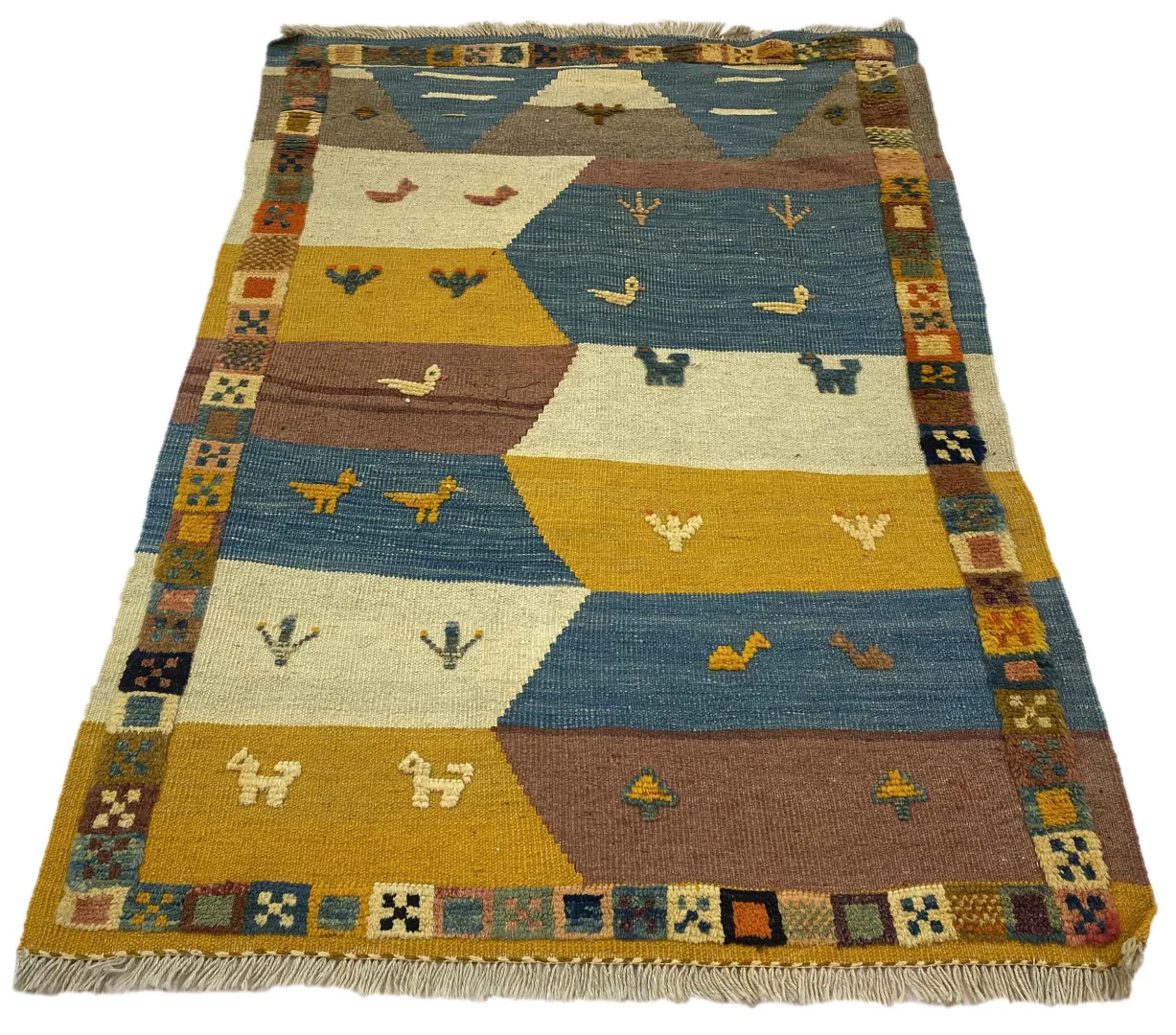
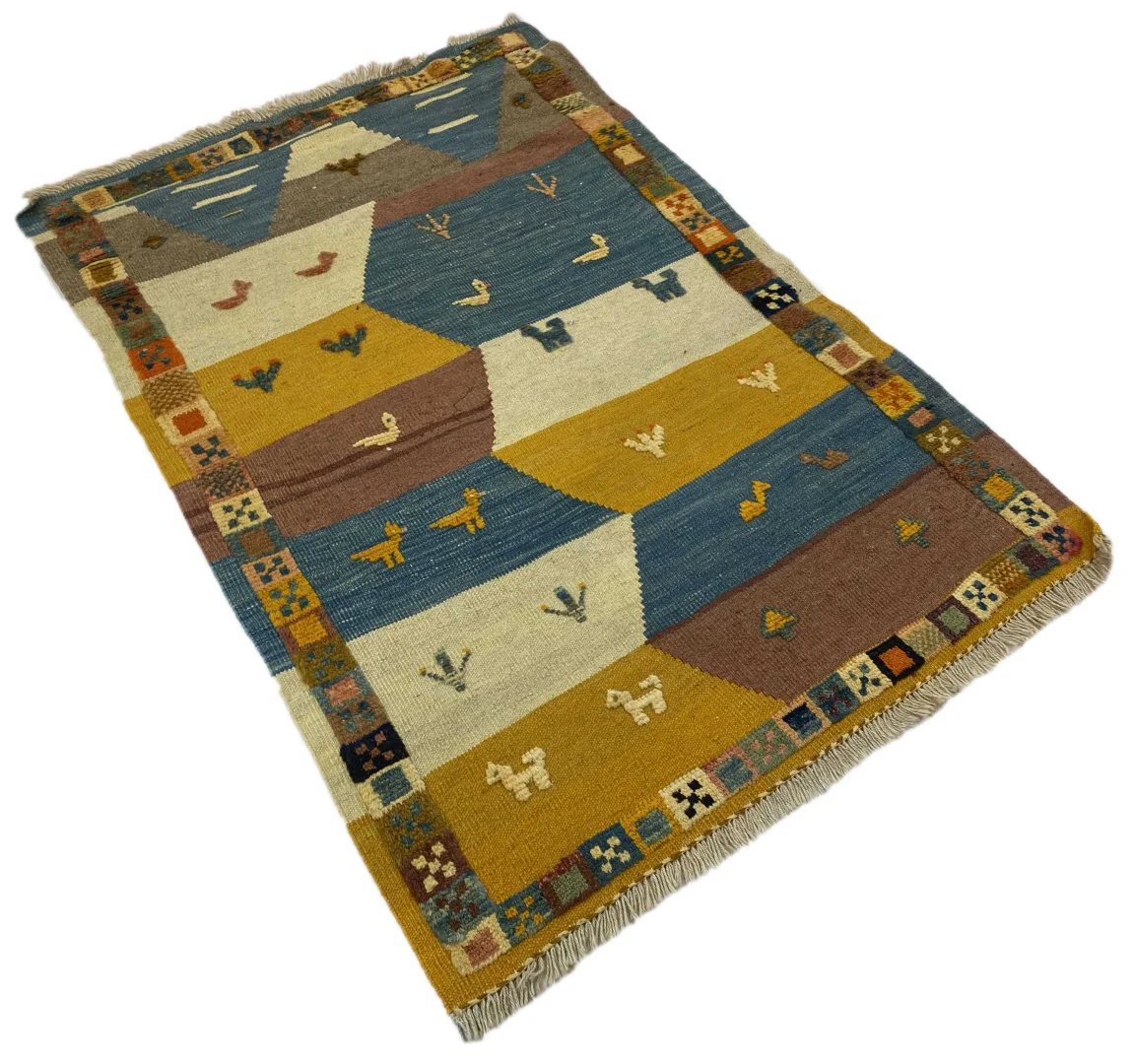
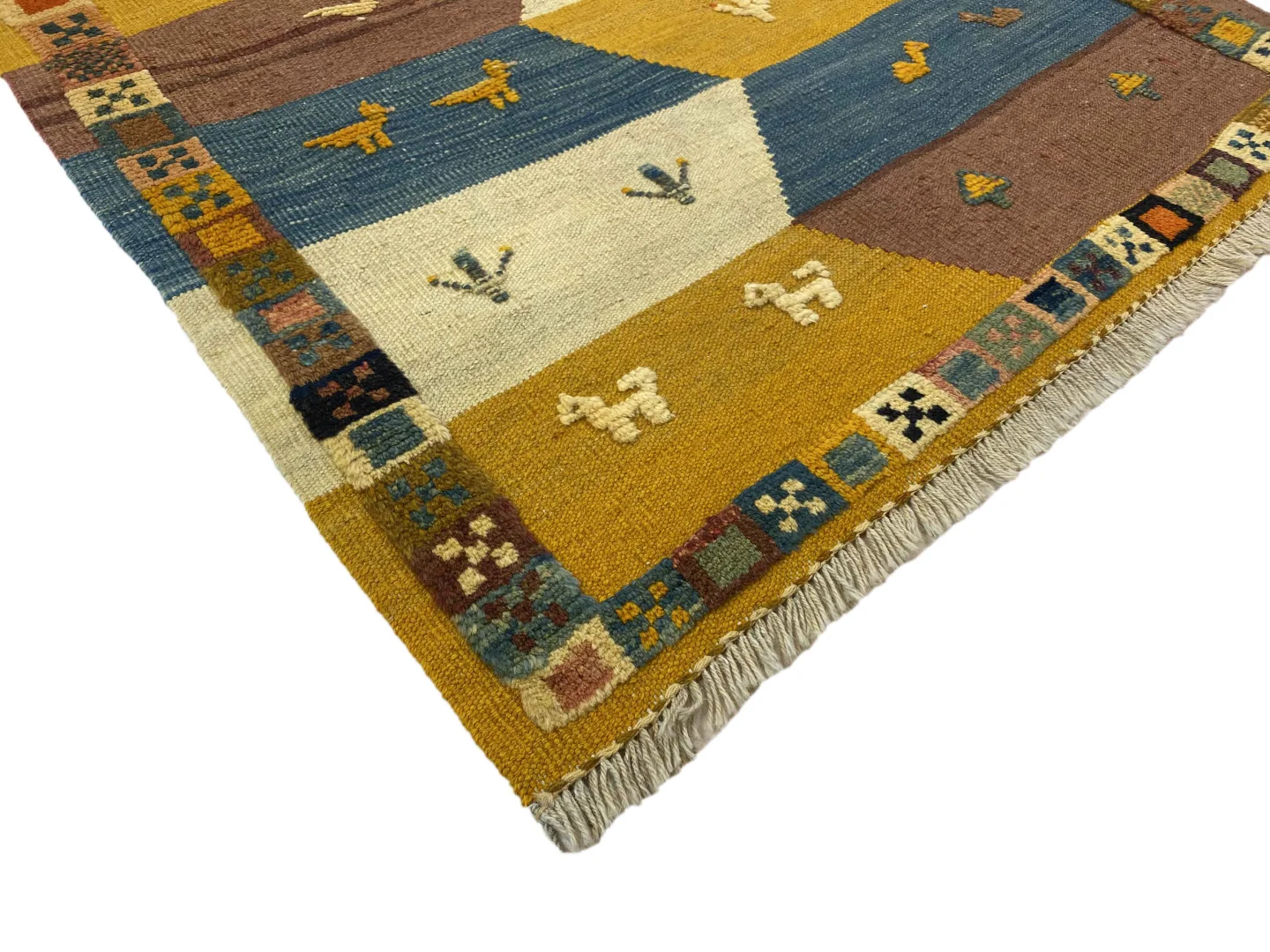
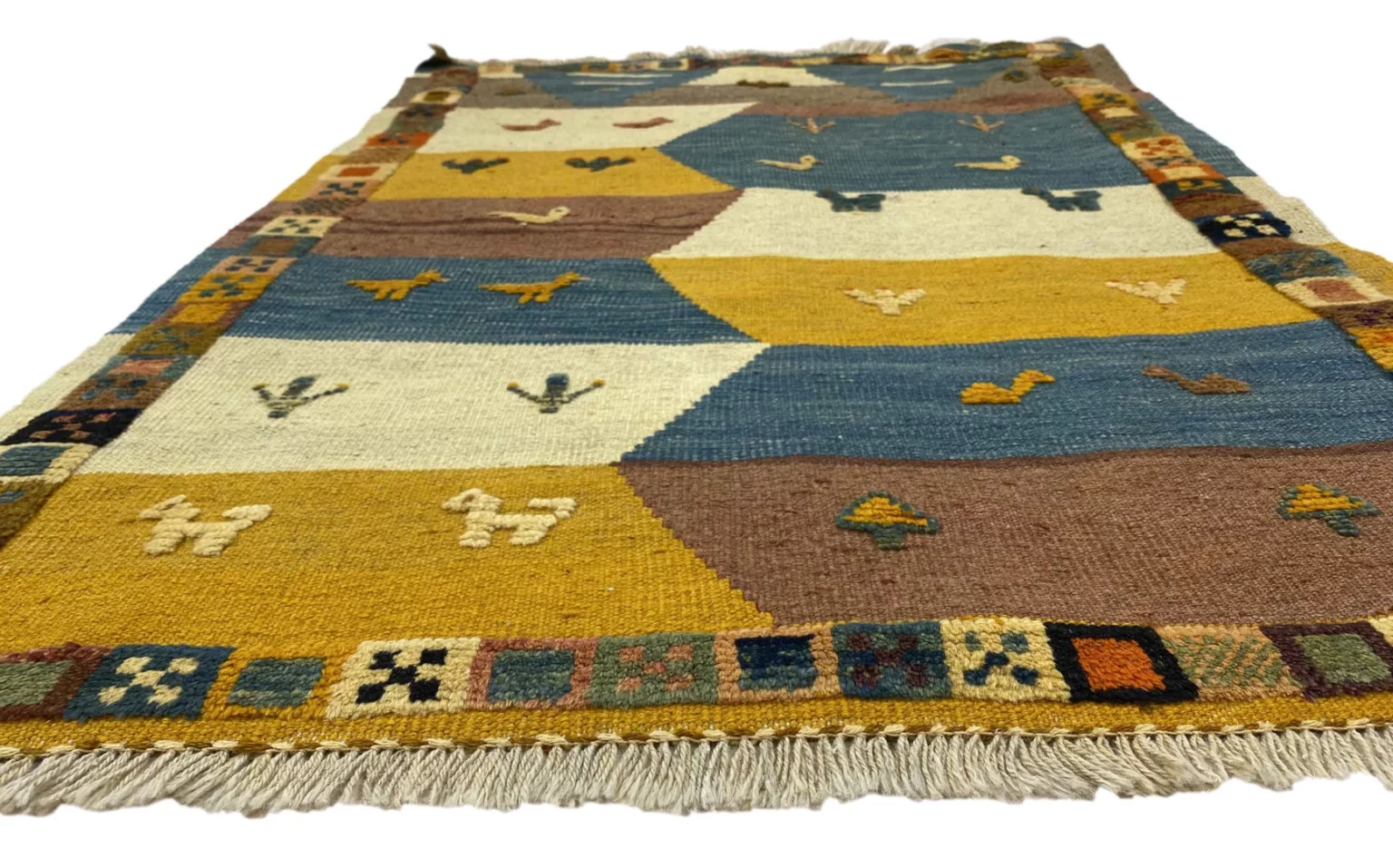
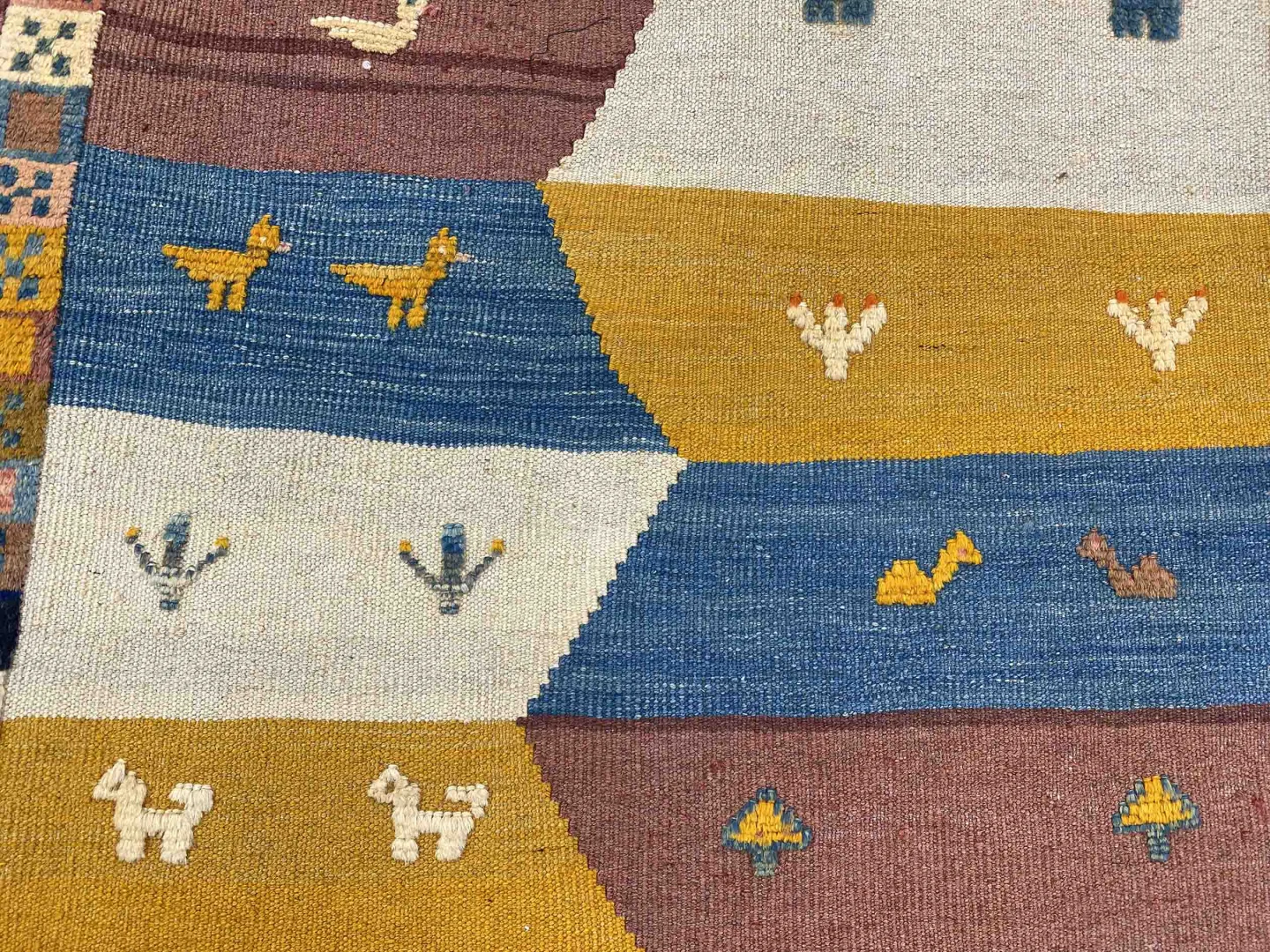
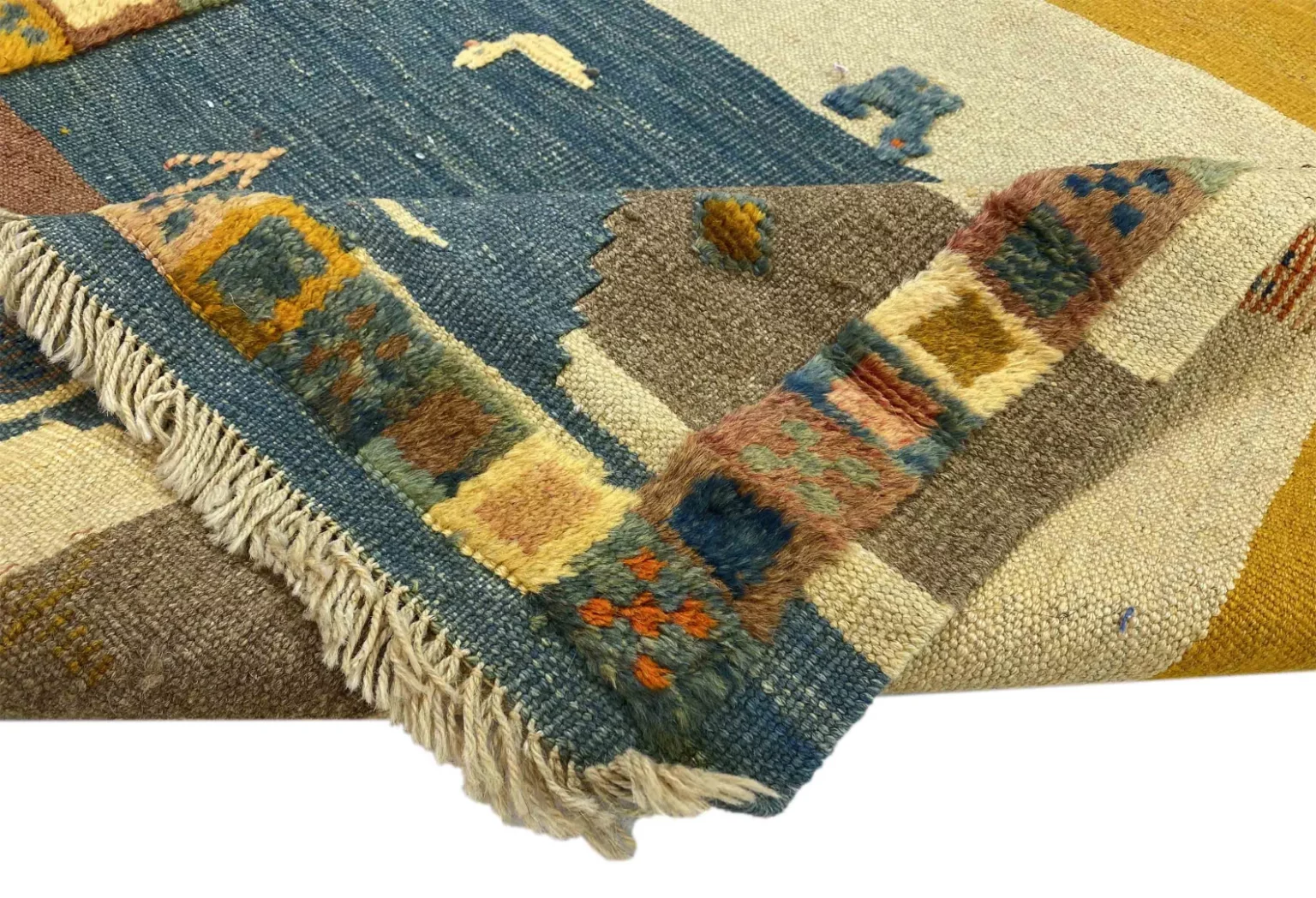
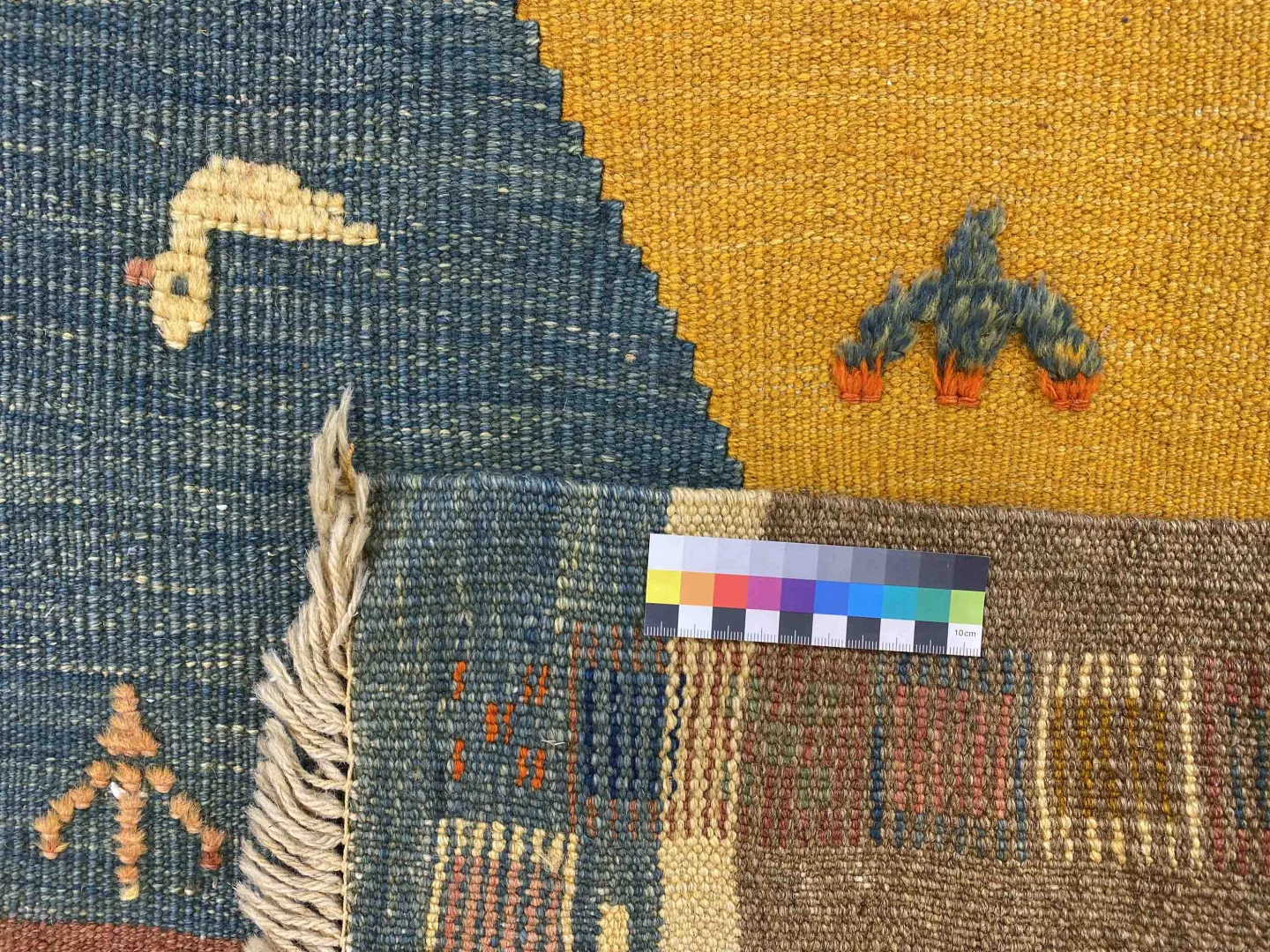
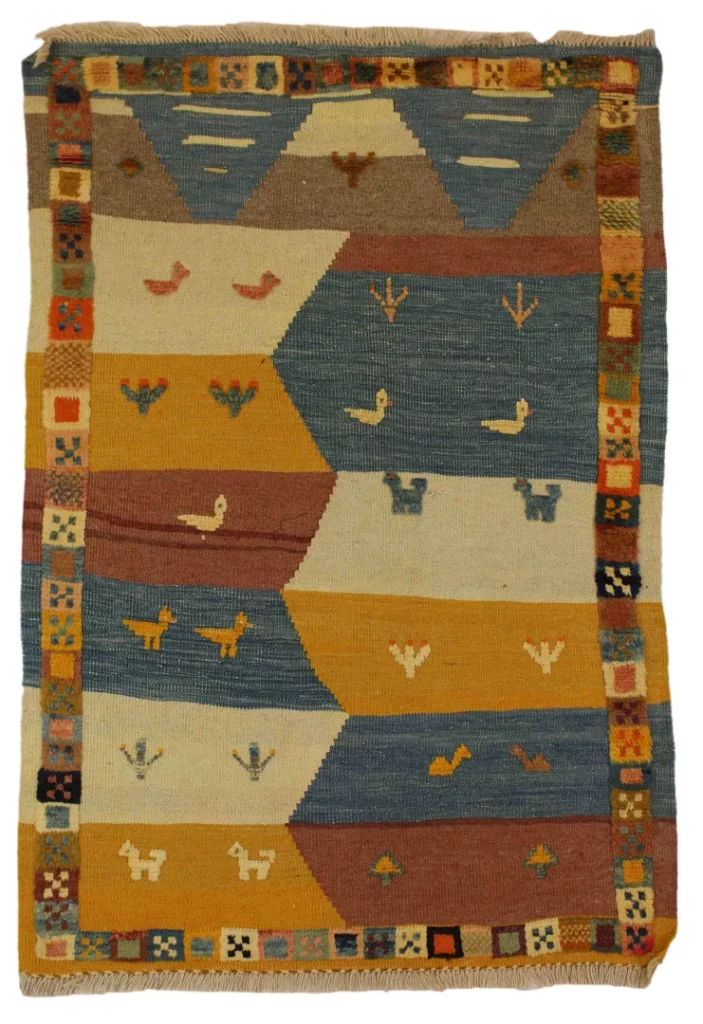
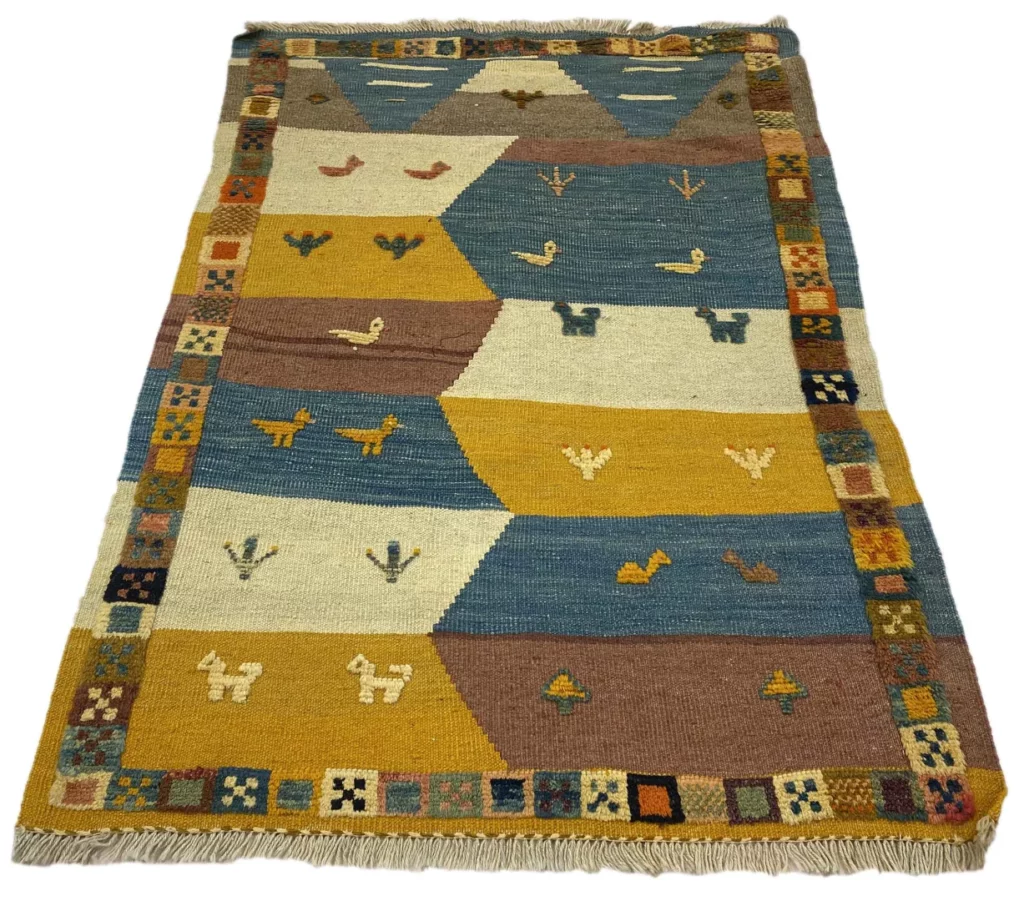
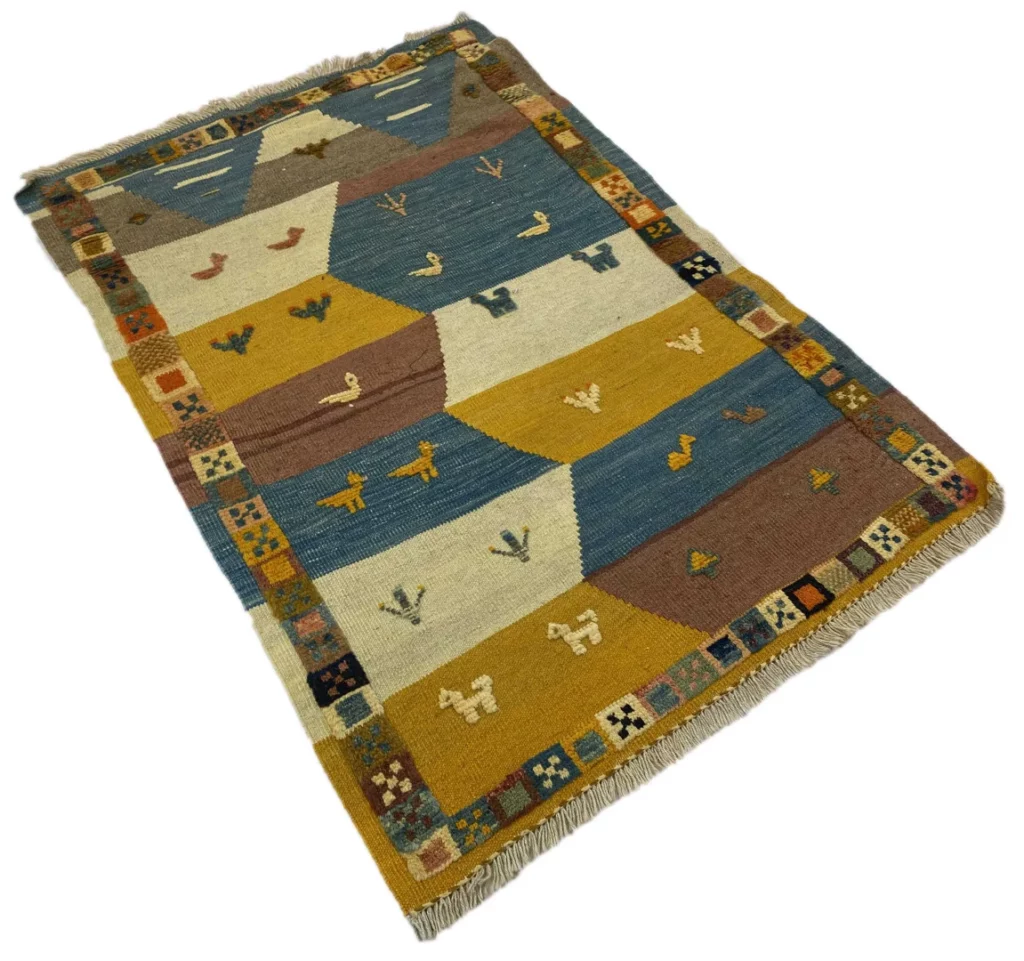
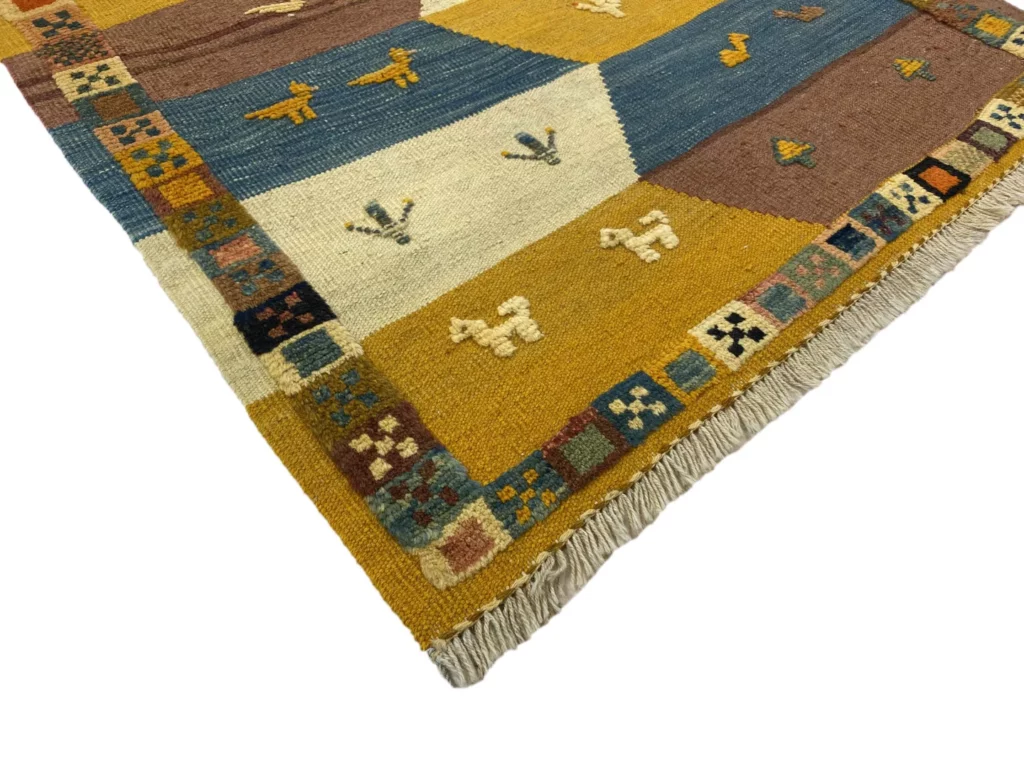
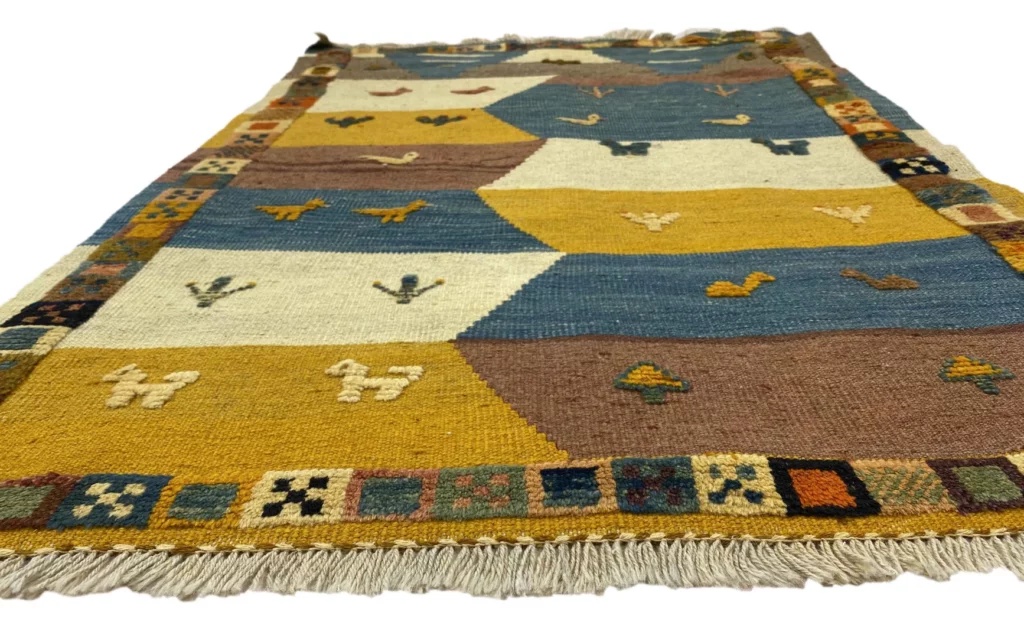
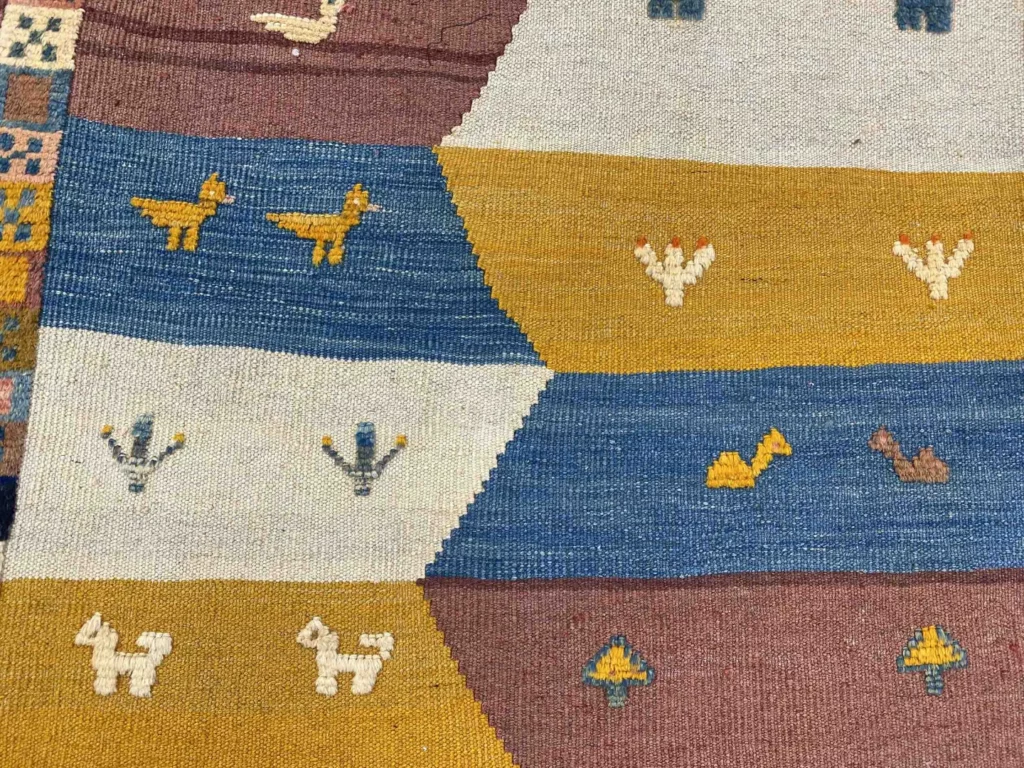
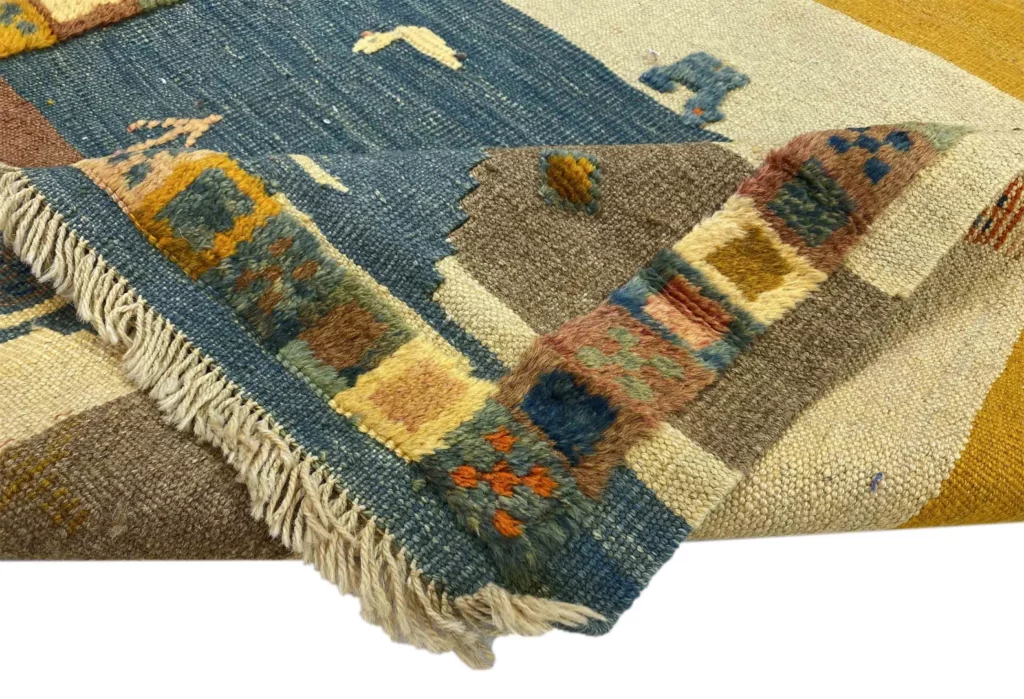
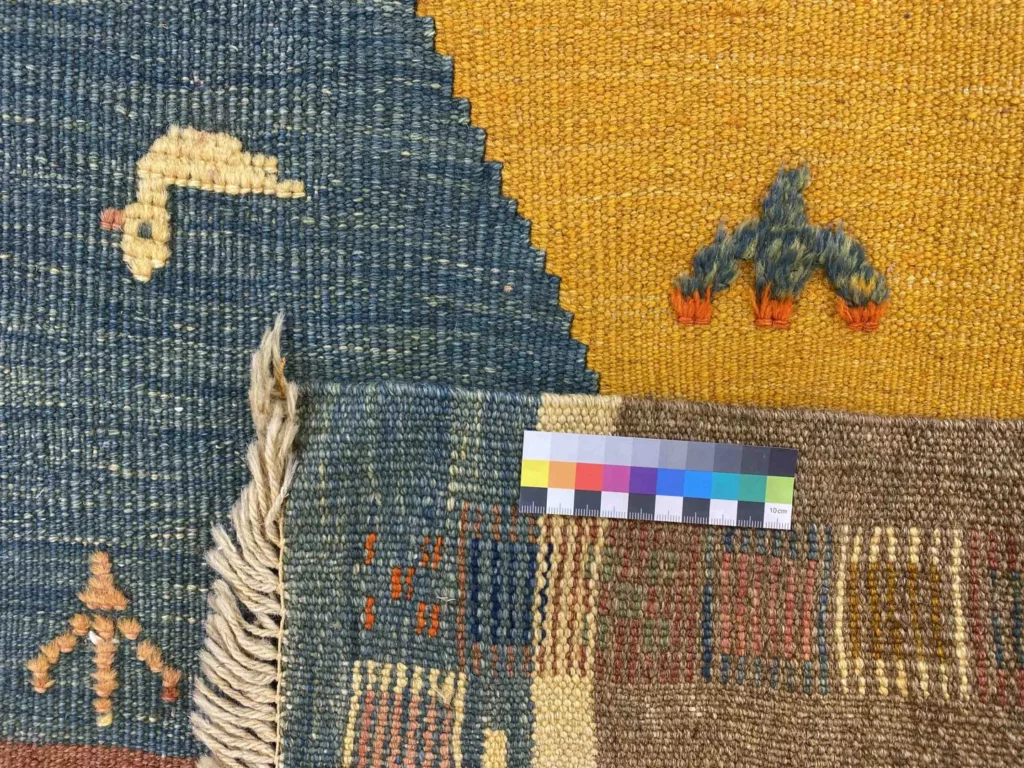
Hand-woven Fars Oriental rug | Material: Wool | Size: 148 x 105 cm | Pattern: Plain, identical on both sides | Use: Rug or wall hanging | Condition: Very well preserved
This kelim is hand-woven from wool. The combination of a natural fibre and a traditional weaving process defines its textile character. A kelim is made as a flat weave rather than by tying rows of individual knots into a pile. Warp and weft threads form the surface together, producing a construction that is visibly different from a rug with a deep cut pile.
Wool has long been used for floor textiles because its fibres are resilient and have a naturally tactile quality. In a hand-woven kelim, the texture of the wool remains an important part of the appearance. Light and use can make the surface appear slightly different from one moment to the next, while the plain design remains clearly legible.
Hand weaving consists of a sequence of individual working steps. The warp provides the foundation, and the weft is inserted across it to build the fabric. In a hand-woven kelim, this method can be understood directly from the flat textile structure. This piece is made of wool, is hand-woven, and is very well preserved. Those are the material, technique and condition features stated for this individual rug.
The flat construction allows the textile to be used in more than one way. On the floor, a kelim introduces a woven surface to the room. On the wall, the same surface becomes a decorative textile. The identical appearance on both sides is one of the stated characteristics of this kelim and supports its flexible use.
Origin and Tradition
Fars is a region in southern Iran and an important centre of Persian culture. The name refers not only to a geographical area but also to a landscape with a long history, several communities and a varied textile heritage. Kelims associated with Fars are connected with regional flat-weaving traditions and with the close relationship between useful household textiles and cultural expression.
Weaving in Fars developed in an environment where textile work was part of everyday life. Nomadic groups, settled communities and workshops each contributed experience in materials, construction and design. For that reason, Fars should not be understood as a single fixed pattern. It describes a wider cultural region in which different forms of flat-woven textiles were made and transmitted.
A kelim is traditionally a woven textile without a cut pile. Its construction depends on the interaction of warp and weft. Weft threads are inserted in rows and compacted to create a continuous surface. Depending on the regional method, the tension of the weave, the edges and transitions within the fabric may vary. Such details belong to the hand-made process and distinguish a hand-woven kelim from an industrially produced flat textile.
Fars has a long history of carpet and textile production. Both practical household pieces and more formal textile works were made in the region. Kelims could serve as floor coverings, covers or decorative fabrics in domestic settings. Their practical role and their visual role existed side by side. The possibility of placing a woven piece on the floor or displaying it on a wall remains part of its continuing tradition.
Knowledge of weaving was passed from one generation to the next. Understanding how to prepare the warp, insert the weft and work with wool was taught within families and communities. Hand-woven textiles therefore carry more than a design: they also reveal a method based on experience, repetition and manual control. The Fars reference identifies the regional design tradition; it does not mean that every textile from Fars has the same appearance.
Unlike a knotted Persian rug, a kelim is defined by its even woven plane. It is therefore an independent form within Iranian carpet culture. Fars design can be restrained or richly structured. This piece combines the regional reference with a plain pattern. The result is a meeting of Fars weaving tradition and a deliberately simple surface treatment.
Design and Pattern
The pattern of this kelim is plain. Instead of a sequence of medallions, borders or figurative motifs, the surface is shaped by a consistent overall colour effect. This allows the woven structure to become more noticeable. The eye encounters the relationship between colour, wool and texture before it encounters a complex ornamental composition.
A plain kelim can be placed alongside many different furnishing styles. In a restrained interior it can provide a quiet textile foundation. Beside contemporary furniture, the hand-woven surface creates a contrast with smooth manufactured materials. In a more traditional setting, the even design can sit alongside existing patterns without introducing another strongly ornamental focal point.
The identical appearance on both sides is a specific feature stated for this rug. Whichever side is facing outward, the design remains the same. This supports flexible placement and means that the front and reverse do not present two separate visual compositions. For a flat-woven textile, that quality is particularly useful when the piece is moved or displayed in different settings.
Plain kelims can be combined with furniture, timber, stone, leather and smooth fabrics. Their effect comes less from a narrative image than from the relationship between area and surface. Depending on the distance and the light, the woven texture can appear more or less pronounced. The design consequently remains calm without becoming entirely featureless.
Fars design is generally associated with regional weaving practices and hand-crafted forms. The wider Fars tradition includes geometric arrangements as well as more open, broadly composed surfaces. This particular kelim is described by its plain execution and its identical design on both sides rather than by a complex ornament. Those characteristics determine its formal appearance.
Used on the floor, the even surface can define a clear area within a room. Used as a wall hanging, the textile itself becomes the decorative element and does not require additional pictorial motifs. The flat construction and plain pattern support both applications. The kelim can therefore be read as a functional floor textile or as a decorative wall piece, while its woven origin remains apparent in either role.
The design is restrained while remaining open to different combinations. It does not prescribe one particular furnishing style or colour scheme. Instead, the continuous surface provides a simple basis for individual interior arrangements. The regional reference remains present through the hand-woven kelim form and the Fars design, while the pattern itself is intentionally uncomplicated.
Special Features
This hand-woven kelim is very well preserved. It can traditionally be used as a rug or as a wall hanging. Its identical design on both sides adds practical flexibility. Depending on the room and the intended presentation, it can lie horizontally or be displayed vertically, with the woven texture and plain pattern remaining visible in both positions.
Hand production makes every piece an individual textile. Minor variations that can occur in hand-woven work belong to manual manufacture rather than to industrial series production. In this kelim, wool, a flat weaving technique, Fars design and a simple colour treatment come together in a clearly defined form.
Regular vacuuming is suitable for removing dust and loose dirt from the surface. If needed, the textile can be cleaned with a damp cloth. Strong direct sunlight should be avoided in order to reduce the possibility of colour fading. Gentle care supports the preservation of the wool, the woven structure and the very well-preserved condition.
FAQ
How should a hand-woven kelim be cleaned?
Regular vacuuming removes dust and loose dirt from the woven surface. If further cleaning is needed, the textile can be treated with a damp cloth. Work carefully and avoid unnecessarily soaking the fabric. Direct sunlight should be limited because it can contribute to colour fading. Consistent, gentle care helps preserve the wool, the flat construction and the very well-preserved condition of this kelim.
Can a wool kelim cause an allergic reaction?
This kelim is made of wool, a natural material. Many people tolerate wool well, but individual sensitivity to wool fibres is possible. It is therefore not possible to make a general statement about allergic reactions. Anyone who already reacts to wool or to particular natural fibres should seek professional advice before use and take personal contact with the material into account.
What makes hand-woven kelims distinctive?
Hand-woven kelims are created by building a flat surface from warp and weft threads, which distinguishes them from knotted pile rugs. Their textile structure, traditional technique and manual production define each individual piece. This kelim combines those qualities with wool, a plain pattern, Fars design and an identical appearance on both sides. It can be used as a rug or as a wall hanging while remaining an individual hand-woven textile.
To provide the best experiences, we use technologies like cookies to store and/or access device information. Consenting to these technologies will allow us to process data such as browsing behavior or unique IDs on this site. Not consenting or withdrawing consent, may adversely affect certain features and functions.
Functional Always active
The technical storage or access is strictly necessary for the legitimate purpose of enabling the use of a specific service explicitly requested by the subscriber or user, or for the sole purpose of carrying out the transmission of a communication over an electronic communications network.
Preferences
The technical storage or access is necessary for the legitimate purpose of storing preferences that are not requested by the subscriber or user.
Statistics
The technical storage or access that is used exclusively for statistical purposes.The technical storage or access that is used exclusively for anonymous statistical purposes. Without a subpoena, voluntary compliance on the part of your Internet Service Provider, or additional records from a third party, information stored or retrieved for this purpose alone cannot usually be used to identify you.
Marketing
The technical storage or access is required to create user profiles to send advertising, or to track the user on a website or across several websites for similar marketing purposes.

 SECURE PAYMENT
 SHIPPING PARTNERS


