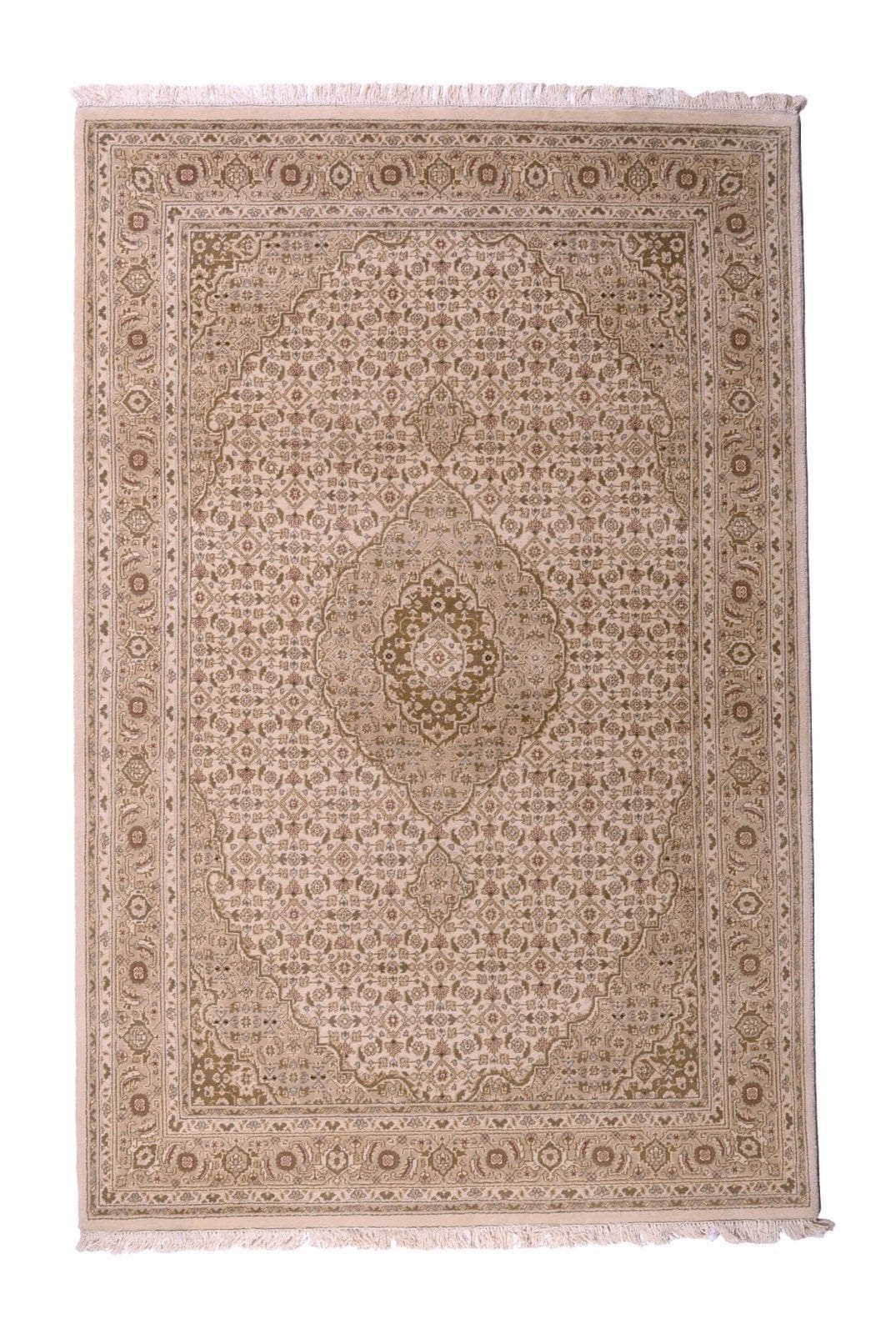
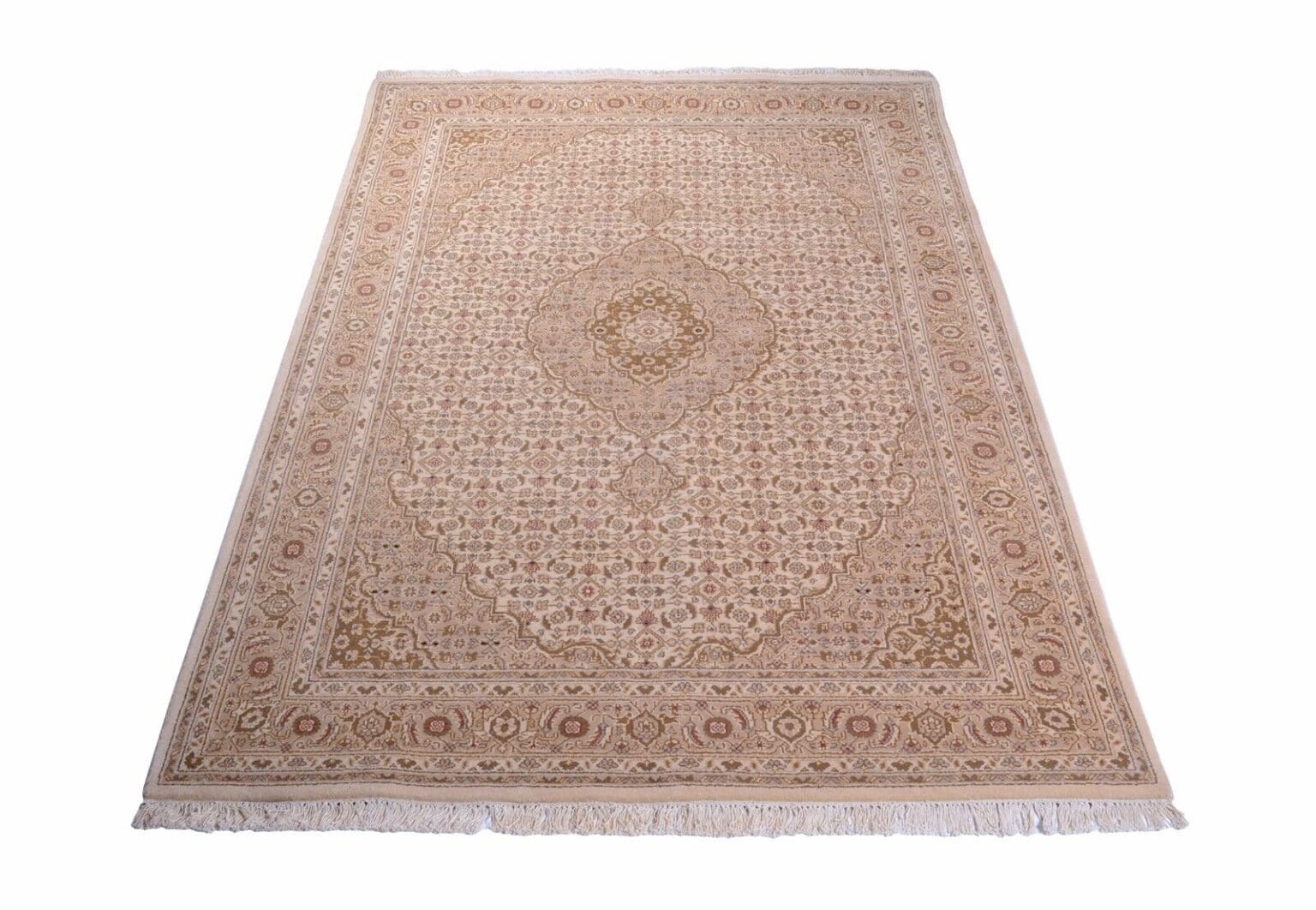
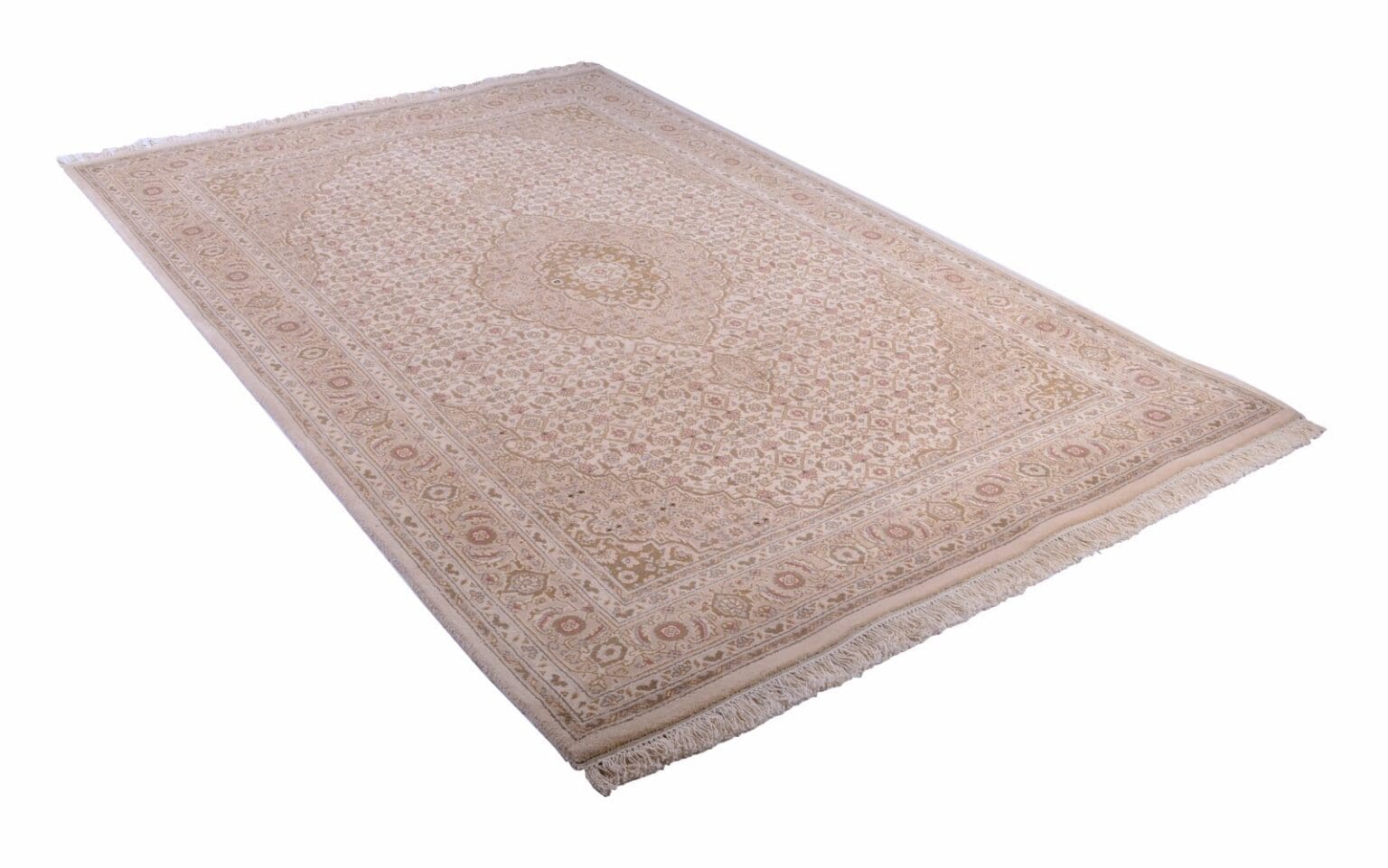
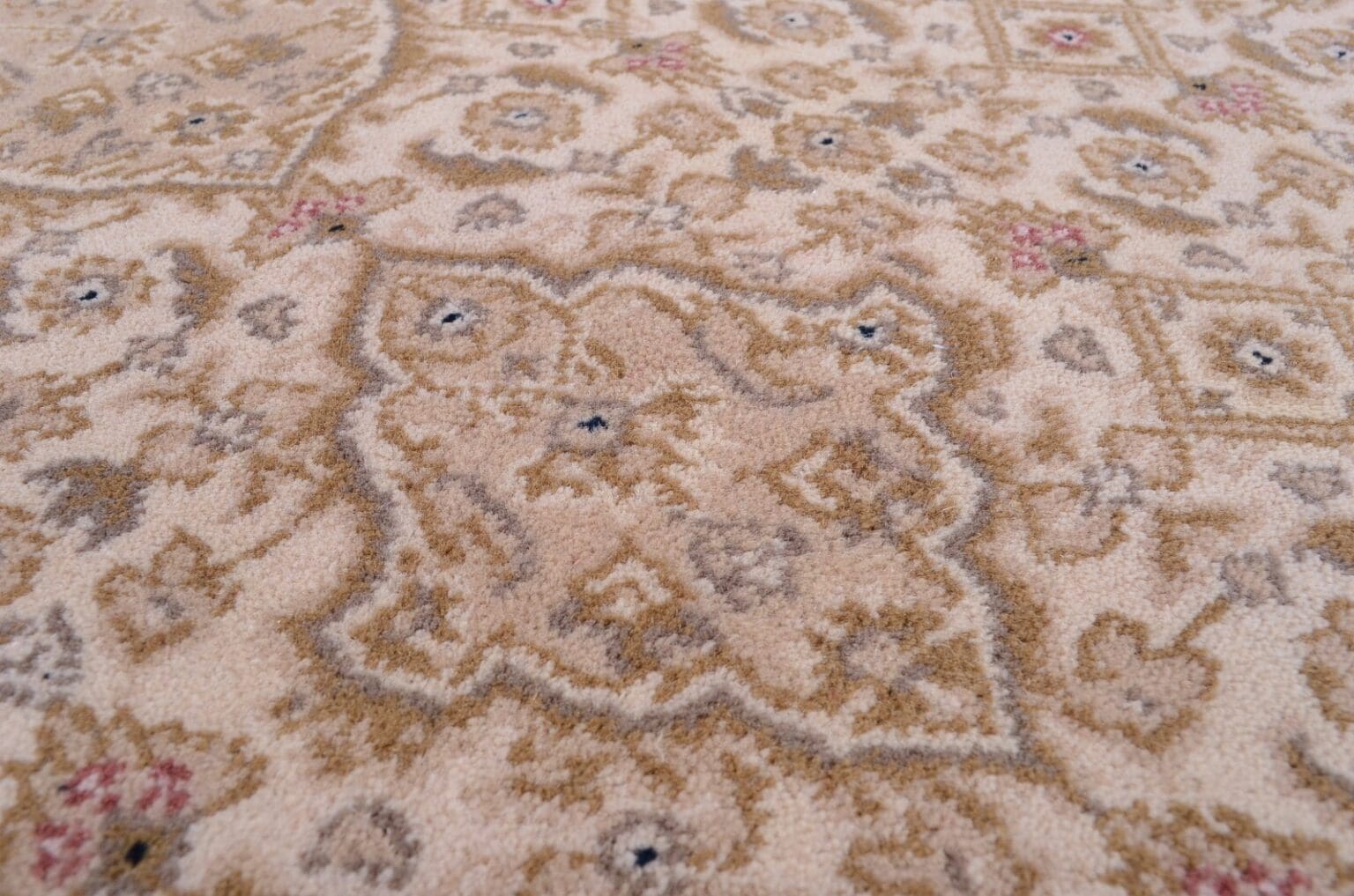
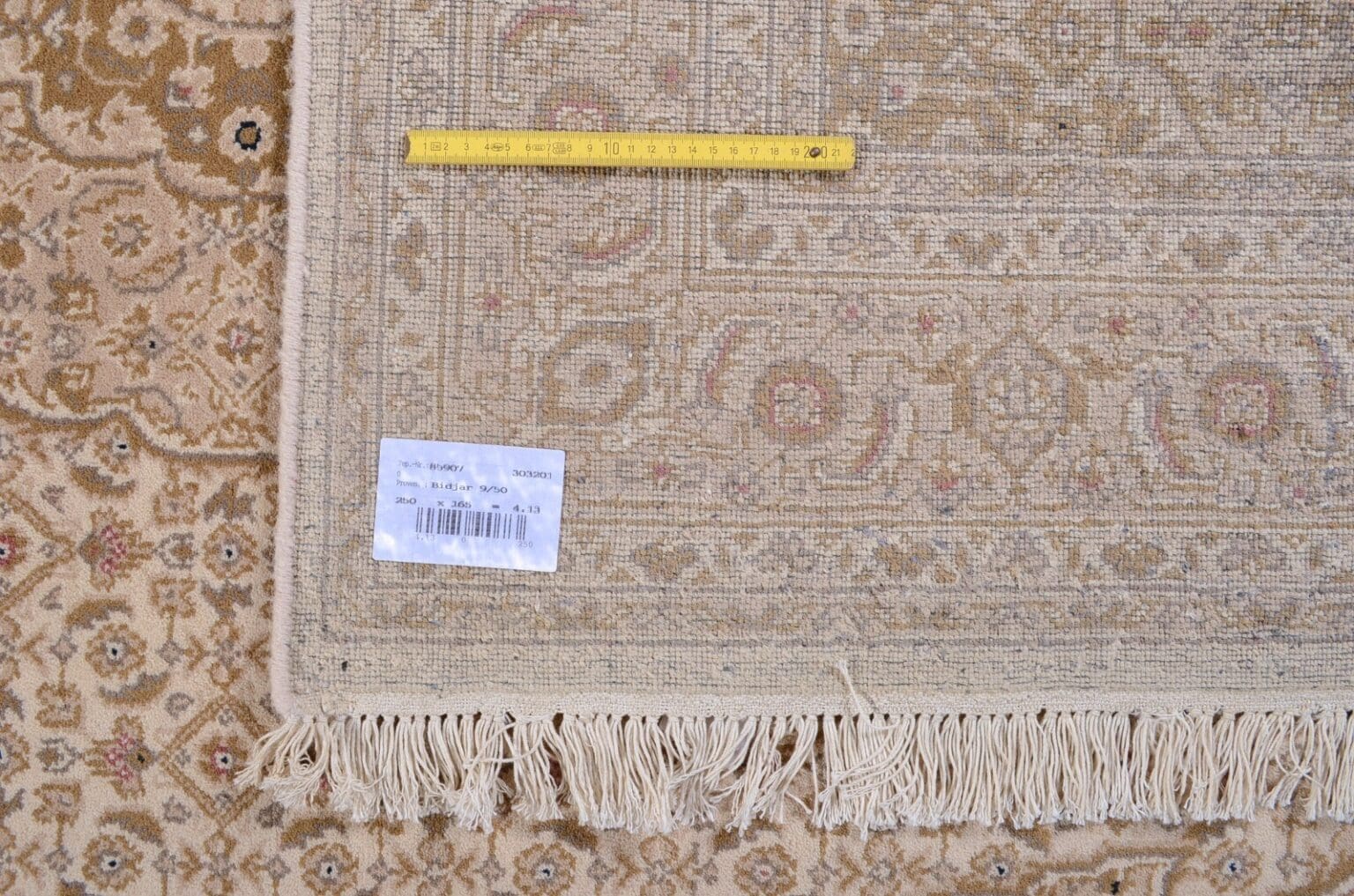
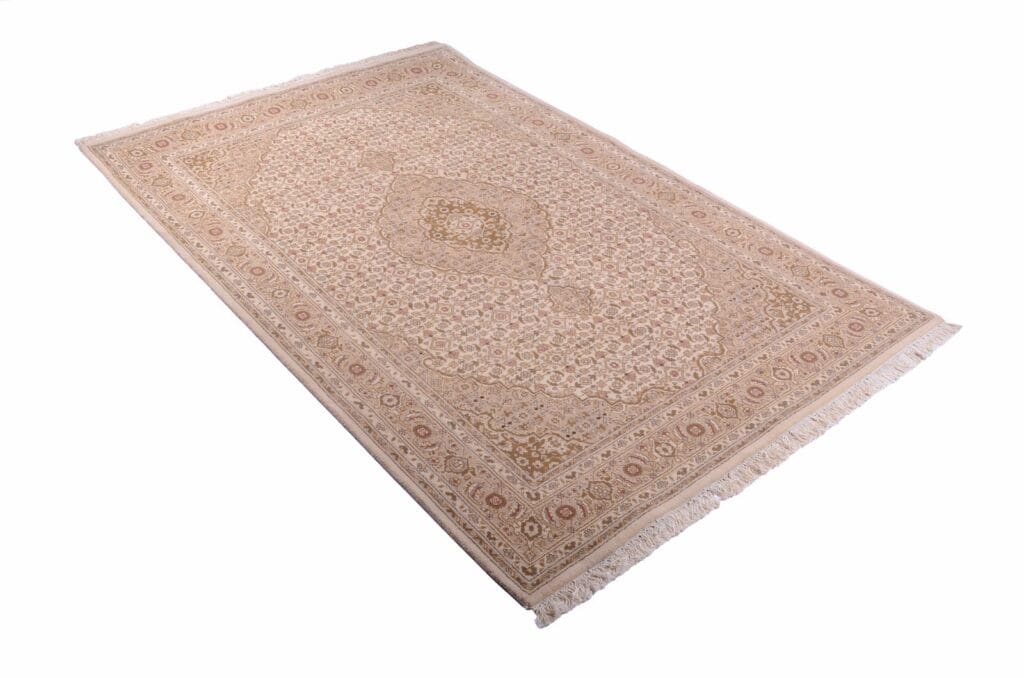
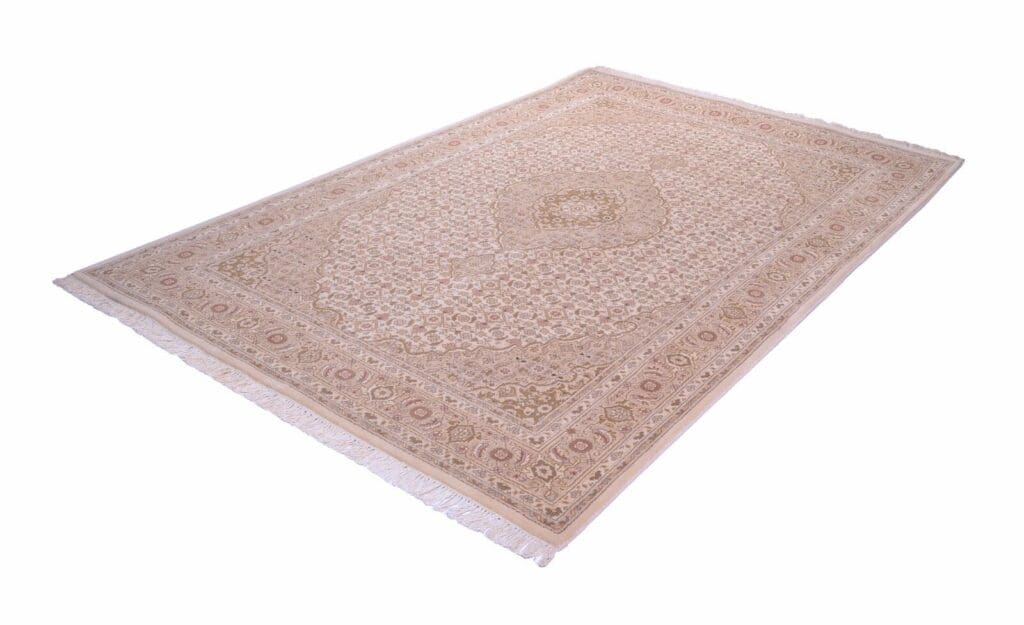
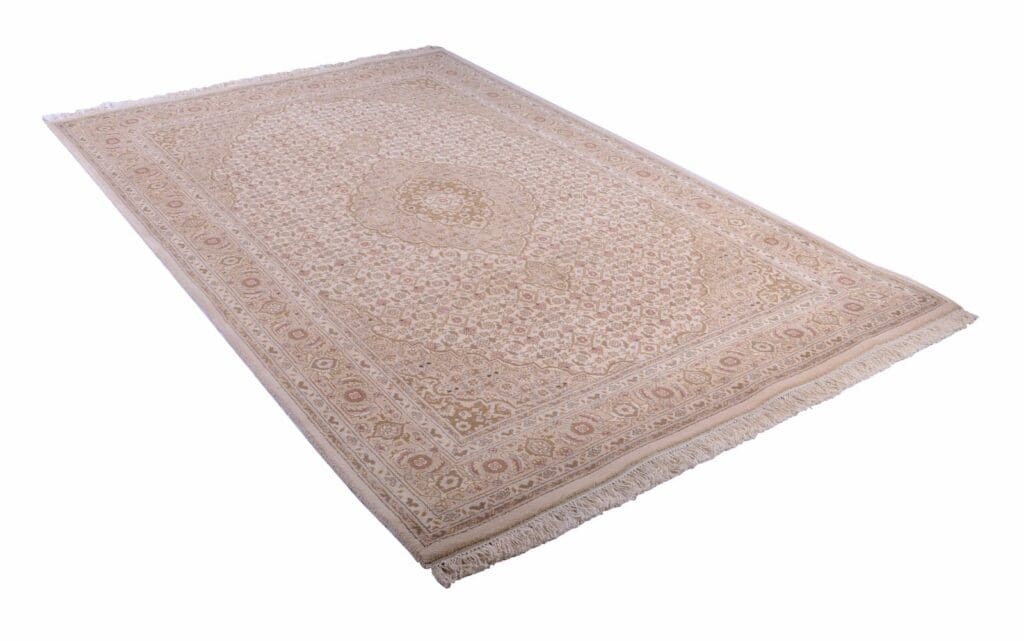
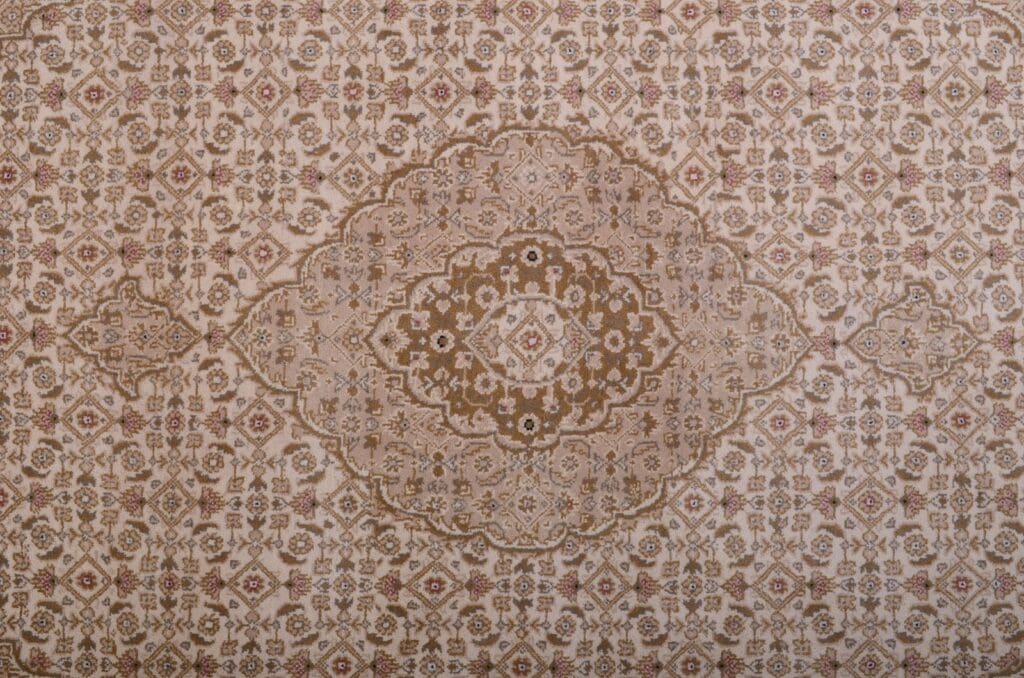
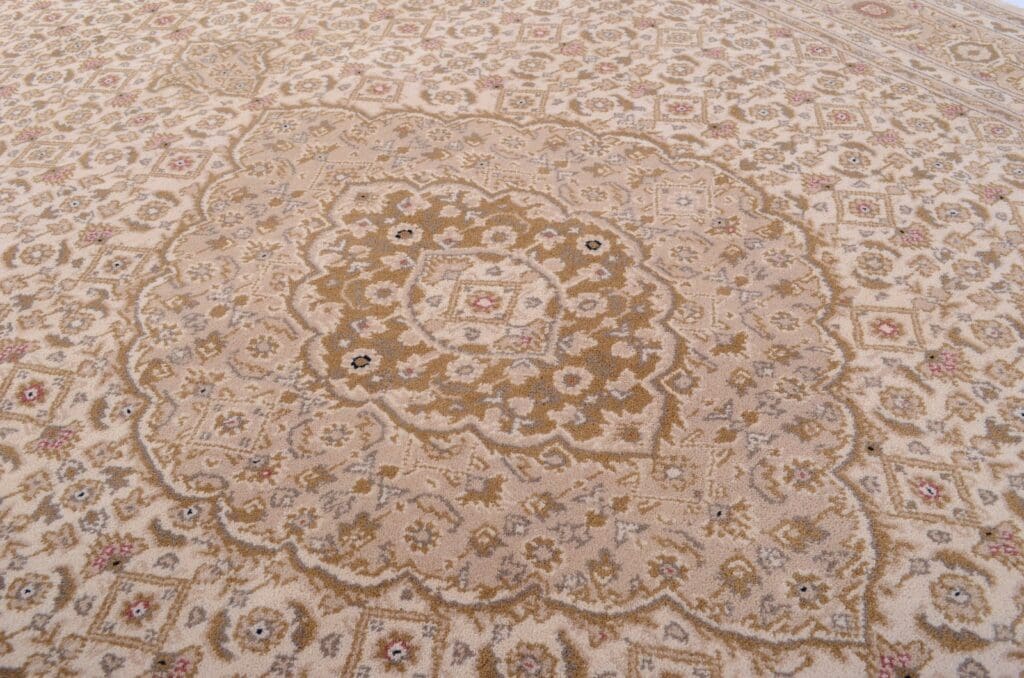
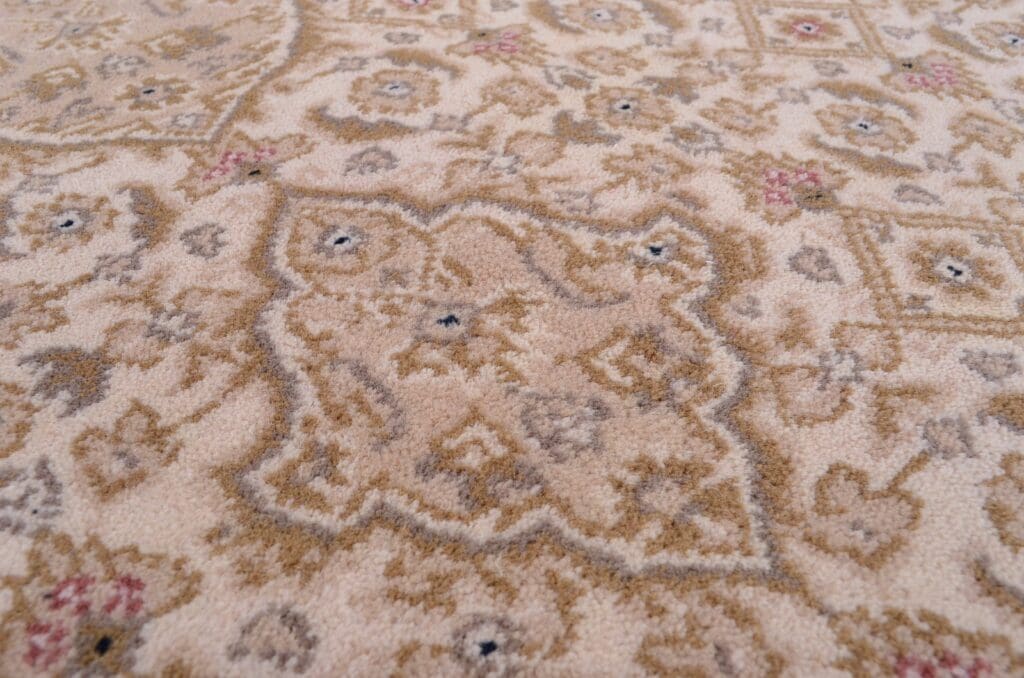
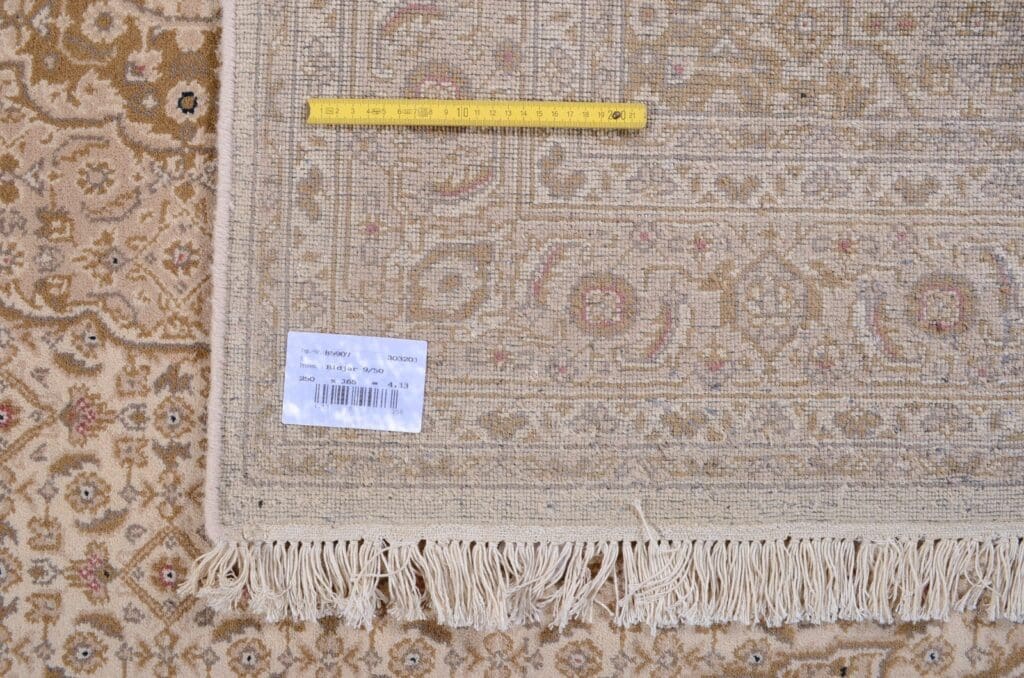
This Oriental rug is hand-knotted and has a pile made from virgin wool. The handmade construction brings each individual knot into the structure of the rug through a sequence of separate working steps. Unlike a machine-made floor covering, the surface is built knot by knot, allowing the design to emerge directly from the weaving process. The wool pile gives the rug a tactile, comfortable surface and supports the clearly organised appearance of the geometric medallion.
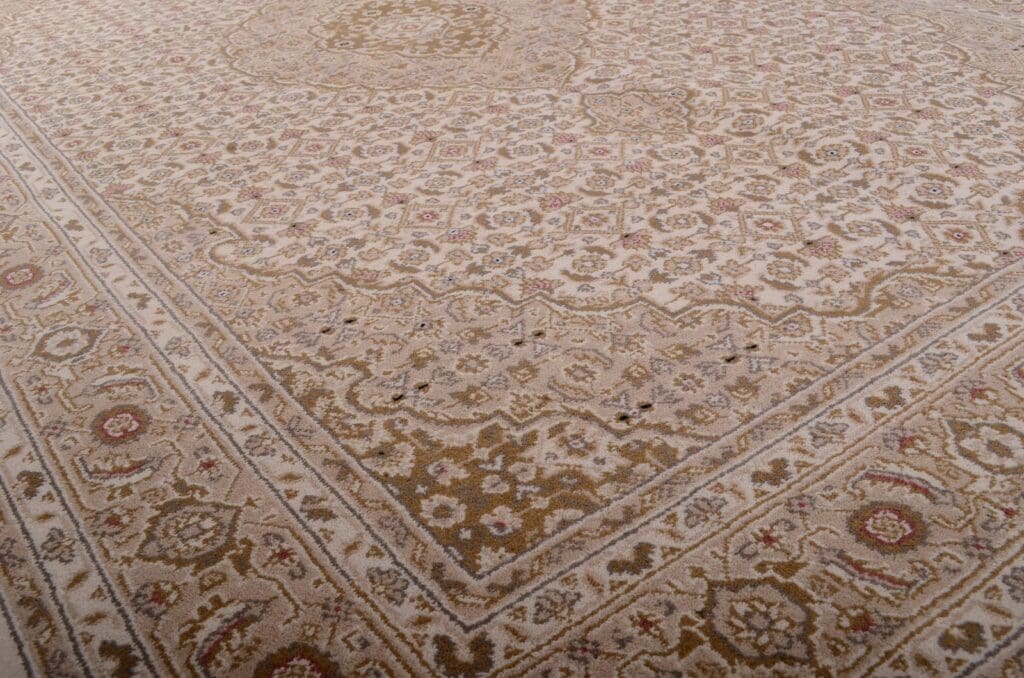
Virgin wool is traditionally used for rugs because it combines a resilient surface with a naturally textured feel. Its fibres take up colour with subtle variation, which gives the beige and sand palette a quiet textile quality. During hand-knotting, the pile yarn is inserted individually before the surface is finished and evened out. This finishing process helps the pattern remain legible and gives the pile a consistent appearance while retaining the character of a handmade rug.
The knot density is specified as 155,000 to 185,000 knots per square metre. This level of knotting supports a differentiated rendering of the geometric forms and allows the medallion to be drawn with clear definition. The rug is new and described as perfect. It is also suitable for use with underfloor heating, combining a traditional hand-knotted technique with a feature relevant to contemporary interiors.
Origin and Tradition
The rug was made in India. The designation Indo Bidjar Modern describes its design classification and its connection with a Bidjar-inspired visual language; it does not make this Indian-made piece an Iranian rug. This distinction matters in Oriental rug terminology because a rug’s place of manufacture and the tradition behind its design are not always the same. This particular rug is therefore an Indian Oriental rug.
India has a broad and independent carpet-making tradition. Workshops in different parts of the country produce hand-knotted rugs using varied techniques, materials and design approaches. Their work may draw on established ornamental vocabularies as well as on contemporary compositions and restrained colour schemes. Indian rug production is consequently not limited to one appearance. It includes classic layouts, detailed patterns and modern designs that reinterpret established forms for present-day interiors.
Bidjar is a rug designation associated with a weaving tradition in Iran. Traditional Bidjar rugs are known for compact construction and for designs with a strong, clearly articulated structure. Dense knotting can help define medallions, borders, fields and repeating geometric ornaments with precision. In a modern Indo-Bidjar rug, this visual vocabulary is taken up within an Indian production context. The origin of the individual piece remains India, and that origin should be kept separate from the regional name connected with its design reference.
Oriental rug history has always involved the exchange and adaptation of patterns. Motifs are passed on, rearranged and interpreted with different materials, colours and workshop methods. A rug can therefore use a familiar regional design language without having been made in the region associated with that name. The term Indo Bidjar Modern expresses precisely this relationship between an Indian handmade rug and a contemporary interpretation of Bidjar-related forms.
The use of beige and sand also reflects a current approach to classical rug design. Neutral colours can make a structured pattern visible without creating a strong chromatic contrast that dominates the room. Indian workshops combine such colour concepts with established hand-knotting methods, creating rugs that retain a connection to Oriental carpet traditions while fitting more restrained furnishing schemes. Here, the regional design reference, Indian origin and modern colour treatment belong to the same description but indicate different aspects of the rug.
Design and Pattern
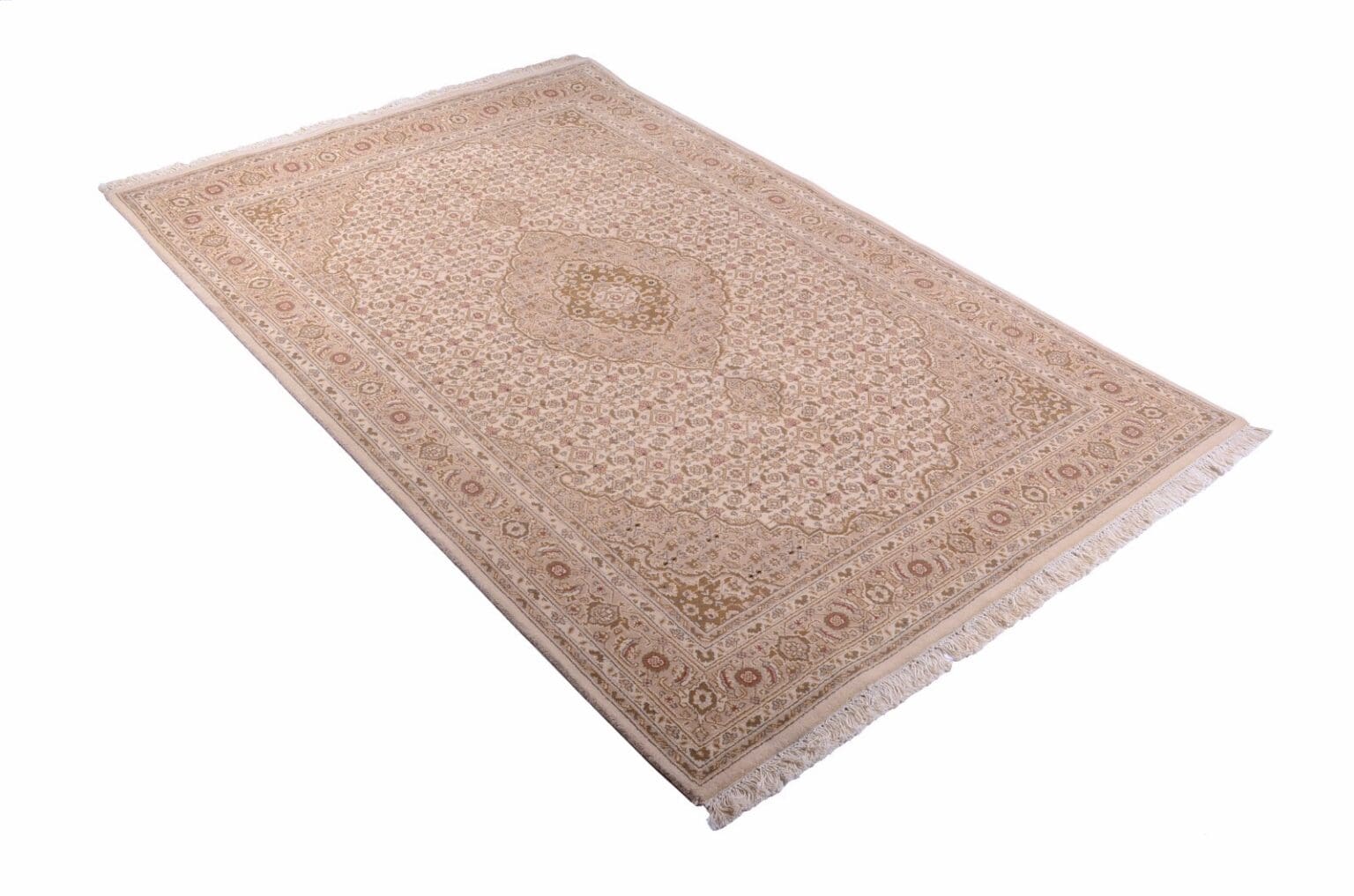
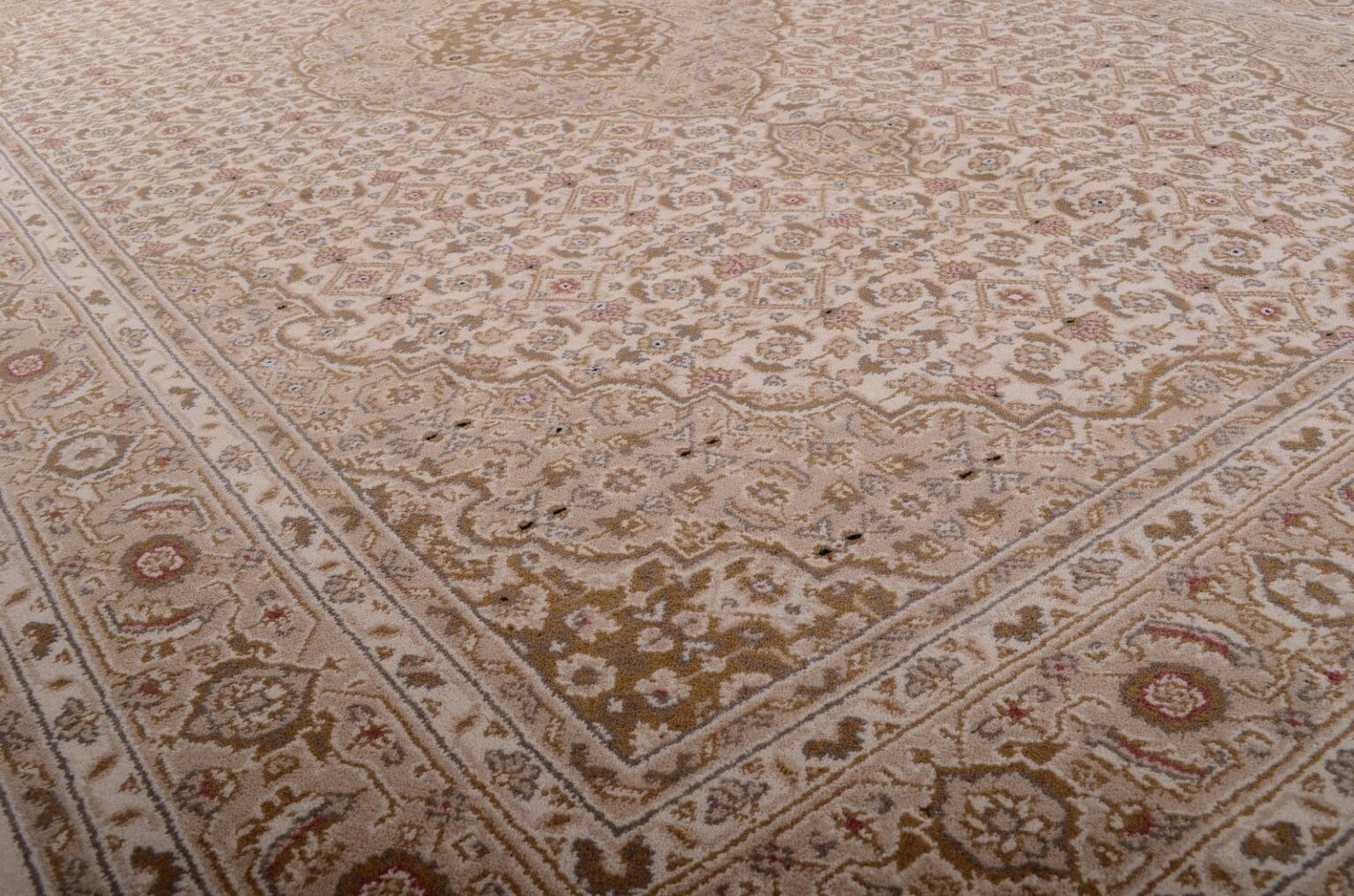
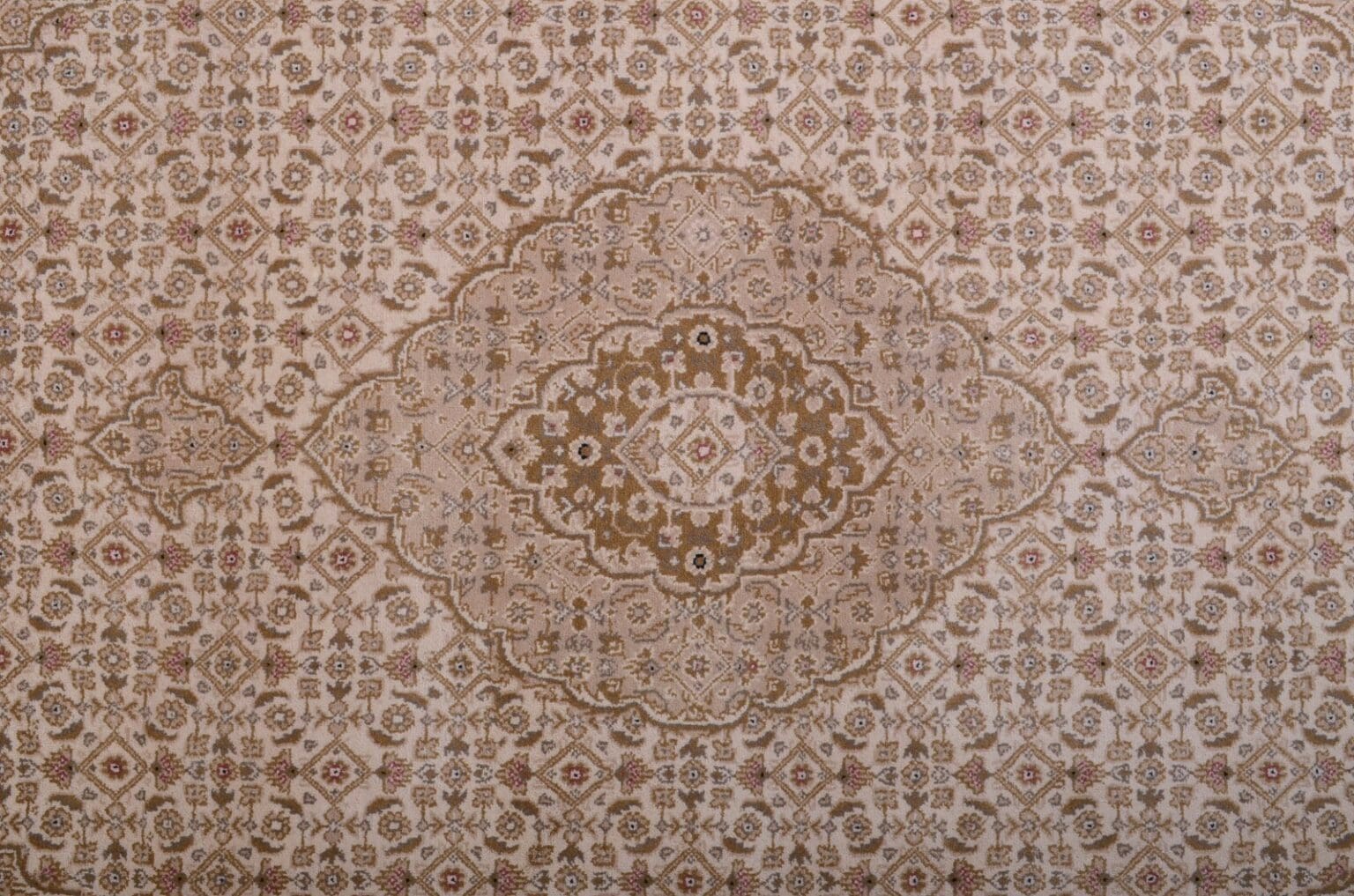
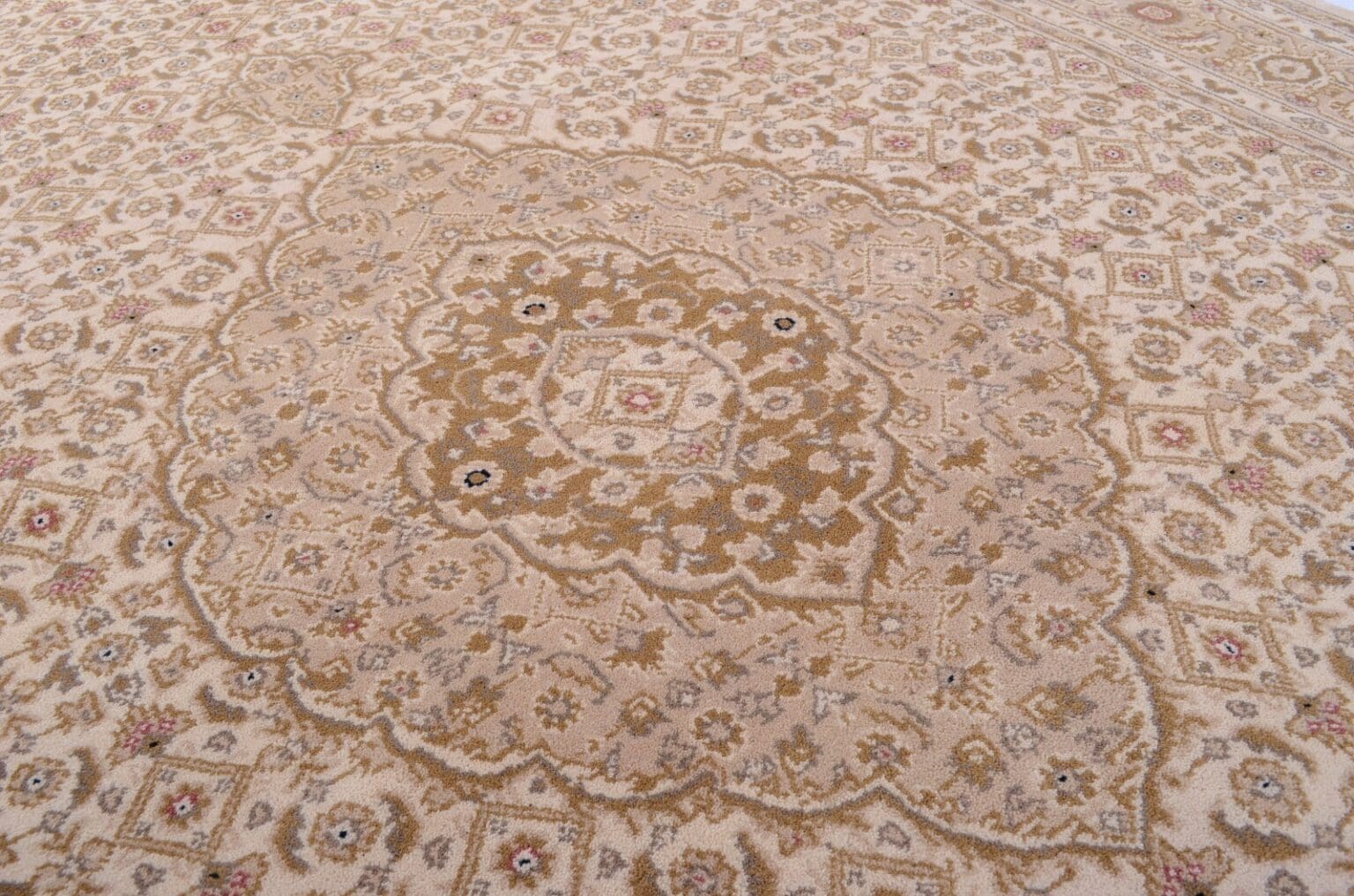
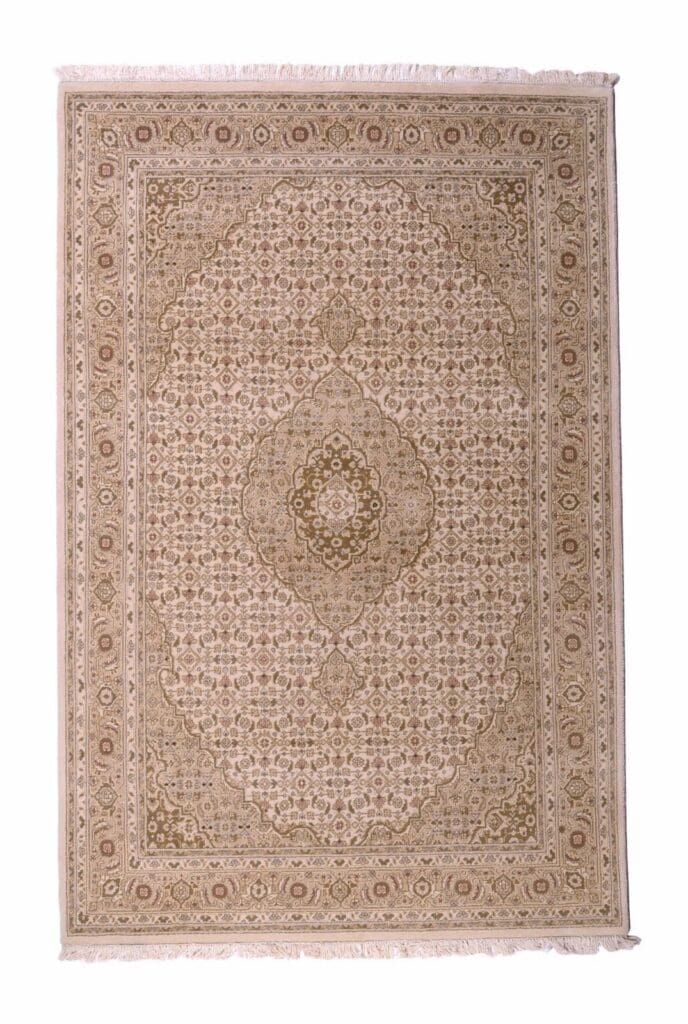
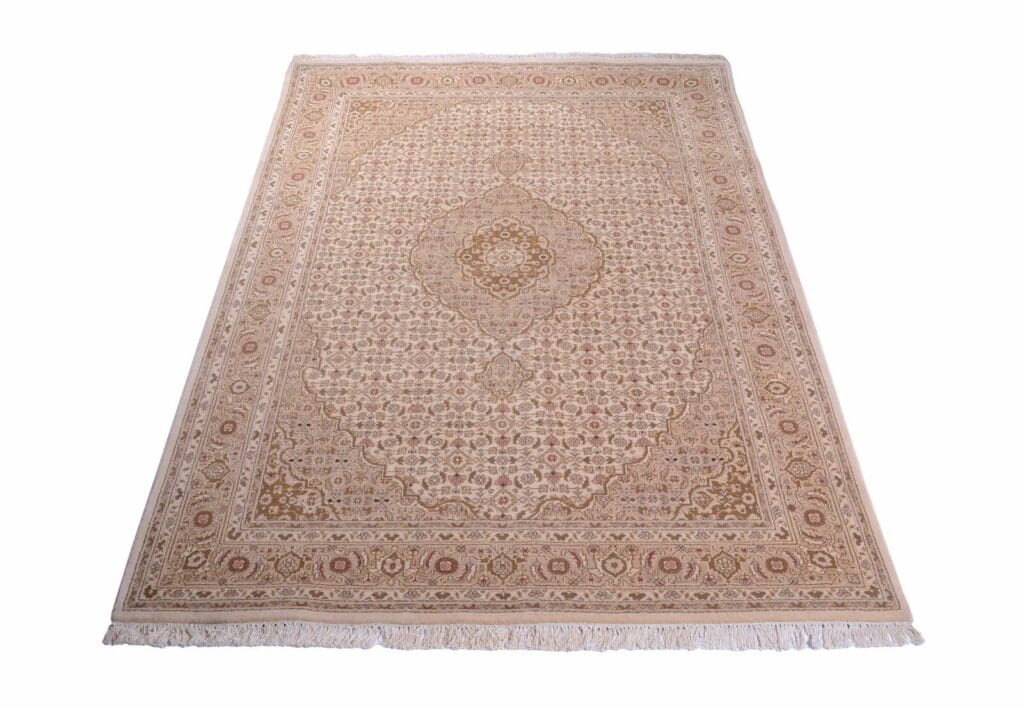
The pattern is described as a geometric medallion. A medallion generally serves as the visual centre of a rug composition and organises the surrounding field. In a geometric interpretation, the effect is created by lines, angles, balanced relationships and clearly separated shapes rather than by naturalistic flowers or freely flowing foliage. This gives the surface a structured and orderly drawing that can be read from a distance as well as at closer range.
The Bidjar-inspired design language can connect a central motif with an ordered division of the surrounding field. Geometric medallions may be formed from nested outlines, polygonal areas and repeated ornaments. Each element contributes to the balance of the overall composition. The restrained beige and sand palette places emphasis on that structure, allowing the contours and arrangement of the medallion to remain the main visual features rather than competing with a broad range of bright colours.
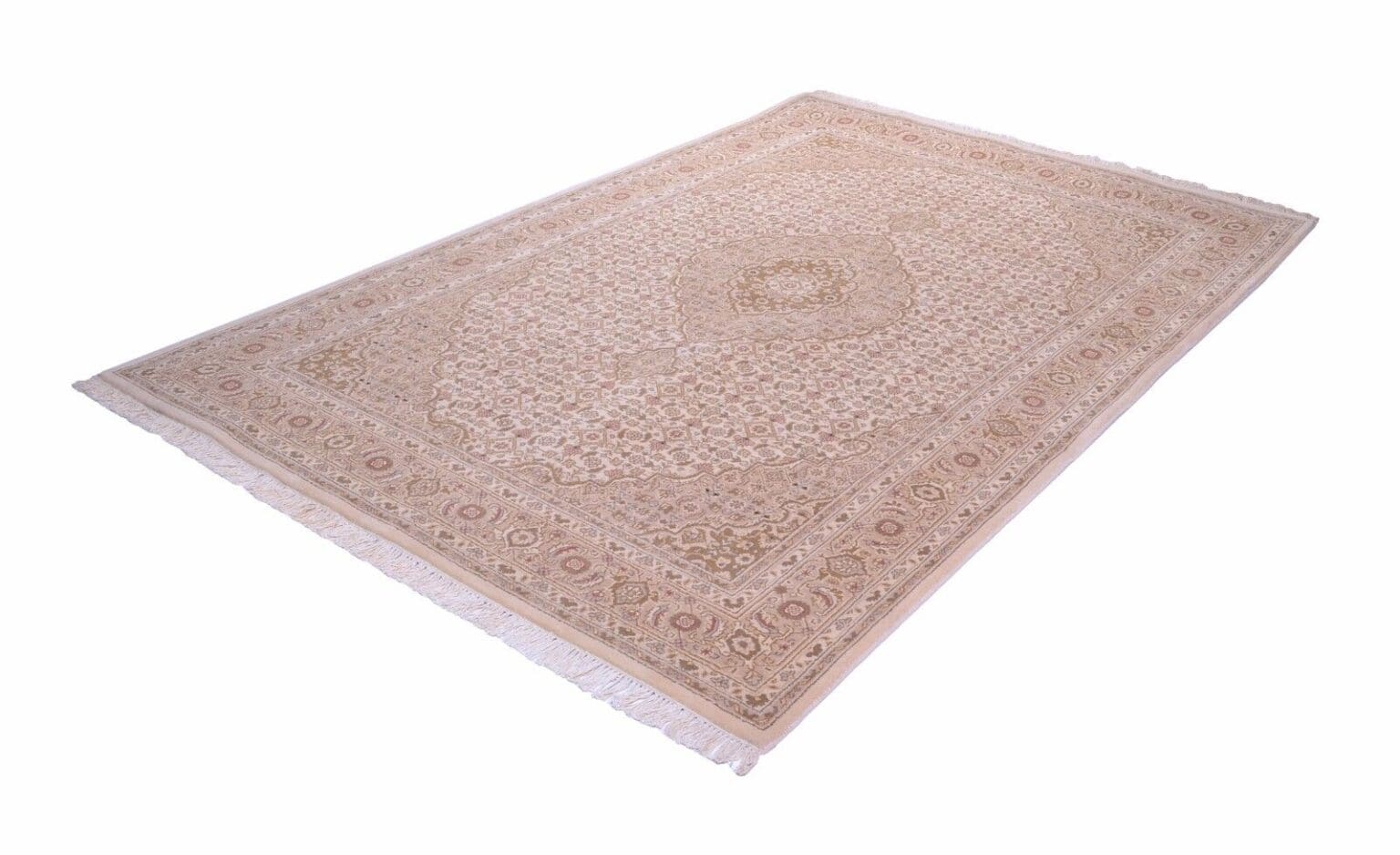
Beige and sand are neutral tones often used in modern rug designs when a pattern should remain present without becoming visually loud. Their appearance can change subtly with the direction of the pile, the available light and the viewing angle. A hand-knotted wool surface adds another layer of variation because the fibres do not reflect light in a completely uniform way. This natural textile quality helps the geometric drawing retain depth while keeping the overall colour impression calm.
A geometric medallion can work in a contemporary room as a defined graphic element. In a minimalist setting it can provide a clear centre without introducing an elaborate colour scheme. In a more traditional interior, its ordered layout can create a link between classic furnishings and a neutral palette. The description of this rug remains limited to the stated geometric medallion and the beige-sand colourway; no additional floral motifs, border arrangement or individual symbolic details are specified.
The word Modern indicates a contemporary interpretation of the Bidjar reference. Modern Oriental rugs often simplify an established pattern language, reduce the number of colours or make selected outlines more prominent. This does not remove the handmade foundation. Instead, a traditional reference is arranged so that the composition remains compatible with current furnishing concepts. In this rug, hand-knotting, geometric order, a medallion layout and a subdued beige-and-sand palette form the essential design relationship.
Special Features
The rug is new and is described as perfect. It is hand-knotted, with a pile made from virgin wool. The geometric medallion provides a defined centre, while beige and sand create a restrained colour impression. The specified knot density supports the detailed rendering of the pattern. As an Indo Bidjar Modern rug, it combines Indian manufacture with a design reference associated with Bidjar.
The rug is suitable for underfloor heating. It can therefore be used in rooms where this type of heating is installed. The handmade construction and wool surface determine its tactile character, while the modern medallion gives the design a clear graphic order. No signature, special wear marks or particular border details are stated, so no additional claims about those aspects are made here.
FAQ
How should I care for this Oriental rug?
For routine care, vacuum the rug carefully without using a brush attachment. This removes loose dust and particles while avoiding unnecessary stress on the wool pile. Spills and stains should be blotted promptly with a clean, slightly damp cloth. Rubbing may work the substance further into the fibres and can affect the surface. Do not use harsh cleaning agents. For a full cleaning, professional rug cleaning is advisable, especially because the rug is hand-knotted and made with a wool pile. A specialist treatment can be selected to protect the colour, knot structure and surface of this new rug.
Is this rug a Persian rug?
No. It was made in India and is therefore an Oriental rug. The name Bidjar in Indo Bidjar Modern identifies a design reference and not the Iranian origin of this individual piece. Bidjar is associated with a traditional rug-making region in Iran, but an Indian-made rug does not become Persian merely because its design draws on that tradition. The accurate description is an Indian hand-knotted Oriental rug with a modern, Bidjar-inspired design. Keeping origin and design terminology separate gives a precise account of both the rug’s manufacture and the tradition behind its visual language.
What distinguishes hand-knotted rugs from machine-made rugs?
A hand-knotted rug is built by tying the pile knots individually by hand. The pattern is formed during this process, so the visible drawing is directly connected with the manual work of the maker. This method gives the rug a handmade character and allows the design to be developed through many separate knotting steps. Machine-made rugs are produced through industrial, standardised processes. They may also use different materials and patterns, but they are not created through the same individual knotting work. In this rug, hand-knotting, dense knotting, a virgin-wool pile and a geometric medallion are the defining elements of its construction and appearance.
To provide the best experiences, we use technologies like cookies to store and/or access device information. Consenting to these technologies will allow us to process data such as browsing behavior or unique IDs on this site. Not consenting or withdrawing consent, may adversely affect certain features and functions.
Functional Always active
The technical storage or access is strictly necessary for the legitimate purpose of enabling the use of a specific service explicitly requested by the subscriber or user, or for the sole purpose of carrying out the transmission of a communication over an electronic communications network.
Preferences
The technical storage or access is necessary for the legitimate purpose of storing preferences that are not requested by the subscriber or user.
Statistics
The technical storage or access that is used exclusively for statistical purposes.The technical storage or access that is used exclusively for anonymous statistical purposes. Without a subpoena, voluntary compliance on the part of your Internet Service Provider, or additional records from a third party, information stored or retrieved for this purpose alone cannot usually be used to identify you.
Marketing
The technical storage or access is required to create user profiles to send advertising, or to track the user on a website or across several websites for similar marketing purposes.
 SECURE PAYMENT
 SHIPPING PARTNERS


