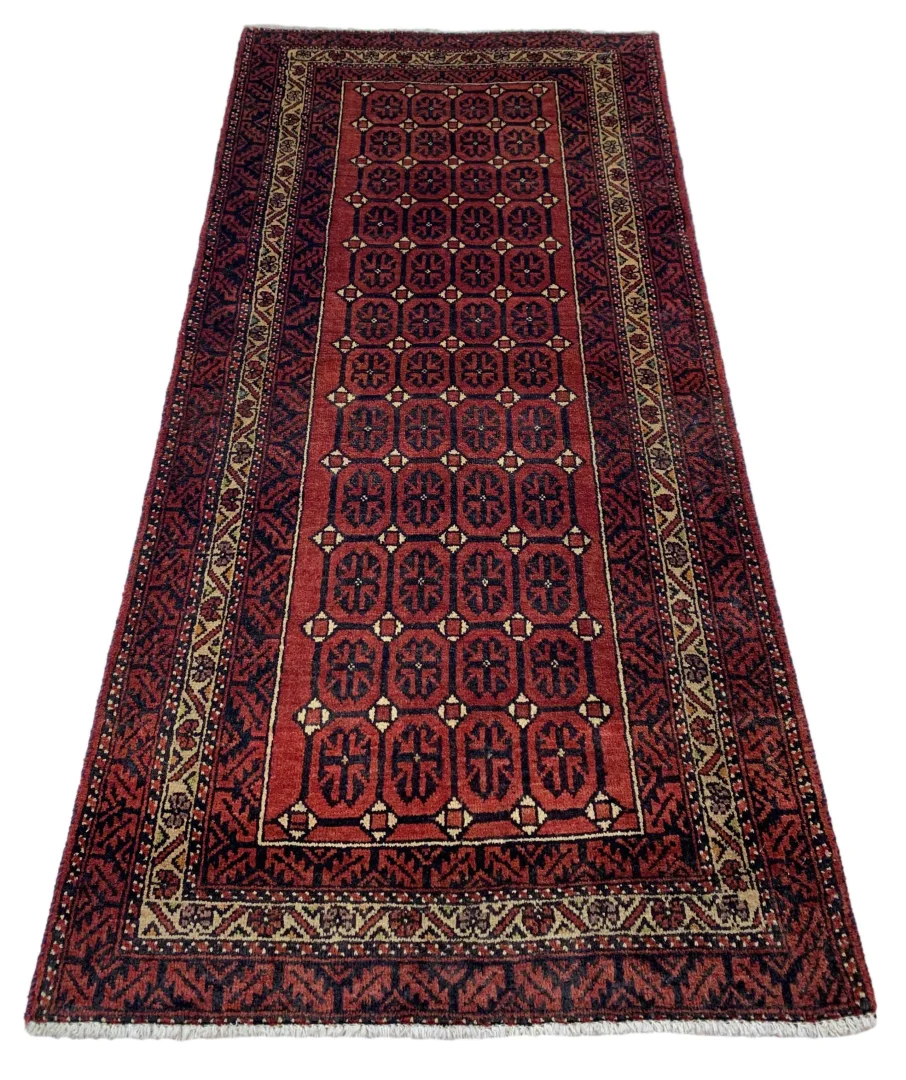
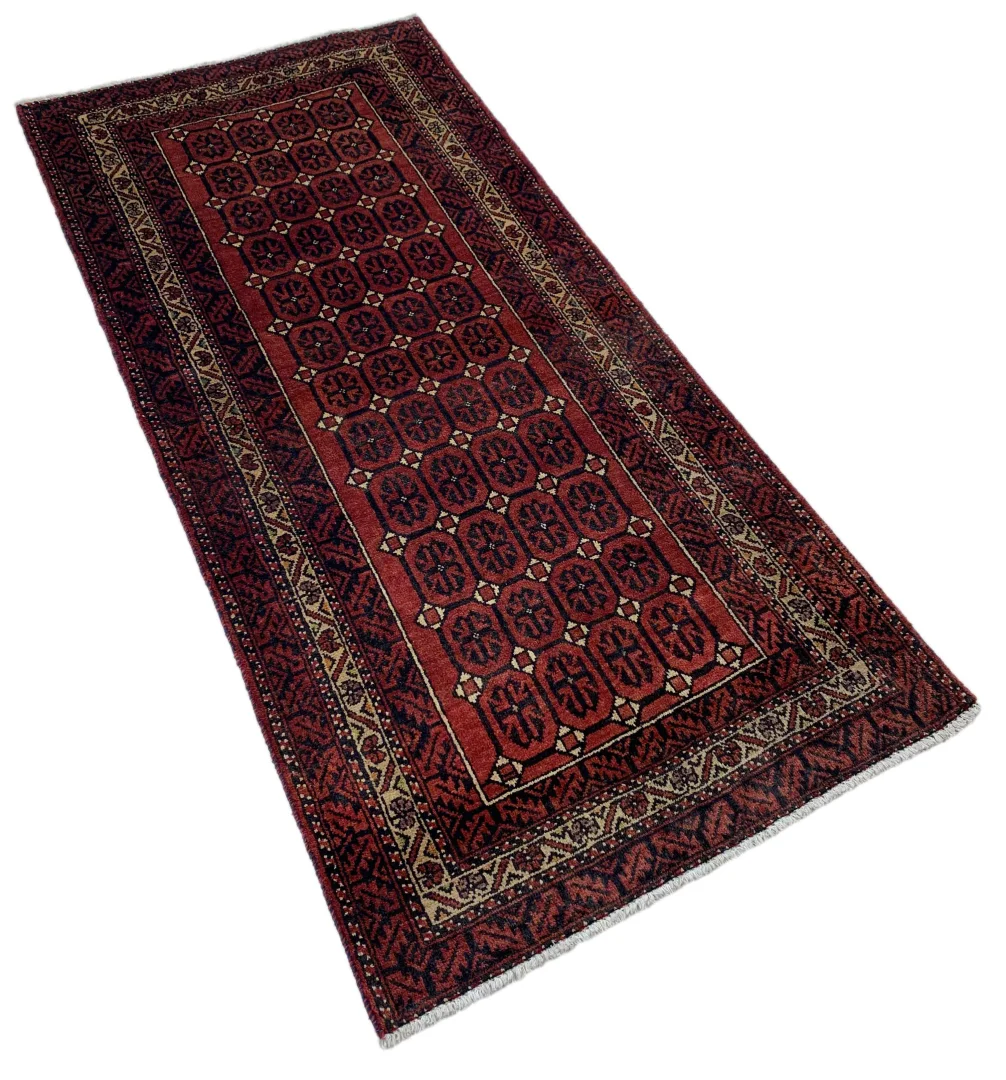
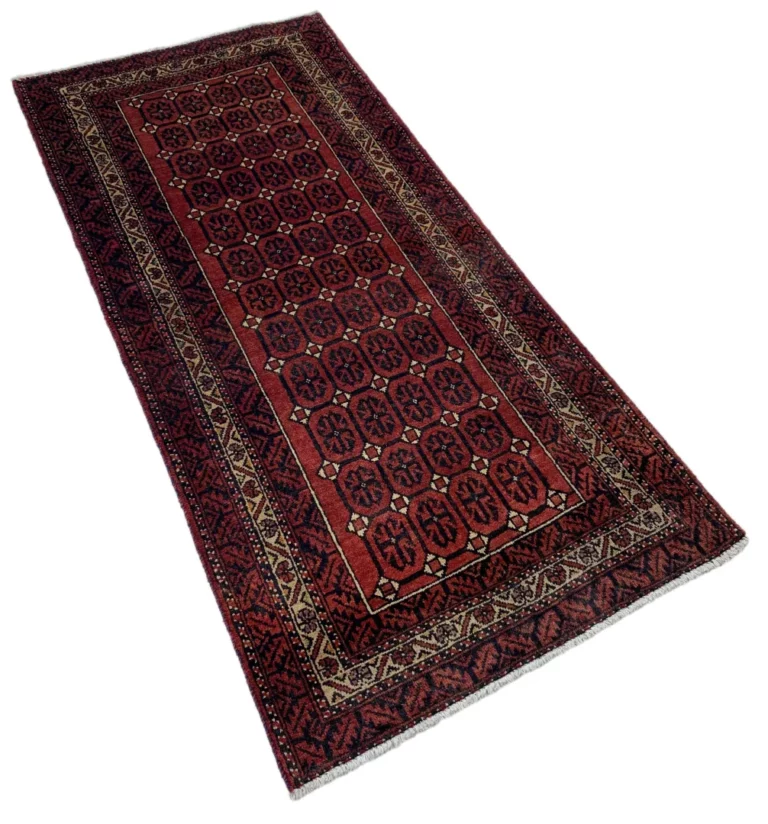
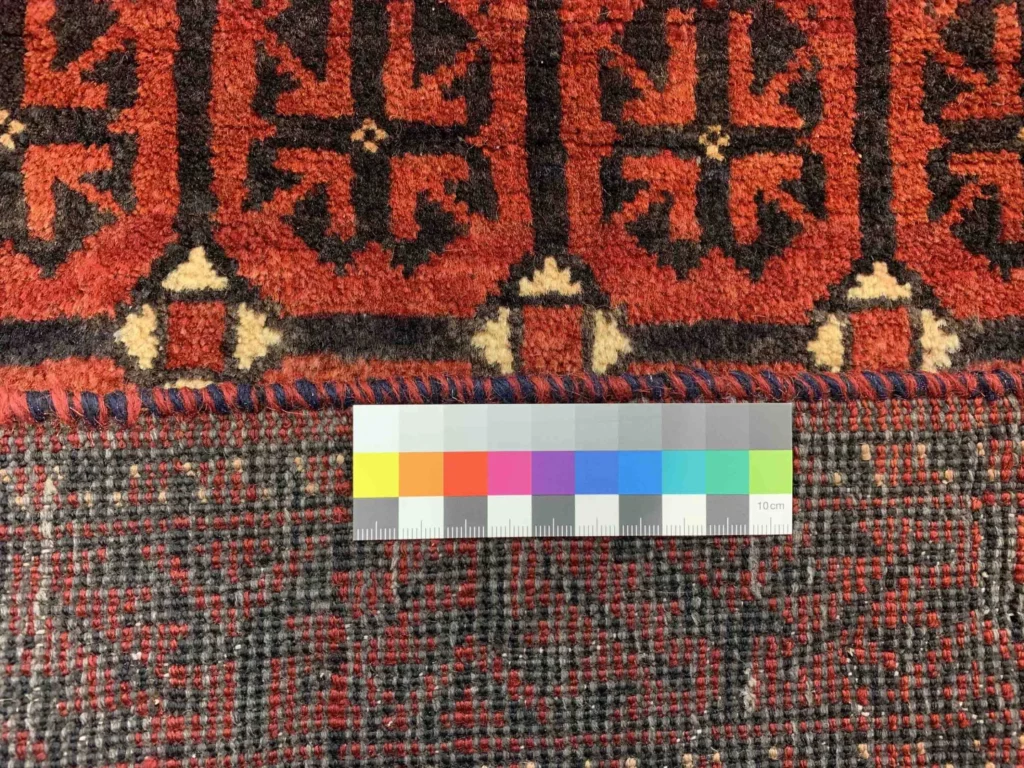
Hand-knotted Balutsch Oriental rug | Knot density: 120,000 – 250,000 knots/m² | Material: natural wool pile | Size: 173 x 84 cm | Pattern: geometric, red and brown tones | Condition: Very good
This Balutsch Oriental rug is hand-knotted and made from natural wool. Wool is a traditional rug material, valued for its resilient fibre structure and distinctive textile feel. In a hand-knotted rug, each knot is inserted by hand into the foundation, building the pile row by row. The finished piece therefore reflects a manual process rather than an identical industrial production method.
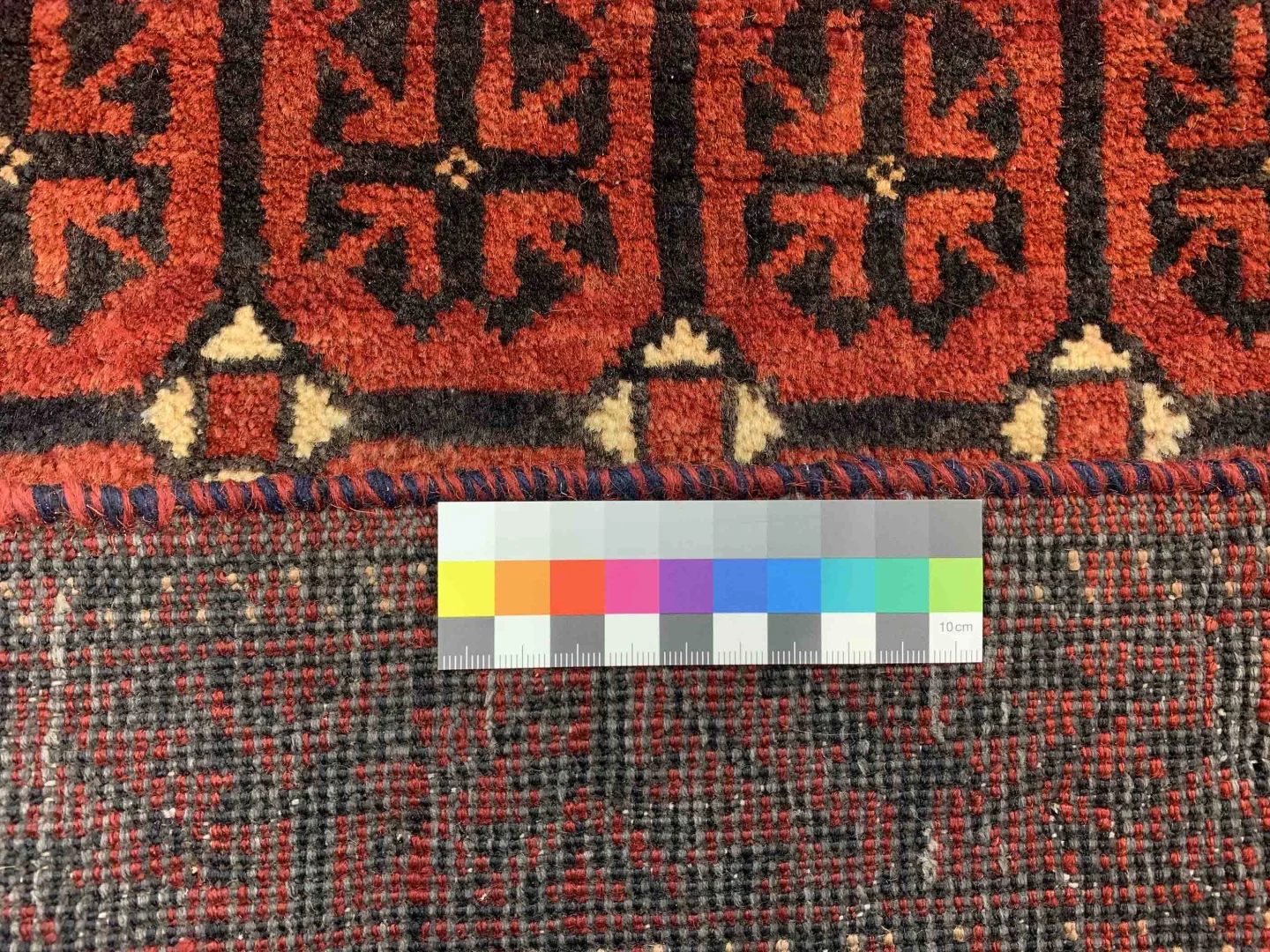
The rug has a knot density between 120,000 and 250,000 knots per square metre. This density supports a clearly defined surface and allows small geometric details to be worked with precision. Wool is also a material traditionally chosen for its durability in floor coverings. Its natural character suits the hand-knotted construction and gives the pile a firm, tactile quality.
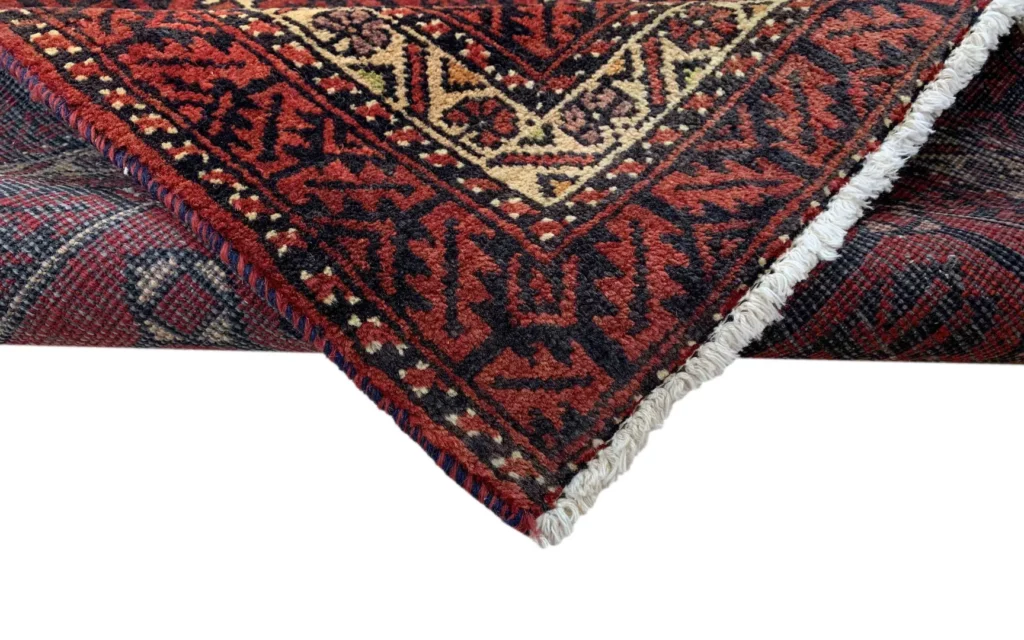
Hand production makes the structure of the rug part of its character. Knots, rows, wefts and colour areas are assembled in a continuous sequence of skilled operations. A geometric design requires careful placement so that lines, borders and repeated forms retain their visual order. The technique is therefore more than a label: it explains how the pattern and the surface have been created.
Origin and Tradition
The Balutsch Oriental rug belongs to the weaving tradition associated with the Baluch people. Its origin is stated as the border region between Afghanistan, Iran and Pakistan. This is a broad cultural area rather than a single workshop centre. Different communities and local practices have developed there, while movement, trade and shared knowledge have allowed textile ideas to circulate across the region. Balutsch rugs form a distinct tradition within this wider setting.
The Baluch people have a rich cultural heritage in which handmade textiles hold an important place. Rugs can serve practical purposes while also carrying inherited visual forms and symbols. Traditional knowledge is passed on through the individual stages of production: preparing the material, setting up the warp, tying the knots, inserting the wefts and finishing the edges. A hand-knotted rug connects the finished object with this accumulated craft knowledge.
Weaving in the region has often been carried out in domestic or small-scale craft settings. Local variations may reflect a particular community, place or weaver. For this reason, Balutsch is best understood as a cultural and design classification rather than as a single uniform formula. The tradition is commonly associated with durable materials, structured compositions and a concentrated palette, while individual rugs can vary in their arrangement and detail.
Afghanistan, Iran and Pakistan form a historic crossroads between several cultural and trading areas. Through these connections, motifs, dye practices and textile skills could be transmitted, adapted and combined. Balutsch weaving consequently reflects both regional identity and the broader exchange that has shaped oriental rug production. Its recognisable design language can appear in different forms without losing its connection to the Baluch tradition.
Other well-known rug traditions from the wider region include Heriz and Tabriz, as well as Kerman and Isfahan. These names refer to different design and weaving traditions and should not be confused with this Balutsch rug. They illustrate the variety of oriental rug cultures found in the surrounding areas. This piece belongs to the Balutsch tradition, identified here by its regional association and geometric visual language.
Design and Pattern
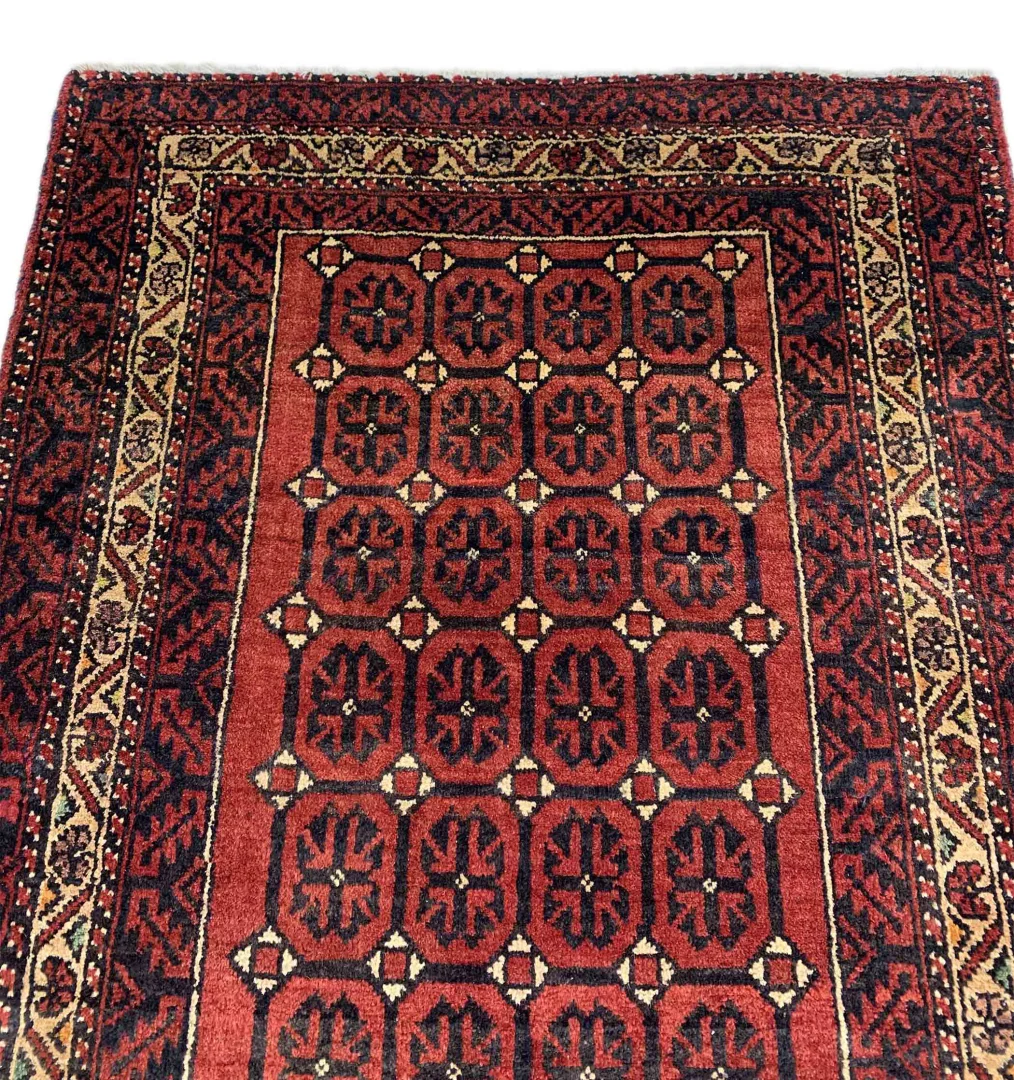
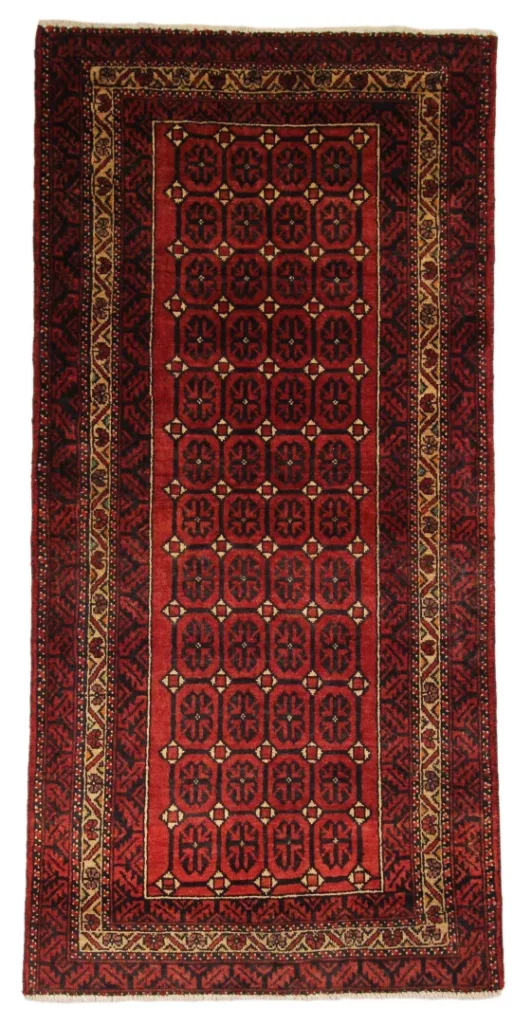
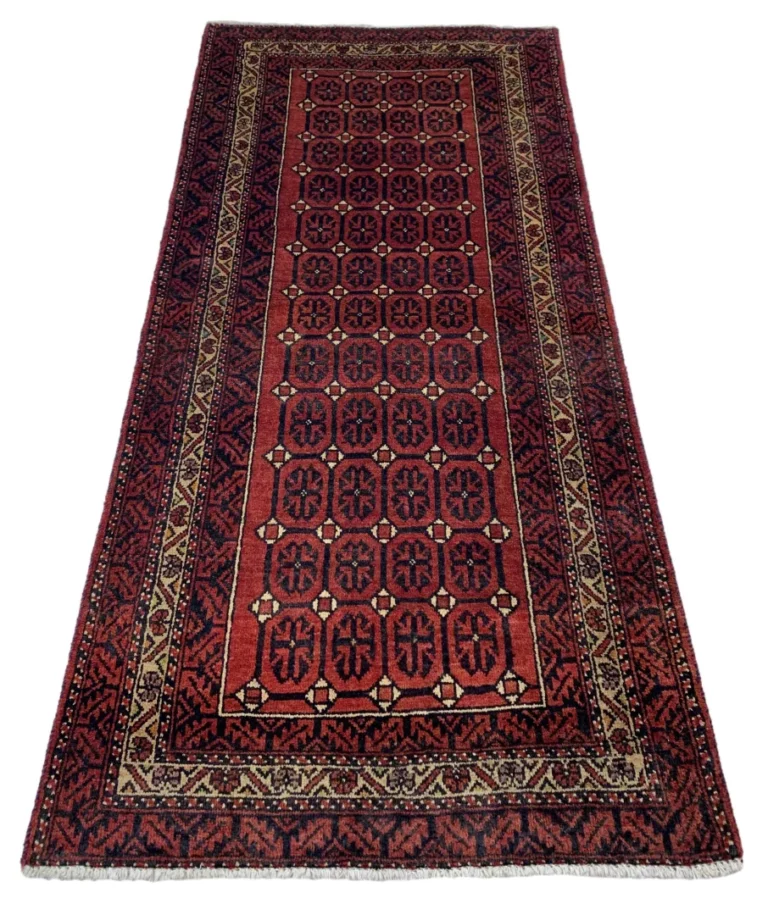
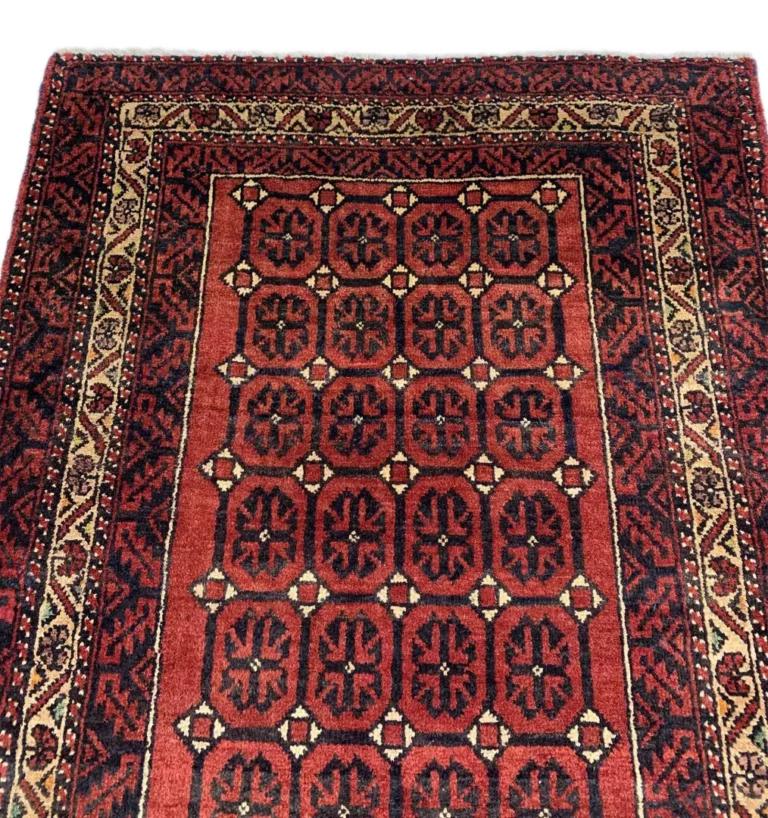
The pattern of this Balutsch rug is geometric. Geometric rug design uses lines, angles, diamonds, compartments, borders and repeated signs to organise the field. Its effect does not depend on a realistic depiction of nature, but on the relationship between forms and the spaces around them. In a hand-knotted rug, these elements are built gradually from individual knots and coloured sections, giving the design a distinctly textile presence.
The dominant colours are red and brown tones. Red is a significant colour in many oriental rug traditions and may range from deep earthy shades to stronger accents. Brown introduces a grounded, restrained counterpoint. Together, these colours create a warm palette whose character depends on the balance of the darker and lighter areas. The colour scheme remains traditional while allowing the geometric structure to remain legible.
Balutsch designs frequently draw on geometric signs associated with the cultural heritage of the Baluch people. Diamonds, hooked forms, stylised botanical references and divided medallions may be arranged into a connected visual system. Such motifs are not intended as literal naturalistic pictures. They are simplified, repeated and adapted to the available field, turning inherited symbols into a rhythm of shapes, lines and intervals.
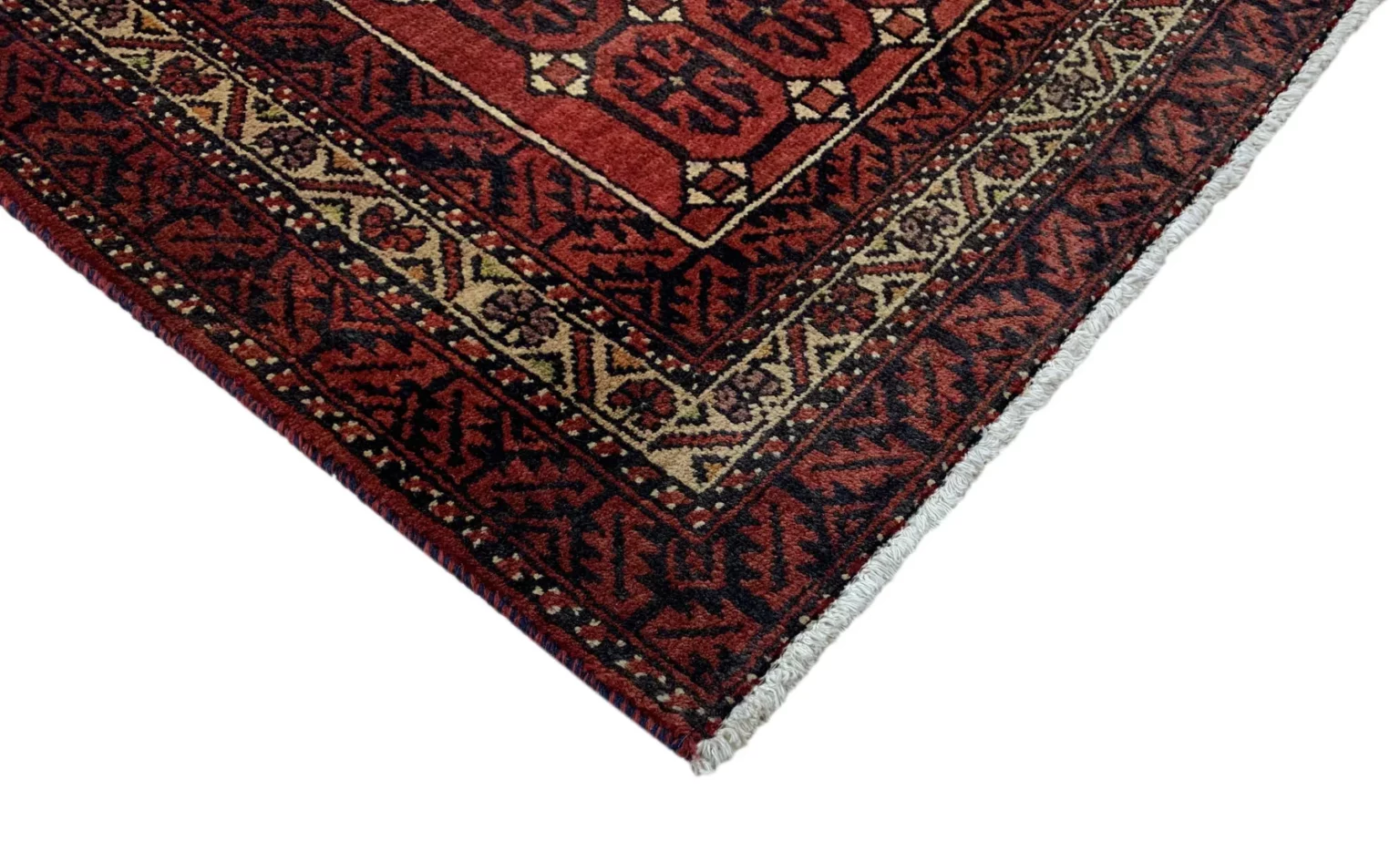
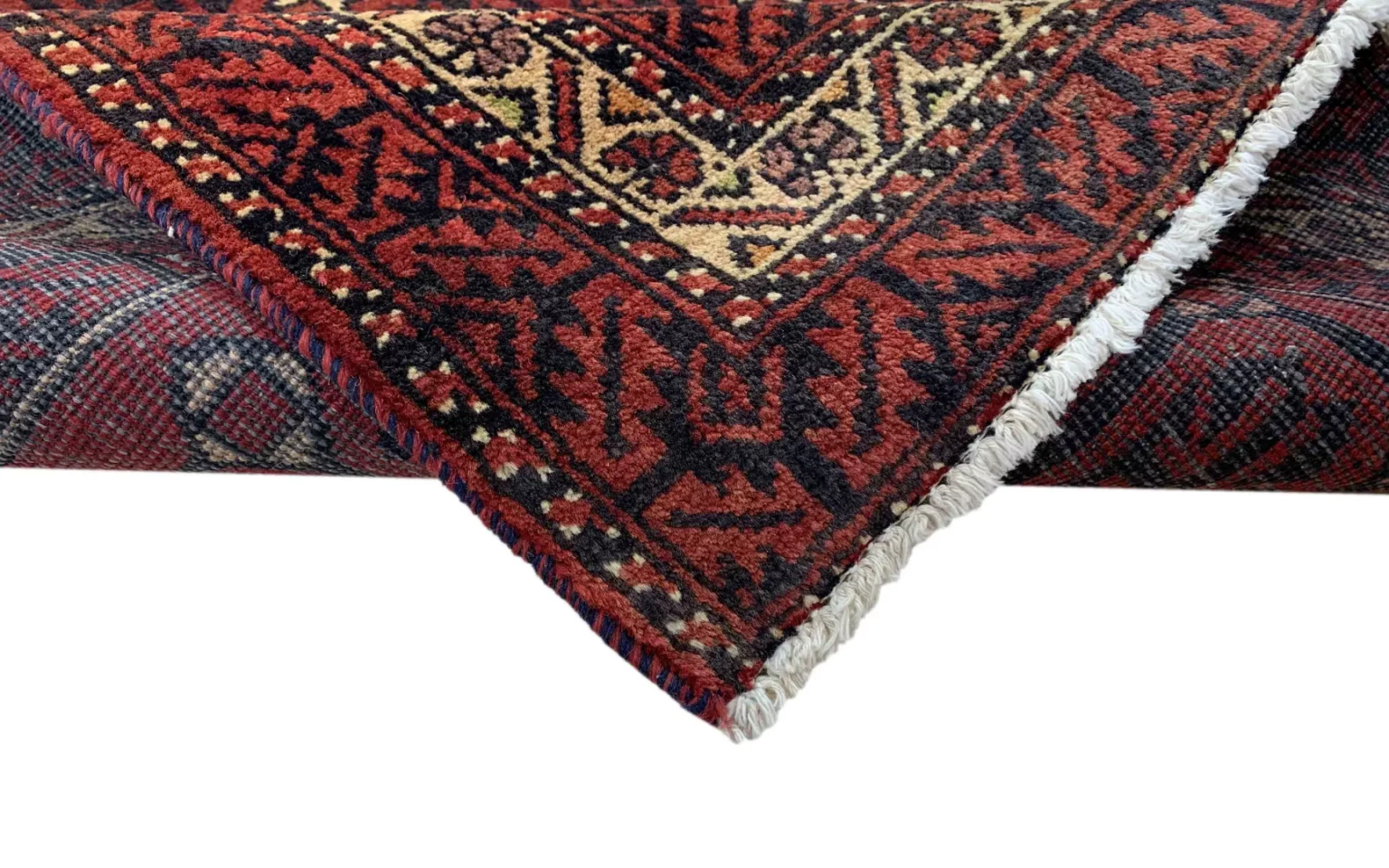
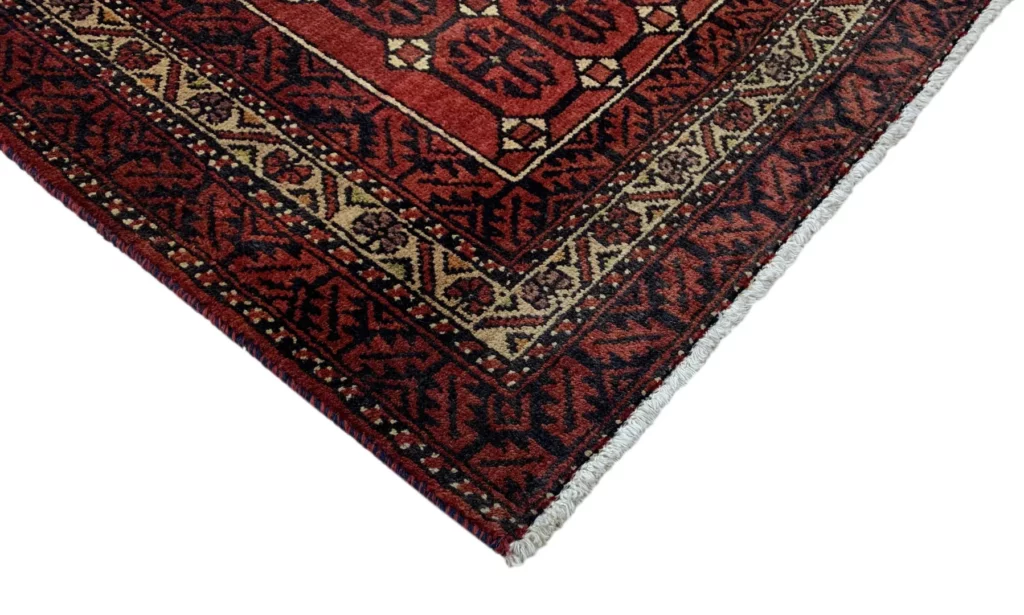
A border can frame the central field and establish a clear transition towards the edges. Repetition creates visual rhythm, while minor variations can reveal the handmade origin of the work. Because the pattern is formed through knotting rather than printed onto a finished surface, the design remains closely connected to the rug’s construction. Colour, pile and structure work together to define its appearance.
The red and brown palette can work with both traditional and contemporary interiors. In a modern room, the geometric pattern can introduce a deliberate contrast to plain surfaces and straight-lined furniture. In a more classic setting, the warm colours can sit naturally alongside wood, leather and subdued textiles. These possibilities arise from the general relationship between the palette and the geometric design, rather than from any particular room arrangement.
Special Features
The rug is described as dirt-repellent, which makes it generally suitable for areas where a floor covering receives regular use. Natural wool provides a traditional and durable material choice. Hallways and kitchens are named as possible settings. The right placement still depends on the level of use and on following an appropriate care routine.
Its condition is listed as very good. Together with the hand-knotted technique, natural wool and geometric Balutsch design, this gives the rug a clearly defined character. Every hand-knotted rug is a one-off because the arrangement of knots, colour areas and manual working stages is not reproduced as an identical industrial series.
FAQ
How should I care for this Balutsch Oriental rug?
For routine cleaning, use a vacuum cleaner without a brush attachment. This removes loose dust while avoiding unnecessary mechanical stress on the pile. If a spill occurs, dab it promptly with a damp cloth rather than rubbing the area. Vigorous rubbing can spread a mark or disturb the pile structure. Professional rug cleaning is recommended when deeper or more extensive soiling needs to be treated. The dirt-repellent description is helpful, but it does not replace regular, gentle care.
Can a Balutsch Oriental rug be used in a modern interior?
Yes. The warm red and brown tones can complement a restrained contemporary room, while the geometric pattern adds a distinct traditional element. The contrast between a hand-knotted surface and clean-lined furniture can create a balanced combination of old and new. The rug is therefore not limited to traditionally furnished rooms. Its final effect will depend on the colours, materials and patterns already present in the interior.
How can the quality of a Balutsch rug be assessed?
Knot density, material and workmanship are important points of assessment. This rug has a knot density between 120,000 and 250,000 knots per square metre, and natural wool is specified as its material. A higher knot density can support detailed pattern work. Other relevant observations include the evenness of the pile, the finish of the edges and the stability of the overall construction. Quality should therefore be considered through the combination of material, technique, pattern and condition.
To provide the best experiences, we use technologies like cookies to store and/or access device information. Consenting to these technologies will allow us to process data such as browsing behavior or unique IDs on this site. Not consenting or withdrawing consent, may adversely affect certain features and functions.
Functional Always active
The technical storage or access is strictly necessary for the legitimate purpose of enabling the use of a specific service explicitly requested by the subscriber or user, or for the sole purpose of carrying out the transmission of a communication over an electronic communications network.
Preferences
The technical storage or access is necessary for the legitimate purpose of storing preferences that are not requested by the subscriber or user.
Statistics
The technical storage or access that is used exclusively for statistical purposes.The technical storage or access that is used exclusively for anonymous statistical purposes. Without a subpoena, voluntary compliance on the part of your Internet Service Provider, or additional records from a third party, information stored or retrieved for this purpose alone cannot usually be used to identify you.
Marketing
The technical storage or access is required to create user profiles to send advertising, or to track the user on a website or across several websites for similar marketing purposes.

 SECURE PAYMENT
 SHIPPING PARTNERS


