This Afghan Kilim is made from 100% virgin wool. The wool is hand-spun and hand-dyed, so the making of the piece involves several manual stages before the weaving itself begins. Preparing the fibre, creating the yarn, adding the colour and building the textile surface are all part of its hand-worked character.
As a Kilim, the rug is hand-woven and belongs to the tradition of flat-woven textiles. In this technique, coloured weft yarns are worked through the warp to form a continuous, flat textile surface. Unlike a knotted rug, it does not obtain its structure from individual pile knots. The result is the compact construction and distinctive surface associated with a flat weave.
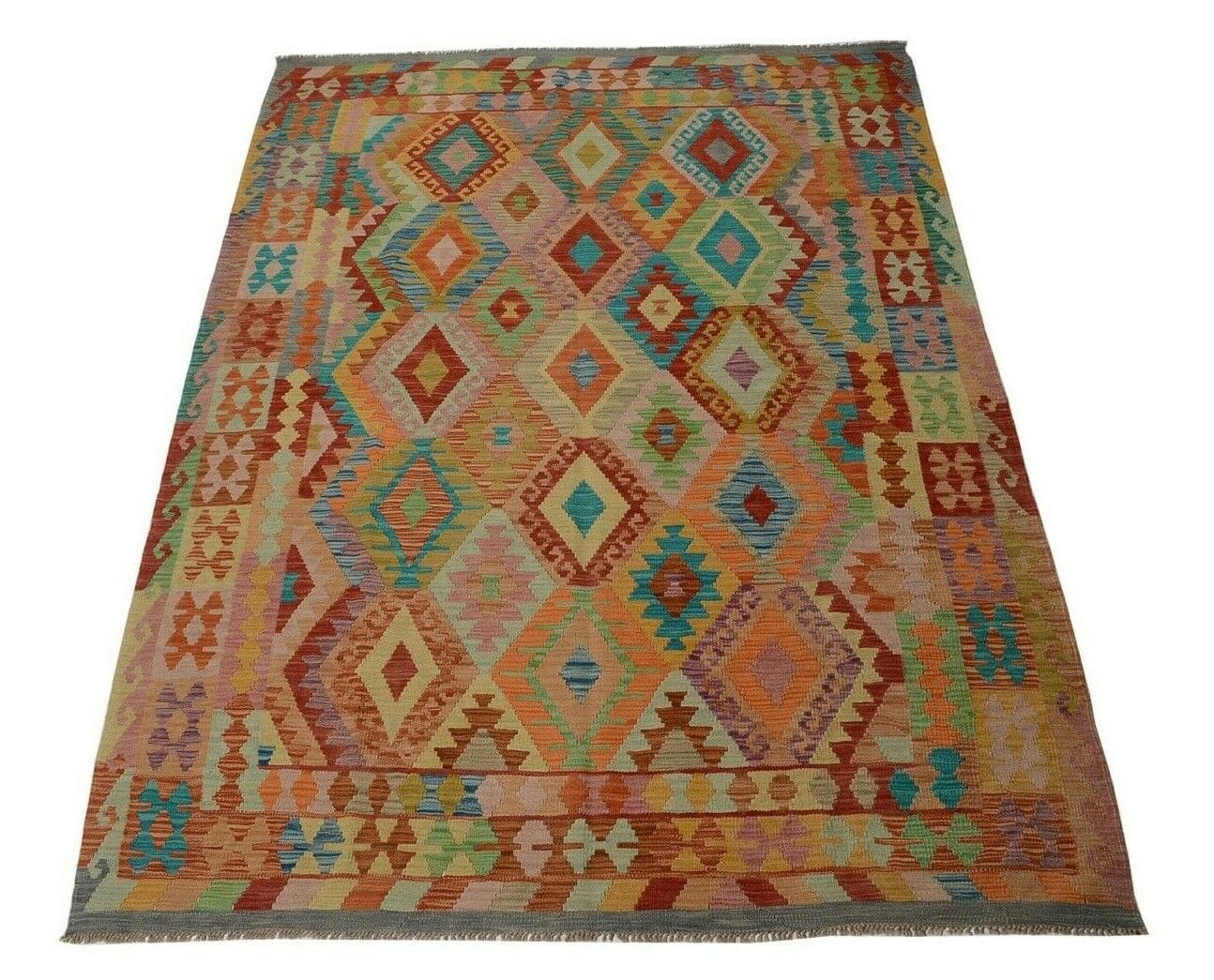
The use of hand-spun virgin wool shapes the feel of the textile. Hand-dyed yarns provide the pastel colours that define the geometric design. This rug is described as new and in perfect condition. It is suitable for rooms with underfloor heating and can therefore be used in interiors equipped with that system.
Origin and Tradition
The Kilim comes from Afghanistan. Afghan rugs and Kilims belong to a varied weaving culture maintained across different regions and communities. Flat weaving is closely linked to the use of wool: the fibre is spun, coloured and then worked on a loom to create a surface that is both useful and decorative.
Afghan Kilims are traditionally made on looms. Weavers pass the weft yarns by hand through the warp and compact the structure progressively. When the design changes, the sequence of coloured yarns changes as well. This method is well suited to clear geometric forms, repeated elements and connected linear arrangements. The weaving process therefore provides the foundation for an ordered pattern language.
Afghan weaving traditions show regional differences in colour, form and composition. The appearance of a Kilim can vary with the community and craft environment in which it is made. The shared basis is the combination of practical textile production and inherited design knowledge. A Kilim is not simply a woven floor covering; it also demonstrates how wool is prepared as a material and transformed into a textile image through colour and pattern.
The transmission of craft knowledge is an important part of this tradition. Skills relating to spinning, dyeing, weaving and arranging motifs are taught within families and communities. Hand production does not create industrially identical objects. Instead, each finished piece reflects its own execution, with the manual process visible in the treatment of colour, the weave and the drawing of the lines. This is part of the character of a one-off textile.
The origin Afghanistan therefore identifies a distinct Oriental weaving culture. Afghan Kilims combine a flat construction with an organised pattern structure and the use of wool. Traditional technique and present-day interiors can exist together: the method remains rooted in established craft practice, while the colour arrangement and geometric design can be placed in a range of contemporary settings.
Design and Pattern
The pattern of this Kilim is geometric. Its composition is based on forms, lines and ordered repetition rather than on a freely painted image. Geometric Kilim designs are developed directly through the weave. Coloured sections are built while the textile is being made, giving the finished surface a clearly structured, woven appearance.
The palette consists of pastel colours. These light, subdued tones determine the visual presence of the rug while retaining the clarity of its geometric arrangement. Pastel shades can connect separate forms and leave the spaces between them visible. A geometric design can therefore appear calm and balanced rather than severe, depending on the relationship between its shapes and colours.
The combination of flat weaving, geometric drawing and pastel colour brings traditional and contemporary aspects together. The forms relate to the long history of patterned textiles in Afghanistan, while the gentle palette allows the piece to sit comfortably within modern interiors. The design remains easy to read: lines and colour fields are the main elements of the composition.
A Kilim does not receive its design after the textile surface has been completed. The pattern is created during weaving with coloured weft yarns. Construction and appearance are consequently connected from the beginning. Edges, transitions and blocks of colour take their character from the manual process. The woven method influences not only the surface but also the way the geometric motif is expressed.
The pastel palette allows the Kilim to work with several furnishing styles. It can be used in a light, restrained room, alongside natural materials or within an interior that includes ethnic references. The geometric pattern provides visible order, while the soft colours remain comparatively quiet. In a living room it can define a seating area; in a bedroom it can add a textile layer; in an entrance it can establish a clear decorative element.
The Kilim can also serve as a textile foundation beneath a dining table. Its flat construction has a different spatial effect from a deep-pile rug and keeps furniture visually close to the floor. The light colour composition can be combined with bright and welcoming interiors. Its defining identity remains the meeting of geometric design and Afghan flat-weaving tradition.
Special Features
The Kilim is new and in perfect condition. Its construction from 100% hand-spun and hand-dyed virgin wool and its hand-woven technique are stated features of this piece. The flat construction makes it suitable for rooms with underfloor heating. It may be used indoors as well as outdoors.
Regular vacuuming on a low setting is recommended for care. When necessary, the Kilim can be gently shaken or beaten outdoors. Direct sunlight should be avoided so that the colours do not fade. If a stain occurs, it should be dabbed immediately with a clean, damp cloth. These instructions take account of the wool fibre and the flat, hand-woven construction.
The combination of manual production, geometric pattern and pastel colours gives this Afghan Kilim a range of possible uses. Its suitability for underfloor heating and its stated use indoors and outdoors extend the settings in which the flat-woven textile can be placed.
FAQ
How should I care for the Afghan Kilim?
Vacuum the Kilim regularly using a low setting. If required, it can be gently shaken or beaten outdoors. Keep it away from direct sunlight to help prevent the pastel colours from fading. Any stain should be dabbed immediately with a clean, damp cloth. There is no need to rub the affected area; careful treatment is appropriate for the hand-woven wool structure.
Is the Kilim suitable for underfloor heating?
Yes. The Afghan Kilim is suitable for rooms with underfloor heating. Its flat-woven construction is appropriate for this type of use. The wool provides pleasant heat insulation, allowing the Kilim to be used in a room with this heating system while retaining its role as a flat-woven textile floor covering.
Where is the best place to put the Afghan Kilim?
The Kilim can be placed in a living room, bedroom or entrance area. In a living room it can serve as a base for a seating area, while in a bedroom it adds a textile element and in an entrance it creates a clearly defined feature. It can also be placed beneath a dining table. The pastel colours are particularly suited to light and welcoming interiors. The Kilim is additionally suitable for both indoor and outdoor use.
To provide the best experiences, we use technologies like cookies to store and/or access device information. Consenting to these technologies will allow us to process data such as browsing behavior or unique IDs on this site. Not consenting or withdrawing consent, may adversely affect certain features and functions.
Functional Always active
The technical storage or access is strictly necessary for the legitimate purpose of enabling the use of a specific service explicitly requested by the subscriber or user, or for the sole purpose of carrying out the transmission of a communication over an electronic communications network.
Preferences
The technical storage or access is necessary for the legitimate purpose of storing preferences that are not requested by the subscriber or user.
Statistics
The technical storage or access that is used exclusively for statistical purposes.The technical storage or access that is used exclusively for anonymous statistical purposes. Without a subpoena, voluntary compliance on the part of your Internet Service Provider, or additional records from a third party, information stored or retrieved for this purpose alone cannot usually be used to identify you.
Marketing
The technical storage or access is required to create user profiles to send advertising, or to track the user on a website or across several websites for similar marketing purposes.
 SECURE PAYMENT
 SHIPPING PARTNERS


