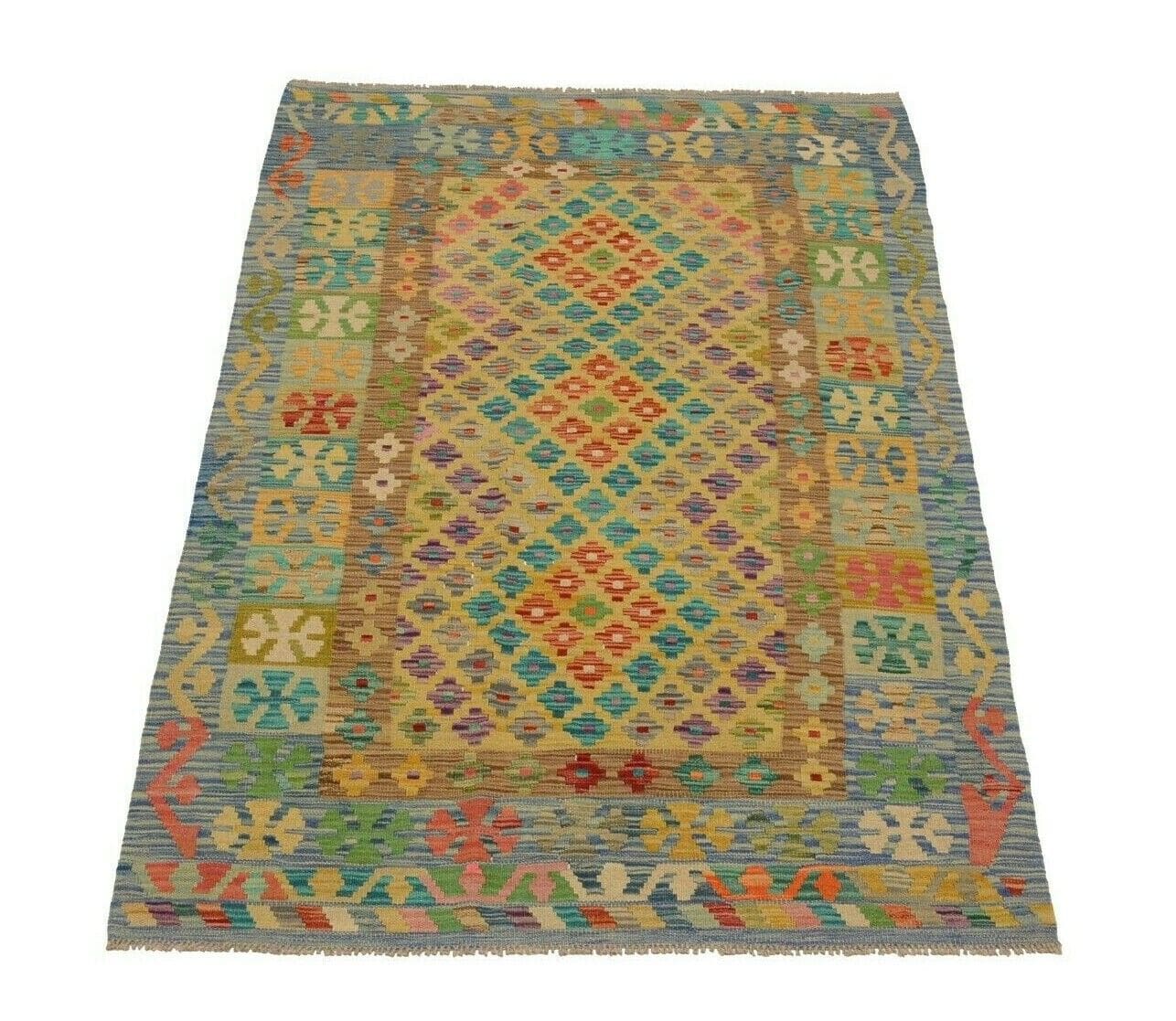
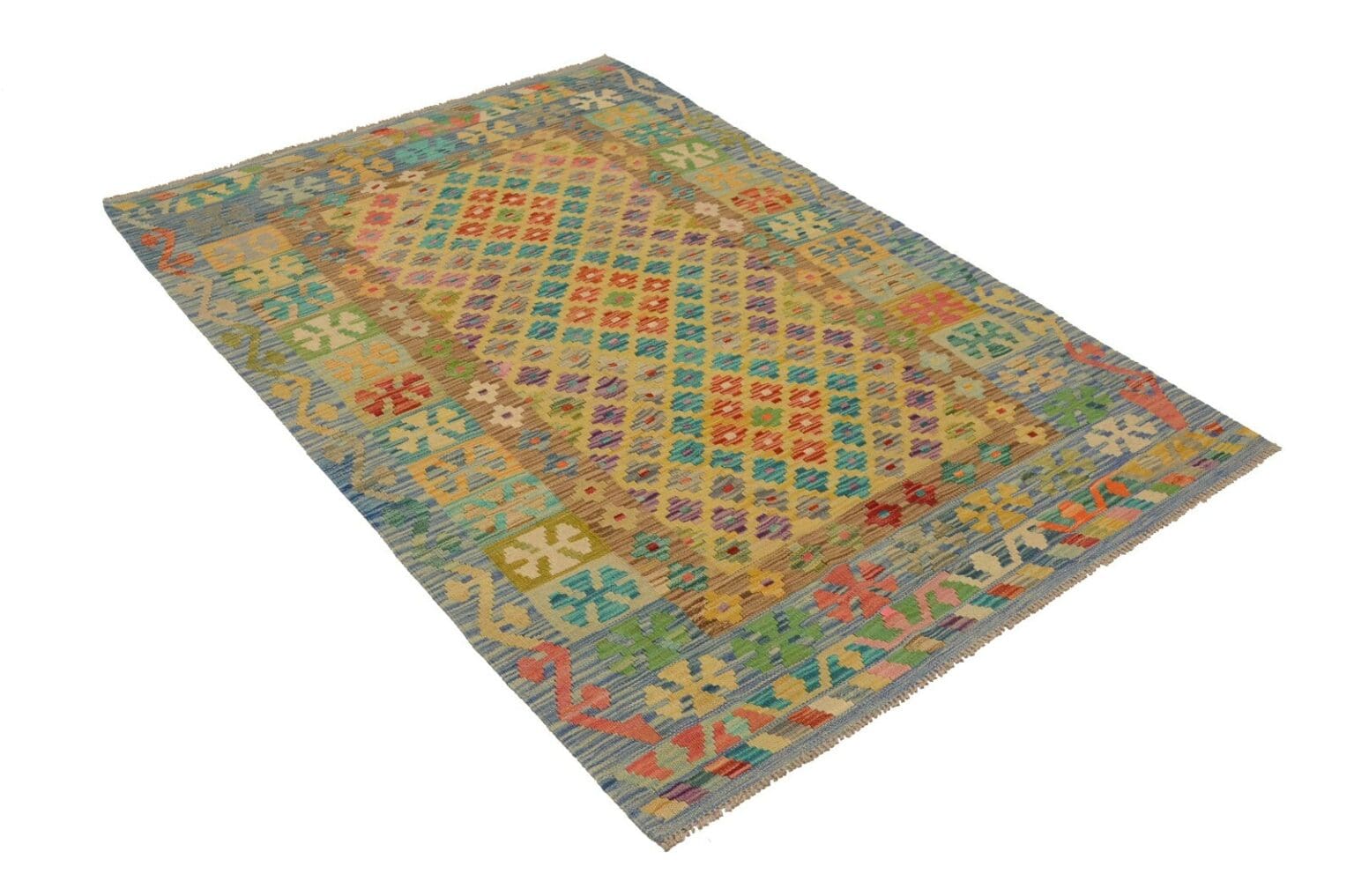
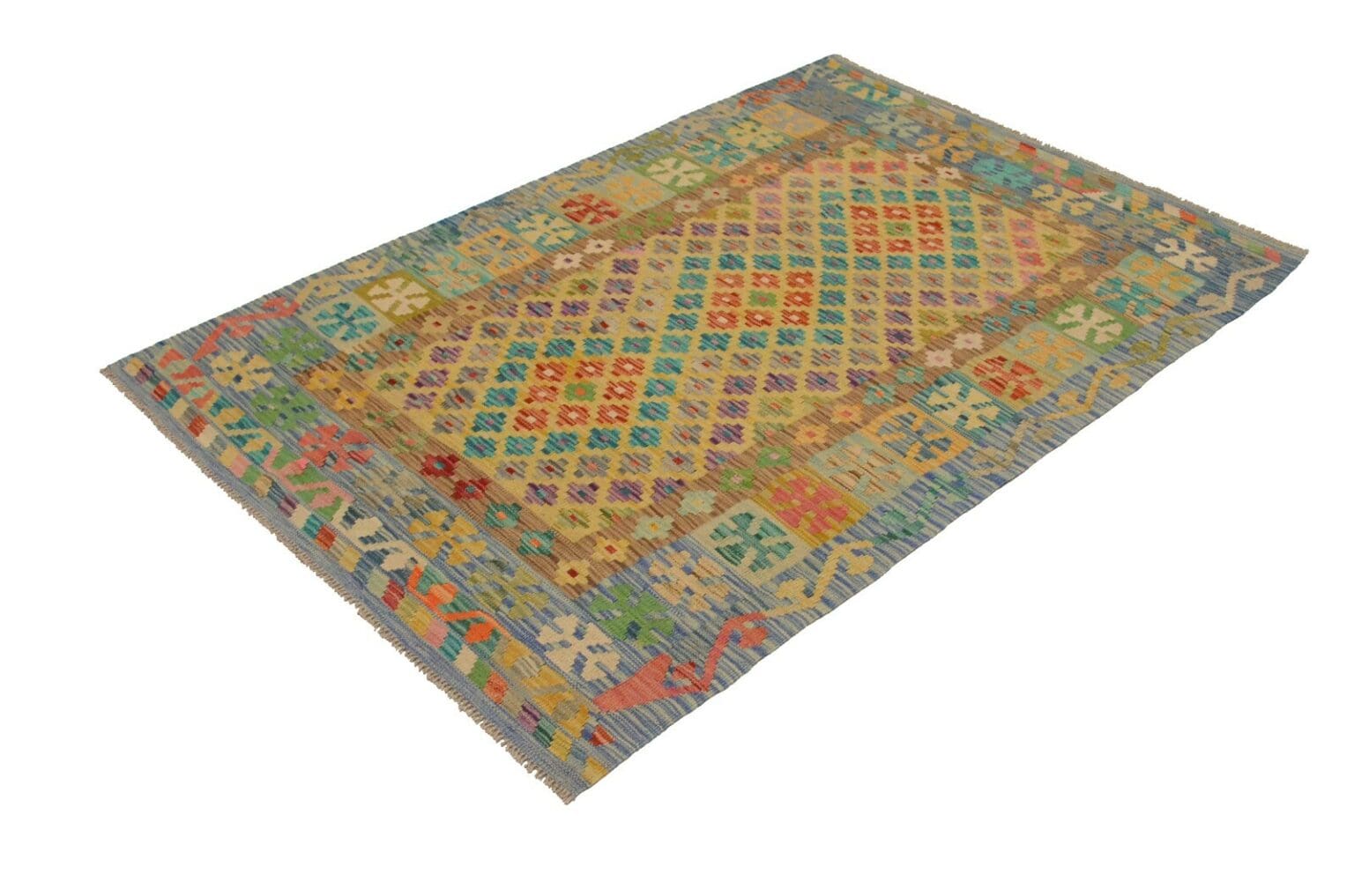
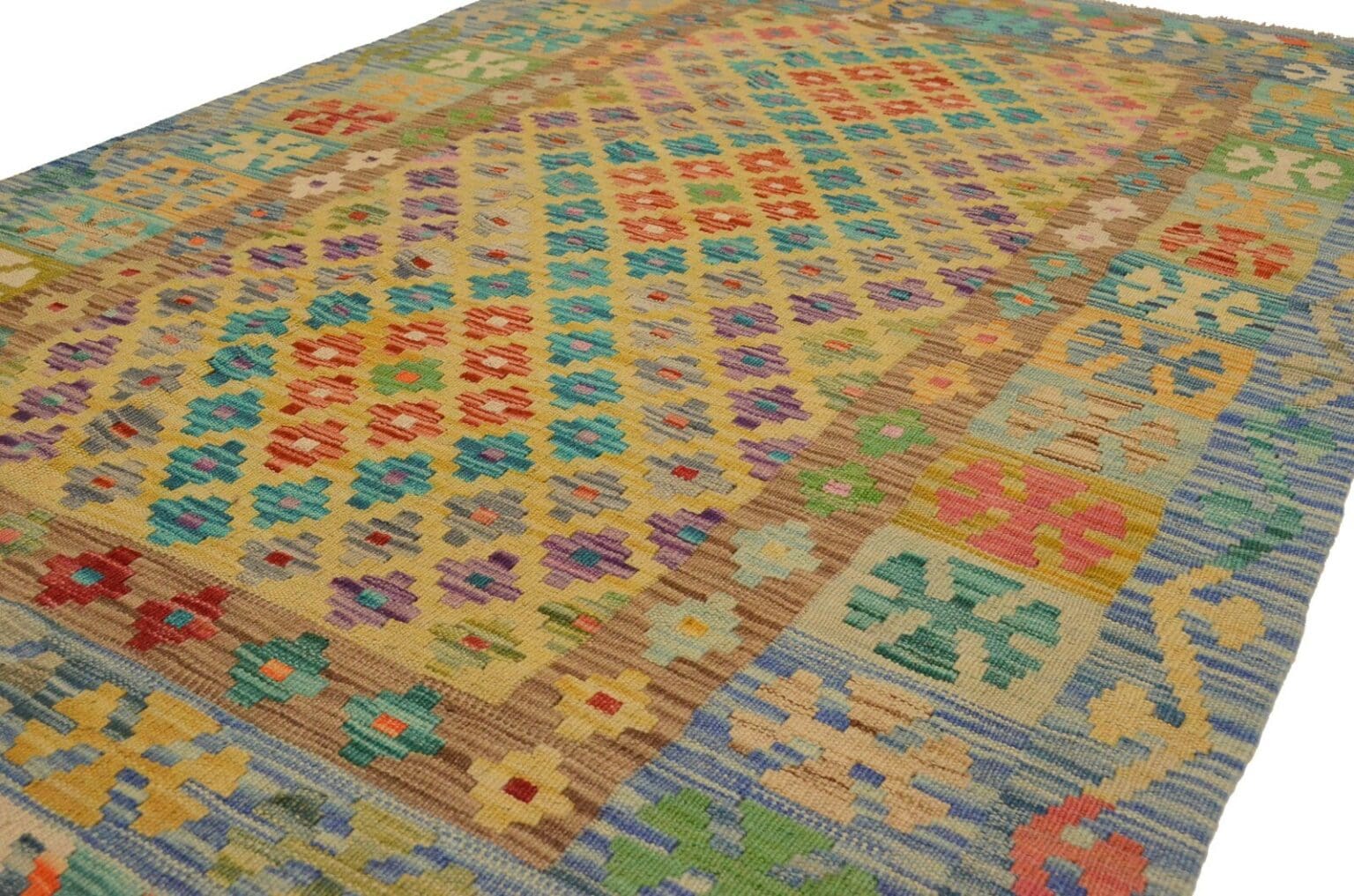
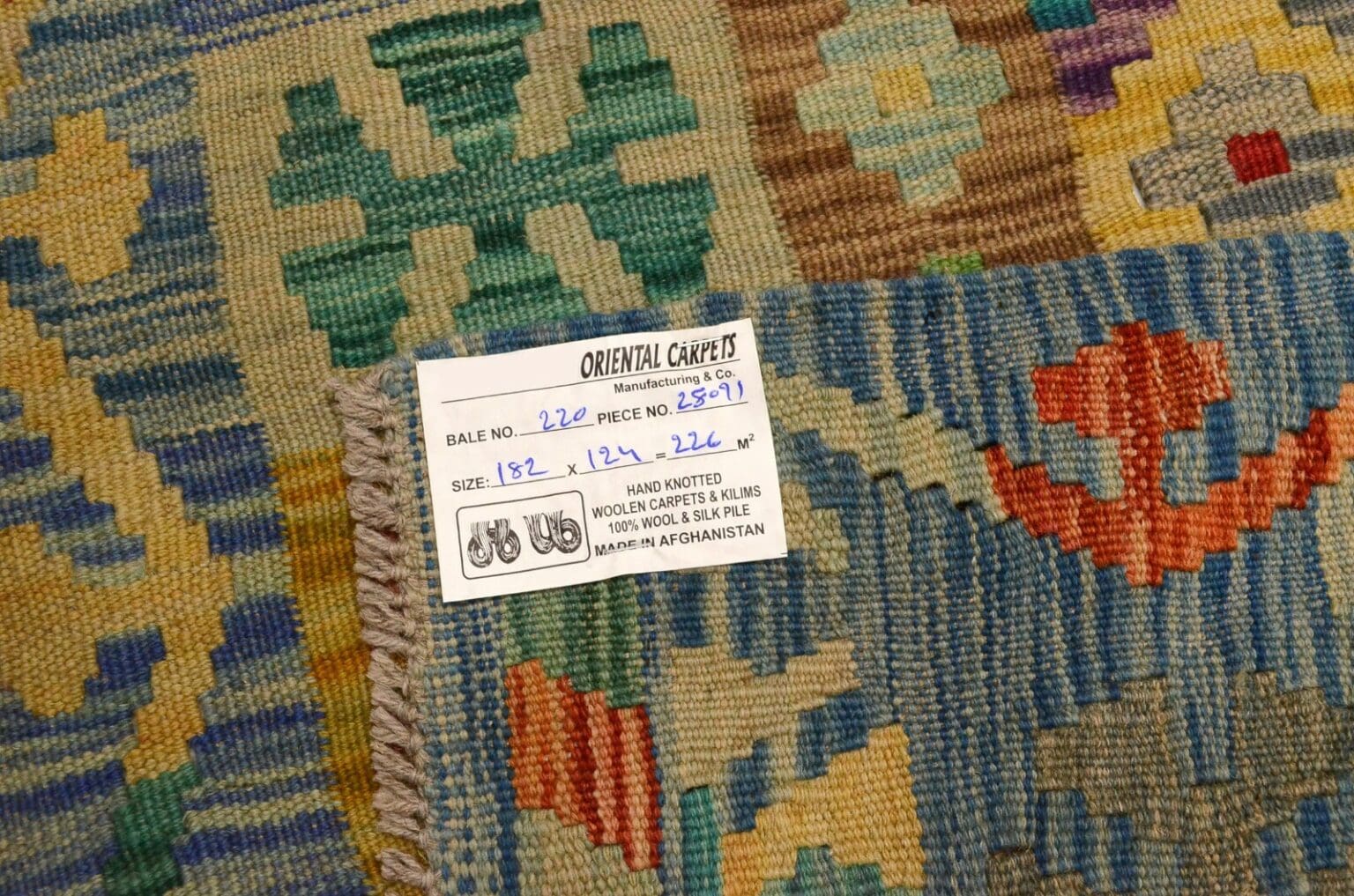
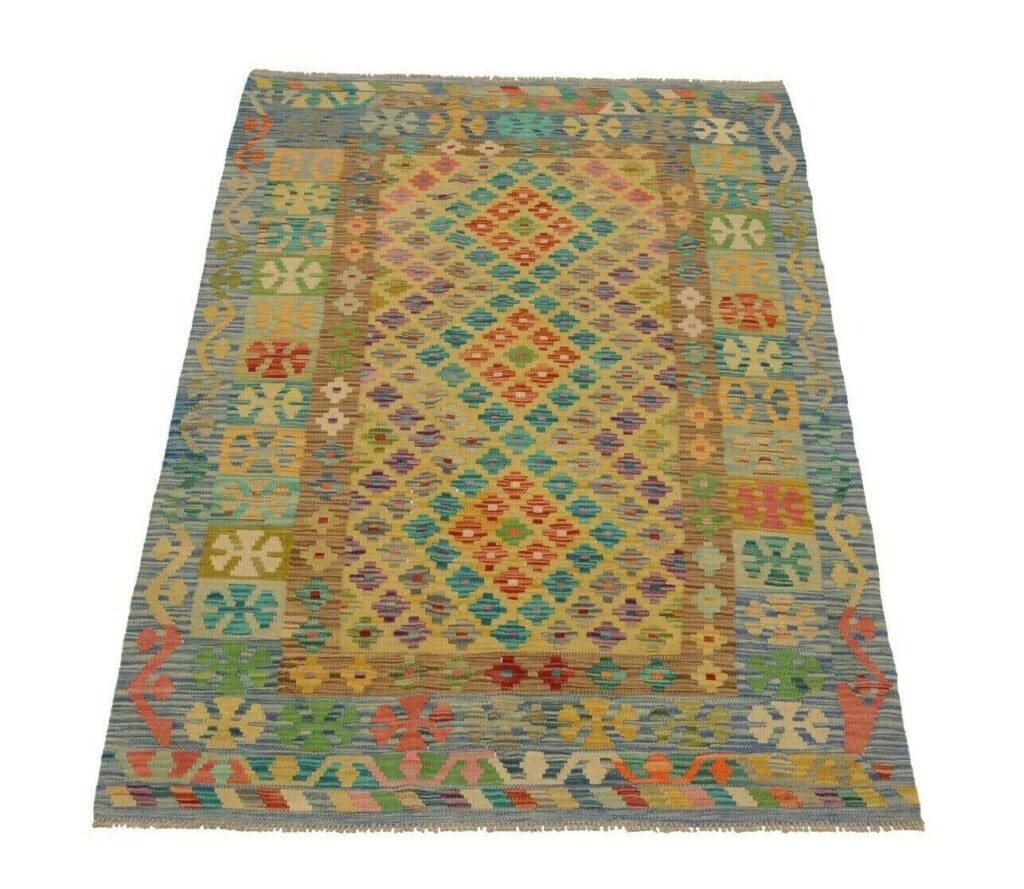
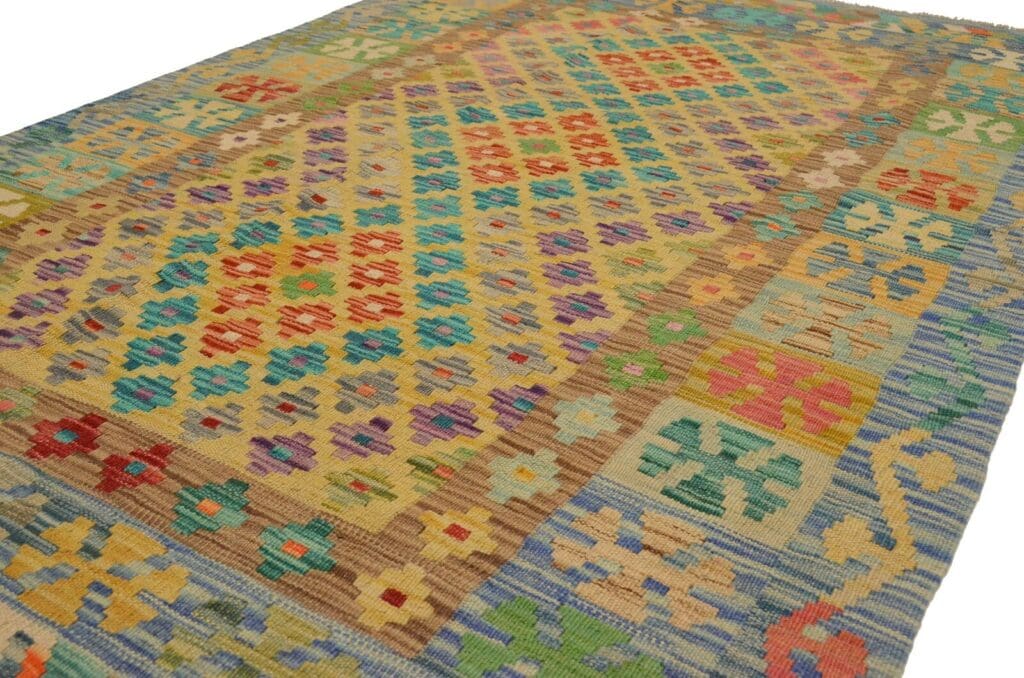
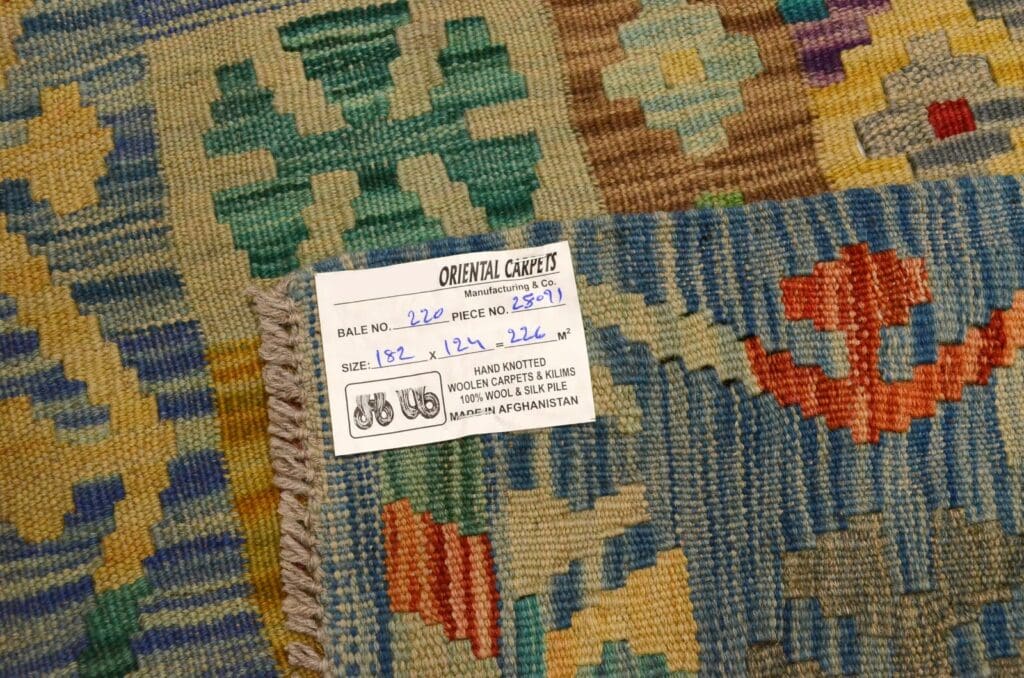
Hand-woven Afghan Oriental rug | Material: 100% virgin wool pile, hand-spun and hand-dyed | Size: 182 x 124 cm | Pattern: Geometric all-over design in pastel colours | Condition: New and in perfect condition
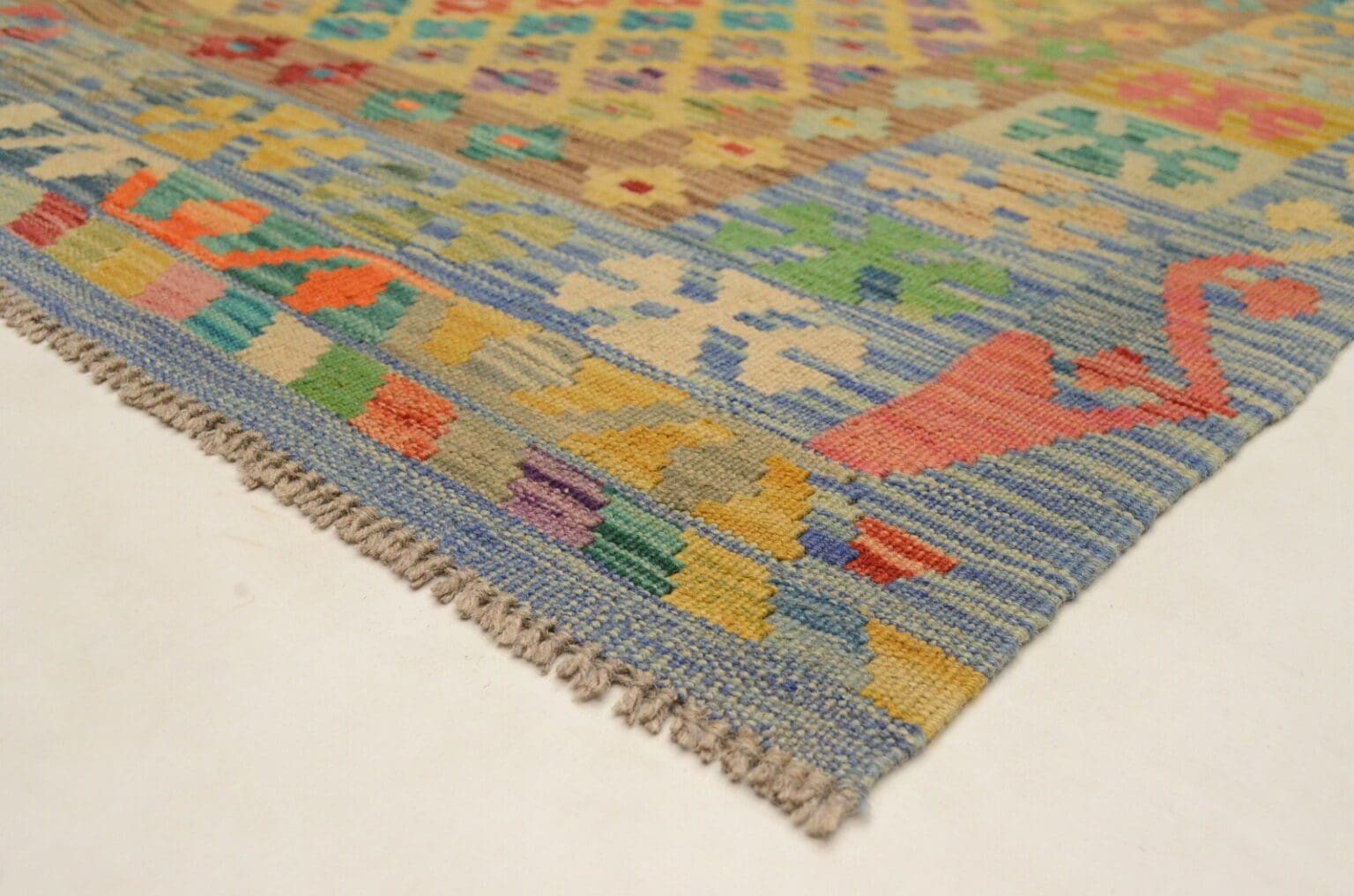
This Afghan kilim is hand-woven from 100% virgin wool. The wool is hand-spun and hand-dyed, so the material passes through several manual stages before becoming the finished textile. A kilim is made by weaving rather than by tying individual pile knots into a foundation. Its surface is therefore flat and textile in character, unlike the raised, fuller structure associated with a hand-knotted rug.
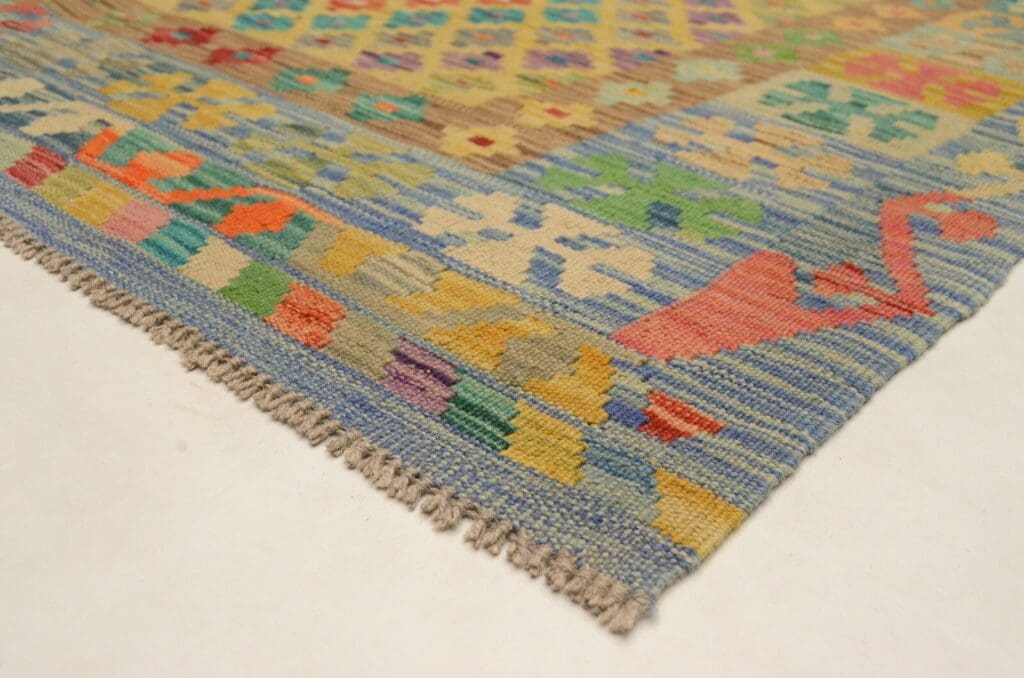
The weaving method gives this piece an even, low-profile construction. Its geometric design is formed as part of the woven surface, with colours and shapes arranged within the textile rather than printed onto it afterward. Hand-spun wool can retain a lively fibre texture, while hand-dyeing gives the colours their individual quality. These are stated features of this rug and describe both the material and the work carried out during its production.
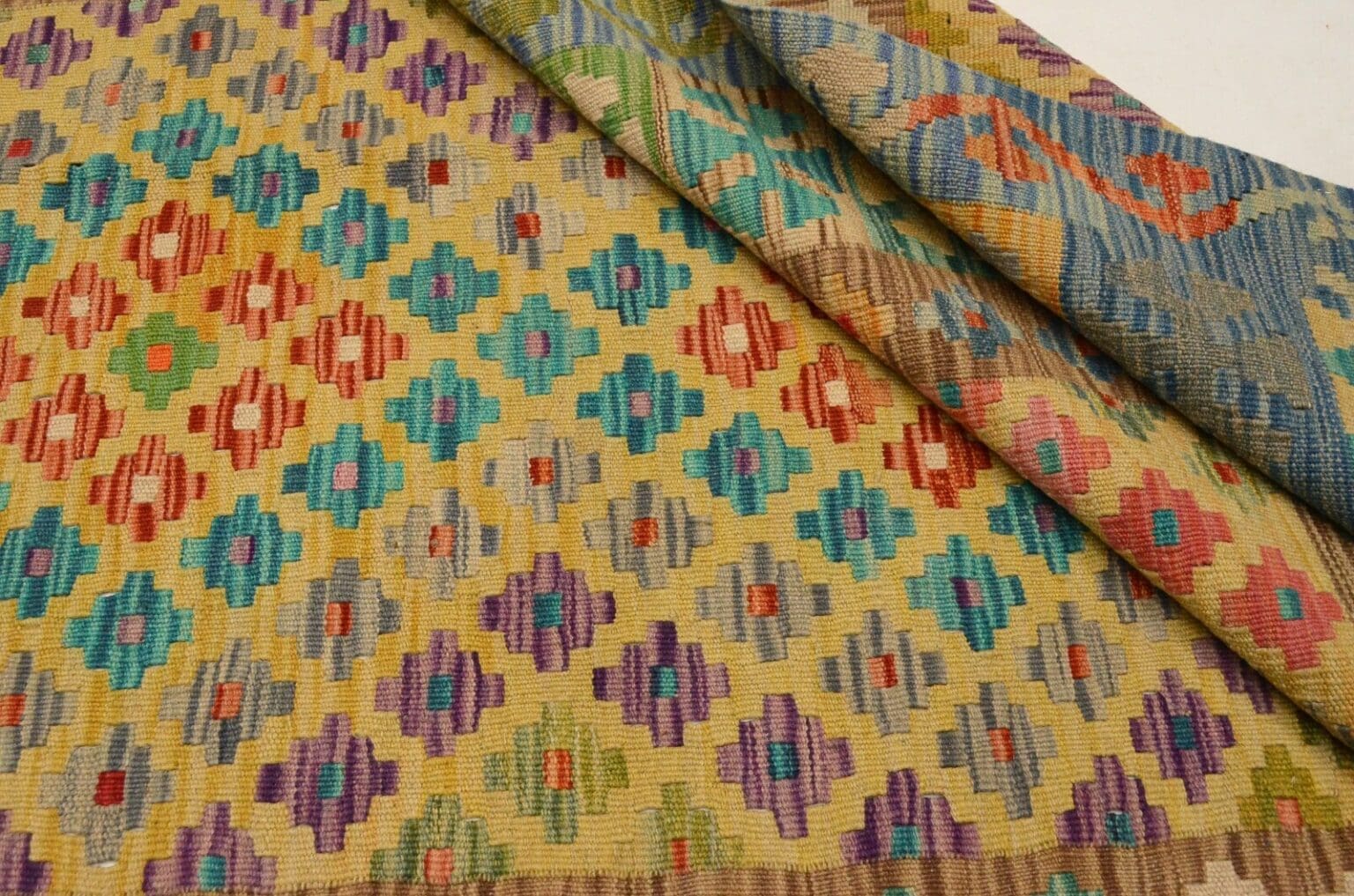
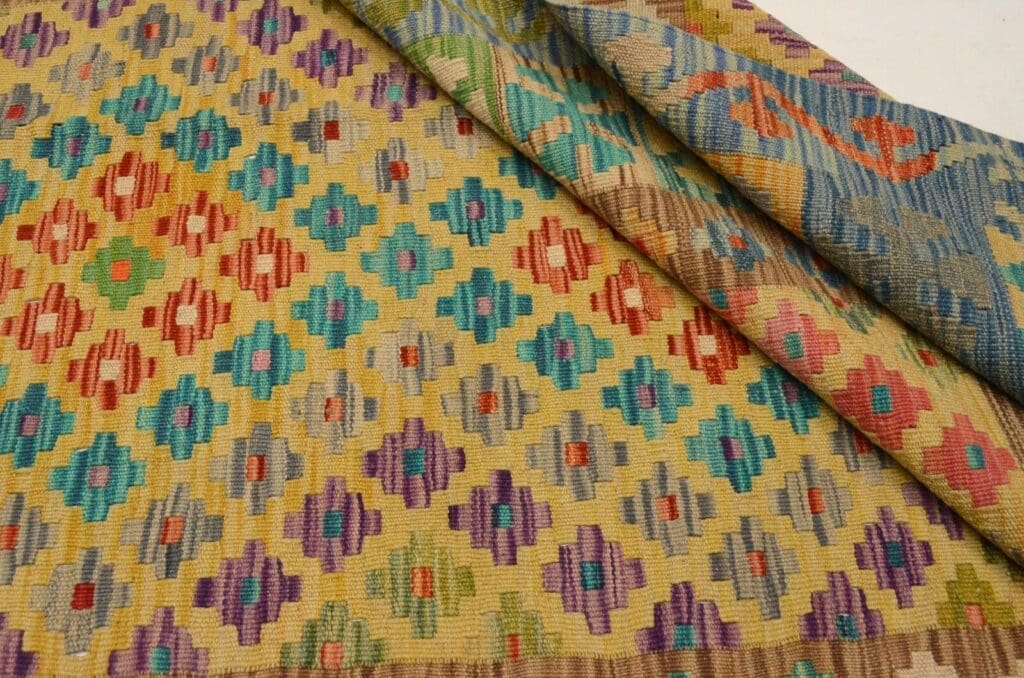
The kilim’s flat structure allows it to be used on the floor or as a wall decoration. A flat-woven textile generally occupies less space than a high-pile rug, making this type of construction suitable wherever a low-profile floor covering is preferred. This kilim is also suitable for underfloor heating. Its thickness is approximately four millimetres, and its listed weight is approximately two kilograms per square metre.
The character of the piece comes from the combination of wool, handwork and weaving. Wool is a natural fibre that can be spun and dyed before being incorporated into a woven surface. The hand-spun yarn and hand-dyed colours preserve a visible relationship between the raw material and the finished design. The result is an individual textile rather than a mechanically uniform surface, with the structure of the weave contributing to its appearance.
In a kilim, the making process remains closely connected to the visible pattern. The weaver coordinates the yarns, colour areas and geometric sections as the fabric is built. This requires regular attention to the sequence of the design and to the relationship between adjacent sections. The stated hand-woven construction, virgin wool, hand-spun yarn and hand-dyed colours therefore belong together as the defining material facts of this Afghan piece.
Origin and Tradition
This kilim comes from Afghanistan. Afghanistan has a long textile and carpet tradition, with different areas and workshops developing their own ways of weaving, colour preferences and pattern languages. Hand-woven kilims form part of this tradition of flat textiles. Their structure is created through the interlacing of warp and weft, producing a woven field without the separate pile typical of a knotted carpet.
In Afghan weaving communities, knowledge of textile production has traditionally been passed from one generation to the next. This knowledge includes preparing wool, spinning fibres, dyeing yarns and organising a pattern during the weaving process. The work requires concentration because the colour sequence and geometric arrangement must be maintained while the textile grows. Depending on the workshop and the individual maker, the finished surface may appear clearly ordered or retain the lively variation associated with handwork.
Afghan kilims are often described as flatter and simpler in construction than hand-knotted carpets. This distinction refers to the technique rather than to the cultural value of the textile. The low-profile structure offers a different practical use and allows the graphic design to remain immediately visible. A kilim can function as a floor covering where a flat solution is wanted, or as a wall textile where its woven construction can be viewed directly.
Natural fibres have an important place in the carpet and textile traditions of Afghanistan. Wool can be spun, dyed and woven into a durable textile, which makes it a practical and expressive material at the same time. The wool used for this kilim is virgin wool and is described as hand-spun and hand-dyed. These details connect the specific piece with established stages of Afghan textile work without assigning it to a region that is not named.
Kilims combine usefulness with visual language. Their flat woven construction supports everyday use, while their colours and motifs communicate the identity of the textile tradition in which they were made. Geometric forms are integrated into the woven structure instead of being applied as a separate surface decoration. Material, technique and design are consequently interdependent. The Afghan origin identifies the cultural and geographical setting of this piece, while the hand-woven method identifies how it was made.
The tradition of Afghan kilim weaving also explains why the category includes a wide range of appearances. Some examples are restrained, others strongly multicoloured; some rely on repeated geometry, while others use floral or symbolic forms. This rug is specifically described as geometric, multicoloured and designed in pastel colours. Its identity therefore rests on the stated Afghan origin, the hand-woven kilim technique and the particular pattern language visible in the woven field.
Design and Pattern
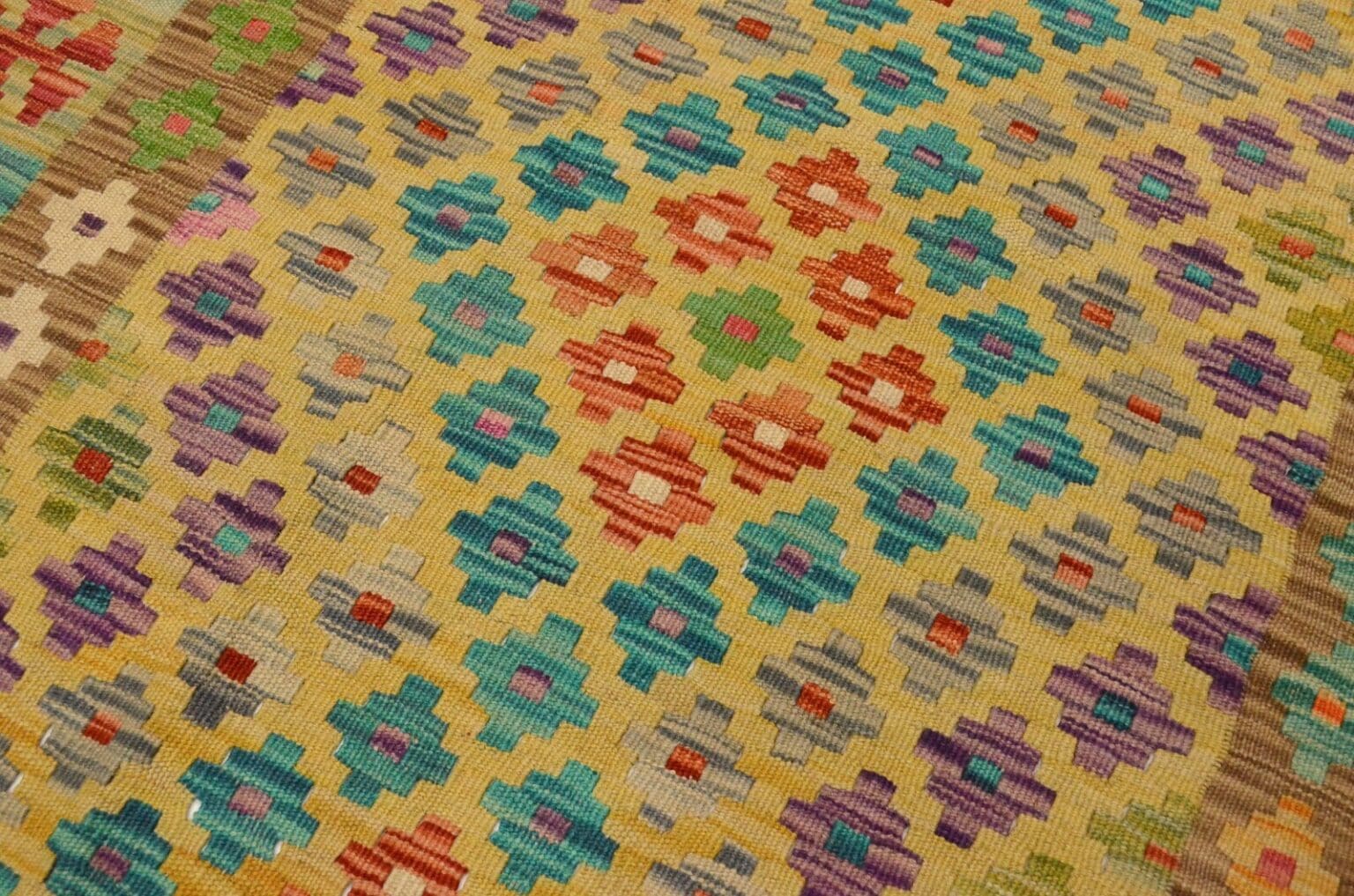
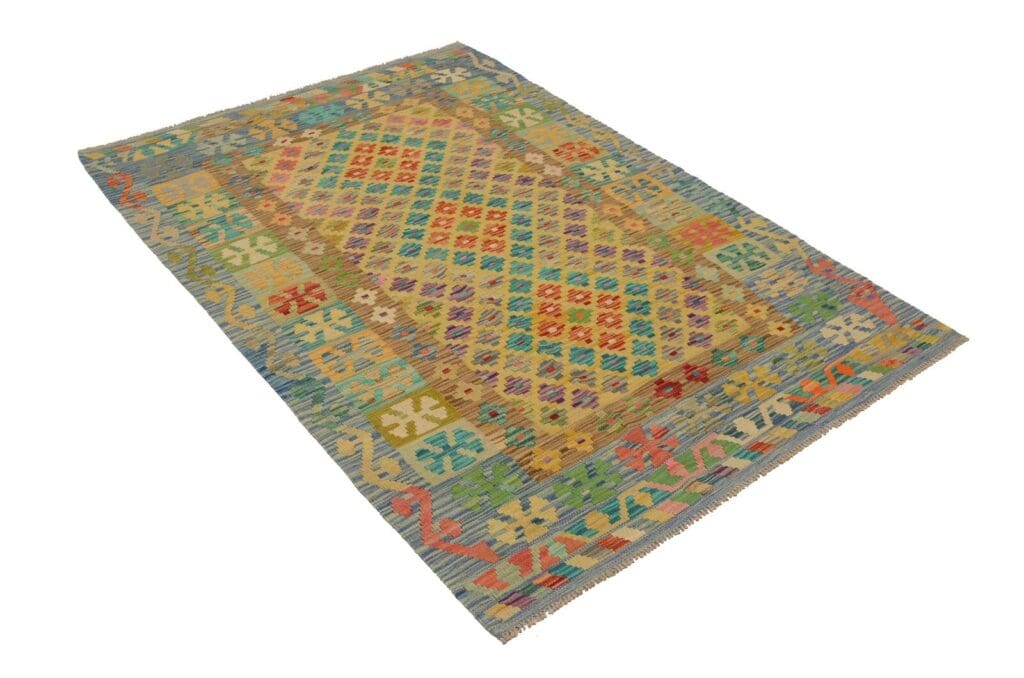
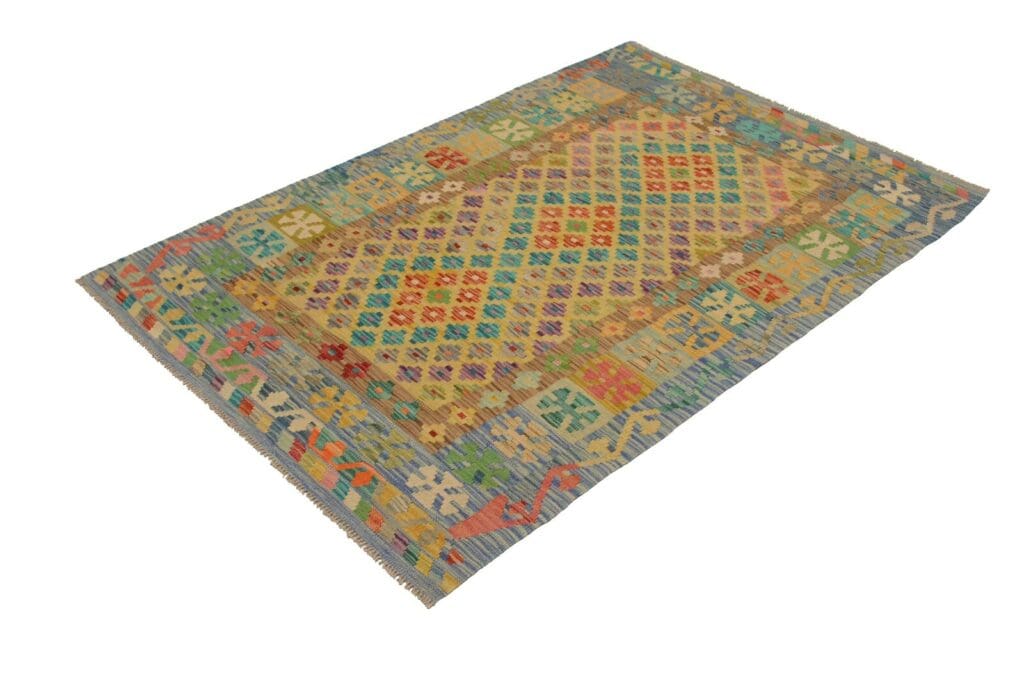
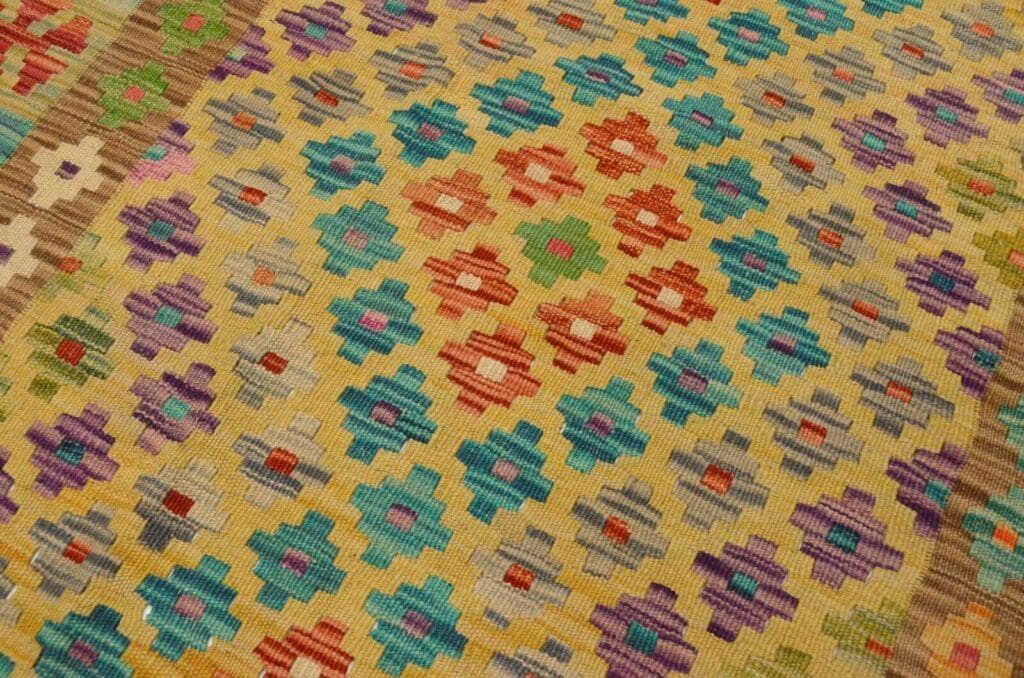
The design of this kilim is a geometric all-over pattern in pastel colours. An all-over composition treats the entire textile as a connected field rather than placing the main emphasis on a single central medallion. Geometric shapes organise the surface through lines, sections and repeated arrangements. The multicolour character brings several colour areas into the composition, while the pastel palette gives those areas a softened and differentiated appearance.
Geometry is one of the established visual languages found in many kilim traditions. Simple forms can be repeated, mirrored, aligned or arranged in rhythmic sequences to create a larger textile structure. Diamonds, stripes, stepped lines, angles and other abstract shapes can all contribute to this kind of design. The meaning of any individual sign cannot be fixed universally. Across textile cultures, however, geometric forms are often associated with ideas relating to life, nature or spirituality.
Here, the all-over arrangement encourages the eye to read the relationship between the forms and colours across the full surface. There is no need for a high pile to define the pattern, because the flat weave leaves the graphic organisation exposed. Hand-dyed wool can give colour areas subtle variation, and the hand-spun yarn may add a small-scale fibre texture. The material is therefore not separate from the design; it helps shape the way the design is seen.
Pastel colours create a particular balance within a geometric composition. They keep the lines, fields and repetitions legible without making the overall effect depend only on strong contrast. The multicolour palette adds further gradation, allowing separate colour zones to remain recognisable while belonging to one coherent design. The result is a woven surface in which orderly geometry and a varied colour arrangement work together.
The flat textile can be placed in different areas of a home because its visual role is not tied to one particular room. In a living room, bedroom or entrance area, it can introduce a graphic layer through its repeated shapes and pastel colours. It can also be used as wall decoration, where the woven construction becomes part of the display. These uses follow from the stated flat structure and design rather than from an invented room-specific provenance.
The pattern is created during weaving. Colour fields and geometric sections become part of the construction of the textile instead of being added to a completed surface. This gives the design a direct connection to the making process. Since the kilim is hand-woven, the particular execution belongs to this individual piece. It is a one-off Afghan textile with a geometric all-over design, pastel colours and a multicolour appearance.
Special Features
This Afghan kilim is new and in perfect condition. It is made from 100% virgin wool that has been hand-spun and hand-dyed. Its hand-woven construction and flat profile make the technique easy to recognise. The piece can be used on the floor or as wall decoration, and it is suitable for rooms with underfloor heating.
The low profile is one of the practical characteristics of kilim weaving. The listed thickness is approximately four millimetres, which allows the textile to be used where a flat floor covering is preferred. Its pattern remains clearly visible across the even surface. The stated weight is approximately two kilograms per square metre.
Routine care can be kept straightforward. Vacuuming without a brush attachment is recommended for regular cleaning, so loose dirt can be removed without unnecessary brushing of the woven surface. Direct sunlight should be avoided to help prevent the colours from fading. If a stain occurs, it should be treated immediately with a damp cloth and a small amount of mild cleaning product.
The piece also illustrates how a natural material and a traditional technique can serve both practical and decorative purposes. The wool provides the textile basis, while hand-spinning and hand-dyeing remain part of its material description. The geometric all-over design gives the flat surface its visual structure. Together, these stated features distinguish the kilim from a hand-knotted, pile-forming carpet.
FAQ
How should I care for my hand-woven Afghan kilim?
Vacuum the kilim regularly without using a brush attachment. Avoid direct sunlight so that the hand-dyed colours are not exposed to unnecessary fading. Any stain should be treated immediately with a damp cloth and a little mild cleaning product. Because the kilim has a flat structure, its surface can be cleaned without dealing with a deep pile.
Where can I buy a hand-woven Afghan kilim?
Hand-woven Afghan kilims can be found at selected carpet shops, specialist online retailers and arts and crafts fairs. It is advisable to choose a trusted seller who provides clear information about material, technique, origin and condition. For this piece, the stated details include Afghanistan as its origin, hand-woven kilim construction, virgin wool and a new, perfect condition.
How does a kilim differ from a hand-knotted rug?
A kilim is hand-woven and has a flat structure. A hand-knotted rug is built from individual knots and usually has a higher knot density together with a thicker, more voluminous surface. Kilims are therefore suited to areas where a flat textile solution is wanted. Hand-knotted rugs are often associated with greater surface depth and a fuller, more substantial feel.
To provide the best experiences, we use technologies like cookies to store and/or access device information. Consenting to these technologies will allow us to process data such as browsing behavior or unique IDs on this site. Not consenting or withdrawing consent, may adversely affect certain features and functions.
Functional Always active
The technical storage or access is strictly necessary for the legitimate purpose of enabling the use of a specific service explicitly requested by the subscriber or user, or for the sole purpose of carrying out the transmission of a communication over an electronic communications network.
Preferences
The technical storage or access is necessary for the legitimate purpose of storing preferences that are not requested by the subscriber or user.
Statistics
The technical storage or access that is used exclusively for statistical purposes.The technical storage or access that is used exclusively for anonymous statistical purposes. Without a subpoena, voluntary compliance on the part of your Internet Service Provider, or additional records from a third party, information stored or retrieved for this purpose alone cannot usually be used to identify you.
Marketing
The technical storage or access is required to create user profiles to send advertising, or to track the user on a website or across several websites for similar marketing purposes.
 SECURE PAYMENT
 SHIPPING PARTNERS


