This Afghan Kelim is hand-woven from 100% hand-spun and hand-dyed virgin wool. Wool is a traditional rug material valued for its resilience, warmth and pleasant natural handle. A Kelim is made by interlacing warp and weft threads to form a textile surface. It is therefore structurally different from a hand-knotted rug, where individual knots create a raised pile. The woven construction gives this piece the flat, light and flexible character associated with Kelims.
The wool is spun by hand before it is dyed by hand. Spinning transforms the fibres into yarn suitable for weaving, while dyeing provides the colours that later form the design. During hand-weaving, the prepared threads are brought together in an organised sequence. The weaver must manage the tension of the warp, guide the weft and maintain the intended arrangement of geometric forms. The finished surface is created directly at the loom rather than decorated after the textile has been completed.
Virgin wool is a natural fibre traditionally used for rugs and flat-woven textiles. It is known for being robust while also contributing natural warmth to a room. The hand-woven method preserves the visible connection between the material and the making process. The listed pile height is approximately 4 mm. The rug is new and described as perfect in condition. Its low profile and woven structure distinguish it from a rug with a taller knotted pile.
In a Kelim, the interaction of the warp and weft is more important than a deep pile. The threads form a continuous fabric, and the pattern is built into that fabric through the arrangement of coloured yarns. Hand-woven textiles may show slight irregularities connected with manual production. The stated characteristics of this piece are its hand-woven technique and its use of hand-spun, hand-dyed virgin wool. Together they define its material and technical identity.
Origin and Tradition
This Kelim comes from Afghanistan, a country with a long history of rug and textile production. Afghan weaving traditions have developed over many centuries and have been shaped by different landscapes, communities and cultural influences. Flat-woven textiles are an important part of this wider tradition. They can be practical floor coverings and, at the same time, carry distinctive colour combinations and patterns that reflect the visual culture of the people who make them.
Afghan textile production has involved both settled weaving communities and nomadic groups. Knowledge of preparing wool, spinning yarn, applying colour and building a pattern was passed on through practical experience. A hand-woven Kelim brings these stages together. The material is prepared, converted into yarn, coloured and then placed into the structure of the textile at the loom. The technique is therefore not only a way of producing a floor covering; it also preserves knowledge through an object that shows how it was made.
Wool has a significant place in many Afghan textile traditions because it is a durable natural fibre that can be spun and woven. Hand-spinning gives the yarn a manually produced character, while hand-dyeing establishes the colour range used by the weaver. The final weaving process joins these elements into one surface. In this Kelim, the Afghan origin, the hand-spun and hand-dyed virgin wool, and the hand-woven construction belong together as clearly stated features.
Afghan rugs and Kelims are often associated with strong colours and expressive, carefully ordered designs. The surrounding landscape, daily life and regional culture may influence the choice of forms and colours. Geometric patterning is one of the established design languages of Afghan textile art. Lines, angles, repeated shapes and colour fields can create order across a textile while leaving room for variation in the individual weaving process.
Nomadic peoples in Afghanistan have helped preserve and develop weaving techniques over generations. Flat weaves can be particularly versatile because they are comparatively light and can serve different practical purposes. Their surfaces can nevertheless contain elaborate arrangements of colour and motif. The loom thus becomes a place where use and design meet. Afghan Kelims belong to this tradition of textiles that are functional while also expressing inherited craft knowledge.
The designation Afghanistan identifies the cultural and manufacturing context of this Kelim. It does not, without further information, assign the piece to a particular city, tribe or workshop. This rug is described as an Afghan Kelim, and that is the appropriate level of origin claimed for it. Its hand-woven construction, wool preparation and geometric design can be discussed within the broader history of Afghan weaving without adding an unsupported narrower attribution.
Traditions develop over time. Older design principles may be retained while colours, arrangements and individual details change. The basic knowledge of hand-weaving remains recognisable even when a particular composition is different from earlier examples. A Kelim makes this continuity especially visible because its surface records the order of the threads and the relationship between the coloured areas. Manual production is consequently part of the tradition itself, not separate from it.
Design and Pattern
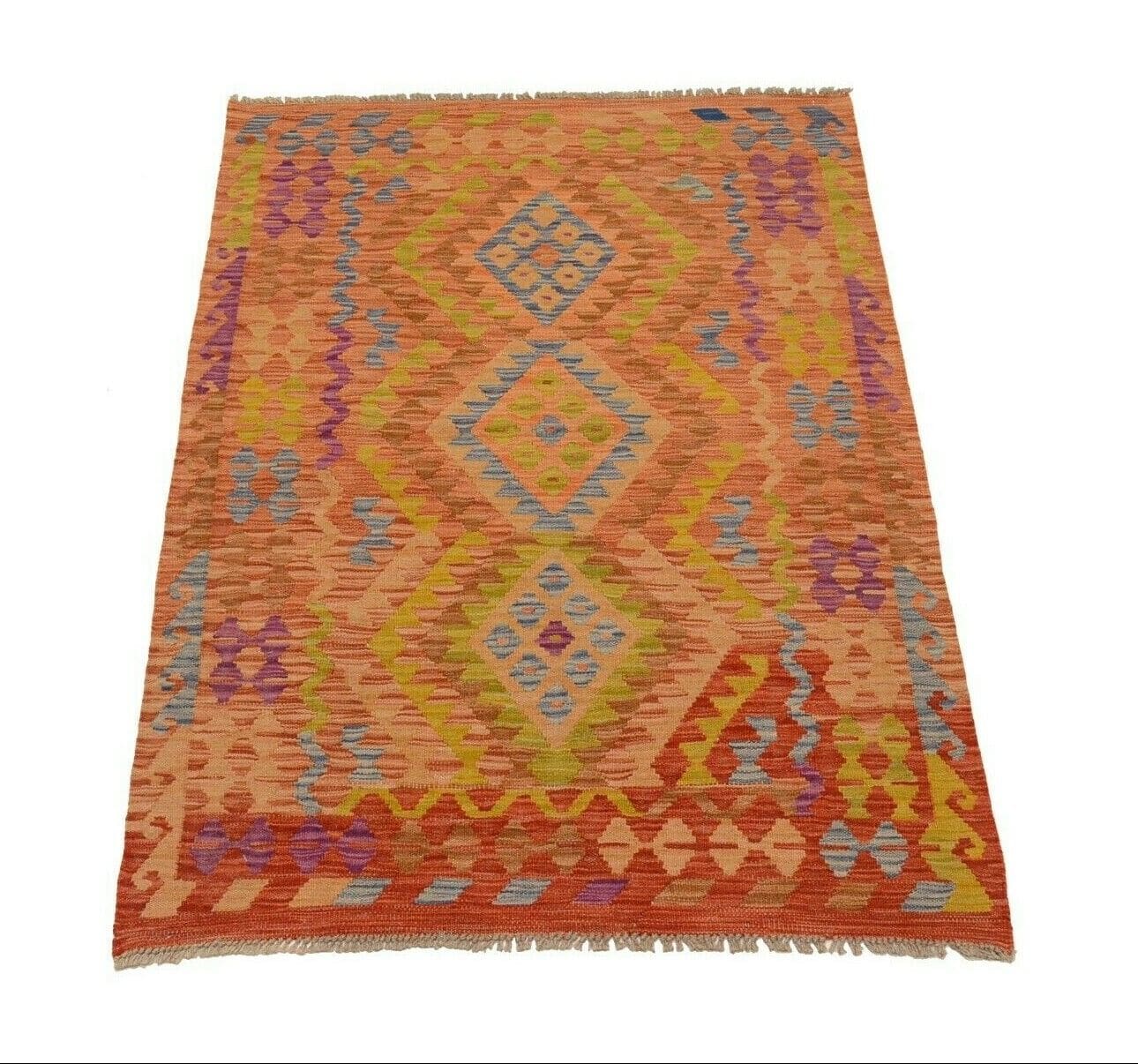
The design of this Kelim is geometric and arranged as an all-over composition. An all-over pattern distributes the visual elements across the field instead of reserving the main emphasis for one central medallion. Lines, angles, repeated shapes and bounded areas can be combined to create a continuous structure. The geometry provides clarity, while repetition gives the surface a rhythm that can be followed from one section to the next.
The colours are described as vivid. This liveliness gives the geometric forms a strong presence and helps distinguish one area from another. Colour fields may define the edges of shapes, reinforce repetitions and establish contrasts across the woven surface. The appearance of this Kelim is therefore determined by both its formal structure and its expressive palette. The pattern is not simply geometric in outline; it is also characterised by the active use of colour.
Geometric motifs are widely used in Afghan carpet art. They can be built from basic forms and developed through repetition, reflection or linked sequences. On a hand-woven textile, the pattern must be translated into the order of coloured threads as the work progresses. The design is consequently created together with the fabric. It is not a separate illustration applied to the surface afterwards, but an integral part of the weave.
An all-over arrangement creates a different visual order from a design divided into a central field and distinct borders. The eye can move continuously through an all-over pattern, finding connections between repeated forms and changes in colour. This approach suits the direct graphic quality of a Kelim. Because the surface is flat, the outlines and colour areas remain closely connected to the textile itself rather than depending on variations in a deep pile.
Afghan patterns may be influenced by nature, landscape, everyday experience and cultural traditions. Stories and myths can also provide a general background for the development of motifs in textile art. No particular symbol or named historical pattern is specified for this rug, however. Its documented design is a geometric all-over composition in vivid colours. That description identifies the visible pattern without assigning an additional meaning or a more specific attribution.
The flat-woven surface allows the colour and line work to remain clear. Since there is no tall pile to alter the image through changing pile direction, the design is read directly from the arrangement of the threads. This gives a Kelim a graphic and textile-based appearance at the same time. The construction and the design are therefore closely related: the woven structure provides the surface, and the coloured threads create the geometric image.
Geometric Afghan Kelims can be used with contemporary interiors that feature clean lines as well as with traditional rooms containing natural materials and other textiles. This is a general observation about the design type, not an additional claim about the individual rug. Its specific features remain its Afghan origin, hand-woven Kelim technique and vivid geometric all-over design. Together, these characteristics place the piece within the broad visual tradition of Afghan flat weaving.
Special Features
This Afghan Kelim combines 100% hand-spun and hand-dyed virgin wool with hand-woven construction. Its flat textile surface distinguishes it from a hand-knotted rug. The vivid colours and geometric all-over design define its appearance, while the wool provides the robust and warm material qualities associated with traditional rug making. The rug is new and described as perfect in condition.
The Kelim can be used in different living areas, including a living room, bedroom or foyer. It is suitable for underfloor heating and can be placed in modern or traditional interiors. For routine care, gentle vacuuming with a soft brush attachment is recommended. Stains should be dabbed carefully with a damp cloth and mild soapy water, followed by drying in a well-ventilated place.
When the rug is used over underfloor heating, the temperature should not be set too high. This helps protect the properties of the hand-spun and hand-dyed wool. The listed weight is approximately 2 kg/m², and the listed pile height is approximately 4 mm. These details accompany the main description of the piece as a new Afghan Kelim and do not alter its flat-woven construction.
FAQ
How should I clean this Afghan Kelim?
For regular care, vacuum the Afghan Kelim carefully with a gentle brush attachment. This removes loose dust and dirt while avoiding unnecessary strain on the flat woven wool surface. If a stain appears, do not scrub it vigorously. Dab the affected area carefully with a damp cloth and mild soapy water. Afterward, let the Kelim dry in a well-ventilated place. Good ventilation helps moisture leave the textile and reduces the risk of mould forming. These instructions are appropriate for the hand-woven construction and wool material described for this rug.
Can the Kelim be used over underfloor heating?
Yes. This Afghan Kelim is suitable for use over underfloor heating. Its flat woven construction allows warmth to pass through the textile, while wool is warm and breathable and can help distribute heat evenly. The heating temperature should nevertheless not be set excessively high. A moderate setting helps preserve the material properties of the hand-spun and hand-dyed virgin wool. Suitability for underfloor heating is specifically stated for this rug and is one of its practical uses in addition to its new condition and hand-woven construction.
How can I recognise an authentic hand-woven Kelim?
Begin by examining the reverse side of the textile. Hand-woven work often has slight irregularities rather than a perfectly uniform appearance. The front does not necessarily show perfect symmetry either, because the design is built manually during the weaving process. The colours of hand-woven rugs can appear natural and less muted. Certificates and buyer reviews may offer further indications when assessing authenticity. These points are general guidance for examining hand-woven Kelims. For this particular piece, the stated construction details are its hand-woven technique and its hand-spun, hand-dyed virgin wool.
To provide the best experiences, we use technologies like cookies to store and/or access device information. Consenting to these technologies will allow us to process data such as browsing behavior or unique IDs on this site. Not consenting or withdrawing consent, may adversely affect certain features and functions.
Functional Always active
The technical storage or access is strictly necessary for the legitimate purpose of enabling the use of a specific service explicitly requested by the subscriber or user, or for the sole purpose of carrying out the transmission of a communication over an electronic communications network.
Preferences
The technical storage or access is necessary for the legitimate purpose of storing preferences that are not requested by the subscriber or user.
Statistics
The technical storage or access that is used exclusively for statistical purposes.The technical storage or access that is used exclusively for anonymous statistical purposes. Without a subpoena, voluntary compliance on the part of your Internet Service Provider, or additional records from a third party, information stored or retrieved for this purpose alone cannot usually be used to identify you.
Marketing
The technical storage or access is required to create user profiles to send advertising, or to track the user on a website or across several websites for similar marketing purposes.
 SECURE PAYMENT
 SHIPPING PARTNERS


