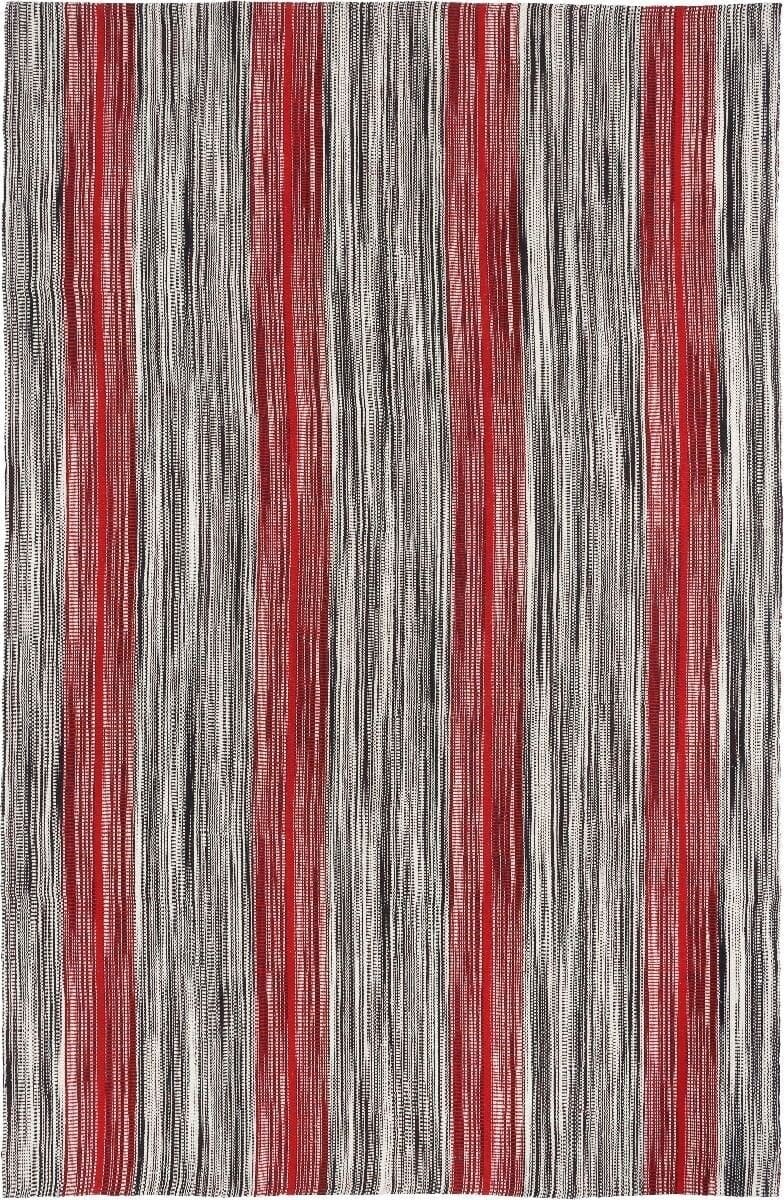
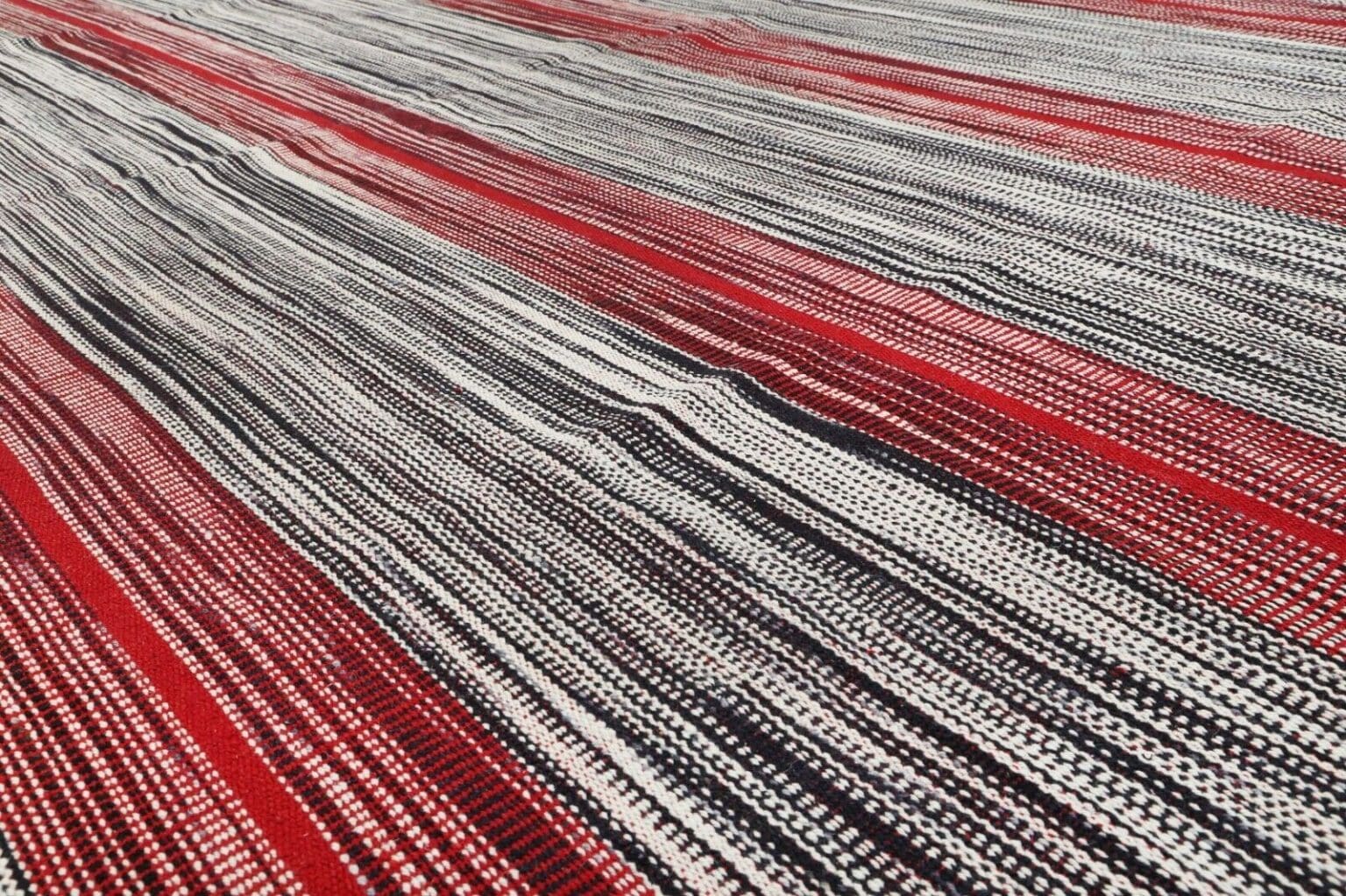
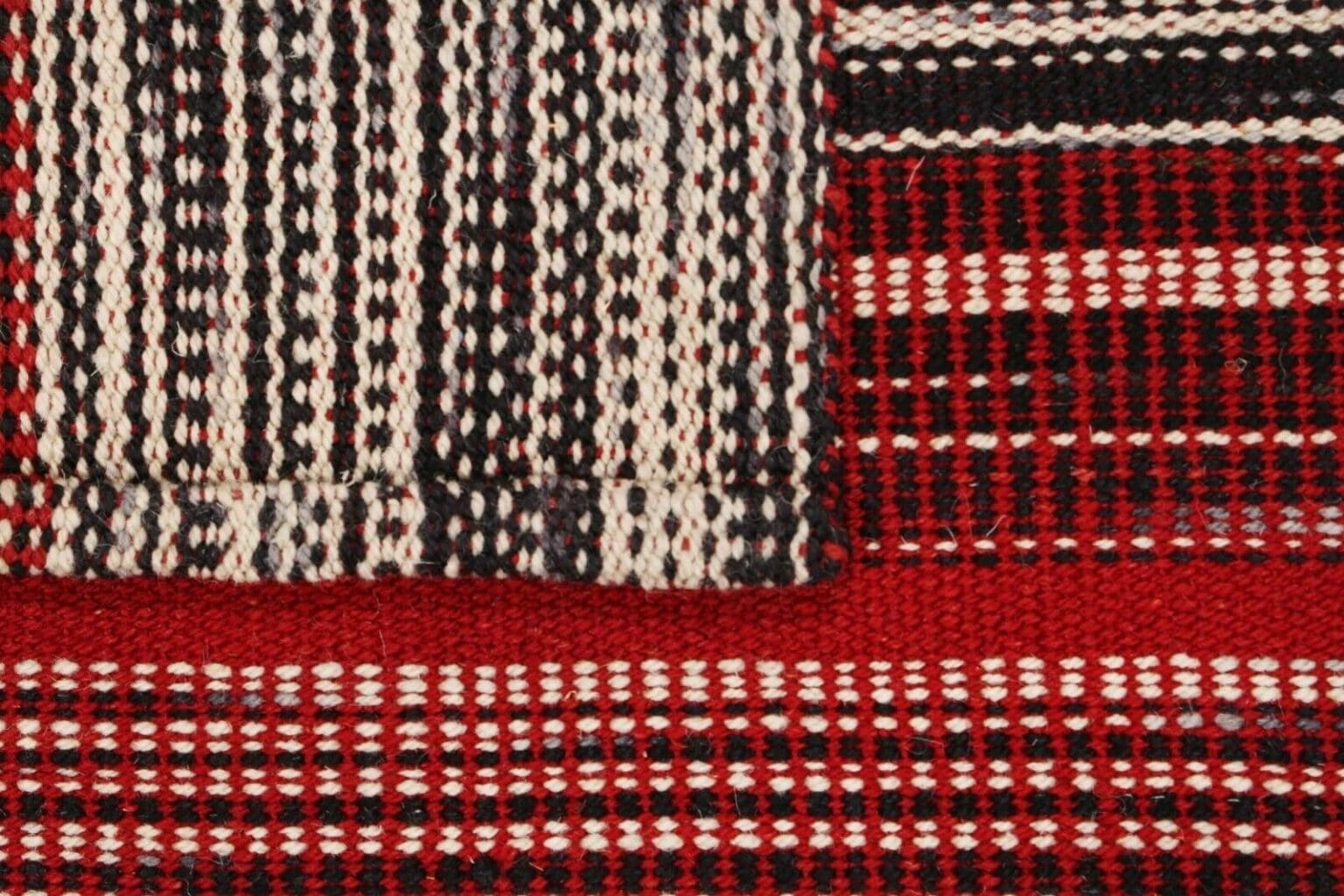
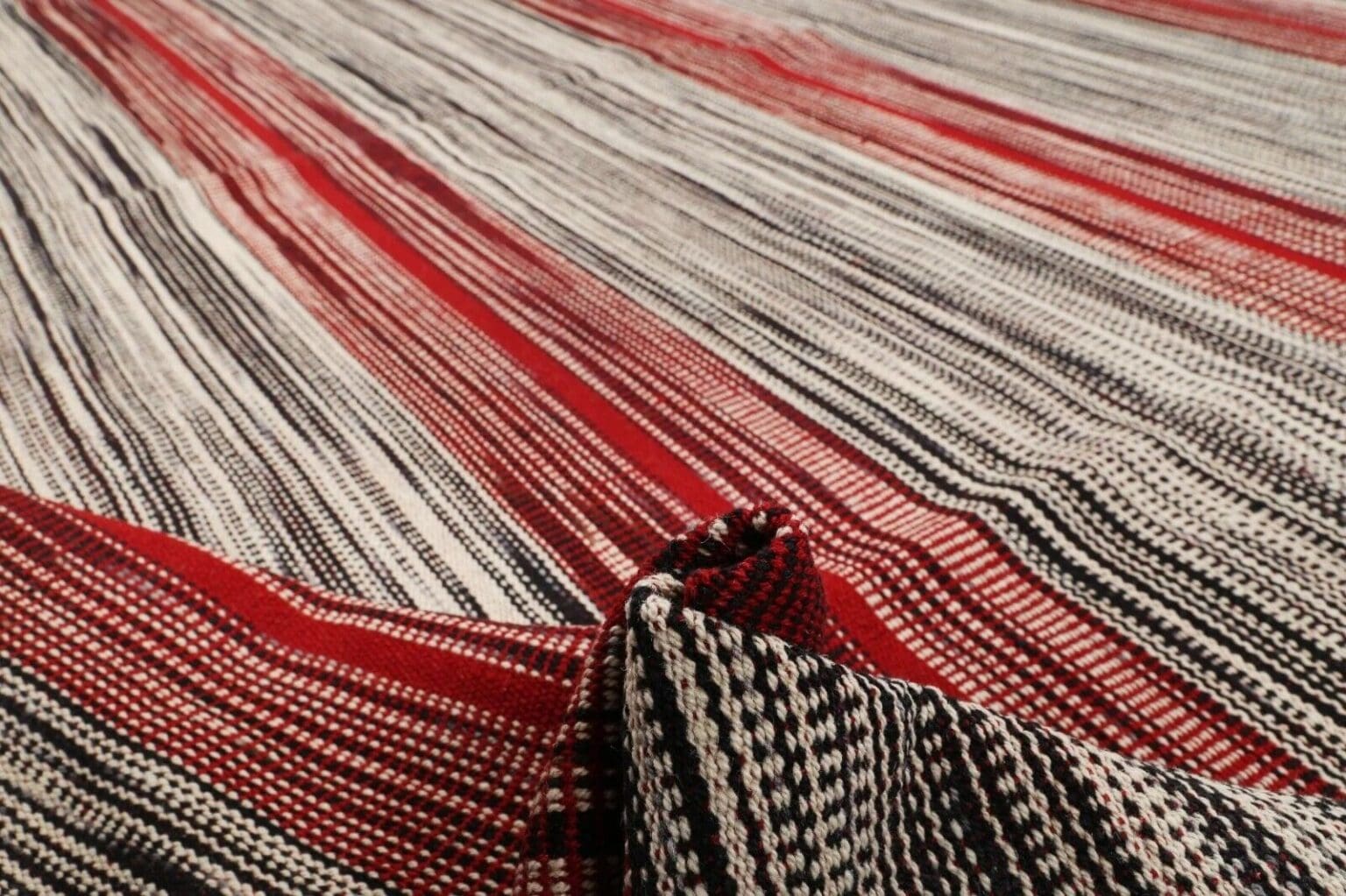
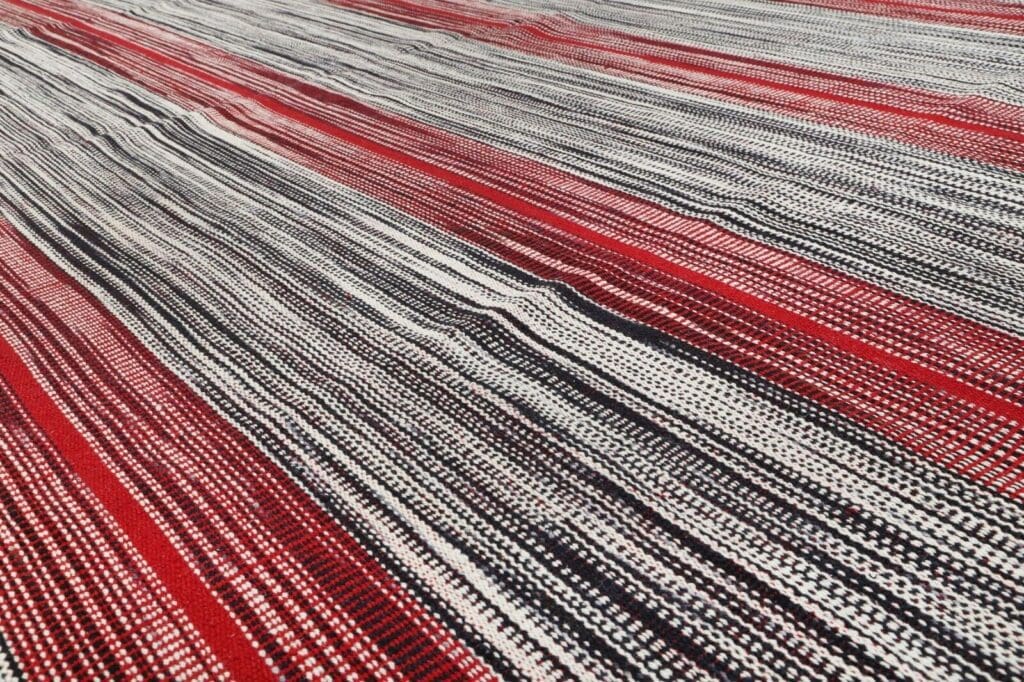
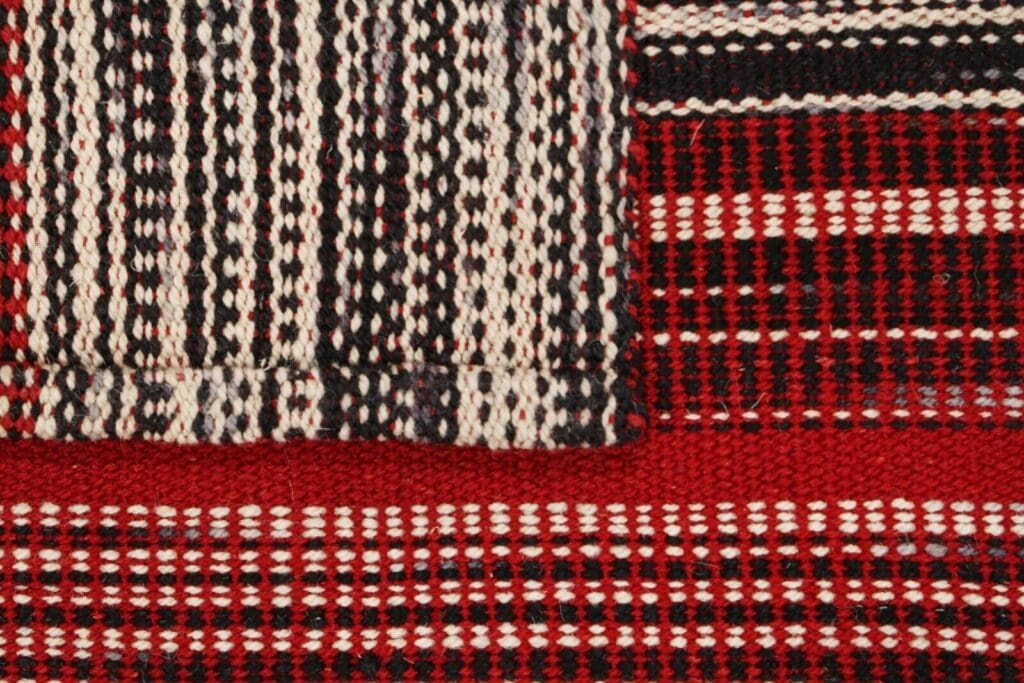
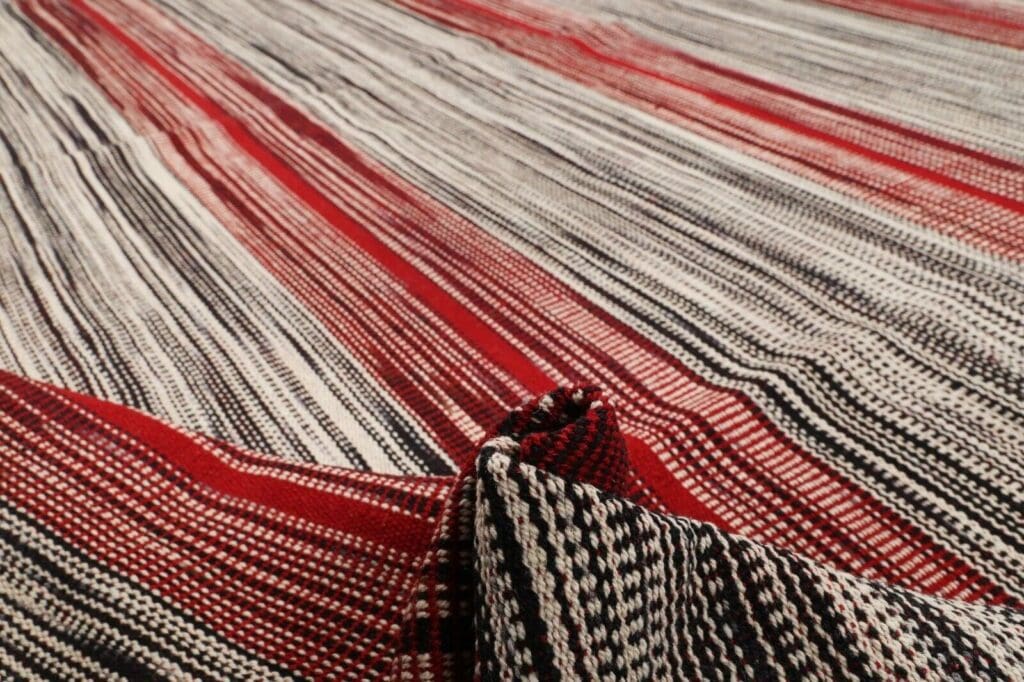
This Oriental rug is hand-woven and made as a modern Kelim. The material is specified as 100% wool. Its weave is described as a flatweave, while the product information also classifies it as a short-pile rug. The result is therefore presented as a woven textile with a flat construction and a short surface. Unlike a knotted rug, a Kelim builds its visible design through the interlacing of warp and weft threads. The pattern is formed during weaving rather than applied to a completed surface.
Hand-weaving is a textile process in which the threads are guided and placed by hand. In a flatweave, the structure depends on the joining of the threads and on maintaining an even tension across the woven field. Wool is the material named for this rug. Wool yarn has long been used in Oriental rug and Kelim traditions because it can be spun, dyed and woven into a textile surface. For this individual rug, the material specification is explicitly 100% wool.
The term modern Kelim describes a meeting of an established weaving method and a contemporary design approach. Kelims can be made without a raised knotted pile and often present a more direct, graphic surface. The structure of the textile is therefore part of the visual language. This piece is identified as a flatweave, while the product information also uses the term short pile. Both descriptions are retained as part of the supplied product details.
The rug is offered in new condition without a label. This condition statement describes the advertised state and also indicates that no label is present. No details are provided about dyes, the warp, or a particular knot density, so those points are not added. The confirmed craft information consists of hand-weaving, a wool construction and a flatweave structure.
Origin and Tradition
The origin is described as regional design. No particular town, province or country is named. The rug is therefore presented through its regional design character rather than assigned to a specific weaving centre. Oriental rugs and Kelims come from many different textile traditions, shaped by available materials, local practices and regional pattern languages. In this context, Oriental rug is a product and design classification, not a claim of a more precise provenance for this one-off piece.
Kelim is a term used for a group of flat-woven rugs. In the technique, warp threads are arranged under tension and weft threads are inserted by hand. The way the weft is handled at colour changes creates fields, lines and geometric structures. Since the pattern is produced by the weave itself, the front and back of a Kelim may have a related appearance. This differs fundamentally from a rug whose surface is formed by individually knotted pile.
Flatweaves have a long history in many textile-producing regions. They have been used as floor coverings, hangings and functional household textiles, and their relatively flat construction has made them practical to move and store. Their designs grow from the logic of weaving: stripes, diamonds, rectangles, stepped forms and other signs can be created through the sequence of the weft. Depending on the tradition, compositions may be strictly geometric, rhythmically repeated or more freely arranged. A single shape does not automatically carry one fixed meaning; interpretation depends on region, period and context.
The Kelim tradition also shows how a craft method can be carried into new design languages. A modern Kelim retains the flatweave technique while working with reduced forms, a different colour arrangement or references to modern styles. This rug is identified as regional design and its style is given as Art Deco. These details bring a traditional textile process together with a clearly named modern design category, without assigning the rug to an unstated place of origin.
Art Deco developed as an international style associated with clear contours, geometric order and decorative surfaces. In textile design, those qualities may be expressed through repeated forms, balanced divisions or an ordered distribution of colour. When combined with Kelim weaving, the geometry is translated into the structure of the textile rather than printed onto a finished rug. The result can retain visible handcraft while using a contemporary visual vocabulary. The Art Deco classification is explicitly part of this rug’s product description.
Design and Pattern
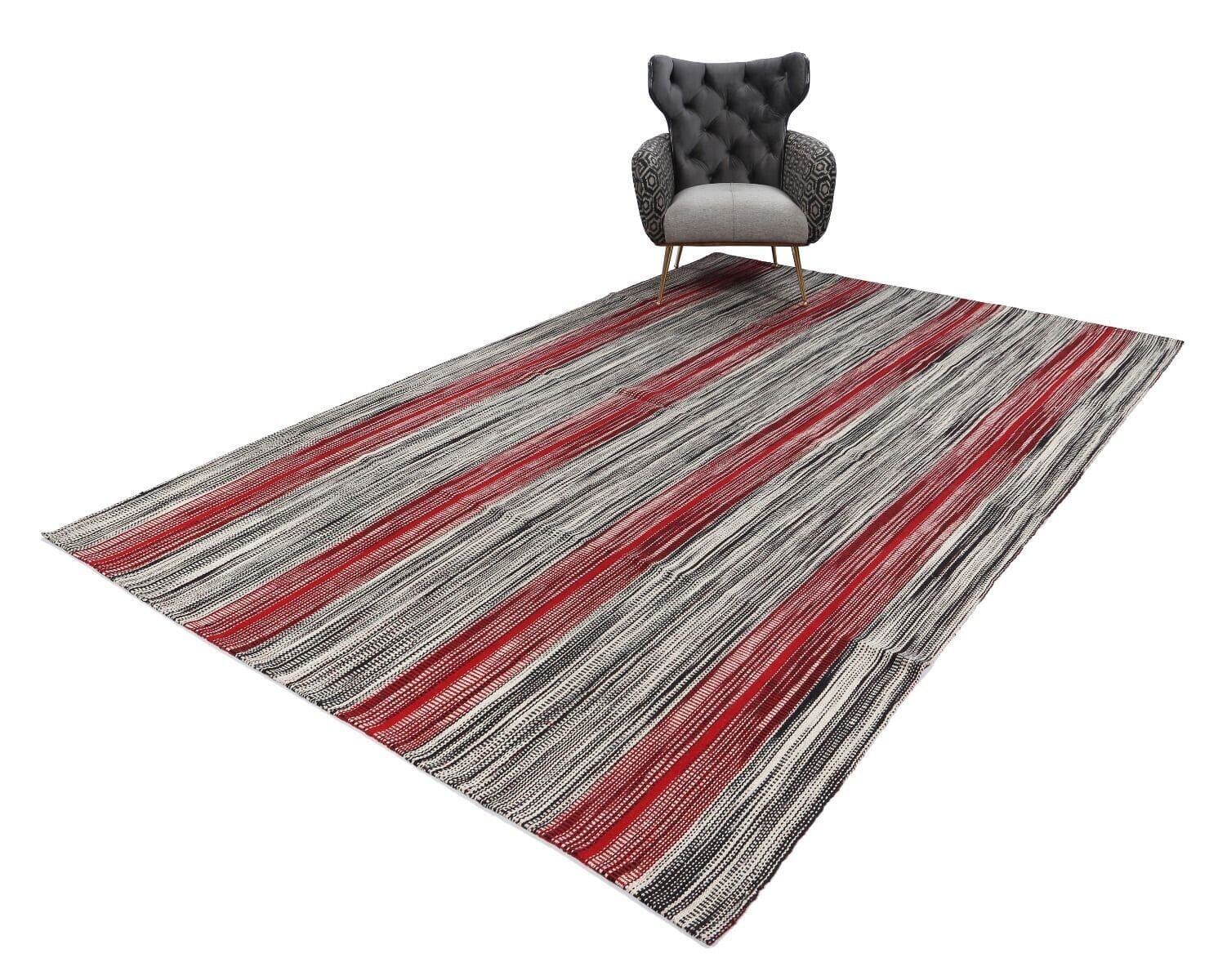
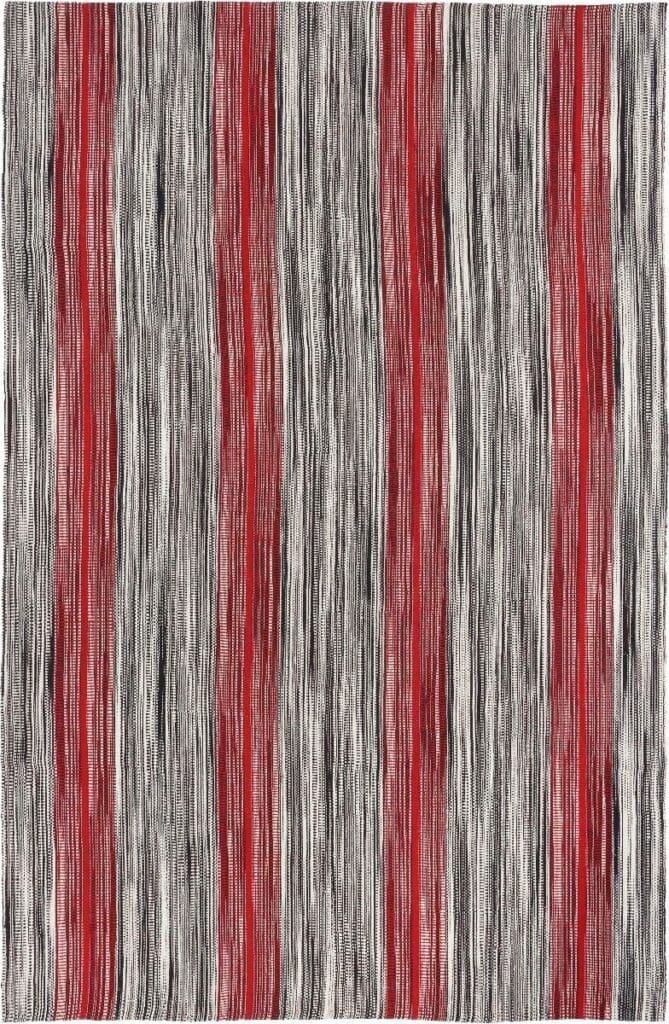
The design is classified as Art Deco and the colour scheme is described as multicoloured. These two details define the stated visual framework of the rug. Art Deco design is often associated with strong outlines, geometric fields and a deliberate decorative order. In a woven Kelim, these qualities can arise directly from changes in colour and from the direction of the threads. The surface is consequently shaped both by its material construction and by its graphic organisation.
Geometric patterning is a natural possibility within a flatweave. Straight lines can be built through the progression of the weft, while colour changes create distinct areas. Diamonds, stripes, rectangles, stepped edges and repeated angles are common tools of textile geometry. These examples explain the design possibilities of a modern Kelim and do not claim that each one appears on this rug. The actual pattern classification supplied for this piece is Art Deco, with a multicoloured appearance.
Multicoloured means that the design uses more than one colour. The effect of such a combination depends on contrast, repetition and placement. Light and dark areas can organise a woven field, while related shades can create quieter transitions. In a Kelim, colour fields are inseparable from the weaving process because they are formed as the weft is inserted. The word multicoloured does not specify individual shades, an exact number of colours or the dyes used.
An Art Deco influence may be interpreted in a regular or more decorative manner. Clear forms can be arranged into a balanced composition in which separate areas relate visually to one another. A modern Kelim does not necessarily reproduce a historical design literally. Instead, the traditional method can serve as a basis for a contemporary arrangement. The rug is described as a modern Kelim, so the term identifies the relationship between its weaving technique and its present-day stylistic direction.
The flat construction also affects how the pattern is perceived. On a high-pile rug, outlines can be influenced by the height and direction of the pile. A flatweave presents the woven plane more directly, so lines and colour changes may appear particularly graphic. The product details additionally use the classification short pile. No specific drawing, central medallion or named ornament is supplied, and none is assigned here.
The design can therefore be described within the documented boundaries: regional in character, made as a modern Kelim, classified as Art Deco and multicoloured. These details provide a clear account of the formal direction without adding an unstated motif or provenance. The rug illustrates how a hand-woven method can support an ordered, modern design language while remaining visibly connected to textile craft.
Special Features
The rug is specified as suitable for underfloor heating. This is a practical feature for rooms in which heat is delivered through the floor. The statement does not replace the instructions for a particular heating system or floor installation, so those instructions should be followed when the rug is used. No further technical performance claim is added.
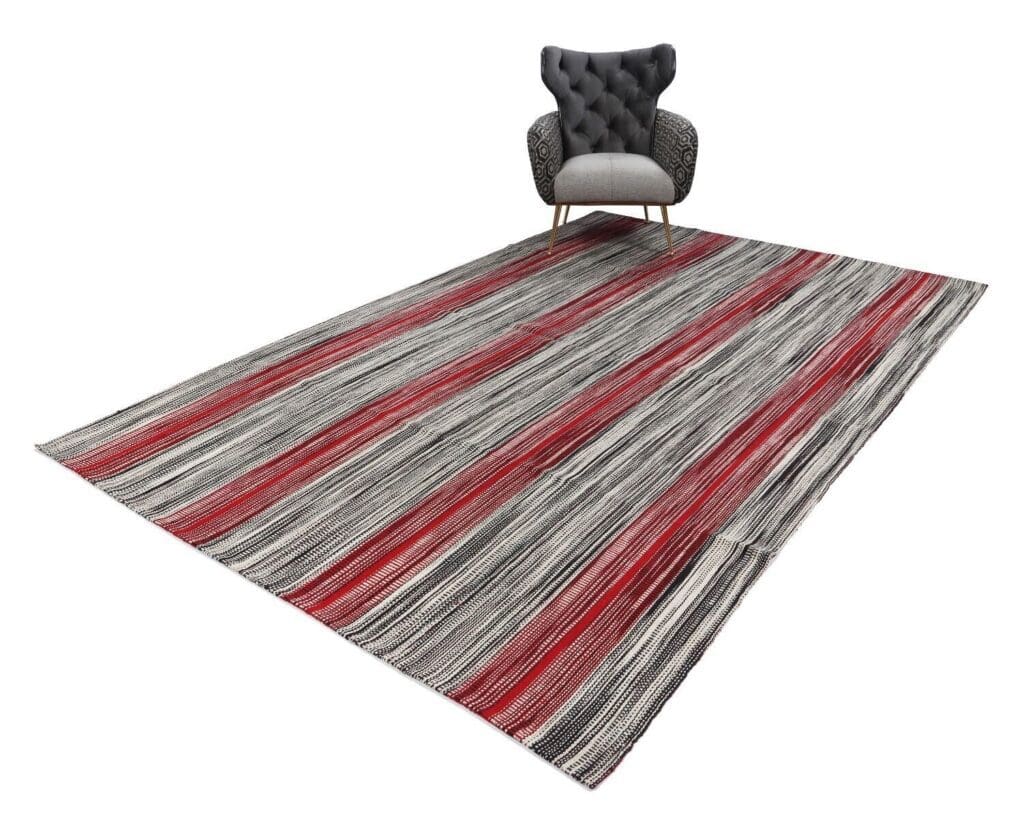
The supplied description names several possible living areas: the living room, dining area and bedroom. In these settings, the rug can function as a textile floor covering and as part of the room’s visual arrangement. Its multicoloured Art Deco design provides the stated decorative identity. Specific claims about wear resistance, treatment, warranty or special finishing are not included because they are not given for this piece.
The condition is new without a label. Together with the hand-woven construction, 100% wool material, flatweave technique and short-pile classification, this defines the product information provided for the rug. Its origin remains described as regional design, with no more specific location named. Technique, material, style and intended use are therefore stated, while unconfirmed manufacturing and provenance details remain omitted.
FAQ
How should I care for a hand-woven Oriental rug?
Regular vacuuming or careful shaking helps remove dust from the weave. Direct sunlight should be avoided to reduce the risk of colour fading. Spills and marks should be treated promptly with a damp cloth so that they do not penetrate further. Any additional cleaning method should take the flat woven construction and wool material into account.
Is this hand-woven Oriental rug suitable for allergy sufferers?
Many hand-woven rugs made from natural materials may contain fewer allergenic substances. Regular cleaning can help minimise dust and allergens. Individual sensitivity varies, so the rug should be considered in relation to the specific household. The material specified for this piece is 100% wool.
Where can the Oriental rug be used?
The rug can be used in a range of living spaces. The supplied applications include the living room, dining area and bedroom. It is also described as suitable for underfloor heating. Its multicoloured Art Deco design and flat, hand-woven construction give it both a textile floor-covering function and a decorative role.
To provide the best experiences, we use technologies like cookies to store and/or access device information. Consenting to these technologies will allow us to process data such as browsing behavior or unique IDs on this site. Not consenting or withdrawing consent, may adversely affect certain features and functions.
Functional Always active
The technical storage or access is strictly necessary for the legitimate purpose of enabling the use of a specific service explicitly requested by the subscriber or user, or for the sole purpose of carrying out the transmission of a communication over an electronic communications network.
Preferences
The technical storage or access is necessary for the legitimate purpose of storing preferences that are not requested by the subscriber or user.
Statistics
The technical storage or access that is used exclusively for statistical purposes.The technical storage or access that is used exclusively for anonymous statistical purposes. Without a subpoena, voluntary compliance on the part of your Internet Service Provider, or additional records from a third party, information stored or retrieved for this purpose alone cannot usually be used to identify you.
Marketing
The technical storage or access is required to create user profiles to send advertising, or to track the user on a website or across several websites for similar marketing purposes.
 SECURE PAYMENT
 SHIPPING PARTNERS


