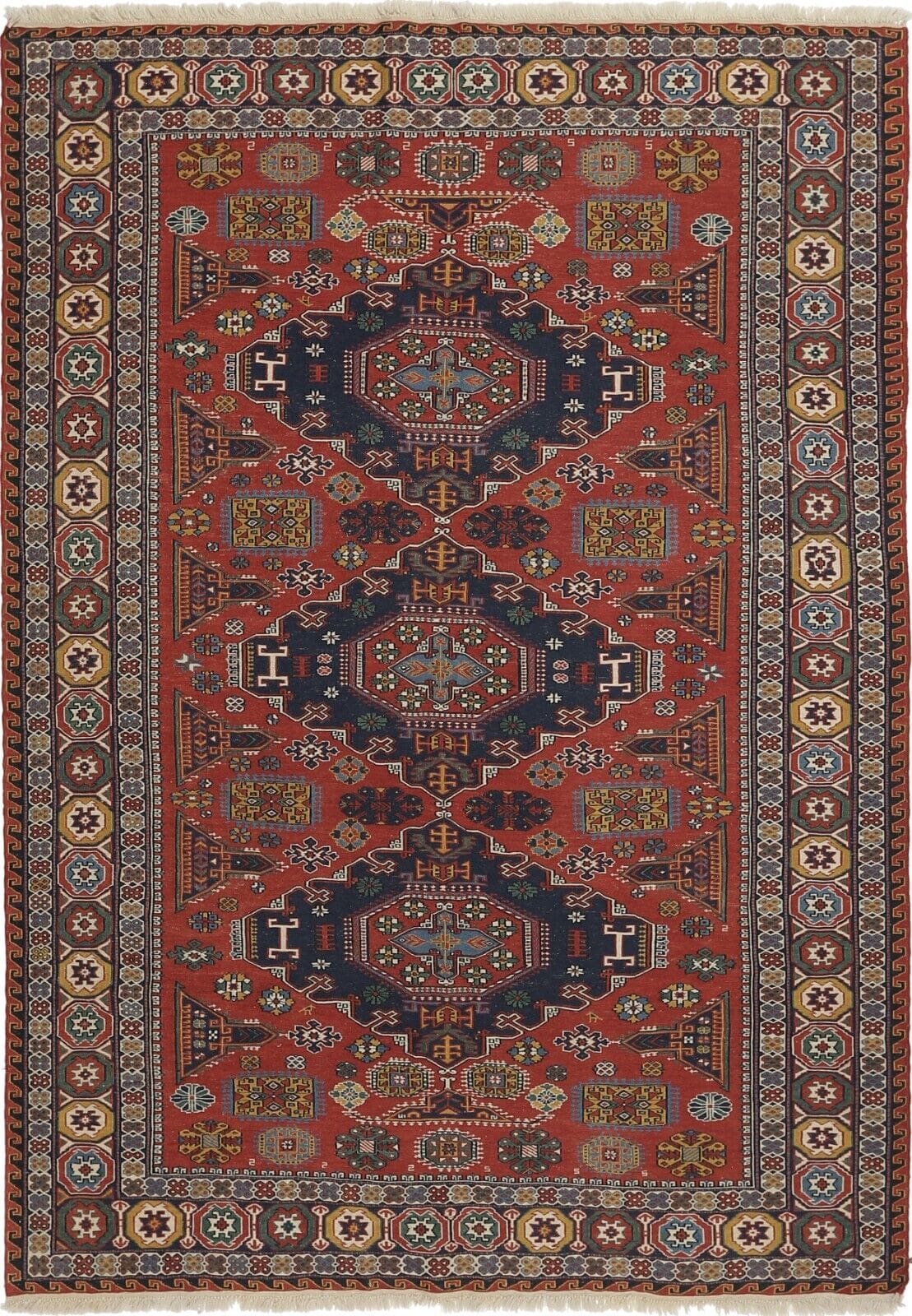
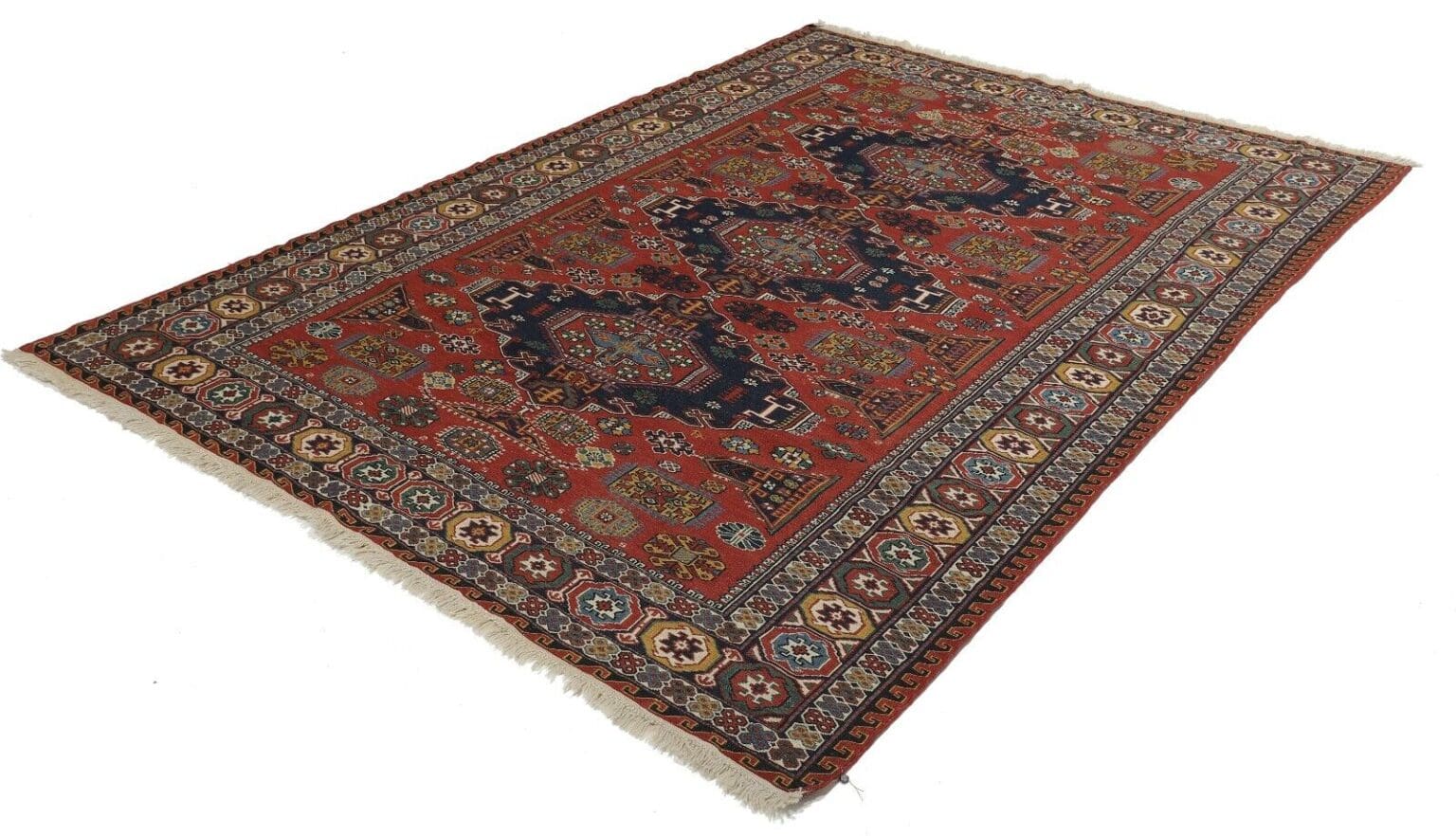
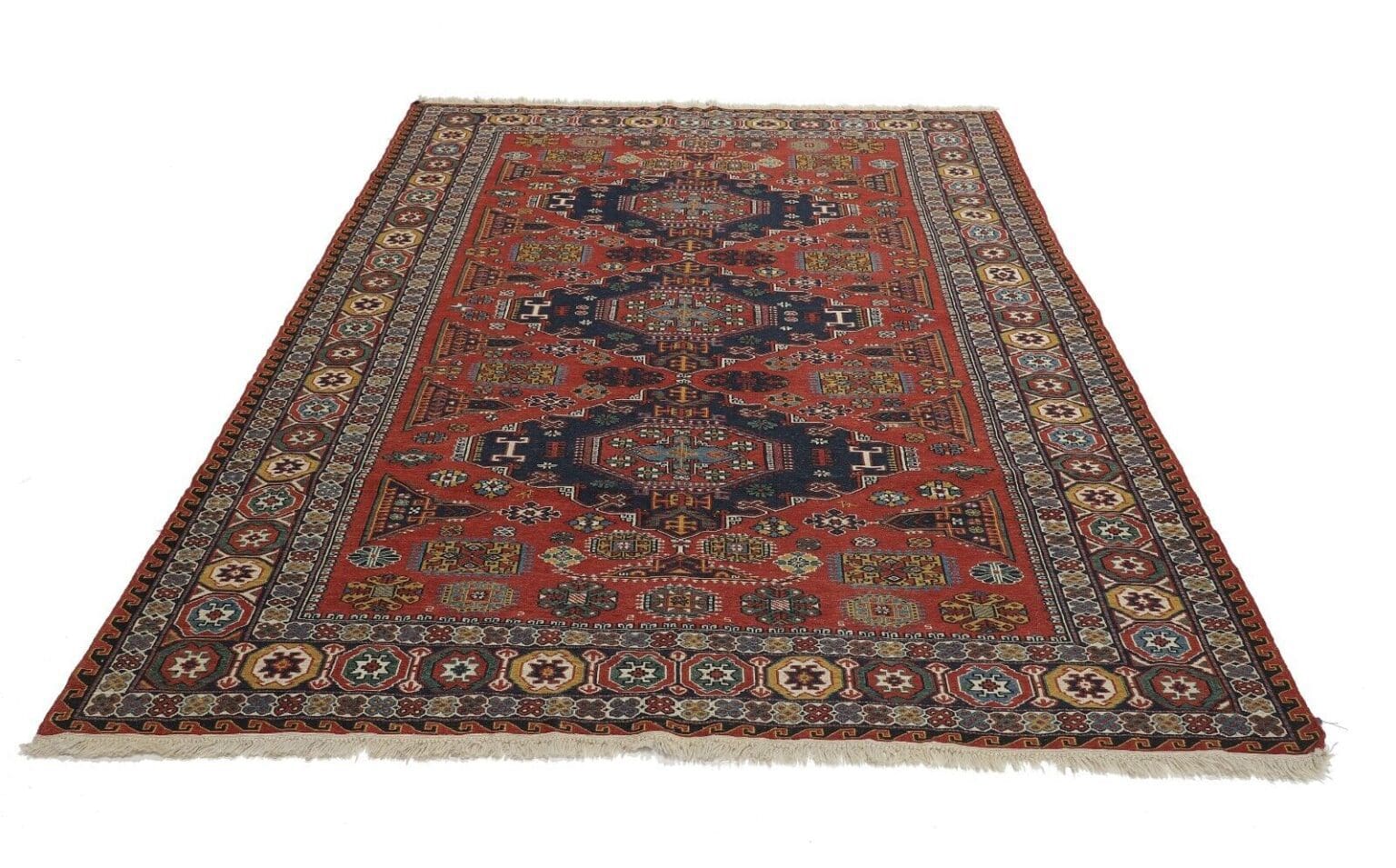
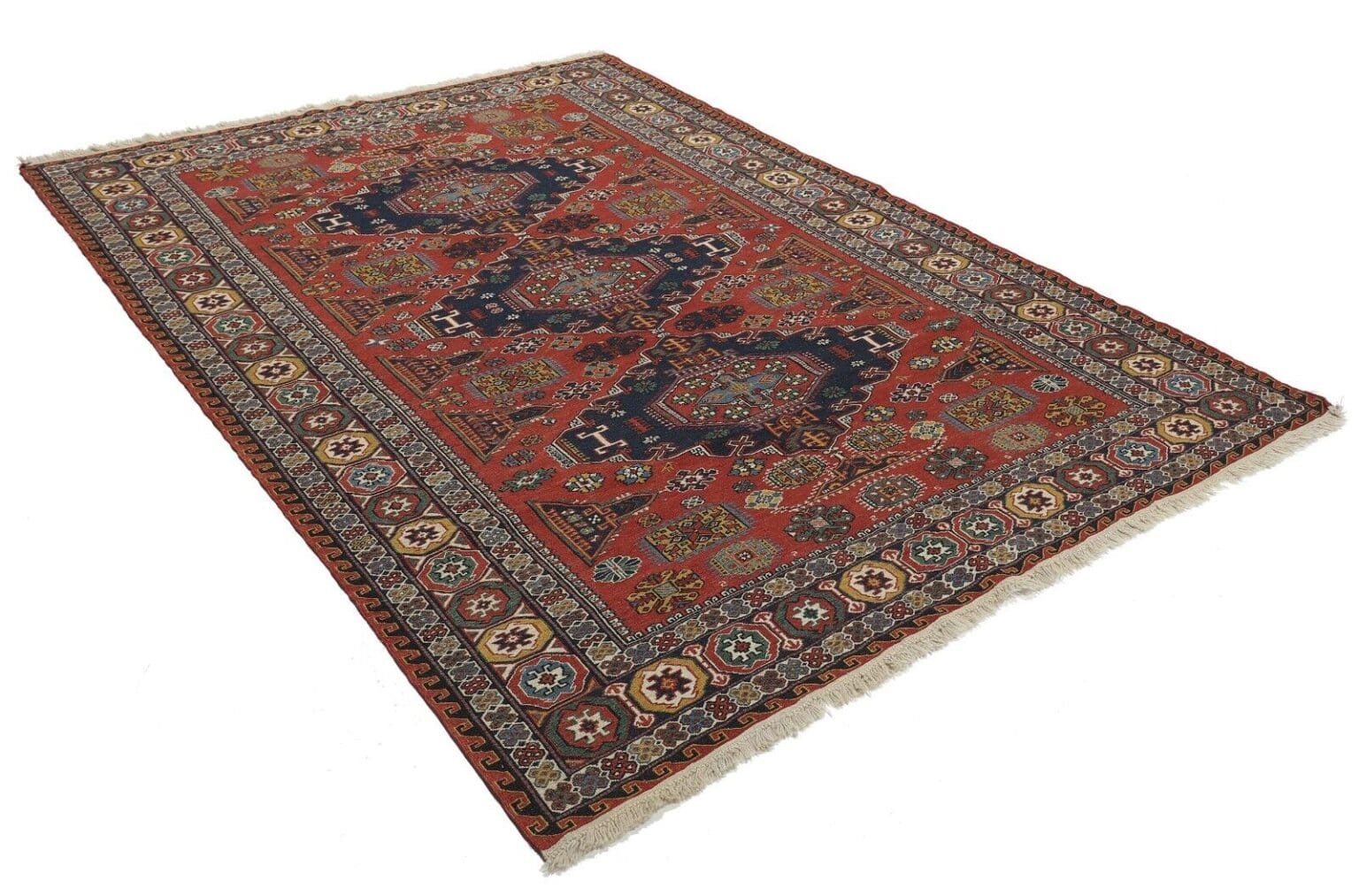
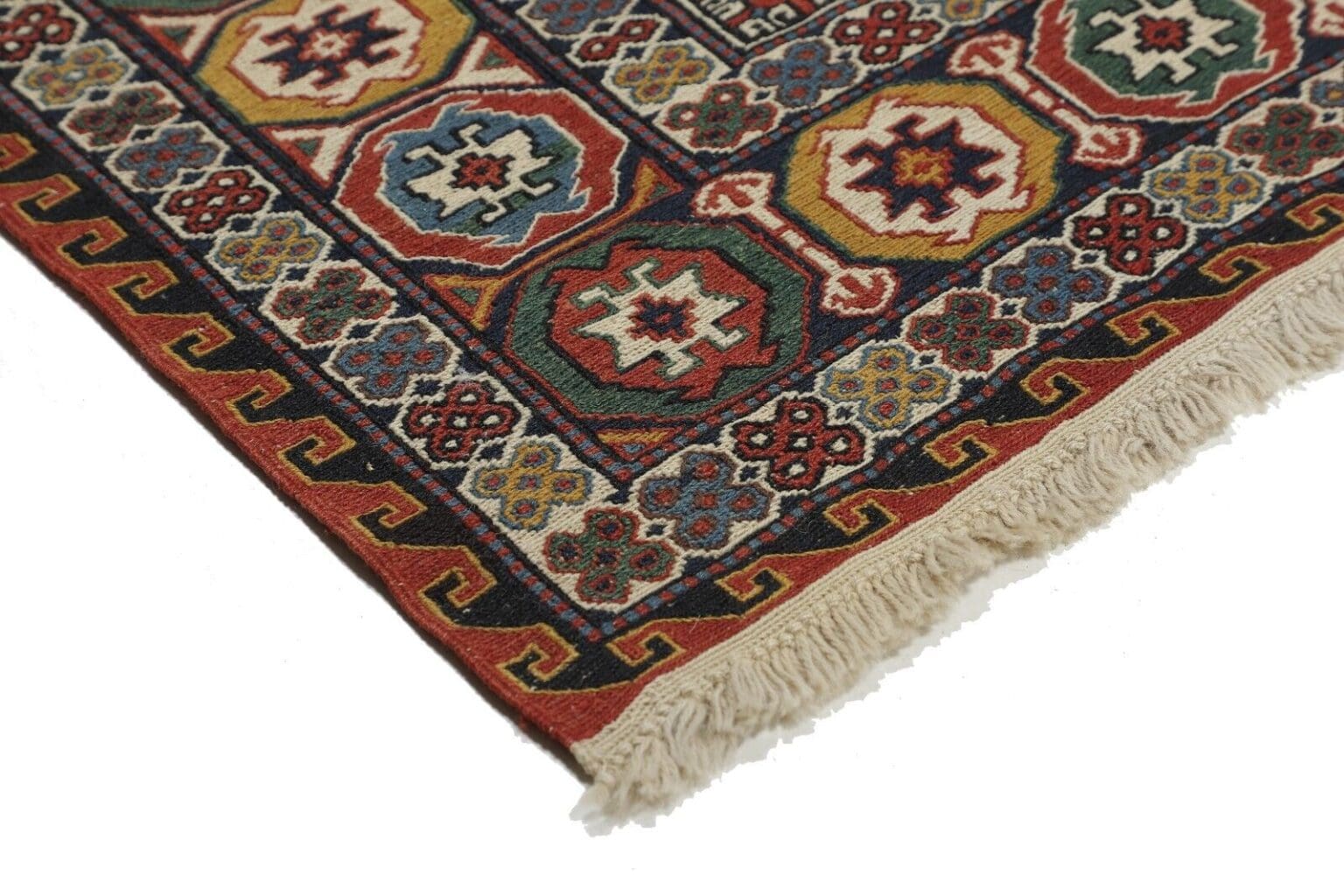
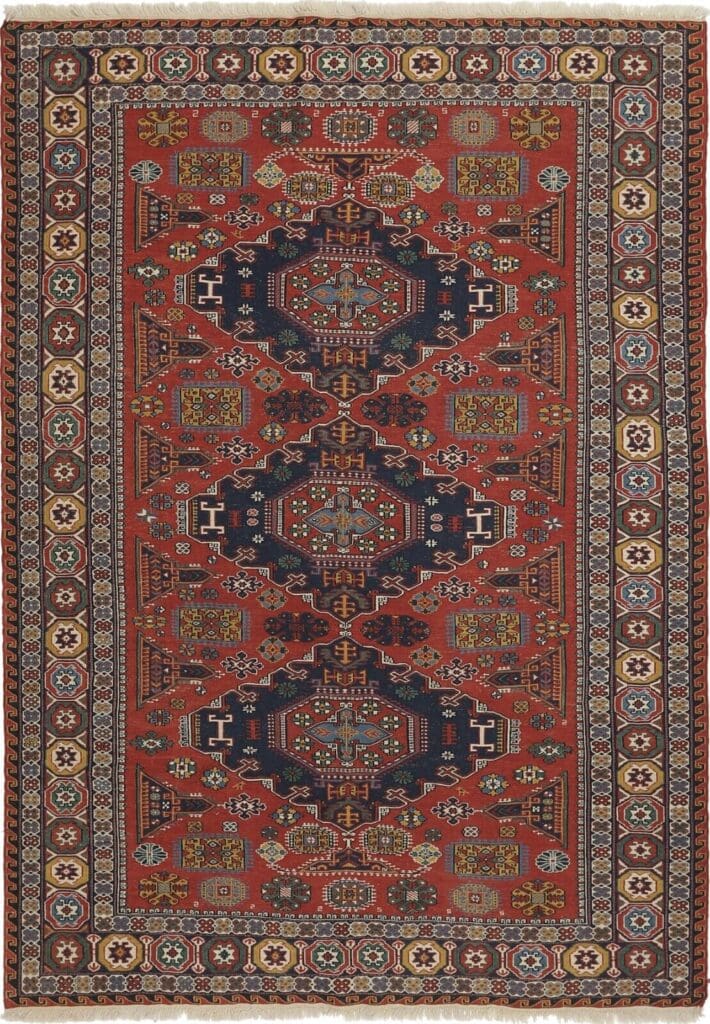
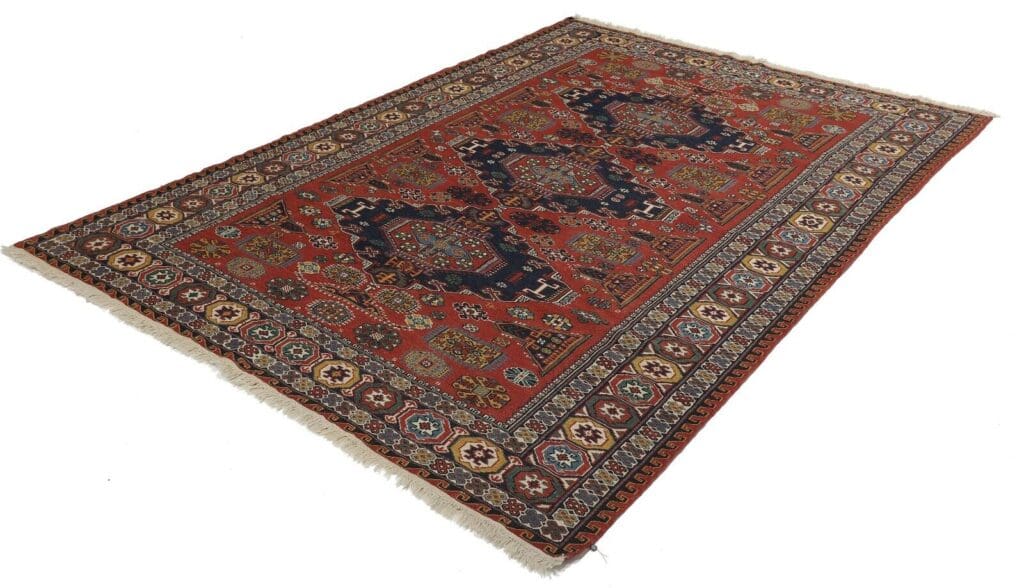
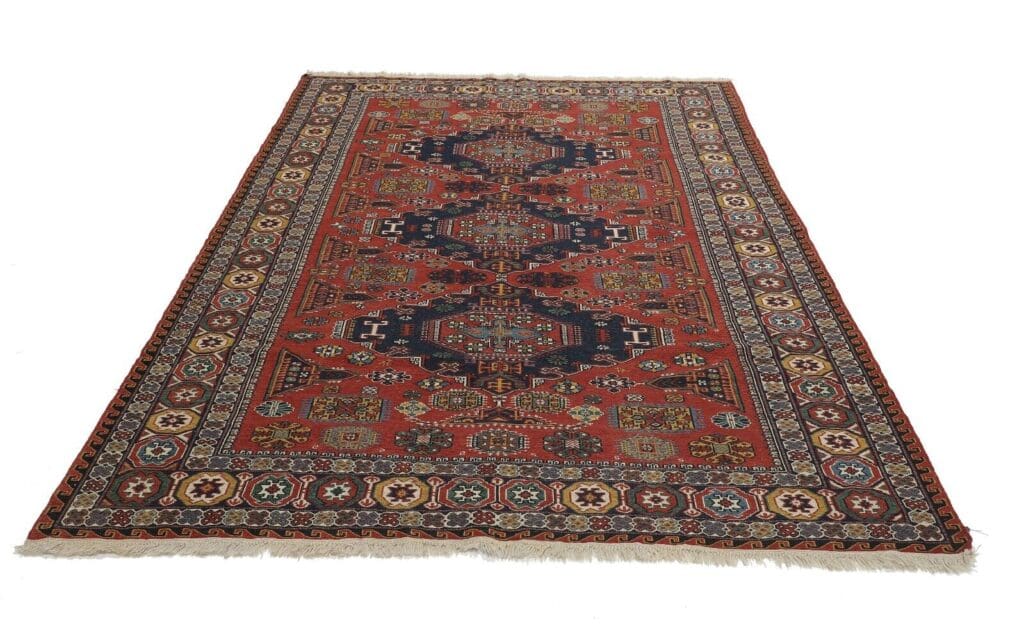
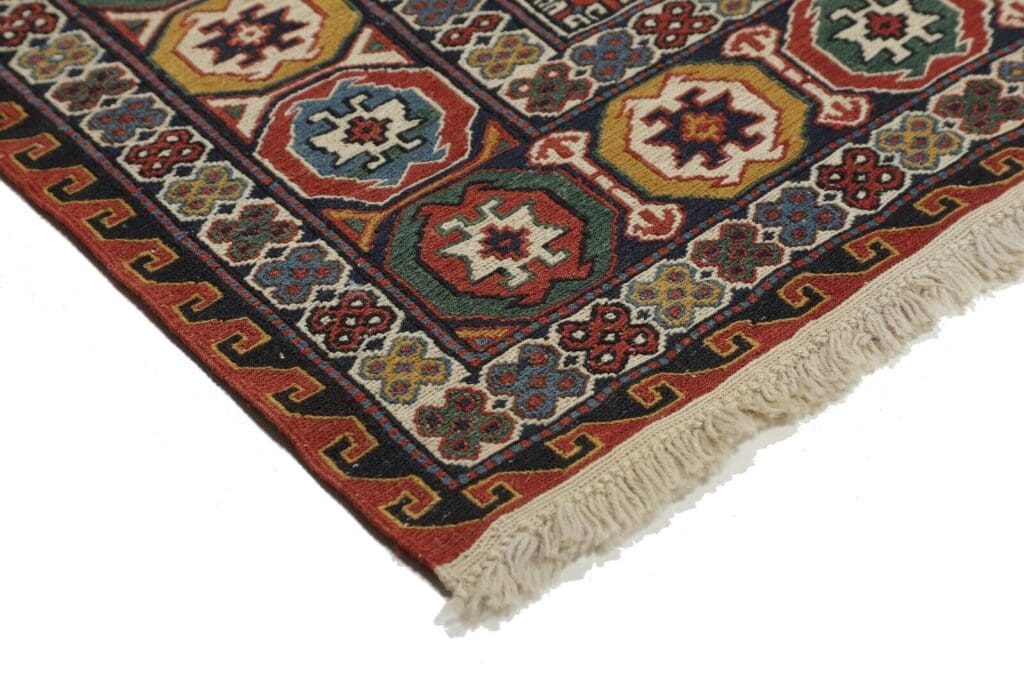
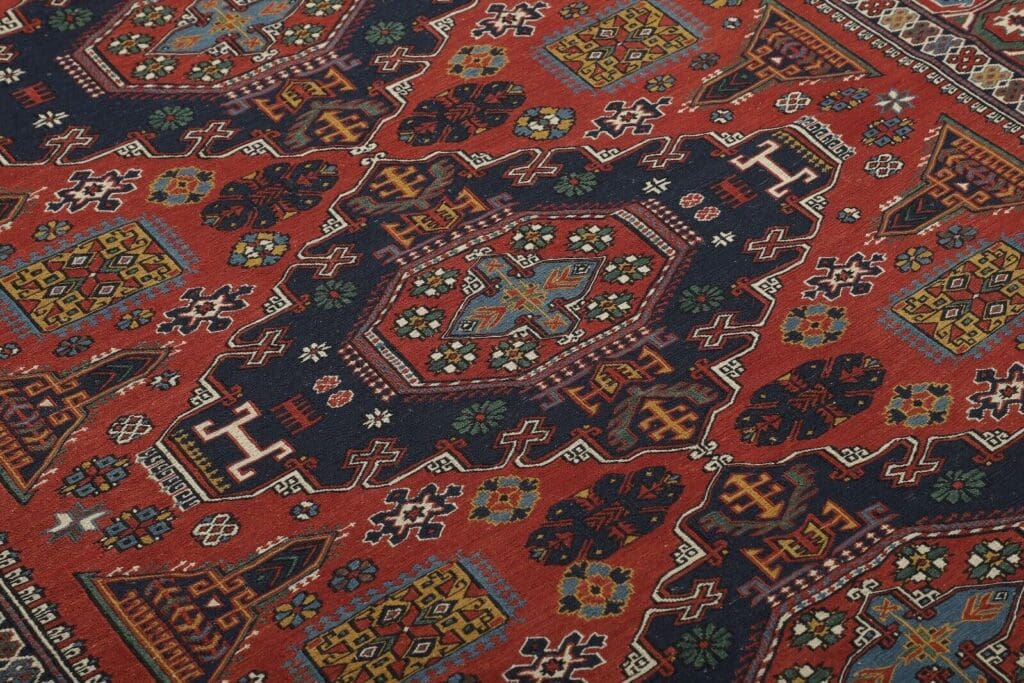
This classic Sumach/Varni Kilim is a hand-woven Oriental rug made of wool. A Kilim is constructed as a flat weave rather than with a cut pile. The textile surface is formed by the interaction of warp and weft, while the design is created directly through the placement of the weft threads. This technique gives the rug its distinct flat profile and makes the woven structure part of its visible character.
Wool is a traditional material for hand-woven rugs and textiles. Its firm, tactile feel is well suited to a flat weave intended for everyday use. In this Kilim, the wool is combined with a short pile height, as stated in the product description. The result belongs to a different construction tradition from a deep-pile knotted rug: the surface remains relatively level, and the pattern is read through the woven field rather than through the height of the pile.
Hand weaving means that the work is carried out through a sequence of individual textile operations rather than by an industrially uniform process. Variations in tension, thread movement and pattern execution can occur in handmade weaving. They form part of the character of a one-off textile piece. This Kilim is described as abrasion-resistant and anti-slip. It is also suitable for use with underfloor heating and is listed as pet-friendly.
Origin and Tradition
The rug’s region of origin is unknown. It therefore cannot be assigned to a particular carpet province or weaving centre. Sumach/Varni is used here as a traditional Kilim designation and as a reference to a stylistic and technical context, not as proof of a documented place of manufacture. This distinction matters in Oriental rug terminology: a name may describe a weaving tradition, a design vocabulary or a type of textile without establishing where an individual piece was made.
Kilims are flat-woven Oriental textiles with a long history of practical and decorative use. Communities of weavers produced them for floors, seating, storage, travel and household purposes. The basic process begins by securing the warp threads, after which weft threads are inserted across them. Areas of colour and pattern are built through the order and density of those wefts. Unlike a knotted rug, a Kilim does not obtain its surface from rows of tied pile knots. Its flat construction gives it a visual and tactile identity of its own.
Kilim knowledge was traditionally passed through families, workshops and local weaving communities. Skills included preparing the loom, maintaining an even tension, planning the sequence of motifs and finishing the edges. Designs could be repeated from established patterns while still allowing the weaver room for individual decisions. Even though this rug has no known origin region, the Sumach/Varni designation places it within a broader textile tradition in which geometric pattern systems and manual technique are closely connected.
Oriental rugs and flat weaves have served both practical and cultural purposes. They could be moved, folded and used in more than one part of a household. At the same time, their colours and motifs expressed a particular visual culture. The textile was therefore more than a simple floor covering: it could carry a recognisable design language and preserve methods learned over generations. The present piece is offered as a used, hand-woven one-off, while its precise place of origin remains unspecified.
The history of flat weaving also reflects the relationship between function and design. A woven surface had to be useful in daily life, but it could still be carefully organised through borders, fields and repeated symbols. The balance between durability, portability and decoration helped establish the lasting role of the Kilim in Oriental textile culture. No specific provenance should be inferred from that general history for this individual rug.
Design and Pattern
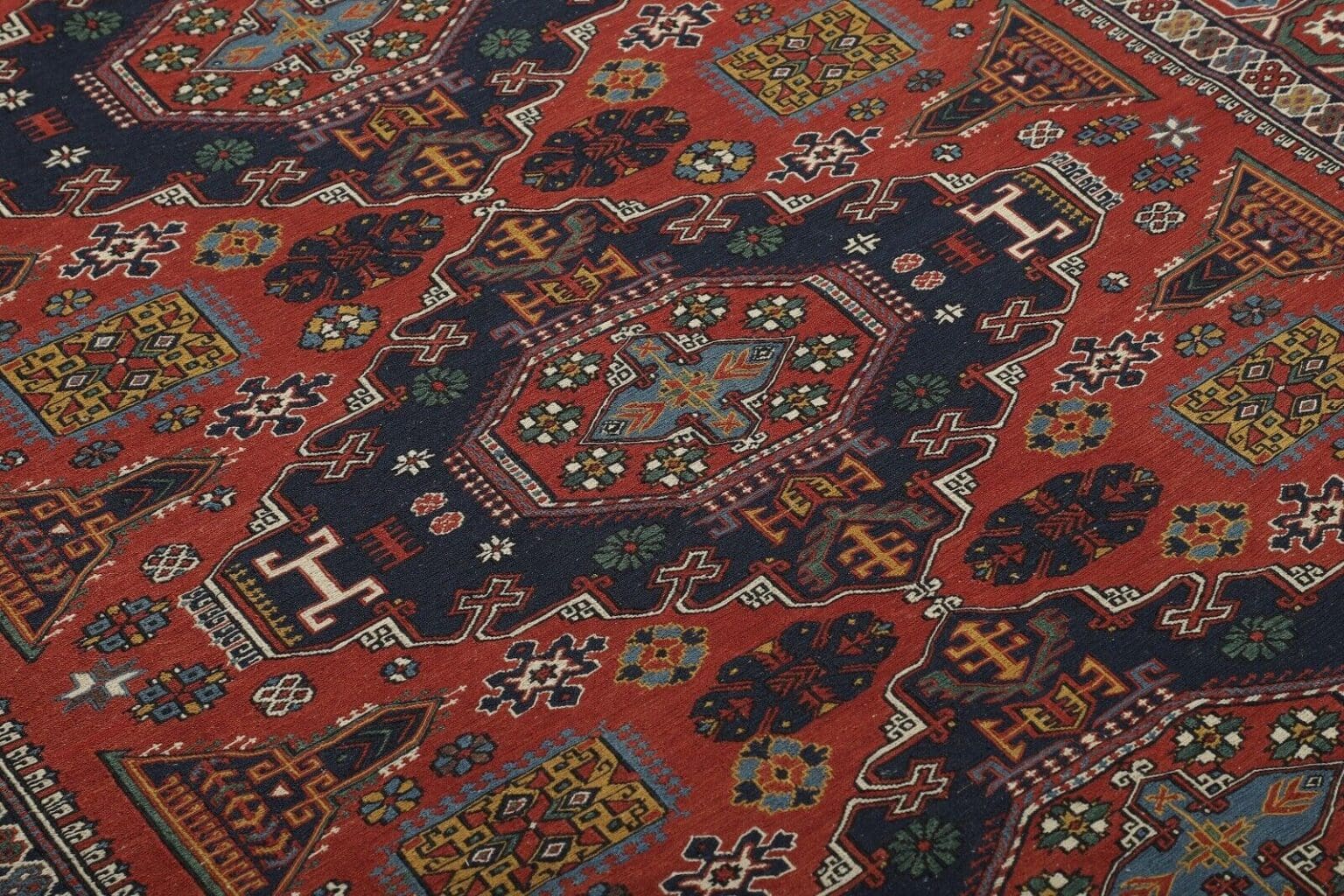
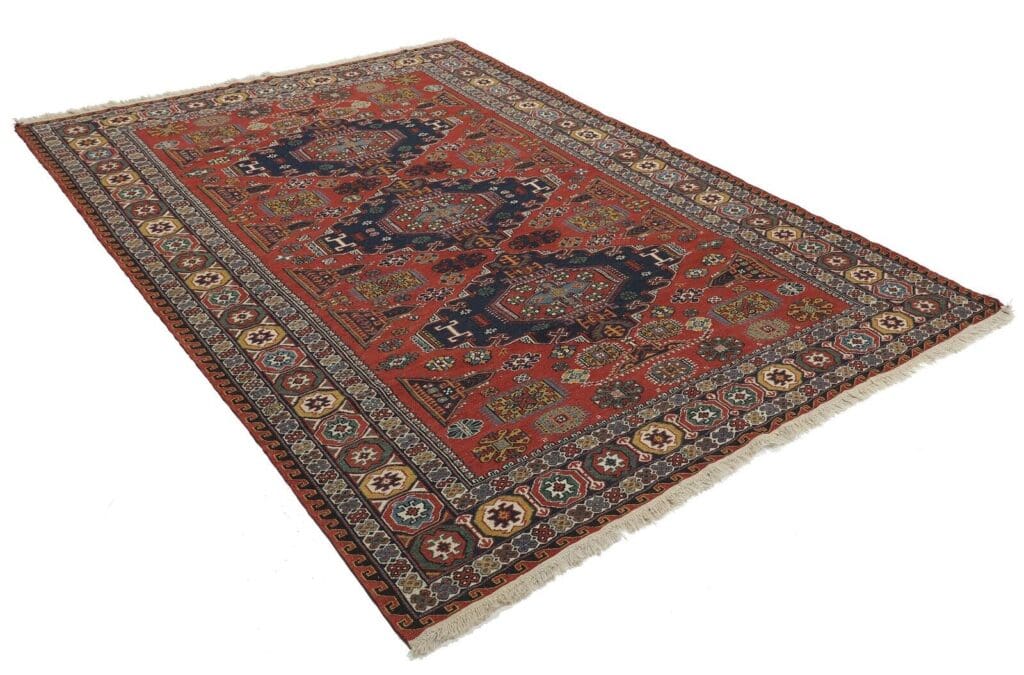
The pattern of the Sumach/Varni Kilim is geometric. Geometric design can be built from angular lines, stepped forms, repeated fields, diamonds, hooks or zigzag structures. In a flat weave, these shapes are not applied on top of the textile after completion. They emerge as the weaver controls the sequence of coloured threads. This gives the pattern a direct relationship with the construction of the rug.
The source description characterises the design through geometric forms and lively colours. In the wider history of Oriental textiles, geometric motifs are often associated with ideas such as protection, fertility or the pursuit of harmony. These interpretations belong to the general symbolic vocabulary of traditional pattern-making. They should not be treated as a fixed translation for every individual shape, since meaning can change with context, arrangement and weaving tradition.
The terms Sumach and Varni are connected with a recognisable field of Kilim design and weaving language. Repeated compartments, angular outlines and rhythmic borders are common examples of the visual tools used in such traditions. The designation alone, however, does not establish that every possible motif is present in this piece. The documented pattern information for this rug is limited to the description “geometric”. Naming a specific medallion, symbol or regional pattern that is not recorded would go beyond the available description.
Flat weaving gives geometric designs a particularly legible appearance. Because there is no deep pile obscuring the surface, changes in direction and colour can remain clearly visible. At the same time, the hand-made process allows slight irregularities in alignment and repetition. These variations distinguish a woven one-off from a mechanically repeated product. The balance between a recognisable structure and individual execution is an important part of the appeal of traditional Kilim design.
A geometric Oriental rug can work with both traditional and contemporary interiors. Its effect depends on the relationship between the patterned textile and the surrounding furniture, materials and colours. In a classic room, the design can relate to other historical forms; in a modern setting, the angular structure can provide a defined graphic element. Those possibilities arise from the general nature of geometric Kilim design and do not require assigning the rug to an undocumented province.
Special Features
This is a used, hand-woven one-off. The product description lists it as abrasion-resistant, anti-slip and pet-friendly. It is also suitable for rooms with underfloor heating. These stated features make the rug adaptable to different residential settings. Its flat construction and short pile height support a versatile role in areas such as a living room, bedroom or dining area.
Care should be gentle and regular. Vacuuming helps remove loose dust and everyday debris. Spills should be blotted promptly with a damp cloth. Harsh chemicals should be avoided, and suitable natural cleaning products are preferred. As a used handmade wool textile, the rug should be cleaned with attention to its woven surface and individual construction.
FAQ
How should I care for the Sumach/Varni Kilim?
Vacuum the Kilim regularly to remove loose dirt from the flat-woven wool surface. If a spill occurs, blot it as soon as possible with a damp cloth rather than treating the area with aggressive rubbing. Harsh chemicals should not be used. For more thorough cleaning, choose a gentle method and suitable natural cleaning products. Because this is a used, hand-woven one-off, care should take account of the textile structure and should avoid unnecessary stress to the weave.
Where does the Sumach/Varni Kilim come from?
The region of origin is unknown. It is described as a hand-woven Oriental rug carrying the Sumach/Varni designation. That name refers to a traditional Kilim context and its associated design language, but it does not document a particular province or country of manufacture. No additional provenance is therefore assigned. The recorded facts are its wool material, hand-woven construction and geometric pattern.
Is the Kilim suitable for allergy sufferers?
The Kilim is described as pet-friendly. The source also explains that rugs made from 100 percent wool are generally considered hypoallergenic and may reduce the settlement of allergens. On that basis, it can be a possible choice for allergy sufferers. Individual reactions differ, however, so a general material statement cannot replace personal medical or household advice. Anyone with a specific sensitivity should consider their own requirements before choosing a textile floor covering.
To provide the best experiences, we use technologies like cookies to store and/or access device information. Consenting to these technologies will allow us to process data such as browsing behavior or unique IDs on this site. Not consenting or withdrawing consent, may adversely affect certain features and functions.
Functional Always active
The technical storage or access is strictly necessary for the legitimate purpose of enabling the use of a specific service explicitly requested by the subscriber or user, or for the sole purpose of carrying out the transmission of a communication over an electronic communications network.
Preferences
The technical storage or access is necessary for the legitimate purpose of storing preferences that are not requested by the subscriber or user.
Statistics
The technical storage or access that is used exclusively for statistical purposes.The technical storage or access that is used exclusively for anonymous statistical purposes. Without a subpoena, voluntary compliance on the part of your Internet Service Provider, or additional records from a third party, information stored or retrieved for this purpose alone cannot usually be used to identify you.
Marketing
The technical storage or access is required to create user profiles to send advertising, or to track the user on a website or across several websites for similar marketing purposes.
 SECURE PAYMENT
 SHIPPING PARTNERS


